
Stop buying toys to solve a diagnosis you haven't made. A chewed shoe, a barky afternoon, and a lap around the coffee table don't prove boredom. They prove something happened. Labeling every unwanted behavior as boredom sends owners to the toy bin when the problem may be anxiety, pain, or a dog who needs a different kind of activity. Learning how to tell if your dog is bored starts with observation, not shopping.
Table of Contents
- Why Most Dog Boredom Lists Miss the Point
- The Four-Question Diagnostic Test for Boredom
- Boredom vs Anxiety, Pain, and Under-Exercise
- The Four Types of Enrichment and What Each One Does
- Matching Activities to Your Dog's Age and Energy Level
- How to Measure Whether Enrichment Actually Worked
- Putting It All Together
Why Most Dog Boredom Lists Miss the Point
Most lists hand you the same cluster and stop there. The American Kennel Club's overview of stimulation and exercise names destructive chewing, excessive barking, digging, restlessness, and persistent attention-seeking as common signs, and notes puppies may invent entertainment by investigating or damaging household items. That's a starting point, not a verdict. A puppy mouthing a chair leg during teething and an adult dog shredding doorframes every workday are not the same case.
Canine-welfare guidance describes enrichment more usefully, as changing a dog's environment to promote behavioral and physical wellness. Purdue's canine enrichment guidance sets goals that include reducing abnormal behavior, increasing healthy behavior, encouraging interaction with the environment, and improving a dog's ability to cope with challenges. Boredom, read that way, is a chronic pattern of under-stimulation, not one bad afternoon.
What Actually Counts as Evidence
Treat a behavior as evidence only when three conditions line up.
- It's repetitive. Pacing, circling, barking, escape attempts, or intense attention-seeking recur across days.
- It's context-dependent. It shows up mainly during inactive stretches or when the dog has little to do.
- It improves after enrichment. Meaningful chances to sniff, search, chew, play, train, move, or interact reliably change it.
One isolated incident tells you almost nothing. Purdue summarizes an enrichment study involving 48 beagles and 432 hours of observation, comparing a control group with increased dog-to-dog contact, brief intensive handling, or permanently available chew and toy objects. That design carries the lesson for owners. Repeated observation across time and contexts beats a breed stereotype or a single energy-level label.
Practical rule: If you can't describe when it happens, how often it happens, and what makes it better, you don't have a boredom diagnosis yet.
A young herding dog chewing the couch after three rainy, walk-free days is a plausible boredom case. A senior dog doing the same thing after years of never touching furniture is a different conversation. Same damage, different first step. Gather a few days of notes before you change anything, so you can tell whether your fix did anything at all.
The Four-Question Diagnostic Test for Boredom
Run this over several days. It takes less than two minutes of notes a day.
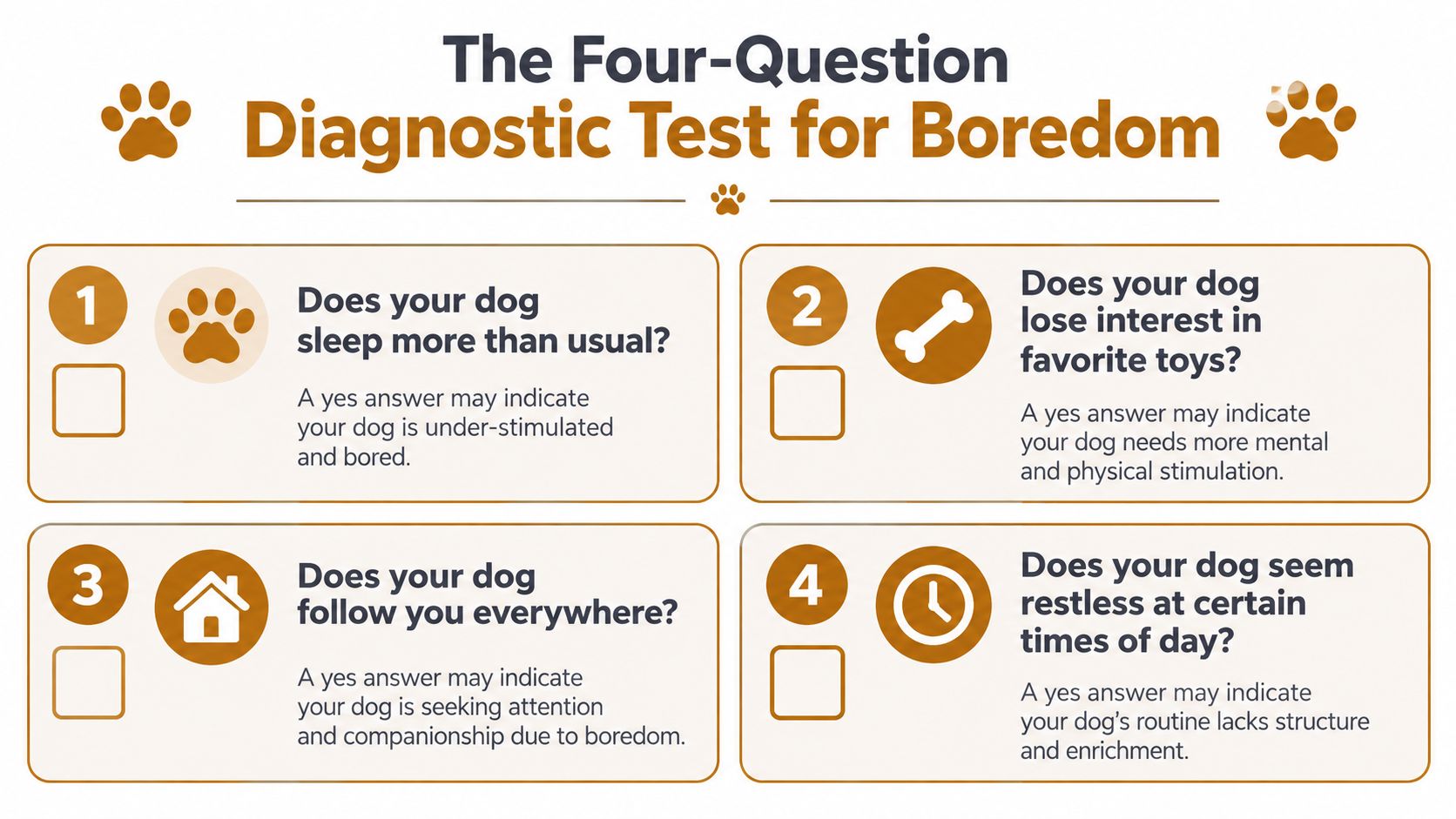
The Four Questions
- Is it context-dependent? A Lab who shreds cushions only on days when walks get skipped and nobody plays with him points toward under-stimulation. Damage that happens even after a full day of activity points elsewhere.
- Is it repetitive? A terrier who paces the hallway every evening around the same hour shows a pattern. One frantic Saturday during a thunderstorm doesn't.
- Did it build gradually? Boredom usually creeps in as routines shrink. Behavior that starts overnight, especially with appetite loss or a posture change, needs a vet conversation first.
- Does it improve after a real enrichment session? Run a proper test. Offer a sniff-heavy walk, a search game, a short training session, or a food puzzle, then watch the next few hours.
That fourth question does the heavy lifting. A 2022 pilot study of 10 assistance-dog training dogs evaluated seven activities, including tug play, play with another dog, handler bonding, an exploratory playhouse, scented bubbles, an interactive food toy, and a stuffed food toy. As summarized in research on enrichment and dog behavior, stress or arousal behaviors such as circling, pacing, excessive panting, whining, and barking declined after enrichment, with the strongest reductions after playhouse exploration and tug play. The principle transfers. Compare before and after, across more than one activity type.
Watch the activity period in this walkthrough and note body language before and after.
Score it plainly. Mostly yes answers, with a clear after-effect, support boredom. Mostly no answers argue against it. Mixed answers mean keep watching and test a different enrichment category before concluding anything. Don't count normal puppy zoomies after a nap as a yes. A puppy who tears around, then settles and sleeps, is usually just a puppy.
Boredom vs Anxiety, Pain, and Under-Exercise
Owners waste months. Barking, destruction, pacing, licking, lethargy, attention-seeking, and house-soiling all get filed under boredom, but none of them is specific to it. Guidance summarized in Chewy's overview of boredom behaviors reflects that overlap, and inactivity alone is only an indirect welfare signal. Low activity doesn't automatically mean a bored dog.
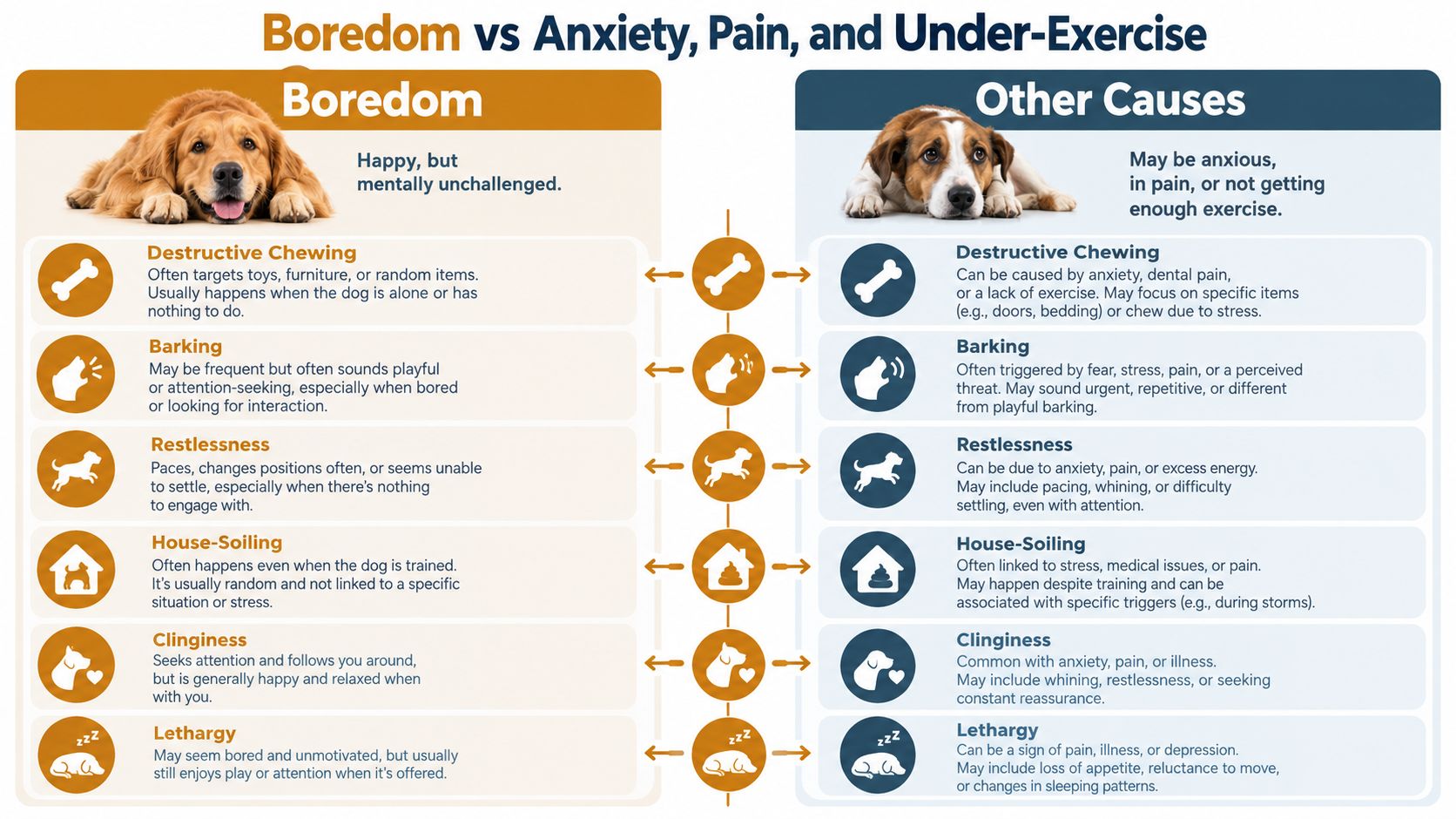
The Tell for Each Cause
- Anxiety. Destruction and clinginess concentrate around departures and alone time. The dog may pant, pace, vocalize, or soil the house mainly when you're gone, and often can't settle even with a food toy available. A pet camera helps here. A bored dog usually engages with what's offered, then rests.
- Pain or illness. Onset is often sudden and pairs with appetite change, excessive licking of one spot, agitation, altered posture, reluctance to move, or house-soiling in a reliably trained dog. Enrichment doesn't fix it.
- Under-exercise. The dog is bright, social, and physically restless, and behavior improves quickly after genuine movement but not after a food puzzle alone. He needs locomotion, not just problem-solving.
- Boredom. The pattern tracks dull, inactive periods, developed gradually, and eases after varied enrichment, not only after exercise.
A dog who ignores a stuffed food toy while alone and paces until you return isn't showing you a toy problem. That's distress until proven otherwise.
When to Stop Self-Managing
Call your veterinarian promptly for sudden behavioral change, appetite loss, marked lethargy, apparent depression, compulsive behavior, or self-injury. Those signs sit past the escalation threshold for home experiments. Persistent anxiety signs warrant a vet visit and, where needed, a certified behavior professional. Treating a medical problem as a training problem is the most avoidable mistake in this whole area, and no rotation of chews compensates for it.
The Four Types of Enrichment and What Each One Does
Enrichment isn't a synonym for more toys. It breaks into four functional categories, and they don't do the same job. Owners who treat them as interchangeable end up giving a frantic dog more arousal and a flat dog more of what already bores him.
Sniff and Chew
Olfactory enrichment covers sniff walks on a long line where the dog chooses the pace, scatter feeding in grass, and hiding kibble in boxes or a snuffle mat. It's typically the lowest-arousal option and suits dogs who need to come down, not rev up. A slow sniff walk on a new route often settles a restless dog more reliably than a brisk march around the same block, because novelty and nose work are doing the work.
Oral enrichment covers appropriate chews, lick mats, and stuffed food toys such as a frozen Kong. Chewing and licking give a dog a sustained, self-directed activity. Supervise new chews and match hardness and size to the individual dog to reduce breakage and swallowing risks.
Search and Move
Cognitive enrichment means training and problem-solving. Short sessions teaching a new cue, shaping a simple trick, or running search games where the dog finds a hidden toy ask the dog to think and make choices. Keep sessions short and end on a success.
Locomotive enrichment is movement with variety. Walks on different terrain, swimming where appropriate, fetch, and tug all fit. The ASPCA guidance on behavior issues recommends at least 30 minutes of aerobic activity each day as one component of managing behavior problems involving boredom or anxiety, and suggests exercising a dog before leaving him alone. Treat that as a component, not a universal prescription. Age, health, fitness, weather, and veterinary advice set the limit.
| Type | Primary Effect | Best For | Watch Out For |
|---|---|---|---|
| Olfactory | Calm investigation | Restless or over-aroused dogs | Too little challenge if never varied |
| Oral | Sustained, settling occupation | Alone-time routines, chewers | Supervision and suitability of chews |
| Cognitive | Focus, choice, problem-solving | Bright dogs who invent jobs | Frustration if difficulty jumps too fast |
| Locomotive | Physical outlet | Under-exercised dogs | Over-arousal, heat, joint strain |
Matching Activities to Your Dog's Age and Energy Level
Any dog can end up under-stimulated. The American Veterinary Medical Association's guidance on selecting and caring for a dog states that any dog can become bored and potentially destructive when left alone all day without outlets for exercise, exploration, and social interaction, and recommends daily shared activities such as walking, playing, petting, and grooming. Boredom isn't a young, athletic dog problem only.
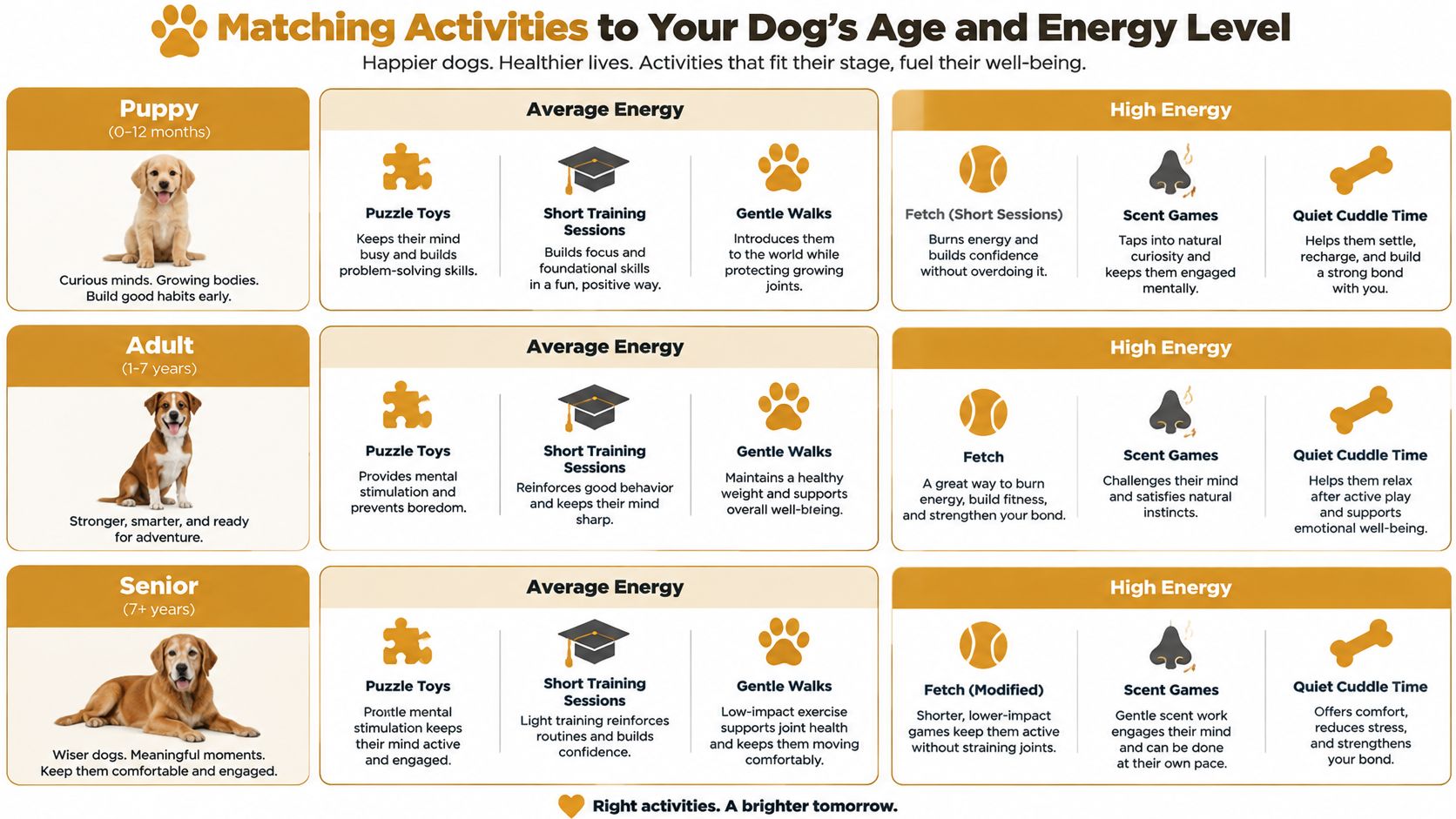
Puppies and Adults
Puppies need short, frequent, easy wins. Rotate a few safe chew items, run brief training reps between naps, and let them sniff and explore novel surfaces. Average-energy puppies often do well with scatter feeding and simple hide-the-toy games. High-energy puppies need the same structure in more frequent doses, not marathon exercise on growing joints.
Adults get the widest menu. An average-energy adult on a work-from-home day might get a sniff walk, a food puzzle at lunch, and a short training session in the evening. A high-energy adult herding or sporting dog usually needs locomotive work plus a job-like task, such as structured tug with trained outs, search games, or a dog sport. A sporting breed such as the American Water Spaniel illustrates why breed background informs the plan without replacing observation of the individual dog.
Seniors and Rotation
Senior dogs still need novelty, adjusted for comfort. Gentle sniff walks on forgiving ground, easy food puzzles, lick mats, and calm social time work well. A senior with arthritis may prefer a chew and lick rotation plus short exploratory outings over anything involving jumping or long distances. Watch willingness to engage, not just activity level.
Rotate so novelty holds. The ASPCA recommendations on destructive chewing advise rotating chew toys every couple of days and keeping the ones that hold attention longest. Apply the same logic to activities.
Watch for backfire. A dog who gets more frantic, vocal, or unable to settle after an activity doesn't need more stimulation. He needs lower-arousal sniffing, chewing, and predictable rest.
How to Measure Whether Enrichment Actually Worked
Busy for twenty minutes isn't the same as better. A dog can empty a puzzle feeder and return to pacing, and you've learned only that he likes food.

Run a simple five-day window. Pick two baseline behaviors you can count, such as destructive incidents, evening pacing episodes, and time to settle after dinner. Log them for a couple of days, add one new enrichment category, and log the same behaviors again. Change one variable at a time or you won't know what helped.
Take a realistic case. An adult dog paces and whines most evenings. Days one and two, the owner notes four pacing episodes and slow settling. Days three to five, she adds a sniff walk on a new route plus scatter feeding, and pacing drops while the dog lies down sooner and sleeps through. That's a result. If instead the dog finishes each activity more wound up and barks at the door, the activity backfired, and a calmer category is next.
Keep expectations honest. Research summarized in a study of short-term toy provision found that short-term provision of toys didn't significantly change activity, eating rate, or cognitive-bias measures, despite a slight, nonsignificant improvement in some positive-welfare measures. One session proves little.
Judge on a short checklist.
- Worked. Fewer target incidents, faster settling, normal sleep, willing engagement, and calm after the activity.
- Didn't work. No change across several days. Switch category, not just brand of toy.
- Backfired. More vocalizing, restlessness, or inability to settle. Lower the arousal level.
Putting It All Together
Boredom earns the label when behavior is repetitive, tied to under-stimulated periods, built up gradually, and reliably improves after the right enrichment. Anything sudden, painful-looking, compulsive, or paired with appetite loss goes to a veterinarian, not a toy drawer.
Do three things this week. Run the four-question test on your own dog. Add one enrichment category you're currently missing, on a rotation of every couple of days. Log two or three target behaviors for five days before you judge it. That sequence, done, tells you more than any generic list of signs.
PetCostEngine offers breed pages, guides, and planning tools that help owners match a dog's needs, energy, and likely care demands to their household before problems start. If you're weighing which breed fits your routine or planning care for the dog you already have, visit PetCostEngine and start with your breed and state.
Estimated lifetime and yearly costs for a American Water Spaniel, state by state, plus whether pet insurance breaks even for the breed.
See American Water Spaniel costs →
Is insurance worth it for a American Water Spaniel? →
Durable chews → Puzzle toys → Crate and bedding →
As an Amazon Associate, PetCostEngine earns from qualifying purchases.