
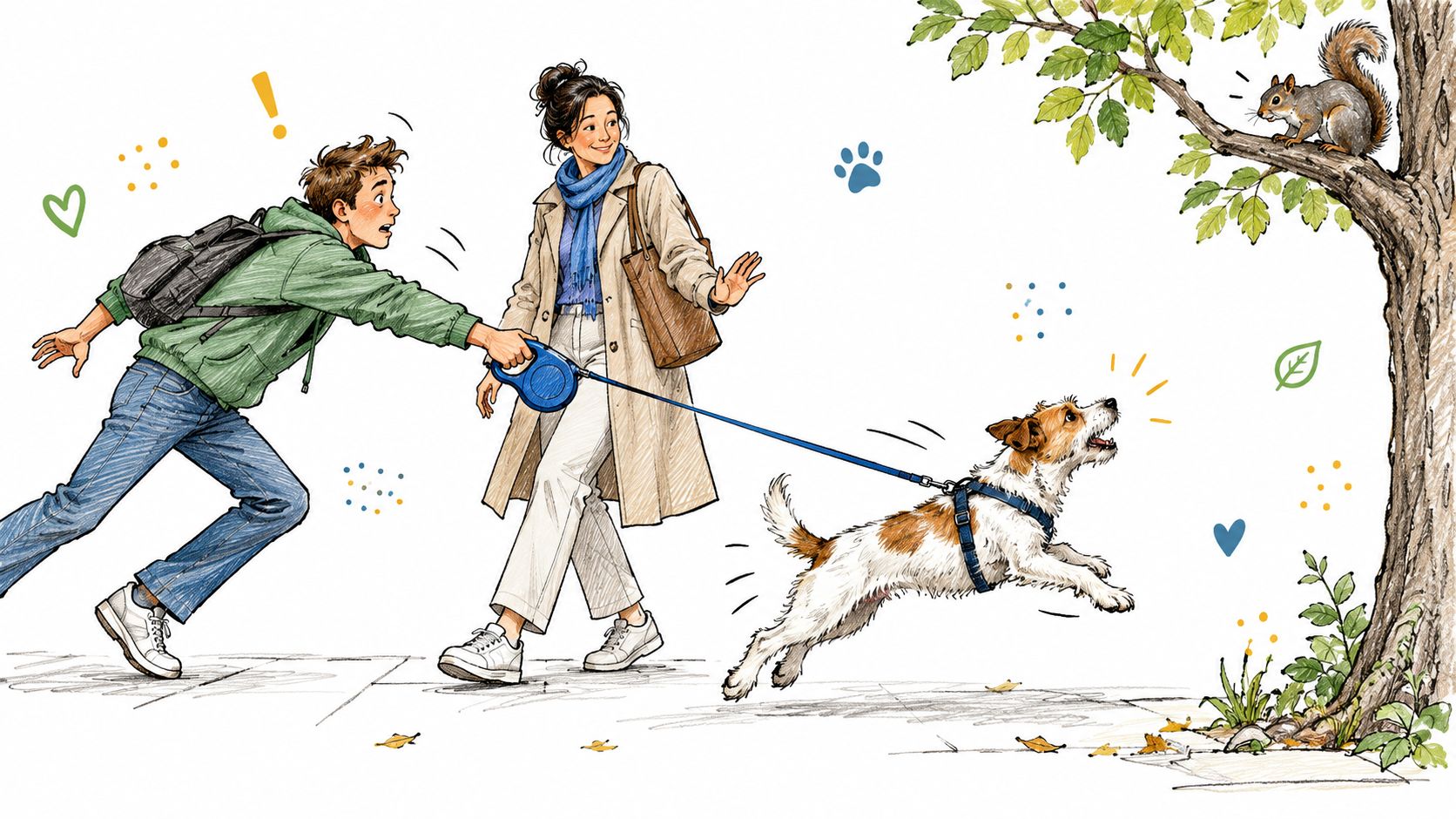
You're halfway down the block when your dog spots a squirrel. The leash snaps tight, your shoulder moves forward, and a passerby gives both of you extra room. A moment later, your dog is pulling toward a fire hydrant, then lunging toward another dog, while you repeat the same cue louder each time.
That pattern doesn't mean your dog is stubborn or that you're failing as a handler. Pulling has been practiced and rewarded by the environment. A tight leash gets your dog closer to scents, movement, greetings, and interesting places. Walking beside you is a trained position, not a default behavior.
Table of Contents
- Why Most Walks Become a Tug-of-War
- The Reward-Based Foundation Every Dog Needs First
- Choosing Walking Gear That Matches Your Dog
- The Inside-to-Street Training Progression
- Common Training Errors and How to Fix Them
- Adjusting the Plan for Puppies, Seniors, and Special Breeds
- A Quick Troubleshooting Guide You Can Use on Tomorrow's Walk
Why Most Walks Become a Tug-of-War
A dog can know a formal heel and still pull through an ordinary neighborhood walk. Older obedience traditions built heelwork around military and service-dog precision, alongside cues such as staying and returning. Modern reward-based training instead teaches behavior through reinforcement, a shift associated with trainers such as Karen Pryor and described in historical accounts of dog training methods. That history explains the strict appearance of heelwork. For daily walks, a slack leash and a dog willing to stay near you are usually more useful than a competition-perfect position.
The environment keeps paying for distance. A tight leash may still lead to a scent, greeting, patch of grass, or exciting movement. Each successful pull makes the next one more likely. Clear reinforcement and manageable distractions change that pattern more effectively than physical force.
Your body and your dog's build also shape the plan. A large, athletic dog can move faster than someone with limited balance or grip strength, leaving less time to respond. The Siberian Husky breed profile illustrates why breed tendencies and physical capacity belong in the setup, while each individual dog still needs a separate assessment.
Build the plan around four parts: reward-based foundation, suitable equipment, staged exposure, and immediate error correction. Match the work to your walking speed, reaction time, comfort, and the dog's age and anatomy. A walk does not require a competition heel from start to finish. Teach when proximity matters, reinforce it often, and increase real-world distractions gradually.
The Reward-Based Foundation Every Dog Needs First
Before you ask for a heel position outdoors, install the communication system that makes the exercise understandable.
Load the marker
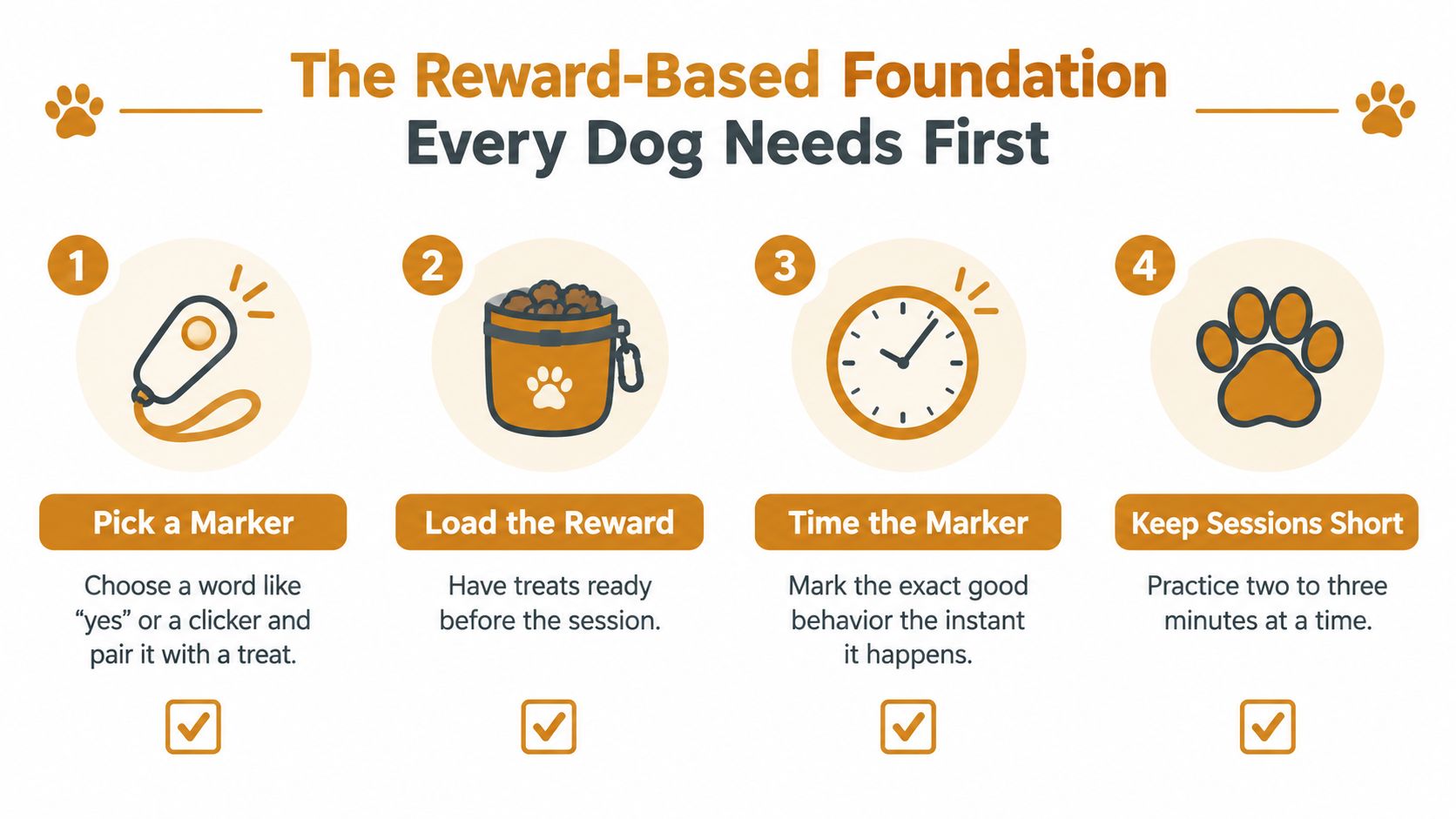
Choose a marker word such as “yes” or use a clicker. Say or click it, then deliver a pea-sized, soft, strong-smelling treat within one second. Repeat the pairing 50 times across two sessions, without asking for a behavior. Your dog should learn that the sound predicts food.
Keep the treats ready before you begin. During early movement practice, plan for roughly 12 to 20 treats per minute, adjusting the value and quantity to your dog's size, health needs, and regular diet. The high rate is temporary. It gives your dog frequent information while the new skill is still fragile.
Put the reward at your hip
Feed beside your left hip, close to your thigh. The location matters because dogs tend to return to the place where reinforcement appears. If you always reach forward or deliver food near your chest, you may accidentally teach your dog to forge ahead or jump up.
Start with the dog standing or sitting near your left side. Mark any glance toward you, then place the treat at your left hip. Don't lure the dog continuously. Use the food to explain the position, then reward the dog for choosing it.
Build check-ins
Say your dog's name once. When the dog turns toward you, mark and reward near your eyes or left hip. This creates a practical check-in rather than a constant demand for eye contact. If your dog is staring at the environment, lower the difficulty and reward smaller responses, such as an ear movement or a brief head turn.
Add “with me” or “let's go” only after your dog is already checking in and following your movement. The cue should identify a behavior your dog understands, not serve as a repeated request for attention that hasn't been trained yet.
Choosing Walking Gear That Matches Your Dog
Equipment can't teach loose-leash walking, but it can change how safely and clearly you can train. A collar, harness, martingale, or head halter creates different mechanical consequences, so choose based on pulling strength, anatomy, escape risk, and your handling ability.
A flat buckle collar can work for a dog who already walks softly and needs to carry identification tags. It isn't a sensible primary solution for a powerful puller. A front-clip harness can redirect forward movement toward the handler and may offer better control when a dog lunges. A back-clip harness is often comfortable for dogs that don't pull, including some short-nosed and toy breeds, but it provides little steering and can let a strong puller lean into the harness.
A martingale collar can help a narrow-headed dog or sighthound avoid backing out, but it shouldn't be used as a correction tool. Head halters offer substantial control for some large pullers, yet they require careful conditioning and aren't a shortcut. A dog that isn't comfortable wearing one may spend the walk fighting the equipment instead of learning beside you.
| Gear Type | Best For | Avoid For | Training Stage |
|---|---|---|---|
| Flat buckle collar | Dogs with an established slack leash | Strong pullers and dogs who lunge | Maintenance and identification |
| Front-clip harness | Dogs needing forward-momentum redirection, including many reactive or small dogs | Poorly fitted equipment or dogs who chafe | Early outdoor practice |
| Back-clip harness | Dogs who already walk without pulling, including some brachycephalic dogs | Dogs who lean hard into the leash | Low-distraction walking |
| Martingale collar | Narrow-headed dogs who may back out | Leash corrections and dogs with respiratory concerns | Safety management |
| Head halter | Some large, powerful pullers when conditioned gradually | Dogs who resist face equipment or handlers who cannot monitor fit | Advanced management |
For owners handling a large dog, the large-breed guide can help put physical size and breed characteristics into context. Use a standard six-foot leash while teaching this skill. It gives you a predictable working area and clearer feedback than a retractable leash, whose changing tension and length make timing harder.
Recent equipment reviews advise caution with tightening harnesses, martingale collars, and head collars because discomfort can undermine welfare, while back-clip and Y-shaped harnesses may be more suitable for dogs who don't pull or for brachycephalic anatomy. The practical rule is simple: use equipment to reduce risk, never to replace training. Fit should be checked by a qualified professional when you're unsure.
The Inside-to-Street Training Progression
A dog that walks calmly indoors may still pull toward traffic, squirrels, or unfamiliar dogs. Build the skill in stages, increasing only one source of difficulty at a time.
Session one in a room
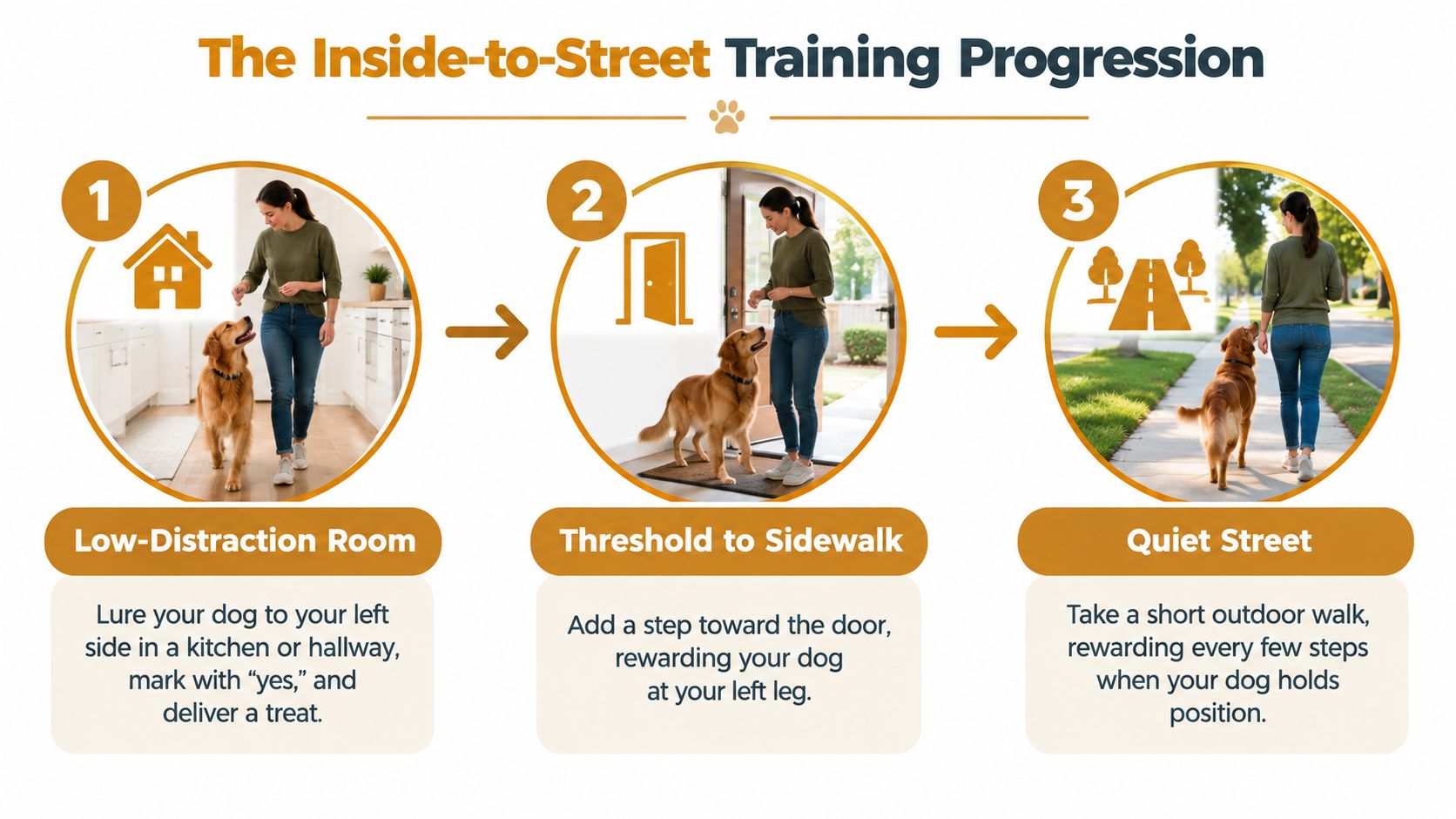
Start in a kitchen or hallway. Guide your dog toward your left side, say “yes” as the dog arrives, and deliver the treat beside your thigh. Repeat the exercise 20 to 30 times in five-minute bursts spread through the day. Mark eye contact, a step toward you, and every moment the leash remains slack.
Attach the leash if your dog can handle it without concern, but keep it loose. The lesson is the location of reinforcement and the experience of moving with you. If your dog wanders away, pause and reset. Lower the lure or shorten the distance instead of pulling the dog back.
Session two near the doorway
Move to a backyard or quiet driveway. Say “with me”, take 10 steps, stop, mark, and feed at your left hip. After the reward, change direction. This teaches your dog to track your movement rather than continue along a fixed route.
Plan for only 60 to 70 percent success before adding another challenge. Repeated misses usually mean the surroundings are too difficult, the reward is not valuable enough, or the walking segment is too long. Reduce the steps and reward more often.
Session three on a quiet sidewalk
Choose a quiet hour and repeat the same path for 10 minutes. Stop immediately when the leash tightens. Wait for your dog to turn back or move toward your side, then mark the slack leash and reward at your hip. Continue only after the leash is loose again.
Raise the criteria after two clean sessions at the current level. Published training estimates place adult dogs at 10 to 15 indoor steps during weeks 1 to 2, quiet-sidewalk practice during weeks 5 to 8, and reliable behavior in many environments around weeks 9 to 12. Stronger default behavior may take 4 to 6 months or longer. Use those ranges for planning, not promises. A calm dog with a history of reinforcement may progress faster, while a reactive or highly aroused dog may need much more repetition.
A separate novice progression estimates 1 to 2 weeks for a basic heel position, 4 to 6 weeks for consistent walking in familiar settings, and 3 to 6 months for reliable performance around distractions (staged heel-training reference). The estimates differ, but they point to the same trade-off: teaching the position is quick, while proofing it around real-world distractions takes time.
This demonstration shows how a handler can keep the leash loose while reinforcing position:
Common Training Errors and How to Fix Them
Most stalled heel training doesn't need a harsher correction. It needs cleaner timing, easier surroundings, or a more realistic pace.
Delayed reinforcement is the first problem. If the treat arrives more than 1.5 seconds after the marker, your dog may associate it with the last behavior performed, which could be pulling or turning away. Practice saying “yes” or clicking, then feeding without movement for two days before you add walking.
Dragging a taut leash creates pressure instead of information. Hold a six-foot leash in a loose J-shape, and stop when the dog reaches the end rather than pulling the dog back. Reward the return to slack.
Practical rule: The leash should tell you when to stop, not serve as a handle for dragging your dog into position.
Repeating the cue weakens it. Saying “heel, heel, heel” teaches the dog that the first request can be ignored. Give the cue once, help the dog succeed through your movement or reward placement, then mark the correct response.
Skipping the indoor stage overwhelms dogs with too many competing rewards. If street practice collapses, replay the room and driveway stages for a full week before trying the sidewalk again.
Training after a full meal can reduce interest in treats. Reserve part of the dog's regular breakfast for training when appropriate, and use small, soft rewards that can be eaten quickly.
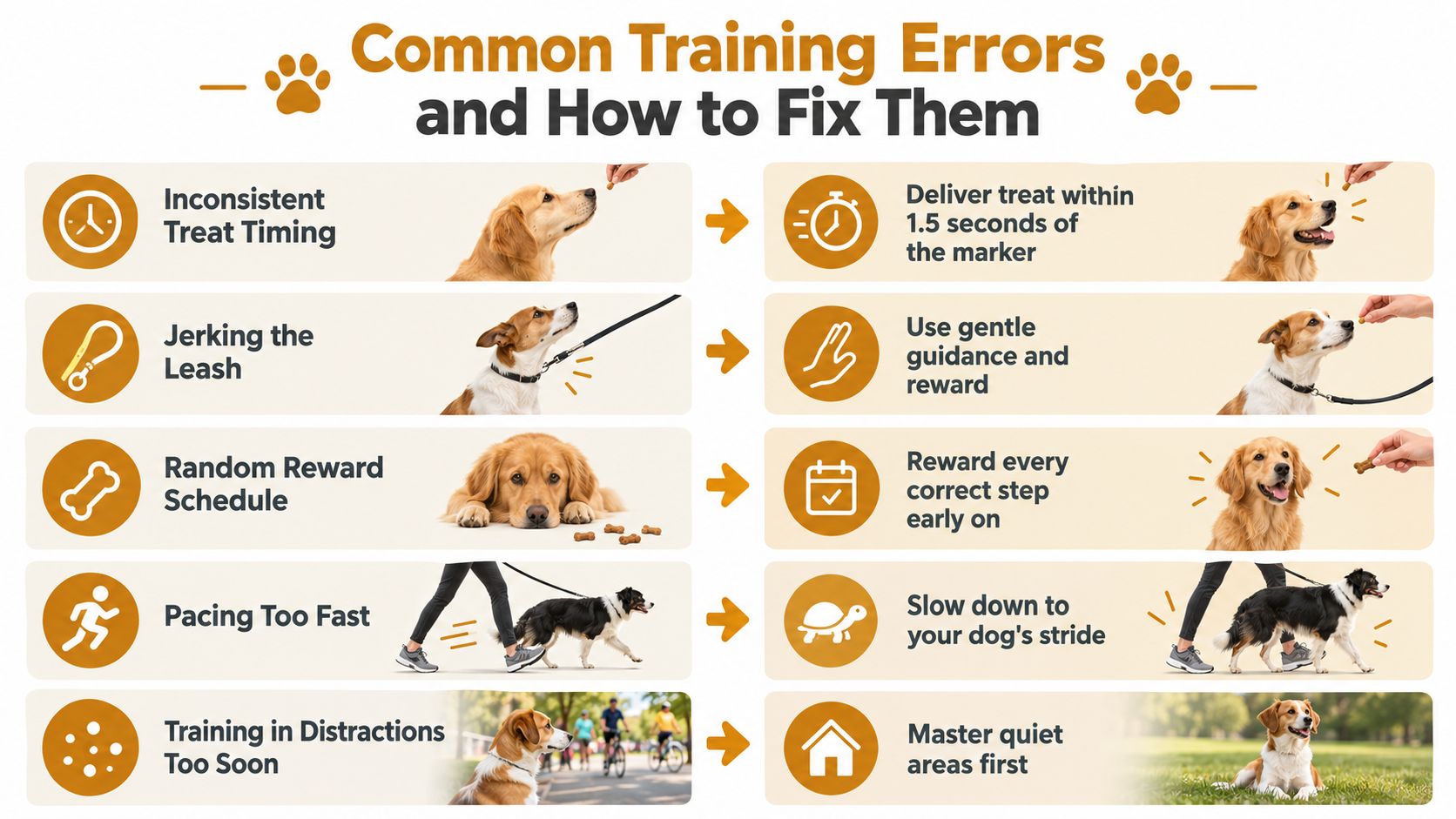
Your pace is another frequent mismatch. If you walk faster than your dog can comfortably follow, the dog may forge ahead just to keep up. A Belgian Malinois breed reference illustrates why athletic ability and arousal level should shape the plan, not just the cue you use.
Adjusting the Plan for Puppies, Seniors, and Special Breeds
Loose-leash training is also an owner-health habit. A walk that feels predictable is easier to repeat, and a handler who feels unsafe may avoid walking altogether. In a feasibility study involving older adults, 73% of participants reported improved leash-walking skills, and the program appeared promising as a physical-activity intervention, although the single-arm design means more research is needed to establish effectiveness (older-adult leash-manners study).
That finding supports a practical adjustment: train for the walk you can safely complete, not an idealized obedience exercise.
| Dog Type | Session Length | Gear Recommendation | Pace / Intensity | Key Adjustment |
|---|---|---|---|---|
| Puppies under 12 weeks | Two minutes | Collar or harness conditioning | Gentle following | Skip formal heel and avoid leash pressure |
| Healthy adults | Full staged plan | Fit gear matched to pulling and anatomy | Moderate, gradually increasing | Raise distractions one at a time |
| Senior dogs | 5 to 8 minutes outdoors | Joint-friendly harness with front and back clips | Slow and comfortable | Deliver treats low to avoid cranking an arthritic neck upward |
| Brachycephalic breeds | Short blocks with two rest breaks | Wide Y-front harness | Slow, never heat-heavy | Skip midday training and avoid fast-paced heeling |
Puppies need confidence and leash familiarity before precision. Seniors may need more frequent pauses, a veterinary assessment for pain, and a lower reward position. French Bulldogs, Pugs, and Boston Terriers can struggle with heat and airway stress, so don't treat fast heeling as a reasonable default for them.
Owners should also consider human mobility. A front-clip harness may improve control, but it still requires supervision and correct fitting. If you can't safely stop a dog when it lunges, arrange professional help before practicing near traffic or unfamiliar dogs. A breed-specific American Water Spaniel guide can also help prospective owners think about activity needs alongside training expectations.
A Quick Troubleshooting Guide You Can Use on Tomorrow's Walk
Keep this decision tree on your phone and solve the immediate problem rather than repeating the same cue.
Equipment check
- Dog pulls steadily: Check fit first, then consider a front-clip harness rather than adding leash pressure.
- Dog backs out: A properly fitted martingale may reduce escape risk for narrow-headed dogs, but don't use it for corrections.
- Dog coughs or shows discomfort: Stop and reassess the collar or harness with a veterinary professional.
- Leash feels unpredictable: Replace a retractable leash with a standard six-foot leash for training.
Timing and cues
- Squirrel lunging: Increase distance before the dog explodes, drop a treat at hip level, and reward the first check-in.
- Forging through a doorway: Stop before the threshold, wait for slack, then release with “with me.”
- Freezing on pavement: Lower your criteria, reward a small weight shift or step, and avoid pulling the dog forward.
- Another dog passes: Turn away early, feed while your dog remains calm, and return to the route only when the leash is loose.
- Dog ignores the cue: Stop repeating it. Return to marker practice and reward attention in an easier setting.
Progression ladder
- Indoor success is missing: Work in the kitchen or hallway.
- Backyard success is inconsistent: Shorten the route and increase reward frequency.
- Street walking breaks down: Drop back to backyard repetitions before retrying the sidewalk.
- Two clean sessions are complete: Add one new distraction, not several at once.
Before leaving, run a 30-second checklist: marker word fluent, treat pouch loaded, leash length set, equipment comfortable, and the next distraction milestone rehearsed. The PetCostEngine calculator can help you account for breed, age, state, training, gear, and other ownership factors while you plan for the dog in front of you.
PetCostEngine provides a personalized lifetime ownership calculator, breed health profiles, state-adjusted estimates, and side-by-side insurance comparisons for U.S. dog owners. Use the practical training plan above, then visit PetCostEngine to explore how your dog's breed, age, and location shape the wider ownership picture.
Estimated lifetime and yearly costs for a Siberian Husky, state by state, plus whether pet insurance breaks even for the breed.
See Siberian Husky costs →
Is insurance worth it for a Siberian Husky? →
No-pull harness → Puzzle toys → Durable chews →
As an Amazon Associate, PetCostEngine earns from qualifying purchases.