

Most dogs are not scared of the dark itself. Their eyes are built for low light, so nighttime distress usually points to something else, like vision loss, cognitive decline, anxiety, or an unfamiliar environment.
That's why the better question isn't whether darkness is the enemy. It's what the dark is revealing about how your dog sees, feels, and moves when the lights go out.
Table of Contents
- What the Quick Answer Looks Like
- How Dogs See in Dim Light
- Reading the Signs of Fear vs Simple Caution
- When the Underlying Problem Is Vision Loss
- Anxiety, Cognitive Decline, and the Senior Dog
- Practical Steps to Help a Nervous Dog at Night
- Putting It Together and Knowing When to Call the Vet
What the Quick Answer Looks Like
A healthy adult dog usually handles dim spaces better than a person does. Dogs have eyes that are adapted for low-light conditions, so a hallway that feels gloomy to you may still be readable to them. Even so, low light is not the same as total darkness, and a dog can still hesitate if it can't judge distance, spot stairs, or make sense of a new room.
The real split most owners miss
The behavior that gets labeled “fear of the dark” often falls into three very different buckets. Some dogs are cautious in dim light. Some are struggling with vision decline, especially as they age. Others are reacting to anxiety, separation, pain, or confusion, and the darkness just makes those feelings more obvious.
Practical rule: If your dog settles once a light comes on, it may be low-light caution. If your dog trembles, hides, pants, or refuses to move, treat it as a real problem, not a personality quirk.
A puppy who pauses at the top of stairs is in a different situation from a senior dog who suddenly won't cross a dark hallway. The first may need confidence and routine. The second may need a veterinary exam.
How Dogs See in Dim Light
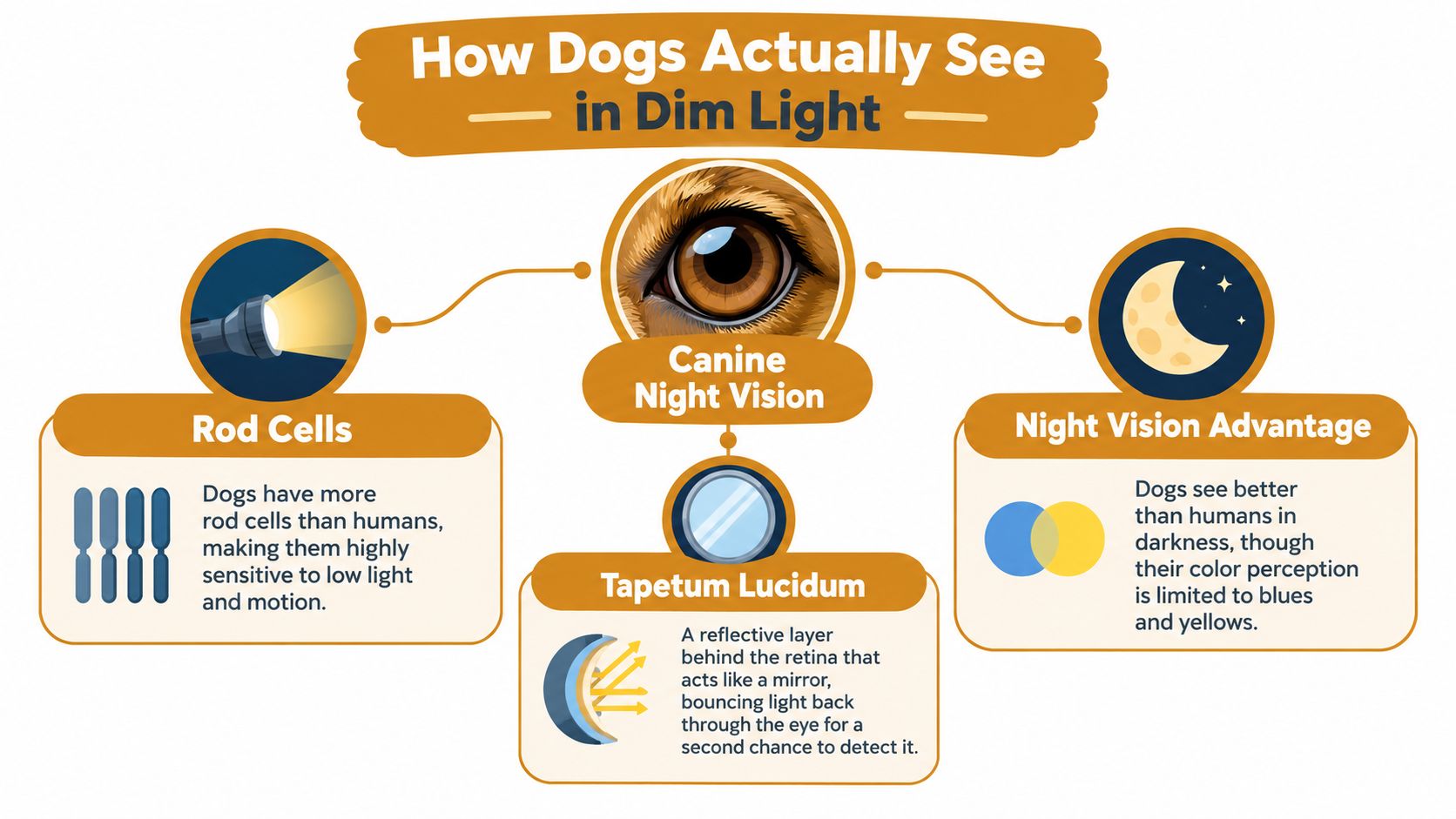
A dog's eyes are built for low light in a different way than ours. They rely more on rod photoreceptors, which are tuned to dim light and motion, and many dogs also have a tapetum lucidum, a reflective layer behind the retina that bounces light back through the eye for a second pass (University of Wisconsin veterinary explanation). The result is a brighter picture in dusk or shadow, but not a sharper one.
A simple way to picture the tradeoff is this. Dogs get more visual signal in dim conditions, while humans get finer detail in brighter light.
Better sensitivity, less detail
The same source estimates dogs can use light roughly five times dimmer than humans need, with visual acuity around 20/80 rather than normal human 20/20. That helps explain a pattern owners often notice but misread. A healthy dog may move through a familiar room with little trouble, then slow down in a guest room, at a doorway, or near stairs.
That pause does not automatically mean the dog is afraid of darkness. In many cases, the dog can see enough to detect motion and large shapes, but not enough to judge edges, depth, or new objects with confidence. A familiar room works like a well-known walking route. The dog is using partial vision plus memory. In a new layout, that same dimness can expose uncertainty.
Why that matters in daily life
This is why darkness is often only the setting, not the root problem. In a young, healthy dog, dim light usually means slower visual processing and a little extra caution. In an older dog, the same hallway may reveal something else, reduced vision, anxiety, or cognitive change.
A small amount of added light can help in unfamiliar spaces, near stairs, or in dogs with reduced vision (Veterinary Information Network review). That practical point matters because it shifts the question. Instead of asking whether a dog is brave in the dark, ask whether the dark is exposing a seeing problem, a confidence problem, or both.
Reading the Signs of Fear vs Simple Caution
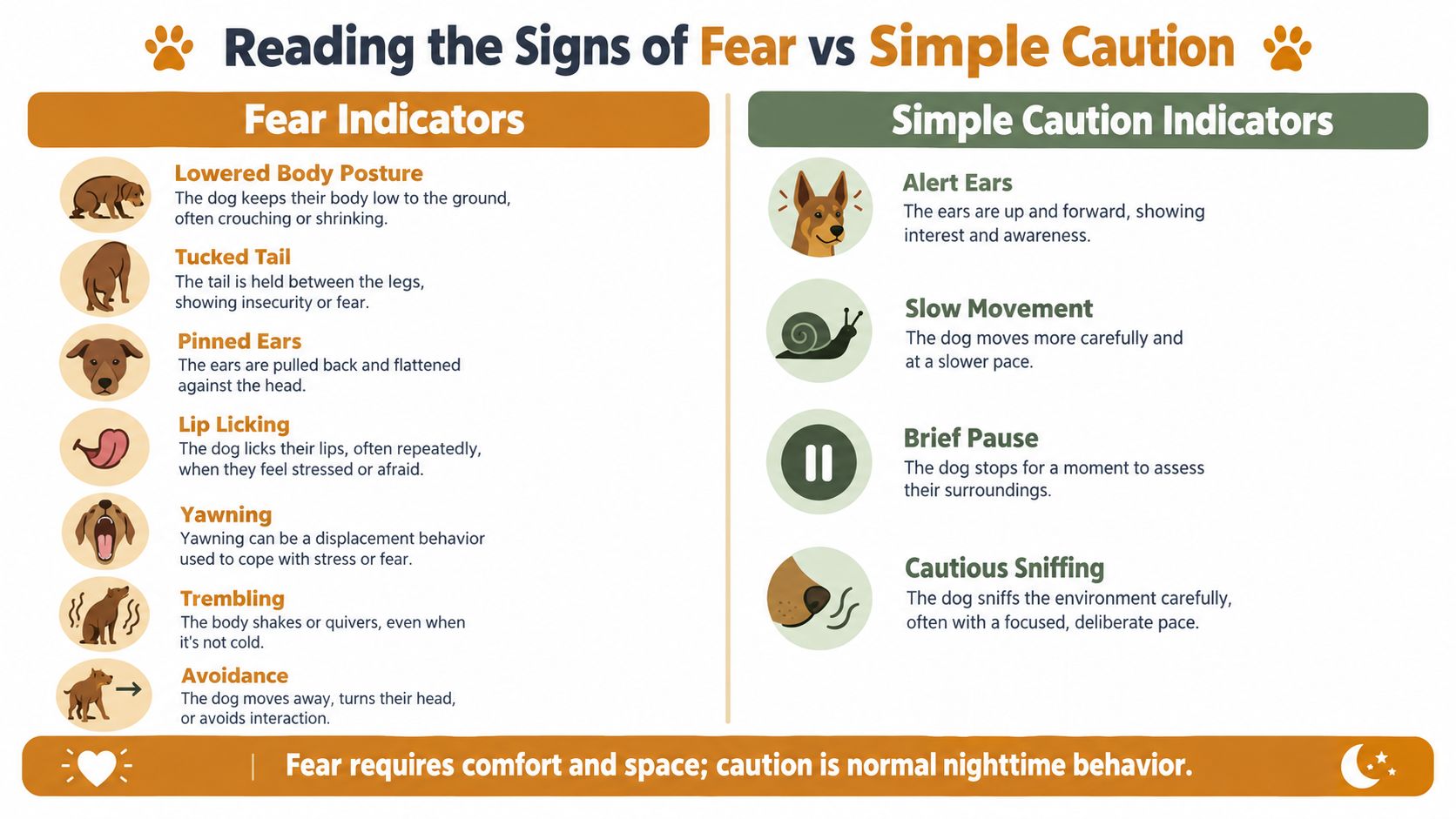
Owners often label every nighttime pause as fear, but body language gives a more precise read. A dog that is cautious may slow down, sniff more, or hesitate at a doorway. A dog that is distressed usually shows a wider stress pattern.
What fear tends to look like
Veterinary behavior guidance lists lowered body posture, raised hair, vocalization, excessive salivation, rapid breathing, rapid heart rate, and gastrointestinal disturbance as fear and anxiety signs (Merck Veterinary Manual). The same Merck guidance also lists pacing, freezing, hiding, fleeing, tucked tails, pinned-back ears, lip licking, yawning, and avoidance of eye contact as common fear signals.
That pattern looks different from simple caution. A cautious dog usually still checks the space and keeps moving after a brief pause. A fearful dog often tries to avoid the area altogether, or acts as if the room itself is unsafe.
A simple at-home filter
Light helps sort the problem. If the lights come on and your dog relaxes right away, low-light uncertainty is more likely. If your dog starts panting, trembling, hiding, or trying to escape, treat the reaction as fear or anxiety rather than a harmless quirk.
| Behavior at night | What it usually means | What to watch next |
|---|---|---|
| Brief pause, sniffing, slower walking | Simple caution | See whether the dog settles and continues |
| Hiding, trembling, pacing, vocalizing | Fear or anxiety | Note whether the dog calms with light, routine, or your presence |
| Refusing stairs or bumping into objects | Possible vision issue | Arrange a veterinary exam |
A dog that sleeps in a different spot at night is not automatically afraid. A dog that repeatedly tries to flee the room is showing a very different level of distress.
When the Underlying Problem Is Vision Loss
Darkness often acts like a stress test for sight. In daylight, a dog can rely on stronger contrast, familiar landmarks, and memory of the room. In dim light, those supports shrink, and an eye problem that was easy to miss can suddenly show up as hesitation.
A 2023 peer-reviewed study developed the Dog Variable Lighting Questionnaire, or dogVLQ, to assess visually guided behavior in bright light, dim light, and near darkness. The study found that older dogs had worse visual behavior across lighting conditions, struggled more during transitions between lighting environments, and showed earlier decline in very low-light vision than in brighter settings (Merck Animal Health USA summary of the dogVLQ study).
That helps explain a pattern many first-time owners find confusing. A dog who pauses at the top of the stairs, misjudges the edge of a hallway rug, or freezes after the lights go out may be doing less emotional reacting than practical compensating. The behavior can look like fear, but the starting point is sometimes reduced visual confidence.
What may sit behind nighttime hesitation
Several eye conditions can interfere with low-light function, including progressive retinal atrophy, cataracts, retinal degeneration, glaucoma, and other disorders affecting the eye. The Merck Veterinary Manual notes that night blindness is the usual first sign of progressive retinal atrophy, and that the condition can progress to total blindness over months to years.
A useful question is simple. Is your dog worried about the dark itself, or struggling to map the space once visual detail fades?
Breed tendencies can add context, though they never replace an exam. If you want an example of how inherited health patterns are summarized, review breed-specific health risk profiles with condition probabilities and treatment costs.
| What you see at night | Most likely cause | What to do next |
|---|---|---|
| Hesitation at stairs or hallways | Reduced visual confidence | Keep paths clear and schedule an exam |
| Bumping into furniture | Vision decline or disorientation | Check lighting, then call the vet |
| Reluctance in unfamiliar rooms | Low-light navigation trouble | Add light and observe whether it improves |
| Sudden nighttime onset in an older dog | Possible eye disease or senior change | Vet visit is the right next step |
Anxiety, Cognitive Decline, and the Senior Dog
Some dogs who act upset at night have no vision problem at all. The darkness strips away the extra cues, sounds, and familiar sights they lean on to feel settled, and what surfaces is anxiety.
Separation anxiety can appear as nocturnal wakefulness, excessive vocalization, and house soiling, especially when a dog is left alone and the home goes quiet (eWash's veterinary guidance on dogs and darkness). In a low-sensory environment, small things get louder. An unfamiliar creak, a changed routine, or the simple absence of a person can tip a nervous dog into restlessness.
Why senior dogs deserve special attention
Older dogs add another layer. Canine cognitive dysfunction works a bit like dementia in people: memory, sleep-wake cycles, and spatial orientation all degrade together. Cornell's veterinary guidance describes "midnight walks," where aging dogs roam the house at night, and recommends night-lights to reduce disorientation and getting stuck (Cornell University Riney Canine Health Center). Cornell also estimates that 22.5% to 68% of elderly dogs show at least one cognitive-dysfunction sign, and that more than 30% of dogs over age 14 have the disease, with diagnosis requiring other causes to be ruled out first.
Those numbers change how you read the behavior. A senior dog pacing at 2 a.m. is probably not "afraid of the dark." The dark is exposing something else: confusion, disrupted sleep cycles, pain, or sensory loss.
Record this before the appointment: time of night, pacing, vocalization, accidents, response to lights, and any daytime confusion.
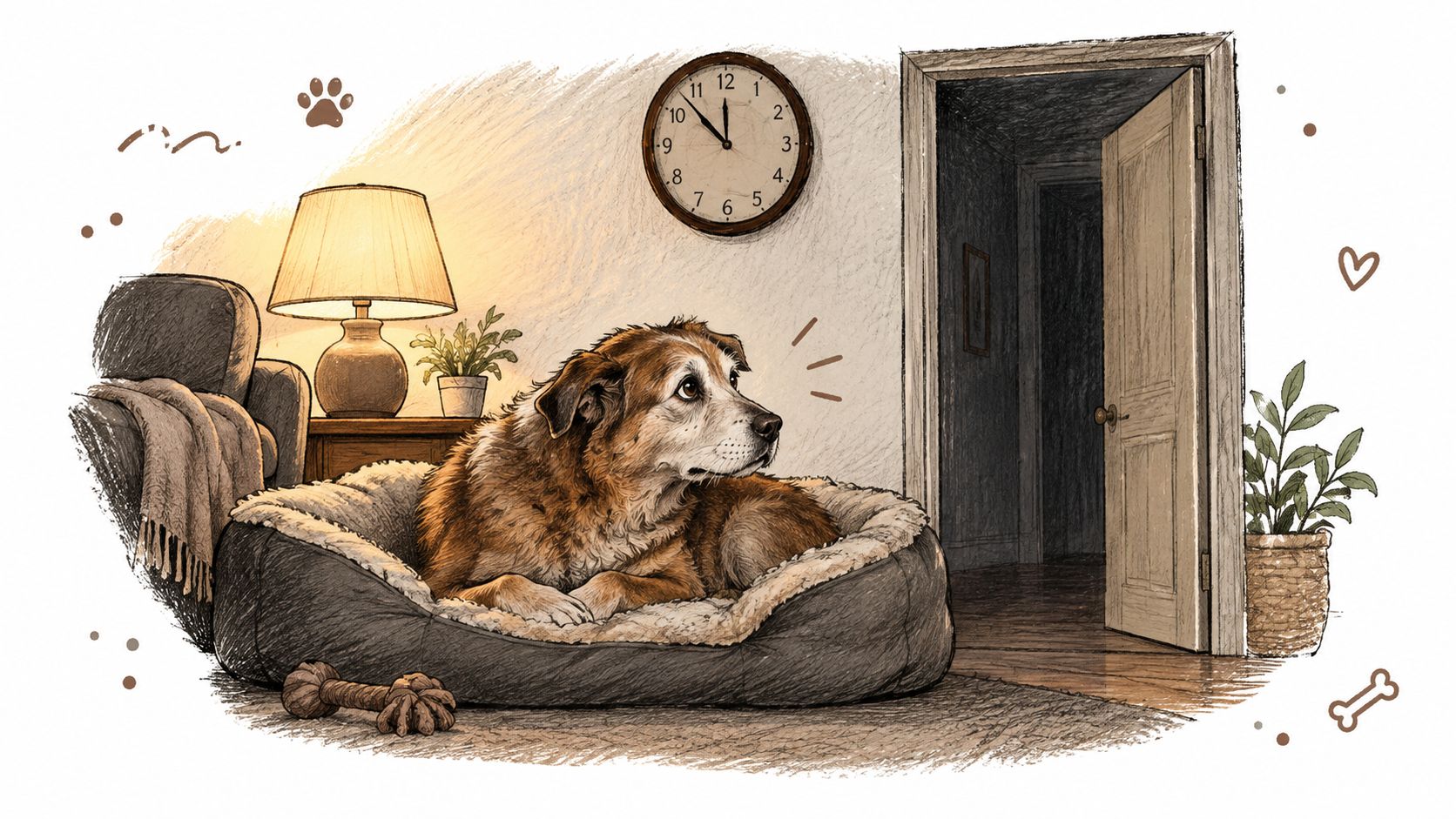
Here is the practical split. A dog that only fusses when the house is quiet and empty is showing anxiety. A dog that wanders, gets stuck in corners, or seems lost after dark may be dealing with cognitive decline. Both deserve help, but they call for different conversations with your vet.
Practical Steps to Help a Nervous Dog at Night
The safest fixes are usually simple. Start with the environment, then adjust the routine, and only then look at behavior training or medical follow-up.
Small changes that often help
A dim, warm night-light can make familiar hallways easier to read, especially for older dogs or dogs in a new home. A predictable bedtime routine also matters, because dogs rely on repetition when the world gets quieter and less visible.
- Use gentle lighting: Put a small light in hallways, near stairs, or by the dog's sleeping area.
- Keep the path clear: Don't move furniture around if your dog already has limited vision.
- Add traction: Non-slip runners or mats can help older dogs feel steadier on hard floors.
- Avoid forcing the issue: If your dog is fearful, let them approach the dark space gradually.
- Watch for pain or disorientation: Nighttime distress can be a clue that something medical is going on.
When a dog's reaction is mild, consistency often helps more than reassurance. When the reaction is severe, the problem is bigger than training.
If you're also trying to plan for possible veterinary follow-up, keep the discussion qualitative and use PetCostEngine's guides and calculators rather than guessing at the financial side on your own. The point is to understand the issue clearly before making decisions.
Putting It Together and Knowing When to Call the Vet
Darkness is rarely the whole problem. It acts more like a test: a dog with healthy vision may move cautiously, while a dog with impaired sight, pain, anxiety, or cognitive changes may struggle when familiar visual cues disappear.
Use three questions to sort the possibilities. Is your dog showing fear, such as trembling, hiding, pacing, or trying to escape? Are there signs of reduced vision, such as bumping into objects, hesitating in unfamiliar areas, or misjudging stairs? Does the change fit a wider medical pattern, especially in an older dog?
When veterinary evaluation is the right move
Arrange a veterinary examination when the reaction is sudden, worsening, or paired with clumsiness, hesitation in unfamiliar or dark spaces, difficulty locating familiar bowls, eye rubbing, watery or inflamed eyes, pupil changes, or startling around familiar people. Merck Veterinary Manual lists these kinds of changes as signs that can point to eye disease rather than simple caution.
A senior dog with new nighttime wandering, confusion, or a marked sleep-pattern change also needs attention. Repeated distress at night may reflect cognitive decline, discomfort, or another health problem, so do not dismiss it as a temporary phase.
For breed-specific health context, state-adjusted estimates, and practical planning tools, visit PetCostEngine. PetCostEngine's breed pages show condition probabilities and average treatment costs by breed, while its lifetime cost calculator lets you model state-adjusted veterinary expenses. A new nighttime vision issue can then be included in planning instead of guessed at.
Estimated lifetime and yearly costs for a American Water Spaniel, state by state, plus whether pet insurance breaks even for the breed.
See American Water Spaniel costs →
Is insurance worth it for a American Water Spaniel? →
Joint supplement → Puzzle toys → No-pull harness →
As an Amazon Associate, PetCostEngine earns from qualifying purchases.