Yes, Shiba Inus can be good dogs for experienced owners, and their median lifespan is 14.2 years, with half of dogs reportedly dying between 13 and 15 years. That long commitment can be rewarding, but it also requires patience with training and preparation for potential health care costs.
The popular advice often stops at “smart, clean, and adorable.” That description misses the more important question: what kind of owner can live successfully with an independent hunting dog whose health risks may become more demanding with age? A Shiba Inu may learn quickly without reliably obeying under distraction, may be reserved with unfamiliar people, and may show tension around other dogs.
The breed can suit a calm, consistent household that appreciates autonomy rather than constant obedience. It may be a poor match for someone seeking an easygoing first dog, a reliably off-leash companion, or a pet that naturally accepts every person and animal. The right decision depends less on appearance than on whether your daily routine, training ability, and long-term planning fit the Shiba Inu's actual behavior profile.
Table of Contents
- The Shiba Inu Temperament - More Than Just Cuteness
- Historical Roots and Their Modern Impact
- Who Should Consider a Shiba Inu
- Hidden Health Risks and Long-Term Care
- Training and Socialization Realities
- Making the Decision - Is a Shiba Inu Right for You
The Shiba Inu Temperament - More Than Just Cuteness
A Shiba Inu's appearance makes it easy to mistake the breed for a simple companion dog. The foxlike face, compact body, and clean habits attract owners who may not realize they're choosing a dog with a strong working history and a pronounced sense of autonomy.
The American Kennel Club breed standard describes the Shiba's character through spirited boldness, good nature, and forthrightness. It also notes independence, reserve with strangers, and the possibility of aggression toward other dogs. Those traits can coexist in the same animal. A Shiba may be devoted at home while remaining cautious with visitors and difficult to manage in a busy dog park.
Practical rule: Judge the Shiba Inu by the behavior you'll need to manage, not by the friendliness you hope appearance will predict.
Intelligence doesn't guarantee compliance
Shibas are intelligent, but intelligence and biddability aren't the same quality. A highly biddable dog often treats cooperation as rewarding in itself. A Shiba may understand a cue, decide whether the reward is worthwhile, and then act according to its own priorities.
That difference explains why the breed can adapt well to different environments while still requiring more management than an eager-to-please companion breed. Training may establish a command without producing dependable compliance around wildlife, unfamiliar dogs, or other distractions. Owners need realistic expectations about recall, greetings, handling, and household boundaries.
Their cleanliness is a genuine advantage. Breed and veterinary guidance describe Shiba Inus as naturally clean and often easy to house train, but that benefit doesn't erase their social and behavioral demands. A dog can be tidy indoors and still require careful planning around prey drive, resource guarding, and dog-on-dog conflict.
The household matters more than the breed label
A Shiba may work well for an owner who enjoys observing canine behavior, setting consistent rules, and rewarding cooperation without demanding constant emotional dependence. It becomes a harder match for a family expecting every dog to welcome children, tolerate rough handling, or enjoy unrestricted interaction with other pets.
Households comparing Japanese breeds should evaluate behavior and care requirements together, rather than choosing only by size or appearance. The Hokkaido breed profile offers a useful comparison point for people considering another Japanese hunting breed.
The central answer to “are Shiba Inus good dogs” is therefore conditional. They can be excellent dogs for owners who value independence and can manage firm boundaries. They aren't universally easy dogs, and their appealing appearance shouldn't be used as a substitute for temperament screening or lifestyle analysis.
Historical Roots and Their Modern Impact
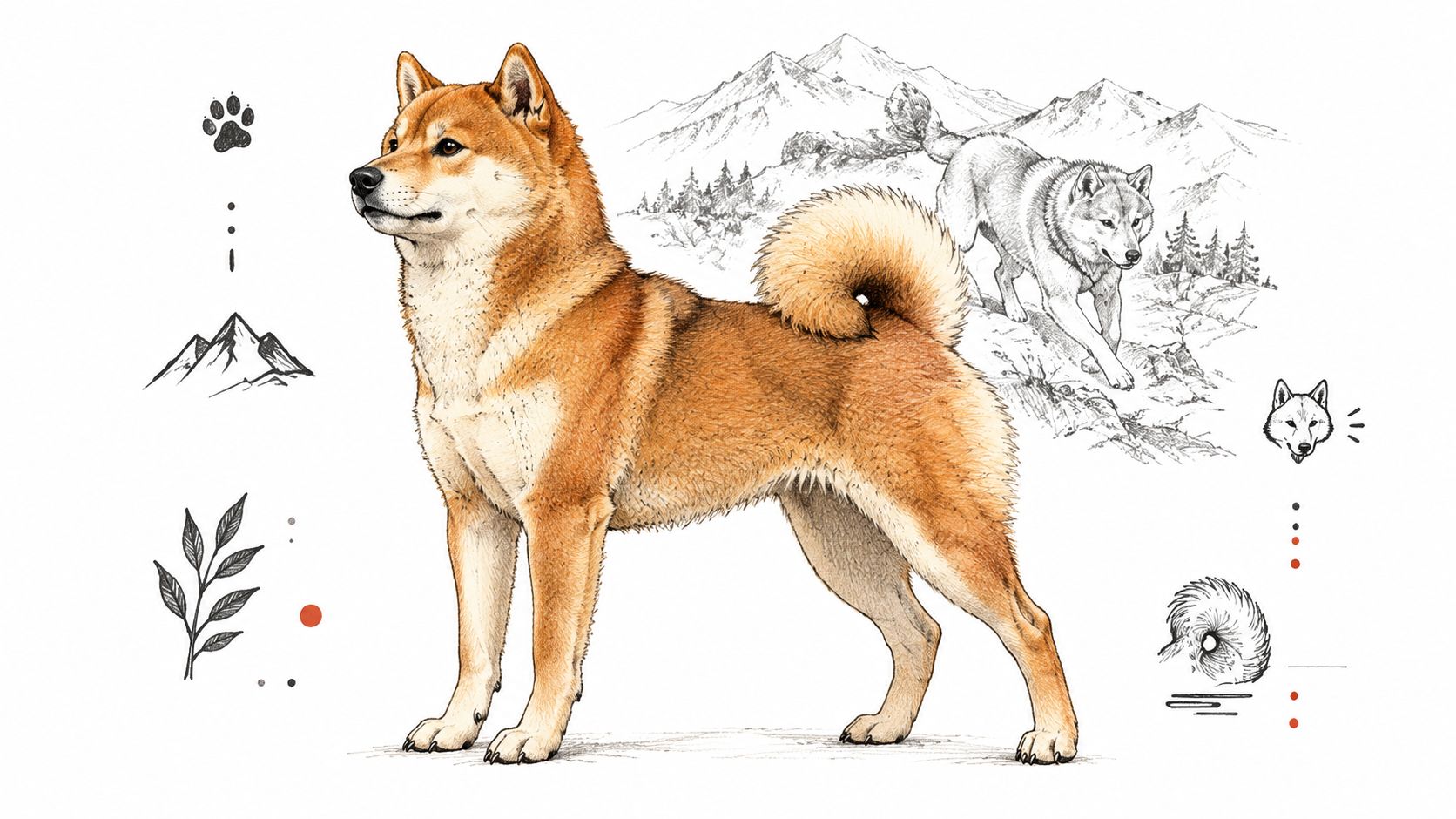
The Shiba Inu wasn't developed first as a lapdog or an apartment accessory. It has documented roots in Japan as an ancient hunting breed, selected to move through mountainous terrain while searching for and flushing small game. That history helps explain why modern Shibas often combine athletic ability with self-directed decision-making.
Preservation efforts began in 1928, the breed standard was unified in 1934, and the Shiba Inu was designated a Japanese National Monument in 1936 or 1937, according to the breed's historical record from Shiba Inu preservation history. The American Kennel Club recognizes the Shiba as the smallest of Japan's native breeds, originally developed for hunting in mountainous terrain.
Function shaped temperament
A hunter working through uneven ground couldn't depend on a person to direct every movement. Agility, alertness, resilience, and independence had practical value. Those qualities remain visible in the modern breed as quick reactions, strong curiosity, and a willingness to investigate without waiting for permission.
That background also changes how owners should interpret stubbornness. A Shiba that pauses before complying isn't necessarily confused or incapable. It may be weighing the environment and deciding whether cooperation serves its interests. Training still works, but it must account for motivation and context rather than relying on repetition alone.
The same functional history appears across Japanese breeds, although each breed has its own size, drive, and social profile. Readers exploring that group can compare the Shiba with the Akita breed profile before assuming that all Japanese dogs offer the same ownership experience.
Why history matters in a modern home
Modern owners may provide food, shelter, and companionship without asking their Shiba to hunt. The dog's inherited behavioral tendencies don't disappear just because its original job has changed. Prey drive, independence, and alertness can surface during walks, around small animals, or when the dog discovers an opportunity to roam.
This creates a practical mismatch. People may want the look and compact size of a Shiba while expecting the automatic cooperation associated with more biddable companion breeds. Understanding the breed's history makes that expectation easier to correct before adoption or purchase.
A Shiba Inu's past doesn't doom it to difficult behavior. It does mean the owner should treat independence as a central breed characteristic, not a training defect that will vanish with enough commands.
Who Should Consider a Shiba Inu
The best Shiba Inu owner isn't defined by age, home size, or an interest in a particular aesthetic. Suitability depends on whether the person can provide consistent guidance while accepting that the dog may never behave like a highly compliant breed.
Start with experience. Major breed guidance describes the Shiba as highly intelligent, independent, and strong-willed, and explains that early socialization, reward-based training, and consistent leadership help reduce problems such as aloofness, resource guarding, and tension with other dogs. The AKC suitability guide for the Shiba Inu supports the conclusion that the breed is often more appropriate for owners prepared to manage those traits deliberately.
Three suitability tests
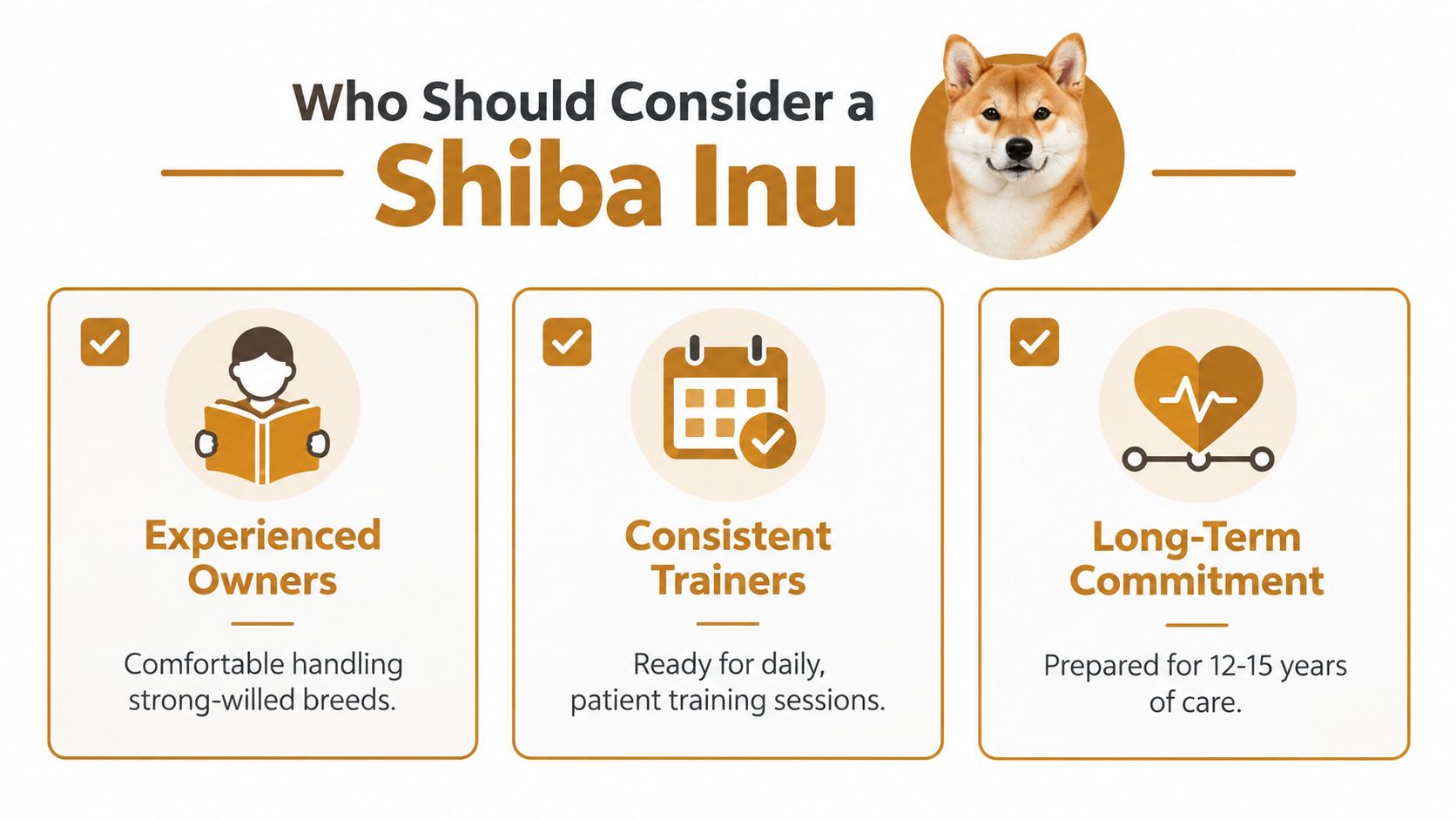
Experience with independent dogs: You don't need to have owned a Shiba previously, but you should understand that obedience isn't guaranteed just because the dog knows a cue. Owners need to recognize warning signs, prevent rehearsals of unwanted behavior, and seek qualified help before conflict escalates.
Consistency in daily training: Shibas respond better to clear, reward-based instruction than to intimidation or inconsistent rules. Everyone in the household should handle greetings, food, doors, toys, and leash behavior in a predictable way. A patient owner who trains in short, regular sessions is better prepared than someone who relies on occasional bursts of enthusiasm.
Long-term responsibility: A median lifespan of 14.2 years, with half of dogs reportedly dying between 13 and 15 years, means the decision extends well beyond puppyhood, as documented in Shiba Inu lifespan and temperament guidance. The senior years may bring more appointments, monitoring, and management than the young adult years.
The household should also assess social expectations. A Shiba may be devoted to its people and sensitive to human moods, yet still need boundaries around visitors, children, other pets, and unfamiliar dogs. That combination can suit an attentive adult household but challenge a busy family expecting effortless social flexibility.
For a structured comparison with other breeds and size categories, use the breed comparison tool. The useful question isn't whether another dog is objectively better. It's whether its behavioral demands align more closely with your experience and routine.
A Shiba can be a strong candidate for someone who enjoys training as an ongoing relationship rather than a one-time project. It is less suitable for someone who wants a low-management dog that can be trusted in every social setting without careful preparation.
Hidden Health Risks and Long-Term Care
A Shiba Inu can look low-maintenance while carrying health risks that demand rapid decisions and long-term planning. Eye disease may be one of the breed's most consequential and under-discussed health concerns. A recent veterinary review found glaucoma was by far the most frequently reported condition in Shiba Inus, followed by cataracts and chronic corneal disease. The review also identified the Shiba as the only breed with repeatedly reported corneal endotheliitis as a distinct breed-specific disease, as discussed in the veterinary review of Shiba Inu eye disease.
An apparently healthy dog can still develop an ophthalmic problem requiring urgent assessment. Owners should treat sudden vision changes, cloudiness, persistent squinting, redness, pain, or unusual rubbing as reasons to contact a veterinarian promptly. Routine examinations matter because some changes are difficult to detect at home.
Common Shiba Inu health issues
| Condition | Prevalence | Management notes |
|---|---|---|
| Glaucoma | By far the most frequently reported condition in the recent veterinary review | Changes in eye appearance, vision, or comfort require prompt veterinary attention |
| Cataracts | Reported among the leading eye conditions after glaucoma | Veterinary monitoring can assess changes in vision and lens health |
| Chronic corneal disease | Reported among the leading eye conditions after glaucoma | Persistent irritation or visual changes may require repeated examinations |
| Corneal endotheliitis | Repeatedly reported as a distinct breed-specific disease | Recurring or unexplained corneal changes warrant veterinary investigation |
| Hip dysplasia | Listed as a breed concern in the VCA Shiba Inu health reference | Maintain suitable activity and follow veterinary advice about mobility |
| Patellar luxation | Also listed as a breed concern in the same VCA reference | Monitor gait changes, intermittent lameness, or difficulty using a limb |
| Hypothyroidism | Also included among the breed concerns in the same VCA reference | Diagnosis and treatment require veterinary evaluation and ongoing monitoring |
The VCA reference supports a broader health assessment that includes allergies and chronic conditions. A compact, clean dog is not automatically a low-management dog, particularly when several risks can require different forms of monitoring.
The late-life tradeoff
A young Shiba may appear sturdy, active, and straightforward to care for. Aging can bring overlapping eye, joint, allergy, and endocrine concerns, turning ordinary ownership into a more management-intensive routine. Medication schedules, modified activity, specialist input, and closer observation may become part of daily care.
This changes the financial and practical calculation. Prospective owners should assess access to veterinary care, emergency options, time for follow-up, and their ability to absorb unpredictable medical needs. Owners comparing long-term health burdens across breeds can review the American Water Spaniel health profile alongside the Shiba's risk model.
Health planning insight: The relevant question is whether you can respond responsibly if a breed-associated problem appears after years of ordinary care, not whether every Shiba will develop a serious condition.
Breed research can inform that decision, but it cannot replace a veterinarian's guidance on screening, preventive examinations, and symptoms specific to the individual dog. Early attention may improve the options available, while delayed attention can make an already demanding health problem harder to manage.
Training and Socialization Realities
Training a Shiba Inu works best when the owner stops treating independence as defiance and starts treating it as a motivation problem. The dog may understand a behavior while choosing not to perform it in a distracting setting. Reward-based methods give the dog a reason to cooperate, while early socialization helps build more flexible responses before avoidance, guarding, or conflict becomes established.
The ideal approach is deliberate and preventative. Introduce handling, household routines, visitors, surfaces, sounds, and calm interactions with suitable dogs gradually. Reward disengagement from distractions, not only perfect obedience. If the dog guards food or objects, use qualified behavior guidance rather than taking items by force, which can intensify conflict.
Two owner profiles
The prepared owner keeps sessions short, uses rewards strategically, and manages the environment so the dog can't repeatedly practice chasing, guarding, or charging at other dogs. This owner also understands that socialization isn't the same as forcing interaction. A Shiba may become more comfortable without becoming universally social.
The unprepared owner waits for a problem, interprets hesitation as disrespect, and uses punishment after the dog has already escalated. That pattern can damage trust and obscure the warning signs that would have allowed earlier intervention.
Shibas are often naturally clean and can be satisfying to house train, but indoor cleanliness shouldn't be confused with broad obedience. A dog may use the right bathroom area and still have unreliable recall or strong opinions about sharing resources. Guidance on distinguishing Japanese breeds, including the Jindo breed profile, can help owners compare similar-looking independent dogs without assuming identical behavior.
Practical training priorities
- Build engagement first: Reward the dog for checking in voluntarily before asking for difficult behaviors.
- Protect recall: Use secure management and carefully chosen environments until the dog has demonstrated dependable responses.
- Teach cooperative handling: Pair grooming, paw checks, ear checks, and veterinary-style touches with rewards.
- Manage dog interactions: Choose calm, compatible partners and interrupt tension before it becomes a confrontation.
- Keep rules stable: Inconsistent access to furniture, food, doors, or toys can make an independent dog harder to guide.
A Shiba doesn't need harsh leadership. It needs clear expectations, appropriate reinforcement, and an owner who can recognize when prevention is more effective than correction.
Making the Decision - Is a Shiba Inu Right for You
A Shiba Inu is a good dog for the right owner, not an easy dog for every owner. Its strengths include cleanliness, intelligence, devotion to its household, adaptability, athletic ability, and a distinctive independent character. Its challenges include strong will, reserved social behavior, possible dog-on-dog aggression, prey drive, resource guarding, and health risks that may become more demanding later in life.
Use this final test:
- Can you maintain consistent, reward-based training?
- Can you manage socialization without forcing interactions?
- Can you accept that knowing a command doesn't guarantee compliance?
- Can you plan for a long relationship that may last 14.2 years on average, with half of dogs reportedly dying between 13 and 15 years?
- Can you respond calmly if eye, joint, allergy, or endocrine problems emerge?
If the answers are yes, a Shiba Inu may offer a rewarding partnership built on trust rather than automatic obedience. If you want effortless sociability, dependable compliance, or minimal long-term management, another breed may fit your household better.
PetCostEngine provides breed-specific lifetime ownership projections, health risk profiles, state-adjusted veterinary estimates, and comparison tools for evaluating the long-term responsibilities of a Shiba Inu. Review your breed and state assumptions at PetCostEngine before you commit, then discuss the health and training considerations with a veterinarian and qualified behavior professional.
Estimated lifetime and yearly costs for a Hokkaido, state by state, plus whether pet insurance breaks even for the breed.
See Hokkaido costs →
Is insurance worth it for a Hokkaido? →
Premium dry food → Puzzle toys → No-pull harness →
As an Amazon Associate, PetCostEngine earns from qualifying purchases.