
The most popular advice is also the riskiest. Let them meet, watch closely, and let them work it out. That approach treats the first meeting as a test your pets pass or fail in one afternoon. It's not. Learning how to introduce a new dog to your cat is behavior training, and the cat needs control over distance from day one.
A dog can look friendly and still make a cat's life miserable. Fast play, hard staring, and a single chase can teach the dog that the cat triggers a game. The cat learns something different. It learns that home is no longer predictable. Judge progress by sustained normal behavior, not by whether they survived a greeting without a fight.
Table of Contents
- Why Rushed Introductions Often Go Wrong
- Setting Up a Cat-Only Safe Zone First
- Scent Swaps and Barrier Visits Before Contact
- Reading Body Language at Every Stage
- Leashed Meetings and When to Advance or Pause
- Timing the Introduction by Age and Temperament
- Next Steps for Long-Term Coexistence
Why Rushed Introductions Often Go Wrong
A single face-to-face meeting is the most common mistake I see owners make. The dog arrives excited. The cat gets carried in or cornered in a room. Everyone hopes a wagging tail means good intentions. It doesn't.
Excitement isn't proof of safety. A dog may bounce, whine, and pull toward the cat with no aggression and still overwhelm the cat in seconds. If the cat runs, a playful approach can turn into a chase. That chase is self-rewarding for many dogs, so preventing the first one matters more than interrupting the tenth.
What Success Actually Looks Like
Success isn't two animals tolerating five tense minutes together. It's ordinary life continuing on both sides.
- The cat eats normally: Meals happen on schedule, without waiting for the dog to leave the house.
- The cat uses the litter box normally: No holding it, no rushing, no sudden accidents in quiet corners.
- The cat moves through the home: It can reach resting spots and people without planning an escape route.
- The dog can disengage: It looks at the cat, then looks back at you when called.
If the cat is eating less, hiding more, or avoiding whole rooms, the introduction isn't going well, even if there's never been a fight.
Breed tendencies play a part, but they don't settle the question. A scent-driven dog profiled on the Beagle breed page may fixate on movement differently than a calmer companion breed. What matters most is what your individual dog does when the cat moves, not what the breed description promises.
The staged plan that follows is built around what you can observe. You'll set up a cat-only zone first, trade scents, use a barrier, read body language, and only then try leashed meetings. Each stage has a clear test. If your pets pass it repeatedly, you advance. If they don't, you step back. No calendar decides for you.
Setting Up a Cat-Only Safe Zone First
Finish the cat's territory before the dog comes through the front door. Pick one room the dog never enters. A spare bedroom or office works well because you can close the door and control traffic. Smaller apartments may need a gated corner, but the cat still needs a space where pursuit is physically impossible.
Stock that room completely. The cat shouldn't have to cross the dog's area to meet any basic need. Shelter and welfare guidance on protecting the cat's escape routes and resources stresses that the cat must reach food, water, litter, and resting places without passing the dog. A calm first meeting can still produce chronic stress if the cat loses control over movement and resources afterward.
Resources to Place in the Cat-Only Safe Zone
| Resource | Why it matters |
|---|---|
| Food and water | The cat can eat without being watched, rushed, or followed. |
| Litter box | Private access prevents avoidance and accidents. |
| Hiding places | Boxes, carriers, and covered beds let the cat withdraw by choice. |
| Elevated resting spots | Cat trees and sturdy shelves let the cat observe from above. |
| Scratching surface and toys | Normal outlets keep daily behavior closer to the cat's baseline. |
| Familiar bedding | Known scents make the room feel like territory, not exile. |
Plan for the Hours Nobody Thinks About
Most households don't fail during planned sessions. They fail during deliveries, feeding time, kids' playdates, and the rush out the door for work. Walk through your actual day. Where does the dog wait while you answer the door? Who feeds the cat, and can that person shut the dog out first? Where does the dog sleep overnight, and can it reach the cat's door?
"Supervise closely" isn't a plan. A plan is a written unsupervised-time rule every adult in the house can repeat. For example, the dog and cat are separated by a closed door whenever no adult is in the room with them. Write it down. Put it where guests and older children will see it.
In a home where separation can't be maintained reliably, a closed door is the only workable answer, not a baby gate a large dog can push through. Be honest about your space and schedule before the dog arrives. That honesty protects the cat's daily life, which is the whole point. A cat that eats, rests, and moves normally across busy routines is adjusting. A cat that only functions when the dog is crated is telling you the setup needs more work.
Scent Swaps and Barrier Visits Before Contact
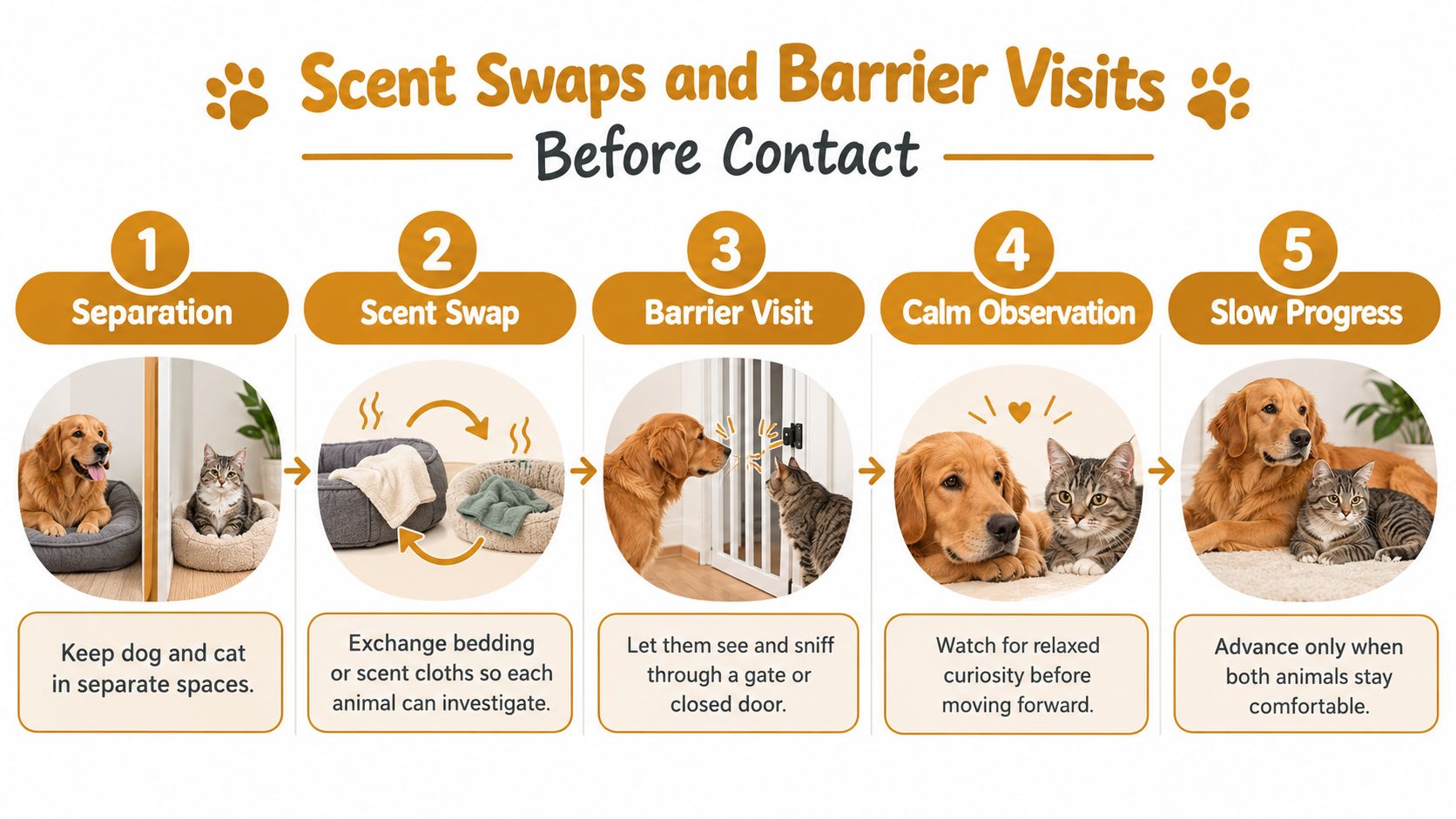
Early stages feel slow because they're supposed to. You're teaching both animals that the new smell and the new face predict calm, boring outcomes. Start with separation. Keep the dog and cat in their own areas for at least the first few days so each one gets used to the other's sounds and smells without direct contact.
Trade Scent Without Forcing an Approach
Swap bedding between the two areas, or rub a soft cloth on one animal and leave it near the other's resting spot. Let each animal investigate on its own schedule. Don't rub the cloth on the cat's face or hold it under the dog's nose. Sniffing and walking away is a perfectly good response.
Feeding near a closed door adds a useful test. Place bowls on opposite sides of the door, several feet back at first. Move them closer over days only if both animals eat with relaxed bodies. If the cat stops eating or the dog whines and paws at the door, you've moved the bowls too fast. Back them up. Eating comfortably near the other's scent is measurable progress you can see.
Move to Visual Contact Through a Barrier
Once scent work is uneventful, let them see each other through a secure, see-through baby gate or screen door. The dog stays on a loose leash and can't reach the cat. The cat chooses whether to watch, approach, or leave.
RSPCA introduction guidance using separation, scent exchange, then barrier viewing recommends keeping these initial visual sessions to about 5 minutes or less, repeated several times daily, before any direct contact. Short and calm beats long and almost calm.
The flow below maps these early stages in order, so you can check where you are before moving forward.
Set the Gate So the Cat Controls the Exit
Gate height and placement matter as much as the session itself. ASPCA shelter guidance on gate setup for cat-only passage describes leaving a gate opening roughly 6 to 10 inches above the floor so the cat can pass beneath while the dog cannot. Test the gap before the first session. A small dog may squeeze through a space meant for a cat.
During barrier visits, reward the dog for the behaviors you want. Pay generously for orientation away from the cat, quiet settling, and quick responses to cues. If the dog fixates, add distance instead of repeating cues louder. End the session while things are still calm.
Advance only when the current stage is boring. If scent work still produces tension, barrier visits will too. Stages build on each other, and skipping one usually shows up as a problem later, when there's no gate between them.
Reading Body Language at Every Stage
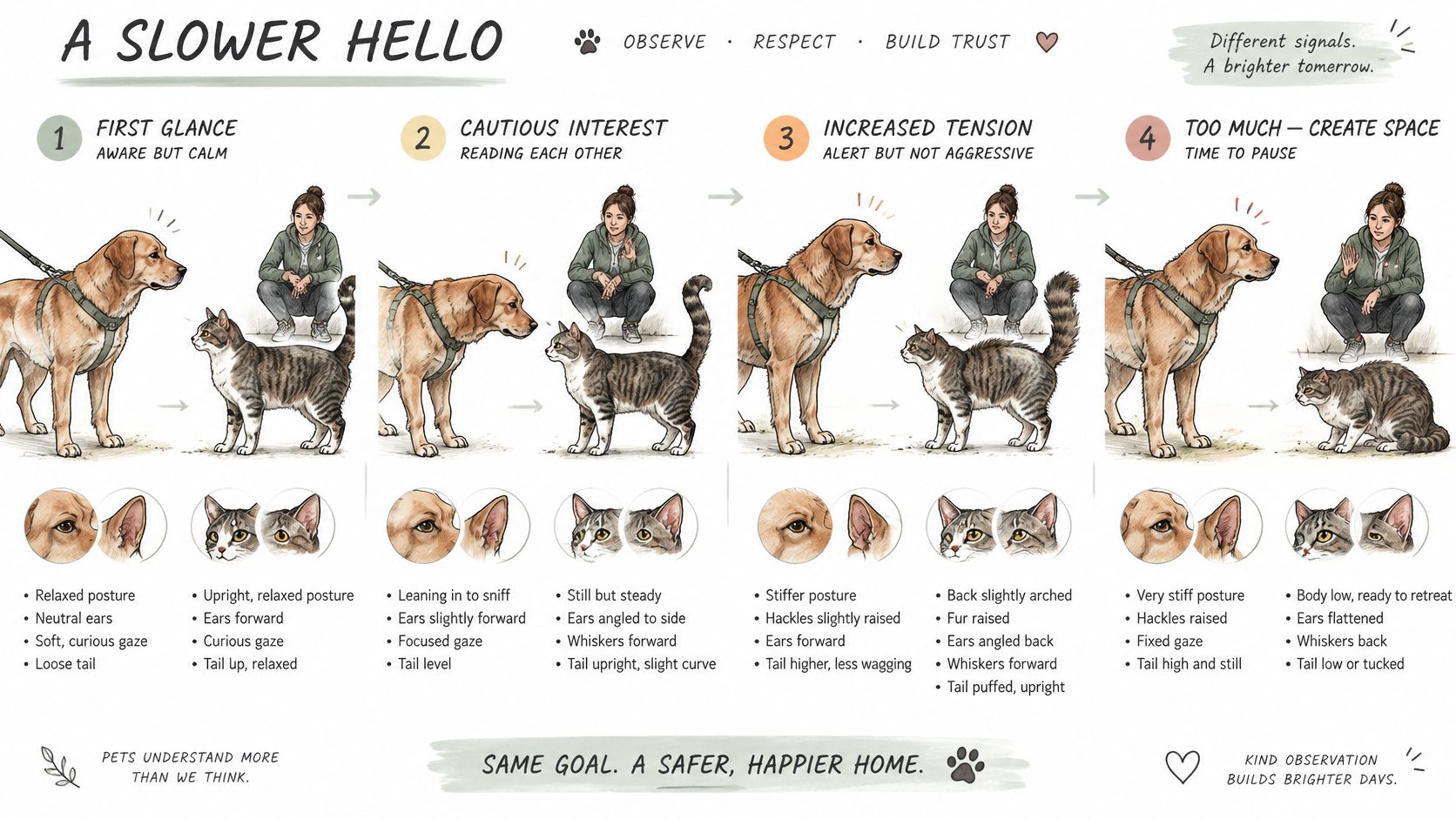
A wagging tail does not prove a dog is safe around a cat. A motionless cat may be calm, or frozen and waiting for the threat to pass. Watch both animals together: one pet's small change can trigger a sharp reaction in the other. Calm moments alone do not show that either animal is settled.
The graphic below groups common signals by introduction stage. Use it to distinguish curiosity from rising tension, then check each pet's posture and ability to disengage.
Dog Signals That Mean Intensity Is Rising
Look for a pattern rather than reacting to one twitch. Increase distance or end the session if the dog:
- Fixates or stares hard: The dog locks onto the cat and no longer responds to its name.
- Stalks: It lowers its body and moves slowly toward the cat.
- Lunges or tightens the leash: The leash stays taut as the dog strains toward the cat.
- Barks or whines repeatedly: Vocalizing directed at the cat comes with a stiff body.
A friendly appearance does not guarantee low risk. ASPCA guidance summarizing puppy introduction behaviors and regression signs reports that, in a study of puppies already living with a household cat, play toward the cat, over-excitement, and chasing were commonly reported. Play and excitement can still overwhelm a cat. Treat high energy as a reason to watch closely, not as proof the pair is getting along.
Breed background can also shape what to monitor. A dog bred to chase by sight, such as a Greyhound, may stay quiet until the cat moves and triggers pursuit. Quiet does not always mean relaxed.
Cat Signals That Mean Stress Is Building
For cats, watch for hissing, raised fur, hiding, flattened posture, and bolting. These are signs to stop and give the cat more space, not reasons to push through the meeting. Hissing signals a need for distance. Raised fur, a flattened body, or a quick retreat for cover means the cat is under pressure.
Watching and freezing can look similar at first. An interested cat has a soft body, blinks, shifts position, and can look away. A frozen cat goes rigid, leans its weight back, and stays still even after the dog turns away. Stillness under pressure is not consent.
Track the cat's behavior outside the meeting too. Skipping meals, avoiding the litter box, or abandoning favorite resting places suggests the current pace is affecting daily life. Success means the cat continues normal routines and can choose distance, access to food, litter, and resting spots without being cornered.
Watch the video below to see these signals in motion. A brief glance is ordinary. A stare that hardens as the body stiffens calls for a pause.
Working rule: If the dog will not respond to a familiar cue, increase distance, even if the session began calmly.
Leashed Meetings and When to Advance or Pause
Same-room meetings come last, not first. Choose a large room where the cat can leave in more than one direction. Open a route to a high perch and a route back to the safe zone before you bring the dog in. If the only exit runs past the dog, pick a different room.
Run the Session With Control
Keep the dog on a loose leash and let the cat move freely. Do not carry the cat toward the dog, set it down in front of the dog, or hold it so the animals can sniff. The cat decides the distance. Your job is the dog.
Three cues do most of the work:
- Sit: Gives the dog an incompatible job instead of pulling forward.
- Stay: Lets the cat pass at a distance the cat chooses.
- Leave it: Pays the dog for turning away from the cat entirely.
Reward disengagement heavily in the first sessions. A dog that glances at the cat and turns back to you is showing you the exact skill that makes shared living possible. Practice matters here, and it matters with individual temperament too. An eager, people-focused dog such as the ones described on the Golden Retriever breed page may respond to cues quickly yet still get overexcited when the cat moves fast.
The Advance or Pause Test
Forget fixed timelines. Seven good days don't guarantee a safe eighth. University of Wisconsin Shelter Medicine guidance on evaluating dog reactivity to cats warns that a dog may look calm around a stationary cat yet chase when the cat runs. Progression should depend on observable behavior, and chasing, intense leash straining, barking, whining, and agitation are warning signs to pause.
Advance only after repeated sessions where all of these hold:
- The dog disengages on cue: It turns away from the cat promptly, including when the cat moves.
- The cat controls distance: It can approach, retreat, and pass without crouching or bolting.
- Daily behavior stays normal: The cat eats and uses the litter box on its usual schedule.
- Bodies stay soft: No hard staring, raised fur, or tight leash by the end.
Pause and return to the barrier stage after persistent vocalization, blocked escape routes, fixation you can't interrupt, or changes in appetite or litter habits. Stepping back isn't failure. It's how you keep a hard moment from becoming a habit.
Interrupt Without Punishing
If the dog fixates or starts to chase, calmly walk it farther away and end the session. Don't yell at the cat for hissing or swatting, and don't scold the dog after the fact. Punishment adds arousal to a situation that already has too much.
Keep the leash on during early room sessions and supervise every interaction for at least the first couple of weeks. Unsupervised access comes only after repeated calm sessions, including sessions where the cat ran, jumped, or played. Test the hard moments while you still have control.
Some pairs reach peaceful coexistence without affection. They share rooms, ignore each other, and live well. That's success. A smaller number need permanent management or help from a qualified behavior professional, especially if the dog can't disengage despite weeks of careful work. Accepting that early is kinder than forcing contact and hoping.
Timing the Introduction by Age and Temperament
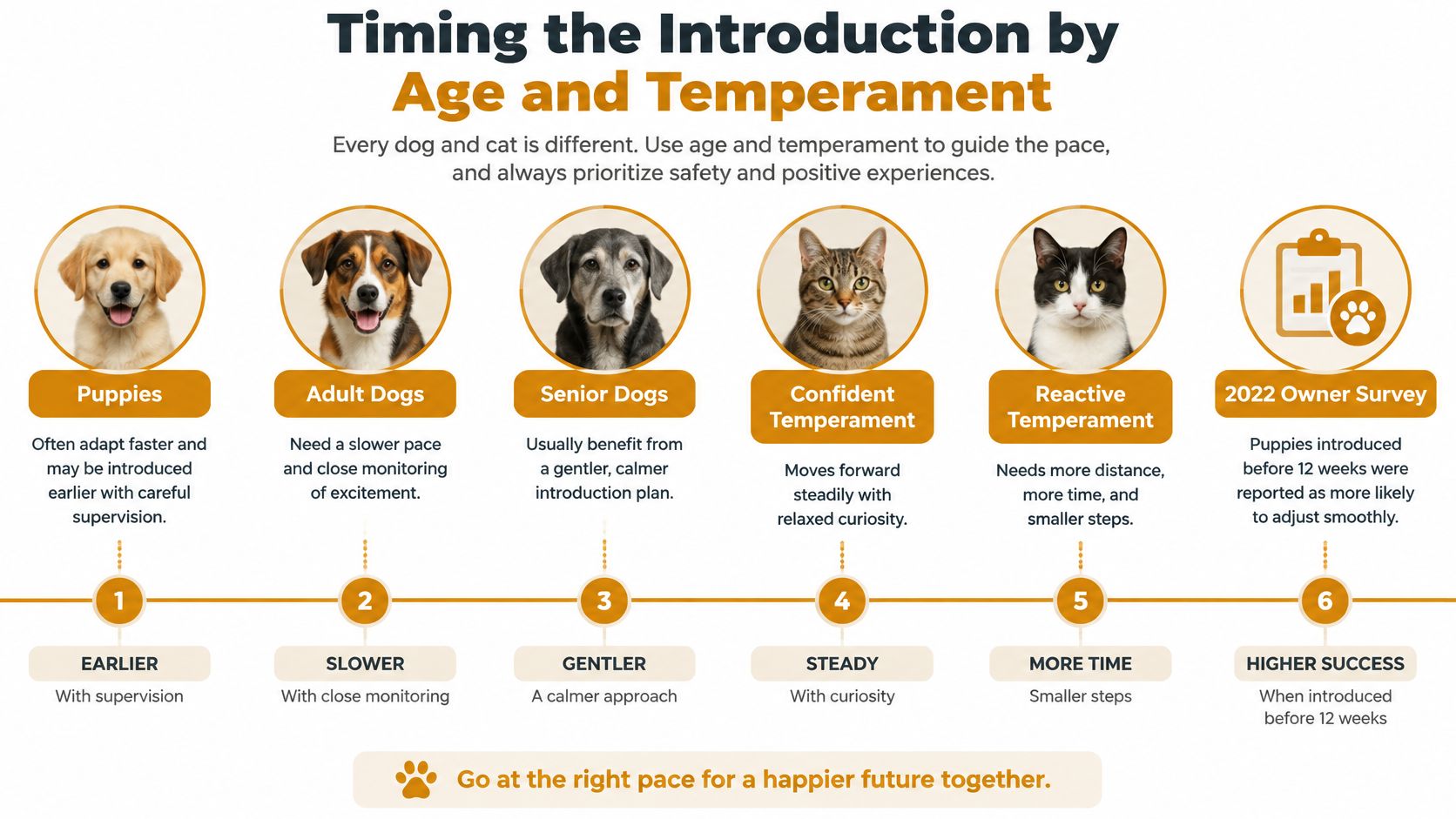
Age changes the pace, but it doesn't change the sequence. Puppies, adult dogs, and senior dogs all go through separation, scent work, barrier visits, and leashed meetings. What changes is how long each stage takes and what tends to go wrong.
What the Puppy Data Actually Says
A 2022 owner survey of 4,678 puppies and their behavior toward household cats found that puppies introduced before 12 weeks of age, introduced gradually, or living in multi-dog households had higher odds of showing only desirable behaviors during introductions. That's a useful signal in favor of starting early and going slowly.
Read it with care. The findings came from owner survey data, not a controlled experiment. They show an association, not a guarantee for your puppy. An early introduction done roughly won't beat a later one done well.
Puppies also bring a specific risk. They're excitable and mouthy, and they rehearse whatever gets a reaction. If chasing the cat becomes a favorite game at ten weeks, you'll spend months undoing it. Short sessions, frequent rewards for settling, and rest before meetings keep puppy energy from running the process.
The timeline below compares pacing by age and temperament, with each stage tied to behavior rather than the calendar.
Adult and Senior Dogs Need a Different Read
An adult dog with prior cat experience may move through barrier work quickly, but verify it. Shelter cat tests are unreliable because behavior shifts with context, stress, and the individual cat. What your dog does in your home, with your cat, across several sessions is the evidence that counts.
A strong prey drive changes the ceiling. Breed tendencies and the individual dog both matter, and a dog that chases wildlife outdoors deserves extra skepticism indoors. If you're still choosing a dog, comparing profiles side by side on the breed comparison tool can help you weigh temperament and energy against your cat's needs before you commit.
Senior dogs often move slowly and startle less, which helps. Pain, poor hearing, and reduced patience can cut the other way. Keep sessions short, watch for irritability, and don't assume a sleepy dog welcomes a curious cat climbing nearby.
Match the Pace to the Cat Too
A confident cat that grew up around dogs may investigate the gate on day one. A shy or senior cat may need weeks of scent work before visual contact. Both are normal. The slower animal sets the pace, every time.
Reactive temperaments on either side mean more distance, shorter sessions, and smaller steps. That's not a character flaw. It's information about how much support the pairing needs.
Next Steps for Long-Term Coexistence
Introductions don't end with the first calm afternoon on the couch. They settle into a household routine that either protects the cat's control or slowly takes it away. The habits you keep matter as much as the stages you followed.
Keep the Safety Structure in Place
Leave the cat-only zone available permanently, even after shared time looks easy. Cats use retreat space most when routines change. Guests, construction noise, a new work schedule, or a visiting child can all raise tension weeks after you thought you were done.
Keep the written unsupervised-time rule active and review it as the pets change. A rule that fit a young dog may need revisiting as the dog ages or the cat slows down. When in doubt, separate them while you're out. Nobody regrets an uneventful afternoon.
- Feed separately: Meals stay calm when neither pet guards or steals.
- Protect the litter box: Keep it behind the gate or in the safe zone so the cat is never followed in.
- Keep vertical routes open: Don't block cat trees and shelves with storage once things improve.
- Reward calm in passing: Treat the dog for ignoring the cat during ordinary moments, not just sessions.
Watch for Drift, Not Just Drama
A successful introduction is measured by sustained normal behavior, not by the absence of a fight.
Check in weekly on the basics. Is the cat eating at its usual pace? Using the litter box on schedule? Resting in shared rooms by choice? Is the dog still able to turn away when the cat darts across the hall? Small changes show up before big ones, and they're easier to fix with a step back to barrier work for a few days.
Some households will always need management. Separate zones during work hours, a closed bedroom door at night, and a dog that never gets unsupervised access can still add up to a good life for both animals. If fixation, chasing, or feline withdrawal persists despite careful staging, bring in a veterinarian or qualified behavior professional before the pattern hardens.
If you're still in the planning stage, temperament research helps. Reading individual profiles, such as the American Water Spaniel breed page, gives you a clearer picture of energy and hunting background than general advice does. Match that picture against your cat's confidence and your home's layout.
Start today with one concrete step. Set up the safe room with food, water, litter, hiding places, and a high perch, or write the unsupervised-time rule and tape it inside a kitchen cabinet. One finished step before the dog arrives is worth more than a perfect plan you build during a chaotic first weekend. Patience here isn't passive. It's the daily work of keeping both animals safe while trust builds at its own speed.
When you're planning life with a new dog alongside a resident cat, PetCostEngine can help you look beyond the first meeting with breed profiles, practical guides, and planning tools for ongoing care. It's free to use and doesn't require an account, so you can research temperament, long-term needs, and household fit before your introduction plan even begins.
Estimated lifetime and yearly costs for a Beagle, state by state, plus whether pet insurance breaks even for the breed.
See Beagle costs →
Is insurance worth it for a Beagle? →
Crate and bedding → Puzzle toys → Training treats →
As an Amazon Associate, PetCostEngine earns from qualifying purchases.