
The dog hears a delivery truck, launches to the front window, and barks hard enough to rattle the room. You say “quiet” five times. The barking stops for a second, then starts again when the driver shuts the van door. Ten minutes later, your dog is still pacing.
That's the moment most owners start looking for bark control for dogs that works fast. The problem is that fast interruption and real learning are not the same thing. If you only suppress the sound, you often leave the reason untouched.
The better approach starts earlier. Watch the trigger, read the dog, then build a plan that lowers arousal and teaches a repeatable quiet behavior. That's what holds up in an actual living room, with an actual doorbell, neighbors, windows, and work calls.
Table of Contents
- Why Dogs Bark and What Your Dog Is Trying to Say
- How to Identify Triggers and Patterns at Home
- Positive Reinforcement Foundations That Build Quiet Behavior
- A Practical Desensitization and Counterconditioning Plan
- Management Tools and Devices Compared Without the Hype
- When to Get Help and How to Keep Progress on Track
Why Dogs Bark and What Your Dog Is Trying to Say
A dog barking at the window is not doing the same thing as a dog barking when you put on shoes, or a dog barking at you over the dinner prep. The sound may be the same. The function is often different, and bark control gets easier once you stop treating every outburst as one obedience problem.
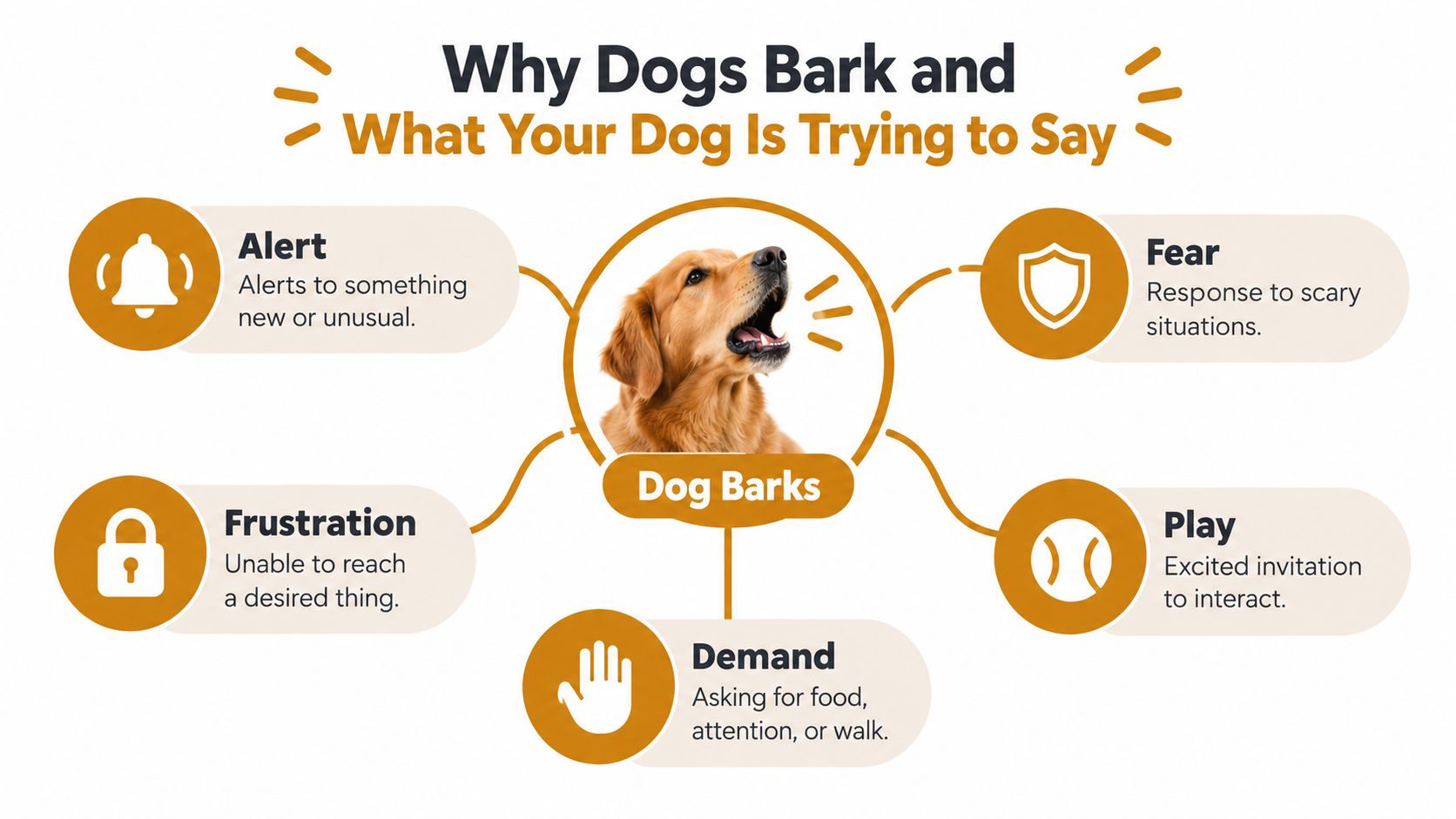
Common motives behind barking
Alert barking usually shows up when the dog detects a change and wants it addressed. You hear hallway steps. Your dog runs to the front window, gets tall, locks on, and sounds off. Many owners read that as defiance. In practice, it is often a dog doing distance-increasing work or announcing something important.
Fear-based barking has a different feel. The dog may bark and back up, stay low, stiffen, or rush in and out instead of holding ground. The message is not confidence. The message is discomfort.
Frustration barking is common in active, social dogs. They see another dog through the glass, hear leash sounds, or watch you handle food and cannot get what they want fast enough. Barking becomes the release valve.
Demand barking is learned very quickly in busy homes. If barking gets eye contact, talk, toy movement, faster feeding, or access to the yard, many dogs repeat it because it works.
Separation-related barking belongs in its own category because the plan changes if the dog vocalizes around your departure cues or after you leave. That pattern can point to distress, not a simple habit.
One label is rarely enough. A dog can alert first, then tip into frustration, then keep barking because the owner starts talking. That mixed picture is why suppression alone so often fails. If the trigger and emotional state stay the same, the barking tends to come back in the next real-life repetition.
Barking is information. The sound matters less than the job the dog is trying to do.
Read the whole dog, not just the noise
Start with body language and timing.
A dog who plants at the window, leans forward, and scans for motion is giving you a different picture from a dog who startles, barks, retreats, and cannot settle. A dog who barks the second you touch your keys may be reacting to departure cues. A dog who barks while you chop chicken and stops the moment you speak has likely practiced getting reinforcement from you.
Three questions help in the moment:
- What changed right before the barking started?
- What is the dog trying to gain, avoid, or push away?
- How long does it take the dog to recover once the trigger is gone?
Recovery time matters. A brief alert burst from a dog who settles within seconds calls for a different plan than barking that rolls into pacing, panting, and room-to-room scanning.
Breed can affect the baseline, though it does not excuse the pattern or fully explain it. A useful contrast is this Basenji breed profile, since Basenjis are known for unusual vocal style rather than classic repetitive barking. In training terms, breed gives you context. It does not give you the full diagnosis.
Durable bark control starts with diagnosis
Owners often ask for the best bark control device first. I start somewhere else. I want to know whether the dog is over threshold at the front window, worried about guests, frustrated by barriers, or distressed about being alone.
That matters because the trade-off is real. If you interrupt noise without changing the trigger picture, you may get a quieter dog in the moment and a more stressed dog underneath. In some dogs, that means more pacing, more vigilance, or a faster bark relapse when the same trigger shows up again.
The stronger plan is welfare-first management plus skill building. Lower the trigger load. Prevent rehearsals where you can. Then teach the dog what to do instead, in timing they can succeed with.
Quiet behavior that lasts is built on that foundation.
How to Identify Triggers and Patterns at Home
Most barking patterns become easier to decode once you stop thinking in labels and start tracking sequences. Not “my dog is stubborn.” More like: door closes, footsteps pass, dog runs to hall, barks, owner talks to dog, dog barks harder, footsteps fade, dog relaxes.
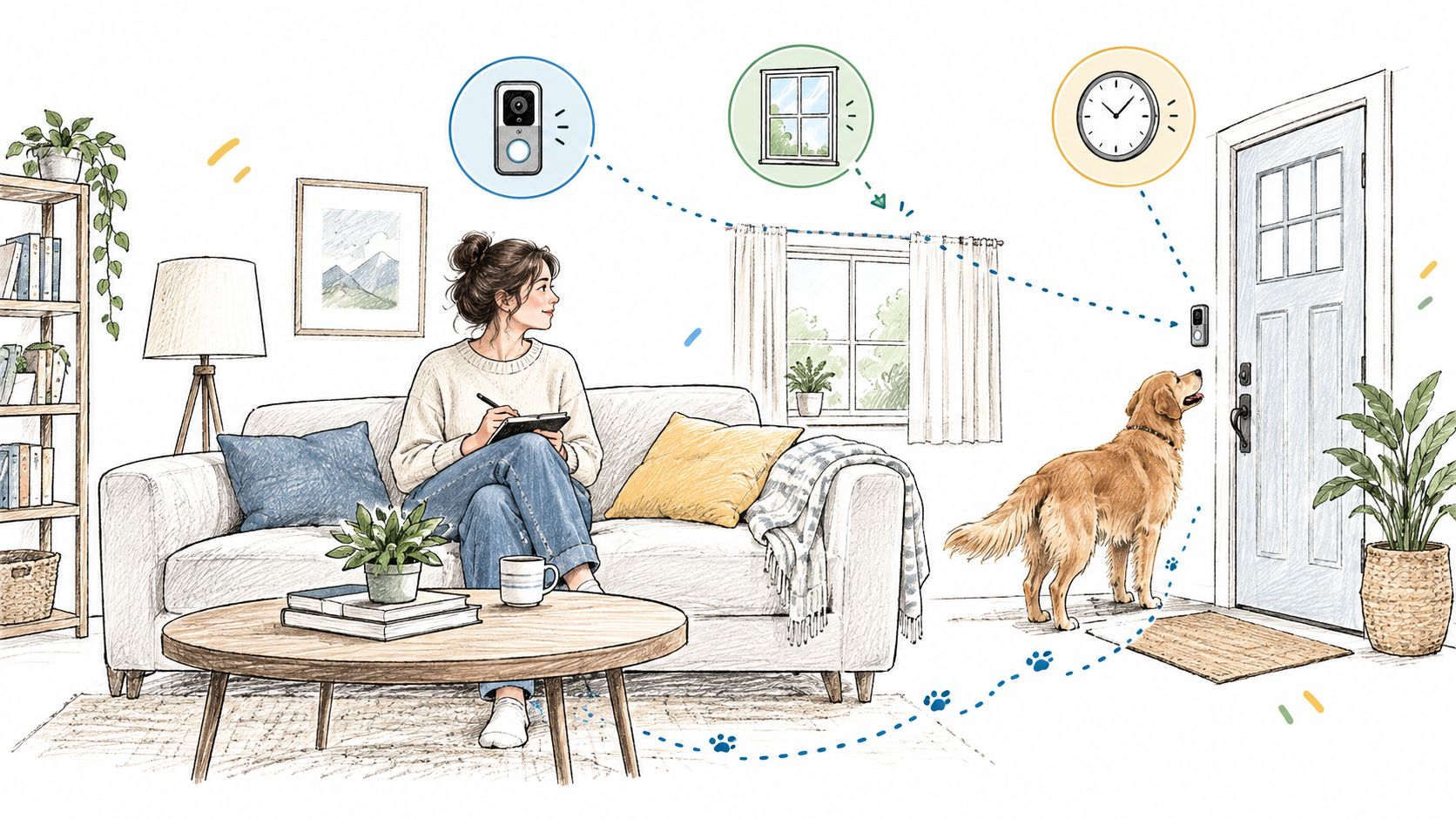
Build a weekend trigger profile
Over one weekend, track four home situations:
| Situation | What to note | What it often suggests |
|---|---|---|
| Door or hallway sounds | Distance from trigger, body posture, how long recovery takes | Alerting, fear, or anticipation |
| Window barking | Specific visual trigger, time of day, room used most | Territorial display, frustration, habit |
| Alone-time barking | Pre-departure cues, time barking begins, signs of panic | Separation-related distress |
| Attention barking | What the dog gets after barking | Learned demand behavior |
A pattern matters more than a single rough day. If barking appears only when delivery drivers stop outside one front room window, that's a setup problem as much as a training problem. If barking starts when you open a laptop for work, your dog may have learned that barking restarts interaction.
Look at what happens before and after
Two terms help here: antecedent and consequence.
The antecedent is what happens right before barking. A knock. A dog across the street. You standing up from the couch. The consequence is what happens right after. You talk, move, toss a toy, close the blinds, or open the door.
That consequence can accidentally pay the barking. For example:
- You call the dog over and the dog gets attention.
- You open the door and the visitor enters, which can intensify the whole routine.
- The trigger disappears and the dog may feel the barking “worked.”
Practical rule: If you can predict the bark one or two seconds before it starts, you're finally in a position to change it.
Separate over-arousal from fear
These can look similar in volume and speed, but they don't train the same way.
An over-aroused dog often looks revved up, pushy, fast, and spring-loaded. A fearful dog may bark with weight shifted back, hackles up, or repeated startle responses. In one home, window film and a settle station may reduce constant rehearsal. In another, the dog needs slower exposure and more distance from the trigger.
For some breeds, vocal behavior is part of the package. A Finnish Spitz breed page is a good reminder that breed tendencies can influence how often owners need to practice quiet behavior. That doesn't mean training won't work. It means your expectations should be realistic and your setup should be thoughtful.
Once you have a trigger profile, training gets clearer. You stop throwing generic “quiet” cues at every bark and start matching the plan to the cause.
Positive Reinforcement Foundations That Build Quiet Behavior
Quiet behavior doesn't become reliable because you said “quiet” louder than the dog barked. It becomes reliable because the dog learned exactly which behavior earned reinforcement, and the timing was clean.
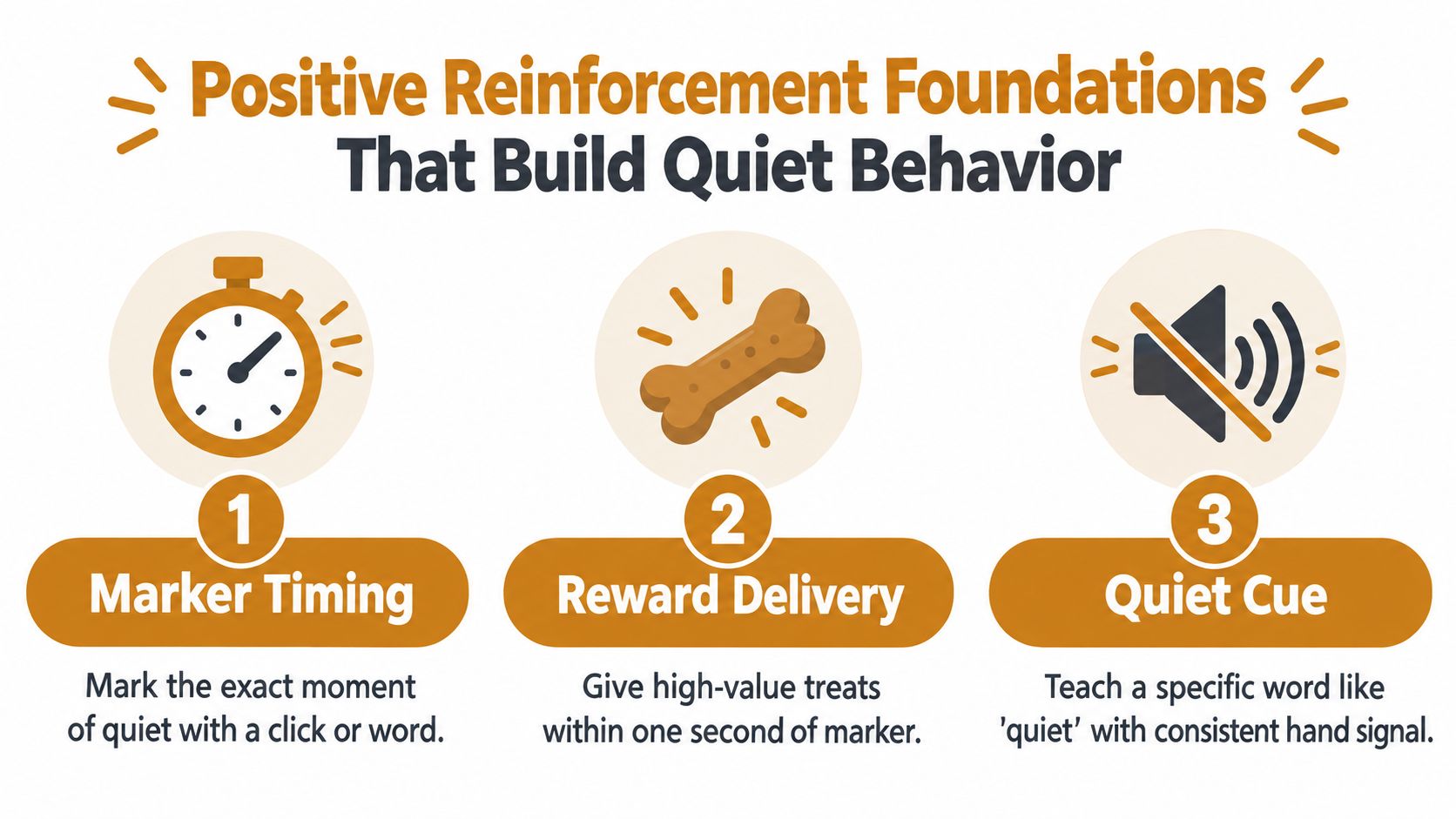
Mark the silence, not the chaos
The AKC's bark-control guidance is simple and useful here. If a bark collar or noise device stops barking, you click and reward the silence, then wait for slightly longer periods of quiet before clicking and rewarding again. The same guidance also notes that when teaching barking on cue, the trainer should mark the behavior as soon as the dog barks and immediately pair it with a cue like “speak” and a reward. The lesson is bigger than either cue. Timing drives learning.
If you mark late, you train the wrong thing. If your dog barks, pauses, spins, looks at you, and then you say “yes,” you may be reinforcing the spin or the stare instead of the quiet.
What good timing looks like in the house
Use a clicker or a short marker word such as “yes.” Then follow three rules:
- Mark the first beat of silence. Don't wait for a perfect ten-second pause at the start.
- Deliver the treat fast. Reward should arrive almost immediately after the marker.
- Place the treat where you want the dog to be. If the barking happens at the window, feed away from the window when possible.
That last part gets missed all the time. Treat placement changes movement. If you feed at the sill, you may keep your dog stationed at the trigger. If you feed on a bed a few feet back, you start building a new default location.
Capture calm before you ask for quiet
A lot of owners only train after barking starts. That's late. You'll make faster progress if you reinforce quiet moments that happen on their own.
Look for:
- Soft check-ins when your dog hears something and glances at you.
- Settling on a mat during ordinary household noise.
- Pausing at the window without escalating.
- Walking away from the trigger after one or two barks.
These moments are easy to miss because they're not dramatic. They're exactly what you want more of.
Reward the dog you want before the barking performance begins.
Teach a quiet cue after the behavior exists
Don't start with the cue. Start with the pause.
Once your dog is reliably giving brief quiet moments in easy setups, add the cue right before the pause is likely to happen. Say “quiet” once, mark the silence, and reward. After enough clean repetitions, the word starts to predict the behavior.
A few common mistakes slow this down:
- Repeating the cue five times in a row
- Using the cue while the dog is over threshold
- Holding food in view so the dog barks, stops, and immediately barks again for another round
- Accidentally rewarding barking chains, where the dog learns “bark, pause, snack, bark again”
Build duration in tiny pieces
Duration should rise gradually. Start with a half beat of silence if that's what your dog can do in the environment. Then ask for a little more before marking. The point isn't to force long silence early. The point is to make quiet profitable and understandable.
A living-room example looks like this:
- The dog hears a hallway sound.
- The dog gives two barks.
- The dog pauses to listen.
- You mark that pause.
- You feed on the mat by the sofa.
- The dog stays quiet for a little longer next repetition.
That's skill-building. Not suppression. The difference matters.
A Practical Desensitization and Counterconditioning Plan
Once the foundation is in place, you can train the trigger itself. Bark control for dogs starts looking less like “stop that” and more like “that sound predicts something safe, then I relax.”
Start with one trigger. Doorbell. Hallway footsteps. People passing the front window. Your departure routine. Don't train all of them at once.
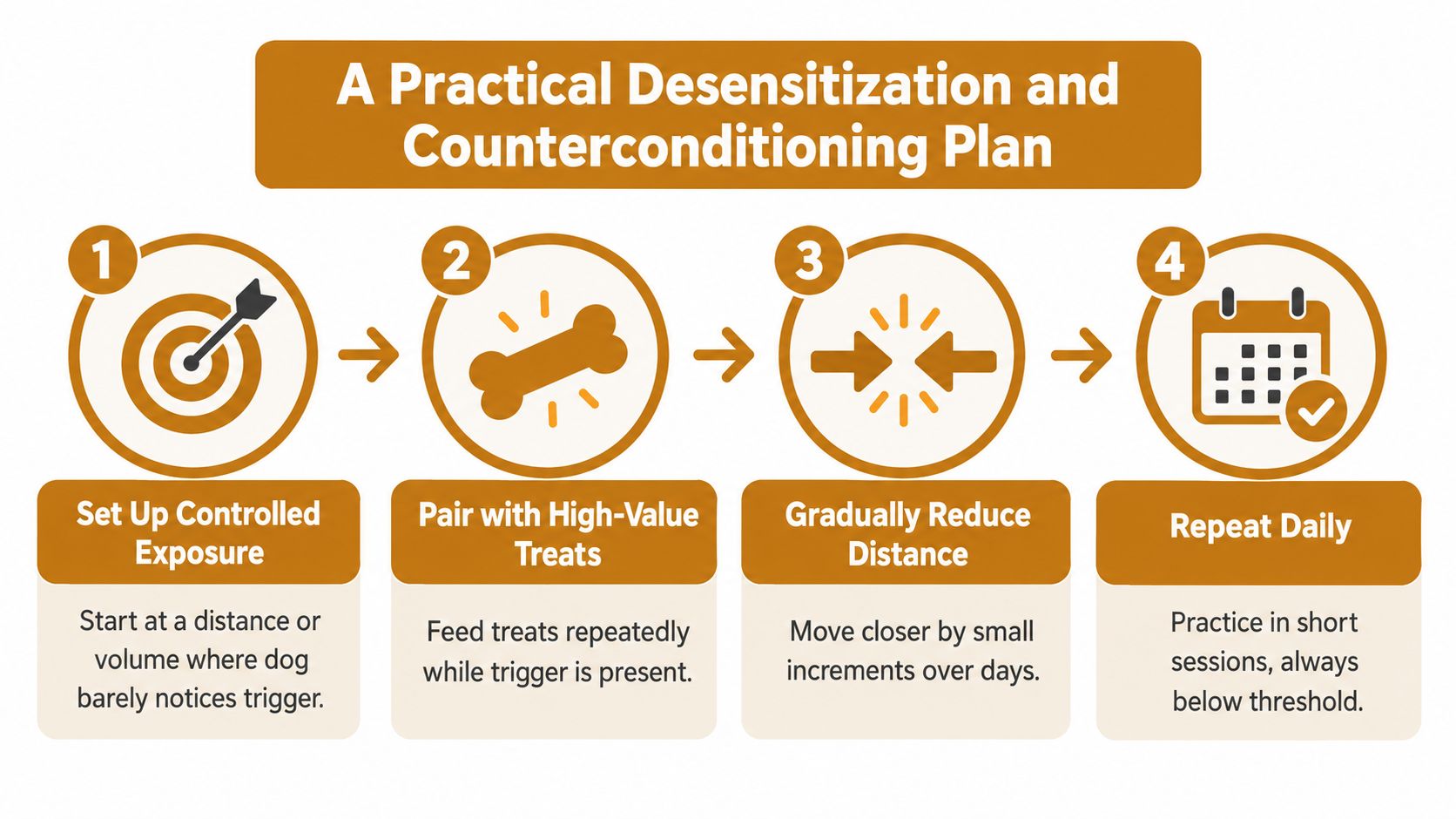
Begin with a controlled setup that keeps your dog under threshold, meaning the dog notices the trigger without tipping into frantic barking. For a visual trigger, that might mean standing farther from the window or working with blinds partly closed. For sound triggers, it might mean using a lower-volume recording.
A visual overview helps before you start daily practice.
Keep the trigger small enough for learning
The pattern is straightforward. Trigger appears at a manageable level. Good food starts. Trigger ends. Food ends.
That sequence matters. You're not bribing the dog to be quiet after panic starts. You're changing the dog's emotional prediction about the trigger.
Try sessions like these:
- Doorbell practice: low-volume bell sound, then rapid small treats while your dog stays oriented to you or a mat
- Window work: brief sight of a helper walking past at a distance, then food as long as the person is visible
- Departure cues: pick up keys, feed, put keys down, stop feeding
If barking erupts immediately, the setup is too hard. Lower the intensity and try again.
Use the ASPCA threshold rule for door and window barking
The ASPCA barking guide gives a clear rule for door- or window-triggered barking. Let the dog bark three to four times, then say “Quiet,” calmly go to the dog, gently hold the muzzle closed, release, step away, call the dog away from the trigger, and reward a sit and quiet behavior with treats. The same guidance offers an alternative if muzzle-holding is stressful: approach calmly, say “Quiet,” and feed a steady stream of tiny, pea-sized treats until the trigger is gone, then gradually extend the time between the cue and the reward.
In many homes, the food-stream version is the cleaner starting point because it keeps the dog engaged without adding handling stress. Timing still matters. The treats need to arrive while the trigger is present and stop when it's gone.
Structure daily practice so the dog can win
Use short sessions. End before your dog looks cooked.
A practical weekly rhythm often works better than marathon training:
| Day type | What to do |
|---|---|
| Practice day | Run a few controlled trigger reps in an easy setup |
| Real-life day | Focus on management and reward any spontaneous calm |
| Recovery day | Lower stimulation, more rest, sniffing, and easy reinforcement |
This keeps learning from turning into constant exposure. Dogs need recovery time, especially when barking is tied to fear or frustration.
Later in the section, watch a visual demo and compare the pace to your own dog's threshold. Fast isn't always better.
Fade food without losing the behavior
Food is the teaching tool at first. It doesn't need to stay constant forever.
Once your dog is staying calmer around the trigger, begin to vary reinforcement:
- reward every quiet response at first
- then reward slightly longer quiet stretches
- then mix food with praise, movement to a bed, or a tossed treat to reset position
Don't fade too early. If the barking spikes back up, go back to denser reinforcement for a while.
One reason this matters is that kennel and housing research points in the same direction. A pilot study on kenneled dogs and a counterconditioning “Quiet Kennel Exercise” approach found improvements in loudness and reduced the number of dogs barking over time, which supports the idea that changing emotional state can matter as much as suppressing sound.
For owners of active sporting breeds, management around exits and windows can matter a lot because arousal rises fast. An American Water Spaniel breed profile is a useful reminder that training plans work best when they respect the dog in front of you, not an imaginary neutral dog who doesn't exist in your house.
Management Tools and Devices Compared Without the Hype
Your dog is at the front window at 5:30 p.m., barking at every person, car door, and delivery truck. If that happens for an hour every night, no collar is going to fix the whole problem. The dog is practicing the behavior, staying keyed up, and getting better at repeating it.
Management matters because it changes how many barking repetitions your dog gets while training catches up. That is the welfare-first part of bark control for dogs. Lower the trigger load first, then decide whether any device belongs in the plan.
What helps before you touch a device
Start with setup, not gear. In many homes, simple changes remove half the battle.
- Window barriers: frost film, curtains, furniture placement, or gated access to the busiest room
- Sound buffering: white noise, fans, or moving the rest area away from the front door and shared walls
- Confinement setup: a crate or pen only if your dog already relaxes there
- Enrichment: stuffed food toys, chew items, sniffing games, and licking options during known trigger times
- Traffic control: keeping your dog away from the entry during school pickup, package delivery, or other predictable noise spikes
These tools do not teach calm by themselves. They buy you cleaner reps. They also protect dogs who are barking from fear, frustration, or chronic over-arousal from spending all day in that state.
The same principle shows up in veterinary behavior guidance. The Merck Veterinary Manual overview of problem barking in dogs recommends identifying the cause, changing the environment, and using behavior modification rather than relying on punishment alone.
What device studies actually support
Owners usually ask about collars because they want fast relief. Fast relief can matter, especially in apartments or tight neighborhoods. The trade-off is that interruption is not the same as treatment.
A Scottish government evidence review summarizing older collar studies reported that citronella collars reduced barking in more dogs than shock collars in one small comparison, while also cautioning that the underlying studies were limited and should be read carefully. See the Scottish government review of electronic collar evidence.
A veterinary hospital study also found that both citronella and scentless spray collars reduced barking more than control collars. You can review the PubMed summary of the spray collar study. That supports one narrow point. Some collars can interrupt barking in some dogs.
The limit is just as important. A 2001 study on citronella collars found reduced barking during use, with different results depending on how the collar was applied. The ScienceDirect abstract for that study is often cited for short-term effect, not for durable behavior change after the device is gone.
A collar can suppress noise. It does not tell you whether the dog is alarmed, lonely, blocked from access, underexercised, or reacting to pain.
Bark control options at a glance
| Approach | Best Use Case | Evidence Signal | Key Limitation |
|---|---|---|---|
| Window film and visual blocking | Barking at passersby, dogs, cars | Strong practical value in home setups | Does not teach calm by itself |
| White noise and room placement | Hallway sounds, apartment noise | Useful for reducing trigger load | Limited if the main trigger is visual |
| Mat training and a reward-based quiet cue | Door, window, and household alert barking | Strong learning value when timing is good | Takes repetition and setup |
| Desensitization and counterconditioning | Fear, frustration, trigger-specific barking | Best fit for durable behavior change | Easy to rush |
| Spray collars | Immediate interruption in some dogs | Short-term reduction shown in studies | Effects may fade, cause remains |
| Shock collars and other aversives | Suppression attempts | Mixed results and welfare concerns | Stress risk, poor long-term learning |
Breed size and home layout can change what management is realistic. A dog in a studio apartment with a busy hallway needs a different setup than a dog in a fenced suburban home. If you want a quick sense of common patterns by size, this small dog breed collection can help you compare likely alert barking tendencies and handling needs.
Use devices, if you use them at all, as a narrow tool inside a bigger plan. If the dog still spends most of the day over threshold, suppression alone usually fails.
When to Get Help and How to Keep Progress on Track
Some barking problems are very trainable at home. Others need veterinary or behavior support early, and waiting usually makes them harder.
Get help sooner if the barking comes with panic when left alone, sudden behavior change, self-injury, escalating fear around people or noises, compulsive repetition, or signs that your dog isn't recovering well after triggers. The AVMA review discussed earlier is clear that excessive barking can be tied to separation anxiety, fear, compulsive behavior, or cognitive decline. Those cases deserve more than generic bark control for dogs.
What professional help should look like
A good plan should include cause-based assessment, not just a command list. Expect questions about:
- Trigger pattern and daily schedule
- Body language during barking
- Medical history and any sudden change
- Recovery time after each event
- Home management already in place
For some dogs, a veterinarian may discuss medication as part of treatment when anxiety, fear, or compulsive behavior is driving the barking. That isn't a shortcut. It can be one piece of a full plan when the dog's emotional state is blocking learning.
Track progress with simple measures
You don't need elaborate charts. Use a few practical metrics:
| What to track | Why it matters |
|---|---|
| Barks per trigger event | Shows whether intensity is dropping |
| Time to recover | Tells you whether arousal is resolving faster |
| Distance from trigger | Helps you see threshold changes |
| Number of successful quiet reps | Keeps training honest |
Progress often looks uneven. One quiet week doesn't mean you're done. One noisy day doesn't mean training failed.
Consistency matters more than dramatic sessions. Quiet behavior gets durable when the whole household responds the same way.
Keep the improvement from sliding backward
Maintenance is simple but not accidental. Continue to rehearse calm responses after the major problem improves. Reward occasional check-ins, keep management ready for high-trigger days, and don't drop structure the minute things feel better.
If your household needs a practical reference point for planning life with your dog over time, the PetCostEngine about page explains the kind of breed and care data owners often use when they're making broader decisions about training, health, and daily management.
Lasting quiet rarely comes from one dramatic tool. It comes from cleaner setups, better timing, and a dog who no longer feels the need to sound the alarm every few minutes.
Pet owners who want more than generic advice can use PetCostEngine to explore breed-specific guidance, planning tools, and practical resources that support day-to-day care decisions. If your dog's barking is part of a bigger picture that includes breed tendencies, training needs, and long-term care planning, it's a useful place to keep researching.
Estimated lifetime and yearly costs for a Basenji, state by state, plus whether pet insurance breaks even for the breed.
See Basenji costs →
Is insurance worth it for a Basenji? →
Joint supplement → Puzzle toys → No-pull harness →
As an Amazon Associate, PetCostEngine earns from qualifying purchases.