
A dog may walk into the veterinary clinic willingly, then brace on the exam table, pull a paw away, or freeze when someone reaches for an ear. At home, the same dog might tolerate brushing until the clippers appear. These moments can leave a first-time owner unsure whether to soothe, hold still, or stop.
Cooperative care training for dogs gives the dog a structured way to participate in grooming and veterinary handling. The dog learns a predictable behavior, such as resting their chin on a target or placing a paw on a towel, and the handler practices small steps while watching for signs that the dog is ready to continue. The aim isn't to make every procedure stress-free or to avoid all restraint. It's to build skills that make routine care more understandable and manageable, while recognizing when a dog needs a pause or professional support.
Table of Contents
- What Cooperative Care Actually Means for Your Dog
- The Four Mechanics Behind Every Cooperative Care Plan
- What the Research on Canine Fear Shows
- A Sample Nail Trim Protocol You Can Start This Week
- Adapting the Same Principles to Exams, Ears, and Grooming
- Reading Consent When the Dog Cannot Say Yes
- Generalizing Training Beyond the Living Room
- Putting It All Together and Knowing When to Ask for Help
What Cooperative Care Actually Means for Your Dog
Cooperative care is a training approach, not a gentle attitude or a handful of treats. A dog learns specific behaviors that make handling more predictable, such as offering a paw, standing on a mat, or resting their chin on a hand. The handler uses those behaviors to guide care in small steps, and the dog can signal when they need a break.
That matters for ordinary tasks, not just for dogs with a known history of fear. Nail trims, ear checks, injections, brushing, and physical exams all involve touch, equipment, and unfamiliar movements. A dog who has practiced those sensations gradually may find them less surprising, though practice doesn't guarantee comfort in every situation.
The distinction is participation. If a dog holds still only because someone is physically preventing them from moving, that stillness alone doesn't show that they're comfortable or choosing to continue. In cooperative care, the handler looks for a trained start behavior and respects an observable pause or opt-out where circumstances allow.
A simple example: teach the dog to rest their chin on a folded towel. Touch the shoulder briefly, then stop and reward. If the dog lifts their head, the handling pauses; if they return to the chin rest, the handler can offer another small step. The position creates a shared routine, but it isn't permission to continue regardless of what the dog's body language says.
This approach is useful for everyday care, but it has limits. Urgent treatment may require a veterinarian to prioritize safety and medical need. Training can prepare a dog for many procedures, while severe fear or a painful condition calls for veterinary guidance rather than a do-it-yourself plan.
The Four Mechanics Behind Every Cooperative Care Plan
Four ideas help separate genuine participation from keeping a dog occupied: desensitization, counterconditioning, stationing, and a consent signal. Together, they make handling more predictable and give the dog a way to show when they're ready.
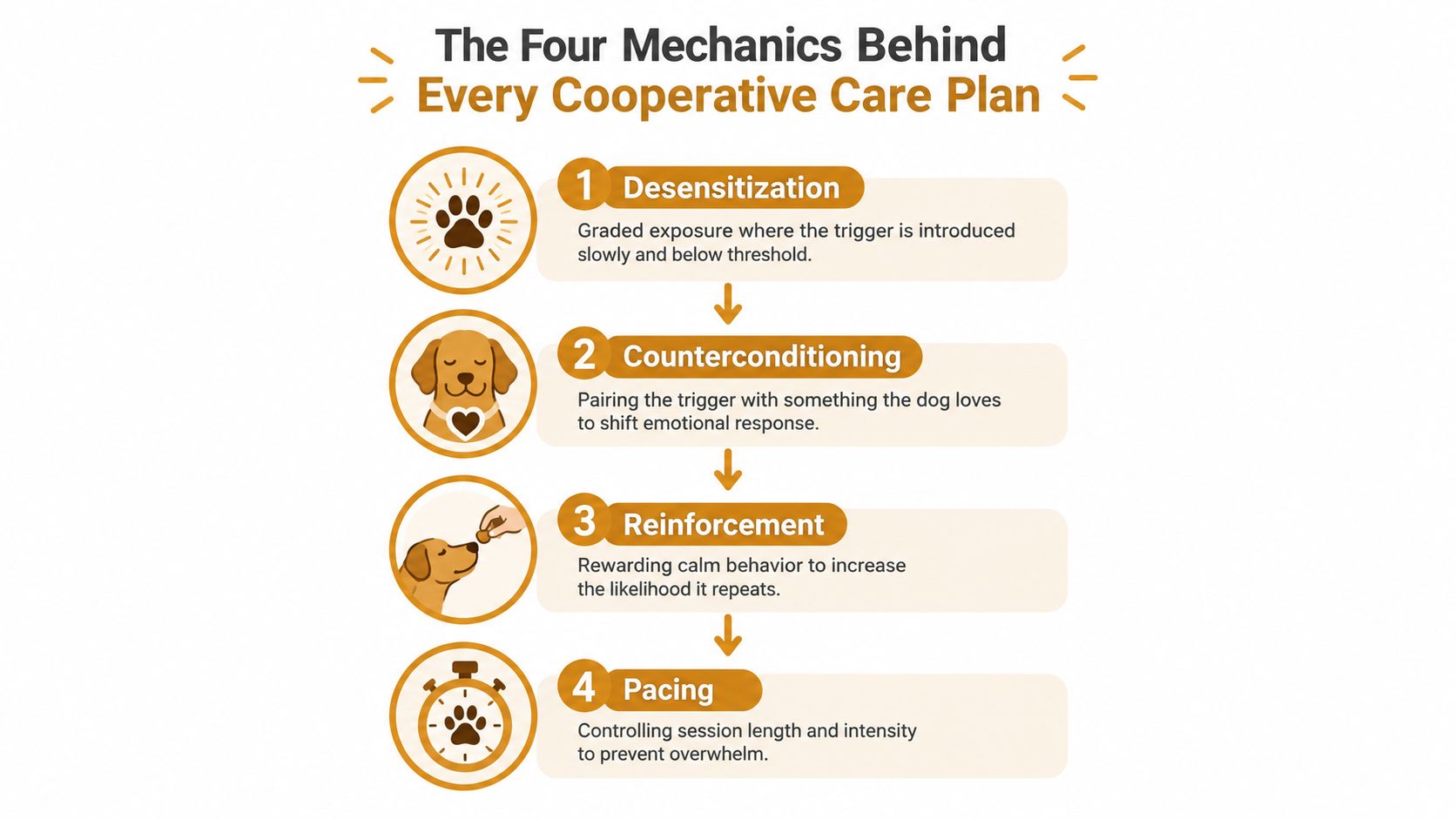
Desensitization means introducing a trigger at a low enough intensity that the dog can remain comfortable, then gradually making it more like the actual procedure. For paw handling, that might mean briefly touching the shoulder before moving toward the foot over later sessions. If the dog stiffens or pulls away, the step may be too difficult.
Counterconditioning pairs the trigger with something the dog values, such as food. The handler might touch the paw, then offer a treat, so the sensation predicts something pleasant. Food isn't a bribe to push through distress. If the dog won't eat or shows escalating stress, reduce the intensity or stop.
Stationing gives the dog a repeatable place or posture, such as a mat, chin rest, platform, or paw target. A station helps everyone know what the dog is being asked to do. The dog can learn to return to it after a pause, rather than being repositioned by force.
A consent signal is a trained behavior that starts or supports the procedure, with a clear way to pause. A chin rest can act as a start signal if the handler stops when the dog lifts their head. The signal only means something if the handler responds consistently.
Practical rule: A treat can reinforce a behavior, but it can't turn restraint into voluntary participation.
In a short session, the dog might rest their chin on a mat, receive food for maintaining a relaxed posture, and lift their head to pause. The handler then waits for the dog to re-engage before offering another small touch. Pacing matters too: keep sessions brief, and end while the dog can still participate comfortably.
What the Research on Canine Fear Shows
Fear during veterinary handling shows up across the general dog population, not only in unusually anxious animals. In a 2019 PLOS ONE survey of guardian-reported behavior in 26,555 dogs, 41.02% showed mild-to-moderate fear during veterinary examinations and 14.23% showed severe or extreme fear, for 55.25% showing fear at some level. The same survey recorded 46.68% with mild-to-moderate fear in unfamiliar situations and 11.02% with severe or extreme fear.
Clinical observations point the same direction. A JAVMA review of veterinary handling research summarized a German practice study in which fewer than half of 135 dogs entered calmly, 18 dogs (13.3%) had to be dragged or carried inside, and 106 dogs (78.5%) were fearful on the exam table. In a separate assessment of 906 dogs covered by the same review, 221 (24.4%) showed fear during every phase of the visit, while 341 (37.6%) showed excitement and 33 (3.6%) showed aggression.
Figures like these give owners a concrete reason to teach handling skills before an urgent visit forces the issue.
What they cannot show is whether a given program removes fear for every dog, or whether what looks like participation is really tolerance with treats nearby. A controlled pilot study of cooperative-care training in 40 dogs assigned 22 dogs to training and 18 to a control group, and the gains made at home didn't clearly carry over to the later veterinary examination. Because the training bundled positive reinforcement with exam-like handling, the study can't isolate what a consent signal contributes on its own.
That gap between the label and the mechanics is where well-meaning programs fail.
Fear-prevention training is a foundation, not a guarantee. Practice has to match the dog, the procedure, and the setting.
A Sample Nail Trim Protocol You Can Start This Week
Start with the tool, not the trim. The American Kennel Club's nail-trimming guidance recommends letting a dog sniff the clipper or grinder, introducing contact with the paws, and familiarizing the dog with the sound or vibration before cutting. The point is to build comfort with each piece of the procedure rather than turning one session into a test of endurance.
Move through small steps
Let the dog investigate. Set the clipper nearby and allow a sniff. Reward calm interest, then put the tool away.
Introduce light contact. Touch the clipper briefly to a paw, then to a toe. Pair each easy touch with food. If the dog pulls away, return to an easier step.
Practice the sound or vibration. For clippers, make the sound away from the dog before bringing the tool closer. For a grinder, introduce its sound and vibration at a distance without touching the nail.
Try one tiny trim. Only when the earlier steps look comfortable, remove the smallest tip from one nail. Keep treats available during the handling, not just afterward.
A lickable food toy can be mounted to a chair, gate, or wall to give the dog a place to engage while a paw is handled. It shouldn't be used to hold a worried dog in position. If the dog stops licking, freezes, or tries to move away, pause and make the next session easier.
Treat each paw and toe as its own training task. A dog may accept handling on one foot and resist another, so don't assume that comfort transfers automatically across the whole body. The AKC also recommends practicing when a trim isn't needed, and stopping at the planned step even if the dog seems ready for more. That planned ending helps keep the session predictable rather than making every practice lead to a full trim.
Adapting the Same Principles to Exams, Ears, and Grooming
A familiar behavior can support different kinds of care, but the steps need to match the procedure. Start with an easy version, reward participation, and pause if the dog stops responding comfortably.
Prepare for a veterinary exam
Teach a chin rest on a mat or low platform before adding touch. Once the dog can settle there comfortably, briefly touch a non-sensitive area, such as the shoulder, then pause. Later, build toward gentle handling of paws, ears, or the body in short, separate steps. The procedure should stop if the dog lifts their head or moves away.
Practice ear and eye care
Begin with the dog standing or resting in a familiar spot. Briefly touch the ear flap, reward, and stop. Build toward lifting the flap, bringing the medication container into view, and rehearsing the movement without applying anything. For eye care, practice a gentle approach near the face before introducing the medication itself. If a veterinarian has prescribed treatment, ask them how to adapt the plan when the dog is uncomfortable or the care is time-sensitive.
Make grooming smaller
Place a mat down and reward the dog for standing or lying on it. Brush one small area, then pause and offer a chance to move away. Add another area only when the dog stays relaxed. A breed's grooming needs may shape what you practice; for example, owners can review American Water Spaniel care information while planning regular brushing and handling practice.
Whale eye, lip licking, freezing, and a sudden stop in eating are reasons to pause, not signals to carry on more efficiently. If the dog has pain or the treatment can't safely wait, contact the veterinary team for a handling plan rather than forcing a home session.
Reading Consent When the Dog Cannot Say Yes
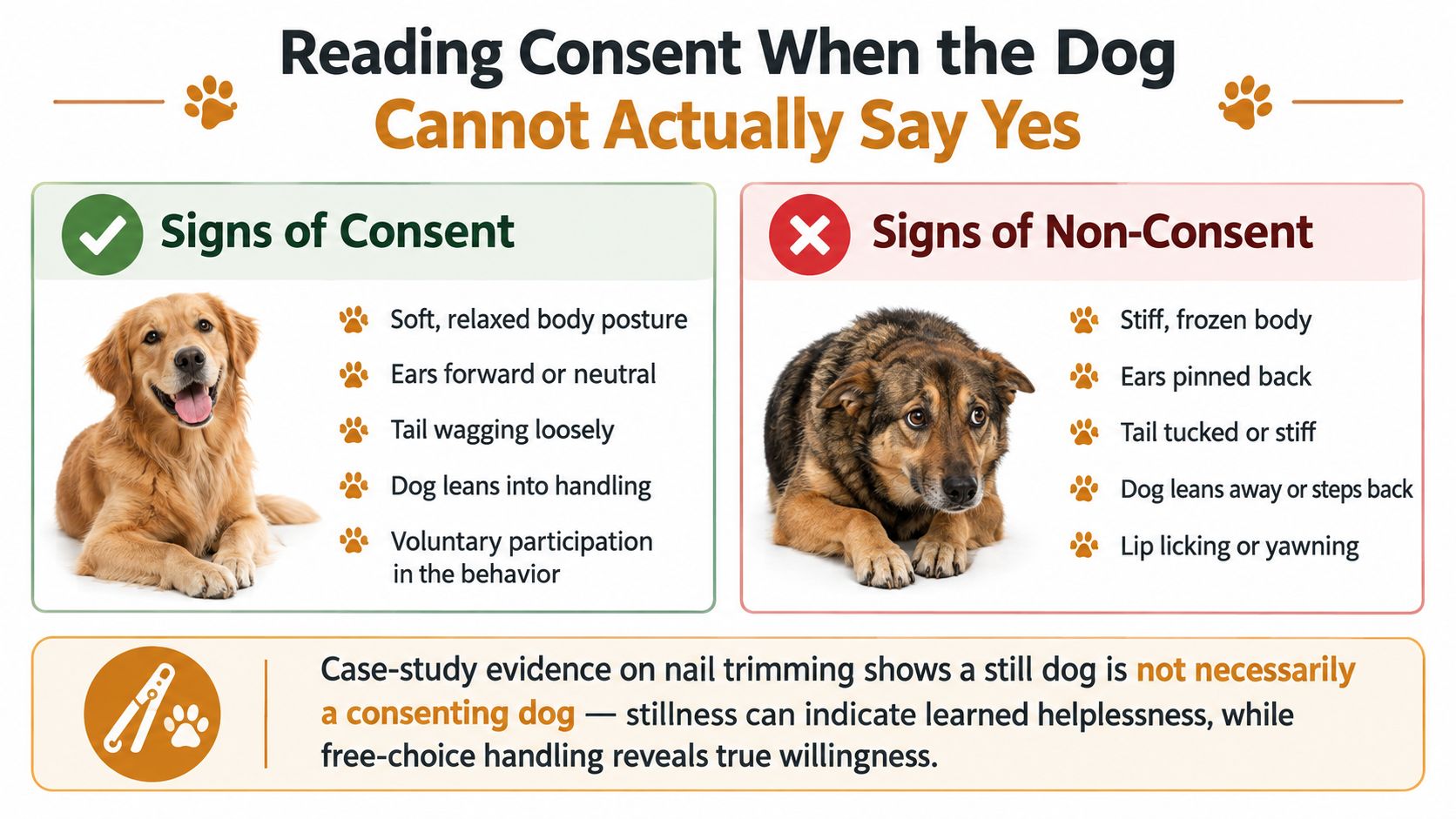
A dog who stays still may be comfortable, or too worried to move. Stillness isn't proof of comfort. In nail-clipping observations, restrained dogs showed more stress signals than dogs given choice and control. Separate free-choice handling research found that dogs could stay within reach while showing more avoidance-related behavior. Proximity alone does not establish willingness. These findings are summarized in cooperative-care research background.
Read the whole dog, not just whether they remain in place. Signs to pause include:
- Eye and face changes: whale eye, repeated lip licking, or turning the head away.
- Body tension: freezing, stiffness, or leaning away from the handler.
- Attempts to create distance: stepping back or leaving the station.
- A sudden behavior change: stopping food or no longer responding to a familiar cue.
One signal may have several explanations. Notice whether signs appear together or grow more pronounced as handling continues. A trained opt-out might be stepping off a mat or lifting the chin from a target. If the dog opts out, stop and allow them to reset. Then offer the familiar cue again, without repeatedly luring them back into a step they avoided.
A dog may remain reachable while feeling stressed. Medical urgency can also mean a veterinarian needs to proceed even when voluntary participation isn't possible. In that situation, prioritize safety and ask the veterinary team how to provide care with the least stress. For routine training, continuing through an opt-out can weaken the positive associations you're building.
The following video offers another perspective on handling and reading a dog's signals.
Generalizing Training Beyond the Living Room
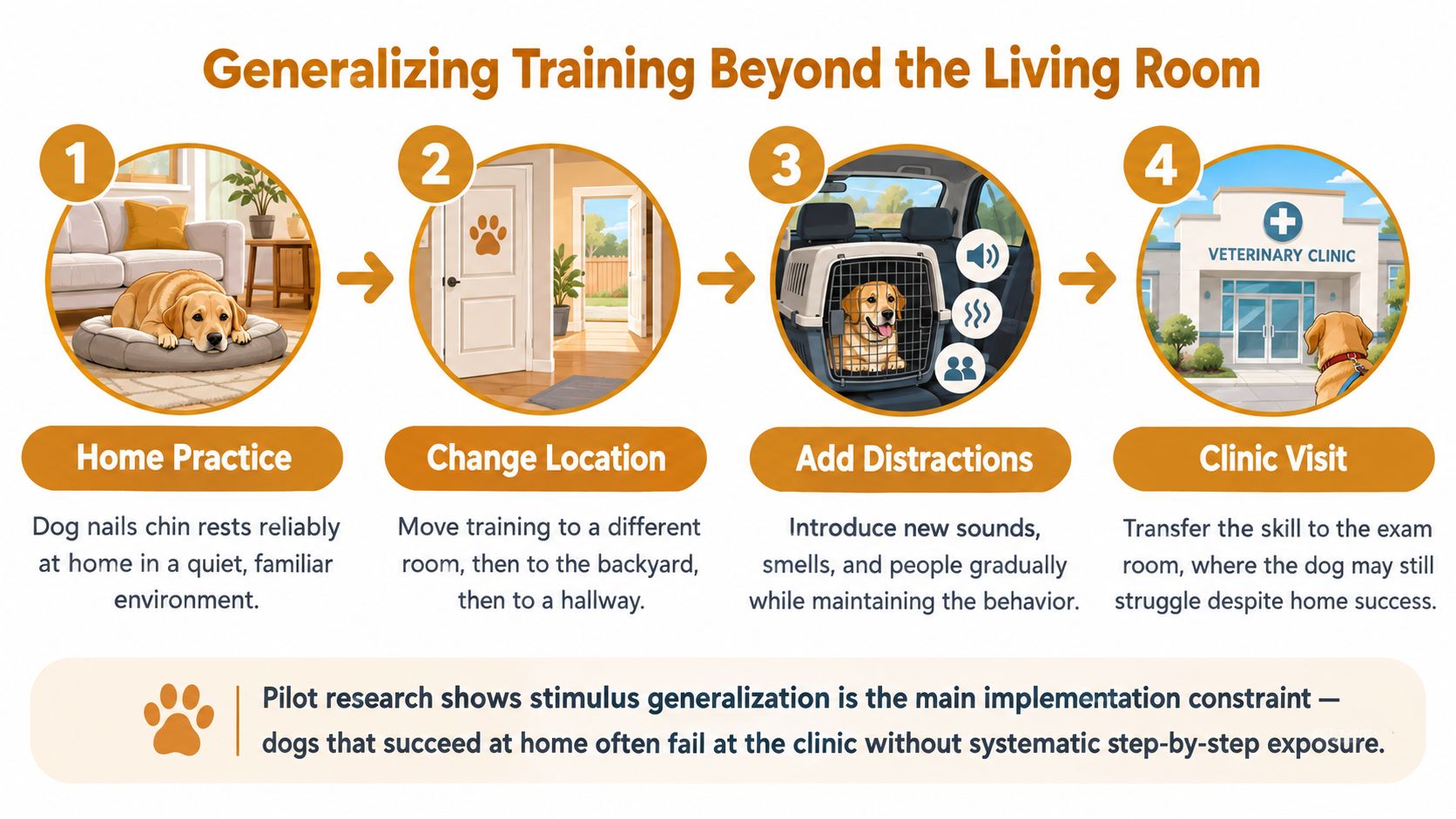
A chin rest that works at home may feel unfamiliar at the veterinary clinic. The smells, surfaces, handler, and order of exam steps can all change. The pilot study described earlier is a reminder that home practice alone does not establish clinic readiness.
Change one feature at a time
Start in a place where your dog already succeeds. Move the mat to another room and practice the same behavior. Once that feels familiar, change one feature, such as the surface or the presence of another person. This gradual approach helps you identify which change affects your dog's comfort.
You can vary:
- Location: another room, a hallway, or a quiet clinic space.
- Handler: a familiar family member, then a veterinary professional if appropriate.
- Surface: the usual mat, then a different stable surface.
- Equipment: introduce exam tools gradually, before using them.
- Sequence: practice touch, pause, and repositioning in the order your dog may experience them.
A familiar cue is a bit like a word spoken in a new room: your dog may need time to recognize it there. Keep sessions short, and repeat each version before adding another change. If your dog has difficulty, return to the last setup that felt comfortable. The goal is recognition across settings, not rapid exposure to every possible variation.
Putting It All Together and Knowing When to Ask for Help
A workable plan can start with one body area and one behavior. Choose a station, identify the smallest handling step your dog can manage calmly, pair that step with something they value, and stop before the dog is overwhelmed. Make the next step more difficult only when the dog remains relaxed and voluntarily maintains the behavior.
Practice the same skill in other settings gradually. Keep watching for opt-out signals, and treat a dog's return to the station as an opportunity to continue only if their body language also looks comfortable. If they freeze, avoid contact, or stop eating, reduce the difficulty or end the session.
Ask your veterinarian for guidance when a procedure is painful, medically urgent, or difficult to adapt at home. A qualified behavior professional or veterinary behaviorist can help when fear is severe, the dog growls or snaps during handling, or steady practice isn't leading to progress. Don't wait for a planned training routine to resolve a problem that could put the dog or handler at risk.
Cooperative care won't remove every difficult moment, but it gives owners a practical way to prepare dogs for routine handling while paying attention to their responses. Choose one everyday task, such as touching a paw or presenting a brush, and practice a small, comfortable step before the next full care session.
PetCostEngine offers breed- and state-based tools for exploring dog ownership projections and comparing insurance options, alongside reference guides for dog owners. Visit PetCostEngine to explore its tools as you plan for your dog's ongoing care.
Estimated lifetime and yearly costs for a American Water Spaniel, state by state, plus whether pet insurance breaks even for the breed.
See American Water Spaniel costs →
Is insurance worth it for a American Water Spaniel? →
No-pull harness → Puzzle toys → Durable chews →
As an Amazon Associate, PetCostEngine earns from qualifying purchases.