
You're halfway through a Saturday morning walk when you notice the change. Your older dog is still eager to come along, but the pace has slowed, the pavement looks tiring, and the trip home may be harder than the trip out. A stroller can keep that outing possible, but only if it solves a real problem for the dog.
A dog in stroller setup is mobility equipment, not automatically a comfort product or a substitute for exercise. The right decision depends on heat tolerance, joint health, recovery restrictions, anxiety, terrain, and the dog's ability to remain calm and secure.
Table of Contents
- Why a Dog in a Stroller Is More Common Than You Think
- The Two Real Reasons Owners Reach for a Stroller
- Core Safety Rules Every Dog Stroller Setup Needs
- Heat, Ventilation, and Hidden Summer Risks
- Which Dogs Actually Benefit From Riding in a Stroller
- Training Your Dog to Accept the Stroller Calmly
- Where a Dog in a Stroller Is Welcome and Where It Is Not
- Cleaning, Maintenance, and the One Rule to Remember
Why a Dog in a Stroller Is More Common Than You Think
On a busy city sidewalk, one person may push a senior dog while another walker wonders whether the setup is sensible. The answer rests on the dog's condition, not on how unusual the stroller looks. A dog with painful joints may enjoy a short walk followed by a ride, while a healthy young dog may need conditioning, rest, or a shorter route instead.
Pet strollers have become more visible in urban pet care because they solve practical access problems. One market estimate puts the global category in the hundreds of millions of dollars today, with steady growth projected through 2034. It identifies dogs as the largest demand segment, accounting for 64.2% in that estimate market research on the pet stroller category. The figures describe commercial demand, not proof that every dog needs a ride.
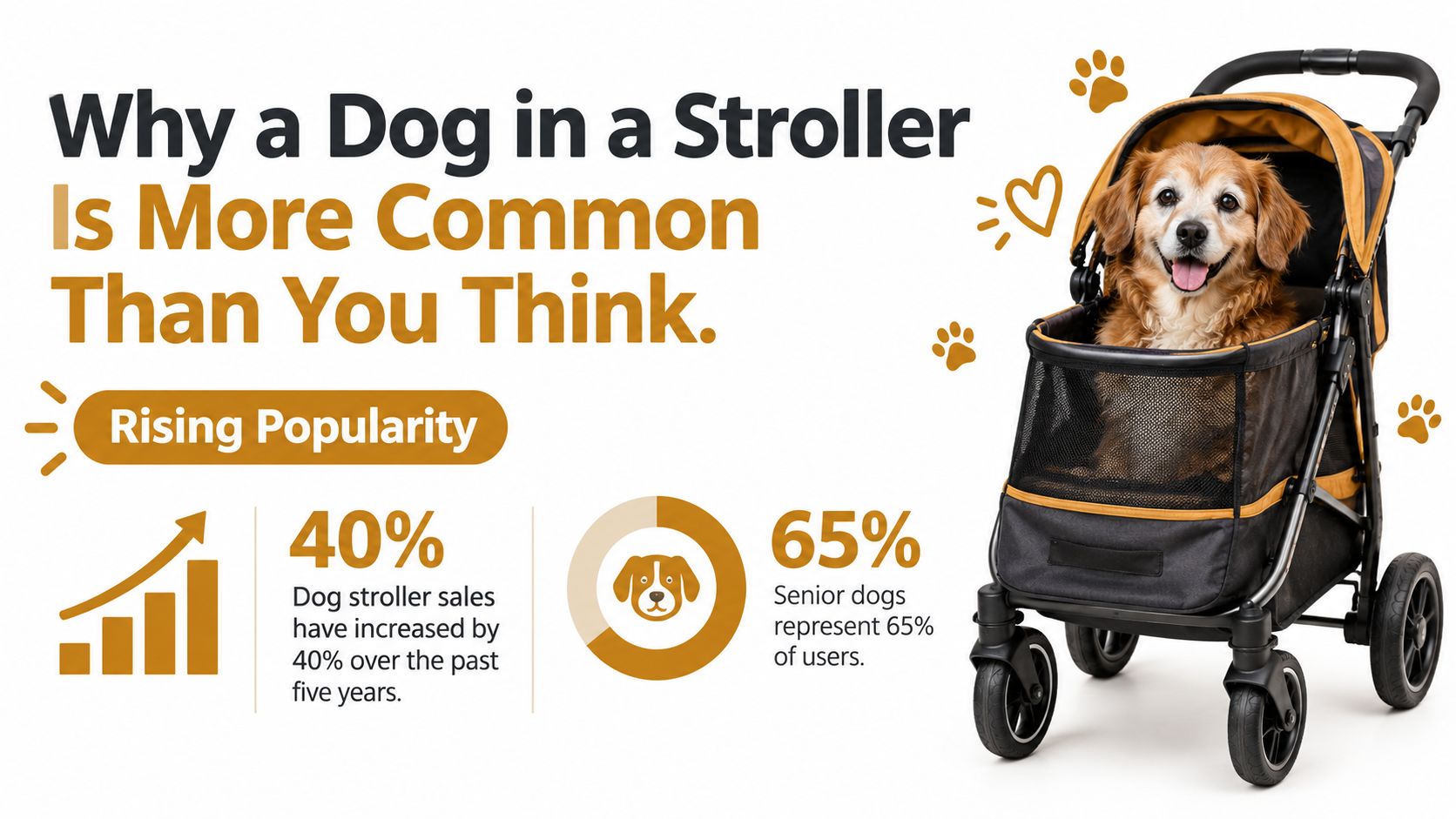
The more useful pattern is how owners apply the equipment. A stroller can preserve outdoor time for a dog whose endurance has declined, provide a controlled place during a recovery period, or reduce exposure to a chaotic crowd. It should function like a temporary mobility aid, not a replacement for every walk or chance to explore on foot.
Small details can change the decision. A short-nosed dog may struggle with heat or restricted airflow, and a dog with joint pain may need alternating periods of walking and rest. Review the Pug breed health profile before placing a brachycephalic dog in an enclosed cabin, especially during warm weather.
The practical test is simple: does the stroller give this dog safer, more comfortable access to the outing? If it adds heat, fear, restraint, or unnecessary inactivity, a different plan may serve the dog better.
The Two Real Reasons Owners Reach for a Stroller
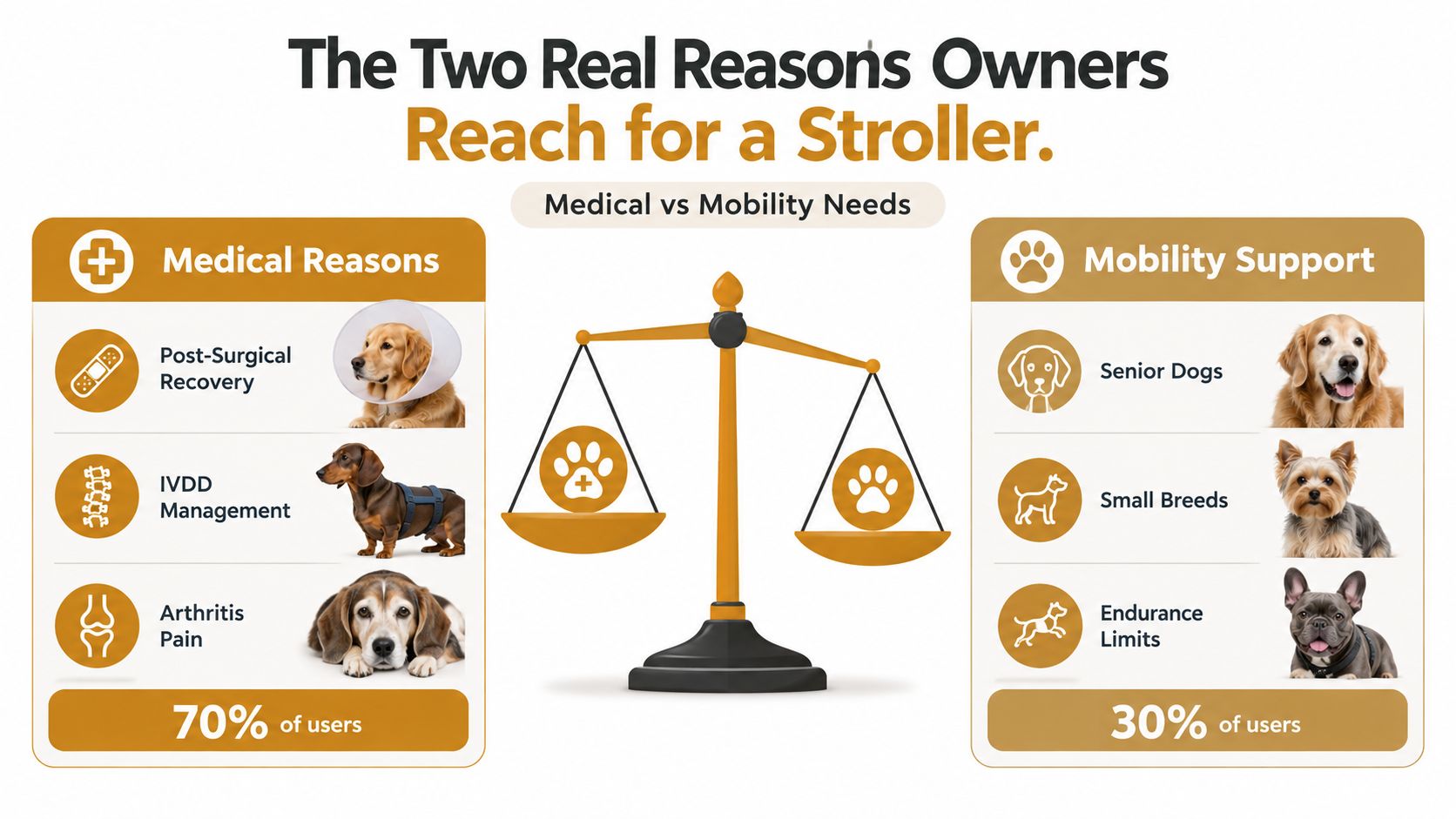
Most stroller use falls into one of two groups. The first is medical or mobility support. The second is lifestyle convenience. They can overlap, but separating them helps you choose sensible limits.
Medical use includes a dog recovering after surgery, living with arthritis, managing a history of IVDD, adapting to degenerative myelopathy, using a brace, recovering from an amputation, or coping with a short-term injury that restricts weight-bearing. An older dog may still want to sniff, watch people, and spend time outside even when a full walk causes pain or fatigue.
A stroller can also support a veterinarian's rehabilitation plan, but it shouldn't replace that plan. If your dog has a new limp, sudden weakness, worsening pain, or a neurological change, get veterinary guidance before deciding that a stroller is the answer.
Lifestyle use deserves an honest assessment rather than ridicule. Crowded sidewalks can overwhelm a nervous dog. Small breeds may tire during a long outing. An owner may be managing multiple dogs, traveling, or trying to keep a puppy away from contaminated ground while still providing controlled outdoor exposure.
Practical distinction: A medical stroller helps preserve access when walking is limited. A convenience stroller helps manage an outing that the dog could potentially handle another way.
A separate industry report describes the category's growth in Europe since 2016 and says search volume for several stroller-related terms became three times higher than it was seven years earlier. In that report, 58% of surveyed buyers cited mobility issues, while 25% used a stroller for recreational purposes only Global Pet Industry's report on dog strollers. Those figures describe different survey and market contexts, so they shouldn't be treated as a universal owner split.
Whether the reason is medical or practical, the safety standards stay the same. The dog must fit comfortably, remain restrained with the right attachment, tolerate the movement, and avoid overheating. The gear is the easy part. Judgment determines whether the outing helps.
Core Safety Rules Every Dog Stroller Setup Needs
A stroller cabin should be treated like a small animal enclosure. The AVMA recommends properly sized, species-appropriate containment for vehicle travel, with enough room for a pet to stand, turn around, and lie down, while avoiding so much unused space that the animal could be thrown around during a sudden stop AVMA guidance on safer pet travel. The same sizing logic is useful for a stroller, even though a sidewalk outing isn't a car ride.
The cabin shouldn't force your dog to crouch, press against mesh, or remain in one position. Flat-faced dogs may need more vertical clearance than their body length suggests because airflow and relaxed posture matter. Check the manufacturer's weight and size limits, but also observe the dog's actual posture inside the compartment.
Secure the dog without creating a new hazard
Use the stroller's built-in tether or harness attachment, and clip it to a properly fitted harness, not a collar. A dog that startles can jump, lean out, or pull the stroller off balance. A collar attachment can also place dangerous pressure on the neck if the dog lunges or slips PetGuide's guidance on stroller tether safety.
The tether should be short enough to prevent an escape but long enough for the dog to sit, stand, turn, and lie down. Secure zippers and openings before moving, and never assume a calm dog cannot react to a skateboard, siren, loose animal, or sudden touch.
Check the equipment before leaving
A brief inspection catches problems before the stroller is moving:
- Harness and tether: Confirm the harness fits securely and the clip is attached to the stroller frame.
- Brakes and wheel locks: Test the brakes whenever you stop, and engage them before releasing the handle.
- Mesh and canopy: Look for tears, blocked panels, damaged seams, and reduced visibility.
- Wheels and terrain: Make sure the wheels roll smoothly and suit the surface you plan to cross.
- Cabin space: Confirm your dog can change position without pushing into the enclosure.
- Weather: Skip the trip if heat, cold, storms, or poor air quality make the cabin unsafe.
- Behavior: Leave only when your dog looks settled, responsive, and willing to take food.
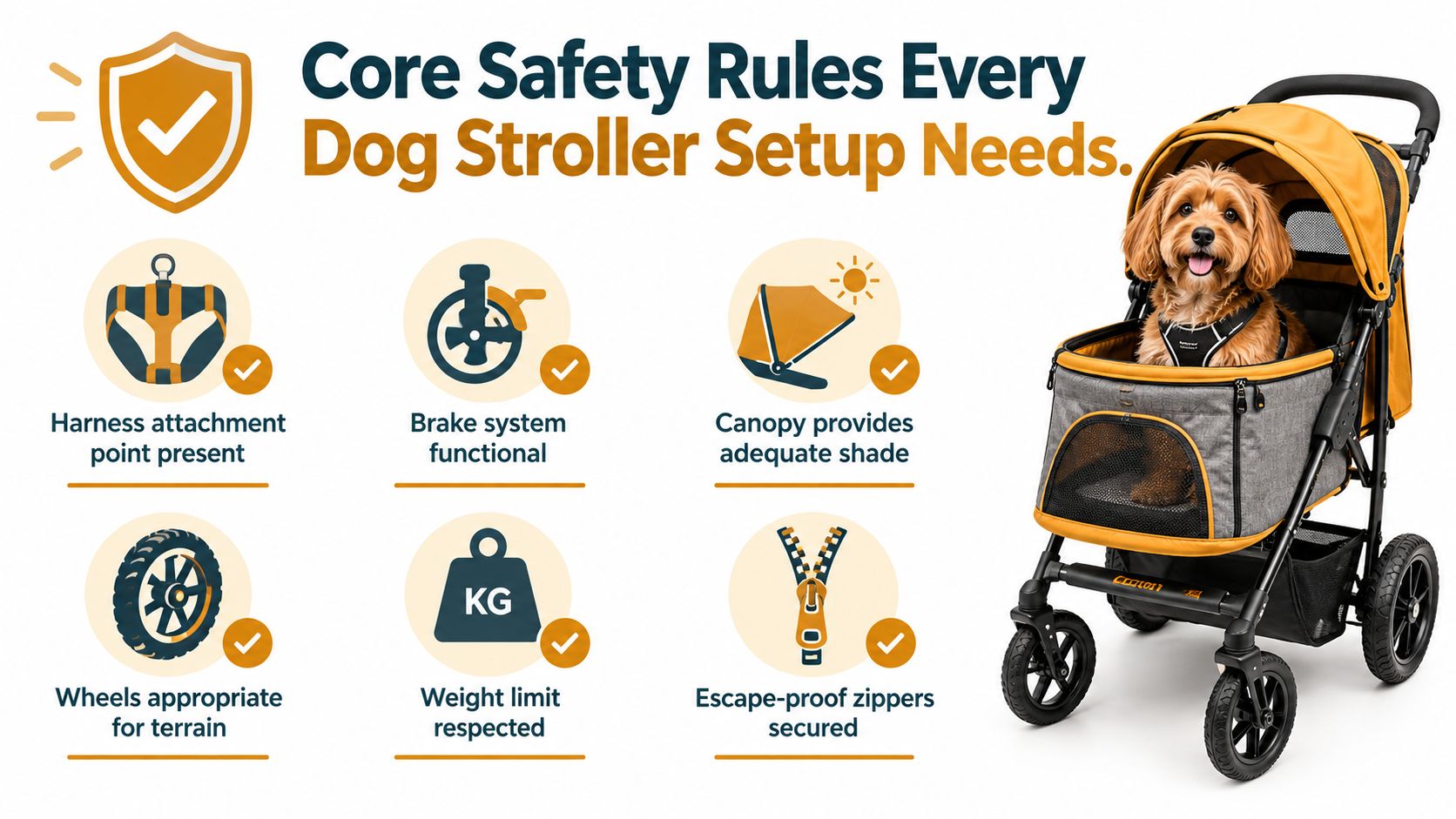
Wheel design affects control. Product specifications for mainstream pet strollers commonly show front wheels in the roughly 5.2 to 6.3 inch range, with some models using larger locking front wheels and rear wheels around 8 inches or more example pet stroller wheel specifications. Larger wheels generally handle uneven pavement better, while swiveling fronts help with tight turns. A locking front wheel can improve straight-line stability on mixed surfaces.
The AVMA also says pets shouldn't ride loose in vehicles and favors either a properly sized enclosure or a suitable safety harness. Never use a stroller as an excuse to transport a dog loose in an open cargo area AVMA policy on transporting pets in motor vehicles.
A short demonstration can make the setup easier to understand:
Heat, Ventilation, and Hidden Summer Risks
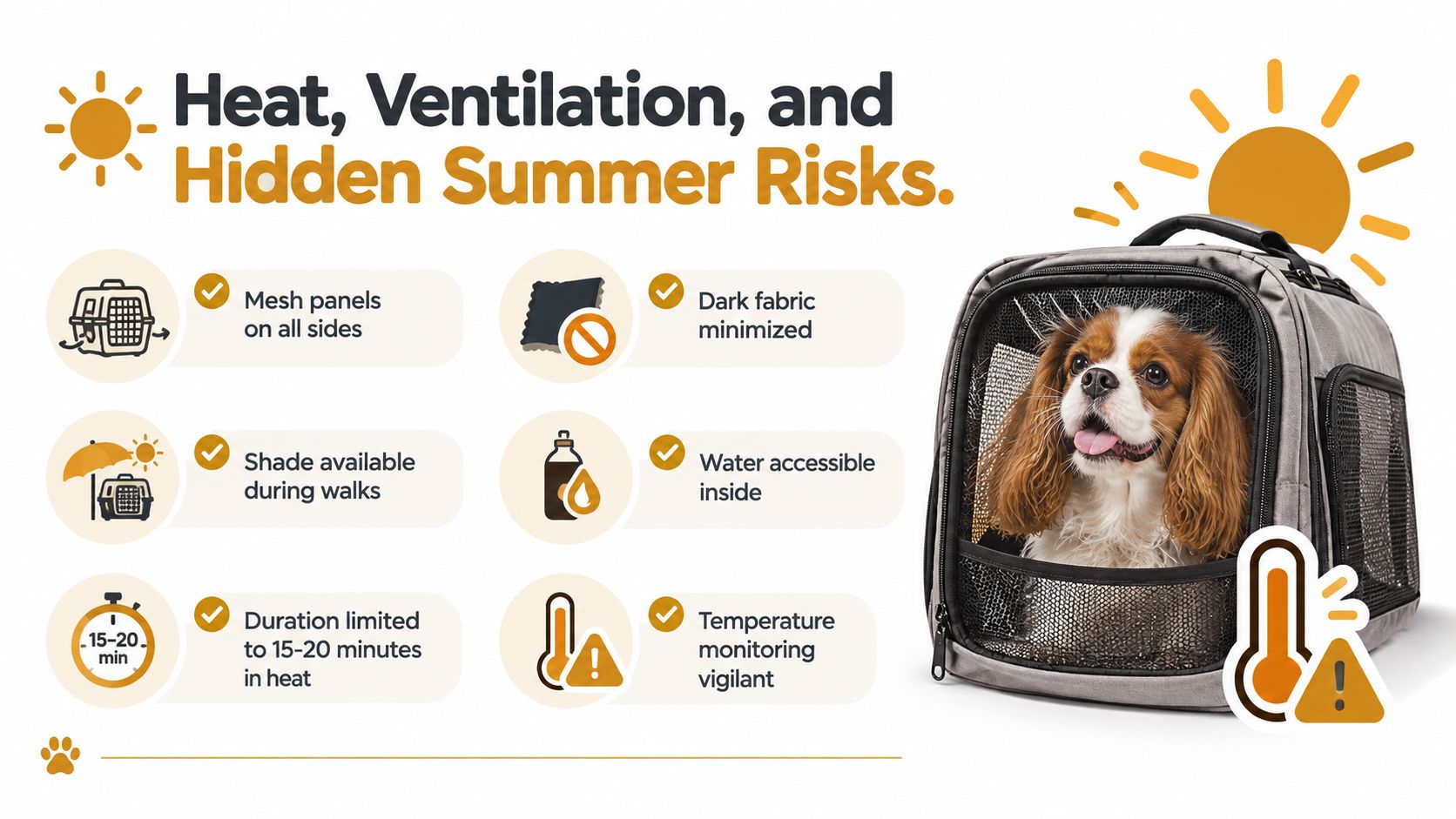
A stroller can feel shaded while still becoming dangerously warm. Dark fabric absorbs radiant heat, the dog adds body heat inside a confined space, and airflow near the ground may be weaker than it feels at the handle. Mesh helps, but it doesn't turn an enclosed cabin into a climate-controlled environment.
Brachycephalic dogs have reduced heat tolerance, so a French Bulldog, Pug, or similar dog deserves a particularly conservative plan. Rapid panting, thick saliva, weakness, disorientation, vomiting, collapse, or abnormal gum color require immediate attention. Move the dog to a cooler environment and contact a veterinarian promptly if heat illness may be developing.
The practical guidance is simple. Advice for warm-weather stroller use recommends limiting outings on days above 80°F and monitoring gum color, even when the cabin has mesh ventilation summer safety guidance for small-dog strollers. Don't interpret the presence of a canopy as permission to continue during a heat advisory.
Reduce cabin heat before it starts
Use ventilation on multiple sides, keep the canopy positioned for shade without blocking air exchange, and avoid thick blankets that cover the mesh. A reflective cover may reduce sun exposure, but it must not seal the cabin or obstruct the dog's airflow.
You can also place a thermometer inside the cabin during test outings. The number matters less than the trend. If the interior warms quickly, the dog pants more than usual, or the dog stops responding normally, end the ride.
Pavement creates a separate risk because the stroller protects the dog's body while leaving paws exposed during loading, unloading, or short breaks. Test the surface with the back of your hand before asking your dog to walk on it, choose shaded routes, and carry water. A stroller is not safer than walking when the cabin itself is hot.
Dogs with dark coats, excess weight, advanced age, or respiratory limitations may deteriorate faster. If the day feels marginal, choose an indoor activity or postpone the outing. For more breed-specific context, see the French Bulldog health profile.
Which Dogs Actually Benefit From Riding in a Stroller
A useful decision starts with the dog, not the stroller. Look at what your dog can do comfortably today, what a veterinarian has restricted, and whether the ride preserves meaningful activity or outright removes it.
A simple yes, maybe, and no framework
Yes usually fits dogs whose mobility is temporarily or permanently limited:
- Dogs recovering from surgery when a veterinarian has restricted walking.
- Older dogs with arthritis or degenerative joint disease.
- Blind or partially sighted dogs that need stable footing and predictable surroundings.
- Small or toy breeds that can walk some of an outing but tire during longer distances, such as an airport connection.
Maybe applies when the stroller solves a specific management problem:
- An anxious dog that relaxes when contained but still needs gradual behavior work.
- A working or show dog being moved between events.
- A puppy that hasn't completed vaccinations and needs controlled outdoor exposure.
No is the better answer for a healthy adolescent that needs to build stamina, a high-drive dog that needs movement and enrichment, or any dog whose owner is using the stroller to avoid exercise altogether. A ride may provide sights and smells, but it doesn't replace appropriate physical activity.
| Dog profile | Stroller use | Why it fits |
|---|---|---|
| Post-surgical dog | Yes, only within veterinary restrictions | Reduces walking while preserving safe outdoor time |
| Senior dog with painful joints | Often helpful | Allows participation without forcing a full route |
| Blind or partially sighted dog | Often helpful | Provides stable footing and controlled navigation |
| Anxious dog | Maybe | Can reduce exposure while training continues |
| Healthy adolescent | Usually no | Needs age-appropriate movement and conditioning |
| High-drive dog | Usually no as a primary activity | Riding doesn't meet the need to exercise |
| Puppy with incomplete vaccinations | Maybe | Supports controlled exposure away from contaminated ground |
Watch the dog, not the label. A small dog that strains to get out may be more comfortable walking. A large dog with limited endurance may need a heavy-duty mobility solution rather than a compact stroller. Breed size and body shape also matter, so use the Chihuahua breed page as background, not as a substitute for observing your individual dog.
Training Your Dog to Accept the Stroller Calmly
A dog shouldn't be pushed into a moving stroller and expected to understand. Familiarity comes first. Park the open stroller indoors near, but not directly beside, food bowls or another calm routine. Let your dog investigate without closing the canopy or moving the wheels.
Once the stroller becomes ordinary, place treats or part of a meal inside the open cabin. Reward voluntary entry and exit. Don't pull the dog in, shut the door immediately, or turn the first session into a restraint test.
Build movement in small increments
Use a gradual sequence:
- Stationary entry: Let the dog step inside and leave freely while you reward calm behavior.
- Harness connection: Add the harness and tether while the stroller remains still. Check that the dog can change position.
- Tiny movement: Roll the stroller an inch at a time on a flat floor, then pause and reward.
- Quiet outdoor surface: Try a short trip on smooth pavement near home.
- Planned route: Add mild distractions only after the dog remains relaxed on simpler paths.
Lip licking, repeated yawning, crouching, frantic scanning, trembling, attempts to escape, or refusal to eat are useful warning signs. Stop before fear escalates. If the dog can't settle after repeated low-pressure sessions, a qualified trainer or veterinary behavior professional can help identify whether the problem is motion, confinement, noise, or a previous negative experience.
Some dogs adapt within a few days, while others need a few weeks. Progress isn't measured by how quickly the stroller leaves the house. It's measured by whether the dog enters willingly, maintains a loose body, accepts food, and recovers quickly from ordinary sounds.
For a breed that may be sensitive to handling and confinement, the Havanese breed profile can provide useful background. Your own dog's behavior still determines the pace.
Where a Dog in a Stroller Is Welcome and Where It Is Not
A stroller doesn't automatically give a pet access to every public place. In the United States, rules vary among businesses, transit systems, parks, and venues. ADA service animal protections apply to trained service dogs, not to every pet riding in a carrier or stroller. Businesses may also set their own policies for non-service animals.
Call a store before arriving if the visit matters. Some retailers welcome contained pets, while others allow only service animals or restrict animals from food areas. Treat the stroller like a shopping cart, keep it out of narrow aisles, and don't let the dog touch merchandise or other customers.
Air travel requires separate planning. A wheeled pet carrier may be treated as checked baggage rather than a cabin accessory, and airline rules can differ by aircraft, route, and animal size. Confirm the policy directly with the airline before going to the airport.
Transit and outdoor spaces need courtesy
City buses and rail systems set their own pet rules. Some require a fully enclosed animal, while others impose size or placement limits. A stroller that works on a broad sidewalk may block a train aisle or prevent another passenger from boarding safely.
Sidewalks are generally appropriate when the owner keeps the lane clear, yields at entrances, and avoids stopping across curb ramps. Parks may distinguish between leashed dogs, enclosed pets, and areas where dogs aren't allowed at all. A stroller doesn't override posted rules.
The practical rule is to call ahead, keep the dog contained, and prioritize legally protected service-animal access over convenience. A very large breed, such as a Great Dane, may also be difficult to accommodate safely in crowded venues, so review the Great Dane breed page while considering space and transport needs.
Cleaning, Maintenance, and the One Rule to Remember
A stroller collects fur, dirt, saliva, food crumbs, and moisture. Shake out loose debris regularly, then wipe washable surfaces with a pet-safe enzymatic cleaner when needed. Let the cabin dry fully before the next ride, especially after rain or an accident.
Use a weekly check for the parts that affect safety:
- Wheels and brakes: Look for wobbling, debris, uneven rolling, or brakes that fail to hold.
- Tether and clips: Replace worn hardware before it breaks under sudden movement.
- Zippers and mesh: Check for fraying, torn panels, and gaps large enough for a paw or head.
- Frame and seams: Look for loosened joints, bent supports, and splitting fabric.
Inspect tire pressure, frame bolts, and fabric seams monthly if the stroller is used often. Machine washing is rarely suitable for the complete unit. Removable liners generally fare better in a cold, gentle cycle, followed by thorough air-drying.
Don't keep using damaged safety parts because the rest of the stroller looks fine. Replace frayed harnesses, cracked plastic cabins, and wheels that no longer lock. A failed brake or tether can turn a calm outing into an emergency.
The rule to remember: The stroller exists because the dog can't comfortably walk that outing, not because the owner can't.
If that test fails, your dog belongs on a leash, with an outing designed around appropriate exercise and rest. For breed-specific planning, use PetCostEngine to review health and ownership projections by breed, state, and age, then use those insights alongside veterinary advice when planning care for an aging, recovering, or mobility-limited dog.
Estimated lifetime and yearly costs for a Pug, state by state, plus whether pet insurance breaks even for the breed.
See Pug costs →
Is insurance worth it for a Pug? →
Joint supplement → Puzzle toys → No-pull harness →
As an Amazon Associate, PetCostEngine earns from qualifying purchases.