
You pull back the comforter and find another wet patch. The sheets need washing, the mattress needs attention, and your dog looks perfectly comfortable beside the mess. When your dog keeps peeing on the bed, the useful next step isn't a stronger correction. It's figuring out whether your dog is leaking urine, emptying a bladder in the wrong place, or leaving small marks.
Table of Contents
- What a Wet Bed Actually Means
- A Five-Clue Triage You Can Do Tonight
- Medical Causes That Mimic Bad Behavior
- Cleanup and Bedroom Access That Actually Work
- A Two to Four Week Re-Housetraining Plan
- Tailoring Prevention by Age, Sex, and Lifestyle
- When to Stop Managing and Call the Vet
What a Wet Bed Actually Means
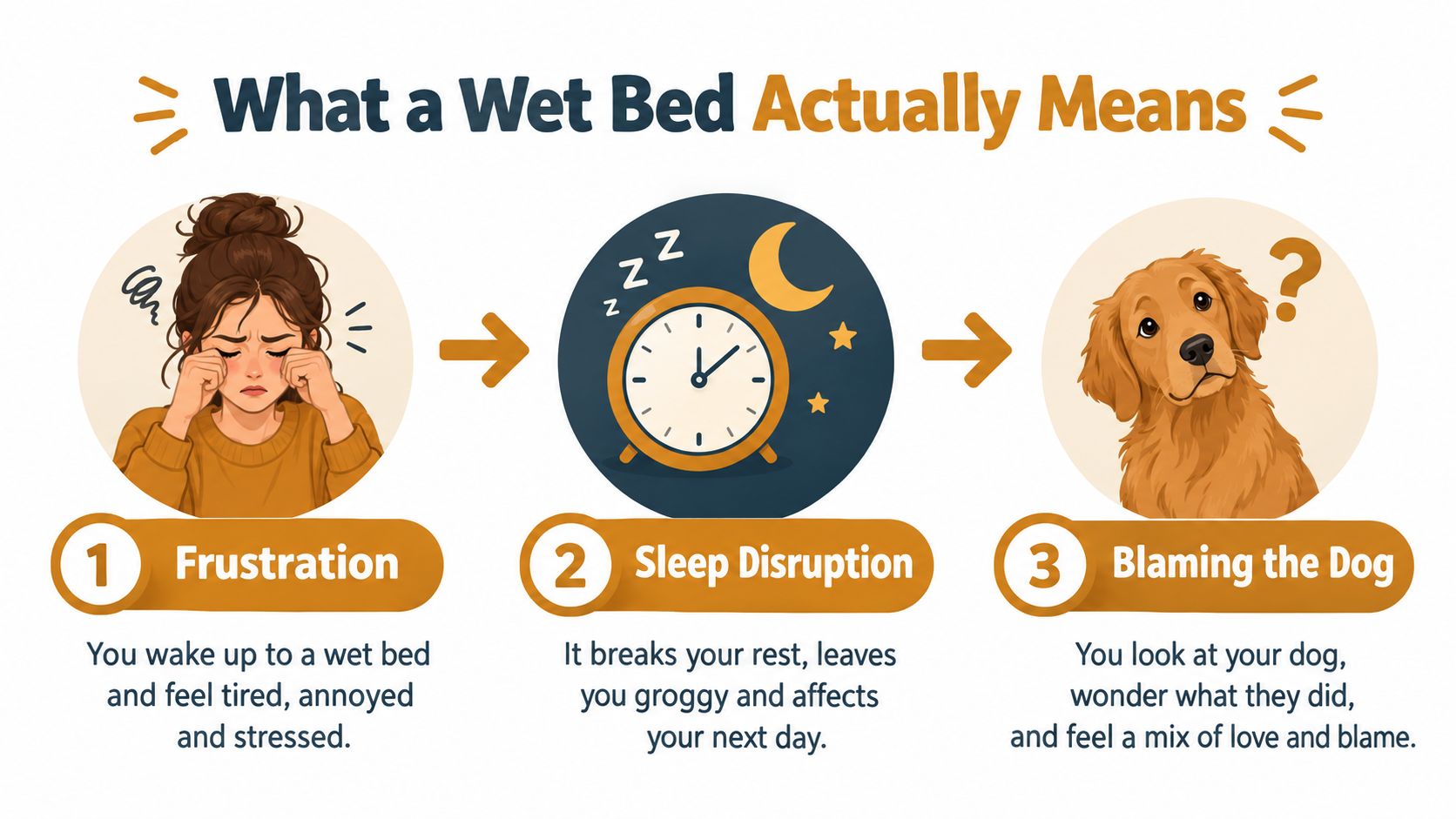
Finding urine where you sleep feels personal. You may have taken your dog outside before bed, washed everything after the last accident, and started closing the bedroom door. Another wet morning can make it seem as though your dog knows the rule and is ignoring it.
But the same wet sheet can come from very different problems. A sleeping dog may leak without waking. An awake dog may squat because it urgently needs to urinate, hasn't learned the household routine, or is responding to stress. Another may leave a small spot associated with marking.
The location isn't a diagnosis. It's a clue that needs context.
Watch what happens before the wet patch
Consider two possible mornings, not as diagnoses but as observation exercises. In one, your dog gets up from a nap and leaves damp bedding beneath its hips, with no squatting observed. In the other, you see your dog climb onto the mattress, sniff, and deliberately adopt a urinating posture.
Those observations deserve different conversations with your veterinarian. The American Kennel Club's explanation of canine incontinence defines it as involuntary leakage and identifies wet spots during sleep or rest as an important pattern. A reliably house-trained dog that starts leaving those spots should be checked for illness.
A soft, frequently used bed also complicates interpretation. It's somewhere your dog rests, somewhere that carries familiar household scent, and somewhere urine can remain hidden beneath clean-looking sheets. Don't assume that choosing this surface proves territorial behavior.
Practical rule: Describe the event before assigning a motive. “Wet underneath a sleeping dog” is more useful than “peed on my bed again.”
Separate the symptom from your reaction
Before changing the routine, establish which description fits:
- Leakage: Urine appears where the dog was lying, without an observed elimination posture.
- Ordinary voiding in the wrong place: The dog appears to empty its bladder while awake.
- Small deliberate spots: Brief urination occurs around a particular target or situation.
You don't need to solve the cause tonight. You need enough information to choose the right next action. Medical assessment comes first when the pattern is new, recurrent, or accompanied by symptoms; focused retraining makes sense once health problems have been evaluated.
A Five-Clue Triage You Can Do Tonight
Use timing, volume, posture, thirst, and discomfort to describe the accident. These clues help a veterinary team assess urgency, but they don't let you diagnose an infection or rule out disease at home. The veterinary review of urinary incontinence emphasizes that leakage can involve more than weakened bladder control, including neurological problems and urine retention.
Collect observations without testing your dog
Timing is your starting point. Note whether the accident happens during rest, immediately after an enthusiastic greeting, during a frightening interaction, or after you leave. An absence-related accident suggests a behavioral trigger worth investigating, not automatic proof of separation anxiety.
Volume and posture belong together. A full puddle differs from scattered drops, but an absorbent mattress makes quantity difficult to judge. Record whether you saw squatting, leg lifting, or urine escaping while the dog lay down; write “not observed” rather than guessing.
Watch thirst and discomfort separately. Increased drinking alongside increased urination calls for medical assessment. Repeated attempts, visible strain, or pain shouldn't be treated as a training setback.
What the Accident Pattern Suggests
The “most likely explanation” column is a working direction, not a diagnosis. Overlapping symptoms are exactly why veterinary evaluation matters.
| What you see | Most likely explanation | What to do first |
|---|---|---|
| Wet bedding after sleep, without observed squatting | Involuntary leakage | Arrange an examination and describe the sleep association |
| Small spots from an awake dog around a recurring trigger | Marking is possible | Record the trigger and request medical screening if new or recurrent |
| Dribbling during greetings or fearful interactions | Excitement or submissive urination | Keep interactions calm and document the circumstances |
| A substantial puddle plus noticeably increased thirst | Increased urine production from a medical condition | Call the veterinarian promptly |
| Repeated attempts with little or no urine | Urinary difficulty or possible obstruction | Seek urgent veterinary assessment |
Don't deliberately leave the bedroom open to reproduce an accident. Use observations from normal supervised activity instead. If accidents occur during your absence, a camera can clarify whether your dog was sleeping, pacing, or approaching the bed before the event.
For your call, organize the information into a short description: "Previously house-trained, now wet after naps, no squatting seen, drinking seems unchanged." Add when it began, whether it's recurring, and any pain or change in energy. Report uncertainty; a precise description is more helpful than a confident label.
Medical Causes That Mimic Bad Behavior
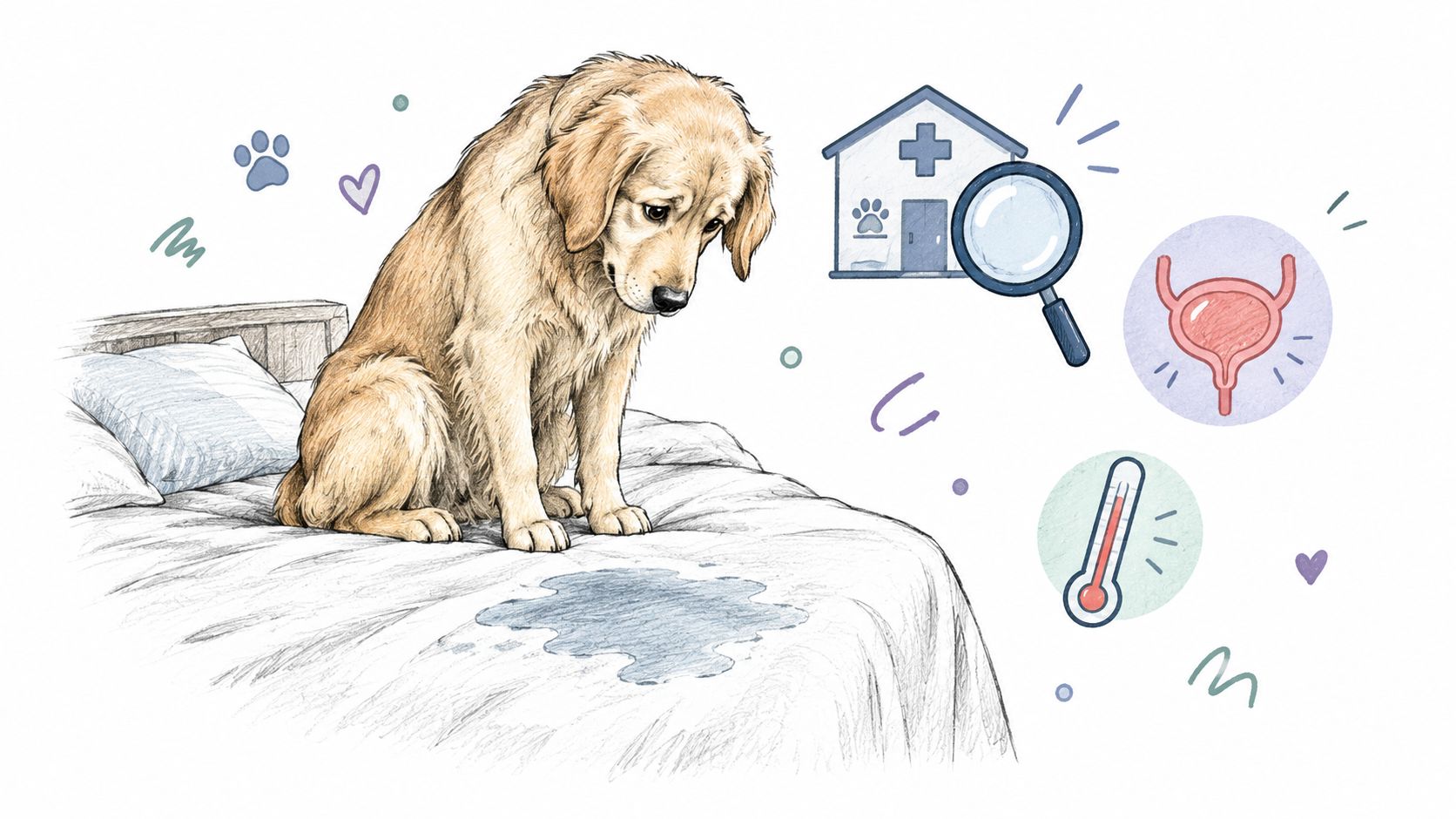
Two dogs can soak the same comforter while needing entirely different treatment. One may have impaired control over urine storage. Another may produce more urine than usual or experience urgency from urinary disease.
The Merck Veterinary Manual's guidance on disorders of urination identifies urinary inflammation or infection, bladder stones, kidney disease, diabetes mellitus, Cushing's disease, neurological disorders, congenital abnormalities, medication effects, and weakened urethral control among possible explanations. That range is why buying cleaning supplies alone can leave the actual problem untreated.
Bedding accidents can be a visible sign of an otherwise less obvious health issue.
Incontinence and urinary disease need different answers
Acquired urinary incontinence deserves particular consideration in a spayed female that wets bedding while resting. The 2024 American College of Veterinary Internal Medicine consensus statement reports published prevalence estimates of 3% to 20% in spayed female dogs, while emphasizing that the exact overall prevalence remains unknown.
Those estimates aren't a prediction for an individual dog. They explain why your veterinarian asks about sex, sterilization status, body size, age, and the relationship between accidents and sleep.
By contrast, urgency or frequent attempts may direct attention toward lower urinary tract disease. Larger accidents accompanied by increased thirst raise a different concern, including kidney disease, diabetes, or Cushing's disease. These patterns guide testing, but none identifies the cause by itself.
What the initial workup can involve
Expect a physical examination and discussion of the accident record, followed by testing selected for your dog's symptoms. A fresh urinalysis with sediment examination helps assess the urine; culture, bloodwork, or imaging may be added when infection, systemic disease, stones, or an anatomical problem is suspected.
A study of dogs assessed for lower urinary tract signs reported positive cultures in 15 of 107 dogs, or 14%, with documented lower-tract signs in only 4 of those 15, or 27%. The practical implication is limited but important: appearance alone doesn't reliably settle whether infection is present.
Bring a medication list and ask the clinic whether it wants a urine sample collected at home. Follow its collection and handling instructions rather than arriving with an old sample.
Financially, distinguish finding the cause from managing an ongoing condition. An initial diagnostic visit and recurrent monitoring serve different purposes. Ask what each proposed test will clarify and what follow-up might be needed, without assuming that every wet bed leads to long-term treatment.
Cleanup and Bedroom Access That Actually Work
Treat the mattress and the dog as separate jobs. Cleaning protects the sleeping surface and removes a possible repeat-location cue. Access management prevents another accident while you investigate the cause.
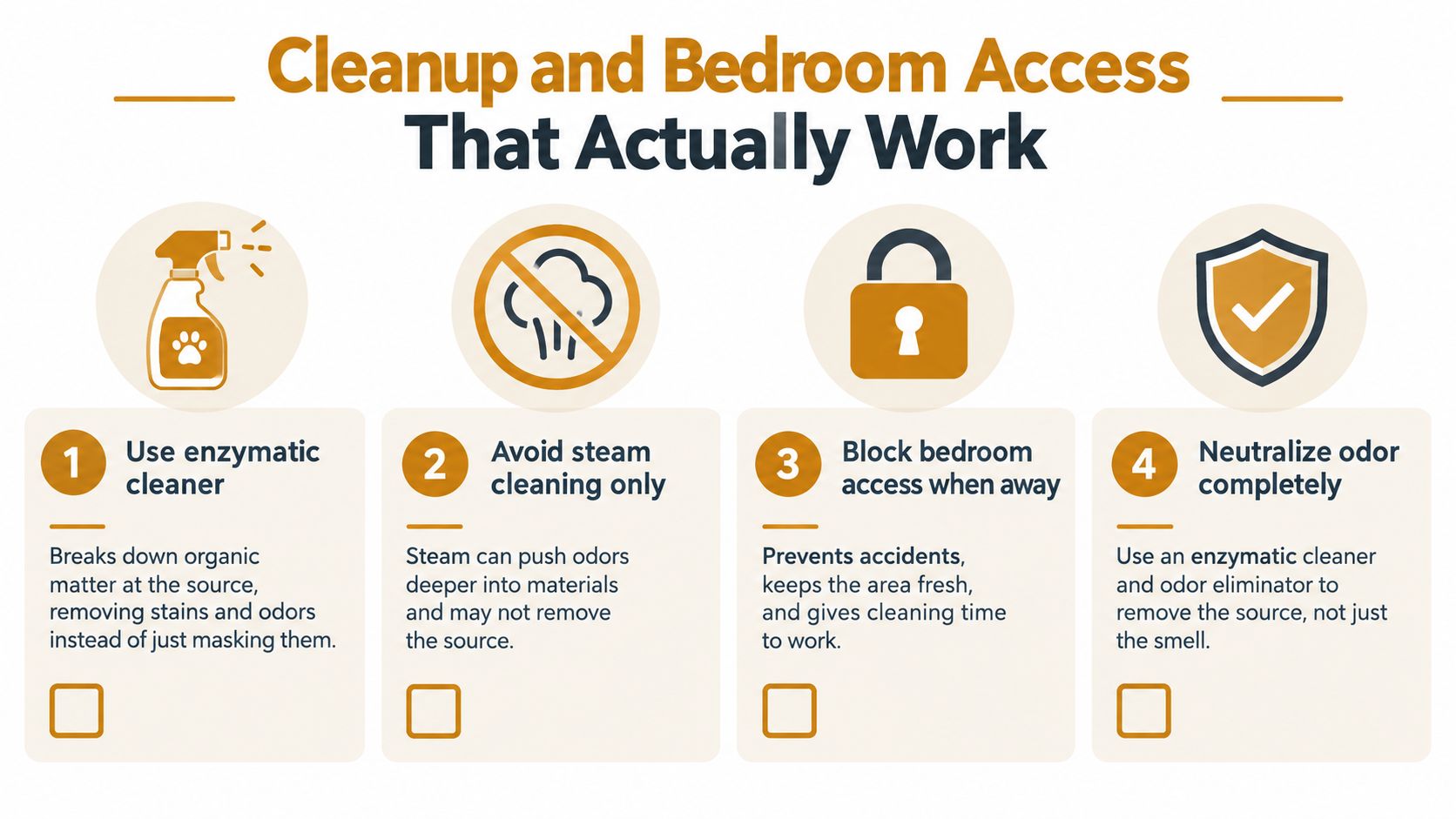
The Merck Veterinary Manual's guidance on canine behavior problems supports enzymatic cleaning, close supervision, and restricting opportunities for inappropriate elimination. Ordinary detergent alone may be inadequate when urine odor remains. Don't assume that a clean-looking sheet means the mattress underneath is ready for your dog again.
Clean to the depth of the accident
Start by removing the bedding and checking every affected layer. Blot accessible moisture rather than spreading it across a larger area. Choose an enzymatic urine cleaner labeled for the material you're treating, and check the mattress manufacturer's care instructions before applying it.
- Read the label first: Follow its application, contact-time, ventilation, and pet-access directions. Don't substitute a homemade treatment schedule.
- Treat the affected material: A surface mist may miss urine absorbed into padding. Use the product only as its directions permit, especially on mattresses that restrict liquid cleaning.
- Allow complete drying: Don't promise yourself a same-night turnaround. The material, amount of moisture, airflow, and product instructions determine when it's ready.
- Reassess before remaking the bed: A thoroughly soaked pillow top may need another label-directed treatment. Don't keep adding products without checking compatibility.
Steam cleaning alone shouldn't be your odor-control plan. The practical issue isn't whether the mattress looks refreshed; it's whether the urine-contaminated material has been appropriately treated. If you can't clean it thoroughly within the manufacturer's limits, consider professional advice rather than repeatedly soaking it.
Use this checklist to keep cleanup and prevention connected.
Make bedroom restrictions easy to maintain
Close the bedroom door when you can't supervise. Fit a washable waterproof mattress encasement beneath the sheets, and provide a designated washable resting place elsewhere. That's temporary management, not punishment.
A crate, exercise pen, or gated room can be useful if your dog is comfortable there and still receives adequate toilet opportunities. Choose the arrangement your household can maintain; a closed door often creates fewer complications than introducing unfamiliar confinement during an already stressful week.
A diaper contains urine. It doesn't explain why the urine is escaping.
Diapers and belly bands may have a temporary management role, but they shouldn't replace diagnosis or retraining. The same applies to the encasement: protection makes cleanup easier, not the underlying condition less important.
A Two to Four Week Re-Housetraining Plan
Once your veterinarian has evaluated medical causes and agrees that retraining is appropriate, run a two-to-four-week controlled reset. Treat that period as a structured observation window, not a guarantee that every dog will be finished on schedule.
The American Kennel Club's bed-peeing and house-training guidance recommends scheduled outdoor opportunities, supervision, restricted access when unwatched, calm interruption of observed accidents, and rewards for successful outdoor elimination. Use those elements together. More trips alone won't help much if your dog still gets unsupervised access to the mattress.
Keep the workflow visible so everyone in the household follows the same routine.
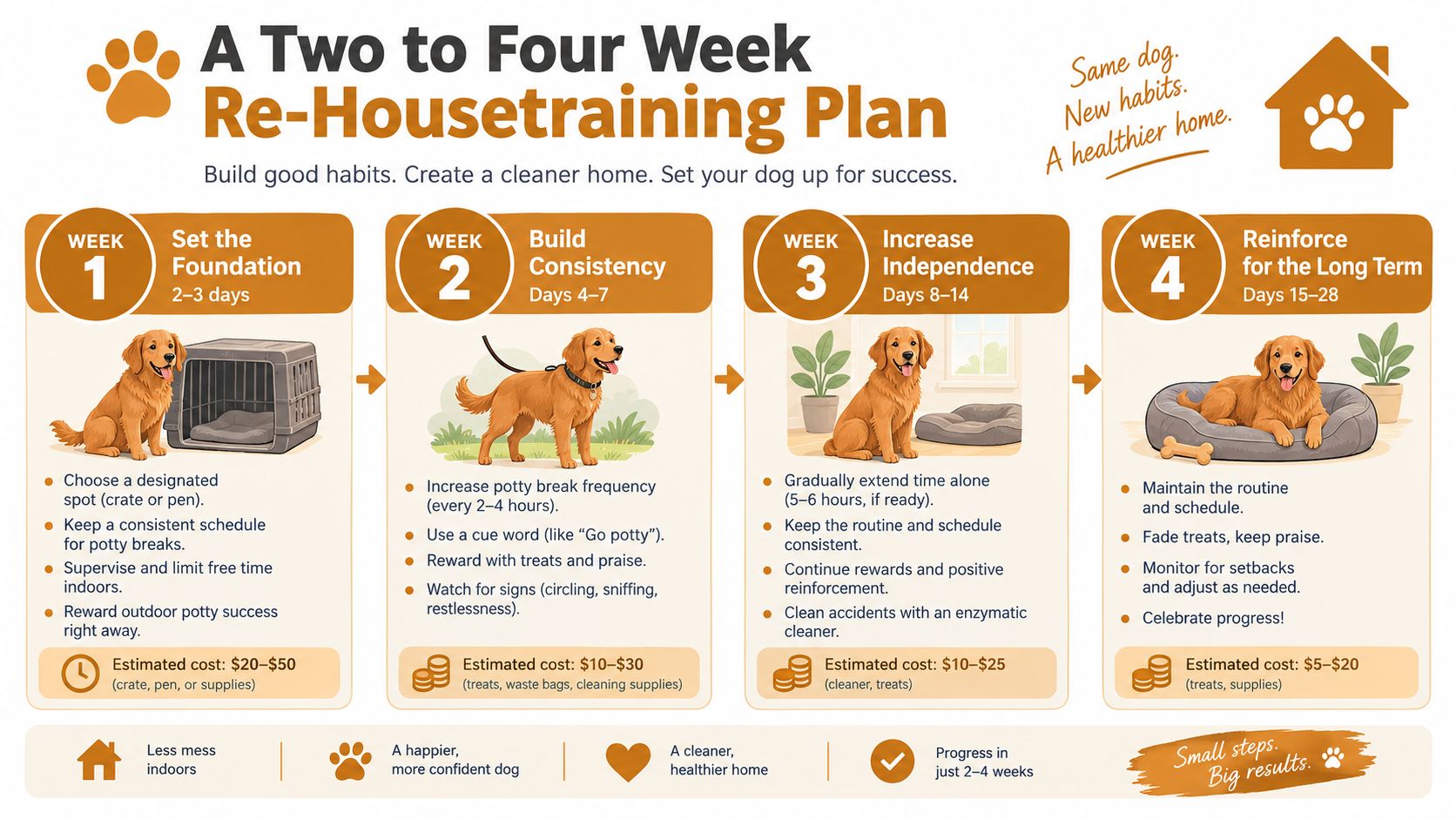
Build the day around successful outdoor elimination
Take your dog out first thing in the morning and before bed. Add opportunities after meals, waking from naps, heavy drinking, play, and confinement. Keep meal timing consistent where practical, and adjust the schedule to the pattern you've recorded rather than expecting your dog to fit an inconvenient routine.
Go outside with your dog and carry a high-value food reward. Reward immediately after outdoor urination finishes, while you're still at the toilet location. A treat delivered after returning to the kitchen is less clearly connected to the behavior you wanted.
Indoors, keep your dog within visual range. A baby gate can preserve sightlines, or a tether attached to an attentive adult can prevent unnoticed wandering; never leave a tethered dog unattended. Sniffing, circling, turning toward the door, or trying to leave the room should prompt an outdoor trip.
Handle accidents without adding fear
If you catch urination beginning, interrupt neutrally and escort your dog outside. Reward completion there. If you discover urine later, clean it without confronting the dog; delayed punishment doesn't provide a useful explanation of what you wanted.
Training checkpoint: Count consecutive accident-free days under consistent supervision, not isolated successful outings.
Keep a simple daily log of outings, outdoor successes, accidents, and supervision gaps. This separates a plan that isn't working from a plan that wasn't consistently followed. If someone allowed an unwatched bed visit, fix that access gap rather than interpreting the result as defiance.
The video can accompany your household's review of the routine, but your veterinarian's recommendations take priority.
Restore bedroom freedom gradually after a sustained clean period, beginning with supervised access after outdoor elimination. If an accident occurs, return to the previous successful level of restriction. Don't extend the experiment indefinitely when careful management produces no improvement.
Tailoring Prevention by Age, Sex, and Lifestyle
Your dog's profile changes which explanation deserves attention, not whether medical screening matters. A puppy learning the routine, an adult male leaving small spots, and a senior with new accidents shouldn't receive interchangeable plans.
The most useful prevention is the intervention that matches the pattern. Adding more confinement to a dog with mobility problems, for example, doesn't address why getting outside has become difficult.
Match the plan to the dog
| Dog profile | What deserves attention | Useful prevention focus |
|---|---|---|
| Puppies and adolescents | An unfinished house-training routine or missed signals | Supervision, predictable outings, and consistent outdoor rewards |
| Intact or recently neutered males | Small awake spots and social or environmental triggers | Track triggers rather than assuming sterilization status explains everything |
| Spayed females | Bedding that becomes wet during rest | Discuss the leakage pattern and ongoing management with the veterinarian |
| Senior dogs | Mobility changes, confusion, new thirst, or altered bathroom habits | Easier outdoor access and medical reassessment |
For young dogs, bedroom freedom should follow demonstrated reliability, not age. Make sure every household member rewards the same outdoor behavior and notices early toilet signals. A newly adopted dog may also need a fresh routine even if it was reportedly house-trained elsewhere.
For adult males, distinguish observed marking from a label applied to every accident. Recently neutered doesn't mean every remaining spot is a training problem, and intact doesn't mean every puddle is territorial. Changes involving visitors, other animals, or household activity are useful details to record.
Spayed females need prevention built around the sleep-leakage pattern already described, rather than repeated attempts to teach a rule they may understand. For seniors, ask whether the route outside has become difficult or whether the dog seems confused about a familiar routine. Report those changes instead of writing them off as normal aging.
Adapt the household, not just the dog
Lifestyle matters when accidents cluster around departures, greetings, or household disruption. The British Veterinary Nursing Association's behavioral first-aid guidance recommends stopping punishment, providing a safe resting place, reducing stimulation, and increasing mental enrichment during owner absence for anxiety-related house soiling.
Use that advice to make a manageable change:
- Busy greeting routines: Keep arrivals calm and move enthusiastic interaction away from the bed.
- Long periods away: Arrange toilet access that fits the dog's needs instead of relying on confinement alone.
- Household upheaval: Preserve familiar feeding, resting, and outdoor routines where possible.
- Absence-related distress: Use camera observations to inform a veterinary behavior discussion, not to justify harsher correction.
Enrichment can support a calmer day, but it isn't a replacement for treating pain, impaired bladder control, or a significant anxiety problem. Match the intervention to the dog you're observing.
When to Stop Managing and Call the Vet
Don't wait for a retraining trial to finish if your dog develops concerning symptoms. Repeated attempts to urinate with little or no output require urgent veterinary assessment. Suspected urinary obstruction is an emergency, not a behavior problem to monitor overnight.
Signs that need same-day attention
Contact your veterinarian or an emergency clinic for:
- Little or no urine: Repeated straining, unsuccessful attempts, or inability to urinate.
- Blood or severe pain: Visible blood in urine or obvious distress during attempts.
- A generally unwell dog: Vomiting, marked lethargy, or a pronounced change in appetite accompanying urinary trouble.
Describe the symptoms when you call so the clinic can direct you to the appropriate level of care. Don't delay because your dog passed a small amount earlier.
Patterns that need a prompt appointment
Recurring sleep-related wet spots, new thirst, and sudden accidents in a previously reliable dog warrant assessment even without emergency signs. The AVMA-published discussion of inappropriate urination identifies medical and behavioral explanations, including urinary disease, endocrine disorders, pain, medication effects, and cognitive dysfunction.
Bring your accident log and medication list. Explain what you observed, what changed, and whether bedroom restrictions and the supervised routine affected the pattern.
If medical causes have been addressed but accidents persist under consistent management, ask about a veterinary behaviorist referral. Anxiety, recurring marking triggers, and cognitive changes may need a different plan from straightforward house training. More punishment or longer confinement isn't a sensible escalation.
PetCostEngine offers lifetime dog ownership estimates personalized by breed, state, and age, along with breed-specific health-risk information. Visit PetCostEngine to plan for routine veterinary care and possible ongoing urinary management while you work with your veterinarian on the cause of the wet bed.
Modeled estimates for 226 breeds, with the formula and sources published in full.
See the data →
Joint supplement → Puzzle toys → No-pull harness →
As an Amazon Associate, PetCostEngine earns from qualifying purchases.