Most owners learn a simple rule: a dog rolling onto its back wants a belly rub. That rule can lead you badly astray. Belly exposure is one posture shared by several very different behaviors, including relaxation, play, appeasement, fear, and physical relief from itching.
Read the whole dog instead. Check muscle tension, eyes, mouth, tail, movement, what happened immediately before the roll, and whether the dog chooses to come back after contact. The same posture can be an invitation in one moment and a request for space in another.
Table of Contents
- The Five Meanings Behind a Dog on Its Back
- A Dog Rolling on Their Back for Attention and Relaxation
- Dog Rolling on Back During Play With Other Dogs
- How to Tell Relaxed Rolling From Fear or Appeasement
- When the Back Roll Is an Appeasement Signal
- Back Rolling as a Response to Itching and Skin Irritation
- When Rolling on the Back Means a Vet Visit
- A Simple Framework for Reading Your Dog Next Time
The Five Meanings Behind a Dog on Its Back
A dog rolling on back can communicate at least five different things: “please interact with me,” “let's keep playing,” “I'm trying to reduce pressure,” “this spot itches,” or “my skin is reacting to something.” The belly itself doesn't tell you which message applies.
A relaxed dog may roll loosely after dinner and seek a chest scratch. A playful dog may roll to block a neck bite or launch a counterattack. A nervous dog may expose its stomach while keeping its body stiff, head turned away, and tail tucked. A dog with pruritus may rub against carpet or grass because mechanical pressure feels relieving, while a sudden reaction to a pyrethrin or pyrethroid product can bring intense rolling, scratching, hives, vocalization, or whimpering. Veterinary behavior guidance emphasizes that context and body tension are decisive (Penn Vet's canine body-language primer).
First-time owners and children often focus on the most visible detail, the exposed belly. A safer habit is to compare the posture with the dog's expression and movement, then consider the event that came first. Breed and individual temperament can also shape how dogs use body language, which is why comparing breed characteristics should never replace watching the individual dog (breed comparison guide).
A Dog Rolling on Their Back for Attention and Relaxation
A relaxed roll usually looks easy rather than dramatic. The dog's muscles stay loose, the hips may wiggle, the legs move freely, and the face looks soft. You may see gentle tail movement, a relaxed or slightly open mouth, friendly eye contact, and a dog that reaches toward you with a paw or shifts closer for more contact.
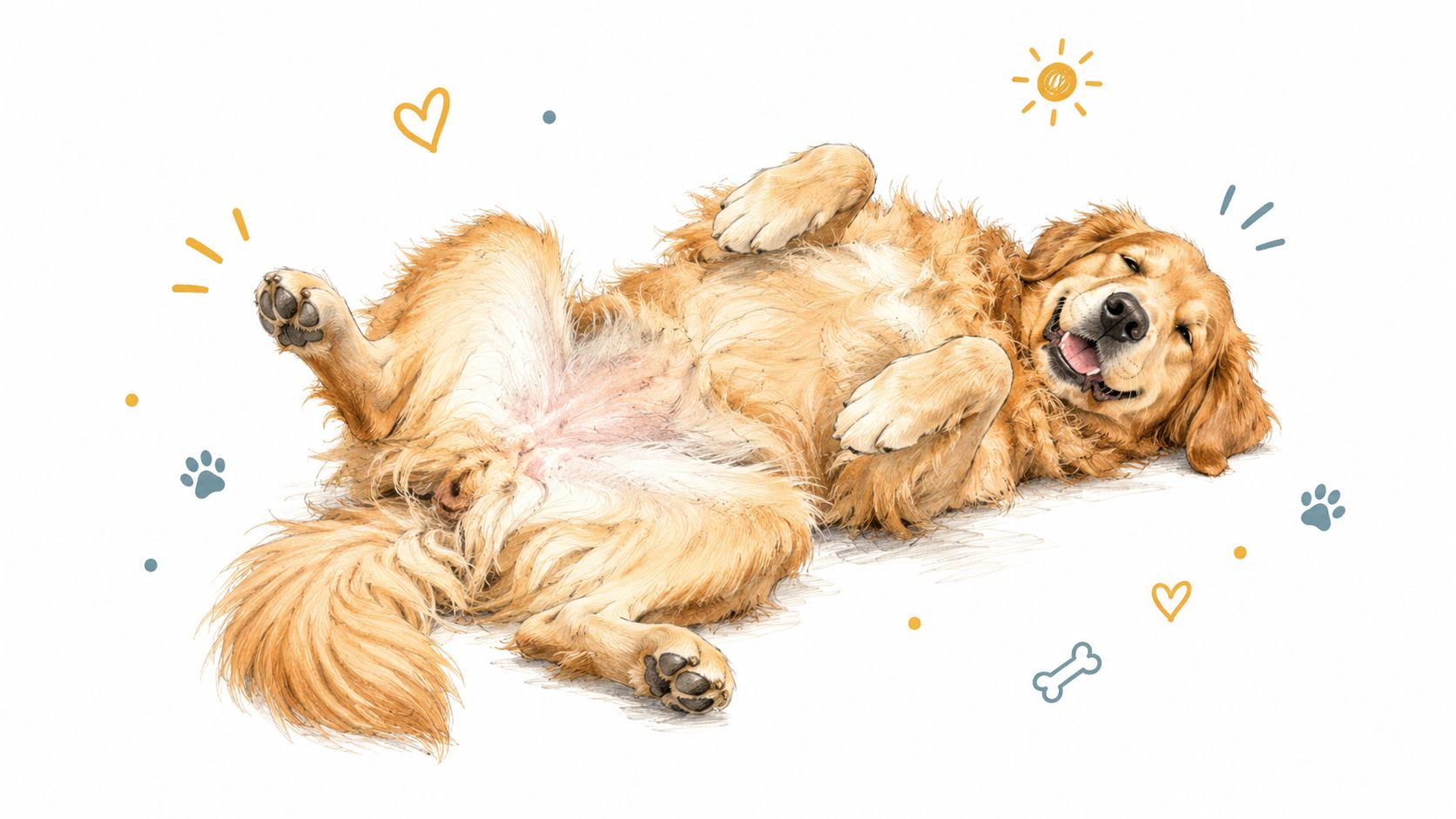
Consider a golden retriever flopping onto the rug after dinner. The dog rolls, stretches its legs, looks toward you with soft eyes, and gets up when you stop scratching. Later, it returns and nudges your hand. That pattern suggests voluntary social engagement, not merely a reflexive exposure of the belly.
A beagle may squirm onto its back when you sit beside it, mouth relaxed and body curved toward your hand. If it rolls upright, follows you, then approaches again, its behavior gives you useful consent information. The dog isn't just tolerating the interaction. It's choosing to resume it.
The five-second consent check
Before touching, scan these details:
- Muscle tone: Loose muscles support comfort. A rigid torso or frozen legs call for caution.
- Eyes: Soft eyes and easy eye contact fit relaxation. Averted eyes or a visible crescent of white, sometimes called whale eye, suggest discomfort.
- Mouth: A loose, open mouth is different from a tightly closed mouth or repeated lip licking.
- Movement: A dog that can smoothly get up and move away has more freedom than one that stays pinned or still.
- After contact: Re-approaching, nudging, or presenting the body again supports continued interaction. Turning away, hiding, or leaving means pause.
Practical rule: A belly-up posture never grants automatic permission to touch. Pause, offer a light stroke to a less vulnerable area, and let the dog decide whether to continue.
The safest response is usually to keep your hands slow and your body relaxed. Don't lean over the dog or hold it in place. If the dog remains loose and voluntarily engaged, gentle chest or shoulder contact may be welcome. If the posture changes, stop immediately.
A short video can help you compare loose and tense movement in real time:
Dog Rolling on Back During Play With Other Dogs
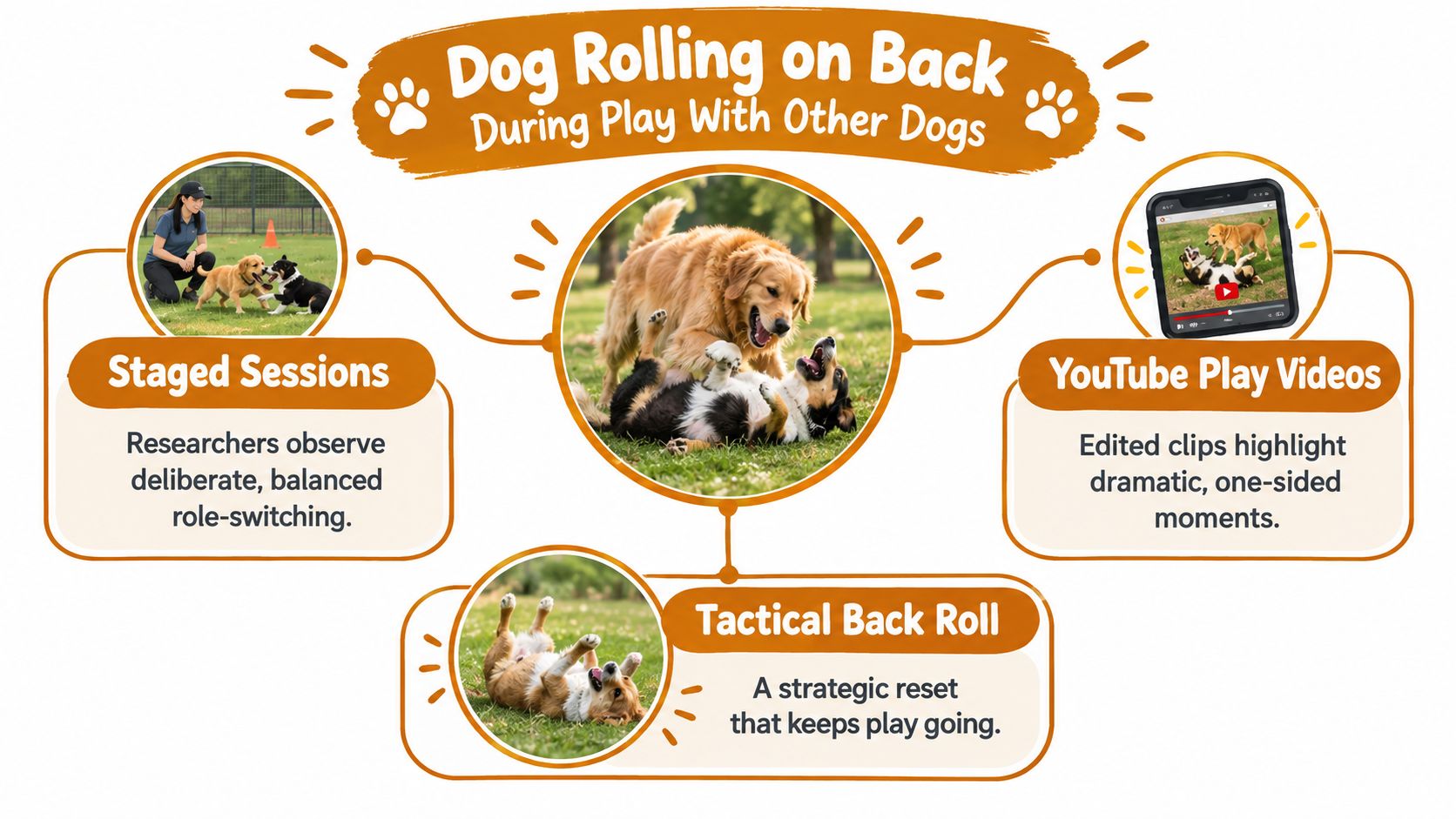
A back roll during dog play is often an active maneuver, not passive surrender. Dogs can use the position to protect the neck from playful bites, create room to move, or attack from below. A dog that rolls, kicks, twists, and springs back up may be managing the interaction rather than conceding it.
A comparison summarized by Scientific American through the American Kennel Club observed rolling in staged play sessions and in selected YouTube play videos. Only 9 play partners rolled during the staged sessions, while 27 of 40 dogs, or 67.5%, rolled in the video sample. The dogs appeared in pairs of similar and different sizes, so the behavior wasn't limited to large dogs playing with smaller dogs.
Those figures need careful interpretation. The videos were selected online clips, not a random sample of dogs, so 27 of 40 is not a population prevalence estimate. It does, however, illustrate an important point from canine play research. Rolling can help dogs block a neck bite and, in some cases, launch their own playful attack.
What balanced play looks like
Healthy play usually has a bouncy, reversible quality. Dogs change roles, pause, and return willingly. A dog may roll onto its back, push at the other dog with its paws, twist sideways, pop up, and invite another chase. A play bow before or after the roll can reinforce that the interaction remains social and voluntary.
Look for these features:
- Role switching: Both dogs chase, retreat, pin, and release at different moments.
- Brief pauses: Dogs can interrupt the action without one dog immediately overwhelming the other.
- Loose movement: Curved bodies and springy steps are more reassuring than rigid posture.
- Voluntary return: A dog that leaves and then chooses to rejoin is showing agency.
- Matched intensity: Excitement can be high, but neither dog consistently bears all the pressure.
Size alone doesn't determine whether play is safe. A smaller dog can enjoy wrestling with a larger dog if both dogs regulate the encounter. Conversely, dogs of similar size can still create a problem if one refuses to release or ignores repeated attempts to escape.
When an owner should interrupt
Watch the dog underneath the roll, not just the dog standing over it. A dog that stiffens, yelps, repeatedly tries to leave, hides behind a person, or stops returning to play is giving you information. Repeated pinning without role reversal can also indicate that the interaction has become one-sided.
Interrupt calmly by calling the dogs apart, using a barrier, or guiding each dog toward a separate activity. Avoid grabbing collars in the middle of a frantic struggle, since aroused dogs may redirect toward nearby hands. In a multi-dog home, give each dog access to a retreat where another dog can't immediately follow.
A dog park roll can look theatrical and still be appropriate, but the outcome matters. If both dogs shake off, move freely, and choose to reconnect, the roll may have helped them reset. If one dog remains low, frozen, or attempts to escape, end the interaction and allow recovery.
The useful question isn't whether the dog rolled. It's whether the roll helped both dogs continue a mutual, voluntary exchange.
How to Tell Relaxed Rolling From Fear or Appeasement
At the park, a confident dog may throw itself onto its back during a loose game. At a veterinary hospital, another dog may show the same belly-up outline while trying to make itself smaller. From across the room, the postures can look alike. Up close, the surrounding signals usually tell a different story.
A relaxed dog moves fluidly. Its mouth may be open, its eyes soft, and its tail loose. It can get up, approach, pause, and return. A fearful or appeasing dog may hold its body rigid, tuck its tail, turn its head away, lick its lips, lower its head, or freeze.
Relaxed Roll vs Fear-Based Roll at a Glance
| Body Cue | Relaxed or Playful | Stressed or Appeasing |
|---|---|---|
| Muscles | Loose, wiggly, flexible | Stiff, tense, or frozen |
| Eyes | Soft gaze, comfortable eye contact | Averted gaze or whale eye |
| Mouth | Relaxed or gently open | Closed tightly or repeated lip licking |
| Tail | Loose movement or neutral position | Tucked tightly or held still |
| Movement | Gets up freely and may re-approach | Crouches, freezes, or tries to escape |
| Interaction | Initiates or resumes contact | Avoids contact or seeks distance |
| Context | Play, greeting, rest, or familiar handling | Restraint, looming, scolding, unfamiliar handling, or pain |
Imagine a dog at a park that rolls during a chase, turns sideways, springs up, and runs back toward its playmate. Its posture is active and reversible. The dog uses the ground as part of the game, then chooses to continue.
Now consider a dog in a veterinary exam room. The owner bends over, the dog rolls onto its back, turns its head away, closes its mouth, and stays still while its tail remains tucked. That dog may be trying to reduce pressure, not requesting a belly rub.
The preceding event matters. A roll that follows a play bow is different from one that follows restraint or unwanted touching. So is the next action. A dog that gets up and approaches again is communicating differently from one that presses against a wall or searches for an exit.
Children need especially clear guidance because they may interpret belly exposure as an invitation. Families should teach children to stop touching when a dog turns away, stiffens, freezes, or tries to leave. Breed information can add useful context, but individual body language remains the decisive evidence, so owners should study the dog in front of them rather than rely on a label (dog breed resource).
When the Back Roll Is an Appeasement Signal
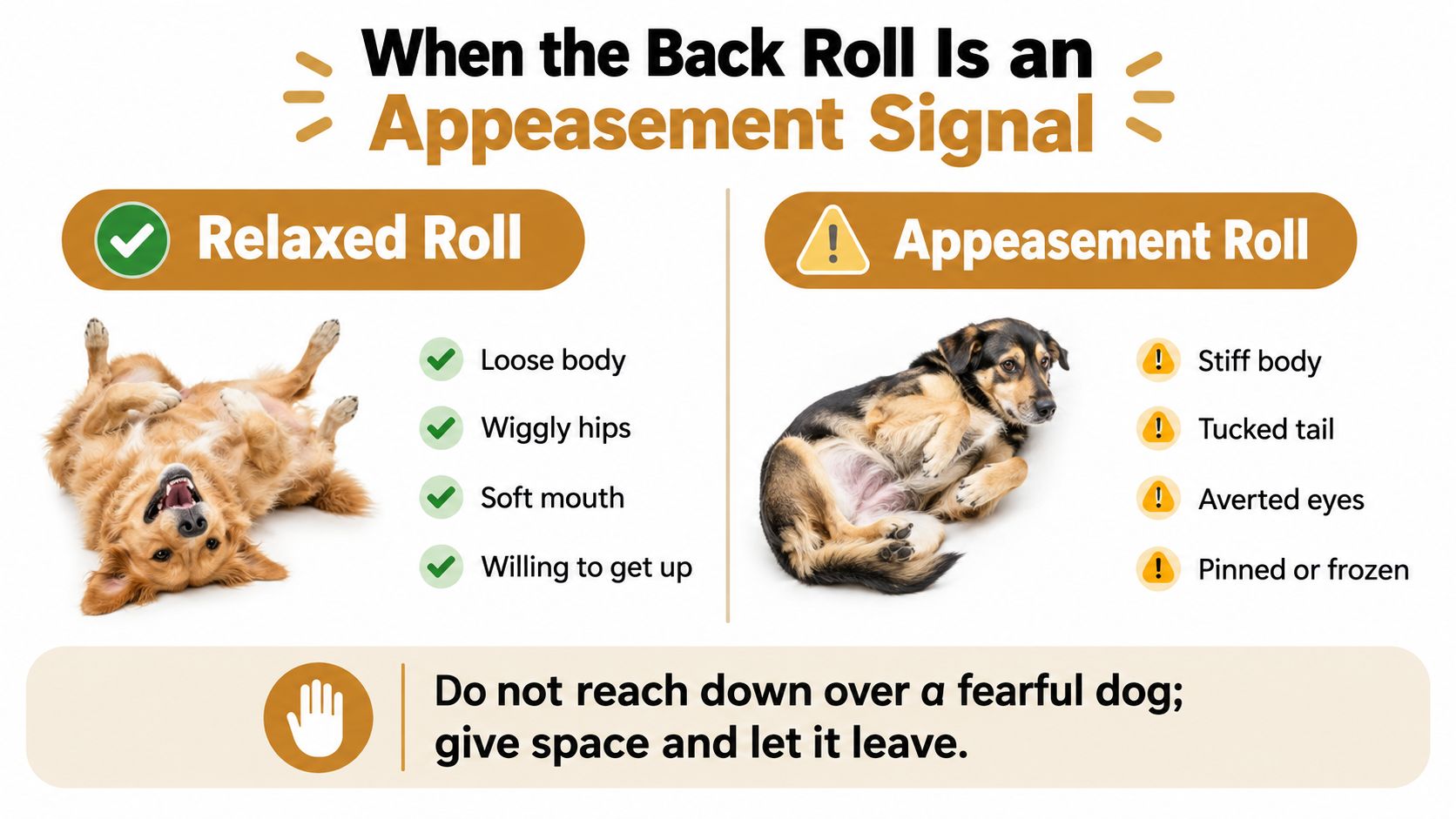
A dog may roll onto its back when it feels afraid, nervous, threatened, or overwhelmed. By exposing the stomach and lowering its body, the dog may be attempting to reduce conflict or discourage aggression. The posture can look submissive, but it doesn't necessarily mean the dog feels safe or wants to be touched.
The ASPCA's dog bite-prevention guidance identifies warning signs that can accompany fear and discomfort:
- Tucked tail: The tail is pulled close rather than moving loosely.
- Ears held back: The ears flatten or stay pinned toward the head.
- Lowered head: The dog drops its head away from the person.
- Lip licking: Repeated tongue flicks can appear during stress.
- Avoided eye contact: The dog looks away instead of engaging.
- Crouching: The body stays low and compressed.
- Freezing: The dog becomes unusually still rather than relaxed.
What to do in the moment
Stop moving toward the dog. Don't reach for the belly, place a hand over the dog, or lean directly above it. A person's height, forward movement, or direct stare can add the social pressure the dog is trying to defuse.
Turn your body slightly sideways and lower your presence without cornering the dog. Give the dog a clear route away, then wait. If children are nearby, calmly move the children back rather than asking the dog to tolerate more contact.
A fearful dog doesn't need reassurance delivered through forced touch. It needs distance, choice, and a predictable exit.
If the dog gets up and leaves, let it leave. Don't follow, call it back repeatedly, or punish the warning signals. Growling, freezing, and avoidance provide valuable information before a bite occurs. Removing the pressure protects everyone and gives you a chance to identify the trigger later.
The same response applies to unfamiliar dogs. Never assume that a dog exposing its belly in a public place has invited a stranger to pet it. Ask the handler first, then watch the dog's voluntary approach and facial expression. If the dog remains tucked, still, or turned away, keep your hands off.
Back Rolling as a Response to Itching and Skin Irritation
Sometimes a dog rolls belly-up to reach an itch. The posture resembles a social invitation, yet the surrounding details can point to skin discomfort.
Pruritus, the veterinary term for itching, can drive a dog to rub or roll against carpet, grass, furniture, or another rough surface. Pressure may briefly ease irritation along the back, flank, or abdomen. Parasites, skin infections, and allergies are common causes of itchy skin, according to PDSA's overview of canine skin problems.
Merck Veterinary Manual lists insect bites, food allergy, and environmental allergens such as pollen, mold, and dust among common causes of allergic itching (Merck Veterinary Manual on canine pruritus). The abdomen is frequently affected, and allergic itching commonly involves the face, ears, paws, skin folds, and hind end. That overlap can make belly rubbing resemble a request for affection.
Social roll or itch-relief roll
A social roll usually occurs around people or dogs. Look for eye contact, loose movement, and a voluntary return to interaction. An itch-driven roll behaves more like a repeated attempt to scratch an unreachable spot. The dog may press the same region against a surface, scratch immediately afterward, lick its skin, or try to bite at its back.
Check for:
- Redness or irritation
- Hair loss
- Scabs or open sores
- Skin thickening
- Unusual odor
- Persistent scratching or licking
- Repeated rubbing against the same surfaces
The posture alone cannot identify the cause. A dog may enjoy a playful roll while also having a separate dermatologic problem. In other cases, discomfort may be driving the entire movement.
Keep a useful observation log
Record the date, frequency, surface used, and body region contacting it. Note possible triggers, seasonality, flea exposure, recent grooming, and changes affecting the skin, ears, paws, sleep, or appetite.
A short video gives your veterinarian a clearer comparison between a brief social movement and repetitive rubbing. Avoid assuming that a belly rub or an over-the-counter product will address the cause. Treatment depends on whether the problem is parasitic, infectious, allergic, or another skin disorder.
Breed context can add useful background. Owners can review French Bulldog breed information when learning about skin folds and breed-related concerns, but rolling by itself cannot establish a breed-linked diagnosis.
When Rolling on the Back Means a Vet Visit
A brief, loose roll during play or a familiar greeting usually calls for observation, not alarm. Repeated rolling deserves a different response, especially when the dog focuses on rubbing its back or belly against surfaces.
Arrange veterinary evaluation when rolling occurs with hair loss, redness, sores, odor, scabs, skin thickening, pain, or marked discomfort. Persistent scratching, licking, disrupted sleep, ear trouble, paw irritation, or a sudden change in behavior also strengthens the case for a medical examination. If a skin abnormality lasts beyond a few days, don't rely on the posture alone to judge its seriousness.
A sudden episode after applying a flea, tick, or garden product needs particular attention. Veterinary guidance on pyrethrin and pyrethroid poisoning in dogs identifies back rolling, intense itchiness, agitation, attempts to bite the back, vocalization, and whimpering as possible signs of a reaction. Hives can produce similar behavior because raised, itchy bumps may be difficult for the dog to scratch directly.
Use a quick triage check
- Loose and social: The dog rolls briefly, looks comfortable, and returns to normal activity. Monitor the pattern and respect its choice about touch.
- Stiff and avoidant: The dog tucks its tail, turns away, freezes, or tries to escape. Stop interaction and reduce pressure.
- Repetitive and itchy: The dog keeps rubbing, scratching, licking, or showing skin changes. Contact your veterinarian.
- Sudden and distressed: The behavior follows a topical product and includes hives, agitation, pain, vocalization, or whimpering. Seek prompt veterinary advice.
Don't wait for the dog to develop dramatic skin damage before calling. Early observation gives your veterinarian more useful information and can help separate a behavior question from a dermatologic problem. If recurring care becomes part of your dog's routine, neutral breed-health references can help you prepare questions for your veterinary team, including information for less commonly discussed breeds such as the American Water Spaniel.
A Simple Framework for Reading Your Dog Next Time
Save this four-part check for the next dog rolling on back:
- Read the whole dog. Look at tension, eyes, mouth, ears, tail, and movement.
- Recall what happened first. Was there play, greeting, restraint, scolding, handling, a new product, or nothing obvious?
- Watch what happens after touch. Re-approach and relaxed movement support consent. Turning away, freezing, or leaving means stop.
- Choose the likely path. Think comfort, play, appeasement, or itch, then respond accordingly.
Chronic skin irritation can lead to repeated veterinary visits, and health patterns vary between breeds and individual dogs. For broader ownership planning, explore breed pages, the dog owner guides library, and an insurance comparison tool, rather than assuming that a breed label alone predicts your dog's needs.
The belly isn't always an invitation. Reading tension, choice, and context protects you from missing both a warning and a health problem.
PetCostEngine helps US dog owners compare breed-specific health information, state-adjusted ownership projections, and insurance options in one place. Use it to put recurring skin concerns and other veterinary needs into a clearer planning context, then visit PetCostEngine to explore the tools for your dog.
Estimated lifetime and yearly costs for a Compare, state by state, plus whether pet insurance breaks even for the breed.
See Compare costs →
Is insurance worth it for a Compare? →
Joint supplement → Puzzle toys → No-pull harness →
As an Amazon Associate, PetCostEngine earns from qualifying purchases.