
A 6-month-old German Shepherd can look almost fully grown while still being biologically immature. Many puppies at this age already weigh close to or above 50 pounds, yet their bones, growth plates, coordination, and judgment are still developing. That mismatch explains why a puppy may seem ready for long runs, jumping, or demanding training while its joints need a more careful plan.
The same stage can feel confusing behaviorally. A puppy that once responded quickly may start ignoring familiar cues, chewing again, or testing boundaries. Those changes don't mean training has failed. They reflect the shift from early puppyhood into adolescence, a period that rewards consistency, controlled exercise, and realistic expectations.
Table of Contents
- The Adolescent German Shepherd Looks Grown but Is Not
- German Shepherd Growth Milestones at Six Months
- Safe Exercise Limits for a Half-Year-Old German Shepherd
- Training and Socialization at the Six-Month Mark
- Vaccinations and Spay or Neuter Timing
- Building a Weekly Routine for Your Adolescent German Shepherd
The Adolescent German Shepherd Looks Grown but Is Not
A six-month-old German Shepherd can look ready for adult life while its joints are still under construction. Broad shoulders, long legs, and a heavy frame make the puppy appear capable of running, jumping, or hiking for long periods. Growth references place many dogs at only about 60–70% of adult size by the end of month six (Pawlicy German Shepherd growth chart). The visible body is ahead of the deeper work inside it.
A puppy weighing more than 50 pounds may also pull with enough force to move an adult. That strength can mislead an owner into increasing exercise too quickly. Bones, growth plates, muscles, tendons, and ligaments still need time to coordinate under load. Repeated high-impact activity during this stage can contribute to orthopedic problems that later require veterinary treatment, rehabilitation, medication, or costly surgery.
What changes during adolescence
By six months, growth commonly slows after the rapid gains of early puppyhood, and the dog may “look like a miniature adult” (Dog Weight Calculator growth guide). Adult teeth are generally in, while coordination, impulse control, and emotional maturity continue developing.
That combination explains selective hearing, renewed chewing, rougher play, and renewed testing of household rules. A puppy may perform a reliable sit in the kitchen but ignore the same cue near another dog or in a busy park. The learned behavior has not necessarily vanished. The puppy is being asked to control adolescent impulses with a body that has become much stronger.
Practical rule: Treat the six-month-old as a large-bodied puppy, not as a finished adult.
Keep cues and household limits consistent. Prevent unwanted behavior from becoming a habit, then reward the response you want before frustration builds. Use breed-specific information, such as this German Shepherd breed profile, when considering size-related care and health planning.
Daily choices now affect more than convenience. Offer movement, training, exploration, and rest in amounts the developing body can handle. Protecting immature joints today can reduce the chance of avoidable orthopedic costs later.
German Shepherd Growth Milestones at Six Months
A six-month-old German Shepherd can look nearly adult-sized while its joints and skeleton are still developing. That mismatch matters: a large frame may invite longer walks and harder play, but the body is not ready for unlimited impact.
Growth charts offer reference points, not pass-or-fail targets. Genetics, sex, body condition, nutrition, and parental size all influence an individual dog's progress. A healthy puppy slightly outside a chart may be developing normally, while a puppy within the expected range may still need veterinary attention if its movement or body condition changes.
Reference points for this age
At six months, males are commonly around 49–57 pounds, and females often around 44–49 pounds, according to this German Shepherd growth guide. A broader reference places many puppies between 44–57 pounds, with males averaging about 53 pounds and females about 46 pounds (Pawlicy growth and weight chart).
Shoulder height is often around 15–18 inches at this age. These figures vary with individual structure, and six months is not the finish line. Continued changes in height, weight, muscle, and bone development are expected over the following year.
| Metric | Male | Female |
|---|---|---|
| Typical weight at six months | 49–57 pounds | 44–49 pounds |
| Broader typical range | 44–57 pounds | 44–57 pounds |
| Common shoulder-height estimate | 15–18 inches | 15–18 inches |
| Approximate adult-size progress | 60–70% | 60–70% |
How to interpret the chart
Adult references commonly place males around 66–88 pounds and females around 49–71 pounds. Those ranges explain why a puppy may look impressively large while still having substantial growth ahead.
Use the chart to follow direction, not to judge one isolated measurement. A veterinarian can assess body condition, gait, muscle development, and growth together. A puppy that becomes unusually thin, gains weight rapidly, develops a limp, or shows discomfort during ordinary movement needs an examination rather than a chart comparison.
This is also the stage to budget for prevention. Protecting developing joints through suitable activity, nutrition, and veterinary monitoring can help avoid orthopedic problems and the treatment costs they may bring. For a personalized estimate based on breed, location, and life stage, use the PetCostEngine dog cost calculator. Use growth charts for physical context, and veterinary examinations for health decisions.
Safe Exercise Limits for a Half-Year-Old German Shepherd
The most dangerous exercise mistake at this age is confusing enthusiasm with readiness. A six-month-old German Shepherd may chase a ball until exhausted, sprint after another dog, or climb stairs without hesitation. That willingness doesn't prove that repetitive impact is appropriate for developing joints.
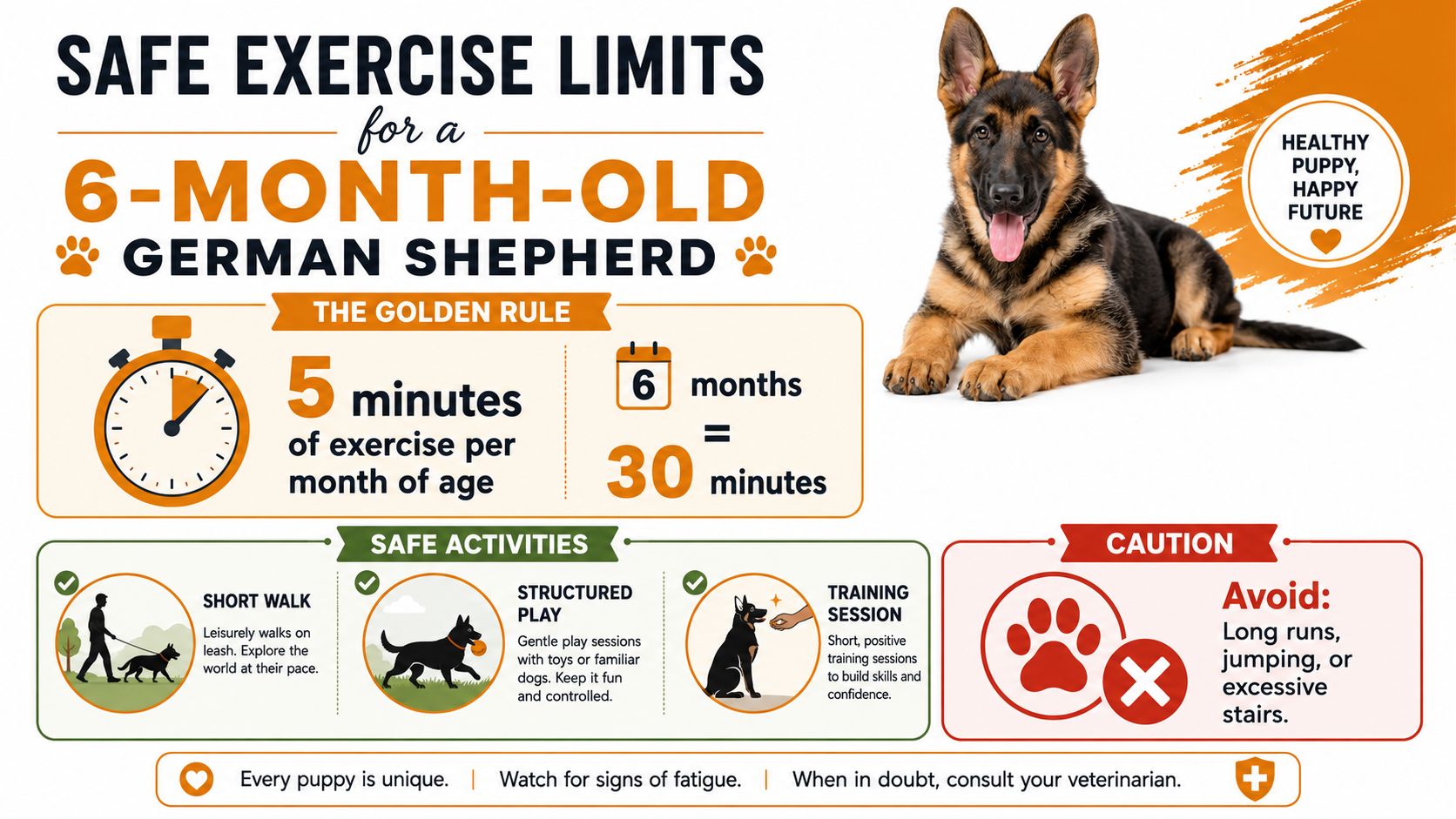
A widely used guideline allows five minutes of structured exercise per month of age, twice daily. For a six-month-old puppy, that works out to about 30 minutes per session, two times a day (German Shepherd puppy exercise chart). Treat this as a practical starting framework, not a license to force a tired puppy to continue.
Choose low-impact movement
A structured walk means a controlled outing with opportunities to sniff, pause, and practice leash manners. Gentle play on grass is preferable to repeated skidding or sharp turns on hard surfaces. Training can also use part of the session, because controlled movement and mental work often tire a puppy without demanding constant running.
Useful choices include:
- Short leash walks: Keep the pace moderate and allow sniffing rather than pushing for distance.
- Structured play: Use brief rounds of tug or calm retrieving, with pauses before the puppy becomes frantic.
- Training sessions: Practice recall, hand targeting, loose-leash walking, and settling in short blocks.
- Free movement: Let the puppy explore safe ground at its own pace, without forcing repetitive climbs or sprints.
Large-breed guidance warns against jumping, hard-surface running, and agility training until roughly 12–18 months, because growth plates in large breeds close later (German Shepherd exercise guide). Long runs and repeated stair work should also wait while the skeleton develops.
Watch the recovery, not just the excitement. A puppy that moves stiffly afterward, struggles to settle, or shows a change in gait has been given too much.
A simple weekly pattern can repeat the same basic structure without demanding identical intensity every day. Use controlled walks on ordinary days, gentle play in short rounds, and quieter sniffing or training sessions when the puppy seems physically tired. The large-breed dog guide offers broader size-related context for planning care.
This restraint protects more than today's comfort. Guidance for growing German Shepherds emphasizes that the dog may look nearly adult-sized while musculoskeletal development remains incomplete, making repetitive high-impact work a poor choice during adolescence (German Shepherd growth stages).
Training and Socialization at the Six-Month Mark
Training hasn't ended at six months. It has changed from introducing a young puppy to managing a stronger, more independent adolescent that already knows some behaviors but may not perform them reliably under distraction.
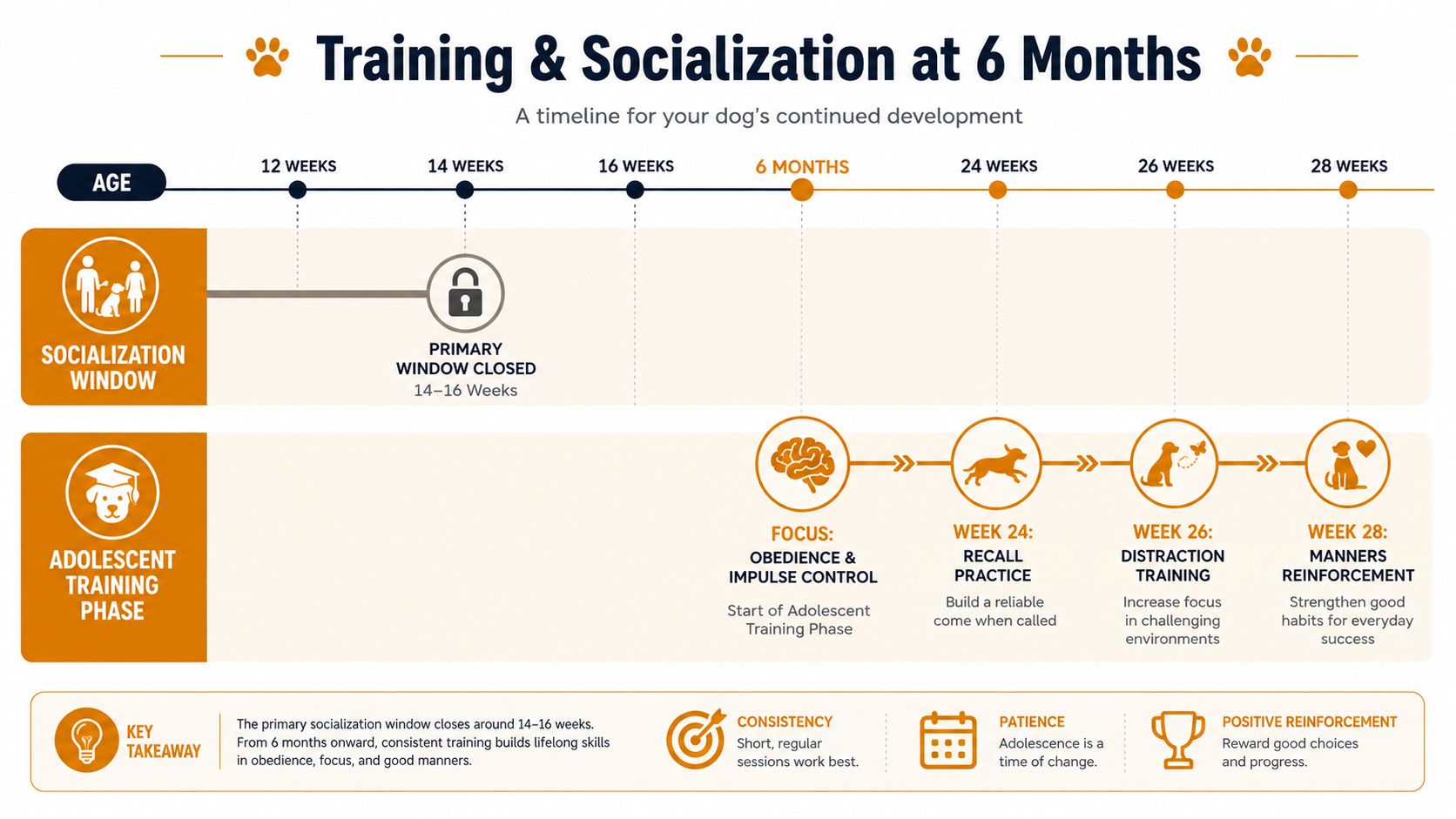
The primary socialization window has largely passed by this age, so delayed exposure can require more patience and careful management. That doesn't mean new positive experiences are pointless. It means you should control distance, intensity, and duration instead of flooding the dog with unfamiliar people, animals, places, or sounds.
Priorities for adolescent learning
Start with behaviors that improve safety and household control:
- Recall practice: Reward turning toward you, coming close, and staying engaged even when something interesting is nearby.
- Impulse control: Ask for a pause before meals, doors, play, and greetings. Release the dog rather than allowing self-appointed permission.
- Distraction training: Begin in easy environments and gradually add movement, sounds, and distance.
- Manners reinforcement: Reward four paws on the floor, calm leash behavior, and settling on a mat.
A six-month-old may know “sit” but still leap at visitors. In that situation, repeating the cue louder won't solve the underlying problem. Manage the greeting, create space, reward calm behavior, and practice before the dog reaches an overexcited state.
Behavior prevention also has a financial dimension. Recent German Shepherd guidance puts a six-week group course well below the price of the same number of private sessions, and both far below what later behavior rehabilitation costs (German Shepherd monthly ownership guidance). These figures aren't a guarantee of what any owner will pay, but they illustrate why addressing pulling, fear, guarding, or reactivity early can be less disruptive than waiting until the behavior is entrenched.
Select the right support
Group classes suit puppies that can remain under threshold around other dogs and people. Private instruction is often more appropriate when the dog shows fear, lunging, guarding, or a pattern that prevents safe participation in a group.
Training should feel repetitive because repetition builds reliability. A few calm successes are more useful than a long session that ends with the puppy overstimulated. For breed and temperament comparisons that can help frame your expectations, explore PetCostEngine's breed comparison tool.
Vaccinations and Spay or Neuter Timing
At six months, many puppies have completed their initial vaccination series, but owners shouldn't assume the record is complete without checking the dates and products with a veterinarian. The AVMA explains that puppy vaccinations are usually given every 2–4 weeks during the first months, and that for most puppies the final shot in the initial series is given at about four months of age (GSDCA veterinary presentation referencing AVMA guidance).
Bring the vaccination record to the appointment. Ask the clinic to confirm which core vaccinations are current, whether a rabies vaccination is due under local requirements, and when any follow-up boosters should occur. Vaccine timing can vary with the dog's history, health status, exposure risk, and local rules, so a generic online schedule shouldn't replace the veterinary plan.
The reproductive-health decision
Spay or neuter timing deserves a separate conversation for a large-breed dog. Some veterinarians may recommend waiting longer in large breeds so the dog has more time for musculoskeletal development, while other recommendations depend on sex, health, behavior, household management, and the risk of an unintended litter.
Your veterinarian should weigh the puppy's growth, orthopedic history, reproductive exposure, and lifestyle. Ask what benefits and tradeoffs apply to your individual dog, what timing they recommend, and whether the plan changes if the puppy develops a medical or behavioral concern.
What to bring to the visit
A useful appointment includes more than a vaccine review:
- Medical records: Bring every vaccination and treatment date you have.
- Movement observations: Note stiffness, limping, reluctance to climb, or changes after exercise.
- Behavior notes: Describe fear, reactivity, guarding, or difficulty settling.
- Growth information: Share recent weights and feeding details rather than relying on memory.
- Written questions: Ask about parasite prevention, nutrition, reproductive timing, and the next examination.
Local veterinary care can vary by state. For location-specific planning related to German Shepherd ownership, consult the German Shepherd Arizona cost reference, while keeping medical decisions with your own veterinary team.
Building a Weekly Routine for Your Adolescent German Shepherd
A good routine alternates controlled physical activity, short learning periods, enrichment, and recovery. It shouldn't turn every day into an endurance test, and weekends shouldn't compensate for quieter weekdays with a sudden burst of running or jumping.
Use this template as a starting point:
- Monday through Friday: Begin with a controlled walk, add a brief midday puzzle or scent activity, and finish with gentle play or a short training session.
- Training focus: Rotate recall, leash manners, impulse control, handling, and calm settling so the puppy practices useful skills without mental overload.
- Saturday: Choose a calm social outing where your dog can observe new surroundings at a manageable distance.
- Sunday: Emphasize grooming, handling, quiet enrichment, and bonding rather than adding strenuous activity.
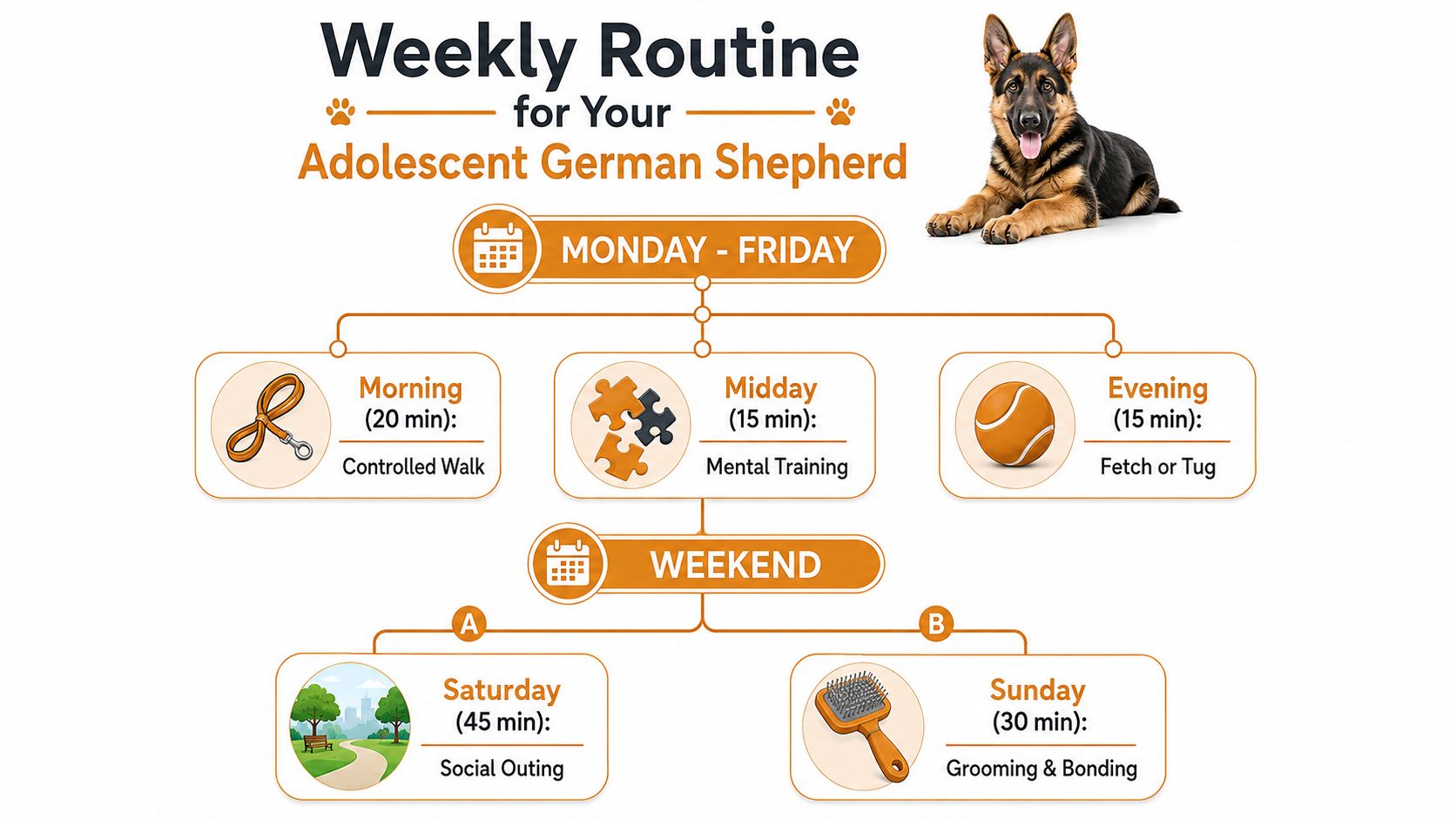
Track how your puppy behaves during the day and after each activity. A relaxed recovery, normal gait, willingness to eat, and steady engagement suggest that the routine is manageable. Stiffness, persistent overexcitement, avoidance, or a new limp means you should reduce the demand and contact your veterinarian if the concern continues.
As the dog matures, adjust gradually rather than making a dramatic change. Protecting joints, reinforcing behavior, and planning for breed-specific care now can reduce avoidable problems later.
Use PetCostEngine to build a breed- and location-specific ownership projection for your six-month-old German Shepherd, review health-related planning factors, and compare the decisions that may shape care over the years ahead. Start with your state, breed, and life stage, then use the results to prepare focused questions for your veterinarian and trainer.
Estimated lifetime and yearly costs for a German Shepherd, state by state, plus whether pet insurance breaks even for the breed.
See German Shepherd costs →
Is insurance worth it for a German Shepherd? →
Crate and bedding → Durable chews → Premium dry food →
As an Amazon Associate, PetCostEngine earns from qualifying purchases.