Most goldendoodle vs labradoodle advice starts with the wrong question. It focuses on which one sheds less or looks friendlier, then treats the answer like a lifestyle preference instead of a long-term ownership decision. That framing misses the bigger issues for US buyers, because the differences show up in health risk patterns, grooming workload, and how those costs and care demands vary by state.
| Attribute | Goldendoodle | Labradoodle |
|---|---|---|
| Parent breeds | Golden Retriever + Poodle | Labrador Retriever + Poodle |
| Origin story | Deliberate crossings traced to 1969 and later broader expansion in the 1990s in the United States and Australia, with a more diffuse history overall (Rover) | Widely credited to Wally Conron in 1988 at the Royal Guide Dogs Association of Australia (Rover) |
| AKC status | Not AKC-recognized, so there's no fixed breed standard (Bloomberg) | Not AKC-recognized, so there's no fixed breed standard (Bloomberg) |
| Size variation | Commonly bred in multiple size categories, with profiles listing 13 to 26 inches and about 45 to 100 pounds (The Spruce Pets) | Size varies widely because it depends on the Poodle parent and breeder program |
| Coat expectations | Can be straight, wavy, or curly, with unpredictability across generations | Can be wavy, curly, or hair-like, with fleece or wool textures common |
| Temperament pattern | Often social and affectionate, but individual lines matter more than the label (PMC study) | Similar behavioral profile overall, with parent lines and socialization driving outcomes (PMC study) |
Table of Contents
- Why the Standard Doodle Comparison Falls Short
- Origins, Size Variants, and Coat Profiles
- Temperament and Exercise Needs in Real-World Settings
- Grooming Demands and the Allergy-Friendly Myth
- Breed Specific Health Risks and Expected Treatment Costs
- Lifetime Ownership Costs Across US States
- Choosing the Right Doodle for Your Situation
Why the Standard Doodle Comparison Falls Short
The usual “goldendoodle vs labradoodle” debate leans on two promises that deserve more skepticism than they usually get, low shedding and hybrid vigor. Neither dog is reliably hypoallergenic, and neither one gets a free pass on inherited disease just because it's a crossbreed. Veterinary guidance notes that allergen exposure still varies by dog and no breed is allergy-proof (Great Pet Care), while recent research on designer crossbreeds has not supported the idea that crossbreeding reliably improves overall health (PubMed).
That matters because the parent breeds shape what you're really buying. A Golden Retriever base and a Labrador Retriever base do not create the same risk profile, even if the marketing language sounds similar. The Labrador Retriever's long-standing popularity in the US helped make Labradoodle crosses especially common, while Goldendoodles gained momentum later as Golden Retriever–Poodle crosses moved from niche breeding into broad consumer demand (Bloomberg).
Practical rule: Don't evaluate the doodle label first. Evaluate the breeder, the specific parent lines, and the care burden you're actually willing to own for years.
The better comparison starts with three questions. What health issues are most plausible for the exact puppy or rescue dog you're considering. How often will that coat need professional care. And how much geographic variation will affect your total ownership burden in your state. Those are the factors that change satisfaction after the novelty wears off.
For a side-by-side cost frame that ties the breed choice to state-level ownership modeling, use the breed comparison tool. It's a better starting point than trying to guess from coat fluff or internet anecdotes.
Origins, Size Variants, and Coat Profiles
The useful question is not which doodle has the cleaner backstory. It is what that backstory says about predictability. The Labradoodle traces to an Australian breeding program associated with Wally Conron, who crossed a Standard Poodle with a Labrador Retriever to meet a specific assistance-dog need. The Goldendoodle developed later through Golden Retriever–Poodle crosses and then spread through broader consumer demand. That difference matters because both lines entered the market as purpose-built crosses, not fixed breeds.
What That Means for Buyers
Neither dog is AKC-recognized, so there is no formal breed standard, no fixed multigenerational registration system, and no single universal size or coat profile for either dog (Bloomberg, HelloBark). For buyers, that means the label on the listing tells you less than the breeder's documentation of parent size, generation, and coat history.
A breeder who cannot explain those three points in plain language is leaving you with avoidable uncertainty. Size can swing widely inside the same doodle category. One Goldendoodle profile lists heights of 13 to 26 inches and weights of about 45 to 100 pounds, which is a reminder that “medium” and “standard” are broad buckets, not promises (The Spruce Pets).
Labradoodles vary for the same reason. The adult dog depends on which Poodle parent was used and how tightly the breeder selected for size and coat traits. Buyers who want a predictable fit should ask for the size of both parents, the generation being produced, and examples of adult dogs from the same line.
Bottom line: if a breeder cannot explain the parent sizes, generation, and coat traits clearly, the puppy's adult frame and grooming burden remain open questions.
Coat Outcomes Are Not Fixed
Coats can be wavy, curly, fleece-like, or more hair-like, and those differences affect brushing, mat prevention, and allergy expectations. A puppy that looks soft and low-maintenance can mature into a coat that needs frequent professional care.
That is why the Poodle parent context matters when evaluating any doodle line. The Poodle side drives much of the texture and coat behavior buyers are reacting to, so parent selection shapes maintenance more than the marketing name does.
The practical takeaway is straightforward. You are not buying a finished breed with a standard outcome. You are buying a breeder program, a set of parent lines, and a range of adult possibilities that should be verified before you commit.
Temperament and Exercise Needs in Real-World Settings
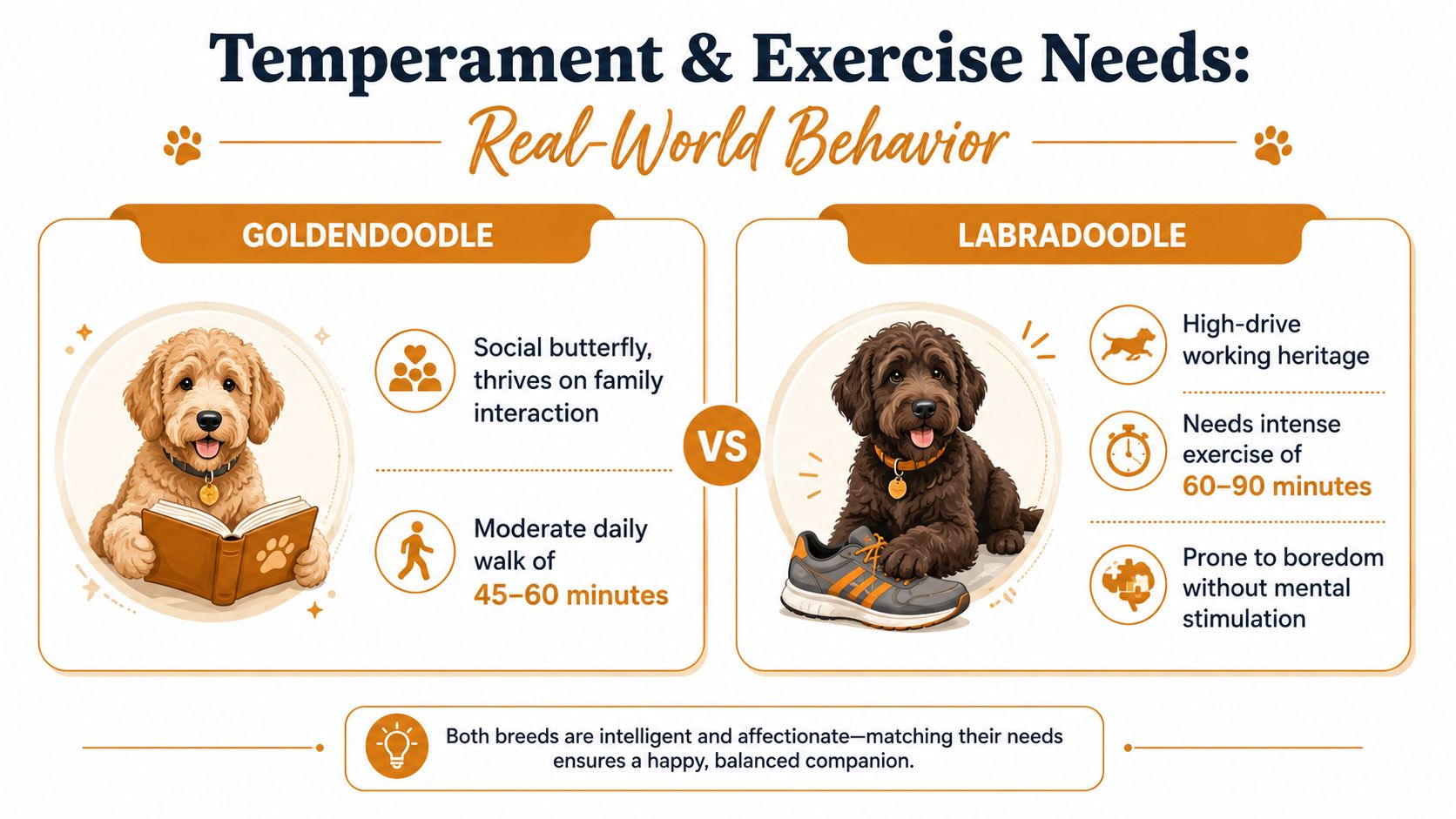
The most useful temperament data doesn't support dramatic personality claims. A peer-reviewed behavioral study found that Goldendoodles did not differ significantly from Miniature Poodles on owner-directed aggression, dog-directed fear, stranger-directed fear, touch sensitivity, or separation-related problems, and the same study reported that Labradoodles showed a similar overall behavioral profile to their parent breeds rather than a uniquely distinct risk pattern (PMC study). That pushes the analysis away from “which doodle is calmer” and toward “which breeder line and socialization plan are you buying.”
The Label Matters Less Than the Line
A Goldendoodle often fits households that want a highly social dog that likes constant interaction. A Labradoodle often attracts buyers who want a task-oriented companion with a stronger working-dog feel, especially if the Labrador side is prominent. But the study above suggests that those are tendencies, not guarantees, and the specific parents and early handling are the more reliable predictors.
Exercise needs follow the same logic. These are active, intelligent dogs that usually need structured activity, not just a quick potty walk and a backyard. The exact amount depends on the individual dog, but both crosses do best when owners pair physical exercise with training games, retrieval work, scent games, or other mentally demanding tasks. If your household is inconsistent, either dog can become restless or destructive.
The Labrador Retriever breed page is useful context because the retriever side helps explain why many Labradoodles lean into high engagement and repetition-based play. That doesn't make them apartment-proof by default. It does mean they're easier to live with when their energy has a job to do.
Fit by Household Type
- Families with children: Both can fit well if the breeder prioritized steady nerves and the home can handle daily activity.
- Single professionals: The right dog can work in an apartment, but only with training, consistency, and enough enrichment to prevent boredom.
- First-time owners: A calmer individual from a reputable program is safer than choosing based on the breed label alone.
- Busy homes: Predictable routines matter more than breed mythology. Neither dog is a plug-and-play companion.
If you want the simplest decision rule, use this one. Choose the individual dog whose parents, socialization, and energy pattern match your home, then ignore the internet's urge to turn the doodle label into a personality test.
Grooming Demands and the Allergy-Friendly Myth
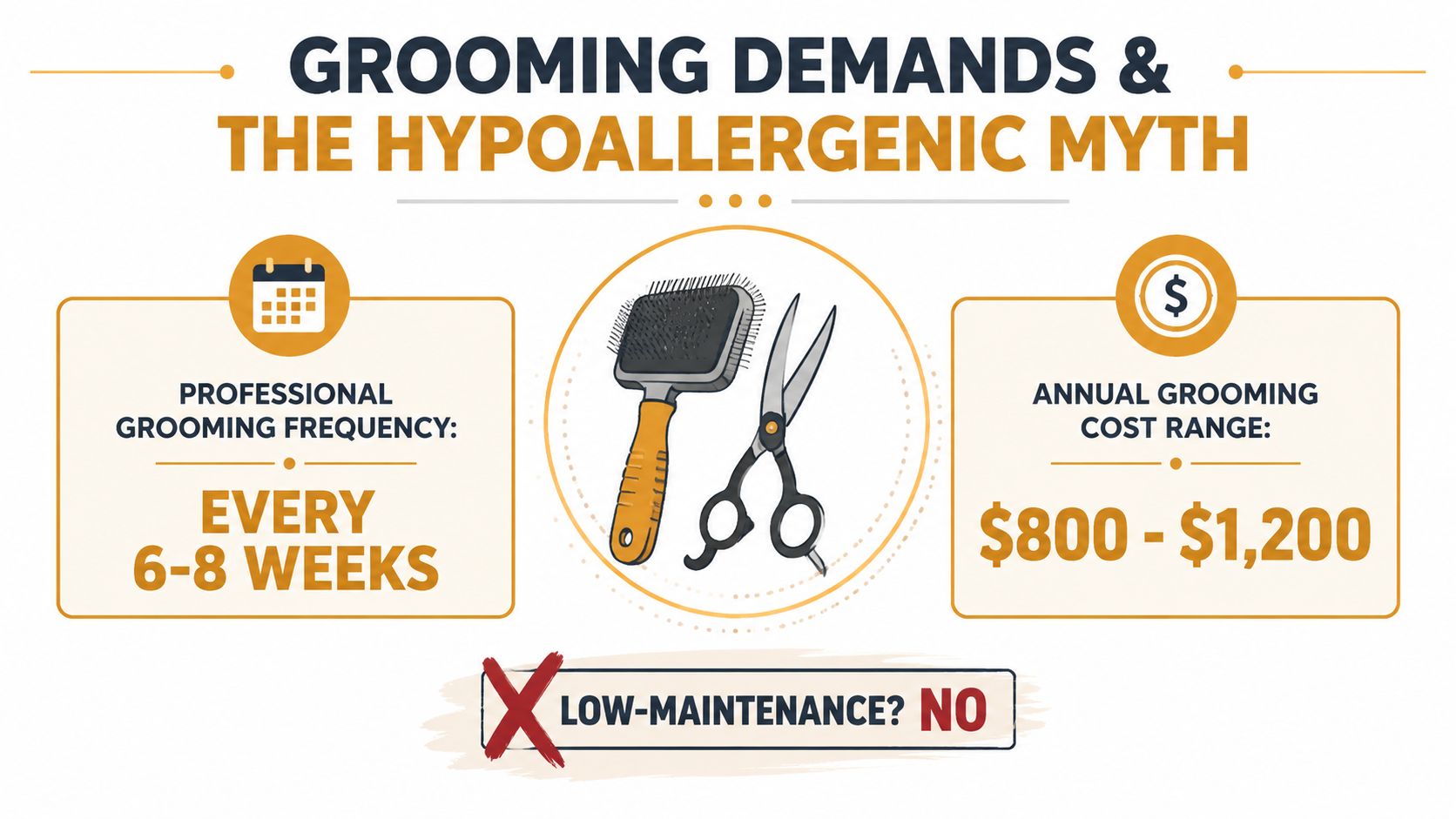
The grooming story is where a lot of buyers get surprised. Independent and recent sources show that Goldendoodles and Labradoodles often need professional grooming every 6 to 8 weeks, and grooming is one of the larger recurring line items these coats bring (HeyDog). That's why “low-shedding” is not the same thing as “low-maintenance.”
Allergy Friendly Is Not Allergy Proof
Major veterinary guidance generally emphasizes that no breed is allergy-proof, and allergen exposure varies by dog rather than by label alone (Great Pet Care). That means the popular claim that doodles are automatically safe for allergy-sensitive households is too simple. Some dogs may be easier for a specific person to live with, but the coat doesn't erase dander, saliva exposure, or the need to test the dog in the home environment.
The maintenance burden also changes with coat type and generation. Wavy and curly coats can trap debris and mat more easily, especially around the ears, collar, armpits, and legs. Hair-like coats can shed more and require a different care pattern, which is one reason two dogs with the same breed name can feel completely different to live with.
Practical rule: if a doodle is being chosen for allergy reasons, treat the individual dog as the test case, not the breed name.
What Owners Need to Budget for in Time, Not Just Money
The trade-off isn't only professional grooming. It's the time spent brushing, checking for tangles, and preventing mats before they turn into a full shave-down appointment. Owners who don't enjoy coat care usually discover that the “designer” part of a doodle doesn't reduce the work, it just changes where the work shows up.
For readers comparing maintenance expectations with the Golden side of the equation, the Golden Retriever breed page helps explain why the retriever ancestry can still leave owners with a dog that wants attention, coat management, and regular upkeep. If the goal is a minimal-care dog, neither cross is a clean fit.
The honest conclusion is that doodle coats can be manageable, but they're not effortless. Buyers should assume regular professional grooming, ongoing brushing at home, and no guarantee that allergies will improve just because the dog has Poodle ancestry.
Breed Specific Health Risks and Expected Treatment Costs
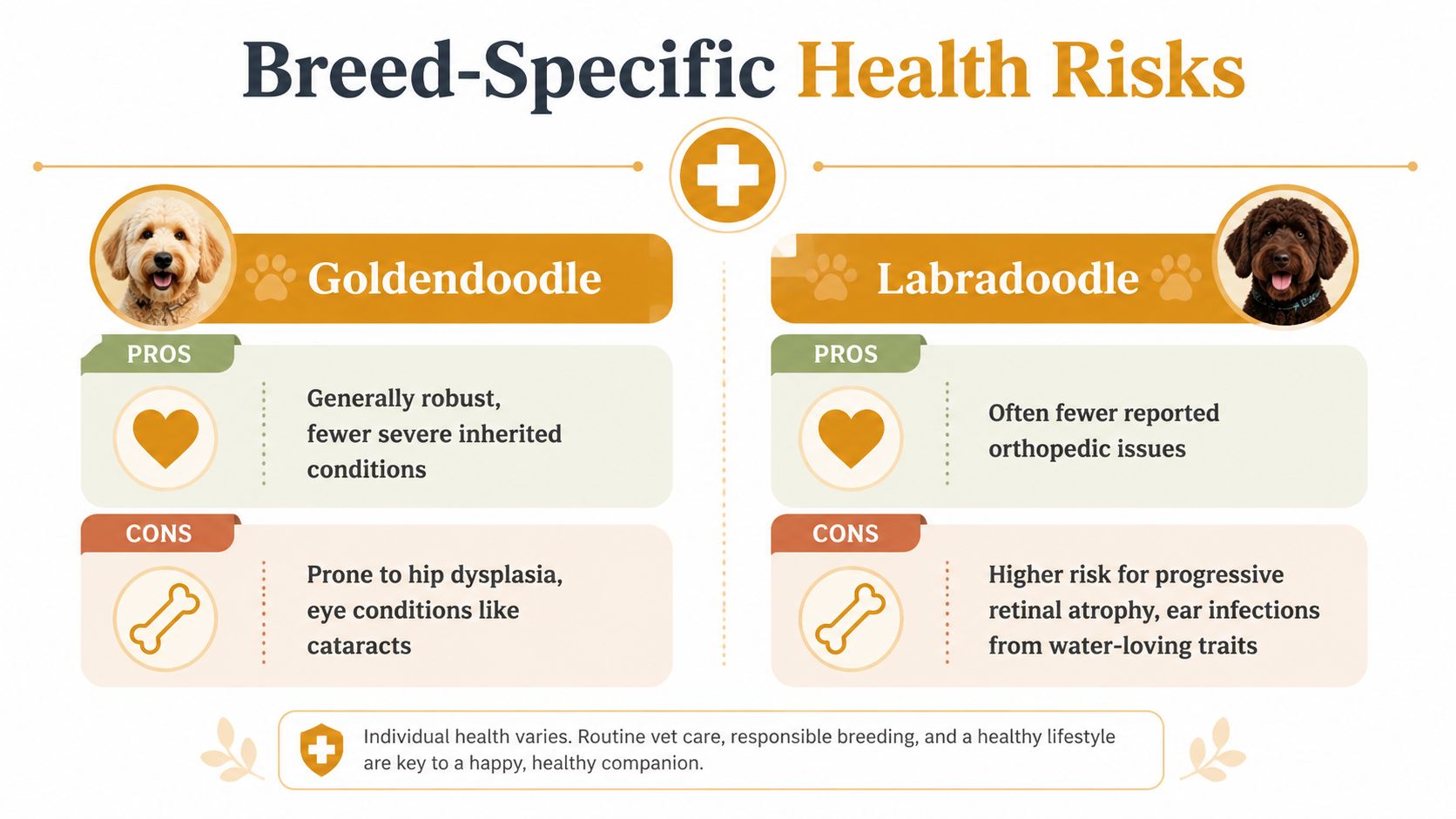
The main health point is straightforward. Both dogs sit in a similar lifespan range, about 12 to 15 years, but the conditions owners should plan for are not identical (PetPlace). That difference matters because treatment risk is driven more by likely diagnoses than by average longevity.
Side by Side Risk Profile
Goldendoodles are more often linked with hip dysplasia, ear infections, and some heart or eye conditions (PetPlace). Labradoodles are more often flagged for hip and elbow dysplasia plus progressive retinal atrophy and related eye disorders (PetPlace). That means the comparison is not just about appearance or temperament. It is about which body systems need closer preventive monitoring.
The practical screening plan should follow those patterns. For Goldendoodles, ear checks and cardiac discussion belong early in routine care, especially if the dog shows head shaking, odor, or exercise intolerance. For Labradoodles, eye exams and orthopedic monitoring deserve early attention, since vision changes and gait issues are easier to manage when caught before they become advanced.
What That Means for Cost Modeling
Cost planning becomes a veterinary scheduling problem, not a vague health guess. Orthopedic, ophthalmic, and ear-related issues can lead to repeat visits, diagnostics, medication, or specialist referral. Because the two breeds cluster around different risks, the better question is which condition set is more plausible for the individual dog.
A recent PubMed study included both Goldendoodles and Labradoodles among affected dogs in a cardiac condition sample, which is a reminder that mixed breeding does not erase inherited disease risk. The useful takeaway is narrower: buyers should screen the parents, ask what tests were done, and treat lineage as one input rather than a guarantee.
Key takeaway: health planning should center on likely orthopedic, eye, ear, and cardiac issues, not on the assumption that breed mixing solved the problem.
State-level pricing changes the bill as well. The same diagnosis can cost very different amounts depending on where a household lives, so a dog in one state can be much more expensive to treat than the same dog elsewhere. That is why state-adjusted analysis gives a more realistic ownership forecast than broad national averages.
For owners who want a breed-and-location estimate, the lifetime cost calculator is more useful than a generic breed summary.
Lifetime Ownership Costs Across US States

A doodle's lifetime ownership burden is shaped by three moving parts, health risk, grooming frequency, and local veterinary pricing. The first two are breed-related, but the third changes by state, which is why the same puppy can look affordable in one place and much more demanding in another. That difference is exactly what state-adjusted modeling is built to capture.
Why Geography Changes the Decision
The cost impact is not just about whether the dog needs care, it's about where that care happens. Vet visits, diagnostics, follow-up appointments, and grooming all vary by local market conditions, so a household in a higher-cost state faces a different planning problem than one in a lower-cost state. That's why comparing doodles only on temperament ignores the part of ownership that hits your household calendar and your wallet.
The better model looks at the dog's likely condition mix and then localizes it. A Goldendoodle with higher concern around ear problems and joint issues won't produce the same long-term profile as a Labradoodle with more emphasis on eye-related monitoring and orthopedic screening. The state you live in changes how expensive those concerns become in practice.
What to Compare Before You Commit
- Condition exposure: Ask which inherited risks are most plausible for the exact dog, not the breed label.
- Grooming rhythm: Expect professional coat care every few weeks, then factor in brushing and mat prevention at home.
- Local vet pricing: Use your state, not a national average, when projecting regular and unexpected care.
- Insurance fit: Compare whether policy coverage lines up with the breed's most likely problems rather than assuming all plans behave the same way.
PetCostEngine's breed-specific and state-adjusted approach is designed for that kind of comparison, and the calculator lets you test the same dog across states and age assumptions. That matters because a doodle's ownership profile is not fixed, it's a function of breed, zip code, and care pattern.
The core insight is straightforward. If you're choosing between these two crosses, the state you live in should influence the decision nearly as much as the coat you like. Ignoring geography is how people underestimate the full commitment.
Choosing the Right Doodle for Your Situation
If you want the dog that is easiest to explain in a narrow breed-summary sense, neither one wins outright. If you want the dog that best fits a real household, the answer depends on how much grooming, risk management, and activity you can handle consistently.
A Practical Matchup
- First-time owners: Lean toward the individual puppy or rescue with the most stable parents, predictable handling, and the clearest breeder history. Breed name alone won't make the transition smooth.
- Families with kids: Either can work, but the better pick is the line with stronger socialization and a home that can support daily exercise and routine coat care.
- Allergy-sensitive homes: Treat both as uncertain. Meet the dog, spend time around it, and don't assume Poodle ancestry solves the problem.
- Owners who hate grooming: Neither is a natural fit. The upkeep is part of the deal, not an optional add-on.
- Buyers in high-cost states: Build the decision around localized care burden, not just temperament or appearance.
- People who want a more task-driven dog: Labradoodle lines often feel like the more working-leaning option, but only if the parent lines support that tendency.
The strongest conclusion from the evidence is that the best goldendoodle vs labradoodle choice is usually not about breed name at all. It's about finding the right breeder program, the right coat expectations, and the right risk tolerance for your household.
If you want a cleaner decision path, start with your state, your grooming tolerance, and your comfort with orthopedic and eye-related care. Then compare the projected ownership picture instead of relying on generic doodle marketing or social media shorthand.
If you're weighing a Goldendoodle or a Labradoodle, PetCostEngine can help you compare breed-specific health risks, grooming burdens, and state-adjusted ownership projections in one place. Use PetCostEngine to run your own scenario, then choose the dog that fits your home, your budget, and your tolerance for long-term care.
Estimated lifetime and yearly costs for a Compare, state by state, plus whether pet insurance breaks even for the breed.
See Compare costs →
Is insurance worth it for a Compare? →
Joint supplement → Puzzle toys → No-pull harness →
As an Amazon Associate, PetCostEngine earns from qualifying purchases.