

Many dogs show initial comfort within three months, but longitudinal research shows that true behavioral and emotional adjustment typically takes four to six months, with some dogs needing over seven months to fully stabilize. In one 2025 study, only 30% of adopters said their dog adjusted within three months, while 41% reported four to six months and 11% reported more than seven months. The study in Animal Welfare also found that 19% felt their dog still hadn't settled by the interview date.
That finding challenges the most popular advice new adopters hear. The 3-3-3 rule is useful as a gentle starting framework, but it isn't a deadline. A rescue dog may sleep through the night, follow you from room to room, and appear easy to live with, while still processing unfamiliar sounds, people, routines, handling, and separation.
Adjustment is better understood as a changing process than a finish line. Your dog may gain confidence in one area and become more reactive in another. They may stop hiding, then begin barking at visitors. They may relax at home while finding walks overwhelming. None of that automatically means you've failed or chosen the wrong dog.
Table of Contents
- The Reality of Rescue Dog Adjustment Timelines
- Navigating the Initial Decompression Phase
- Why Behavior Changes Months After Adoption
- Looking Settled Versus True Emotional Stability
- Factors That Accelerate or Delay the Transition
- Recognizing Progress and Knowing When to Seek Help
- Building a Long-Term Bond Beyond the Adjustment Period
The Reality of Rescue Dog Adjustment Timelines
A rescue dog can look settled after three months and still be far from emotionally stable. The 3-3-3 rule offers a useful starting point, not a finish line. The ASPCA's adoption guidance describes the first 3 days as decompression, the next 3 weeks as a period for learning household routines, and the first 3 months as a common window for becoming comfortable. It also explains that individual pets may adjust faster or need longer.
Longitudinal research places the adjustment process on a longer curve. In a six-month study, owners were contacted at 7, 30, 90, and 180 days. By day 180, 100% of owners reported that their dog had adjusted either “extremely” or “moderately” well. During that period, 93.7% rated overall behavior as excellent or good, while 75% said behavior had improved since adoption. The full study in Animals supports using the half-year point to assess broad behavioral change.
Three months is a checkpoint, not a verdict
The 2025 Animal Welfare study adds an important qualification. Among adopters, 70% placed adjustment beyond three months, including those who reported four to six months, more than seven months, or no completed adjustment by the interview date. More than one in four said the process lasted beyond six months or remained incomplete. The peer-reviewed study found that many dogs need longer than the familiar three-month framework suggests.
A dog may therefore look comfortable before deeper coping patterns have changed. They might eat normally, rest near family members, respond to their name, and follow bathroom routines, yet still react strongly to visitors, handling, unfamiliar sounds, or time alone. Early cooperation shows that learning has started. It does not prove that the dog feels secure in every situation.
Practical rule: Use the first three months to observe patterns and support progress. Avoid making final judgments about temperament while your dog is still learning whether the home is safe.
History can lengthen the process. Multiple transitions, limited social exposure, illness, pain, or a shelter setting with little uninterrupted rest may all affect how quickly a dog settles. To anticipate how size and breed-related needs may shape expectations, use this breed comparison tool before adoption.
You may never know every detail of your dog's past, and you do not need a dramatic explanation for each behavior. Track what helps the dog function better today. That long view turns adjustment from a countdown into an ongoing process of building safety.
Navigating the Initial Decompression Phase
The first few weeks should feel intentionally uneventful. Your new dog has entered a home filled with unfamiliar smells, surfaces, voices, appliances, doors, and expectations. Even a friendly dog may need quiet time before they can learn effectively.
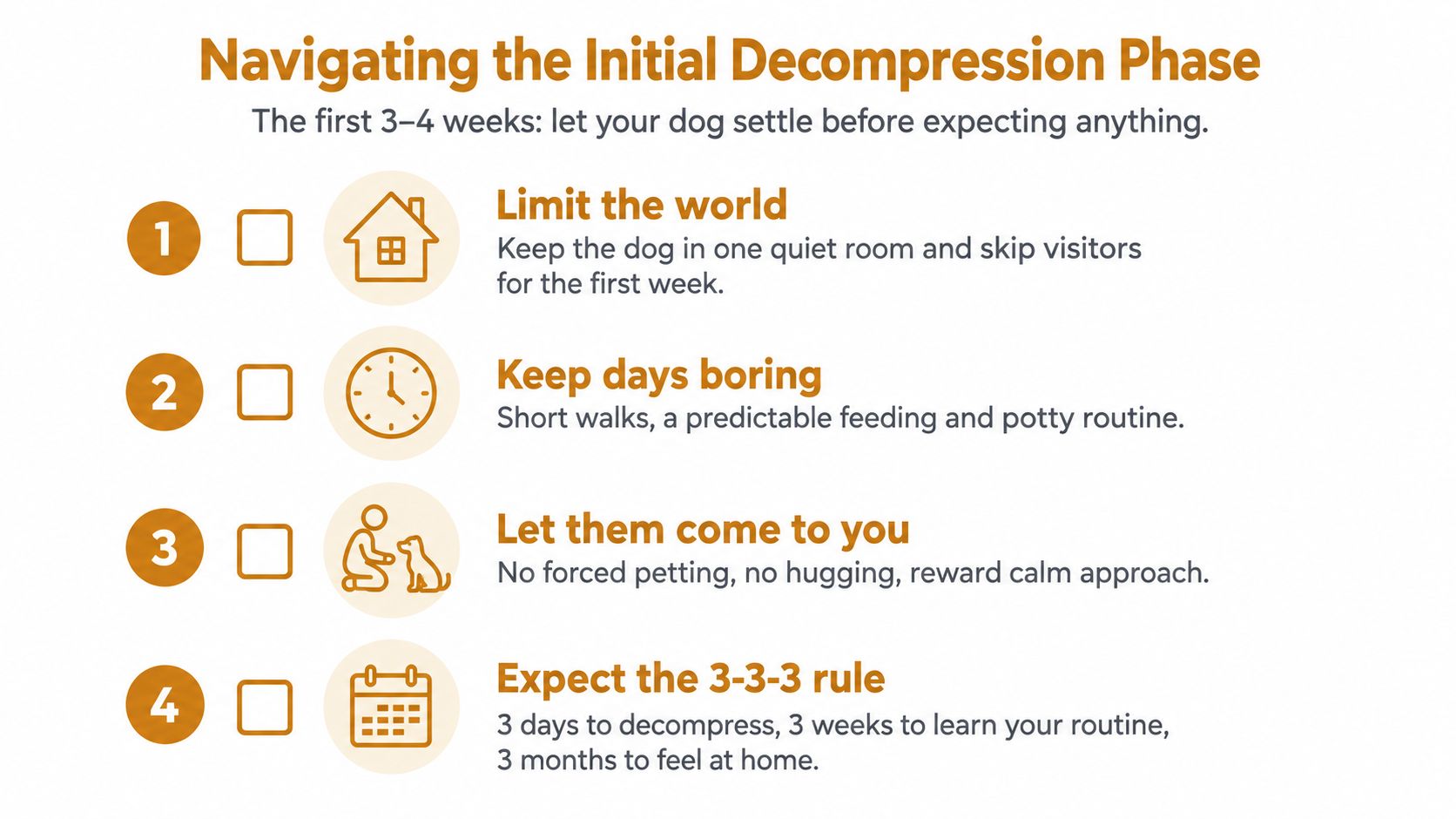
Make the first days smaller
Choose a calm area where your dog can rest without being surrounded by activity. A baby gate, pen, or quiet room can prevent accidental crowding and reduce the number of decisions your dog has to make. Keep food, water, bedding, and safe enrichment close by, and let the dog leave that space voluntarily when possible.
For the first week, skip unnecessary visitors and avoid turning the arrival into a greeting event. Family members should sit still, angle their bodies away, and allow the dog to approach. Petting should be an invitation, not an obligation. A dog that backs away, freezes, turns their head, licks their lips, or yawns is communicating that the interaction feels difficult.
Build a predictable rhythm around meals, bathroom breaks, rest, and short walks. The walk isn't a sightseeing tour yet. Choose quiet routes, keep the leash secure, and return home before your dog becomes overwhelmed. For dogs who find outdoor life intense, calm sniffing in a controlled area may be more useful than covering distance.
Introduce people and animals gradually
If you live with another dog, begin with management rather than forced friendship. Use separate resting and feeding areas, supervise shared spaces, and watch for stiff bodies, hard staring, guarding, or repeated attempts to escape interaction. Cats and other small animals need physical separation and careful observation, even when the rescue organization described the dog as comfortable with them.
A breed page can help you think about activity needs and handling considerations, but it can't predict one individual dog's behavior. Use the American Water Spaniel breed information as an example of breed research, then assess the dog in front of you rather than relying on a label.
Your first-month checklist is simple:
- Limit stimulation: Keep the home calm and postpone optional social plans.
- Protect sleep: Provide uninterrupted rest instead of constant interaction.
- Reward voluntary contact: Reinforce a calm approach, eye contact, or settling nearby.
- Prevent rehearsals: Use gates and leashes to stop dangerous chasing, stealing, or door rushing.
- Record patterns: Note appetite, sleep, bathroom habits, triggers, and recovery after surprises.
The purpose of decompression isn't to isolate your dog indefinitely. It's to lower pressure long enough for learning, trust, and ordinary household routines to take hold.
Why Behavior Changes Months After Adoption
A dog can appear remarkably easy during the first weeks and then begin showing behavior that surprises the household. That change often reflects increased confidence, not a sudden personality switch. A quiet dog may have been observing and coping rather than feeling relaxed enough to express preferences or concerns.
The six-month longitudinal research followed dogs through several checkpoints and found that adjustment wasn't linear. Separation-related behaviors decreased by the six-month mark, while stranger-directed aggression, excitability, touch sensitivity, chasing, and training difficulty changed at earlier points or increased across the study period. The behavior-focused analysis makes an important distinction: reduced distress in one context doesn't guarantee broad behavioral stability.
The honeymoon period can hide information
During the early period, some dogs eat little, sleep heavily, stay close to a person, or avoid exploring. Others seem quiet and compliant because they haven't yet learned the household's patterns. Once they understand that the home is likely to remain available, they may investigate more, test boundaries, guard resources, vocalize, or react to situations they previously ignored.
That doesn't mean the dog is manipulating you. It means the dog's behavior is changing as the environment becomes more predictable. A dog who begins barking at guests in month two may be revealing a concern that wasn't visible during the first days, not becoming “worse” for no reason.
Respond by reducing intensity and increasing clarity. Use distance from triggers, barriers, food scatters, short training sessions, and predictable exits. Avoid flooding the dog with visitors or repeating difficult exposures until they stop reacting. If touch sensitivity or aggression is emerging, arrange veterinary and qualified behavior support rather than trying to prove that the dog should tolerate handling.
A calmer house and a broader behavior profile can appear at the same time. Track each behavior separately instead of assigning the dog one overall label.
Measure direction, not perfection
A useful journal might show that your dog now settles after a visitor leaves, even though they still bark when the visitor arrives. That's progress. Another dog may walk farther but take longer to recover after seeing a stranger. Both observations matter.
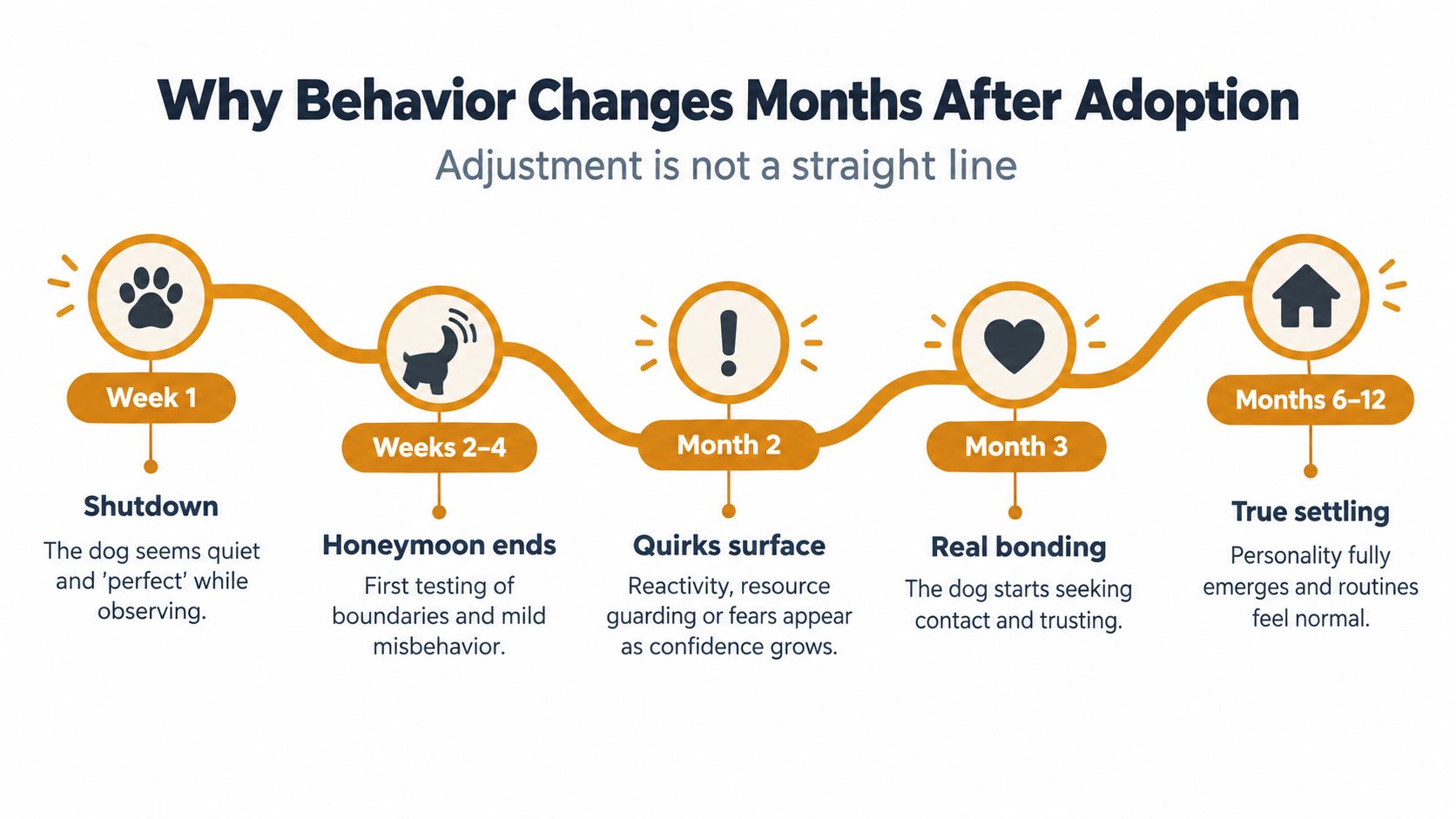
The most helpful records describe what happened before the behavior, what the dog did, and how long recovery took. That information gives a trainer or veterinary behavior professional something concrete to analyze.
For a visual explanation of this non-linear process, watch the following resource:
Looking Settled Versus True Emotional Stability
A dog can look settled before they feel secure. Sleeping in a visible place, using the yard, and following a household routine are encouraging signs, but they don't tell the whole story. Some dogs cope by staying still, monitoring people, eating only when alone, or complying without offering relaxed social behavior.
Researchers have also examined physiological stress during the post-adoption period. Peer-reviewed shelter-dog research notes that stress markers such as cortisol may continue changing for up to six months after adoption, and owner-reported adjustment often clusters across three to six months. The study's published research report supports waiting before treating early behavior as a final temperament assessment.
Compare coping signals with relaxation signals
| Looks settled | More convincing stability |
|---|---|
| Lies down but keeps the body tense and tracks movement | Rests with a loose body, soft eyes, sighs, or stretches |
| Walks politely because they're inhibited or overwhelmed | Checks in, explores appropriately, and can disengage |
| Eats only when nobody is watching | Eats consistently in ordinary household conditions |
| Stops hiding but remains watchful | Chooses proximity and moves away comfortably |
| Appears quiet after a stressful event | Recovers and returns to normal behavior within a reasonable period |
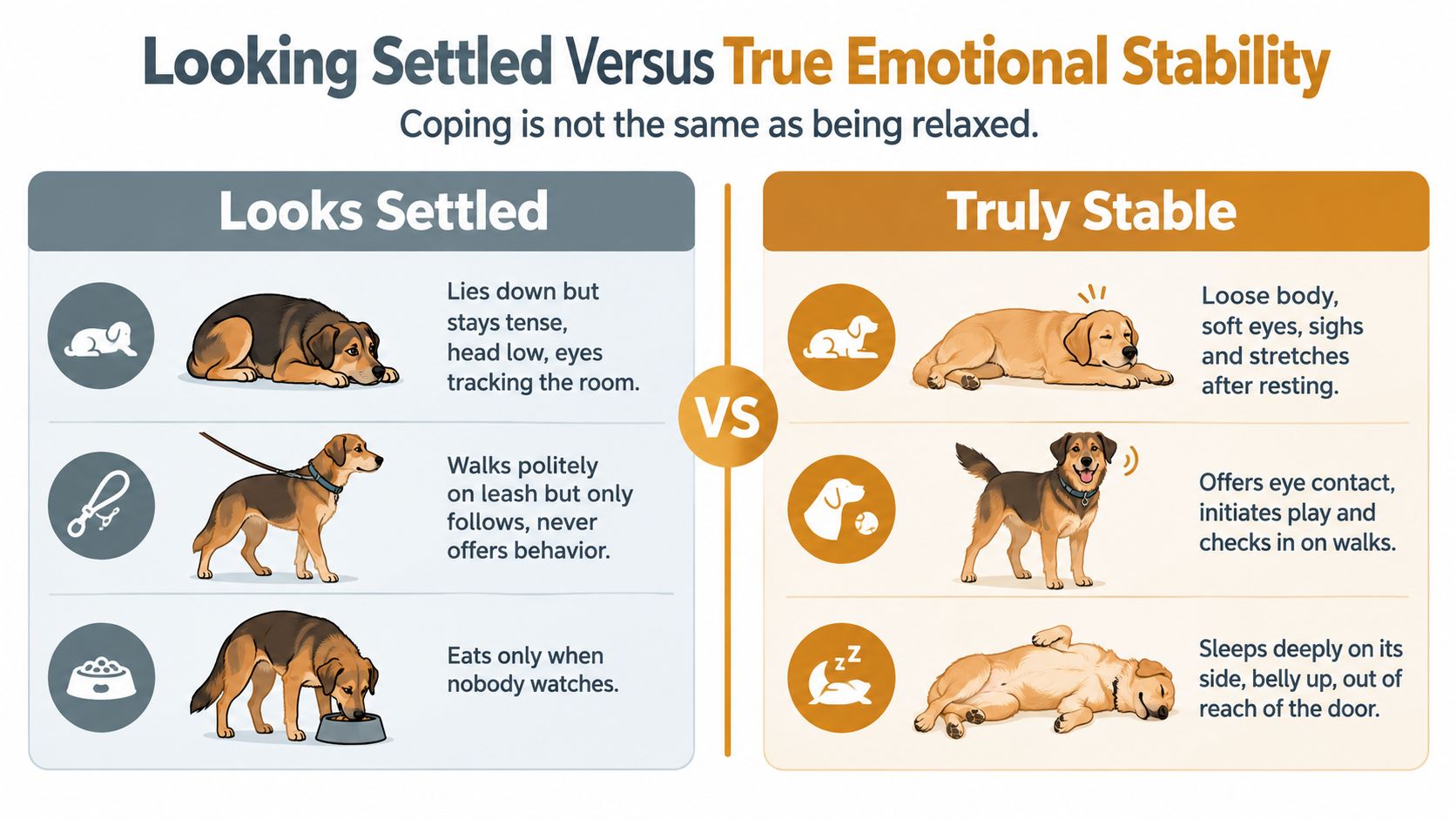
No single behavior proves emotional stability. Look for patterns across sleep, appetite, play, movement, social contact, and recovery. A dog who can rest away from the door, initiate play, and return to baseline after a startle is showing more than simple compliance.
Don't make final assumptions during the first few weeks. Instead, ask whether your dog is gaining flexibility. Can they handle a small change in routine? Can they pause near a trigger? Can they seek help, move away, and settle again? Those abilities provide a more useful picture than whether the dog appears “good” in a new home.
Factors That Accelerate or Delay the Transition
Rescue-dog adjustment depends on the interaction between the dog and the home, not on time alone. A confident adult dog entering a quiet household may progress differently from a fearful dog entering a busy home with children, visitors, stairs, and other animals. Age, previous experience, health, sensory sensitivity, breed-related tendencies, and daily structure all shape the process.
Breed is one consideration, not a diagnosis. A high-drive working dog may need thoughtful outlets for movement, sniffing, problem-solving, and training. A senior dog may need slower introductions to flooring, stairs, vehicles, and handling, particularly if discomfort affects confidence. A small dog may still have intense exercise and enrichment needs, while a large dog may require careful management because their physical responses carry more force.
The home can either lower or add pressure
Predictability helps most dogs. Consistent meal and bathroom routines, planned rest, clear access rules, and calm transitions reduce the number of surprises your dog must process. The schedule doesn't need to be rigid, but it should be understandable.
Your own readiness matters, too. Reliable access to veterinary care, appropriate food, secure equipment, training support, and safe confinement removes practical friction during a demanding period. If you're comparing dogs with different activity levels or health considerations, browse the breed pages to prepare better questions for the rescue organization and your veterinarian.
Some dogs need more management before they can safely earn freedom. Gates, closed doors, a properly fitted harness, and supervised interactions aren't signs that the adoption is failing. They prevent rehearsals of chasing, door rushing, resource guarding, or destructive behavior while you teach alternatives.
Match enrichment to the individual
Avoid using exercise as the only answer to high arousal. A dog who becomes frantic after intense fetch may need shorter play, sniffing, chewing, quiet training, and enforced rest instead. Another dog may benefit from gradual outdoor exploration, food puzzles, or simple pattern games.
The right test is the dog's response afterward. Useful enrichment leaves the dog able to rest, eat, and engage. If an activity produces prolonged pacing, mouthiness, barking, or inability to settle, reduce the intensity and consult a qualified professional.
Recognizing Progress and Knowing When to Seek Help
A rescue dog can look settled before feeling secure. Progress is easier to see when you track functional changes, not a sudden personality transformation. In the early weeks, ask whether your dog can predict basic routines, rest more often, eat consistently, and recover from ordinary household activity. Over the following months, look for flexibility: moving through familiar routines with less prompting and handling manageable changes without prolonged distress.
Longitudinal follow-up supports a longer view. By the six-month mark, owners in one study generally described their dogs as adjusting well, with overall behavior often rated positively and improvement reported since adoption. The pattern was uneven. One behavior might improve while another becomes visible as the dog grows comfortable enough to express it. Review the study's follow-up results (Animals longitudinal study, day 180 follow-up) for that fuller context.
Use a simple progress record
Once or twice a week, record a few observations:
- Recovery: How long does your dog need after a startling sound, visitor, or difficult walk?
- Routine tolerance: Can they manage departures, meals, grooming, and rest periods with less distress?
- Social choice: Do they approach, move away, or seek contact without pressure?
- Body language: Are their muscles loose, movements fluid, and eyes soft in familiar settings?
- Behavior trend: Which behaviors are improving, unchanged, or becoming more intense?
Short notes reveal patterns that memory can blur. A dog who still startles may nevertheless recover faster, accept food sooner, or choose to rejoin the household. Those are meaningful gains.
Seek professional help when behavior threatens safety or prevents basic welfare. Escalating resource guarding, snapping, biting, severe separation distress, repeated panic, inability to sleep, or inability to eat should not be managed by waiting alone. Sudden changes also warrant veterinary attention because pain and medical problems can affect fear, irritability, appetite, and tolerance for touch.
Choose support carefully. A veterinarian can assess health and discuss referrals. A qualified reward-based trainer or veterinary behavior professional can create a plan for reactivity, separation-related distress, guarding, or handling concerns. Punishment can suppress growling or avoidance without changing the underlying emotion, removing useful warnings instead.
Seek help early: Professional guidance is not an admission that the adoption went wrong. It gives you a safer plan while your dog is still learning.
Patience suits mild hesitation and gradual confidence building. It does not require leaving a dog or household in danger. Use the PetCostEngine calculator to organize ownership planning while you decide which veterinary and training support fits your situation.
Building a Long-Term Bond Beyond the Adjustment Period
A rescue dog doesn't pass an adjustment test and become finished. The early months establish the conditions for a lasting relationship. You're teaching your dog that rest is safe, communication works, routines are predictable, and people respond without unnecessary pressure.
The practical timeline is longer than the popular slogan suggests. Some dogs show comfort within the first three months, while research has found that many owners place fuller adjustment at four to six months, with some reporting a longer period. Behavior may improve in one area and become more visible in another, so judge progress by flexibility, recovery, and trust rather than by the disappearance of every challenge.
A dog who once watched the door may eventually sleep across the room. A dog who initially followed may later bring a toy, check in on a walk, or choose contact. Those changes come from repeated safe experiences, not from forcing affection or demanding quick independence.
For more information about the organization behind the ownership tools, visit PetCostEngine's about page. Keep your expectations generous, your routines steady, and your observations specific. Your rescue dog doesn't need you to predict the entire future. They need you to make today safe enough for tomorrow's progress.
PetCostEngine offers breed- and state-specific ownership planning tools, including a lifetime calculator, breed health references, and practical guides that can help you prepare for veterinary and training needs alongside your dog's adjustment. Visit PetCostEngine to build a clearer plan for supporting your rescue dog throughout the first months and beyond.
Estimated lifetime and yearly costs for a Compare, state by state, plus whether pet insurance breaks even for the breed.
See Compare costs →
Is insurance worth it for a Compare? →
Crate and bedding → Puzzle toys → Training treats →
As an Amazon Associate, PetCostEngine earns from qualifying purchases.