

You're standing in an apartment hallway with a puppy who urgently needs to go. The elevator is still several floors away, a neighbor is waiting by the lobby door, and your puppy has already started circling. In a house, you might open the back door. In a high-rise, the trip to the potty area is part of the training problem.
Successful apartment house training depends less on reacting to accidents and more on preventing them. You need a schedule that respects immature bladder control, a plan for elevators and shared spaces, and a deliberate choice about whether an indoor backup station belongs in your routine. The method should fit your building, your puppy's age, and how quickly you can reach an acceptable elimination area.
Table of Contents
- Understanding Puppy Bladder Capacity and Timing
- Choosing Between Outdoor and Indoor Potty Stations
- Building a Realistic Daily Apartment Schedule
- Mastering Crate Confinement and Reward Timing
- Navigating Hallways and Shared Building Spaces
- Managing Setbacks and Long-Term Ownership Costs
Understanding Puppy Bladder Capacity and Timing
A puppy doesn't choose to ignore your training when an accident happens on the way to the elevator. Young dogs have limited bladder and bowel control, and apartment transit can consume the time they do not have. Treat capacity as a physical limit first, then build your routine around it.
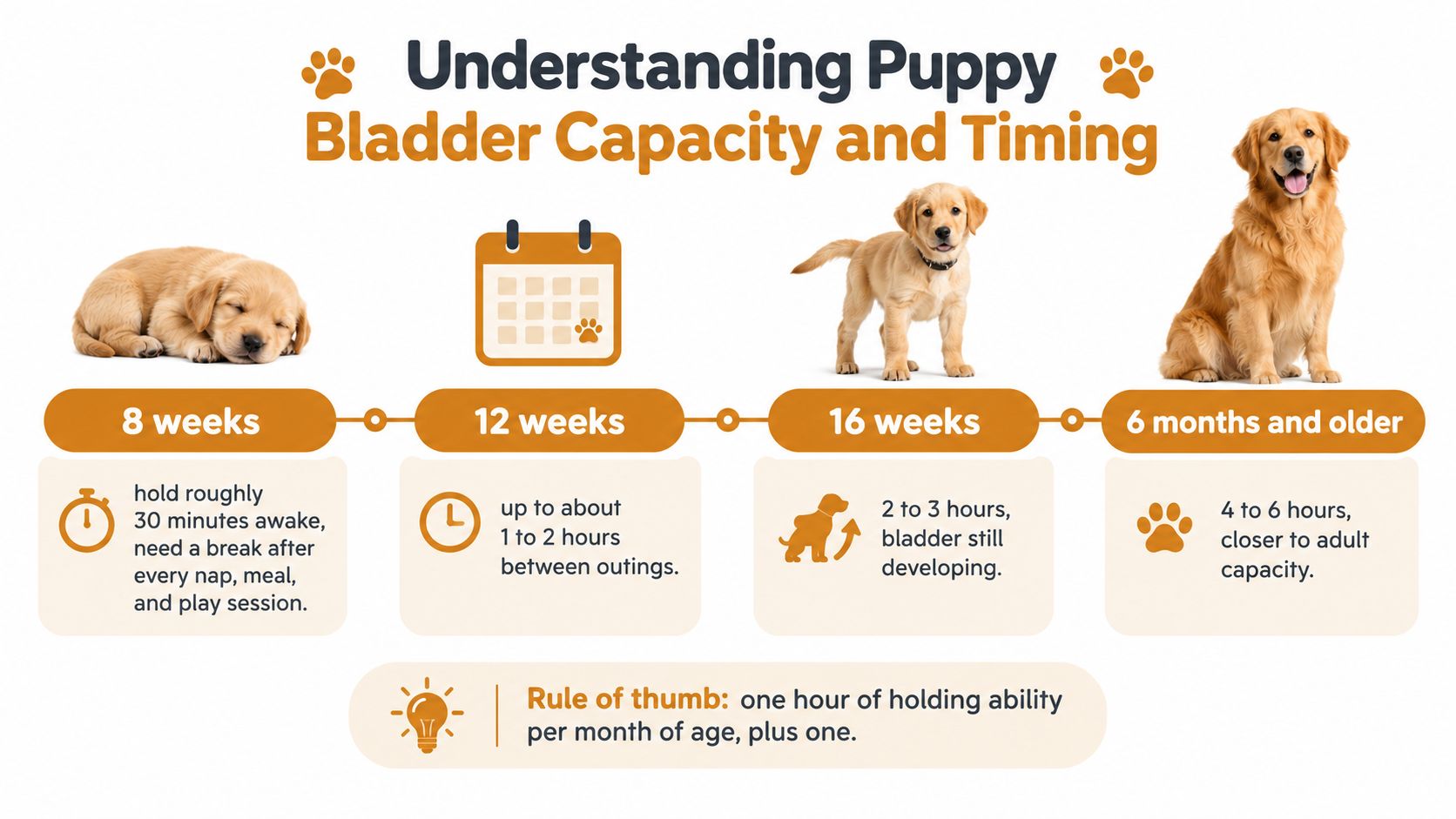
A widely used guideline estimates that a puppy can generally hold its bladder for about one hour per month of age, with a common adult ceiling of 6 to 8 hours according to ASPCA Pet Health Insurance's crate-training guidance. That rule is only a starting point. Excitement, water intake, meals, naps, play, illness, and the time required to leave your building can shorten the practical interval.
Use age as a planning limit
Age-based guidance gives apartment owners a more useful framework than a single formula. Puppies around 9 to 10 weeks may manage roughly 30 to 60 minutes, while puppies around 11 to 14 weeks may manage about 1 to 3 hours. At 15 to 16 weeks, the practical range is often 3 to 4 hours, and after 17 weeks, guidance commonly places it around 4 to 6 hours, as outlined by ASPCA Pet Health Insurance.
Another source gives tighter expectations for younger puppies: 8 to 10 weeks, up to 1 hour; 11 to 12 weeks, up to 2 hours; and 13 to 16 weeks, up to 3 hours. It also advises that puppies under 6 months shouldn't remain crated for more than 3 to 4 hours at a time. SPCA Wake's crate-training guidance supports the practical conclusion that short, structured confinement is safer than asking a young puppy to endure a long absence.
For apartment planning, subtract the building delay from the puppy's realistic capacity. If your puppy can barely wait an hour and the elevator can take several minutes, you can't wait for a clear signal at the front door. Take the puppy out immediately after waking, then again after meals, play, and naps. Owners of smaller dogs may find the small-breed reference pages useful when comparing how body size and lifestyle affect daily management, but don't use breed size as a substitute for observing your individual puppy.
Practical rule: Schedule the next break before your puppy needs to ask. Prevention teaches faster than repeated cleanup.
Choosing Between Outdoor and Indoor Potty Stations
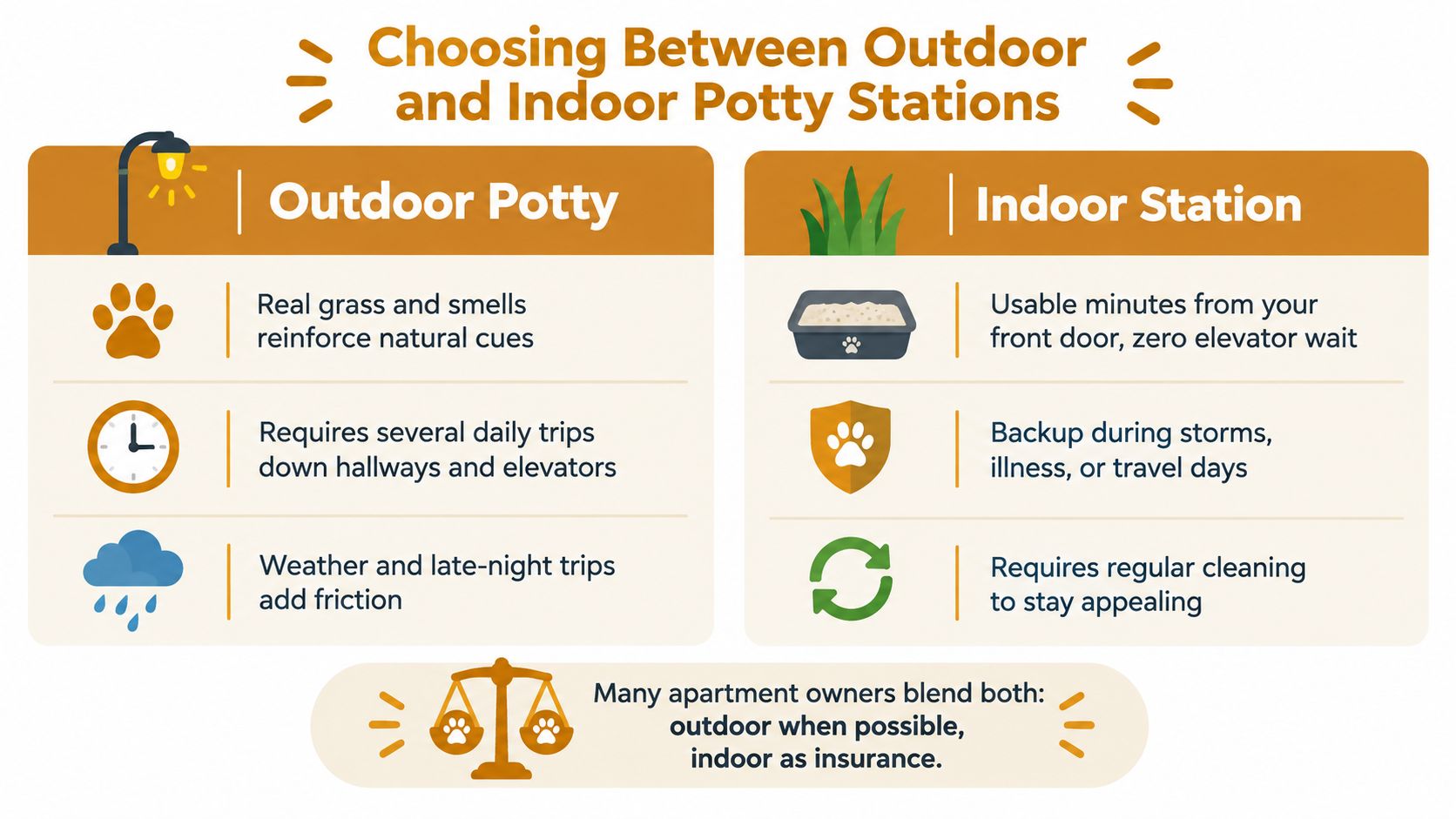
High-rise living usually presents two workable systems. Outdoor-only training gives the clearest message: eliminate on grass or another outdoor surface, never inside. An indoor backup station gives you a safe option when the elevator is delayed, weather is severe, or your puppy can't physically wait through the trip.
Neither method is automatically correct for every household. Outdoor-only training can produce a clean distinction between acceptable and unacceptable locations, but it demands frequent trips and reliable access. Pads, indoor turf, dog litter, or a balcony potty area reduce transit pressure, yet they introduce another surface that the puppy must learn to use selectively.
Outdoor-only training
Choose outdoor-only training when someone can provide frequent breaks and the building route is manageable. Carrying a very young puppy through the hallway and elevator can reduce the chance of an accident before you reach grass. Keep the destination consistent, walk directly there, and reward elimination as soon as it happens.
The downside is logistical rather than theoretical. A puppy may need an outing immediately after waking, after eating or drinking, after a nap, and after active play. If you work away from home or live high above the ground, the schedule may be difficult to maintain without help.
Indoor stations as a controlled backup
An indoor station works best when it has one fixed location, a surface that's easy to clean, and a clear role in your routine. VCA Animal Hospitals' potty-training guidance describes a structured approach built around wake-up, meal, play, and nap breaks, with a return to supervision when the puppy doesn't eliminate. That same logic applies indoors. Bring the puppy to the station during a genuine emergency or planned backup period, then reward immediately.
Indoor training can slow the transition to outdoor-only reliability because the puppy learns that elimination is acceptable on more than one surface. Avoid moving the station from room to room, placing pads throughout the apartment, or lining the crate with pads. WebMD's puppy house-training guidance notes that puppies can learn to use pads, but inconsistent placement and a pad inside the crate can create confusion.
A practical compromise is to use outdoor trips as the default and keep one indoor station for situations your building makes genuinely difficult. The toy-breed pages can help you compare dogs whose physical size may affect carrying and transit decisions, but the right station is ultimately the one you can maintain consistently.
Building a Realistic Daily Apartment Schedule
A schedule that says “take the puppy out often” ignores the elevator, lobby, street crossing, and time spent finding a suitable spot. Build the schedule backward from the actual elimination area. If the puppy is awake and active, assume the clock is moving faster than it would in a quiet home with a backyard.
Very young puppies generally need opportunities first thing in the morning, after meals, after drinking water, after naps, after crate time, after play, and before bed. AKC guidance on puppy schedules says many young puppies need breaks every one to two hours during waking periods, and some may need to eliminate at least every 45 minutes while awake. Those are quantitative limits, so keep the source attached when using them as planning benchmarks.
A schedule that includes building transit
Use the table as a framework, not a promise that every puppy will follow the same pattern. Shift the blocks to match your workday, but preserve the trigger-based trips even when the clock changes.
| Time Block | Activity | Potty Action |
|---|---|---|
| Morning wake-up | Puppy leaves the crate or sleeping area | Go directly to the outdoor spot, carrying the puppy if needed |
| After breakfast | Meal and water | Return outside soon after eating and drinking |
| Midmorning | Short play or training | Take another break immediately after activity |
| Late morning | Nap or crate rest | Go out as soon as the puppy wakes |
| Midday | Meal, water, and supervised activity | Repeat the direct post-meal and post-play trips |
| Afternoon | Quiet rest followed by movement | Potty after waking, then use a timer before the next likely accident |
| Evening | Dinner and household play | Go out after eating, drinking, and active play |
| Before bed | Calm wind-down | Make one final outdoor trip, then settle the puppy |
| Overnight | Sleep interrupted by the puppy's need to eliminate | Keep the route quiet and direct; very young puppies may still need overnight breaks |
The AKC's general potty-training guidance commonly frames holding ability as roughly the puppy's age in months in hours, up to about 9 to 12 months. Use that as an upper planning boundary, not a target for daytime confinement. A three-month-old puppy shouldn't be expected to wait through a long stretch just because the arithmetic appears to allow it.
Add a timer before the puppy signals
Take the puppy out before the usual accident window, especially after a large drink, energetic play, or an exciting visitor. If the puppy doesn't eliminate within a short period, return to close supervision or the crate and try again 15 to 20 minutes later, following the procedure described in VCA's puppy potty-training method.
Keep a leash, treats, waste bags, and shoes beside the door. If you must search for supplies while the puppy waits, your apartment has already added unnecessary delay. During overnight trips, use low lights and minimal interaction so the puppy learns that the outing is for elimination, not a midnight play session.
Mastering Crate Confinement and Reward Timing
A crate helps you control access to the apartment, but it doesn't extend bladder capacity. Use it to prevent unsupervised wandering between planned breaks, not as a place where a puppy must remain until your schedule becomes convenient.
For daytime confinement, stay below the puppy's realistic holding ability. Guidance commonly limits older puppies to about 3 to 4 hours and recommends substantially shorter intervals for young puppies, because an accident in the crate can undermine the puppy's natural preference for a clean sleeping area. SPCA Wake's crate-training recommendations support this short-confinement approach, particularly for puppies under 6 months.
Make the crate part of a sequence
The useful sequence is simple: wake, leave the crate, go directly to the potty area, wait, reward, then allow supervised freedom. After play or eating, repeat the sequence rather than sending the puppy loose through the apartment and hoping a signal appears.
A crate shouldn't be large enough for the puppy to sleep in one corner and eliminate in another. It should be comfortable and safe, while still supporting the clean-sleeping-area habit. If your puppy repeatedly soils the crate, shorten the interval, check whether the space is oversized, and consider a veterinary conversation if the pattern seems unusual.
Reward the exact behavior
Deliver the treat and praise within 2 seconds of successful elimination, as recommended in the Southwest Humane puppy crate-training packet. The reward should happen outside, beside the correct surface, not after the elevator ride back upstairs. A delayed reward may teach the puppy that returning home, entering the lobby, or approaching you matters more than eliminating in the right place.
Use a consistent verbal marker as the puppy finishes, then produce the treat immediately. Don't interrupt the puppy while it is still searching for a spot or midstream. Quiet patience before elimination and immediate reinforcement afterward create a clearer association than excited chatter throughout the entire outing.
Navigating Hallways and Shared Building Spaces
Many owners assume the front door marks the boundary between “inside” and “outside.” A puppy in an apartment often learns a different map. Hallways, elevators, stairwells, and lobbies may feel like novel, open spaces, especially when the puppy has already been carried through them during urgent trips.
Carry the puppy when it is young, the route is long, or the puppy has just woken and is likely to need relief immediately. Keep a washable towel and enzymatic cleaner accessible, but don't treat cleanup supplies as a substitute for faster transport. If carrying isn't practical, use a short leash, walk briskly, and avoid letting the puppy pause on rugs, mats, or quiet corners.
Teach the route as transit, not a toilet
After the puppy has eliminated outdoors, practice brief trips through the lobby or elevator area. Reward calm walking, eye contact, and standing beside you. These sessions are easier when the bladder is empty, because you can focus on the building behavior rather than racing toward the exit.
A puppy learns locations through repetition. If the hallway repeatedly precedes an accident, the hallway can become part of the elimination pattern.
Don't punish a hallway accident. Punishment can make the puppy hide elimination or become anxious around you, while it does nothing to change the physical delay created by an elevator. Clean the area thoroughly and shorten the next interval. ASPCA guidance on house training recommends prompt cleaning with an enzymatic cleaner and advises against punishment.
Here is a practical transit routine:
- Before opening the door: Put on shoes, attach the leash, and have treats ready before releasing the puppy.
- During the elevator wait: Keep the puppy close or carry it. Stand on a washable surface when possible, and avoid letting the puppy sniff every corner.
- Inside the elevator: Reward stillness and attention. Keep the trip uneventful.
- In the lobby: Move directly toward the exit unless the puppy has already emptied its bladder.
- After successful practice: Give a small reward for calm behavior, then return upstairs without turning the lobby into a play area.
This same discipline matters when selecting a breed and lifestyle fit. Pet owners can review breed reference pages before bringing home a dog whose exercise, size, or handling needs may complicate high-rise routines.
A short demonstration can help new owners visualize calm crate and potty transitions. Watch it after reading the practical sequence above, not as a replacement for adjusting the routine to your building.
Managing Setbacks and Long-Term Ownership Costs
Accidents are part of the process, but repeated accidents provide information. They usually mean the interval is too long, the puppy had too much unsupervised access, the building route takes longer than expected, or the puppy has learned an indoor surface as an acceptable alternative.
Clean every accident with an enzymatic cleaner, following the product's directions and treating the surrounding area rather than only the visible spot. Ordinary surface cleaning may leave odor cues that remain meaningful to a puppy. Don't scold after the fact. Interrupt gently only when you catch the puppy beginning to eliminate, then move quickly to the approved station and reward completion there.
Adjust the plan instead of blaming the puppy
When progress slips, return to the last interval the puppy handled successfully. Increase supervision, remove access to rooms where accidents occurred, and use the crate for shorter periods. If the puppy must stay home longer than it can reasonably hold, ASPCA's indoor potty-area guidance recommends a gated area with a plastic baby pool or box containing dog litter or sod, rather than expecting the puppy to endure discomfort.
Urban ownership also includes longer-term planning for veterinary care, training, grooming, boarding, food, gear, and other recurring needs. PetCostEngine's lifetime dog ownership calculator organizes projections by breed, state, and age, which can help you account for the broader commitment without reducing house training to a financial calculation. Good early management can also reduce avoidable property damage and the need for repeated remedial training, although no schedule eliminates every challenge.
The practical goal isn't a perfect accident-free week. It's a puppy that gets enough timely opportunities to succeed, learns that shared building spaces are transit zones, and understands exactly where an indoor backup station is allowed if you choose to use one.
PetCostEngine provides breed-, state-, and age-specific lifetime ownership projections, along with breed comparisons and insurance evaluation tools, so you can plan for the broader responsibilities that follow apartment puppyhood. Visit PetCostEngine to compare your dog's needs and build a more informed ownership plan.
Modeled estimates for 226 breeds, with the formula and sources published in full.
See the data →
No-pull harness → Puzzle toys → Durable chews →
As an Amazon Associate, PetCostEngine earns from qualifying purchases.