

You've turned off the lights, put away the toys, and finally climbed into bed. Your dog is still walking between the doorway and the bed, asking to go out again, or whining after an evening that already included plenty of exercise.
Knowing how to make a dog fall asleep starts with a different question: is your dog having trouble winding down, or has something changed? A predictable routine can help a healthy, overstimulated dog. Persistent nighttime restlessness deserves a closer look before you add more exercise or reach for a sleep aid.
Table of Contents
- Sleep Hours by Age and What They Mean at Bedtime
- The Six-Step Wind-Down That Helps a Dog Settle
- Exercise Timing and Bedroom Setup That Support Sleep
- When Restless Nights Point to a Medical or Behavior Problem
- What to Check First
- Confirm the Routine Works Before You Change Anything Else
Sleep Hours by Age and What They Mean at Bedtime
| Dog Stage | Total Sleep per 24 Hours | Nighttime Sleep | What It Means at Bedtime |
|---|---|---|---|
| 16-week-old puppy, study average | 11.2 hours | About 7.0 hours | Frequent naps are normal; check for a bathroom need first |
| 12-month-old dog, study average | 10.8 hours | About 7.3 hours | Start with a fixed evening routine |
| Senior dog, AKC range | 12 to 15 hours | No separate nighttime benchmark given | More than 20 hours, or a sudden shift, warrants a vet visit |
The puppy and young-adult figures are owner-reported averages, not required sleep targets, from research on sleep duration in domestic dogs. The senior range and veterinary threshold come from AKC guidance on older dogs' sleep.
These figures describe different populations and shouldn't be treated as interchangeable prescriptions. A dog sleeping somewhat less than an average isn't automatically unwell. Pay attention to whether your dog wakes comfortably, behaves normally, and follows a reasonably stable pattern.
Separate Sleep Needs From Bathroom Needs
For puppies, use bladder planning rather than expecting an uninterrupted adult night. A practical guideline is one hour per month of age, plus one hour, so a five-month-old puppy may manage about six hours, according to AKC's explanation of canine sleep and bathroom needs. That's a planning estimate, not permission to delay a puppy who needs to go.
For broader context, the Dogs Trust 2024 National Dog Survey reported that 95% of dogs regularly slept through the night. It's a useful benchmark, not a reason to expect the same from a young puppy or medically complex dog.
Tonight's check: Compare your dog's recent sleep with the appropriate life-stage row. A longstanding schedule mismatch suggests working on timing; a sudden departure from the dog's usual pattern calls for veterinary advice.
Think back over the last two weeks if you can, without pretending your memory is an exact sleep log. The site's guides and data studies can provide broader ownership context, but your dog's own baseline matters most.
The Six-Step Wind-Down That Helps a Dog Settle
Dogs don't necessarily fall asleep immediately after activity. In observational research involving kennel dogs, nighttime sleep averaged 6.1 hours across roughly 10.8 bouts, more than 65% began their first bout between 6 and 7 p.m., and average settling time was 51 minutes, with very wide variation.
Those findings support allowing a settling window, not timing your dog against a stopwatch. Kennel conditions differ from home life, so these figures aren't promises about your dog's bedtime.
Use the visual as a reminder of the evening's main ingredients.
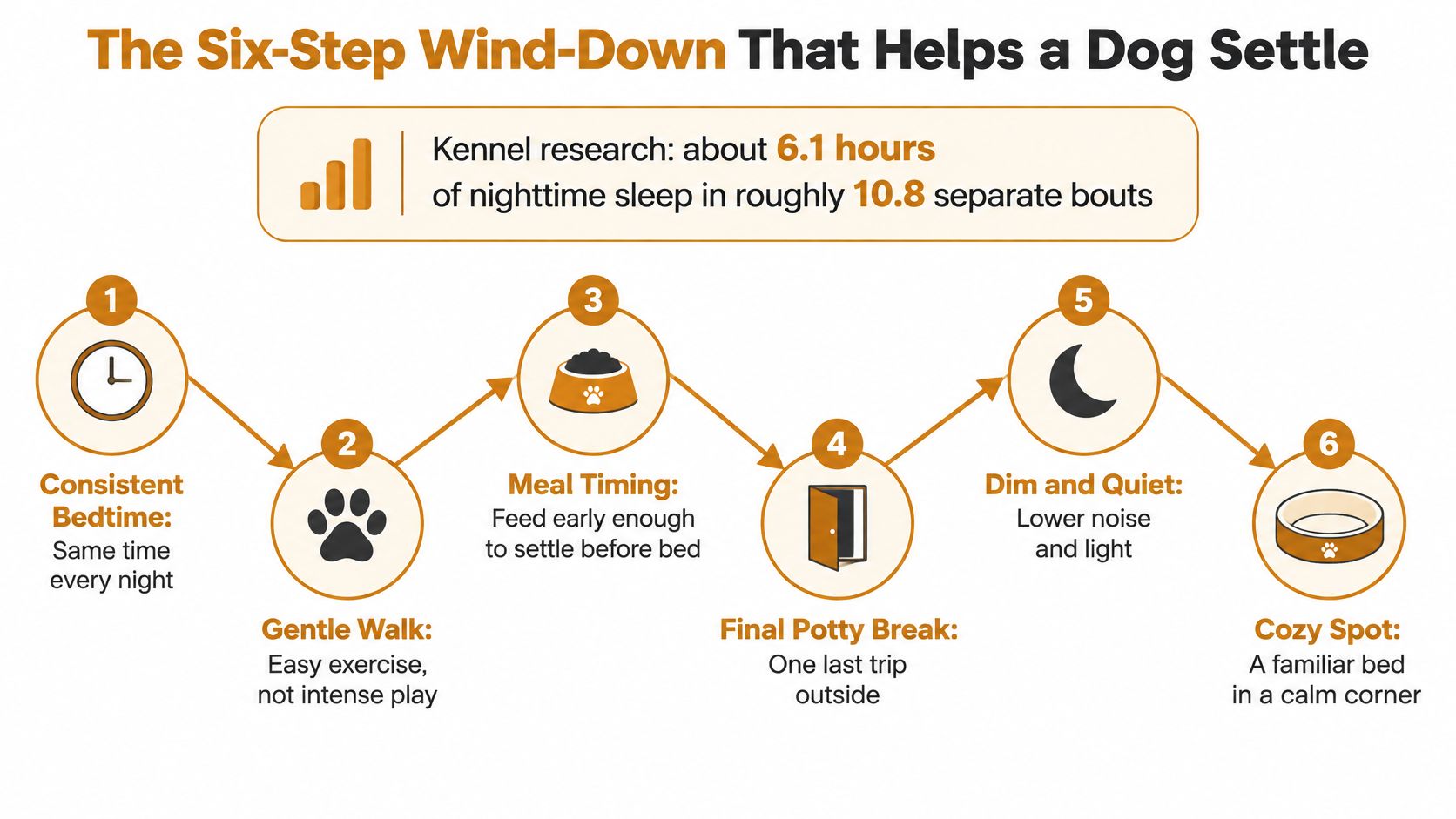
Follow a Predictable Sequence
Take a quiet bathroom trip. Use a leash, a familiar spot, and your usual potty cue. Keep this outing practical rather than turning it into a neighborhood adventure.
Allow a short, slow sniffing walk. About ten minutes is a practical starting suggestion, not a research-backed sleep dose. Skip ball throwing and chase, and shorten the outing if your dog becomes more alert rather than calmer.
Offer low-arousal enrichment. Try a snuffle mat or an appropriate chew in the same resting area. Choose something your dog already uses calmly, supervise as needed, and remove it before leaving the dog unattended if it presents a safety concern.
Make the household quieter. Dim the lights and turn off the television or music. Ask visitors and family members to stop calling the dog over for another interaction.
Give the familiar bed cue. Use the same phrase and familiar bedding, then let your dog choose a comfortable position. Don't repeatedly reposition the dog or insist on a particular sleeping posture.
Acknowledge quiet lying calmly. A soft word or discreet treat can mark the behavior you want without starting another training session. Brief, familiar grumbling doesn't need an exciting response, but check bathroom needs, discomfort, or escalating distress rather than automatically ignoring whining.
The sequence should feel ordinary. If your dog gets up, avoid immediately cycling through toys, snacks, commands, and another energetic outing.
Keep Lights-Out Uneventful
A common mistake is getting the dog settled, then restarting everything with excited praise or a last wrestling game. For example, a dog lying calmly on its mat may be invited onto the bed for play, then expected to switch off again as soon as the owner is tired.
Keep your response boring without becoming unresponsive. Calm support and punishment aren't the same thing, and whining shouldn't earn scolding.
For a visual demonstration to accompany your routine planning, use the video below.
Exercise Timing and Bedroom Setup That Support Sleep
A dog who finishes a hard game of fetch and then paces, carries toys around, or waits for another throw may be overstimulated, not short on exercise. Put vigorous play earlier in the evening, and give your dog time to settle before bed. If nighttime restlessness is new or persistent, don't assume more exercise will solve it. It can be a sign of discomfort or another problem, so note the pattern and raise it with your veterinarian.
| Activity | Intensity | Timing Before Bed | Effect on Settling |
|---|---|---|---|
| Vigorous fetch, tug, or agility | High | Finish at least 60 minutes beforehand | Can delay settling when done too late |
| Structured training session | Moderate, depending on the dog | An hour or two beforehand as a starting plan | Offers mental activity, but exciting drills may increase arousal |
| Sniffing or slow leash walk | Low | During the wind-down period | Supports toileting and a quieter transition |
| Late-evening zoomies or visitors | High | Avoid during the final wind-down | May restart activity when you want quiet |
This table is a practical scheduling aid, not a tested timetable. Finish vigorous activity at least 60 minutes before bed. A fast-recall session with excited rewards belongs earlier than quiet, familiar mat practice. If a final meal seems to affect your dog's settling, track its timing separately rather than treating it as part of this activity schedule.
The trade-off is straightforward: dogs need suitable daytime activity, but more activity immediately before bed isn't always better. A quiet sniffing walk may help with toileting and transition; another round of fetch can leave some dogs keyed up. Adjust the evening to your dog's response instead of adding activity automatically.
Make the Resting Area Less Interesting
Check what your dog can see and hear from its bed. A bedroom may seem quiet while headlights move across the wall, a television plays nearby, or people pass through the hallway.
- Block visual triggers. Close blinds or move the bed away from a street-facing window.
- Reduce household traffic. Ask children, visitors, and other pets not to approach the resting dog repeatedly.
- Lower stimulation. Dim lights and turn off entertainment that keeps drawing the dog's attention.
- Preserve choice. Leave enough room to stretch, curl up, or change position without being disturbed.
A crate helps only if your dog is comfortable using it. The ASPCA's guidance on dogs and babies is not a source for crate setup, so don't rely on it for that advice. Offer comfortable bedding and a quiet resting spot, and don't use confinement to punish a frightened dog. If the crate causes distress, consider a pen or suitable quiet room while you work on a gradual, positive reintroduction.
Breed can inform daytime planning, but it does not explain every restless night. The American Water Spaniel profile offers breed-specific context; don't use a breed label to dismiss a new change in sleep. Record when restlessness occurs and what happened beforehand, then use that pattern to guide your next step.
When Restless Nights Point to a Medical or Behavior Problem
A dog pacing at night doesn't automatically need a longer walk. Persistent restlessness can accompany pain, cognitive changes, urinary problems, anxiety, or breathing disorders, and veterinary guidance on nighttime sleep problems emphasizes investigating the underlying cause.
Watch what the dog really does. Repeatedly standing after lying down, heading toward the door, or waking with abnormal breathing gives your veterinarian more useful information than just reporting that the dog won't sleep.
| Pattern | Causes to Rule Out | Next Step |
|---|---|---|
| New pacing or panting at night in an older dog | Pain, cognitive dysfunction, urinary problems | Arrange a prompt vet visit; film the episode if safe |
| Night waking with noisy or labored breathing | Airway or other medical problems; discuss weight and heat exposure | Seek prompt assessment; labored breathing needs same-day advice |
| Restlessness with house-soiling or new urination | Urinary disease, illness, anxiety | Contact your vet and keep a dated log |
| Sudden inability to settle with separation signs | Anxiety, sensory changes, environmental triggers | Ask your vet about medical assessment and a behavior plan |
| Collapse, blue or muddy gums, breathing that doesn't resume, prolonged seizure-like activity | Medical emergency | Go to an emergency veterinary hospital now |
These are possibilities to investigate, not diagnoses you can make from a bedtime pattern. For breathing changes, describe the sound, the effort involved, and whether the dog is awake or asleep when it happens.
Use this image as a reminder to assess comfort before treating wakefulness as disobedience.
When to Call Your Vet
Call within a few days for new pacing, new house-soiling, or an unexplained sleep-pattern change in an otherwise stable dog. Call the same day for labored breathing, and seek emergency care immediately for collapse, blue or muddy gums, breathing that doesn't promptly resume, severe confusion, or prolonged seizure-like activity.
Don't wait for a routine appointment if the dog deteriorates. These timing categories are practical triage guidance, not a substitute for a veterinary team assessing the individual episode.
As noted in the earlier AKC guidance, reported canine sleep disorders include insomnia, sleep apnea, narcolepsy, and REM sleep behavior disorder. An unusual movement during sleep isn't enough to identify any of them, which is why a short video can help.
Bring Evidence Without Delaying Care
Record the behavior from a safe distance, including the dog's whole body and breathing when possible. Note what happened before and afterward, and whether the dog responded normally when awake.
Brachycephalic dogs have airway concerns that make breathing changes especially important to discuss promptly. Review available breed health profiles for context, but don't let breed familiarity turn abnormal breathing into something you accept as normal.
A routine may support a dog receiving treatment. It shouldn't replace investigating why a previously comfortable sleeper now spends the night pacing.
What to Check First
Sedation can hide the problem you need to identify. Making a dog quieter doesn't establish that pain, airway trouble, anxiety, or cognitive decline has been addressed.
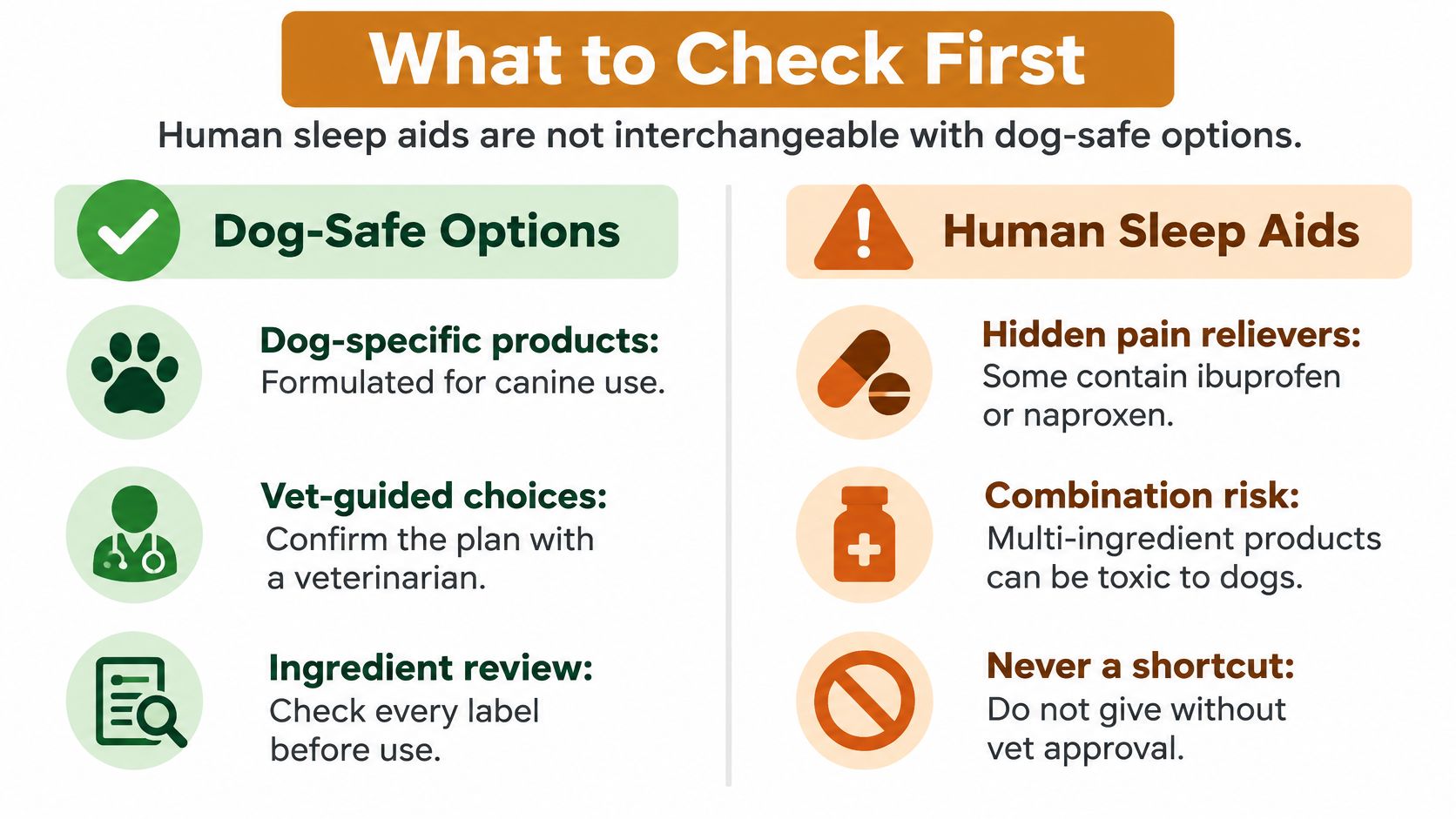
Human sleep aids aren't interchangeable with dog-safe treatment. ASPCA's sleep-aid safety guidance warns that some products combine sleep ingredients with ibuprofen or naproxen, which can cause serious gastrointestinal and kidney injury; overdoses of certain products may also cause agitation, rapid heart rate, tremors, or dangerous temperature changes.
Use the following checklist to prepare a veterinary conversation, not to select a sedative independently. This site tests no products and doesn't rank brands.
| Category | What the Label Should Disclose | Question for Your Vet |
|---|---|---|
| Human sleep aids, including melatonin or antihistamine products | Every active ingredient, exact amount per dose, and any combined pain reliever | Is this safe for my dog's weight, age, and conditions, and what dose is correct? |
| Pheromone diffusers or collars | Product type, active compound, and whether claims are dog-specific | Would this suit my dog's anxiety, or is a behavior plan needed? |
| Calming chews or supplements | Full ingredient list, species labeling, and any third-party testing claim | Could an ingredient interact with existing medication? |
| Prescription sedatives | Prescribing veterinarian, dose, schedule, and monitoring instructions | Which signs mean I should stop and call you? |
Check the Entire Formulation
A familiar ingredient name on the front doesn't tell you everything inside. Bring the actual package or clear photographs of the complete label, including inactive ingredients, rather than asking about melatonin or a calming chew in the abstract.
Dog-specific labeling also isn't a guarantee that a product suits your dog. Your veterinarian needs the dog's current medications, health history, and symptoms before deciding whether any aid belongs in the plan.
The visual below summarizes the label-review distinction, but veterinary approval still matters for products marketed for dogs.
Medication may be appropriate when a veterinarian identifies a reason and provides monitoring instructions. The useful comparison isn't natural versus prescription; it's an informed treatment plan versus an unassessed attempt to make symptoms disappear.
If your dog may have swallowed human medication, contact a veterinarian or animal poison control service immediately and bring the packaging. Don't wait to see whether the dog becomes sleepy on its own.
Confirm the Routine Works Before You Change Anything Else
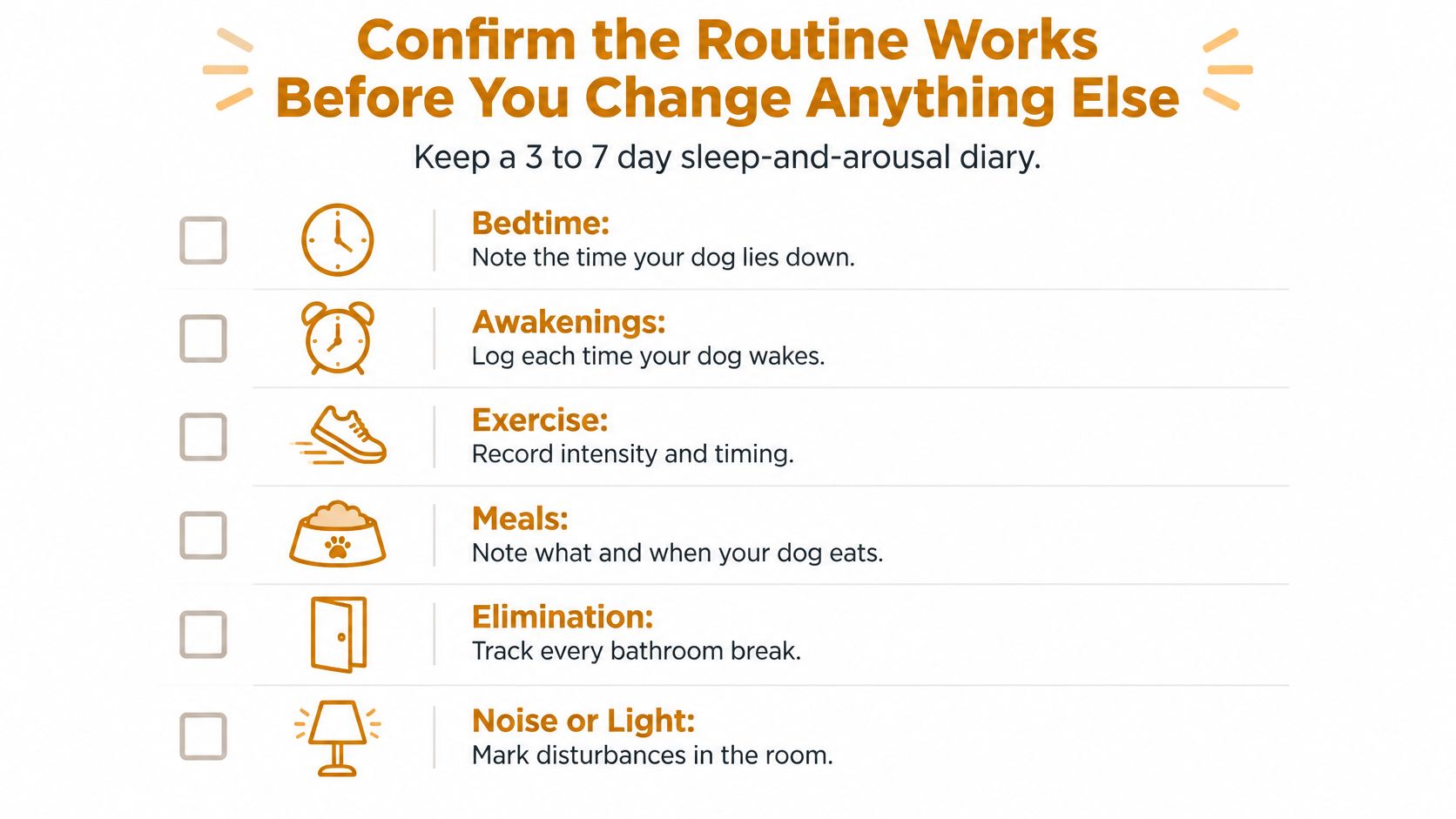
A short diary beats guessing about whether bedtime is improving. Keep a 3-to-7-day sleep-and-arousal record covering bedtime, awakenings, exercise intensity and timing, meals, elimination, environmental triggers, and settling latency, following the IAABC Foundation's sleep troubleshooting guidance.
Record settling time in minutes, but don't hover over the bed waiting for sleep. Test one manageable adjustment at a time, such as closing the blinds or moving vigorous activity earlier.
If the routine has been consistent for about two weeks without improvement, and no medical red flag has appeared, book a veterinary appointment and bring the diary. That's a practical reassessment point, not a reason to wait when symptoms are new or worsening.
Use a Seven-Night Checklist
Tick these fields each night alongside the fuller diary:
- Bathroom trip: Final potty break logged.
- Activity: Last vigorous activity recorded.
- Meal: Feeding time written down.
- Consistency: Same familiar cue and resting place offered.
- Environment: Lights and noise lowered.
- Response: No punishment for whining; needs and distress checked.
- Outcome: Settling time and awakenings recorded.
Use the visual checklist to keep the record easy to repeat.
A notebook or phone note works; explore the site's free tools for additional planning support. Use breed information to inform expectations, while letting the dog's recorded behavior guide adjustments.
Aim for comfortable, calm settling, not just a dog that's sedated. Start tonight with an uneventful wind-down and an honest record of what happens.
For breed-specific health profiles, ownership-planning guides, and individualized care projections, visit PetCostEngine. Use those resources alongside your sleep diary to prepare practical questions for your veterinarian and plan for any follow-up care.
Estimated lifetime and yearly costs for a American Water Spaniel, state by state, plus whether pet insurance breaks even for the breed.
See American Water Spaniel costs →
Is insurance worth it for a American Water Spaniel? →
Premium dry food → Puzzle toys → No-pull harness →
As an Amazon Associate, PetCostEngine earns from qualifying purchases.