
A wagging tail isn't permission to approach a dog. That familiar shortcut leaves out the information you need most: whether the dog's body is loose or rigid, whether they're moving toward you or trying to leave, and what changed when you got closer. Learning how to read dog body language means watching the whole dog through an interaction, not matching a pose to an emotion.
At the park, your most useful observation may happen before a growl: your dog turns their head away, closes their mouth, and stops moving freely. You don't need to prove exactly what they're feeling before giving them more room.
Table of Contents
- Why Reading One Signal Gets Dogs in Trouble
- A Field Method for Reading Any Dog
- The Green-Yellow-Red Stress Scale in Practice
- Confident Versus Fearful Postures Side by Side
- Reading Your Dog in Real Situations
- Breed Shape, Age, and Individual Baseline
- Practice Drills and When to Call a Professional
Why Reading One Signal Gets Dogs in Trouble
A dog standing at the park gate may wag while holding their body stiff, showing teeth, and facing another dog directly. If you watch only the tail, you might open the gate. If you notice the whole posture, you have good reason to pause.
The ASPCA's dog-bite prevention guidance describes threatening postures that can include a raised, wagging tail alongside raised fur and a stiff, straight-legged stance. It also explains that dogs can combine fearful and threatening signals. Movement doesn't cancel tension.
This visual shows how an isolated observation can lead an owner toward the wrong decision.
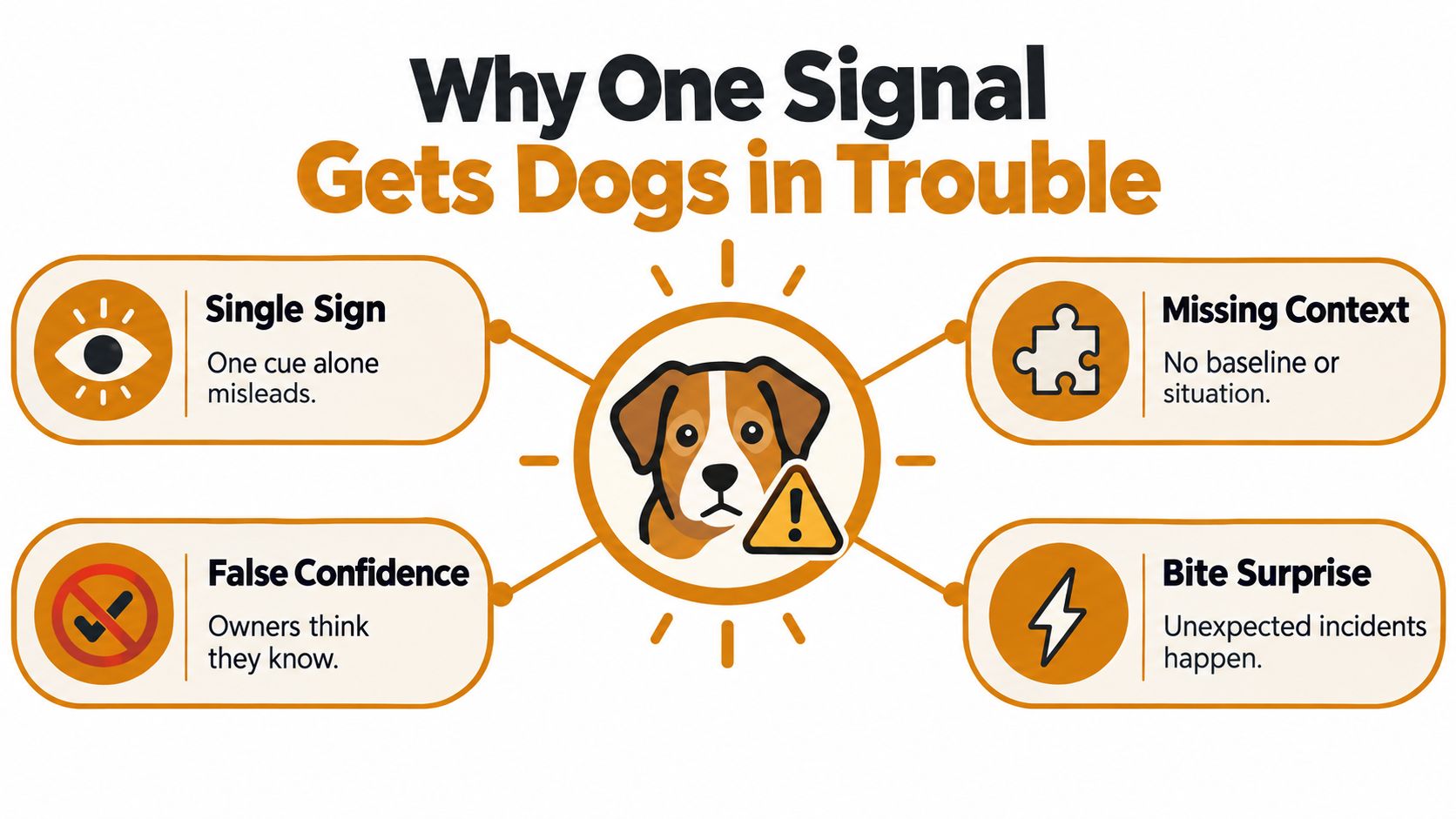
Watch the combination, not the highlight
A useful reading combines clusters, context, and trajectory. A cluster is a group of signals occurring together. Context is what's happening around the dog. Trajectory is the direction of change: becoming looser, staying tense, or becoming more uncomfortable.
Consider a hypothetical greeting. Your dog initially walks with an easy posture, then stops when an unfamiliar dog approaches. Their tail still moves, but their weight shifts away and their face tightens. The important observation isn't that the tail kept wagging. It's that several other features changed as the distance closed.
Don't turn every movement into a diagnosis, either. A lip lick after eating has a different context from repeated lip licking while someone leans over a dog. Likewise, an exposed tooth isn't enough information to decide whether a dog is comfortable.
Practical rule: Describe what you can see before deciding what it means.
Instead of saying your dog is being friendly, try describing a loose body, soft eyes, and voluntary approach. Instead of calling them stubborn, notice that they've lowered their head and leaned away.
Those descriptions lead to more useful decisions. You can stop an approach, change direction, or end a greeting without settling on a precise emotional label. Responding to discomfort matters more than naming it perfectly.
A Field Method for Reading Any Dog
Start observing before anyone reaches toward the dog. Once an interaction is underway, you need a reference point to tell whether the dog's behavior has changed.
Keep this sequence in mind as a field routine.
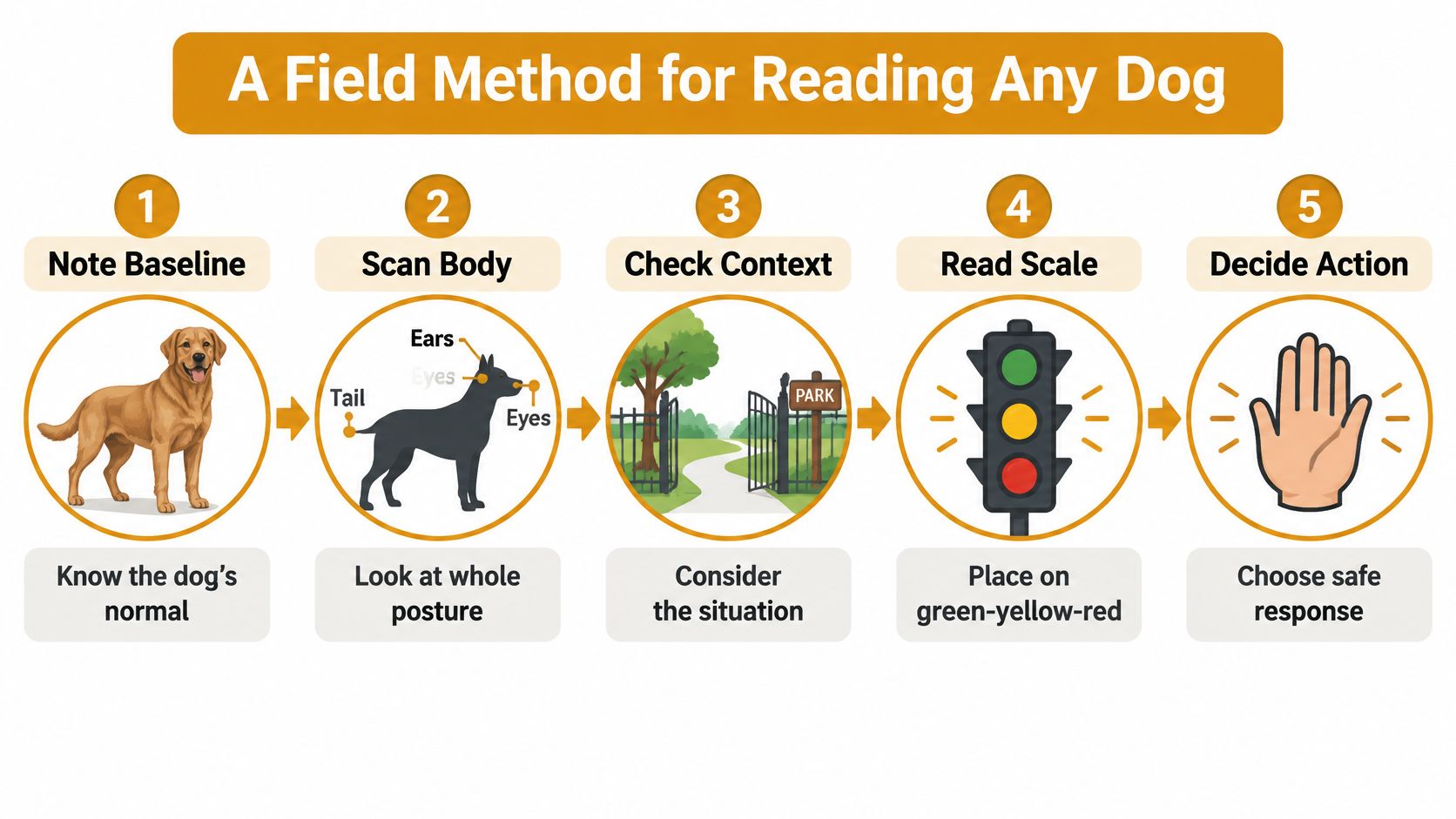
Establish the starting point
Notice the dog's usual posture in that moment: how they hold their head, where their ears rest, how their mouth looks, and how freely they move. For an unfamiliar dog, call this a starting observation, not a known baseline. You haven't seen enough to know what's normal for them.
Next, identify the immediate situation. Is someone reaching over the dog, holding them still, approaching their food, or bringing another dog closer? Write the event into your mental description: the dog turned away when the person reached.
The PLOS ONE research on human recognition of canine emotions supports caution about assuming people read dogs accurately. Experience can help with recognizing fear, but it doesn't make interpretation infallible.
Use this short observation loop:
- Before contact: Notice posture, expression, movement, and available space.
- During the interaction: Look for changes across the face, body, ears, and tail rather than repeatedly checking one feature.
- After a change: Reduce pressure or increase distance, then watch whether the dog relaxes.
Separate interpretation from action
As a working habit, look for several converging signals before assigning an emotional label. That's an observation aid, not a requirement to wait when you see an obvious warning. A snap or lunge already warrants stopping.
Suppose a dog looks away, shifts backward, and hesitates as you approach. You can step back without deciding whether the best label is fear, uncertainty, or conflict. Then observe what happens when you stop advancing.
For background on different dogs' physical characteristics, use the breed reference library. Treat that information as context, not a prediction of the individual dog's behavior.
The final step is often overlooked: check the recovery. Don't assume that removing the immediate trigger means the dog is ready to resume the same interaction.
The Green-Yellow-Red Stress Scale in Practice
Think of green, yellow, and red as an action framework, not a diagnostic test. The colors help you decide whether to continue cautiously, add space, or stop.
A study using a fear-anxiety-stress framework reported average scores of 0.80 at rest, 1.00 during a stressor, and 0.48 during recovery, with the stress-to-recovery decrease statistically significant at p < 0.001. The practical lesson is to observe change through the whole encounter, including what happens afterward.
Use the illustration for its broad visual categories only. Its bite percentages and absolute safety claim aren't supported by the cited evidence and shouldn't guide decisions.
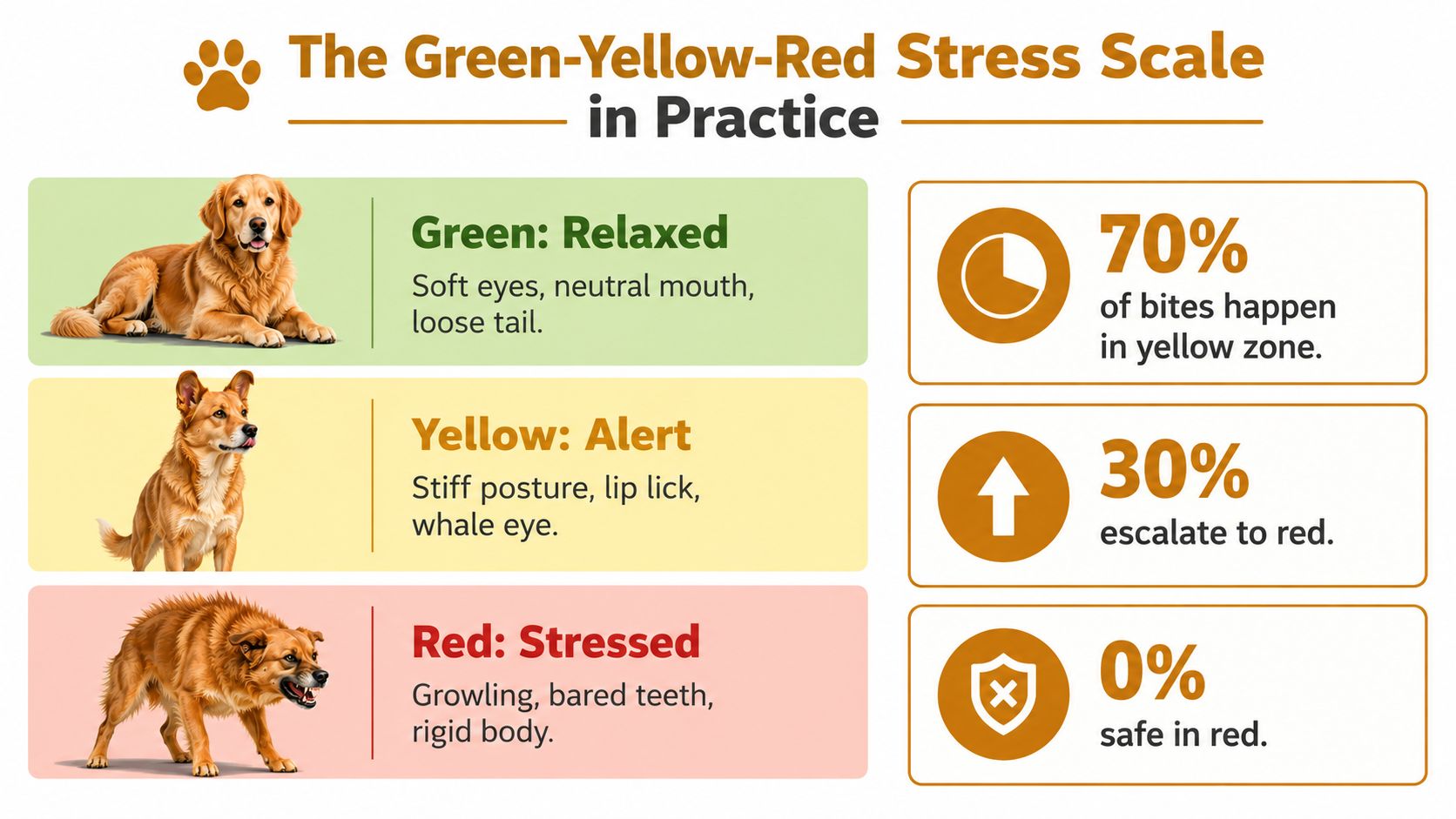
Green means comfortable in this moment
Look for a loose posture, soft eyes, a neutral or slightly open mouth, and ears and tail carried naturally for that dog. The useful impression is ease rather than a particular tail height.
Green isn't a guarantee that any interaction will be welcome. A dog who looks relaxed at a distance may respond differently when someone reaches toward their face. Continue watching as the situation changes, and don't treat a comfortable appearance as permission to crowd them.
Yellow means reduce pressure
Early concern may appear as a lowered tail, ears moving back or sideways, fidgeting, head turning, or hesitation to engage. Panting with facial tension can add to that picture.
At the park, this might look like a dog who was walking freely but now keeps turning away as another dog approaches. Your action is simple: create more room before asking for more interaction.
- Change distance: Move away from the approaching person or dog.
- Remove the demand: Stop reaching, leaning, or asking the dog to remain close.
- Observe the result: Watch for a return toward their earlier, easier posture.
Red means stop the interaction
A tightly tucked tail, trembling, hunched posture, escape attempts, snarling, or lunging indicates a high-concern situation. A rigid freeze also deserves immediate caution. Don't interpret stillness as cooperation.
The aim isn't to see how much a dog will tolerate. It's to notice when you should stop asking.
The colors aren't a compulsory sequence. Don't assume you'll always receive a long, readable yellow phase before a serious warning. When the dog's posture becomes markedly tense or threatening, end the interaction rather than waiting for a more dramatic signal.
Confident Versus Fearful Postures Side by Side
An upright dog and a crouching dog can both need space. Their bodies may look different, but neither posture tells you that approaching is a good idea.
The word confident needs care here. A forward posture can accompany interest, but when it includes stiffness and threat signals, it shouldn't be treated as social comfort. Likewise, a dog trying to appear smaller isn't necessarily willing to be touched.
Confident vs fearful posture cues at a glance
| Body region | Confident or threatening | Fearful or anxious | Mixed signal to watch |
|---|---|---|---|
| Whole body | Upright, stiff, directed toward the perceived threat | Crouched, hunched, leaning away, or retreating | Forward orientation followed by withdrawal |
| Legs and movement | Straight-legged, braced stance | Lowered posture, hesitation, or freezing | A dog who stops moving despite an active tail |
| Ears | Forward with heightened attention | Flattened, back, or sideways | Changing ear positions alongside growing tension |
| Tail | High or rigid, possibly wagging | Lowered or tucked | Wagging paired with a tense body |
| Head and eyes | Direct orientation or a fixed stare | Lowered head, looking away, exposed eye whites | Low head position combined with a hard stare |
| Mouth | Tense expression or teeth displayed with other warnings | Repeated lip licking or yawning | Visible teeth without enough surrounding information |
Veterinary-behavior guidance on fear and anxiety identifies clusters including cowering, leaning away, lowered head and tail, tension, flattened ears, and exposed eye whites, often called whale eye. Subtler signs can include scanning, excessive sniffing, refusal of treats, and salivation unrelated to food.
The confusing middle deserves caution
A low tail doesn't cancel a fixed stare. A wag doesn't override a rigid stance. When signals conflict, resist choosing whichever one makes the greeting seem easiest.
Visible teeth create another common trap. Owners sometimes describe them as a submissive grin, but the label shouldn't substitute for observing the rest of the dog. If you're unsure, don't move closer to test your interpretation.
Raised hackles require similar restraint. They indicate emotional arousal, not automatic proof of aggression or dominance. Treat them as a reason to inspect posture and movement more carefully, rather than assigning a personality judgment.
Also remember that panting, licking, and similar actions can occur with heat, exercise, food, or illness. Your interpretation should account for those possibilities. The question is not whether the signal is present, but whether its appearance fits the dog's surroundings and recent behavior.
Reading Your Dog in Real Situations
Use ordinary encounters as observation opportunities, not tests of tolerance. Begin with what the dog is doing before someone asks them to interact.
These settings call for the same attention, even though the surroundings differ.
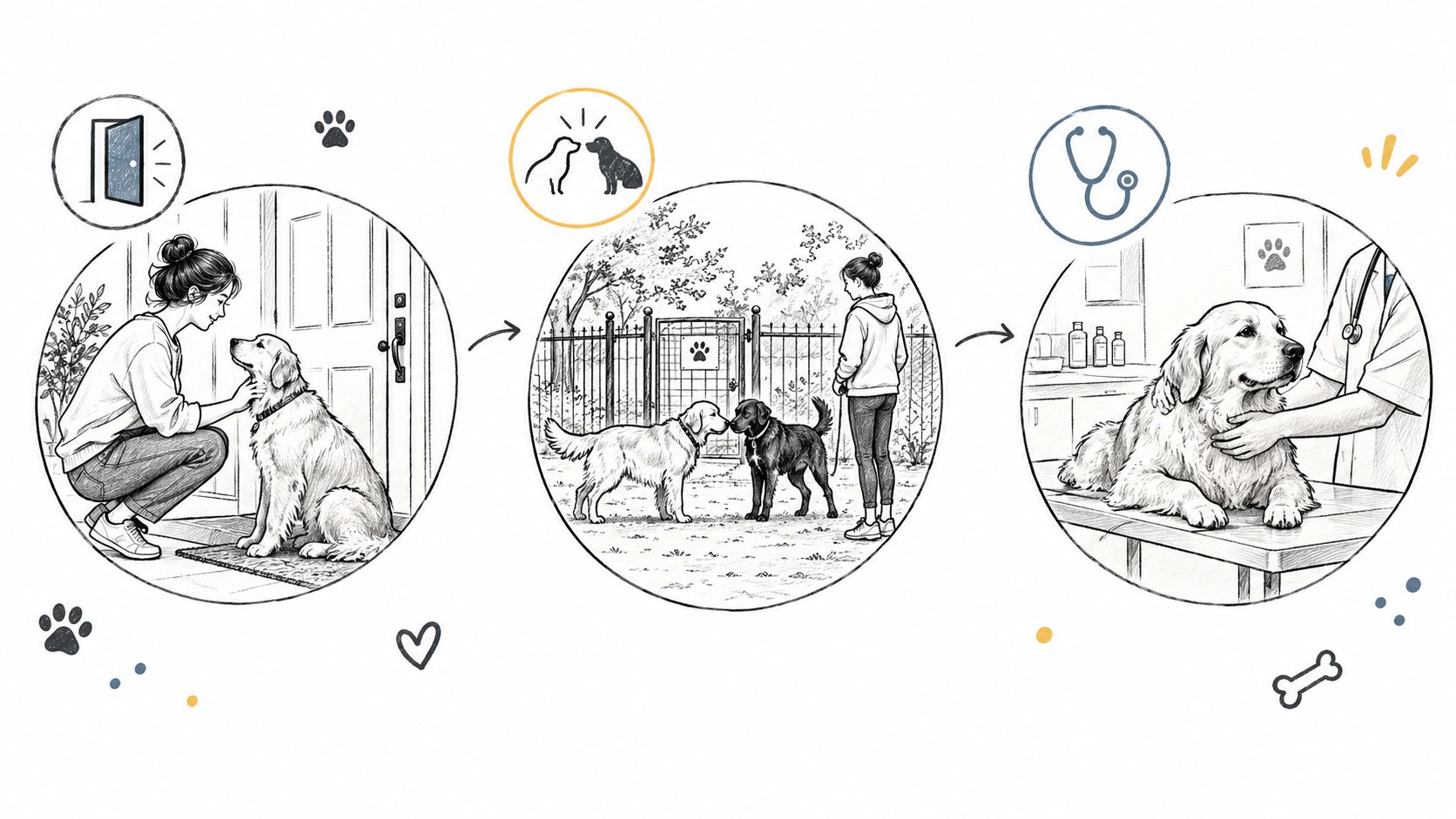
Greetings at home and on walks
With a familiar dog, pause before reaching. Notice whether they approach freely or turn away as your hand moves. If they withdraw, let that end the greeting rather than following them to finish petting.
With an unfamiliar dog, stay at a distance that allows observation without contact. If your dog starts avoiding, stiffening, or lowering their posture as the gap closes, change direction. Completing a sidewalk greeting isn't an obligation.
The AVMA's dog-bite prevention guidance identifies yawning, ears held back, and a raised paw as possible worry signals. It also describes more concerning behaviors, including tucking the tail, stiffening while staring, growling, and snapping. These are reasons to adjust the situation, not challenges to overcome.
Handling and children
At a veterinary or grooming appointment, describe changes plainly: your dog stopped taking treats when handling began, turned their head away, or became rigid. Ask for a pause so the professional can reassess how to proceed.
Around children, have an adult watch both the dog and the interaction. If the dog looks away, retreats, or becomes tense, help the child stop and give the dog an unobstructed way out. Don't ask the child to interpret ambiguous signals or decide whether to continue.
Video observation can provide another opportunity to practice noticing changes without approaching a dog.
For an individual breed's background, a reference such as the American Water Spaniel profile can complement your observations. It can't tell you whether the dog in front of you wants contact right now.
A successful encounter may be the greeting you choose not to complete.
Breed Shape, Age, and Individual Baseline
A short-tailed dog can't give you the same visible tail picture as a dog with a long, easily observed tail. A heavily coated dog may hide facial tension that would be easier to notice on a smooth-coated dog.
That doesn't make either dog unreadable. It means you need to avoid relying on the body part that's hardest to see.
Read the dog you actually have
For a brachycephalic dog, don't force every facial expression into an illustration drawn around a longer muzzle. Watch changes in body tension, approach, withdrawal, and willingness to engage.
For a dog with cropped, folded, or heavily coated ears, focus on whatever movement is visible while checking the rest of the body. With a docked or naturally short tail, give more attention to posture and motion rather than trying to infer the position of a tail that isn't there.
In a senior dog, age and pain may alter the starting picture. Don't assume a change in movement is purely emotional, or that familiar stiffness makes a new change unimportant. Seek veterinary input when behavior or mobility changes concern you.
Research discussing canine behavioral and morphological variation supports interpreting signals with attention to physical form, familiarity, and individual differences. Breed appearance should inform what you can observe, not become a shortcut for temperament.
Build a personal reference
Make brief notes during calm, ordinary activities:
- Resting comfortably: Notice the usual mouth, eyes, ear position, and posture.
- Easy movement: Watch how freely the dog walks and changes direction.
- Low-pressure interaction: Observe whether they approach, remain nearby, or leave.
- After an interruption: Record how their behavior changes once the disturbance ends.
The breed comparison tool can help you explore breed differences while researching dogs. Keep those comparisons separate from your judgment of an individual encounter.
Your most useful reference is this dog's normal behavior in a comparable situation. A change from that reference often deserves more attention than a mismatch with a textbook photograph.
Practice Drills and When to Call a Professional
Practice where your dog is already comfortable. You're training your observation skills, not arranging stressful encounters to see what happens.
Short drills for ordinary days
- Baseline video review: Record a calm everyday moment. Watch it normally, then replay while focusing separately on the face, posture, and movement.
- Greeting review: If you already have a recording of an uneventful greeting, slow it down. Notice what changed as the distance closed. Don't stage unwanted contact for footage.
- Whole-dog walk check: During routine pauses, scan the eyes, mouth, ears, tail, and body movement. Describe what you see before adding an emotional label.
Keep a simple exit checklist in mind: Were there converging signs of discomfort? Did the behavior change as someone approached? Did you reduce pressure promptly? Is the dog returning toward their earlier posture?
Get help before repeating a difficult encounter
My recommendation is to contact your veterinarian and seek qualified behavior support for recurring growling or snapping, escalating avoidance, worsening resource guarding, or any bite event. A veterinary behaviorist or certified applied animal behaviorist can help assess the situation and develop a safer plan.
Don't repeat an interaction to confirm that the warning will happen again. Write down what occurred immediately before it, what the dog did, and what happened after you stopped.
Give yourself credit for noticing a quiet refusal and respecting it. Reading a dog well doesn't mean you can make every encounter work. It means you can recognize when continuing isn't the right choice.
Alongside veterinary guidance and qualified training support, PetCostEngine offers breed references and individualized dog-ownership planning tools. Visit the breed library to learn more about your dog's background, then pair that information with a calm baseline observation at home today.
Estimated lifetime and yearly costs for a American Water Spaniel, state by state, plus whether pet insurance breaks even for the breed.
See American Water Spaniel costs →
Is insurance worth it for a American Water Spaniel? →
Training treats → Puzzle toys → No-pull harness →
As an Amazon Associate, PetCostEngine earns from qualifying purchases.