
You're halfway down the sidewalk when your dog spots another dog. Their body stiffens, the leash goes tight, and within seconds they're barking, lunging, or spinning at the end of the line. You apologize, turn around, and wonder whether your dog is aggressive, stubborn, or somehow beyond help.
That reaction is frightening, but it's also workable. Leash reactivity is usually an emotional response, not a character flaw, and effective training starts by lowering the pressure rather than demanding perfect obedience in the hardest moment. The practical aim is to keep everyone safe while teaching your dog that seeing a trigger predicts space, food, and a way out.
Table of Contents
- What Leash Reactivity Really Is and Why It Happens
- Find Your Dog's Threshold Before You Train
- Choosing Gear That Keeps Everyone Safe
- The Counterconditioning Session Step by Step
- Real Timelines and What Progress Actually Looks Like
- When to Bring in a Certified Trainer or Vet
- Preventing Setbacks and Planning the Long Game
What Leash Reactivity Really Is and Why It Happens
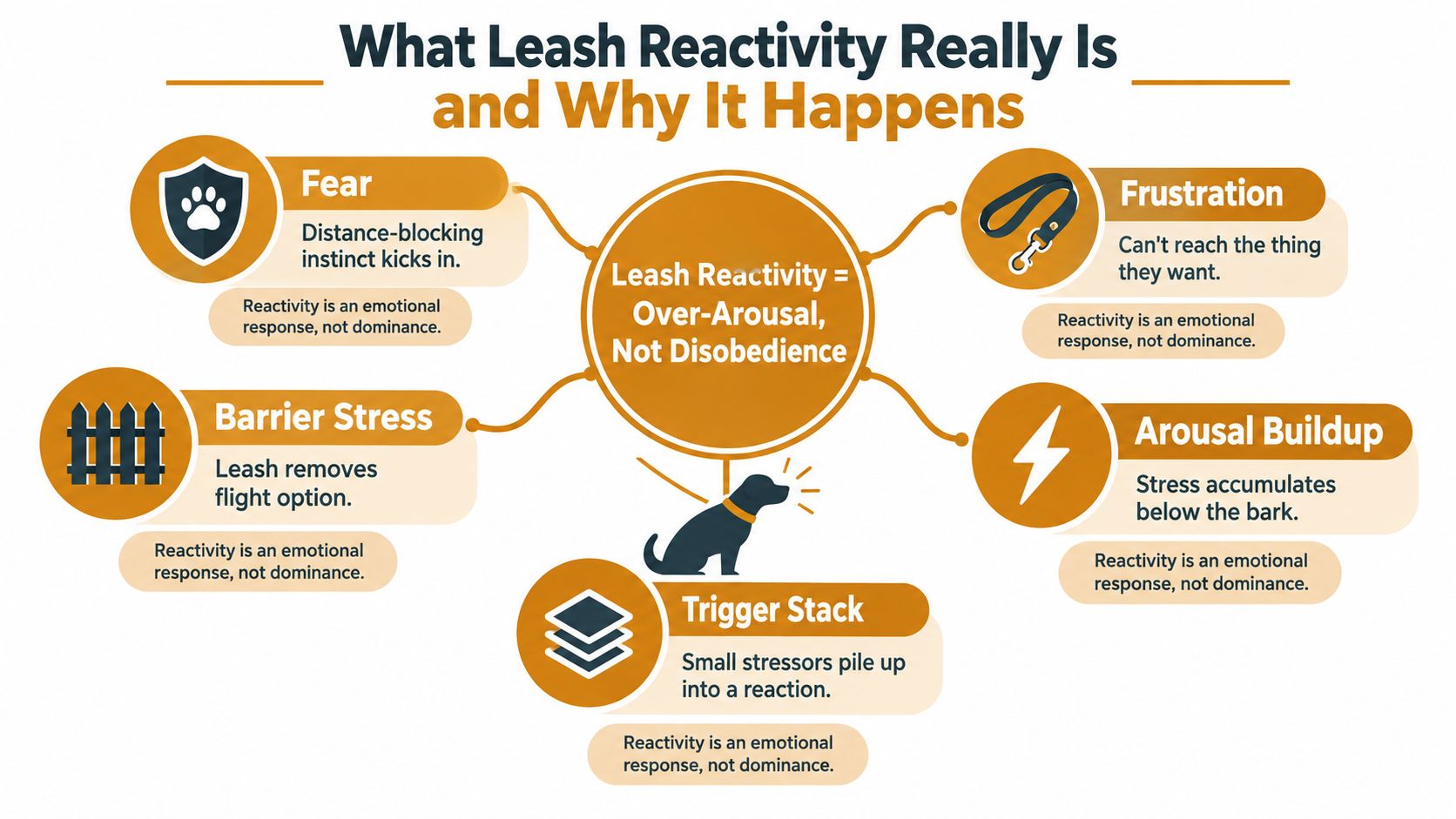
Leash reactivity is an over-aroused emotional response. Fear, frustration, or conflicted anxiety can push a dog into barking, lunging, growling, freezing, or frantic pulling when the leash prevents the dog from creating distance or approaching on their own terms. Your dog may look confrontational, but their nervous system may be communicating, “I can't handle this proximity.”
That's different from simple disobedience. It's also different from aggression, although a reactive dog can become dangerous if the behavior escalates or the handler can't maintain control. A leash can remove the option to flee, curve away, or investigate gradually, so the dog uses the behavior that has worked before to make the trigger disappear.
Other dogs are common triggers, but they aren't the only ones. Strangers, traffic, skateboards, joggers, dogs behind fences, and barking dogs visible through windows can all produce the same response. Genetics, gaps in early socialization, traumatic experiences, and pain may contribute, and the correct response depends on the cause.
The working assumption: Your dog isn't trying to dominate the sidewalk. Your dog is having an emotional reaction that needs distance, predictability, and carefully managed learning.
Punishment-based corrections often add another layer of stress. A leash pop or harsh verbal correction may interrupt the outward behavior briefly, but it can also make the trigger predict pain or conflict. Modern reactive-dog work has moved toward distance-based desensitization, counterconditioning, and management, with the objective of changing the dog's emotional response rather than merely suppressing the bark. A standard 5-to-6-foot leash and a well-fitted harness are common parts of that management approach, as described in this behavior resource on reactive dogs.
Breed tendencies can influence arousal, motion sensitivity, sociability, and recovery, but breed alone doesn't diagnose the problem. Reviewing your dog's breed traits alongside individual history can help you plan realistic enrichment, exercise, and handling needs through breed reference pages.
Find Your Dog's Threshold Before You Train
Threshold is the distance at which your dog notices a trigger but can still think, eat, and respond. If your dog can see another dog at a distance but won't take food once that dog comes closer, the closer point is already too difficult for learning.
Choose a quiet street, open field, or low-traffic parking lot. Work with one known trigger, such as a calm helper dog, and begin farther away than you think you need. Watch for early shifts, including lip licking, a raised tail, stiffening, ears suddenly locked forward, a hard stare, or a closed mouth.
Locate the green zone
Close the distance gradually until you see two early body-language changes. Mark that location, then move back until your dog's body softens and food becomes easy to take. That farther position is your initial working distance.
A small dog might notice another dog across a cul-de-sac and begin barking at 40 feet, while a large dog might lunge toward a dog on a trail at 80 feet. Those examples aren't universal measurements. They show why you must measure your individual dog instead of borrowing a distance from someone else.
The ASPCApro threshold protocol defines threshold as the point where a dog notices another dog but hasn't yet growled, barked, or lunged. In one example, a dog with a threshold of 40 feet begins the exercise with a helper dog about 50 feet away, then receives rapid treats after noticing the trigger.
Treat threshold as a moving boundary
Every repetition should stay below threshold. If your dog stops eating, locks onto the trigger, pulls hard, or begins vocalizing, don't wait for the behavior to finish. Turn away, create space, and let the dog recover.
Threshold changes with weather, health, sleep, recent activity, and the number of stressors already encountered. A dog who can work calmly on a quiet morning may need much more room after a restless night or a noisy car ride. Record the trigger, approximate distance, body language, food response, and recovery so you can spot changes before they become rehearsed outbursts.
The same principle applies to breed planning. A dog's exercise needs and sensory sensitivity can vary substantially across breeds, so the American Water Spaniel breed profile can be one reference point when you're building a broader behavior plan.
Choosing Gear That Keeps Everyone Safe
Equipment doesn't cure reactivity. It changes influence, control, and the consequences of a sudden movement, so choose it according to your dog's emotional state and physical safety.
A standard Y-front harness distributes pressure across the chest and reduces direct neck strain, but it won't automatically stop pulling. A fixed-length leash gives you predictable contact and enough room for normal movement without allowing a dog to accelerate far ahead. A retractable lead can reward forward lunging by extending whenever the dog pulls, which makes careful threshold work harder.
Front-clip harnesses redirect forward momentum toward the handler and can help with highly social dogs who surge toward people or dogs. For a fearful dog, however, constant redirection can feel restrictive or frustrating if the harness is being used to force proximity rather than create distance.
Head halters provide substantial mechanical force around the head and neck. They can be useful in carefully selected cases, but many dogs need two weeks of gradual desensitization before wearing one comfortably. A head halter is a training aid, not a substitute for emotional work or a solution for every daily walk.
| Gear | Effect on Arousal | Best Use Case | Key Limitation |
|---|---|---|---|
| Y-front harness | Can reduce neck pressure without directly changing emotion | General management and controlled training | Doesn't stop pulling by itself |
| Fixed-length leash | Creates predictable handling and distance | Threshold work and emergency turns | Requires active leash management |
| Retractable lead | Can reinforce forward motion and sudden lunges | Low-risk decompression areas for dogs with reliable control | Poor fit for reactive-dog training |
| Front-clip harness | Redirects forward momentum | Strong pullers and high-arousal greeters | May frustrate fearful dogs if overused |
| Head halter | Increases steering leverage | Carefully introduced management tool | Requires gradual acclimation and skilled handling |
Keep a safety kit ready: current identification tags, a backup slip lead for emergencies, and reflective gear for low-light walks. For car travel, use a rear-seat tether or crash-tested harness that suits your dog's size and movement. Gear selection also varies by body shape and breed, so breed comparisons can help you investigate physical and management differences before choosing equipment.
The Counterconditioning Session Step by Step
Counterconditioning pairs the trigger with something your dog values, while desensitization keeps the trigger at a manageable intensity. The AKC leash-lunging guidance recommends starting where the dog can notice the trigger without reacting, pairing that sight with high-value food, and moving closer only in very small increments.
Use this protocol for one controlled session.
Decompress first. Begin with 3 to 5 minutes of quiet sniffing before asking for any formal behavior. Sniffing gives your dog time to orient to the environment instead of beginning the session already loaded with arousal.
Set the station. Move to the measured threshold distance. Your dog should be able to notice the trigger, take food, and keep a reasonably soft body. If the trigger appears too close, don't try to “work through it.” Increase distance immediately.
Feed while the trigger is visible. Use one soft, pea-sized reinforcer every 2 to 3 seconds while the trigger remains in view. The ASPCApro protocol recommends 10 to 15 rapid treats after the dog notices the trigger, then stopping when the trigger leaves view. The food isn't a bribe for obedience. It changes what the trigger predicts.
Mark calm behavior. A clicker or calm “yes” can mark a soft mouth, loose tail, offered eye contact, or a voluntary glance back toward you. You can add “look at me” or “watch” later, once your dog can respond without losing awareness of the trigger. The AKC guidance on leash challenges also recommends rewarding calm attention and involving a professional if fear persists.
Exit before the dog deteriorates. Use an “all clear” cue, such as a calm verbal marker followed by a shoulder turn and a steady walk away. Finish with a 10-minute cooldown walk home, allowing your dog to sniff without another training demand.
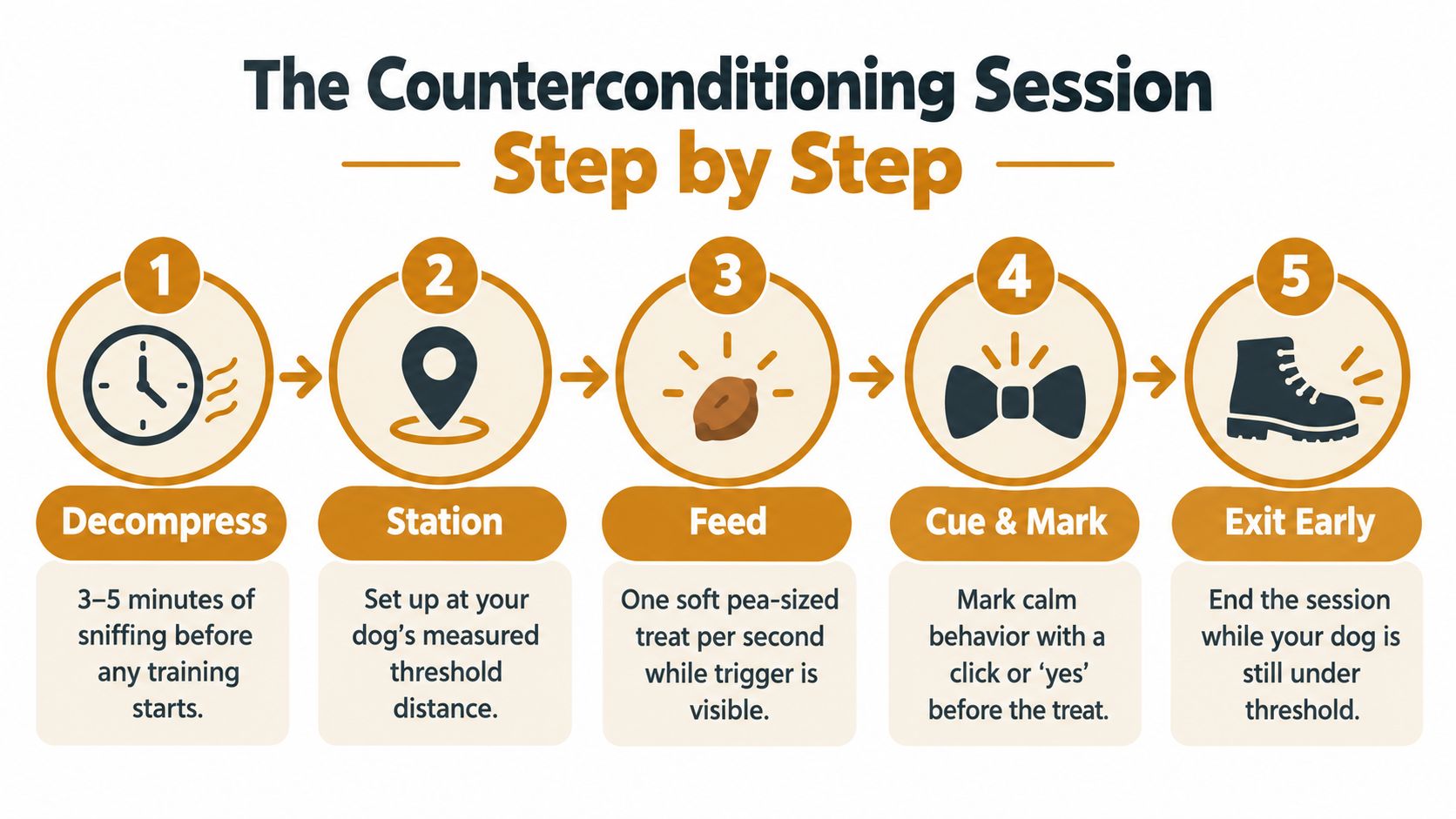
Keep the formal session to 8 to 12 minutes, with 3 to 8 trigger exposures. Log whether your dog recovered with a soft mouth, loose tail, or offered eye contact. If the dog finishes below threshold, mark the day green. If the dog goes over threshold even once, end the session immediately and increase distance next time.
The feeding rhythm matters more than flashy obedience. You're teaching the dog that the appearance of a trigger predicts rapid reinforcement and then an exit, not a confrontation.
Real Timelines and What Progress Actually Looks Like
A fast responder may show meaningful change quickly, but “quickly” still means observable nervous-system changes, not a dog who suddenly enjoys every close encounter. One herding mix began with a large working distance, then reduced that distance by half over two weeks and showed relaxed body language by week four. The useful milestones were fewer lip licks, shorter recovery after a trigger, and voluntary check-ins replacing constant scanning.
A hound with a bite history moved much more slowly. That dog needed eight weeks to hold a sit at 50 feet from a trigger before the broader behavior began to shift. The milestone was not closeness. It was the ability to remain physically organized and recover without escalating.
| Week | Fast Responder, Herding Mix | Slow Responder, Hound, Bite History |
|---|---|---|
| 1 | Notices trigger, eats at a wide distance, recovers with help | Needs substantial space and may scan continuously |
| 2 | Working distance reduced by half, with fewer early stress signals | Holds the original distance with careful management |
| 3 | Offers more eye contact and recovers sooner | Practices calm observation without demanding proximity |
| 4 | Relaxed body language appears during controlled exposures | Progress remains modest, with safety and recovery prioritized |
| 8 | Generalization begins across locations and trigger presentations | Can hold a sit at 50 feet before broader behavior shifts |
These timelines are examples of how progress can look, not promises. A dog may improve for several sessions, plateau, and then regress during adolescence, illness, household stress, or a run of unavoidable trigger encounters. A single bad walk doesn't erase training, but repeated over-threshold exposure can slow the process.
Track behavior rather than judging the calendar. Note whether the dog can eat, how quickly the body softens, whether the dog checks in without prompting, and whether you can change direction before a reaction. For broader ownership planning, the lifetime cost calculator can help you account for training, veterinary care, gear, boarding, and other recurring needs by breed, age, and state.
When to Bring in a Certified Trainer or Vet
Owner-led work is appropriate only when you can maintain safety and your dog can still learn at a manageable distance. Bring in professional help when the behavior exceeds that range, when the cause is unclear, or when your dog's responses are becoming more intense despite consistent handling.
Red flags that need escalation
Seek a qualified professional if any of these apply:
- A bite with contact: Any bite that broke skin or made contact with a person or animal is beyond casual leash coaching.
- Escalating intensity: Reactions are becoming stronger despite consistent distance-based work.
- Freeze or shutdown: Your dog stops eating, walking, or responding around triggers.
- Distant aggression: The dog reacts aggressively even when the trigger is more than 30 feet away.
- New behavior after age six: A new symptom in a dog over six years old warrants veterinary investigation, particularly when pain, sensory changes, or illness may be involved.
- Husbandry interference: Reactivity affects nail care, veterinary handling, grooming, medication, or safe transport.
A CPDT-KA or CDBC professional generally focuses on behavior training and practical management. Look for someone who uses reward-based methods, explains the plan clearly, and can coordinate with your veterinarian. A board-certified veterinary behaviorist, identified by the DACVB credential, can investigate medical contributors and prescribe medication when appropriate.
A veterinary behaviorist consultation costs considerably more than a session with a trainer, and medication follow-ups add a recurring monthly cost on top. These figures vary by location and professional experience, so confirm fees, follow-up structure, and cancellation policies before booking.
Behavior support belongs in lifetime ownership planning. A reactive dog may require additional training, behavior medication, veterinary assessment, and insurance planning alongside routine care. Breed-specific health risks and behavior needs can affect those decisions, which is why PetCostEngine's background and methodology is one place to review how breed and ownership data are organized.
Don't wait for a serious incident before asking for help. A professional can reduce exposure, improve handling, assess pain or illness, and show you how to practice without repeatedly pushing the dog past the point where learning is possible.
Preventing Setbacks and Planning the Long Game
Reactivity training doesn't end when your dog can pass one trigger on one sidewalk. Maintenance protects the new response, keeps skills usable in different locations, and helps you identify threshold drift before a full relapse.
A practical weekly routine includes two short refresher counterconditioning sessions, one carefully managed exposure to a novel trigger, and regular notes about distance, body language, food response, and recovery. Novelty should be introduced conservatively. Generalization doesn't mean taking a fragile success into the busiest environment available.
Match the response to the setback
- Illness: Pause difficult exposures and return to easy enrichment and familiar distances. Resume only when your dog's appetite, movement, and recovery look normal.
- Schedule change: Shorten sessions and increase distance if disrupted sleep or routine raises arousal.
- New household member: Add predictable decompression and prevent surprise interactions while the dog adjusts.
- Reduced exercise: Use sniffing, food puzzles, and low-conflict movement rather than trying to solve arousal with an intense walk.
- Missed sessions: Restart at the last reliable distance instead of assuming previous progress remains intact.
If your dog reacts repeatedly, drop back to the earlier protocol step. That might mean returning to trigger observation without moving closer, rebuilding the “all clear” exit, or practicing focus in a quiet location before reintroducing the trigger.
Skipped maintenance can surface as a veterinary visit, damaged rental property, or a boarding and training bill. That's why behavior work belongs in the same planning conversation as nutrition, preventive care, breed-specific health risks, and insurance decisions. PetCostEngine offers breed and state-based ownership projections, health-risk references, and insurance comparison tools, while its dog guides provide additional planning context without replacing veterinary or behavior advice.
PetCostEngine helps dog owners estimate lifetime ownership needs by breed, age, and U.S. state, including veterinary care, training, gear, boarding, and insurance considerations. Visit PetCostEngine to build a more realistic plan for your reactive dog's safety, behavior support, and long-term care.
Estimated lifetime and yearly costs for a American Water Spaniel, state by state, plus whether pet insurance breaks even for the breed.
See American Water Spaniel costs →
Is insurance worth it for a American Water Spaniel? →
No-pull harness → Puzzle toys → Durable chews →
As an Amazon Associate, PetCostEngine earns from qualifying purchases.