
The established resting respiratory rate for dogs is approximately 18–34 breaths per minute. For puppies younger than 12 months, a median of 20.1 breaths per minute has been observed during quiet sleep.
That answer is useful, but it isn't a pass-or-fail rule. A puppy's breathing can change with play, heat, stress, dreaming, body size, breed, age, and time of day. A reading taken after a game of fetch tells you something very different from a reading taken while your puppy is sleeping soundly.
The most useful habit is to measure under consistent conditions and learn your puppy's personal baseline. A single high count can be misleading. A repeated change during quiet rest, especially when paired with visible effort or other symptoms, deserves veterinary attention.
Table of Contents
- Understanding Normal Puppy Breathing Ranges
- How to Measure Respiratory Rate at Home
- Factors That Temporarily Change Breathing Rates
- Age and Breed Considerations in Breathing Patterns
- Red Flags When to Seek Urgent Veterinary Care
- Creating a Health Monitoring Log for Your Puppy
- Quick Reference Table Respiratory Rates by Age
- Common Myths About Puppy Breathing Debunked
- Integrating Respiratory Checks into Daily Routine
Understanding Normal Puppy Breathing Ranges
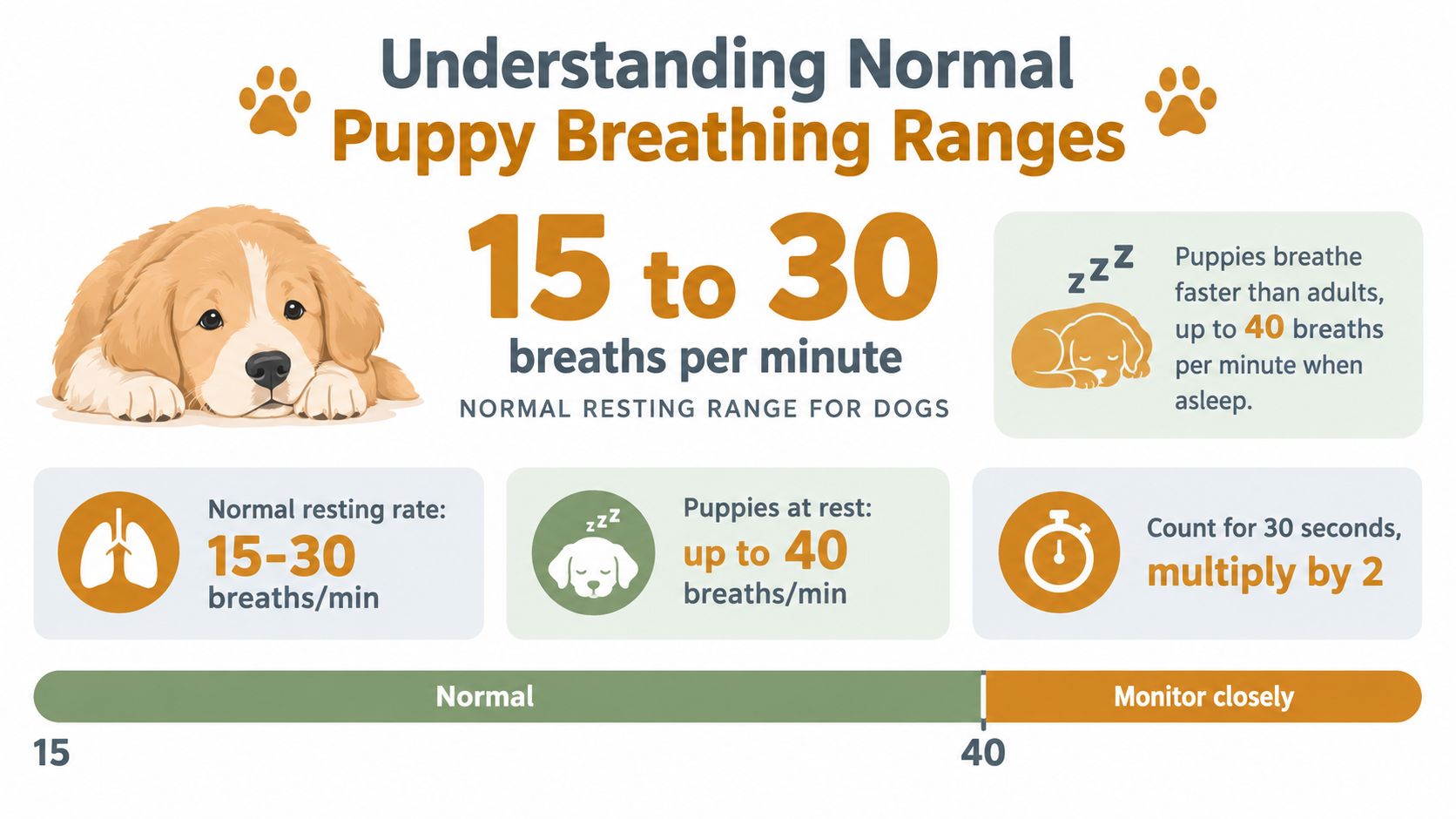
The established canine resting range is approximately 18–34 breaths per minute, according to the Merck Veterinary Manual's normal physiological values for dogs. That range is a practical starting point for a calm puppy, but it isn't a puppy-specific diagnostic cutoff. Your puppy's age, size, breed, temperature, and health can all influence the reading.
A real-life prospective study of 703 dogs found that respiratory rate varied with age, body weight, breed, season, and circadian rhythm. Among puppies aged 12 months or younger, the median was 20.1 breaths per minute, with an interquartile range of 16.0–25.7 across 659 observations during the study's measured conditions. The study also found lower rates at night than during the day and a decline through the first year of life, so one fixed number can't describe every puppy at every stage. Read the study of real-life canine respiratory patterns for the full context.
Why the setting matters
Count only when your puppy is resting or sleeping. Activity, excitement, anxiety, warm conditions, panting, and some dream activity can raise breathing temporarily. The count becomes much more useful when you compare similar situations, such as quiet sleep in the same room at a similar time.
Some veterinary references use a broader resting or sleeping range. VCA describes normal resting or sleeping breathing as generally 15–30 breaths per minute in its guidance on canine heart disease, while the Merck interval of 18–34 breaths per minute provides a useful general reference for resting dogs. These ranges overlap, but neither should replace an assessment of breathing effort and overall behavior.
For owners of smaller dogs, the small-breed reference pages can provide useful breed context, but they shouldn't be used to dismiss labored breathing. A puppy breathing smoothly with a regular pattern may be fine near the upper end of a reference range. A puppy with obvious effort may need care even if the number looks acceptable.
How to Measure Respiratory Rate at Home
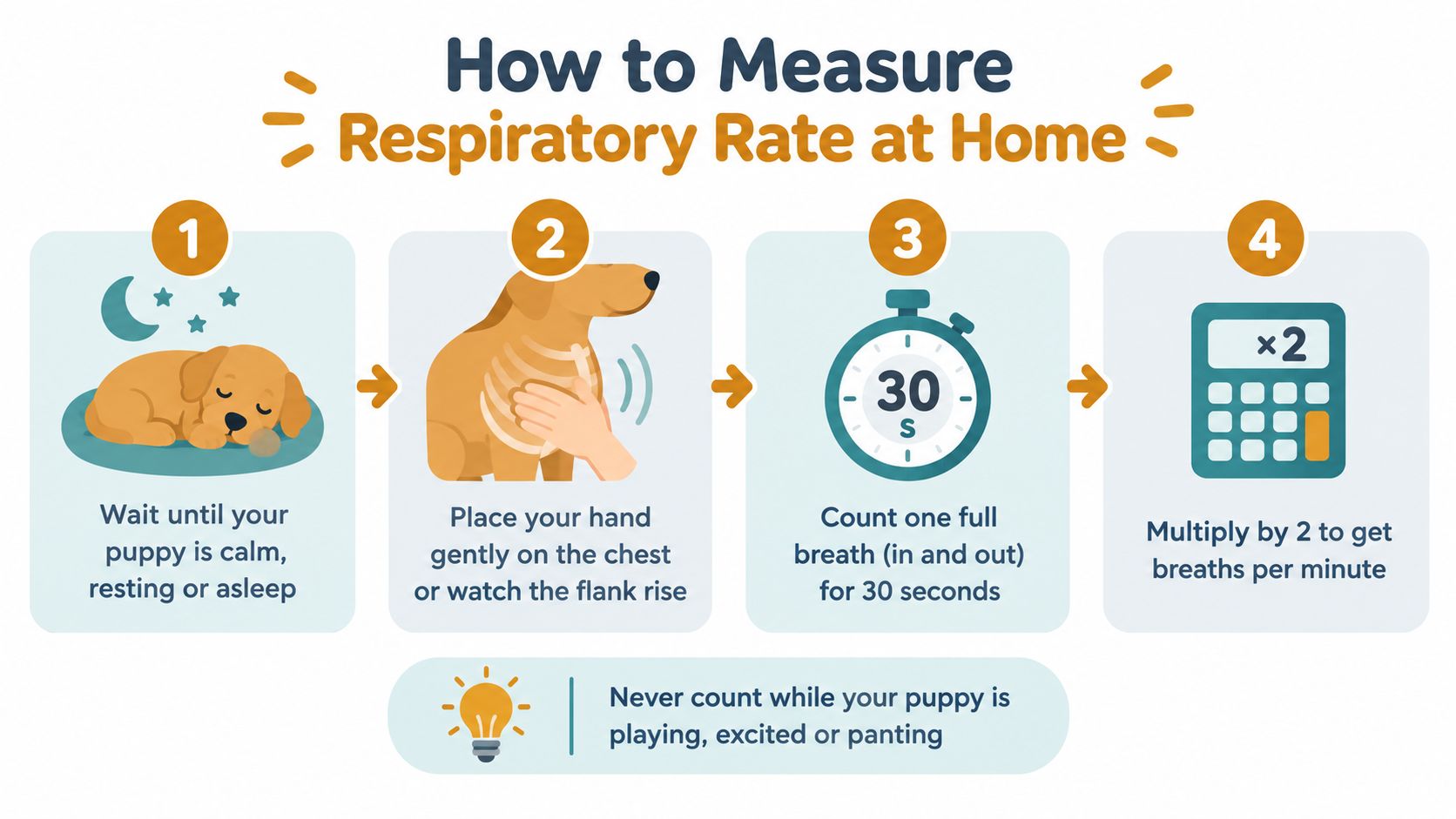
Measure your puppy when sound asleep or resting in a cool environment. A reading after running, barking, playing, exercising, or panting reflects recovery, not a resting baseline. Do not wake a sleeping puppy solely to obtain a count. Wait for a calm opportunity instead.
Use this method:
- Choose a repeatable moment. Measure when your puppy is relaxed and undisturbed. Record the time and situation so later readings can be compared fairly. If the puppy is twitching, vocalizing, or shifting during an active dream, wait until the body becomes still.
- Watch the chest or abdomen. One complete rise and fall equals one breath. Watching the flank usually causes less disturbance than touching the puppy. If your puppy remains relaxed, you may rest a hand lightly on the chest.
- Count for 30 seconds. Count every complete breath, then multiply the total by 2 to estimate breaths per minute.
- Count for 60 seconds when needed. Use a full minute if the rhythm is irregular, your puppy keeps moving, or the result seems close to a level that concerns you. This avoids errors caused by multiplying a short, uneven count.
Make the count repeatable
Write down the result instead of relying on memory. Include whether your puppy was asleep or calmly awake, whether the room was warm, and whether breathing looked smooth or effortful. Repeat readings under similar conditions whenever possible. Sleep stages and activity can change breathing substantially, so your puppy's usual pattern is more informative than a single number taken at an inconsistent time.
Keep both the count and the context. A rate that rises repeatedly during quiet sleep deserves more attention than one high reading after play, even when the two numbers are identical.
The Virginia Tech respiratory-rate handout states that a normal dog's resting rate generally does not exceed 36 breaths per minute and recommends contacting a veterinarian when the resting rate exceeds that level. For puppies, use this as a prompt to seek professional guidance, not as an isolated diagnosis. Age, breed, breathing effort, posture, and behavior all affect interpretation.
This short demonstration shows the counting process:
If you are organizing broader care records for a growing dog, the PetCostEngine puppy-care calculator may help with planning. It cannot assess breathing symptoms. Contact a veterinary professional when the pattern or effort concerns you.
Factors That Temporarily Change Breathing Rates
A fast count isn't automatically an emergency. The first question is whether the puppy was at rest when you measured it.
Play and exercise commonly increase breathing because the body needs to move more oxygen and release heat. Excitement, barking, fear, and handling can do the same. Panting in a warm environment is a cooling response, but it should gradually settle after the puppy rests in a cool, quiet place. Counting during that recovery period won't give you a reliable resting baseline.
Dreaming creates another common trap. A puppy may breathe faster, twitch, vocalize, or shift position during active dreaming. Wait until the puppy is still before counting. A single raised number during a dream is less informative than repeated raised counts during quiet sleep.
Environment and timing
The 2025 prospective study found meaningful variation by season and circadian rhythm, with lower respiratory rates at night than during the day. That finding supports a simple practical rule: measure at comparable times whenever possible. A morning reading after a calm night shouldn't be compared casually with a daytime reading after activity.
Age and body size also matter. The same study found that respiratory rate changed with age and body weight, while breed influenced the pattern as well. That doesn't mean every breed needs its own home threshold. It means a number should be interpreted alongside your puppy's usual rate, posture, effort, and behavior.
Practical rule: If the situation could make a healthy puppy breathe faster, postpone the count until the puppy is calm. If the puppy still breathes rapidly at rest, focus on the persistent pattern rather than explaining it away.
A breed reference, such as the Beagle health and care page, may help you understand general body and activity characteristics, but it can't determine whether an individual puppy is in respiratory distress. Rate is one observation. Effort and condition complete the picture.
Age and Breed Considerations in Breathing Patterns
A two-week-old puppy, an eight-week-old puppy, and a nine-month-old puppy shouldn't automatically be judged against the same expectation. Respiratory physiology changes during early development, and younger puppies can have higher and more variable resting and sleeping rates than dogs aged four months or older. The 2025 canine study also found a significant decline in respiratory rate through the first 12 months.
That doesn't create a reliable set of universal age cutoffs for home use. Very young or neonatal puppies can be difficult to assess because their sleep, temperature, activity, and feeding patterns change quickly. For these puppies, a trend and a veterinary examination carry more weight than comparing one count with an adult-oriented reference.
Rate and effort are different observations
A calm puppy with a smooth chest movement is different from a puppy using the abdomen forcefully with each breath. Compare the signs rather than focusing on rate alone:
| More reassuring pattern | More concerning pattern |
|---|---|
| Quiet, regular chest movement | Strong abdominal effort |
| Settles comfortably in a resting position | Repeatedly changes position or can't settle |
| Mouth closed when cool and resting | Open-mouth breathing without heat or exertion |
| Normal alertness for the situation | Weakness, collapse, or marked lethargy |
| Gums retain their usual healthy color | Gums appear pale, blue, gray, or otherwise abnormal |
Flat-faced, or brachycephalic, puppies require especially careful interpretation. Their airway anatomy can produce noisy breathing or a higher apparent baseline, but that doesn't make obstruction harmless. Persistent snorting, struggling to cool down, open-mouth breathing at rest, or visible effort should be evaluated rather than labeled as a breed trait.
The American Water Spaniel breed page illustrates why breed information can add background but can't replace an individual assessment. Breed, size, and age may shape a normal pattern, yet the most important question remains whether the puppy can breathe comfortably.
A puppy that pants after exertion and settles in a cool place is showing a different pattern from one that breathes noisily while resting. If you aren't sure which pattern you're seeing, record a short video and contact your veterinarian. A video can preserve posture, effort, and sound that a respiratory count can't capture.
Red Flags When to Seek Urgent Veterinary Care
Consider two common owner mistakes. In the first, someone counts a puppy immediately after play, sees a high number, and panics. The better response is to move the puppy to a cool, quiet place, watch whether breathing settles, and repeat the measurement only after genuine rest.
In the second, an owner sees a number within a familiar range and ignores the puppy's extended neck, abdominal heaving, or inability to lie down. That is the more dangerous mistake. Breathing effort overrides reassurance from a single count.
Signs that need immediate action
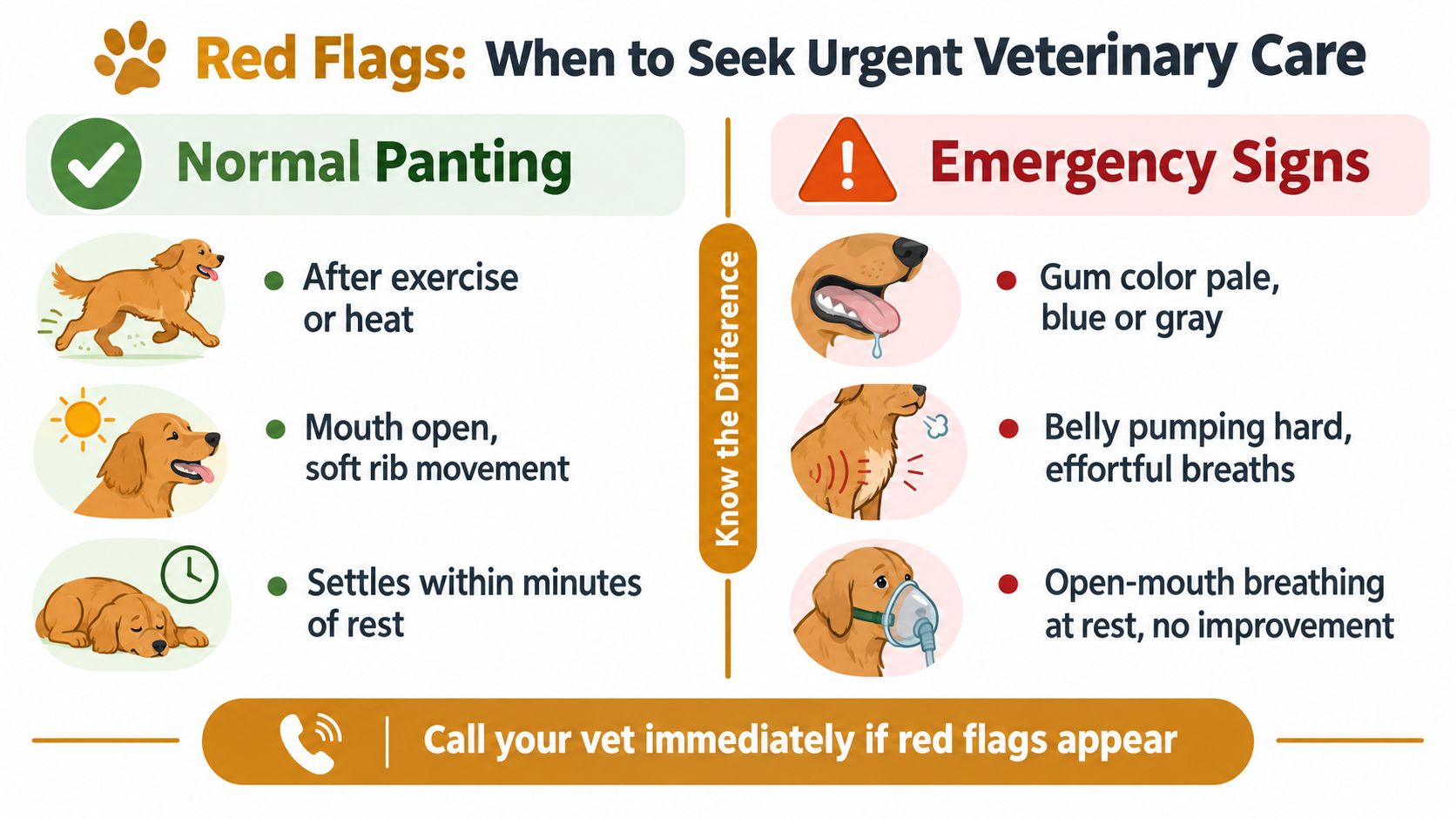
Seek urgent veterinary care if your puppy has:
- Labored breathing: The abdomen pumps hard, the neck stretches forward, or each breath appears physically difficult.
- Open-mouth breathing at rest: The puppy is cool, has not been exercising, and still breathes with the mouth open.
- Abnormal gum color: Blue, gray, pale, or markedly discolored gums are emergency signs.
- Collapse or weakness: The puppy can't stand normally, becomes unresponsive, or suddenly loses strength.
- Persistent distress: The puppy can't settle, repeatedly changes position, or appears frightened by the act of breathing.
- Breathing plus other symptoms: Coughing, nasal discharge, poor appetite, unusual sleepiness, or a sudden change in behavior adds concern.
The Virginia Tech guidance recommends veterinary contact when a dog's resting rate exceeds 36 breaths per minute, and it emphasizes prompt assessment when elevation persists or appears with increased effort, open-mouth breathing unrelated to heat, abnormal gum color, coughing, weakness, or collapse. Use that advice as a reason to call, not as permission to wait if your puppy looks distressed.
The Pug breed reference can help owners recognize why flat-faced dogs deserve extra care in heat and during exertion. It should never encourage you to normalize respiratory struggle. If your puppy is working to breathe, stop counting and seek help.
Creating a Health Monitoring Log for Your Puppy
A respiratory log turns scattered observations into a pattern your veterinarian can use. You don't need elaborate equipment. A notebook, phone note, or spreadsheet is enough if you record the same details consistently.
What to record
Create one entry for each check and include:
- Date and time: Similar timing makes comparisons more meaningful.
- Sleep or resting state: Note whether the puppy was sound asleep, awake, or moving through a dream.
- Respiratory count: Record the breaths counted and whether you used a shorter count or a full minute.
- Breathing quality: Write down whether movement was smooth, noisy, shallow, or visibly effortful.
- Environment: Note whether the room was cool, warm, humid, or unusually active.
- Recent activity: Include play, exercise, excitement, barking, travel, or stress before the check.
- Other observations: Record coughing, nasal discharge, appetite changes, weakness, or unusual behavior.
Try to measure at the same general time each day, ideally while the puppy sleeps. The purpose isn't to create a perfect medical record. It's to establish what normal looks like for this puppy and identify a sustained departure from that pattern.
A trend is more useful than a single number, but a sudden change in effort is urgent even before a trend develops.
Bring the log to routine veterinary visits, especially if the readings have changed repeatedly. If breathing becomes difficult, don't delay care while collecting more entries. The log supports a veterinary assessment. It doesn't replace one.
Quick Reference Table Respiratory Rates by Age
The table below is a reference aid, not a set of diagnostic cutoffs. Available evidence supports a general resting range for dogs and shows that rates tend to change during the first year, but it doesn't establish universally reliable home thresholds for every puppy age group.
| Age Group | Normal Resting Rate (breaths/min) | Notes |
|---|---|---|
| Neonatal puppy | Use individual veterinary guidance | Very young puppies can have higher and more variable breathing patterns. A universal home range isn't established by the available data. |
| Young puppy, under 4 months | Use the calm resting canine reference of approximately 18–34, with context | Earlier analysis found higher and more variable resting and sleeping rates than in dogs aged four months or older. See the Merck resting respiratory reference. |
| Puppy, under 12 months | Approximately 18–34 as a general resting reference | A 2025 study reported a median of 20.1 during quiet sleep in puppies aged 12 months or younger. |
| Older puppy approaching adulthood | Use the general canine resting reference and personal baseline | Age, size, breed, temperature, and health still affect the reading. Persistent elevation at rest warrants veterinary guidance. |
Count only during quiet rest or sleep. If the puppy is panting, dreaming actively, recovering from play, or showing effort, the table can't safely interpret the situation. The number belongs alongside posture, gum color, energy, coughing, and the ability to settle.
Common Myths About Puppy Breathing Debunked
Myth one: Every puppy should breathe at exactly the same rate.
There is no single perfect number for every puppy. Age, body size, breed, temperature, recent activity, and sleep stage can all change the reading. Compare measurements taken in similar conditions and build a personal baseline rather than judging one isolated count.
Myth two: Any panting means heatstroke.
Panting commonly follows exercise, excitement, stress, dreaming, or warm conditions. Concern rises when it fails to settle with rest, occurs while a puppy is cool and resting, or appears with weakness, collapse, abnormal gums, or visible breathing effort.
Myth three: Faster breathing during sleep always signals illness.
Dreaming can briefly change breathing speed and rhythm. Wait until the puppy is still, then count again. A repeated increase during quiet sleep deserves more attention than a short change accompanied by twitching or vocalization.
Myth four: A normal number rules out a breathing emergency.
Breathing effort and overall appearance matter as much as the count. Open-mouth breathing, strong abdominal movement, an unusual posture, abnormal gum color, coughing, weakness, or collapse require prompt veterinary attention. The Virginia Tech veterinary guidance also emphasizes interpreting respiratory rate alongside these signs.
Myth five: More checks always provide better protection.
Frequent interruptions can disturb sleep and increase anxiety without improving the assessment. Measure deliberately, record the context, and watch for a persistent change from your puppy's usual pattern.
Integrating Respiratory Checks into Daily Routine
Respiratory monitoring works best when it becomes a quiet observation rather than an event. Check while your puppy is already sleeping before bedtime or resting after a calm cuddle. Avoid touching the chest if contact wakes the puppy. Watching the flank from a short distance is often enough.
Keep the routine simple:
- Choose one calm opportunity: Use a familiar rest period rather than interrupting play.
- Count consistently: Use the same method each time, with a full-minute count when the rhythm is irregular.
- Record the context: Note sleep state, recent activity, room conditions, and breathing effort.
- Look beyond the number: Check whether your puppy can settle, whether movement is smooth, and whether behavior is typical.
- Escalate promptly: Contact a veterinarian for persistent elevation at rest or any concerning effort, gum color, weakness, or collapse.
Don't turn every nap into a medical examination. The purpose is to recognize a meaningful change, not to chase tiny fluctuations between sleep stages. A calm puppy may briefly breathe differently during a dream and then return to its usual pattern without intervention.
Your personal baseline becomes more useful as you collect comparable observations. If that baseline shifts repeatedly during quiet sleep, share the log and any video with your veterinarian. If your puppy is struggling to breathe, skip further monitoring and seek urgent care.
A reliable home approach has three parts: count under valid resting conditions, compare the result with the puppy's own pattern, and judge breathing effort at the same time. The normal respiratory rate for puppies is best understood as a context-dependent reference, not a number that can overrule visible distress.
PetCostEngine offers data-driven tools that organize breed, age, and state information for practical dog ownership planning. Visit PetCostEngine to explore the tools and build a clearer plan for your puppy's care.
Estimated lifetime and yearly costs for a Beagle, state by state, plus whether pet insurance breaks even for the breed.
See Beagle costs →
Is insurance worth it for a Beagle? →
No-pull harness → Slow-feeder bowl → Orthopedic bed →
As an Amazon Associate, PetCostEngine earns from qualifying purchases.