

Most puppies start sleeping through the night between 12 and 16 weeks of age, with many reaching a full 6- to 8-hour stretch by 4 months. An 8-week-old puppy usually still needs overnight potty breaks, while many healthy puppies can sleep from bedtime to morning by 5 to 6 months.
If you're standing beside a crate at 3 a.m., wondering whether the whining means “bathroom” or “I'd like company,” you're in the hardest part of the transition. Your puppy isn't being stubborn, and you haven't failed at crate training. Nighttime sleep develops as the bladder grows, sleep-wake rhythms settle, and your household establishes a predictable routine.
The useful question isn't only when do puppies start sleeping through the night. It's also what is waking this puppy right now, and what can I change without asking more of their body than it can manage?
Table of Contents
- What the Typical Puppy Sleep Timeline Looks Like
- How a Puppy's Sleep Needs Change Week by Week
- Why Bladder Control Drives Overnight Sleep
- Breed and Size Differences That Shift the Timeline
- Building a Bedtime Routine That Supports Longer Stretches
- Common Reasons a Puppy Still Wakes at Night
- A Practical Milestone Checklist for the First Six Months
What the Typical Puppy Sleep Timeline Looks Like
Most puppies begin sleeping through the night between 12 and 16 weeks, or roughly 3 to 4 months, according to several pet-care references that place this period at the point when bladder control can support a 6- to 8-hour overnight stretch. Some guidance identifies about 16 weeks as the more practical turning point, so a puppy who still needs one outing before then is usually within a normal range. See the puppy sleep schedule guidance for an age-based overview.
That range is a guide, not a deadline. An 8-week-old puppy has only recently left their litter and typically needs help getting through the night. A 5-month-old puppy who wakes occasionally may still be adjusting to teething, a new environment, or a changing daily rhythm. The trend matters more than one difficult night. You're looking for longer stretches, quicker resettling, and fewer accidents over time.
Three influences explain most of the variation:
- Bladder capacity: A puppy may wake because they physically need to eliminate, even if they're tired and comfortable.
- Breed and size: Smaller puppies often have less bladder capacity relative to the length of the night. Larger puppies may reach longer stretches sooner, although individual development still varies.
- Household routine: Late meals, exciting evening play, irregular crate time, and household noise can interrupt sleep even after a puppy has begun making progress.
Practical rule: Treat uninterrupted nighttime sleep as a developmental milestone supported by training, not as a behavior your puppy can produce on command.
A puppy who wakes once, potties without fuss, and returns to sleep is making meaningful progress. A puppy who cries, plays, and stays awake for a long period may need a different response, such as a calmer wind-down or more daytime structure. The next sections place your puppy on the age curve, explain the role of bladder control, compare breed and size differences, and give you a routine for handling ordinary wake-ups and possible warning signs.
How a Puppy's Sleep Needs Change Week by Week
Puppies sleep for much of the day because growth takes energy. In the first weeks, total daily sleep commonly reaches 18 to 20 hours, then gradually falls toward about 10 to 14 hours by 6 months, as described in this age-based puppy sleep chart. That total includes naps, so a puppy can sleep heavily during the day and still need a bathroom trip overnight.
| Age Range | Daily Sleep | Overnight Stretch |
|---|---|---|
| 8 to 10 weeks | About 18 to 20 hours | Potty breaks commonly needed every 2 to 3 hours |
| 10 to 12 weeks | Still sleep-heavy, with naps throughout the day | Some puppies begin reaching a 4-hour stretch |
| 12 to 16 weeks | Daytime naps gradually become less frequent | A 6- to 8-hour stretch becomes typical for many puppies |
| 4 to 5 months | Total sleep continues to moderate | Many puppies need only a single overnight break |
| Around 6 months | About 10 to 14 hours in a full day for many puppies | Most healthy puppies can sleep through the entire night |
At 8 to 10 weeks, plan around the puppy you have rather than the schedule you wish you had. Take them out when they wake, keep the trip focused on elimination, and return them to the crate. By 10 to 12 weeks, some puppies produce their first longer block of sleep, but that doesn't mean every night will follow the same pattern.
The 12- to 16-week period often brings the biggest improvement. Daytime naps may begin spreading farther apart, and the overnight stretch can lengthen as the puppy's body matures. The change is gradual. A puppy may sleep well for several nights, then wake again during a stressful or physically uncomfortable phase.
Teething, unfamiliar sounds, changes in the household, and temporary fear periods can all cause setbacks. Don't interpret a regression as proof that the routine has stopped working. Return to the last schedule your puppy handled comfortably, then extend the interval again when the puppy is ready.
Why Bladder Control Drives Overnight Sleep
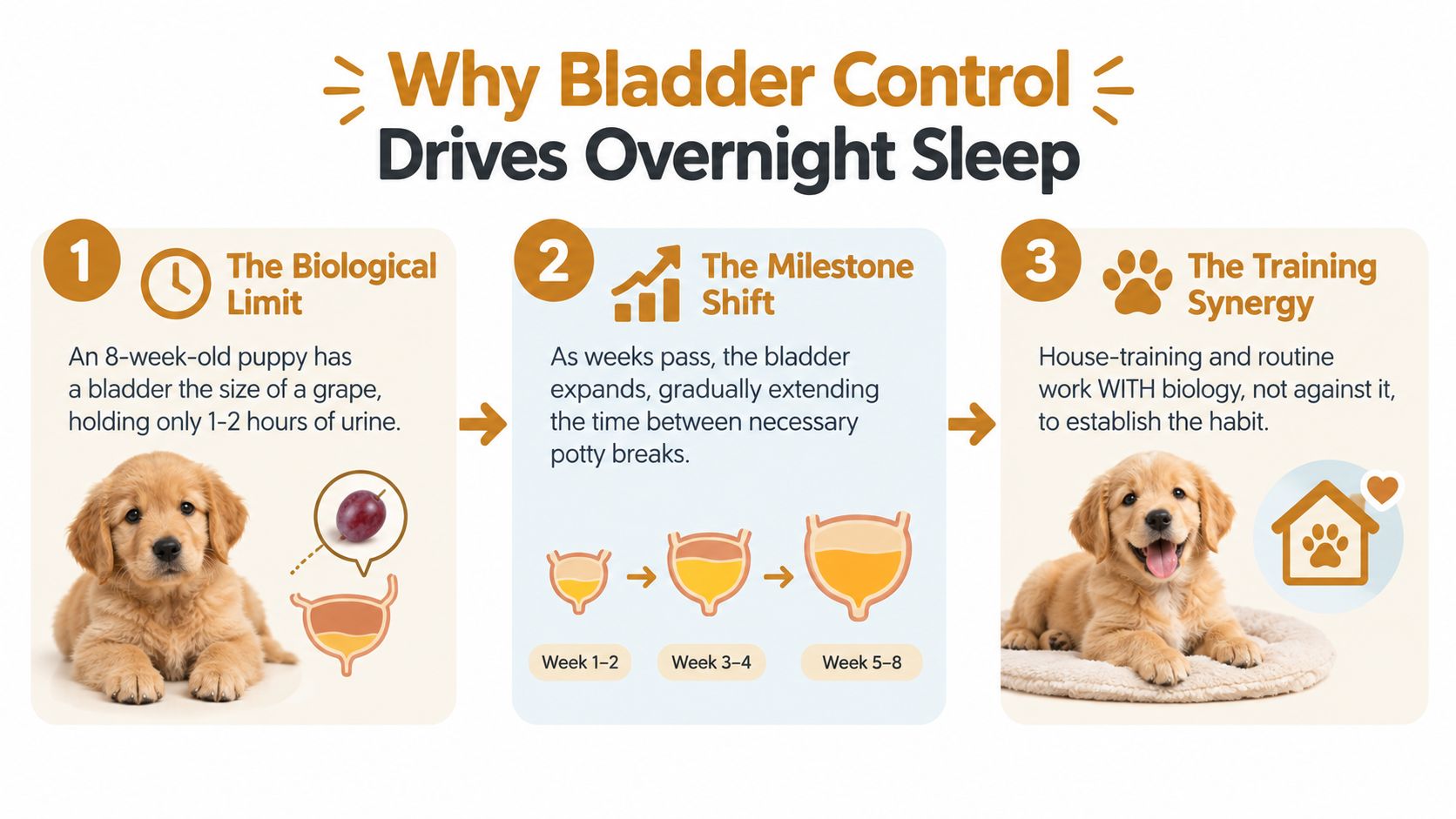
Nighttime sleep is a bladder-capacity milestone, not a switch that flips when a puppy learns obedience. A young puppy may understand where you want them to potty and still be unable to hold urine for the entire night. Waking to eliminate is a biological response, not a training failure.
A commonly used rule of thumb is that a puppy can hold urine for about one hour per month of age, plus one, as summarized in this puppy bladder-control guidance. Under that estimate, a 2-month-old puppy may manage about 3 hours, while a 4-month-old puppy may manage about 5 hours. A 3-month-old puppy would be expected to manage about 4 hours under the same rule.
That guideline isn't a promise. Activity, water intake, health, stress, body size, and whether the puppy is awake or asleep all affect the result. It's best used as a ceiling for planning, not a challenge to test.
Work with the limit
If you keep a puppy confined longer than they can comfortably hold urine, an accident becomes more likely. Repeated crate soiling can make house-training harder because the puppy no longer has a clean sleeping area to protect. The answer isn't punishment. Shorten the interval, improve the bedtime routine, and give the puppy more time to mature.
Sleep-wake rhythms develop alongside bladder control. A puppy who can remain asleep for longer can also avoid waking from every small internal signal, but that ability comes with development rather than willpower. This is why guidance from Chewy on teaching puppies to sleep through the night generally treats uninterrupted 8-hour sleep as unrealistic before about 12 weeks.
Small-bodied puppies may need especially patient scheduling. If you're raising a toy-breed puppy, compare your expectations with this toy-size breed reference, then let the puppy's actual signals guide the next adjustment.
Breed and Size Differences That Shift the Timeline
Size changes the practical timeline because a smaller puppy's bladder has less room, and some small breeds need more time before they can manage a long overnight interval. Larger puppies may sometimes reach a full-night stretch closer to 3 months, while many small puppies take longer. These are broad patterns, not guarantees. A puppy's individual development still matters more than a label on the breed standard.
Breed type can affect settling in a different way. Working, sporting, and herding puppies may stay alert after the household goes quiet because they're highly responsive to movement, sound, and interaction. Brachycephalic puppies may have fragmented sleep if breathing discomfort interferes with rest. These puppies need comfortable sleeping conditions and veterinary attention if breathing appears abnormal, rather than simply more crate time.
| Factor | Typical Effect on Nighttime Sleep | Range vs. Average |
|---|---|---|
| Toy or small size | May need more frequent potty opportunities | Often later |
| Large or giant size | May reach longer stretches as bladder capacity develops | Similar to slightly earlier |
| Working, sporting, or herding type | May take longer to settle after stimulation | Often later |
| Brachycephalic structure | Breathing-related discomfort may interrupt sleep | Variable |
| Individual temperament | Anxious or highly alert puppies may wake more easily | Variable |
| New household or shelter transition | Adjustment can temporarily fragment sleep | Often later at first |
A puppy's starting point also shapes the first nights. Early weaning, a move from a shelter or foster home, and a busy household can make settling harder. A breeder-raised puppy may still cry after separation from littermates, while a rescue puppy may react to unfamiliar sounds, confinement, or a changed sleep location. Neither response predicts the final outcome.
For larger dogs, a giant-breed reference page can help you set breed-appropriate expectations, but don't use size as permission to skip potty breaks. The 12- to 16-week window is a useful average guide. An outlier isn't automatically a problem, especially when the puppy is steadily improving.
Building a Bedtime Routine That Supports Longer Stretches
A good bedtime routine reduces avoidable wake-ups, but it can't override bladder development. Keep the sequence the same each night so your puppy learns that the final potty trip leads to quiet sleep rather than another round of activity.
Set up the final hours
Offer the last meal about 3 to 4 hours before bed, and remove access to water about one hour before sleep, following the routine guidance summarized by the Louisiana SPCA's crate-training resource. Don't restrict water if your veterinarian has told you otherwise, or if your puppy has a medical need that requires free access. The purpose is to avoid a large meal or drink immediately before lights out, not to make a thirsty puppy uncomfortable.
Use the final part of the evening for calm activity. A short, on-leash potty trip works better than an exciting game in the yard. Inside, offer a safe chew session or practice a brief settle cue in the crate. Dim lighting and steady background sound, such as white noise, can reduce startling from household movement.
Make overnight trips boring
If your puppy still needs an overnight break, take them out at a predictable time when possible. Keep the room dark, use minimal speech, walk directly to the potty area, and return to the crate after elimination. Don't turn the outing into play, training, feeding, or extended affection.
Nighttime goal: Your puppy should learn that waking leads to a quiet bathroom trip, then back to sleep.
Place the crate near your bed during the first weeks. You'll hear genuine potty signals sooner, and your presence may help a worried puppy settle without prolonged crying. Once the puppy sleeps comfortably, move the crate farther away in small stages rather than relocating it abruptly.
In the morning, release the puppy on a predictable schedule and take them out promptly. Calmly reinforce a dry night and a quiet return to sleep, but don't create a dramatic celebration that encourages early waking. If you're organizing broader dog ownership planning alongside training, the PetCostEngine calculator can help you account for routine care needs without turning bedtime decisions into guesswork.
Consistency matters more than perfection. One disrupted night won't erase progress, but a changing response every night can teach your puppy that persistent noise eventually earns attention.
Common Reasons a Puppy Still Wakes at Night
Frequent waking usually fits one of three categories: physical needs, environmental disruption, or medical and behavioral concerns. Start by observing what happens immediately before the puppy wakes. A puppy who whines, circles, and settles after urinating has given you different information from one who pants, paces, and remains distressed after a quiet potty trip.
Physical needs
A full bladder is the most ordinary explanation for a young puppy. Teething discomfort can also make the puppy fidget, chew bedding, or struggle to settle. Hunger may play a role if the puppy isn't receiving adequate daytime nutrition, but changing meal timing or portions should be discussed with your veterinarian rather than handled by guesswork.
For teething discomfort, offer an appropriate chew that the puppy can use safely under supervision. If the puppy wakes soon after going outside and appears restless rather than relieved, look at comfort as well as elimination.
Environmental triggers
Late feeding, a warm crate, uncomfortable bedding, bright lights, and household noise can fragment sleep. Check the crate's location and temperature, then look for a repeatable pattern. A puppy who wakes when a family member returns home may need a quieter sleeping area, while one who wakes after evening excitement may need a slower wind-down.
Medical or behavioral concerns
A urinary tract problem, gastrointestinal parasites, separation distress, or a temporary regression after illness can all disrupt sleep. If a puppy older than the usual transition window continues waking frequently, veterinary guidance is appropriate. French Bulldog owners should be particularly attentive to breathing-related sleep disruption because flat-faced anatomy can complicate comfortable rest.
Call your veterinarian for frequent small accidents, blood in the urine, persistent crying that doesn't improve after a boring potty break, or any sudden sleep change after illness. Also seek help if the puppy shows vomiting, diarrhea, unusual tiredness, poor appetite, or obvious discomfort.
Waking is information. Record the time, behavior, whether the puppy eliminated, and how quickly they resettled. That simple pattern can show whether you need a schedule adjustment, a crate change, a training refresh, or a medical evaluation.
A Practical Milestone Checklist for the First Six Months
Use this checklist as a flexible reference, not a test your puppy must pass. The strongest sign of healthy progress is a gradual increase in sleep duration paired with fewer accidents and faster settling.
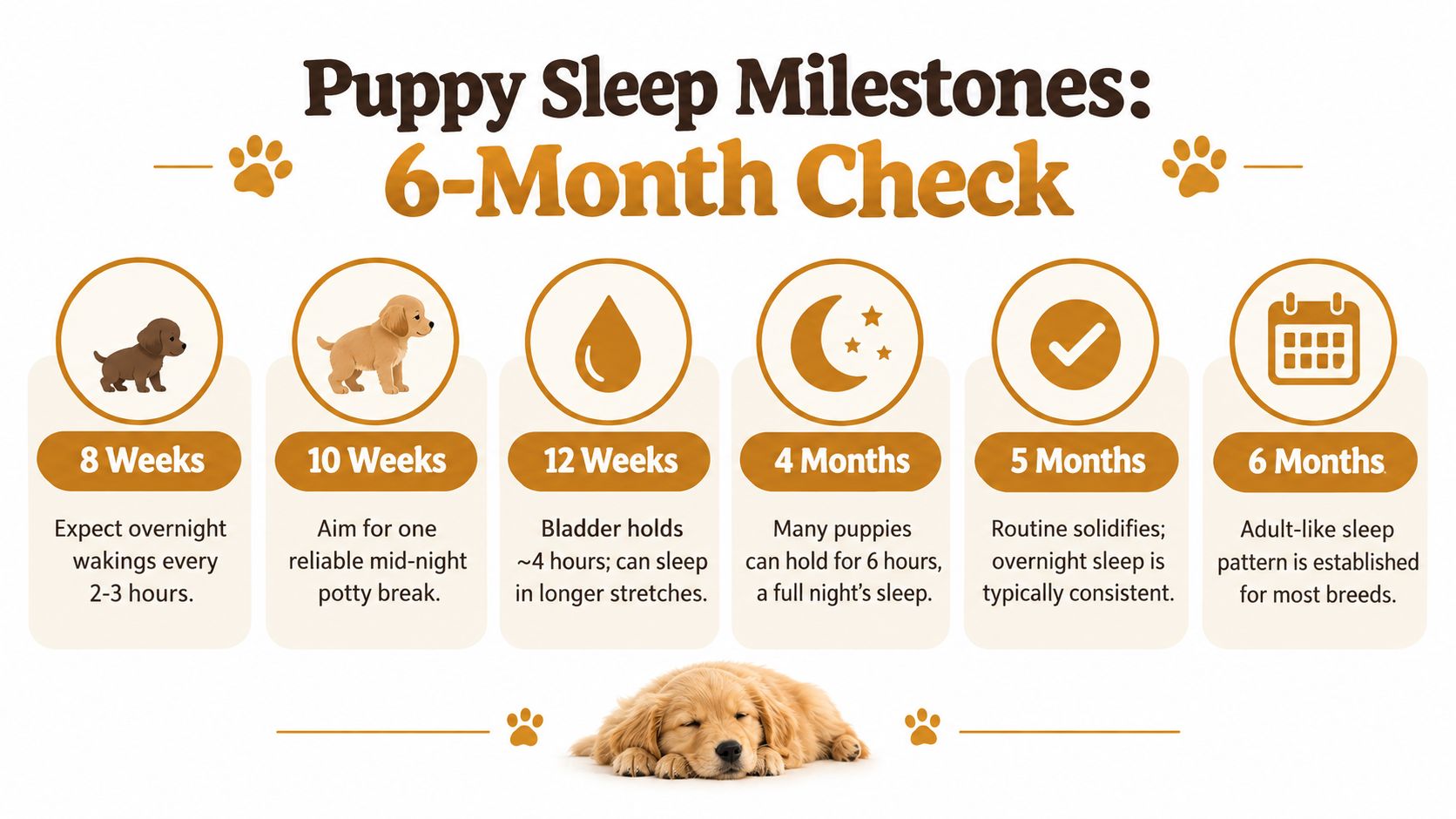
- 8 weeks: Focus on making the crate familiar and safe. Expect one to two overnight breaks, and respond rather than leaving a very young puppy to struggle for a long period.
- 10 weeks: Work toward 3- to 4-hour stretches when your puppy can manage them. Offer the last meal before 7 p.m. if that fits your bedtime and veterinary guidance, then schedule a final potty trip.
- 12 weeks: Many puppies can handle one overnight break and fall back asleep quickly afterward. Keep that trip predictable.
- 16 weeks: A 6- to 8-hour stretch becomes realistic for many puppies as bladder capacity catches up with sleep. Keep the routine steady instead of extending the interval suddenly.
- 20 weeks: Expect one reliable overnight break or none, depending on size and individual development. The most valuable habit is a consistent bedtime sequence.
- 6 months: Most healthy puppies can sleep through the entire night, although small-breed and toy puppies may remain exceptions. Continue watching the puppy's signals instead of relying only on age.
The ASPCA's age-based crate-training guidance also shows why this milestone develops in stages. Puppies around 9 to 10 weeks may manage only 30 to 60 minutes in a crate during some daytime situations, those around 11 to 14 weeks may manage 1 to 3 hours, and puppies around 15 to 16 weeks may manage 3 to 4 hours. At 17 weeks or older, many can manage 4 to 6 hours at a time, although overnight sleep and daytime crate tolerance aren't identical.
Watch two veterinary checkpoints. Contact your veterinarian if there's no meaningful improvement past 16 weeks, or if your puppy suddenly regresses after months of dry nights. A urinary issue and other medical causes can look like a training setback.
For breed-specific temperament and activity context, you can also review this American Water Spaniel breed page.
PetCostEngine helps dog owners connect everyday care decisions with breed and location-specific planning through its calculator, breed references, and data-driven guides. Visit PetCostEngine to explore your dog's profile and build a clearer care plan while you work toward calmer, longer nights.
Estimated lifetime and yearly costs for a French Bulldog, state by state, plus whether pet insurance breaks even for the breed.
See French Bulldog costs →
Is insurance worth it for a French Bulldog? →
Crate and bedding → Durable chews → Premium dry food →
As an Amazon Associate, PetCostEngine earns from qualifying purchases.