
You're halfway down the block when your dog spots another dog across the street. His leash goes tight, his body locks in place, and a burst of barking turns a quiet morning walk into a public event. You feel embarrassed, the other dog's owner looks over, and you're left deciding whether to cross the street, apologize, or pull your dog away.
That moment can look like simple disobedience, but barking is usually the visible tip of a larger emotional chain. Your dog may be afraid, frustrated by the leash, excited by a possible greeting, guarding space, or redirecting arousal toward whatever is closest. Understanding why your dog barks at other dogs helps you choose a response that changes the underlying pattern instead of merely interrupting the sound.
Table of Contents
- The Walk Where Everything Goes Sideways
- What Barking at Other Dogs Really Means
- The Five Common Causes Behind the Barking
- Normal Communication or Real Reactivity
- Management and Training That Works
- Matching the Cause to the Right Next Step
- Popular Beliefs That Hold Dogs Back
- When to Bring in a Trainer or Vet
The Walk Where Everything Goes Sideways
Your dog knows this route. He's sniffed the same mailbox, paused at the same driveway, and walked past the same corner many times. Then another dog appears half a block away.
At first, your dog notices. His ears point forward. His tail becomes stiff, and all four feet plant against the pavement. The other dog continues walking, seemingly unaware of the crisis developing across the street. Then your dog barks, once, twice, and again, until the leash snaps taut and his whole body leans toward the trigger.
You try his name. You offer a treat. Nothing reaches him. The other owner glances over, their dog looks confused, and you start wondering whether your dog is aggressive, overly excited, or ignoring everything you've taught him. Even a normally vocal breed, such as a Beagle, can produce very different sounds for very different emotional reasons.
What happens inside that moment
The bark isn't an isolated choice. Your dog sees or hears another dog, evaluates the distance and movement, experiences an emotional surge, and then uses the behavior that has worked most reliably in similar situations. If barking makes the other dog pass by, creates more distance, or produces a response from you, the pattern can become easier to repeat.
The same scene can also mean different things for different dogs. One dog may be trying to greet but can't reach the other animal. Another may be warning a perceived threat to stay away. A third may have become so aroused by the sight of a dog that he can't organize a calmer response.
Your task isn't to judge the outburst from the sidewalk. It's to decode the chain behind it. Body posture, trigger distance, location, leash tension, and recovery after the bark all provide clues about what your dog is feeling in that second.
What Barking at Other Dogs Really Means
Dogs use barks the way people use words. The same sound can carry different meanings depending on the situation. Dogs have lived alongside humans for roughly 30,000 to 50,000 years, and domestication shaped how they use vocal signals around people and other animals, as described in research on canine bark communication.
A sharp, repeated bark may warn of danger. A high, quick bark can signal excitement, while frantic barking behind a barrier may express frustration because the dog cannot reach or control what has caught his attention. Other barks can communicate danger, fear, greeting, play, loneliness, or discomfort.
The sound alone cannot identify the emotion. Pay attention to pitch, duration, repetition, body posture, and what happened immediately before the vocalization. A loose, forward-moving dog gives you different information from a stiff dog leaning away, even if both are barking loudly.
Context changes the message
A dog barking at another dog through a front window faces a different problem from one barking during a leash greeting. In a yard, the dog may be responding to an unfamiliar animal near the property. On a walk, the trigger may be fear, social excitement, or frustration because the leash prevents approach.
Location and movement matter too. A dog behind a fence may bark as another dog passes, then settle once the animal disappears. A dog on a narrow pavement may escalate because the approaching dog keeps getting closer and there is no easy escape route.
Playback research found that dogs can distinguish between different bark contexts and between familiar and unfamiliar callers. When test dogs heard a strange dog barking at a fence, they stayed closer to the gate, barked more often, and paid more attention than when they heard a familiar dog or a lonely bark, according to the reported playback findings.
Practical rule: Treat the bark as information about an emotional state. Then examine the trigger and body language before choosing a response.
Older canine-behavior literature also describes barks as useful for short-range communication, while howls can carry over longer distances. One dog's vocalization may prompt another dog to join in, helping explain why a single bark can start a chain reaction in a neighborhood, apartment hallway, or yard.
The Five Common Causes Behind the Barking
The loudness of the behavior doesn't identify the cause. A loose, social dog and a frightened dog can both bark intensely, but their bodies and trigger patterns often reveal what the sound means.
Social excitement and arousal
Some dogs bark because another dog is highly socially important. They may want to greet, play, chase, or investigate, but their excitement rises faster than their self-control.
Look for a loose body, wiggly movement, a sweeping tail, bouncing steps, or a play bow. The dog may alternate between barking and pulling forward, especially when an off-leash dog approaches or when a familiar playmate appears. This isn't automatically friendly or safe, but the relaxed posture suggests social arousal rather than immediate defensive fear.
Fear-based reactivity
A fearful dog may bark to increase distance from the other animal. Defensive signs can include a tucked tail, crouched body, flattened ears, weight shifted backward, whale eye, or attempts to retreat before lunging forward again. The dog can look aggressive because barking and lunging often make the perceived threat move away.
The American Veterinary Medical Association's behavior definitions describe fear toward animals as behavior that may include attempts to escape and defensive postures. A dog that barks at a dog approaching too closely may be saying, in effect, “I need more space.”
Territorial behavior
Territorial barking appears most reliably around a home, yard, car, window, fence, or doorway. The dog may stand tall and rigid, stare hard, raise the hair along his back, and move toward the boundary while vocalizing.
The location matters here. A dog who walks calmly past dogs but erupts when one passes the house may not have a broad dislike of dogs. He may be responding to an unfamiliar animal entering a space he considers his responsibility to monitor.
Frustration and barrier frustration
A leash or fence can prevent a dog from reaching another dog. That blocked access creates an approach-avoidance conflict. The dog is socially drawn toward the other animal, but physical restraint prevents him from moving normally, so barking, spinning, and lunging release the rising arousal.
Veterinary behavior guidance describes barking and lunging when access is blocked as a common frustration response, while also noting that fear, territoriality, and learned reinforcement can maintain the pattern. Seeing another dog approach off-leash, stare, bark, or run nearby can be especially provocative.
Redirected arousal
Sometimes the nearby dog triggers the emotional surge, but your dog directs the behavior at the leash, a fence, a person, or another animal. You may see frantic spinning, leash biting, snapping toward a hand, or barking at a dog who happens to be standing closest.
Redirected behavior is more likely when your dog is already highly aroused. It doesn't mean the original trigger was irrelevant. It means the emotional load exceeded your dog's ability to respond directly and safely.
| Cause | Typical Trigger | Key Body Language Signs |
|---|---|---|
| Social excitement | Possible greeting, playmate, off-leash dog | Loose movement, wiggly body, bouncing, play bow |
| Fear-based reactivity | Close approach, staring, unfamiliar dog | Tucked tail, crouching, whale eye, retreat attempts |
| Territorial behavior | Dog near home, car, yard, window, or fence | Rigid posture, hard stare, raised hackles, boundary patrol |
| Frustration | Leash or barrier prevents access | Pulling forward, spinning, barking, lunging |
| Redirected arousal | Intense trigger with no clear outlet | Leash biting, snapping at nearby target, frantic movement |
Breed tendencies can influence how a dog notices and responds to the environment, but breed alone won't reveal the emotional cause. Comparing behavior patterns across dogs is more useful than assuming one label explains every case, and a breed comparison guide can provide broader context without replacing individual observation.
Normal Communication or Real Reactivity
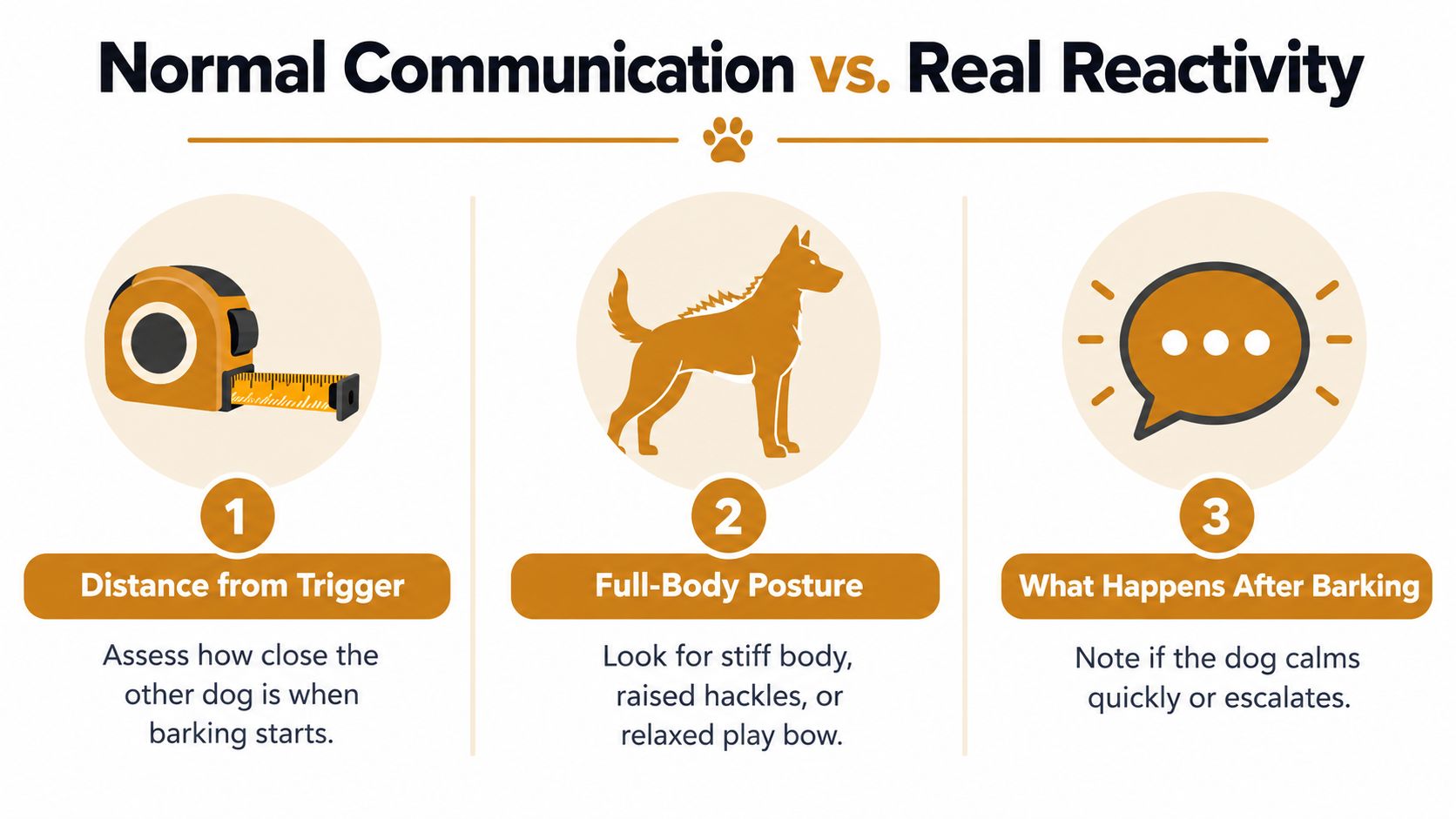
Barking on a walk is data, not a verdict. Start by watching three things: distance from the trigger, full-body posture, and what happens after the first bark.
A Labrador who notices another dog at thirty feet, barks once, breaks eye contact, takes a treat, sniffs the ground, and keeps walking may be communicating. The bark could be a brief alert or social signal. The dog remains able to process information and recover.
A German Shepherd who begins lunging whenever another dog appears within fifty feet, freezes before exploding, refuses food, and escalates through repeated barking is showing a different pattern. The label “reactive” describes an exaggerated response to a trigger. It doesn't automatically mean the dog intends to harm another dog.
Use recovery as your clearest clue
Ask yourself:
- Can your dog turn away from the other dog?
- Can he take food or respond to a familiar cue?
- Does his body stay loose, or does it become rigid?
- Does he recover quickly, or remain scanning and tense?
- Does each encounter intensify the next one?
A dog over threshold has moved beyond the point where casual social signaling works. He may not be capable of learning in that instant, so repeated cues, leash corrections, and louder commands usually add pressure rather than clarity.
The best diagnosis comes from patterns across several walks, not from one embarrassing encounter. Note the setting, distance, movement of the other dog, your dog's posture, and the time needed to return to normal. An American Water Spaniel breed profile may help you learn about breed characteristics, but your dog's individual threshold remains the more important training guide.
A short video can also help a qualified professional see details you miss while managing a leash. Use safe distance and never arrange a close encounter just to record one.
Management and Training That Works
Training begins before the bark. Your first job is to keep enough space between your dog and the other dog for him to notice without losing the ability to think, eat, or respond. The American Kennel Club recommends working below threshold, where a dog can observe the trigger and still accept rewards, in its guidance on leash reactivity and lunging.
Create space on ordinary neighborhood walks
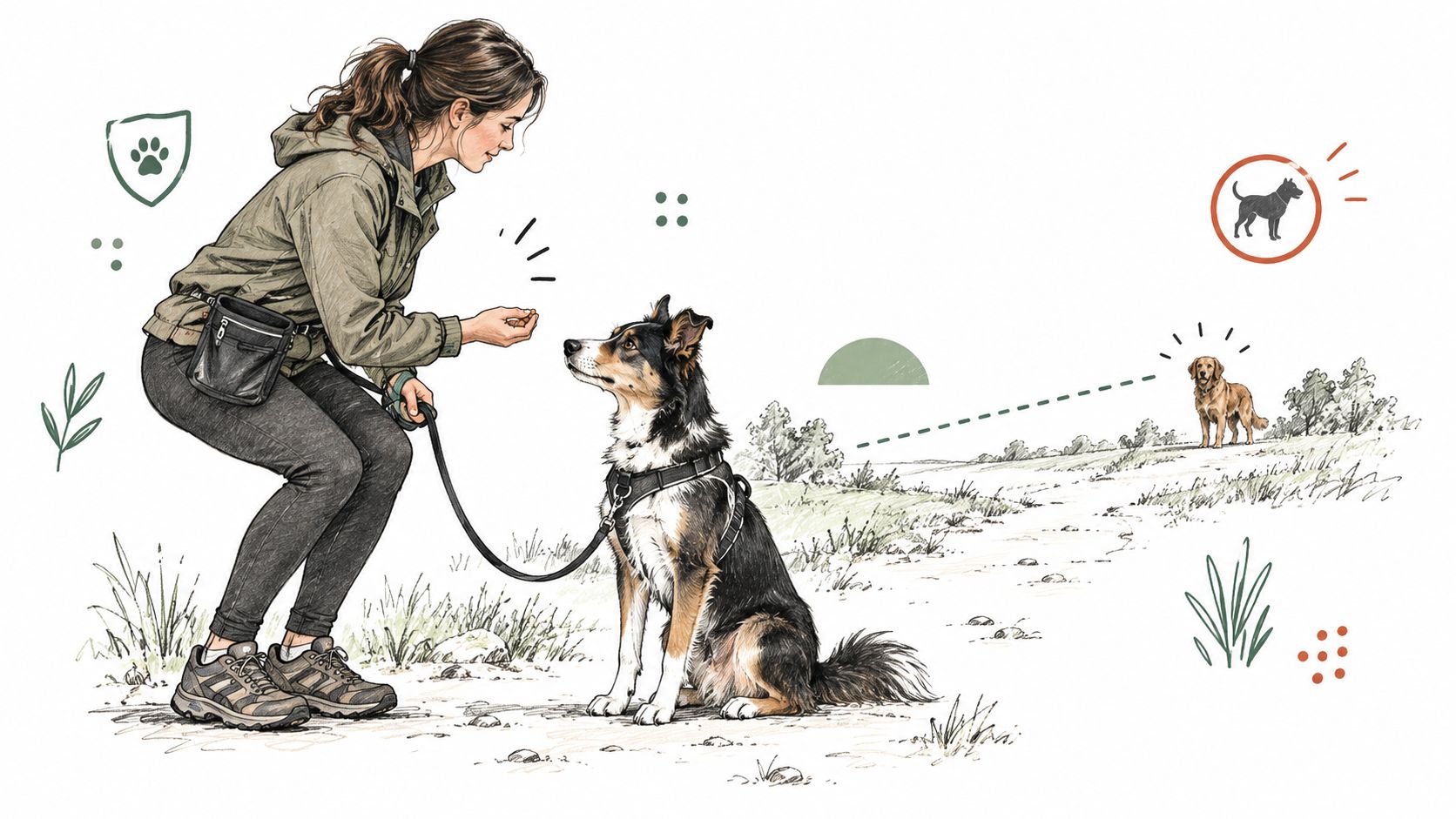
On a residential block, scan driveways, corners, parked cars, and sidewalk crossings. If another dog appears, cross the street early, step behind a parked vehicle, or turn around before your dog fixes his feet and locks onto the trigger.
Use a simple U-turn script:
- Say “this way” in a calm voice.
- Turn your body and move away in an arc.
- Feed several small, high-value treats as your dog follows.
- Stop only when his body loosens and he can look back at you.
Keep the leash as loose as safety permits. A front-clip harness can give you more control without adding a painful correction. Avoid prong or shock corrections, and do not punish a fearful response. Stopping the bark does not resolve the fear or frustration underneath it, and may remove a warning signal before the dog escalates to another behavior.
Pair the trigger with something valuable
Counterconditioning changes the emotional meaning of the trigger. At a workable distance, your dog sees another dog and receives small pieces of high-value food. When the other dog disappears, the food stops. Over repeated calm exposures, the sequence becomes, “Dog appears, good things happen.”
Keep sessions short and successful. If your dog barks, lunges, or refuses food, increase distance instead of repeating the exposure. Desensitization changes intensity gradually. It does not force close contact until the dog stops reacting from exhaustion.
Add an alternative behavior after the trigger can be handled calmly. Practice a hand target, name response, or “find it” cue at home first. On walks, ask for it while the other dog is still far away, reward the response, and leave before arousal rises.
Training principle: Distance isn't failure. Distance is the space that allows learning.
A practical first week
Choose a quieter route and avoid crowded dog paths. Carry treats before leaving, record the distance at which your dog notices another dog, and reward calm glances followed by turning away.
A dog with strong working drive, such as a Belgian Malinois, may need especially thoughtful management because fast movement and intense focus can raise arousal quickly. The same principle applies to every breed: match the plan to the driver behind the barking. A fearful dog needs safety and gradual exposure, while a frustrated dog may need more distance, movement, and practiced alternative behaviors.
Log each walk. Early progress may appear as a softer body, quicker recovery, or the ability to take food before barking disappears entirely.
Matching the Cause to the Right Next Step
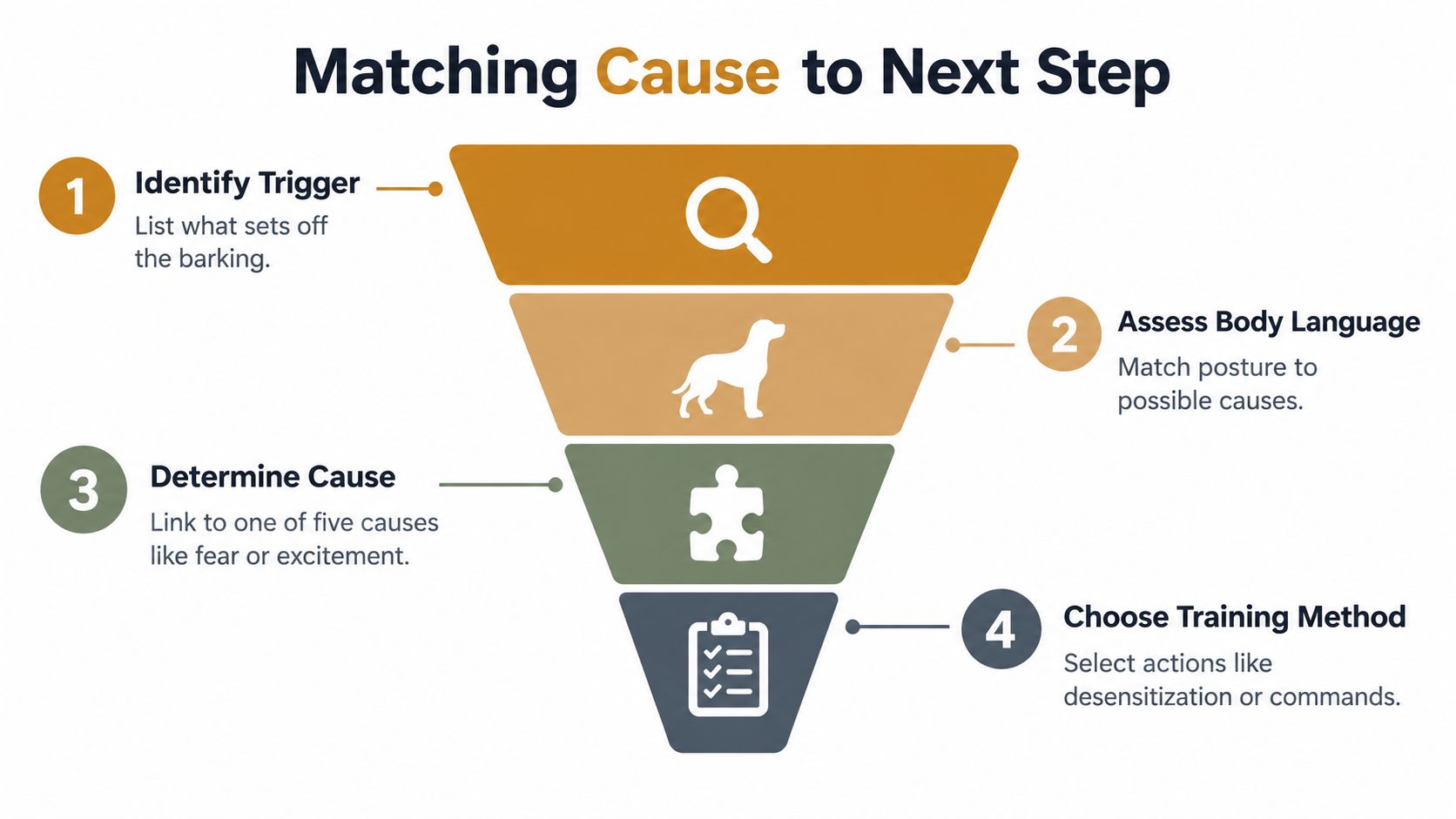
A useful decision path begins with the trigger, not the volume of the bark. Write down where the behavior happens, what the other dog is doing, how close the dog is, and what your dog's body looks like before and after the episode.
Mild social barking or manageable arousal often responds to consistent positive-reinforcement practice. A well-run group class may help if your dog can remain below threshold around other dogs and the instructor can provide enough space. A class isn't appropriate if your dog spends the session overwhelmed.
Fear, territorial behavior, or frustration with a clear history usually deserves individualized support from a certified force-free trainer who has experience with behavior cases. The professional should help you adjust distance, identify patterns, and build a structured counterconditioning plan rather than just drilling obedience around triggers.
Three questions that clarify the path
- How far away can my dog see another dog before reacting? A shrinking threshold suggests the problem needs prompt management and careful assessment.
- Has the behavior become worse over months? Escalation means your dog is getting more opportunities to rehearse the response or may need additional support.
- Does my dog bite the leash or me? Redirected biting raises safety concerns and makes professional guidance more urgent.
Sudden onset, escalating intensity, biting risk, or a possible pain-related change belongs with a veterinarian or veterinary behaviorist. A decision funnel for matching cause to next step can help you organize observations before you book an appointment.
Popular Beliefs That Hold Dogs Back
“Your dog is dominant” is a common sidewalk diagnosis. A terrier that lunges with a stiff body may instead be frightened and trying to create space. The American Kennel Club distinguishes reactivity from aggression, describing reactivity as an exaggerated emotional response and giving barking at a dog across a fence as a common example of that pattern in its reactivity and aggression guidance.
“He's just excited” can also miss the point. A spaniel may bark in a high pitch, but if his tail is tucked, his weight is shifted backward, and he keeps glancing away, fear or social uncertainty deserves attention. Excitement and fear can also overlap, especially when a dog wants contact but feels unable to manage the interaction.
“Yelling or a shock collar will stop it” confuses silence with improvement. A correction may interrupt the warning without changing what the dog feels when another dog appears. If the dog associates the other animal with pain or intimidation, the trigger can become more threatening.
Replace each myth with a better question:
- Instead of dominance: Is my dog trying to increase distance?
- Instead of simple excitement: Is his body loose, or is he conflicted and tense?
- Instead of punishment: What distance and reward will help him stay calm?
A Shiba Inu breed page may help you understand general breed traits, but no breed label can substitute for observing posture, context, and recovery.
When to Bring in a Trainer or Vet
Call a qualified professional when the behavior intensifies, spreads to more triggers, or becomes difficult to control even at a distance. A certified professional dog trainer with CPDT-KA or KPA-CTP credentials can help with management and force-free behavior training. A veterinary behaviorist with DACVB credentials can assess complex emotional, medical, and safety factors.
Seek help promptly if your dog has bitten and broken skin, lunges while showing whale eye and raised hackles, or can't work below threshold despite careful distance. A sudden change in an adult or senior dog deserves a veterinary visit first because pain, sensory changes, or cognitive decline can affect behavior.
Bring a short video if you can record one safely, along with a written history of triggers, locations, distance, body language, recovery, previous training, and any incidents involving contact. Include current veterinary records and medication information.
A professional shouldn't focus only on stopping the bark. The assessment should identify the likely emotional driver, evaluate safety, reduce rehearsal, and give you a training plan that fits real walks. Early support can also prevent you from practicing strategies that increase fear or frustration.
If you're asking, “Why does my dog bark at other dogs?” start with observation rather than blame. The bark is a signal, and the right response depends on what your dog is communicating.
PetCostEngine helps US dog owners research breed-specific ownership planning, veterinary needs, training, and related care considerations in one place. Visit PetCostEngine to explore breed and state-based tools while you build a practical plan for your dog's needs.
Estimated lifetime and yearly costs for a Beagle, state by state, plus whether pet insurance breaks even for the breed.
See Beagle costs →
Is insurance worth it for a Beagle? →
Joint supplement → Puzzle toys → No-pull harness →
As an Amazon Associate, PetCostEngine earns from qualifying purchases.