You're standing at the edge of a field while your dog noses toward an interesting patch of grass. A longer leash would let your dog explore without making you follow every zigzag, but the sidewalk behind you and the squirrel ahead make that extra reach feel less straightforward.
A 30-foot retractable dog leash can suit that open-field walk. It isn't a general-purpose replacement for a fixed lead, and its advertised length tells you little about whether you can stop your particular dog safely.
Table of Contents
- Where a 30 Foot Retractable Leash Works and Where It Does Not
- How the Retractable Mechanism Works
- Stopping Distance and Force at the End of the Line
- Inspection Checklist for Line, Clasp and Brake
- Handler and Bystander Injuries to Prevent
- Retractable Versus a Fixed Long Line
- Leash Laws and Restricted Places to Check
- Confirm Your Setup Before the Next Walk
Where a 30 Foot Retractable Leash Works and Where It Does Not
Full extension is conditionally acceptable for a trained adult dog on wide, open, low-traffic ground, with reliable recall and a handler who can see the entire line. The dog should be walking calmly, not building speed toward the end.
According to the American Kennel Club's retractable-leash guidance, these leashes commonly range from 10 to 30 feet, with 16 feet the most common length; at roughly 26 feet or more, an owner may not supervise quickly enough to prevent eating hazards, animal encounters, or traffic exposure. That makes maximum extension a deliberate handling choice, not the default setting.
Full 30 foot extension by environment and dog type
| Environment or dog | Full 30 ft extension | Use instead |
|---|---|---|
| Open field, trained adult dog, reliable recall | Acceptable with lock ready | Fixed lead when recall is weak |
| Wooded trail or brush | Avoid; line tangles in underbrush | Fixed lead at a short working length |
| Sidewalk, roadside or busy street | Avoid | Fixed lead, held close |
| Dog park or dog-to-dog meeting | Avoid | Fixed lead, held close |
| Veterinary clinic | Avoid | Fixed lead, held close |
| Training session | Avoid | Fixed lead for control and cueing |
| Dog that eats off the ground or chases wildlife | Avoid | Fixed lead and a secure recall |
| Reactive, pulling, brachycephalic, senior or neck-injured dog | Avoid | Fixed lead and a vet check on the neck and airway |
Treat the last row as a conservative screening decision, not a diagnosis. An older dog may have excellent manners but limited balance, while a flat-faced dog may need particular attention to breathing and attachment fit.
A field also stops being suitable when a loose dog arrives, maintenance equipment starts moving, or pedestrians cross your route. Reassess the space during the walk rather than approving it once at the entrance.
Working rule: Reserve full length for places where you can stop your dog before it reaches a hazard. Switch to a fixed lead when you can't.
How the Retractable Mechanism Works
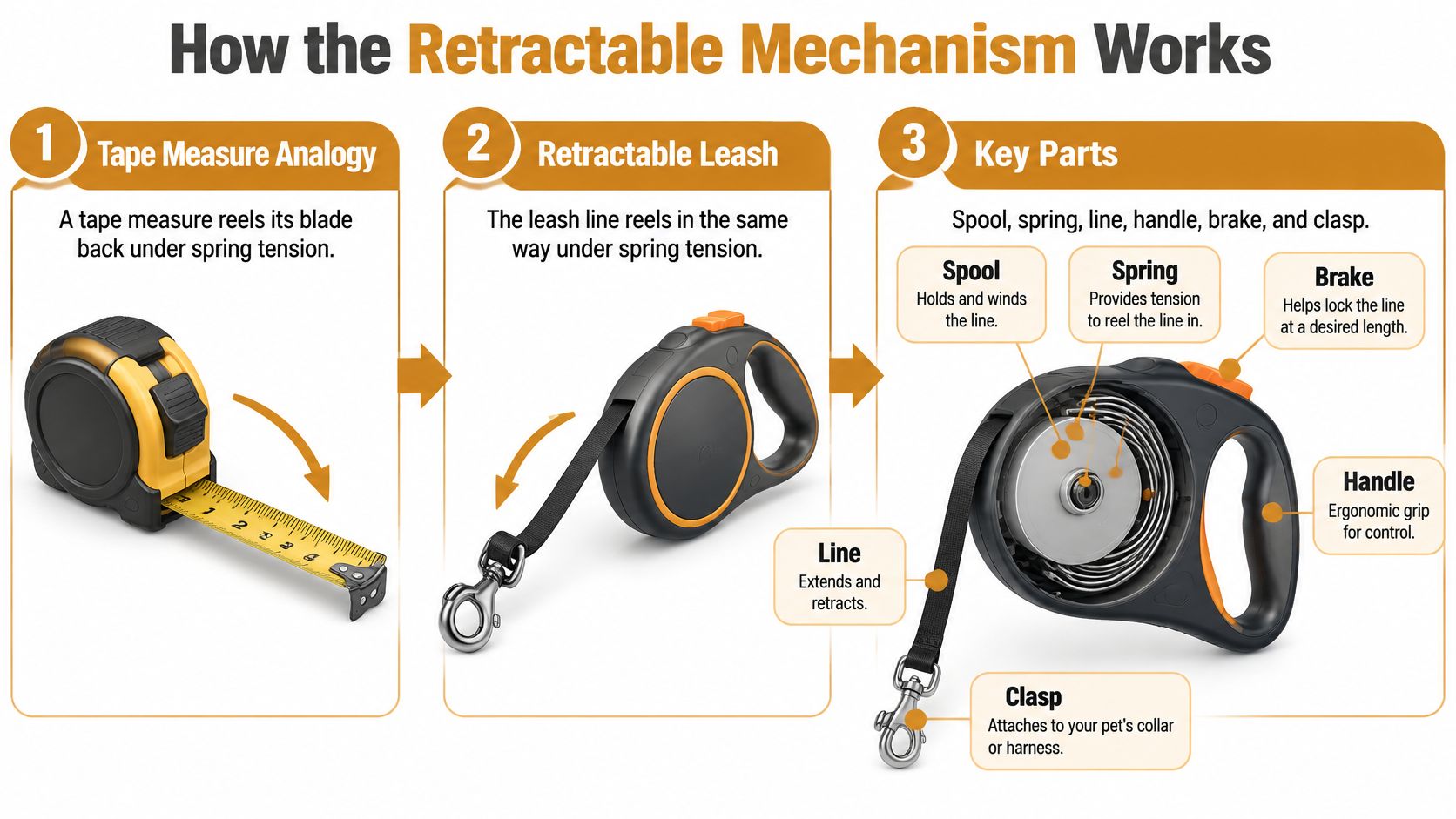
A 30-foot retractable leash gives a dog about 10 yards of reach. Inside its housing, a spring-loaded spool holds the tape or cord and winds it back as slack becomes available. The line passes through an opening in the housing and ends at a clasp attached to the dog's walking equipment.
Brake, lock and rewind do different jobs
The brake and lock control the spool; the spring rewinds the line. Depending on the model, pressing the brake stops the spool temporarily, while engaging the lock keeps it from turning until you release it. Check how your leash responds before attaching it to your dog. Some controls stop the spool abruptly rather than slowing it gradually.
- Brake: Controls the moving spool while you press the button.
- Lock: Holds the line at a selected length by preventing spool rotation.
- Spring: Takes up slack when the spool is free. It does not pull a reluctant dog back to you.
- Accessories: A hand loop or belt clip may be included, but a storage clip is not automatically designed to bear a load.
The patent record for a retractable leash design provides a reference for the reel-and-spring arrangement. That familiar mechanism does not give the handler a different kind of control just because the line is longer.
If you drop the handle, spring tension can pull the housing toward the dog. A bouncing handle may frighten the dog and trigger it to run, so keep a secure grip and know where the brake is.
The parts work as a system: the spool pays out the line, the spring takes up slack, and the brake or lock controls movement. A handle can look intact while its brake slips or its spool rewinds unevenly.
Stopping Distance and Force at the End of the Line
Your dog spots a squirrel and accelerates while the line pays out. When the line ends, the dog stops abruptly, and you receive the pull through the handle.
This is the kind of sudden chase that makes maximum reach difficult to manage.
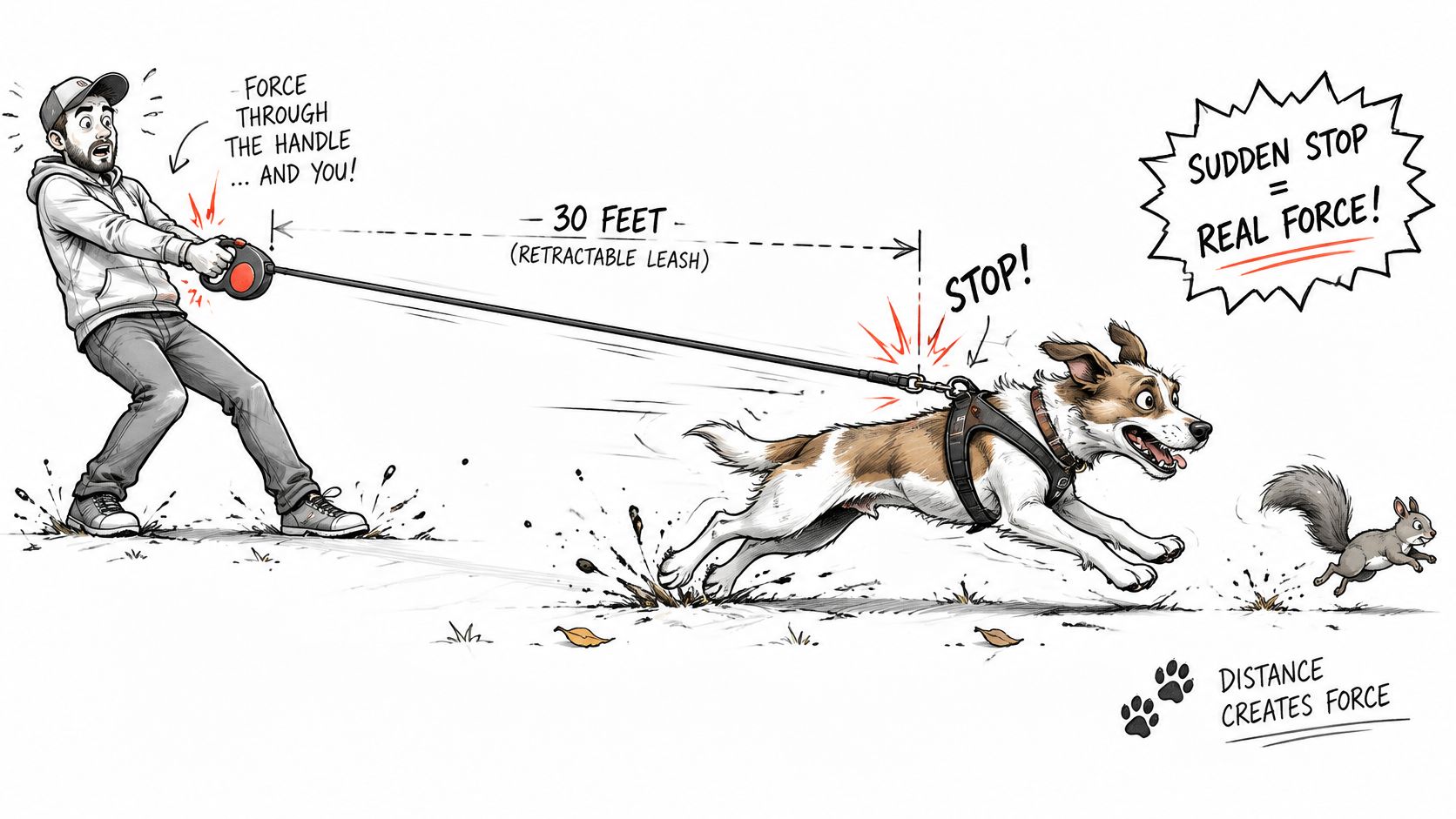
The American Kennel Club cautions against allowing a dog to run at full speed while the line unspools, and WebVet's retractable-leash safety discussion describes how abrupt deceleration can transfer force through the attachment and injure the trachea, neck or spine. You're stopping a moving dog with momentum, not restraining a dog that's standing still.
Factors that change stopping at full extension
| Factor | Why it changes the stop | Check before the walk |
|---|---|---|
| Dog speed and momentum | A running dog reaches the line end with more force | Full extension only when the dog walks at your pace |
| Distance left before the line ends | Less distance means less time to brake | Lock the leash when hazards are within the line's reach |
| Handler grip and stance | A loose grip or poor balance can let the handle slip or pull you forward | Keep a hand on the handle and your feet balanced |
| Attachment point | A flat collar, martingale and harness distribute force differently | Match the attachment to the dog's airway and neck history |
| Terrain | Slopes, loose ground, mud and wet grass reduce footing | Shorten the working length on uneven ground |
| Distractions | Animals, people and sounds can trigger sudden lunges | Lock before the distraction is within reach |
A harness doesn't make an end-of-line collision harmless. Nor should a martingale be treated as protection against a sudden jerk; its fit and suitability need individual consideration.
A controlled full-length handling routine
- Hold the molded handle securely. If the manufacturer supplies a hand loop, use it as directed without winding it tightly around your hand or wrist; never wrap the leash line around either.
- Keep your thumb ready on the brake or lock.
- Release line only while your dog walks steadily at your pace.
- Engage the lock before a hazard enters the dog's reachable area.
- Never grab a moving line. Use the control, and move away from the hazard while you still have room.
The accompanying video provides another visual reference for leash handling.
Near hazards, maintain a shorter working length rather than repeatedly letting the dog accelerate and stopping it. Full extension is appropriate only while calm movement and a dependable response to recall continue.
Inspection Checklist for Line, Clasp and Brake
Start with a manufacturer-stated weight rating above your dog's actual weight, a brake you can engage predictably with one hand, and visible tape or reflective material. If the label doesn't explain the operating limits, don't fill the gaps with assumptions.
Wirecutter's discussion of retractable-leash safety highlights veterinary and animal-welfare concerns about line visibility, direct contact injuries and equipment failure. Broad tape is easier for pedestrians to notice and less likely than thin cord to cut into skin, but neither design removes the force of a lunge or prevents injury.
Use these selection checks before considering handle comfort or storage features.
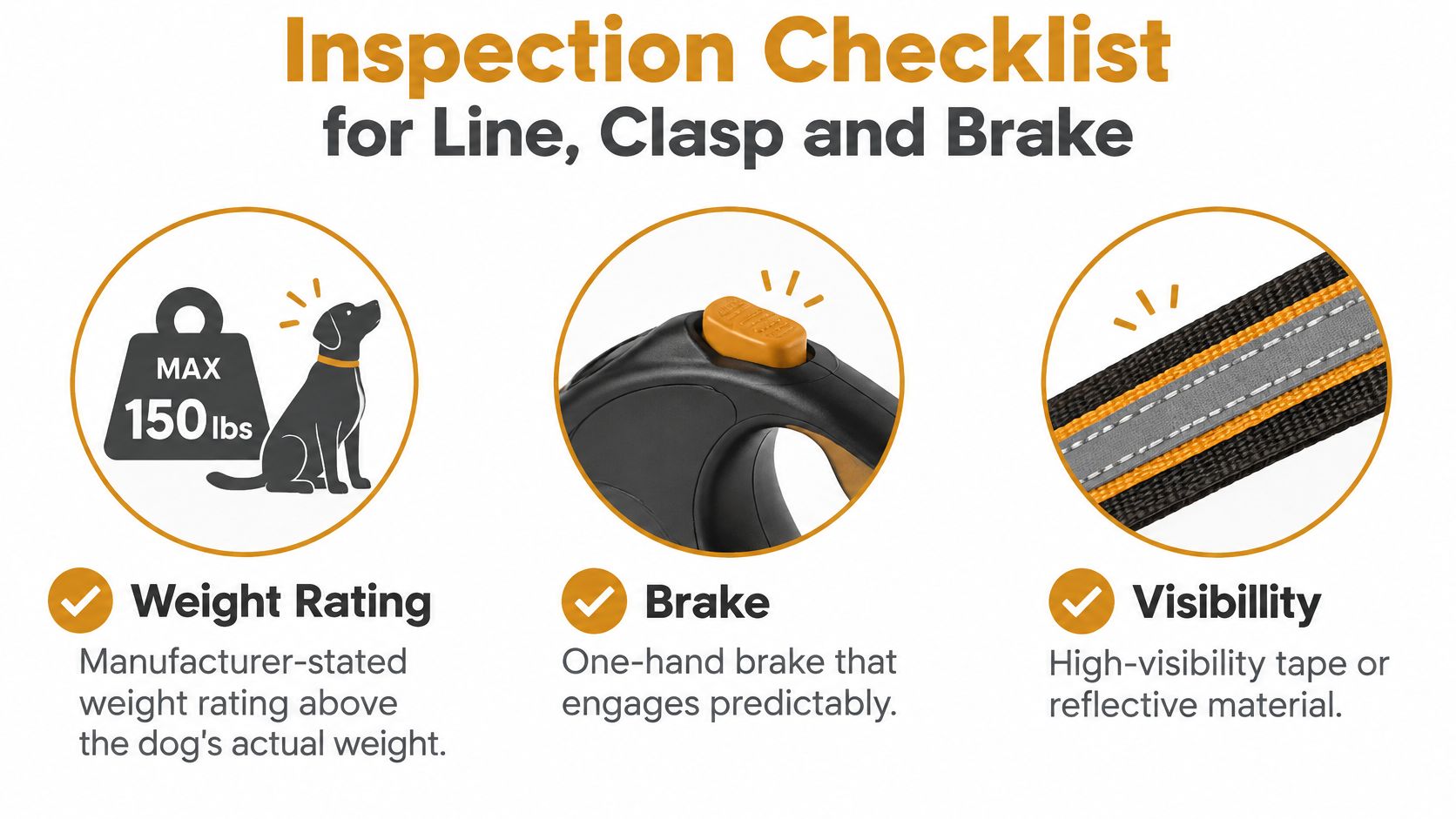
Pass or retire checks for a retractable leash
Inspect the full exposed line in good light. Don't slide a bare hand along a tensioned cord to search for defects.
| Part | Pass sign | Retire sign |
|---|---|---|
| Line | Smooth, even tape or cord with no fraying | Cuts, fraying, stiffness or visible wear |
| Handle stitching, if present | Tight and intact | Loose, torn or pulled stitching |
| Clasp and swivel | Closes firmly and turns freely | Deformed, bent or loose |
| Brake | Holds at a short lock with one hand | Slips or fails to hold |
| Retraction | Even, steady rewind | Sluggish, jerky or uneven rewind |
| Housing | Solid with no cracks | Cracks or damaged latch |
Check that the clasp gate closes fully after you press it open. Dirt caught in the gate or swivel can interfere with movement, and a bent clasp shouldn't be straightened and returned to service.
Test the mechanism without a lunge
A controlled function test can reveal an obvious fault. It cannot certify the leash against every load your dog might generate.
- Clip the leash to a secure test object, or to a calm dog's properly fitted collar or harness in an enclosed area. Never ask the dog to pull sharply for the test.
- Extend a short working length, engage the lock, and apply gentle, steady tension.
- Release the lock, then operate the temporary brake with one hand to confirm it holds.
- Allow the line to retract under control. Watch for jerks, hesitation or uneven spooling, and don't let the clasp whip toward the housing.
- Repeat after a fall, wet walk or rough use, as well as during your normal pre-walk check.
Follow the manufacturer's cleaning directions rather than opening a spring-loaded housing or adding an unspecified lubricant. Let the unit dry before storage, and keep it out of direct sun.
A weight rating doesn't override visible damage. Retire a damaged unit rather than testing how long it will last.
Handler and Bystander Injuries to Prevent
Retractable-leash safety isn't only about dogs becoming tangled. A handler can fall after a pull, a pedestrian can trip over the line, and direct contact can injure a hand before anyone has time to intervene.
A 2024 review in the Journal of the American Veterinary Medical Association describes dog-walking injuries involving pulling, tripping and tangling: in two cited studies, trips or tangles accounted for 63.3% of incidents, while leash pulling accounted for 29.2% in reported lower-extremity injury data; the review also reports extendable-leash use by 25.8% of surveyed owners versus short-leash use by 58.1%, while treating a direct increase in injury incidence from extendable leashes as a hypothesis requiring further research. These findings don't establish a retractable-specific injury rate.
Keep people out of the line's path
- Hands: Grabbing a moving cord can cause friction burns or cuts. Don't use your palm as a brake.
- Wrists and legs: Never wind the line around your body. A sudden pull can tighten it before you can release it.
- Pedestrians: Don't allow the line to stretch across a shared walking path, even if your dog is calm.
- Dog encounters: Prevent circling and crossing lines. Dogs can become entangled while their handlers are still attempting a greeting.
- Dropped equipment: Avoid reaching into a moving line to recover a handle. Secure the dog without putting your fingers near a tightening loop.
Keep your phone put away while managing extended line. Watching the dog alone isn't enough; you also need to notice people approaching from the side or behind.
When to call your vet
Contact your vet the same day after a sudden stop if your dog coughs, gags, develops a honking cough, resists turning its head, cries when its neck is touched, limps or seems weak. Don't repeatedly press the neck to test for pain.
Seek emergency veterinary care for collapse, labored breathing or significant or persistent bleeding. Stop the walk and keep your dog quiet while arranging help.
For a person with a deep cut, uncontrolled bleeding, numbness or a serious fall, seek medical care rather than finishing the walk.
Retractable Versus a Fixed Long Line
30 foot retractable versus a fixed 15 to 30 foot long line
| Criteria | 30 ft retractable | 15 to 30 ft fixed long line |
|---|---|---|
| Control at a distance | Lock and brake control reach; abrupt stops can transmit substantial force | Held short or released progressively; no spring tension |
| Stopping power | Depends on brake, lock, grip and footing | Depends on grip, line handling and footing; abrupt stops remain hazardous |
| Recall training fit | Poor for structured practice because payout changes the working distance | Better suited to deliberate control of working length |
| Entanglement risk | Line can wrap people, dogs and brush | Line can tangle and requires active handling |
| Failure points | Spring, brake, lock, housing, clasp and line | Cord or tape, clasp and stitching |
| When dropped | Housing can retract toward and frighten the dog | Dog may drag the line, which can snag |
| Inspection burden | Mechanism, line and hardware checks each walk | Line, stitching and clasp checks each walk |
| Portability | Compact housing | Coiled line that packs flat |
The MSPCA-Angell's retractable-leash guidance recommends a non-extendable lead and notes that a 20-foot cotton lead can be held short or released fully as needed. That removes the spring mechanism, but it doesn't remove the handler's responsibility to manage the line.
Choose by failure mode and task
With a fixed long line, you gather and release slack yourself. Keep the spare line in loose folds rather than tight loops around your hand, and prevent it from collecting around your feet.
A fixed line's simpler construction makes its main inspection points easier to see. A retractable adds concealed mechanical parts, and brake slippage may change the dog's reachable area without an obvious break in the line.
Neither tool makes a full-speed stop safe. Neither substitutes for teaching the dog to return when called.
The ASPCA's outdoor safety guidance advises against both long and retractable leashes in wooded hiking areas because they can tangle in underbrush. A fixed long line is therefore not permission to use maximum length among trees or crowds.
- Calm exploration on open ground: A retractable can suit a trained dog when the handler will actively operate and inspect it.
- Recall practice: A fixed long line allows deliberate handling without automatic rewind.
- Wooded or crowded routes: Use a fixed lead at a short working length, not an extended long line.
- Airway or neck concerns: Ask your vet about attachment choice and use a fixed lead for close, predictable handling.
The MSPCA's position is safety-first guidance, not proof that every retractable causes injury.
Leash Laws and Restricted Places to Check
Start with state law, then check city or county ordinances and the rules for the specific property. A general leash requirement doesn't necessarily tell you which leash length or type a particular park permits.
Parks, trails, beaches, housing associations and dog parks may have additional restrictions. Local permission also doesn't make an unsuitable handling situation safe.
Read the scope, not just the word leash
Look for language about physical restraint, maximum length, retractable devices and keeping a dog under control. Check whether the rule covers all public property, a named recreation area, a particular trail or a seasonal access period.
- General requirement: Does the dog need to remain leashed throughout the visit?
- Length or type limit: Does the rule restrict extension or prohibit particular equipment?
- Location and timing: Does the requirement change within designated areas or during posted access periods?
- Responsible authority: Is the rule issued by the municipality, park agency or property manager?
A sign permitting dogs isn't necessarily permission to let the line extend fully. Likewise, an off-leash designation doesn't mean a long line is appropriate during dog-to-dog contact.
Make a local check before leaving
- Search the official city or county code for “leash” and read the surrounding provisions, not only the search-result snippet.
- Read the park or trail's official visitor rules and confirm the posted signs when you arrive.
- Call the local animal control office or site manager if the wording is unclear. Ask specifically about retractable equipment and permitted working length.
The same leash may be allowed on one trail and restricted on another. Site rules operate alongside applicable law; they don't automatically replace it.
For practical suitability, use the environment verdicts in the opening table. Confirm current requirements before relying on a previous visit, because access rules and local ordinances can change.
Confirm Your Setup Before the Next Walk
Make the next walk a setup decision, not a trial of how far your dog can go. If any part of the plan feels uncertain, take the fixed lead.
Read the label before trusting the tool
The packaging or manual should identify the manufacturer-stated weight rating, line material and width, and how the brake and lock operate. Look for clasp specifications, high-visibility or reflective features, and clear replacement or warranty terms.
Ask the manufacturer about missing information rather than assuming the clasp shares every rating printed on the housing. Also distinguish a walking leash from a retractable tie-out; equipment intended for tethering isn't automatically suitable for handheld walking.
A stated weight rating is not a guarantee of safe use with a fast or pulling dog. Your ability to keep hold, anticipate movement and maintain footing matters too.
Breed-related airway and joint predispositions can help you prepare questions for your vet. Consult the breed health profiles for background, but let your dog's examination and medical history guide the actual setup.
Run the final pre-walk checklist
- Dog fit: Check temperament, recall, size and current behavior. Consider airway, neck, joint and senior health concerns.
- Location: Choose open, low-traffic ground with a clear view and no reachable hazards.
- Equipment: Confirm the line, hardware and housing pass inspection and the brake holds during a gentle test.
- Permission: Verify the rules for that specific site.
- Handler readiness: Keep a hand on the handle and the control ready. Use a fixed lead if you'll be distracted, carrying awkward items or managing another dog.
A suitable setup can become unsuitable during the outing. Shorten up or leave when the surroundings change rather than trying to preserve the original walking plan.
Ask your vet specific questions
- Is a retractable appropriate given my dog's airway, neck, mobility and medical history?
- What fixed-lead length and attachment should I use for recall work?
- Which signs after a sudden stop require a same-day visit for my dog?
Bring your collar or harness to the appointment if fit is uncertain. Leave with a clear attachment recommendation and a handling plan you can follow on your usual route.
PetCostEngine offers breed-specific health references and personalized dog ownership planning tools. Use them to understand the health considerations behind your walking setup and prepare for ongoing care. Visit PetCostEngine to explore your dog's breed profile and build an individualized ownership estimate.
Modeled estimates for 226 breeds, with the formula and sources published in full.
See the data →
No-pull harness → Puzzle toys → Durable chews →
As an Amazon Associate, PetCostEngine earns from qualifying purchases.