
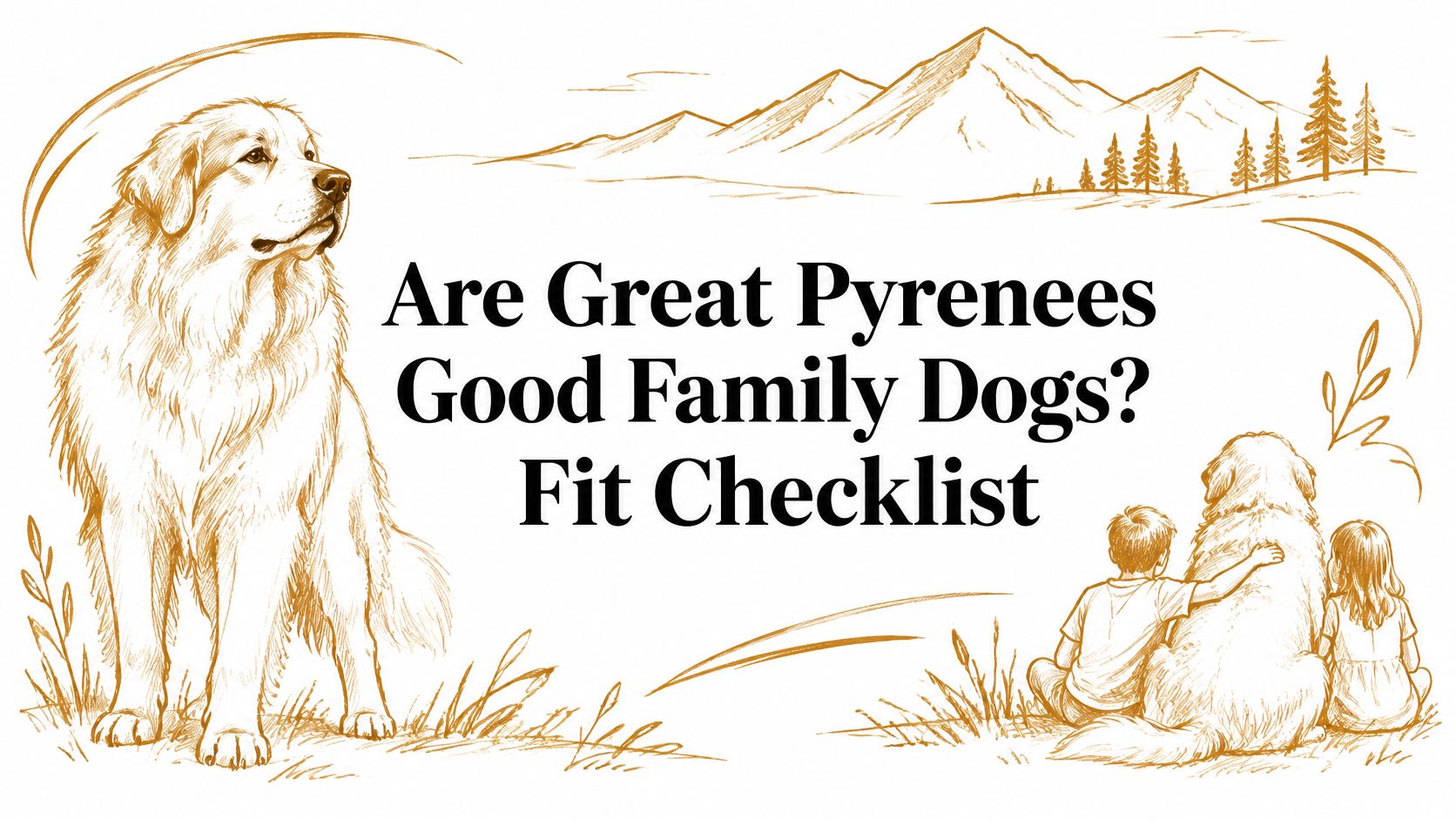
Great Pyrenees can be good family dogs when the home can manage an independent guardian of about 85 pounds for females and about 100 pounds or more for males. They're a poor fit for homes that want a small, quiet, or highly obedient dog.
The familiar advice that they're gentle with children leaves out the hardest decisions. A patient temperament doesn't prevent accidental knockdowns, make visiting children familiar to the dog, or stop territorial barking when neighbors are trying to sleep. The useful question isn't whether Great Pyrenees are good family dogs, but whether your family can accommodate the behavior they were bred to perform.
Table of Contents
- Household Fit Checklist Before You Choose
- Size Temperament and a Decade of Care
- Guardian Instincts Barking and Fencing
- Children Visitors and Other Pets
- Daily Exercise Space and Coat Care
- How to Train an Independent Guardian
- Hip Dysplasia Bloat and When to Call the Vet
- Confirm the Fit Before You Bring One Home
Household Fit Checklist Before You Choose
Choose for your household's hardest day, not its quietest afternoon. A fenced home with capable adults may suit this breed well, but the same home can become a poor match if a preschooler regularly shares the dog's space or an owner expects dependable off-leash control.
Use the table by selecting the row closest to your daily situation. If several rows apply, let the poorer fit win until you've resolved the conflict. These are conservative household-selection judgments, not claims that every individual dog behaves identically.
Great Pyrenees Household Fit
| Household situation | Fit | Deciding reason |
|---|---|---|
| Fenced home with teens or adults | Strong fit | Calm with family when size and rules are managed |
| Home with toddlers or preschoolers | Poor fit | A giant dog can knock a small child over |
| Apartment or no secure yard | Poor fit | Patrol instinct and barking need real containment |
| Suburban lot with close neighbors | Conditional | Night alerts and delivery traffic can become a housing problem |
| Home with other dogs or livestock | Conditional | Often devoted to animal charges after careful introductions |
| Owners who want eager obedience | Poor fit | Selected to decide independently, not to repeat cues |
| Experienced home wanting a watchful companion | Strong fit | Patient with its family and naturally protective |
The American Kennel Club's suitability guidance pairs the breed's loyal, affectionate character with a warning about supervising small children because of its size. That distinction matters: gentleness is a temperament trait, not a safety system.
A strong-fit household also accepts a long-term care commitment and the possibility of nighttime alerting. A conditional household needs a workable plan, not a promise that training will remove every inconvenient trait. School-age children who follow boundaries may be manageable; close neighbors who require silence may present a problem the owner can't solve by adding another walk.
The Non-Negotiables
Assess adult size, independent guardian decisions, and supervision that changes with child age separately. Being comfortable with shedding doesn't compensate for inadequate containment, and owning a large yard doesn't compensate for unsafe child-dog interactions.
After the behavioral match is clear, check the Great Pyrenees health-risk profile through the breed directory. Use the lifetime planning calculator to consider the ongoing care commitment, rather than letting the appeal of a puppy settle the decision.
Selection rule: A strong fit means the household can meet the dog's needs without depending on the dog becoming a different kind of breed.
Size Temperament and a Decade of Care
The American Kennel Club breed standard describes the Great Pyrenees as “confident, gentle, and affectionate,” with a generally patient and tolerant demeanor toward its family; it lists males at 27–32 inches at the shoulder and about 100 pounds at the lower end, and females at 25–29 inches and about 85 pounds at the lower end.
Those are not maximum weights or a promise about a puppy's eventual size. Plan your home around a fully grown giant dog, including the space needed to turn around in a hallway, rest away from children, and enter a vehicle safely.
The same standard identifies independence, reserve, fearlessness, and loyalty to human and animal charges. These qualities aren't contradictions. A dog can be affectionate with familiar people while remaining cautious about someone approaching the property.
What the Temperament Means at Home
A useful comparison is a night watchman who lives indoors. The dog may rest near its family without constantly asking for interaction, yet still consider watching the entrance part of its job. Calm doesn't necessarily mean eager to follow the next instruction.
The size and temperament commitments belong together.
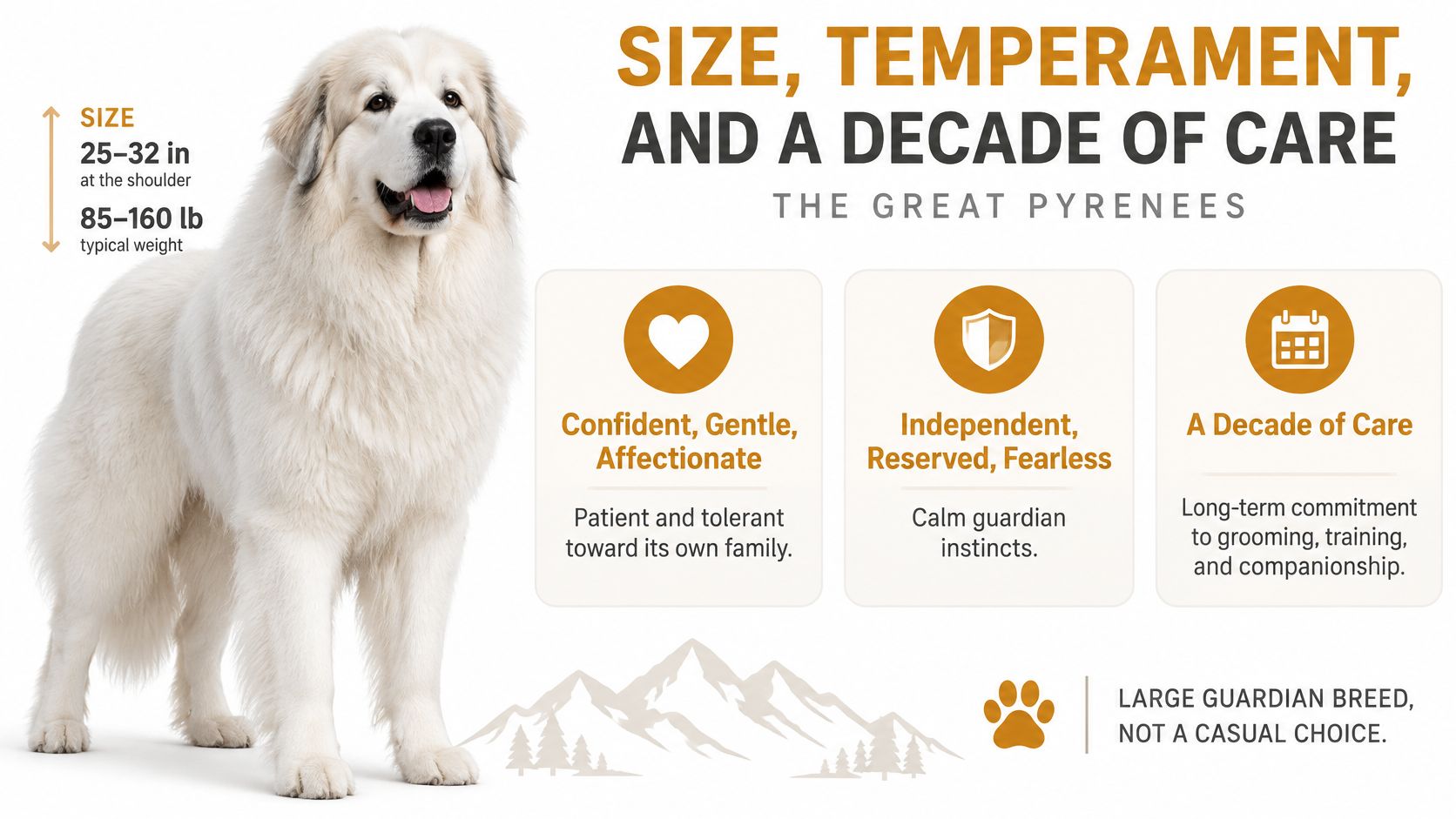
Think beyond puppyhood when allocating sleeping space, transport, grooming access, and veterinary handling. A giant dog leaning into a greeting can put a small child off balance without showing aggression. Narrow doorways and crowded family arrivals deserve as much attention as playtime.
Our giant-breed size category provides a useful comparison point when considering the practical scale of daily care.
Run a Household Size Test
Write down everyone who will handle the dog regularly, including relatives and pet sitters.
- Leash handling: Identify who can guide the dog using trained skills rather than a contest of strength.
- Door control: Assign an adult who can manage arrivals without simultaneously supervising a small child.
- Care access: Confirm who can inspect feet, brush difficult areas, and help the dog into transport.
- Backup coverage: Name someone capable of taking over when the usual handler is ill or away.
If the plan works only while the dog is young and easy to lift, it isn't an adult-dog plan.
Guardian Instincts Barking and Fencing
The Great Pyrenees' household challenges make more sense when you consider its original job. The AKC's breed history describes a livestock guardian from the Pyrenees Mountains between France and Spain, protecting animals against predators such as wolves and bears, and reports that fewer than 10% of Pyrenees worldwide are used as working dogs.
The working setting explains why vigilance, territory, and independent judgment remain relevant in a companion home.
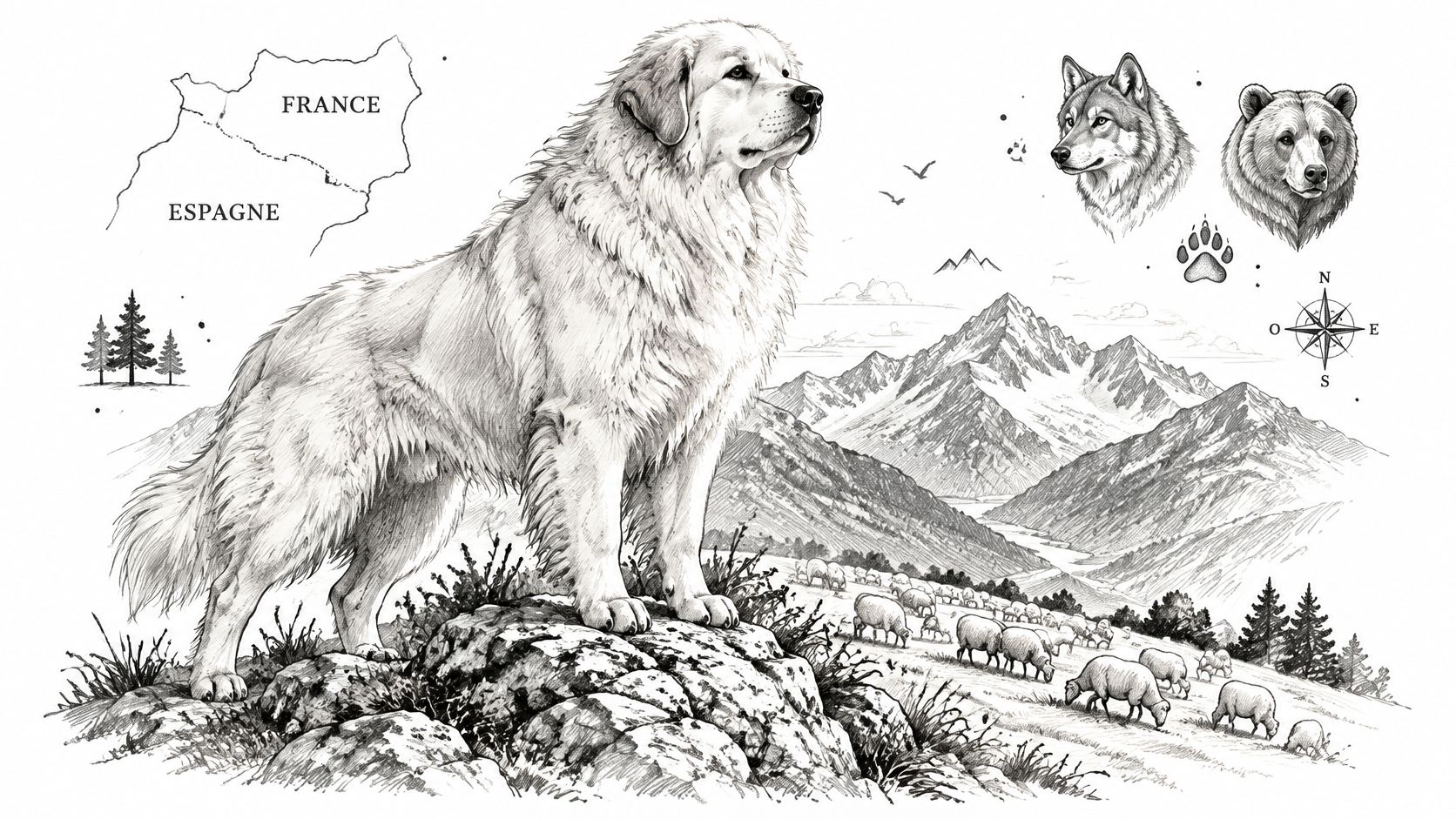
A shepherd couldn't direct every decision a guardian made around a flock. Unlike a dog selected to move livestock in response to frequent cues, this dog needed to notice possible danger and act without waiting.
In a US neighborhood, the apparent threat might instead be a delivery driver, movement beyond the fence, or an unfamiliar nighttime sound. The dog's response can be normal guardian behavior and still be unacceptable for a particular housing situation.
Set Containment and Noise Rules Before Arrival
Moderate activity needs don't eliminate patrol behavior. A tired dog still needs secure boundaries, and an owner shouldn't assume that calling from the back door will reliably interrupt every investigation.
- Inspect the full fence. Look for climbable objects, loose panels, gaps beneath gates, and places where digging could create an exit. Check the perimeter at the start of each season and after damage or yard work.
- Agree on alert management. Write down how adults will respond to barking at the door and overnight. Bringing the dog indoors and managing access to triggers is different from expecting the breed to become silent.
- Keep recall separate from containment. Practice coming when called, but don't use that cue as the property boundary. Leashes, closed gates, and secure fencing remain necessary safeguards.
For a visual introduction to the breed, the accompanying video adds context.
If you're also considering an Anatolian Shepherd, compare guardian-management demands rather than choosing on appearance alone. Another livestock guardian isn't automatically a solution to concerns about independence or territorial behavior.
A good family dog is one the household can live with safely and comfortably. It doesn't mean a dog that will be universally friendly or surrender every decision to its owner.
Children Visitors and Other Pets
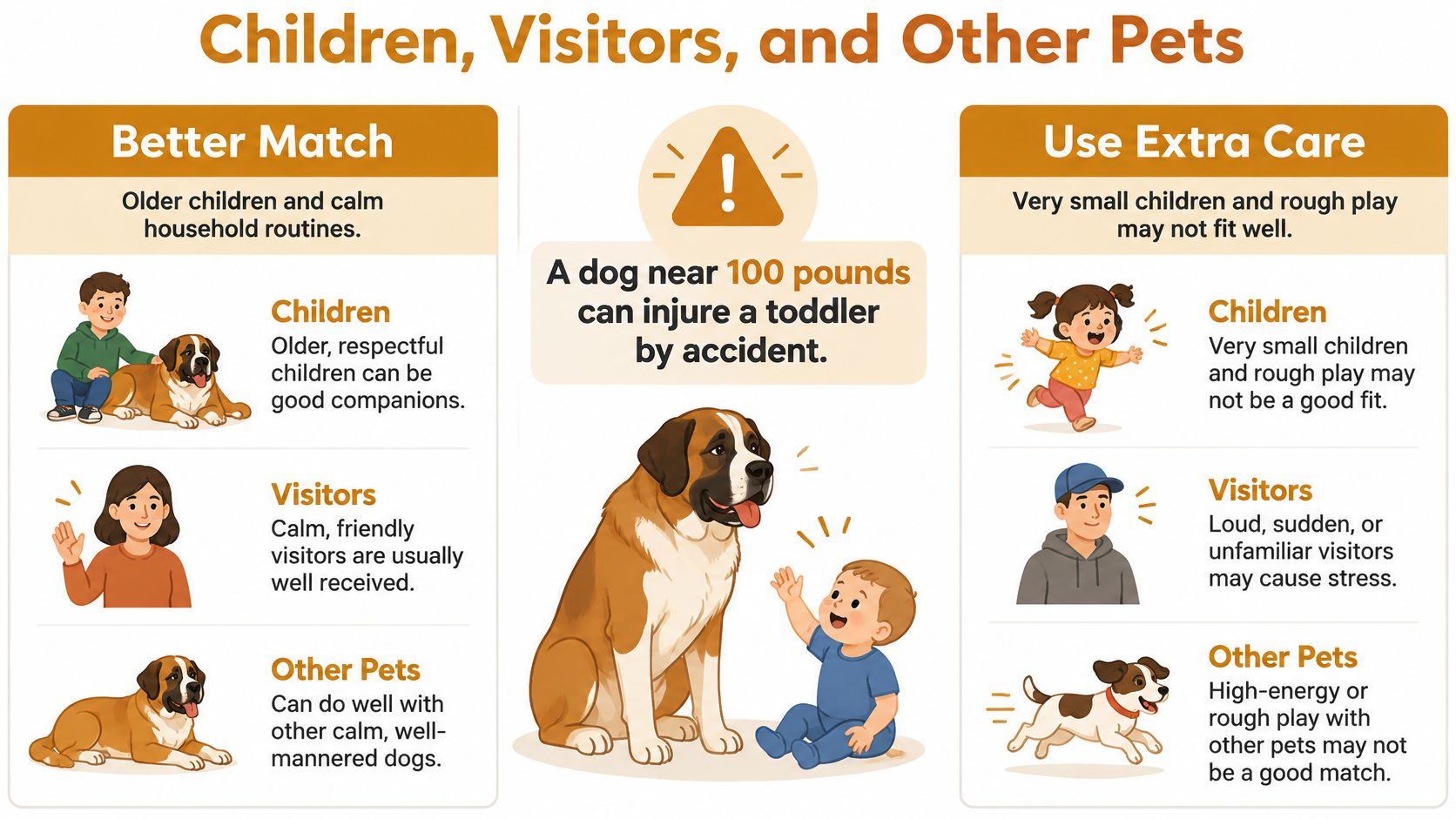
Child age and visitor status matter more than a blanket “good with kids” label. PetMD's Great Pyrenees profile notes that the breed may be better suited to homes without very small children. A friendly bump can cause harm even when the dog is behaving affectionately.
For toddlers and preschoolers, the conservative recommendation is to choose another breed. Young children can't consistently protect a resting dog's space or anticipate the consequences of moving underfoot. Parents shouldn't have to depend on perfect supervision throughout every ordinary household transition.
School-age children can learn boundaries, but adults must enforce them. Teenagers may help with care after demonstrating competence; age alone doesn't qualify someone to manage a giant dog at a busy doorway.
Child Age Visitor and Pet Rules
| Who is involved | Main risk | Rule to set |
|---|---|---|
| Toddlers and preschoolers | Knockdown or a startled response | Do not choose this breed for that age group |
| School-age children | Rough play and disturbed rest | Supervise and ban climbing, riding, tight hugs, and meal or sleep interruptions |
| Teenagers | Overconfident handling of a giant dog | Assign leash and door jobs with an adult still in charge |
| Children's friends | Stranger caution on home turf | Greet outside on a leash before anyone comes in |
| Adult visitors | Territorial alerting at the door | Use one visitor routine every time |
| Other dogs, cats, or livestock | Guarding mixed with resource tension | Introduce slowly and feed separately |
Treat an outside greeting as a controlled introduction, not an obligation to approach. An adult should handle the leash, allow distance, and end the interaction if the dog appears uncomfortable. If you can't manage that greeting safely, keep the dog comfortably separated from guests instead.
The distinction between familiar family and unfamiliar visitors is central to safe household routines.
Make Supervision an Active Job
Supervision means an adult is watching closely enough to interrupt, not merely occupying the same room. Stop a child approaching the food bowl, waking the dog, or following it after it walks away. Give the dog a resting area children aren't allowed to enter.
Other pets need their own introduction plan. Guardian ancestry doesn't establish compatibility with a particular cat, dog, or livestock animal. Use barriers and controlled encounters, protect escape routes, and keep meals separate.
If your family's priority is a companion selected around different household expectations, include the Golden Retriever in your comparison rather than assuming all family-oriented breeds offer the same fit. Write the rest, meal, and door rules before the puppy arrives, not after the first growl.
Daily Exercise Space and Coat Care
A 2025 Chewy breed guide says Great Pyrenees typically need 20–30 minutes of exercise a couple of times per day, with supervised play because of their size. That's a manageable activity pattern for many households, but it doesn't make the breed low-maintenance.
Use leashed outings for movement, sniffing, and practicing calm handling. Adjust the pace to the individual dog's age, condition, weather tolerance, and veterinary advice rather than treating an exercise range as a quota to force through.
A fenced yard supports play and exploration. It doesn't replace walks, handling practice, or time with the household, and it isn't permission to leave the dog outside barking overnight.
Work Through the Coat Rather Than Over It
The breed's dense double coat requires attention beneath the visible surface. Seasonal shedding can make the workload noticeably heavier, so a tidy-looking outer coat isn't enough to judge whether grooming is complete.
- Choose for undercoat access: Look for a brush or rake whose label identifies use on double coats and undercoat. Rounded working surfaces and a comfortable grip matter more than promotional claims.
- Brush in sections: Part the coat and work outward gently, checking behind the ears, under the legs, and around friction points.
- Increase attention during shedding: Plan several short sessions through the week, moving to daily checks during a heavy coat blow.
- Protect the skin: Don't pull hard through mats or use scissors close to skin hidden beneath tangled hair.
Don't shave the coat merely to avoid brushing. Ask a veterinarian or qualified groomer how to handle extensive matting, especially when you can't see the skin underneath. Redness, odor, tenderness, or sores call for veterinary attention rather than more forceful grooming.
Include Feeding in the Daily Routine
A giant dog's food needs are a continuing practical commitment. Choose food appropriate to life stage, measure meals, and ask your veterinarian to assess body condition instead of assuming a large frame should carry extra weight. The food planning guides can help organize that part of care without relying on a generic serving estimate.
Day to day, a typical routine looks like leashed outings, secure yard time, and hands-on coat maintenance. Moderate exercise removes neither the household-management work nor the grooming that comes with the dog.
How to Train an Independent Guardian
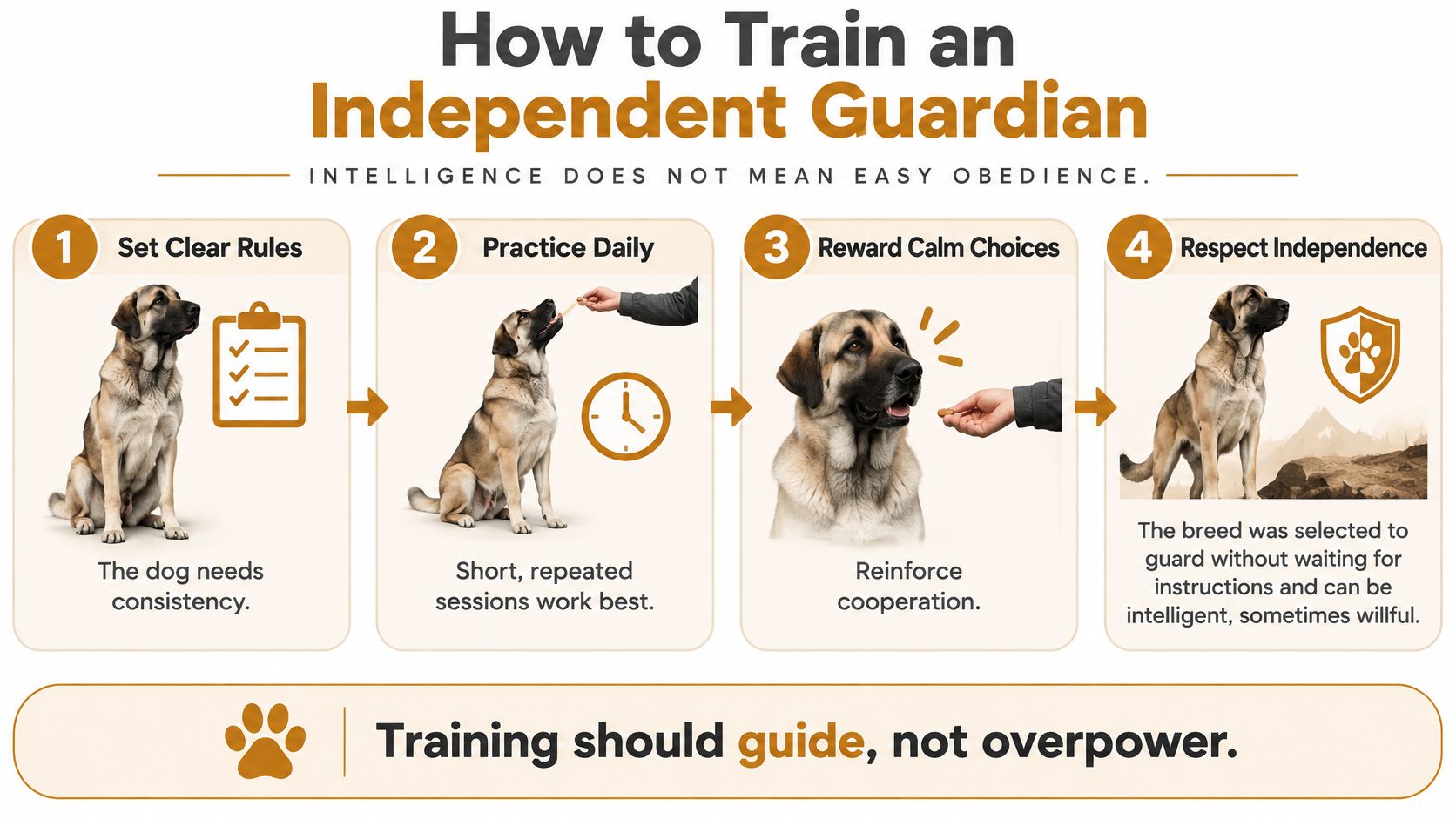
Intelligence doesn't guarantee easy obedience. The Great Pyrenees Club of America describes the breed as intelligent but sometimes willful and not easily obedience-trained. Training should build cooperation and predictable routines, not depend on physically overpowering the dog.
Start with the behaviors that make family life safer. A calm entrance routine is more useful than a long sequence of tricks if the dog crowds an open front door.
Build Practical Skills in Order
- Start during puppyhood. Teach the household rules before the dog gains adult reach and confidence. Waiting until pulling or doorway rushing becomes difficult gives you a larger management problem.
- Keep sessions brief and consistent. Reward a useful response and finish successfully rather than repeating a drill until the dog disengages. Practice in ordinary moments, such as waiting while you pick up the leash.
- Introduce household experiences gradually. Pair manageable exposure to visitors, appliances, and everyday movement with calm reinforcement. Practice comfortable handling of feet, mouth, and coat without forcing prolonged restraint.
- Establish leash manners early. Reward staying near the handler and turning away from distractions before they become overwhelming. The failure to avoid is a handling plan based entirely on an adult's strength.
- Give every adult the same rules. Decide where the dog waits during arrivals, whether furniture access is allowed, and how people protect resting space. Inconsistent exceptions make routines harder to maintain.
- Prevent rehearsal of unwanted behavior. Use secure boundaries, planned greetings, and reinforcement rather than allowing roaming or uncontrolled guarding and then trying to punish those habits away.
The central training principles are consistency, calm reinforcement, and realistic expectations.
Choose Help That Matches the Dog
Look for a local puppy class or trainer comfortable with giant guardian breeds and reward-based handling. Tell the instructor about your household traffic, children, and containment before the first session so practice addresses actual risks.
Our newsletter includes a downloadable training guide, but written instruction doesn't replace observing your dog with a capable local instructor. Seek individual help if the dog stiffens, growls, lunges, or guards resources during routine interactions.
Training target: Aim for comfortable leash walking, a settle spot, manageable handling, and a repeatable visitor routine. Don't make competition-style obedience the test of whether your family dog is succeeding.
Hip Dysplasia Bloat and When to Call the Vet
Behavioral suitability and medical preparedness are separate decisions. VCA Canada's Great Pyrenees guidance gives a usual lifespan of about 10–12 years and identifies concerns including hip dysplasia and gastric dilatation-volvulus, or GDV. Families need both routine veterinary care and a plan for urgent treatment.
Hip dysplasia involves abnormal hip-joint development and can affect comfortable movement. Trouble rising, reluctance to jump, or a persistent limp deserves assessment, although those signs can also have other causes. Ask about appropriate screening and weight management rather than waiting until the dog is clearly struggling.
GDV is an emergency, involving a gas-distended stomach that can twist. Don't try to confirm the diagnosis at home or wait to see whether the dog settles.
When to Call a Vet for a Great Pyrenees
| Sign | Concern | Action |
|---|---|---|
| Unproductive retching or heavy drooling | Possible bloat or GDV | Call a vet or emergency clinic now |
| Swollen hard abdomen with restlessness | Possible GDV | Go to emergency care and do not wait overnight |
| Collapse or pale gums | Emergency | Call a vet immediately |
| Limping or trouble rising that continues | Hip or other joint pain | Book a vet visit |
| Redness, odor, or sores under the coat | Possible skin infection hidden by the double coat | Call if it spreads, hurts, or the dog stops eating |
A dog doesn't need to show every listed sign before you call. Explain what you're seeing, when it began, and whether the dog is trying unsuccessfully to vomit. Follow the clinic's instructions and arrange transport promptly.
Prepare Without Assuming Prevention Is Guaranteed
Ask your veterinarian about measured meals, activity around feeding, and whether a gastropexy discussion belongs in the spay or neuter plan. Don't treat meal timing or any single household precaution as a guarantee against GDV.
- Save emergency contacts: Keep your regular clinic and an after-hours hospital in every responsible adult's phone.
- Plan transport: Know how you'll move a painful or weak giant dog without relying on lifting alone.
- Review financial readiness: Use the site's veterinary-care and insurance guides when considering emergency preparedness, not a named-carrier recommendation.
The breed's moderate exercise needs don't reduce the seriousness of these medical concerns. A calm dog still needs prompt attention when symptoms suggest an emergency.
Confirm the Fit Before You Bring One Home
Run these checks in order and stop at the first failure. Don't count an intention to fix something later as a pass.
- Fence: Walk the entire perimeter and confirm that the dog won't be able to jump, dig, or slip through the boundary.
- Household: Confirm that toddlers and preschoolers aren't part of the daily handling and shared-space plan.
- Nights and neighbors: Have every adult agree in writing to the alert-management responsibilities.
- Training: Book appropriate puppy instruction before adolescence and agree on consistent household rules.
A failed check means choosing a different breed is the honest result for the household as it stands. Use the breed comparison resource to explore alternatives rather than hoping affection will overcome a structural mismatch.
Finish the Research After the Behavioral Decision
If every check passes, review the Great Pyrenees health-risk profile, then consider lifetime food, veterinary care, grooming, and gear. Our founder's view is that new owners should see the breed's full picture before the first bill arrives, not afterward.
Keep modeled probabilities separate from a diagnosis. PetCostEngine's breed probabilities are our own estimates; other health points refer to published veterinary literature and your veterinarian. Direct questions about coverage to the site's insurance guides, and medical questions to the clinician who knows your dog.
The final decision should describe the household you have now, not the one you hope to create after bringing a puppy home. A Great Pyrenees is a good family dog only for homes that already matched a strong-fit row.
PetCostEngine's free analysis asks four questions and gives an answer based on your dog's breed, state, and age, helping you consider the care commitment after the household match is clear. Visit PetCostEngine to assess the Great Pyrenees' lifetime care needs and review breed-specific health and insurance considerations before bringing one home.
Estimated lifetime and yearly costs for a Anatolian Shepherd, state by state, plus whether pet insurance breaks even for the breed.
See Anatolian Shepherd costs →
Is insurance worth it for a Anatolian Shepherd? →
Premium dry food → Slow-feeder bowl → Digestive support →
As an Amazon Associate, PetCostEngine earns from qualifying purchases.