
Your dog sits down, scoots across the rug, then turns to lick under the tail. You're left checking the carpet and wondering whether this needs a cleanup, a vet appointment, or urgent care. If your dog rubs its butt on the carpet, the most useful first step is to check for pain, swelling, bleeding, and trouble passing stool, not to assume worms.
A brief episode in an otherwise comfortable adult dog can allow some observation. A painful rear, discharge, or repeated attempts to defecate calls for a different response. The pattern matters more than how dramatic the carpet drag looks.
Table of Contents
- What a Carpet Scoot Actually Signals
- Watch or Call Checklist for Scooting
- How to Inspect the Rear Safely
- Anal Sac Disease Behind Many Scoots
- Allergies Parasites and Grooming Lookalikes
- Safe Short-Term Relief at Home
- If Scooting Returns After the Visit
What a Carpet Scoot Actually Signals
After a bowel movement, a dog may drag its rear across the carpet, then lick or bite beneath the tail. That action is called scooting. It signals discomfort, much like rubbing an itchy spot, but the movement alone cannot reveal the cause.
The anal sacs are small scent glands on either side of the anus. They may become impacted, inflamed, infected, or abscessed. The Merck Veterinary Manual describes anal sac disease as the most common disease affecting the anal region in dogs. Signs can include scooting, licking or biting, painful defecation, straining, and constipation.
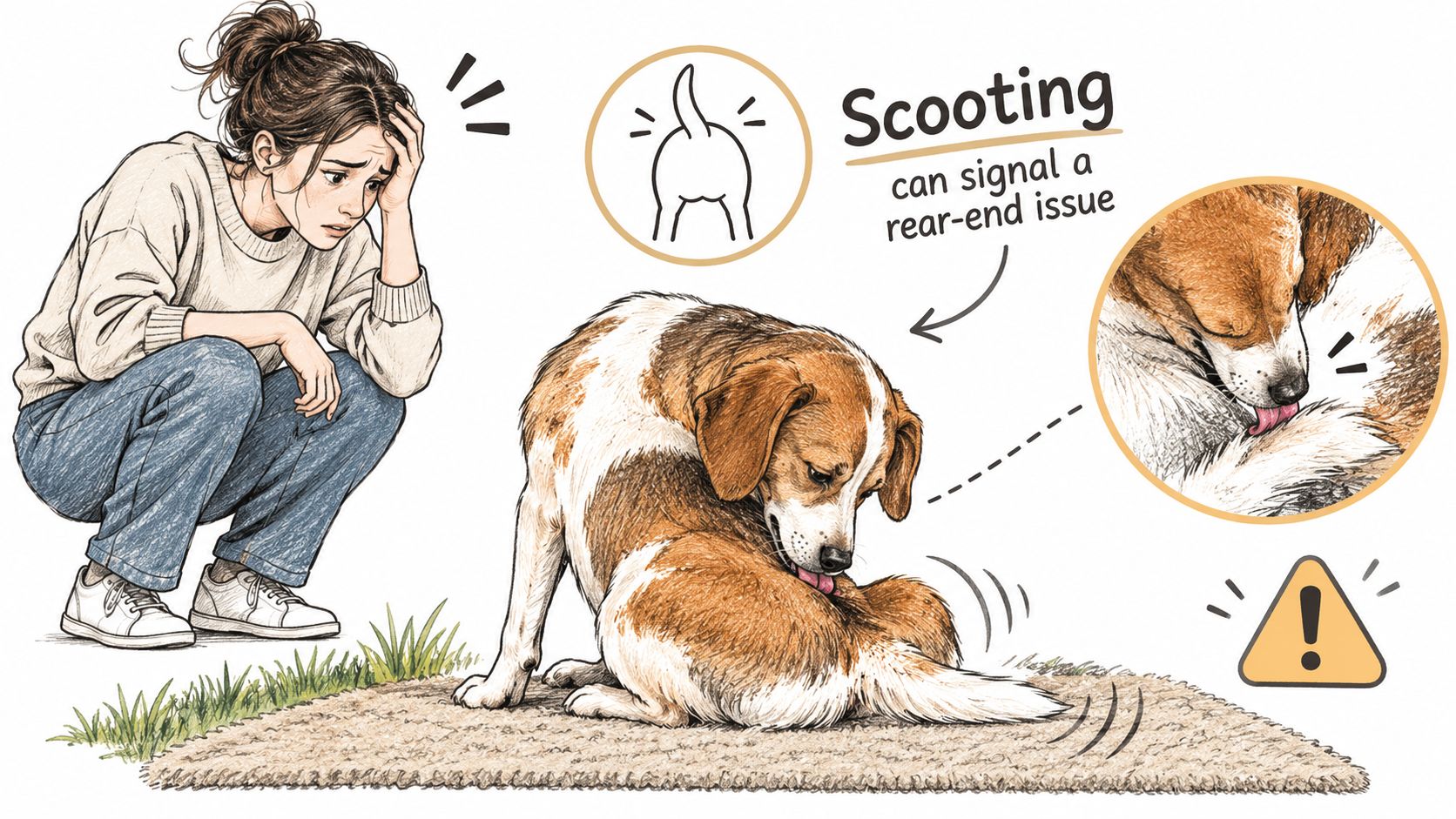
A clue, not a diagnosis
A smear of stool caught in the coat can irritate the skin. An uncomfortable anal sac can cause similar rubbing, so note whether scooting follows a bowel movement and whether the stool is firm or soft. The carpet drag itself cannot tell these causes apart.
Anal-sac problems can occur in dogs of any breed and are often seen more in smaller dogs. Breed patterns can help a veterinarian frame questions, but they cannot diagnose an individual dog. If the behavior recurs, the pattern, stool form, and other signs help distinguish possible causes, including irritation, anal sac trouble, allergies, or parasites. Worms are one possibility, not the default explanation.
Practical rule: Treat a carpet rub as a clue to discomfort, not proof that your dog needs deworming or gland expression.
One brief rub in a comfortable dog differs from repeated scooting accompanied by swelling, foul odor, discharge, blood, or painful stools. Those signs call for a veterinary examination rather than a worms-first assumption.
Watch or Call Checklist for Scooting
| Pattern | What else you see | Action |
|---|---|---|
| One brief episode | Eating and drinking normally, no swelling, odor, blood, or straining | Watch about 24 hours and note the stool |
| Returns over several days | Licking, fishy odor, or itch on feet, ears, or belly | Book a vet visit; don't express glands |
| Urgent rear-end signs | Swelling, blood, pus, a draining spot, severe pain, or straining | Same-day veterinary care |
| Puppy, senior, or ongoing illness | Scooting plus any discomfort or stool change | Same-day call rather than a home wait |
The about-24-hour observation window is for a mild episode in an otherwise well dog, while repeated scooting, foul odor, swelling, bleeding, or pain warrant veterinary evaluation, consistent with American Kennel Club guidance.
Use the row that matches your dog's current condition, not the row that matched earlier. A dog that seemed comfortable in the morning but develops swelling later shouldn't stay on a home-observation plan.
When watching is reasonable
The observation row fits an adult dog that's eating, drinking, walking normally, and comfortable between episodes. If a little stool is caught in the coat, wipe only the outside of the rear. Notice whether the next bowel movement is formed or soft and whether the scooting stops.
Watching doesn't mean waiting through worsening symptoms. Persistent licking, another bout of scooting, or a newly obvious odor changes the picture. Contact the clinic and describe what has changed rather than repeatedly restarting the observation period.
For puppies, elderly dogs, and dogs with ongoing conditions, soft stools are a same-day call to the vet. A call lets the clinic decide whether the dog needs an appointment immediately; it doesn't mean every such dog requires emergency hospitalization.
What to tell the clinic
Have these details ready when you call or arrive:
- Start and pattern: When the scooting began, how often it has happened, and whether it follows bowel movements.
- Stool description: Formed, soft, watery, unusually colored, or difficult to pass. A photo can help.
- Recent changes: New food, treats, medications, grooming, or a change in routine.
- Parasite prevention: Current flea prevention and any missed doses.
- Other itching: Paw licking, ear trouble, belly irritation, or a seasonal pattern.
- Visible changes: Swelling, discharge, bleeding, or a spot that appears to have opened.
Severe pain includes crying, refusing to sit comfortably, or snapping when someone approaches the tail. Don't keep checking a sore area to confirm that it hurts.
This checklist doesn't lead to automatic deworming or internal gland expression. Its purpose is to choose the appropriate level of care while leaving the diagnosis to the veterinarian.
How to Inspect the Rear Safely
A home check should be visual, external, and brief. It's appropriate only for a calm adult dog that allows handling without distress. A puppy, a dog guarding its rear, or a dog that cries or snaps should skip this inspection and receive veterinary guidance.
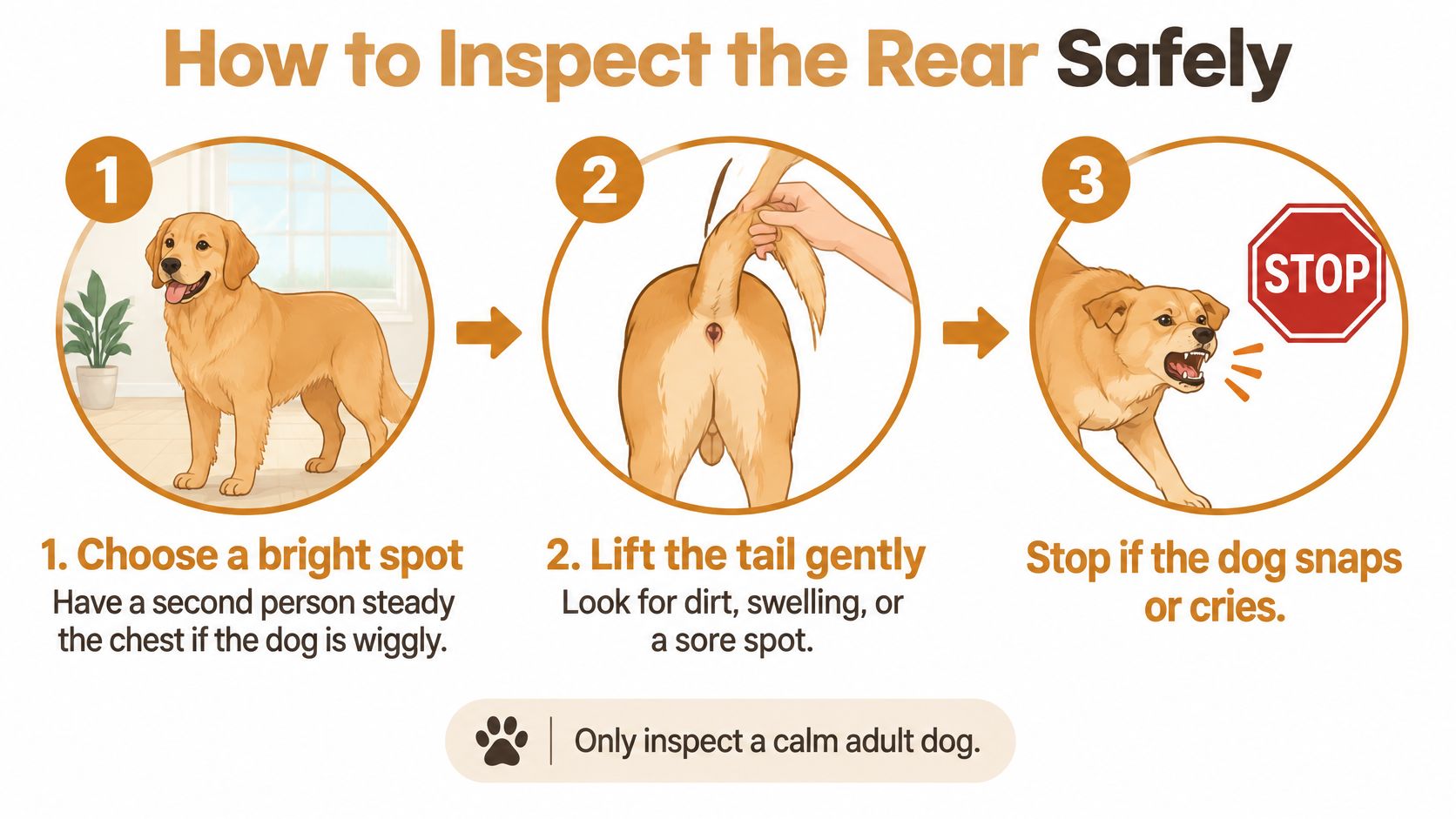
An external check without squeezing
Choose a bright spot. Good lighting helps you distinguish dirty hair from irritated skin. If the dog is wiggly but relaxed, have another adult gently steady the chest without pinning the dog down.
Lift the tail gently. Raise it only as far as your dog comfortably allows. Don't pull it upright or continue if the dog stiffens, turns sharply, or tries to move away.
Look around the anus. Check for swelling on either side, redness, blood, stool caked in the coat, or a small opening with discharge. Observe rather than touching a suspicious spot.
Notice odor without pressing. A strong fishy smell can support suspicion of an anal-sac problem, but it can't tell you whether infection is present or where it lies.
Part long hair only on the outside. Don't insert a finger, cotton swab, or tissue into the anus. Don't pull dried stool or mats away from tender skin.
Check the wider itch pattern. Look at the paws, groin, armpits, and outer ears for licking, redness, or irritated skin. Discomfort away from the rear gives the veterinarian useful context.
Record bowel and appetite changes. Note the last stool's consistency, any straining, and whether your dog is still eating normally. These observations matter even when the rear looks unremarkable.
Take a photo if it's easy. Photograph visible swelling or discharge only if the dog permits it without additional handling. Save it for the clinic rather than delaying care to get a better image.
Write a short timeline. Include the first scoot, repeated episodes, new foods, and missed flea prevention. A phone note is enough.
Where inspection should stop
Pressing a swollen sac can injure already inflamed tissue and may contribute to rupture. A painful rear also isn't a suitable place for scissors or home clippers. If a sanitary trim is needed, let a clinic assess a painful dog; routine coat maintenance in a comfortable dog can be handled by an appropriate groomer.
A normal-looking rear doesn't rule out a problem inside an anal sac.
Your notes can help the veterinary team focus the examination. They don't clear your dog medically, and you don't need to complete every step before calling.
Anal Sac Disease Behind Many Scoots
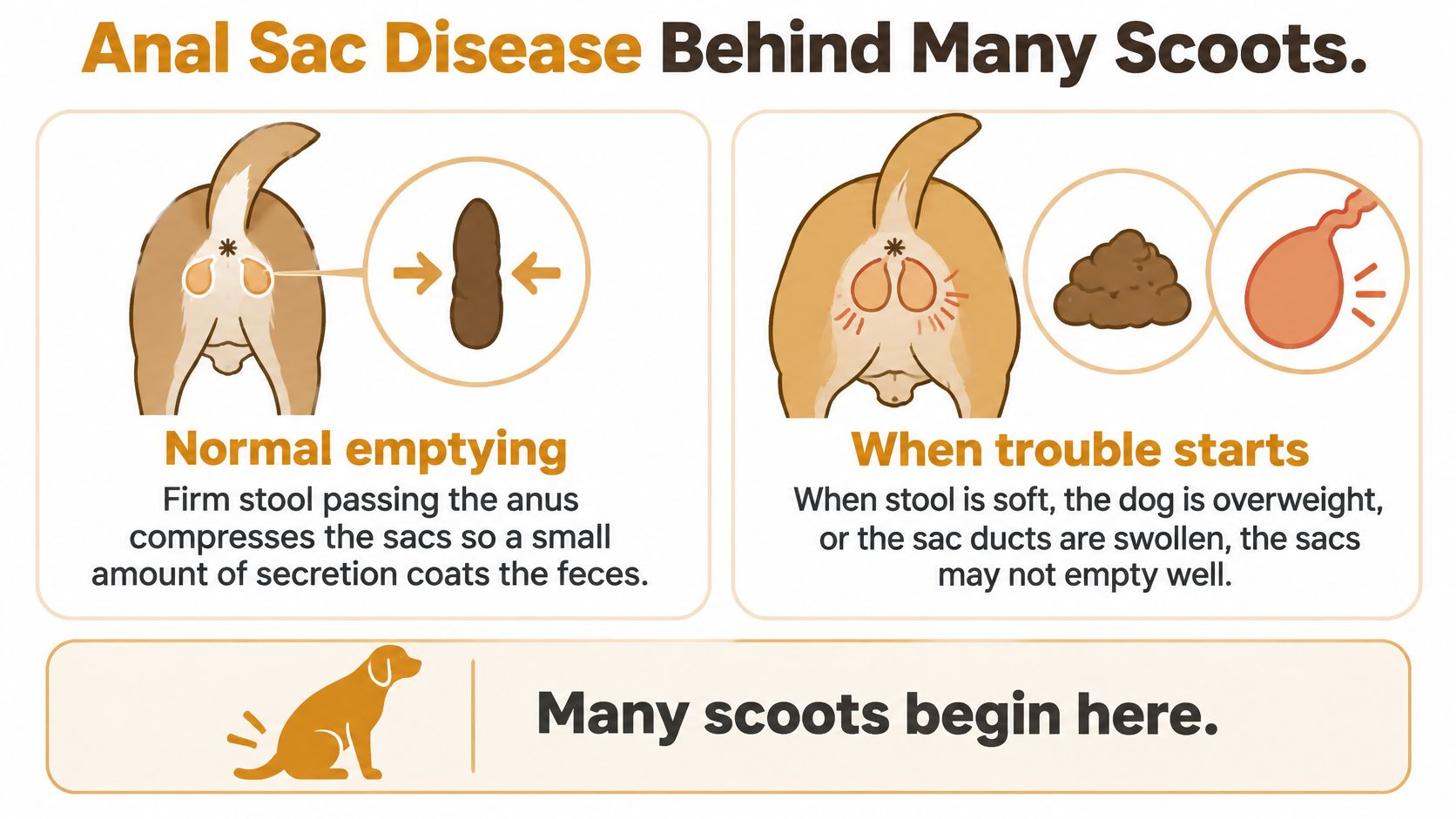
During normal defecation, firm stool passing through the anus helps compress the anal sacs, releasing a small amount of secretion onto the feces. When stool is soft, the dog is overweight, or the sac ducts are swollen, the sacs may not empty well. Retained material can become thicker and harder to release.
Impaction means retained material has built up in the sac. Sacculitis means inflammation of the sac. Infection and abscess formation are more painful complications, and an abscess may open through the skin.
What breed patterns can tell you
The UK primary-care findings summarized by Webvet identified 2,372 cases among 104,212 dogs under veterinary care in 2013, with an estimated one-year prevalence of 4.40%; the reported breed figures and odds comparisons appear below.
Anal sac disorder prevalence in one UK primary-care set
| Group | Figure from the study | How to read it |
|---|---|---|
| All dogs in the set | 4.40 percent estimated prevalence; 2,372 cases among 104,212 dogs | One-year prevalence estimate, 2013 UK primary care |
| Cavalier King Charles Spaniel | 14.83 percent | Highest breed figure in the cited set |
| King Charles Spaniel | 13.78 percent | Spaniel-type elevation |
| Cockapoo | 8.47 percent | Above the all-dog figure |
| Bichon Frise | 7.29 percent | Small-breed elevation |
| Shih Tzu | 6.93 percent | Above the all-dog figure |
| Brachycephalic dogs | More than twice the odds versus dolichocephalic dogs | Skull shape association, not a US rate |
| Spaniel types | More than twice the odds versus non-spaniels | Breed-type association, not a US rate |
The overall prevalence is a reported estimate, not a percentage obtained by dividing the listed case count by the full population. Odds comparisons also aren't individual probabilities. They describe associations between groups in that study.
Use breed as context, not a forecast
These findings give owners of small dogs, spaniels, and brachycephalic dogs a reason to mention breed-related concerns during the visit. They don't mean an otherwise comfortable dog needs preventive expression solely because of its breed.
For US owners, the figures are an epidemiological reference rather than an American prevalence rate. Breed mix, veterinary recording, and access to care differ between countries.
The practical question remains individual: does this dog have retained material, inflamed skin, abnormal stools, or another source of discomfort? A common diagnosis still requires an examination, and a dog outside the higher-risk groups can still develop anal-sac disease.
Allergies Parasites and Grooming Lookalikes
Scooting isn't diagnostic of anal-sac disease. When it happens again, the veterinarian may need to assess the skin, stool, coat, and surrounding structures rather than treating every episode as another full gland.
The location of other symptoms helps narrow the possibilities. A dog licking its feet and scratching its ears presents a different pattern from a long-coated dog with stool stuck beneath the tail.
Match the clue to the check
| Possible driver | Clues at home | What the visit usually includes |
|---|---|---|
| Anal sac impaction or infection | Fishy odor, licking under the tail, discomfort around the sacs | Physical exam and anal sac assessment |
| Allergy or fleas | Feet, ears, belly, or seasonal itch along with scooting | Skin and flea check plus diet and environment history |
| Intestinal parasites | Soft stool, visible worms or segments, or missed fecal tests | Fecal testing |
| Coat residue or mats | Stool caught in long hair, dirty rear, no visible swelling | External cleaning or a sanitary trim |
| Fistula, prolapse, mass, or foreign body | Blood, a visible lump, severe pain, or straining | Examination and further diagnostics when simpler causes don't fit |
Allergic skin disease may produce paw licking, rusty saliva staining, recurring ear irritation, or seasonal flare-ups. Inflammation around the anus can also interfere with sac emptying. Cleaning the coat won't resolve an underlying allergic condition.
Parasites remain a possibility, particularly with stool changes, visible segments, or a gap in testing. But worms shouldn't be the default explanation. Allergies and anal-sac disorders are often more likely explanations, and giving a dewormer doesn't establish what caused the discomfort.
External irritation versus deeper disease
Coat residue is an outside problem. It fits a dog with long furnishings, recent soft stool, or mats close to the skin. Removing the residue gently may address the immediate irritation, but a clean coat doesn't exclude a separate problem beneath it.
Less common conditions include perianal fistulas, rectal prolapse, foreign bodies, urinary disease, vulvar irritation, and tumors around the anus. Owners can't reliably distinguish these by appearance. A lump, protruding tissue, blood, or persistent straining needs examination rather than repeated cleaning.
Useful distinction: Seeing something unusual is enough to report it. You don't need to identify it before calling.
For breed and stool context, our breed catalog covers 226 breeds, including 26 with a digestive or allergy-based skin predisposition estimated at at least 15%, and our free tools include a poop color and consistency check. These resources can help organize observations, but those modeled predispositions aren't scooting probabilities, and a stool tool can't diagnose the cause.
Safe Short-Term Relief at Home
For a comfortable dog that fits the observation category, home care should stay external and gentle. Wipe visible stool away with a damp cloth, pat the area dry, and allow a short, relaxed walk so the dog can pass stool without being rushed. If carpet rubbing has made the skin raw, calmly interrupt further rubbing while arranging veterinary advice.
A warm, not hot, compress may provide comfort in selected cases. Hold it gently against the outside without squeezing, and stop if your dog objects. Don't let a comfort measure postpone an examination for persistent symptoms or pain.
Comfort measures aren't treatment
The Merck Veterinary Manual's owner guidance describes treatment for anal-sac inflammation that may include controlled expression, flushing with saline or an antiseptic, and local antimicrobial and anti-inflammatory medication; infection or abscess may require systemic antibiotics and pain relief.
Those are clinical decisions made after assessment. Flushing a sac isn't the same as wiping the skin, and an abscess isn't something an owner should try to empty.
- Skip irritating products: Don't apply essential oils or human hemorrhoid cream.
- Don't reuse prescriptions: Leftover antibiotics may be inappropriate for the problem and don't provide a diagnosis.
- Leave internal expression to the clinic: Don't insert a finger or attempt to force material out.
- Avoid sudden diet experiments: Ask about fiber and stool management rather than changing food to treat an acutely painful rear.
Care depends on what the examination finds
| Problem | Typical clinic steps | Owner role |
|---|---|---|
| Single uncomplicated impaction | Examination and expression | Book a visit; no home squeezing |
| Recurrent inflammation | Examination plus skin and stool workup | Bring the timeline and photos |
| Infection or abscess | Drainage, systemic antibiotics, pain control, possibly a procedure | Obtain same-day care |
For repeated impactions, the veterinarian may review stool consistency, diet, body condition, and allergic or other skin disease. Additional dietary fiber may help selected dogs produce bulkier stool and improve natural emptying, but fiber is a prevention discussion, not treatment for an abscess.
Preventive chews and gland powders won't remove a foreign body, treat a mass, or replace flea control. They also shouldn't be used to delay care for a dog that's bleeding, painful, or snapping. At that point, the owner's job is to arrange care and avoid further manipulation.
If Scooting Returns After the Visit
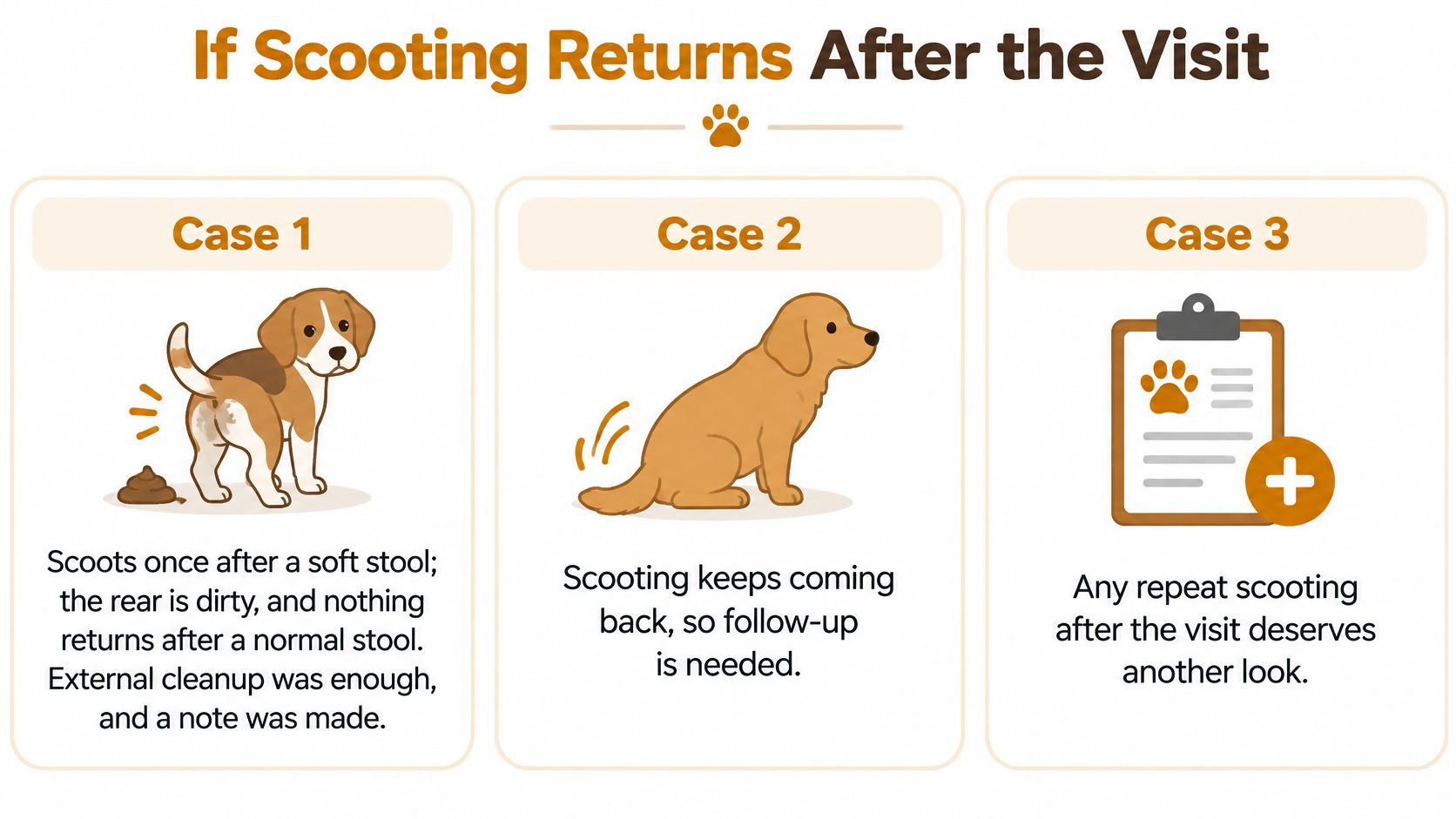
A brief episode after dirty stool. Say a comfortable adult dog scoots after a soft bowel movement, and you find stool in the coat. Gentle external cleaning resolves the irritation, normal stool follows, and the behavior doesn't return. A note in your phone preserves the history without turning an isolated event into a chronic diagnosis.
Recurring odor in a small dog or spaniel. Another dog repeatedly returns to scooting despite expression at previous visits. Ask what the examination showed and whether stool quality, body condition, or persistent inflammation needs attention. Repeating a procedure without reviewing the reason for recurrence can leave the underlying problem unaddressed.
Scooting alongside ongoing itch. A dog with year-round paw licking or flea exposure may need a broader skin plan. VCA Animal Hospitals' scooting guidance explains that allergies can inflame anal sacs and interfere with normal emptying, so treatment may need to address the allergic condition as well as the sacs.
Make the follow-up specific
Contact the clinic with the new timeline and ask questions tied to the previous findings:
- Confirm the diagnosis: Was there impaction, inflammation, infection, or an external skin problem?
- Clarify testing: Was fecal testing appropriate, and was it performed?
- Review itch control: Were fleas or allergies identified, excluded, or left for follow-up?
- Discuss prevention: Does stool consistency or body condition need a structured plan?
- Question routine expression: Is a scheduled procedure treating a documented problem, or should the diagnosis be reassessed?
Choose the watch, appointment, or same-day action that fits today's signs. A previous examination doesn't make new swelling or pain safe to monitor at home.
Keep educational resources in their proper role
This page provides general information, not a veterinary examination. Matteo Giorgi, PetCostEngine's founder, is not a veterinarian. We publish a Methodology page explaining how our breed health context is built, but an individual dog's diagnosis must come from its veterinary team.
For a returning problem, the most useful next action is to call with a concise account of what improved, what returned, and what looks different. Bring the photos and treatment history rather than trying another round of home expression.
PetCostEngine offers breed health references, a lifetime care calculator, and insurance guides to help owners plan for ongoing veterinary needs. Visit PetCostEngine to explore your dog's breed context and prepare for recurring care, while letting your veterinarian determine what's causing the scooting.
Modeled estimates for 226 breeds, with the formula and sources published in full.
See the data →
Car restraint → Crate and bedding → No-pull harness →
As an Amazon Associate, PetCostEngine earns from qualifying purchases.