
In a large US Dog Aging Project sample, 47.4% of dogs showed fear or anxiety toward unfamiliar dogs, compared with 25.5% toward unfamiliar situations, objects, or noise and 22.3% toward unfamiliar people, according to Cornell's guidance on fearful dogs. Fear isn't one uniform problem. A dog who welcomes visitors may still panic at traffic, while another may tolerate noise but freeze when someone reaches toward them.
Learning how to help a fearful dog gain confidence starts with measuring what your dog can comfortably handle. A written stop-go checklist makes that decision more reliable than judging whether an outing seemed successful because your dog didn't bark.
Table of Contents
- Score Every Session Before You Raise Difficulty
- Teach Four Skills Before You Add Triggers
- Run Short Desensitization and Counterconditioning Sessions
- Arrange the House and the Walk
- Tell a Shut-Down Dog From a Calmer Dog
- Bring in a Veterinarian When Sessions Stall
Score Every Session Before You Raise Difficulty
Threshold is the point where a trigger causes barking, lunging, freezing, fleeing, or refusal of food. Work below that point, where your dog can notice the trigger without losing the ability to eat, move voluntarily, and recover.
Eating alone isn't permission to move closer. Some dogs take food while holding a stiff posture, then drop it or become more worried on the next exposure.
Write down what actually happened
After each repetition, record the distance from the trigger or the recording volume, whether your dog ate, the seconds until their body softened, and whether a familiar cue still worked. A phone note, paper worksheet, and stopwatch are enough.
Use landmarks to make distance repeatable: the far driveway, the opposite sidewalk, or the back of the room. For recordings, note the device, volume setting, and speaker position. A volume setting without that context is hard to reproduce.
Fear session stop-go checklist
| Check | Under threshold | Over threshold | Next session |
|---|---|---|---|
| Food | Takes high-value food readily | Refuses food, or takes it and drops it | Step back until eating returns |
| Posture | Loose body, soft eyes, can look away | Freeze, tucked tail, lowered body, hard stare | End the session |
| Movement | Stays or chooses to approach | Flees, hides, lunges, or pins in place | Increase distance or reduce intensity |
| Sound or startle | Brief glance, then back to the handler | Barking, growling, or nonstop scanning | Lower volume, add visual cover, or increase distance |
| Recovery | Settles within about 30 seconds after the trigger leaves, used as a working checkpoint rather than a validated cutoff | Stays aroused after the trigger is gone | Do not raise difficulty |
| Known skill | Can hand-target or settle on a mat | Cannot perform a cue the dog knows at home | Return to the last easy level |
| Starter setup | About 20 feet from a stranger, or a vacuum switched off in the room, as illustrated by the AKC's fearful-dog training guidance | Closer approach, or vacuum on, while any row above fails | Hold this setup until every row is clean |
The starter setups are examples, not safe distances for every dog. Begin farther away if your dog's posture or eating tells you to.
Let the weakest row decide
Check eating first, then posture and movement. Listen for vocalizing and watch whether your dog can stop scanning. Finally, record recovery and try the familiar skill only if your dog otherwise looks comfortable.
Practical rule: An over-threshold response outweighs a brief exposure. Short doesn't automatically mean easy.
If any over-threshold box is checked, the next session stays at the last comfortable setup or gets easier. Several clean repetitions permit a small change, but not an automatic march closer every day. Keep the sheet beside your session plan and use it to decide whether you proceed.
Teach Four Skills Before You Add Triggers
A fearful dog needs opportunities to succeed when nothing frightening is happening. Familiar behaviors give you useful ways to communicate without pulling, pushing, or repeating commands.
Teach these skills in a quiet room with food your dog enjoys. Mark the moment you want with a consistent word such as yes, then deliver the food; add the behavior's cue once the movement comes easily.
Make the behaviors voluntary
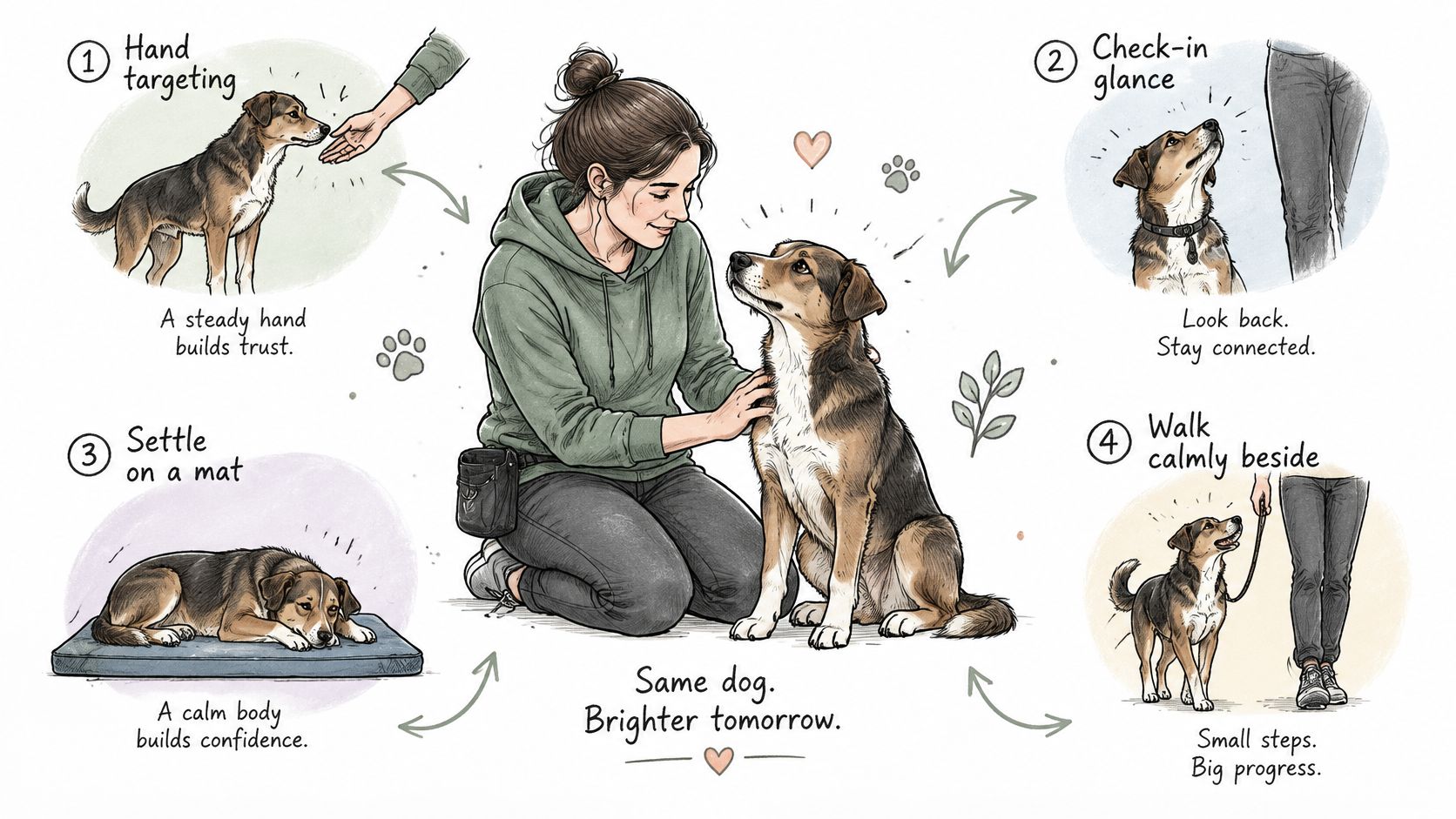
- Hand targeting: Present an open hand near your dog's nose without moving it into their face. Mark a voluntary nose touch and feed from your other hand. If they lean away, withdraw your hand and make the next presentation less intrusive.
- Checking in: Wait for your dog to glance toward you. Mark that glance and reward it without demanding prolonged eye contact. This gives you a lightweight way to reconnect outdoors.
- Settling on a mat: Put a mat on the floor and reward voluntary investigation, then stepping onto it. Gradually reward comfortable standing, sitting, or lying down. Don't repeatedly place the dog on the mat or insist on a down.
- Walking beside you: In a clear indoor space, reward your dog for choosing a position near your leg. Move, then feed while they remain comfortably alongside you. Keep the leash slack rather than using it to arrange their body.
Reward voluntary approaches during ordinary life, too. If an accidentally dropped spoon causes a mild startle, allow space and reward when your dog recovers and reconnects. Don't deliberately drop objects to test their courage.
Use a skill before the situation becomes difficult
Say a shy terrier practices hand targeting in the kitchen until the motion is familiar and relaxed. On a later walk, a jogger appears across the street. The handler offers the target while the terrier can still move easily, rewards the touch, and continues away from the jogger.
That's different from demanding a target while the dog is already lunging. The skill provides an available response; it doesn't override fear.
For visitors, practice a mat settle behind a baby gate while guests are still outside. Maintain comfortable distance even if the dog performs the behavior well. Obedience isn't consent to a greeting.
A 2025 Dog Aging Project analysis found that smaller dogs were, on average, more fearful and less trainable than larger dogs. That population pattern isn't a prediction about an individual dog, but it's a reason not to dismiss a small dog's difficulty as stubbornness.
For toy and small dogs, make the task easier and offer more successful practice rather than applying a harsher standard. Keep your own posture nonthreatening, especially when presenting a hand or reaching toward equipment.
Choose the behavior your dog offers most comfortably as the checklist's familiar cue. A reliable hand target is often easier to assess than a long mat settle.
Run Short Desensitization and Counterconditioning Sessions
Desensitization means presenting a trigger at a manageable intensity and increasing difficulty gradually. Counterconditioning means pairing that trigger with something your dog wants, so its appearance begins to predict a positive outcome.
The MSD Veterinary Manual's guidance on canine behavior problems recommends these approaches for fear and warns against continuing exposure when the dog reacts. The procedure depends on controlling intensity, not just bringing treats to a difficult place.
Follow a repeatable session recipe
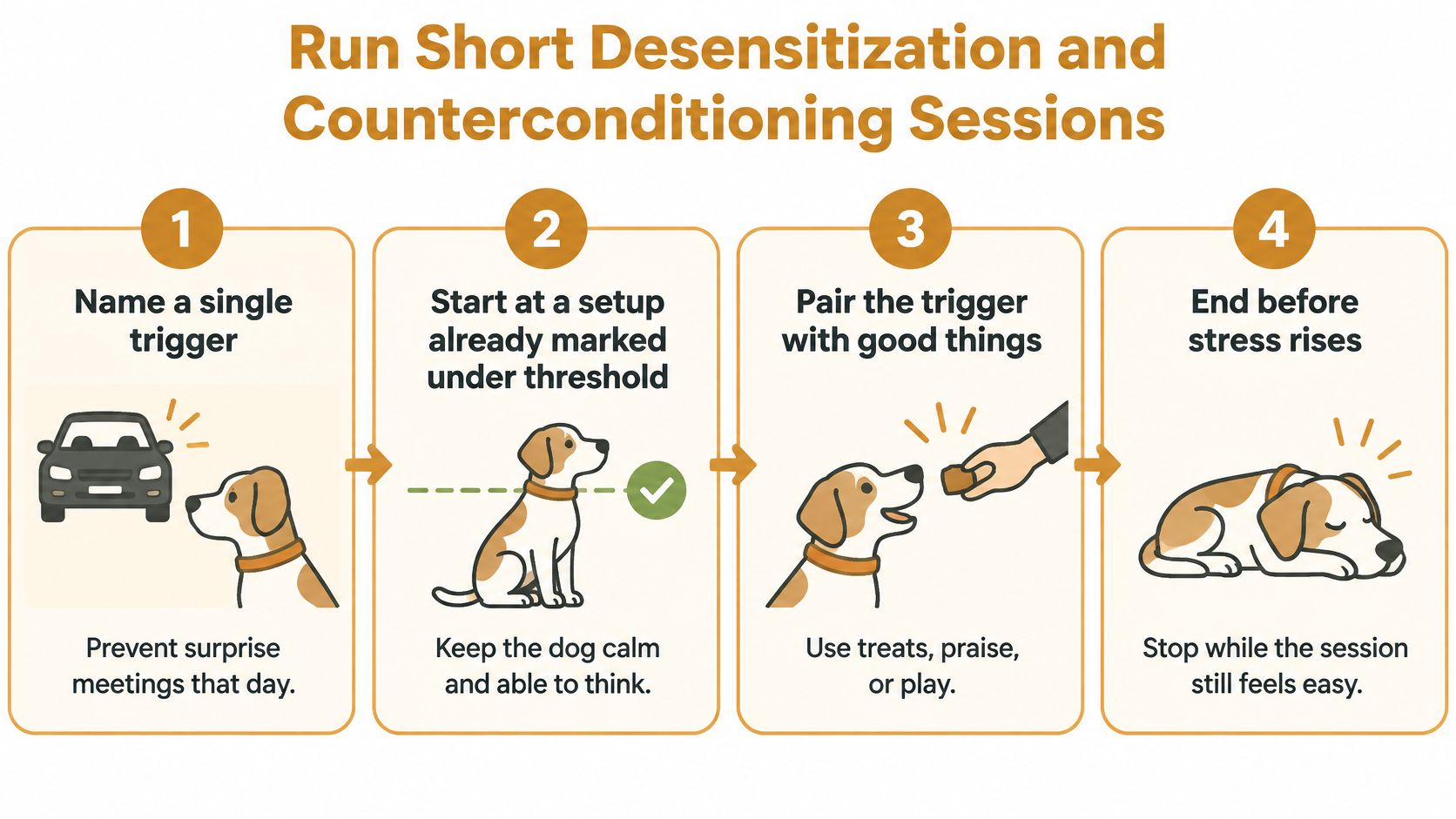
Name a single trigger. Be specific: a stationary stranger, a moving dog, the vacuum motor, or a recording of thunder. Prevent unnecessary encounters with that trigger while you're arranging controlled practice.
Prepare an easy setup. Use a location and intensity that already produced comfortable responses. Plan an exit before beginning. A helper should know where to stand and when to move out of sight.
Present the trigger briefly. Let your dog notice it while their body remains loose. Don't lure them toward it with food. Noticing from safety is enough.
Pair it immediately with something desirable. Deliver especially appealing food or offer play if your dog wants it in that setting. The order matters: the trigger appears, then the good thing follows. Don't wait for an elaborate obedience performance.
Keep demands simple. A familiar cue can help you assess comfort, but repeated commands add pressure and obscure what you're measuring. If the cue disappears, adjust the environment instead of drilling obedience.
Finish before stress rises. End while your dog is still eating comfortably and moving freely. You don't need to reach the next distance or switch on the appliance to justify stopping.
Record the repetition. Note the setup, food response, recovery, and familiar cue. Include surprises, such as a passing truck or the helper moving unexpectedly.
Choose brief, frequent practice over a prolonged outing. Leave recovery time between sessions. Don't repeat exposures just because your dog eventually stopped reacting.
For sound fears, a recording lets you control both volume and duration. Start at a low enough level that the sound doesn't change your dog's posture, then pair it with food. A recording is a controllable practice tool, not proof that your dog will tolerate a real storm.
Change difficulty without forcing progress
After repeated calm responses, change a single feature slightly. You might make a sound a little louder while keeping it brief, or allow a distant helper to move while preserving distance. Mix easier repetitions among harder ones rather than making every attempt more demanding.
The emotional association needs to change. Visible quiet isn't the goal.
If your dog freezes, flees, vocalizes, or refuses food, stop the exposure and allow recovery. Continuing at the provoking intensity can strengthen the fear association. Don't hold your dog in position until they accept food.
Consider a vacuum session. Your dog comfortably eats while the unplugged machine sits across the room, but stops eating when you switch it on. Turn it off, create space, and end the exposure rather than repeatedly testing the motor.
A later session may involve only the switched-off vacuum again. That isn't wasted practice. You've learned that the motor, rather than the object alone, needs a gentler introduction, perhaps through a quiet recording from farther away.
Arrange the House and the Walk
Management means arranging daily life so your dog doesn't repeatedly encounter more than they can handle. Training is harder to organize when the dog spends the rest of the day reacting at the window or dodging greetings on narrow sidewalks.
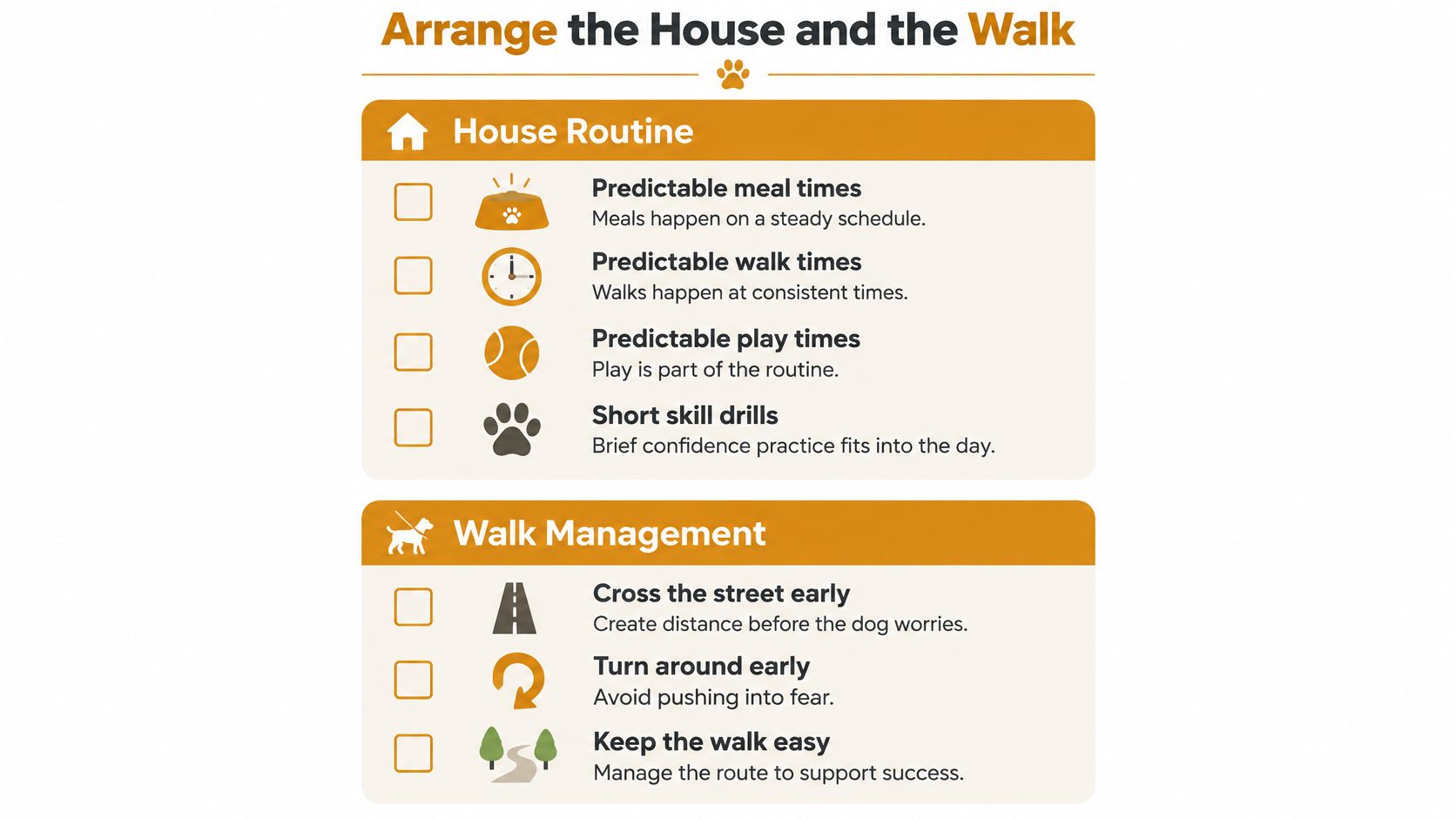
Keep meals, walks, play, and skill practice on a steady routine. Predictable doesn't mean following the clock rigidly. It means your dog can recognize familiar sequences without facing frequent surprises.
Reduce pressure before it builds
At home, close curtains or move resting places away from a busy window. Offer a quiet back room or a covered crate area only if your dog already finds that space comfortable, with adequate ventilation and no forced confinement. A refuge shouldn't become somewhere the dog gets trapped with a frightening visitor.
On walks, scan ahead and cross the street or turn around before your dog stiffens. Choose routes with escape options instead of narrow paths where another dog can block your way. Distance is more useful than repeatedly asking for attention while someone approaches.
Match enrichment to your dog's current capacity:
- Quiet exploration: Choose a sniff-heavy walk on a calm block rather than a crowded destination.
- Food activities: Offer an easy food puzzle when your dog is rested and willing to engage.
- Restful chewing: Provide an appropriate chew in the safe room, with supervision suited to the dog and item.
Don't introduce the hardest puzzle during a storm or a visit. A worried dog who abandons it needs relief from the situation, not a more exciting challenge.
Set boundaries for people and equipment
Tell guests to ignore the dog and remain out of the retreat route. Meetings wait until the dog chooses to approach, and an approach doesn't automatically invite touching. Guests who insist the dog must say hello aren't suitable training helpers.
When hiring help, look for a reward-based trainer or veterinary behavior professional who will review video, identify the threshold, and refuse forced exposure. Ask for a written plan describing the trigger, starting distance, warning signs, and how a failed repetition will be reset.
A useful plan explains when to stop, not just what to practice.
For walking equipment, look for clear sizing measurements, adjustment instructions, and fit guidance on the label. A properly fitted front-clip harness may help with control, but it won't change the dog's emotional response by itself.
Check that the equipment doesn't rub, restrict comfortable movement, or allow escape when the dog backs away. Ask your veterinarian before adding a supplement or calming product, particularly if your dog already takes medication.
Tell a Shut-Down Dog From a Calmer Dog
A silent dog isn't necessarily a comfortable dog. Freezing, withdrawal, and a lowered posture can be fear responses even when nobody hears barking.
A dog who stops eating, won't move voluntarily, or remains still only while restrained hasn't demonstrated confidence. Look for choices and flexibility: shifting weight, looking away, accepting food comfortably, and reconnecting with you.
Read the whole response
The Merck Veterinary Manual's behavior guidance emphasizes changing emotional responses rather than only suppressing behavior and adjusting treatment when a dog regresses. Handling deserves the same scrutiny: passive handling has been associated with lower fear scores, while standing restraint, abdominal lifting, and muzzle holding have been associated with more fear-related behavior.
Those associations don't mean every still dog is shut down or every examination can happen without restraint. They mean stillness alone is a poor measure of cooperation.
Quiet dog or shut-down dog
| What you see | Easy to misread as | Check this | Adjustment |
|---|---|---|---|
| Still and silent | Calm | Will the dog eat and shift weight on its own? | If not, increase distance and end |
| No barking | The fear is gone | Posture, tail, and ability to look away | Reinforce loose movement; don't demand silence |
| Slower retreat | Bravery | Recovery time versus the last clean session | Advance only if recovery is shorter and other checks pass |
| Takes food then drops it | Almost fine | Delay before eating and whether the next repetition is worse | Return to the last easy level |
| Allows handling while frozen | Cooperative | Food, voluntary chin or paw presentation, no pinning | Stop restraint and reward gentle, nonrestrictive touch |
Use the table to reassess a quiet session with a clear eye. If your dog stood motionless while a visitor petted them but wouldn't eat afterward, record that as difficulty, not a successful greeting.
Practice handling without pinning
For examination preparation, teach a voluntary chin rest on your open palm or a folded towel. Reward the dog for placing their chin there, then allow them to lift it freely. Add a brief side-body touch only when the chin rest itself is comfortable.
For nail-care preparation, reward looking at the tool, then comfortable voluntary paw presentation before attempting a trim. Don't combine unfamiliar equipment, paw restraint, and clipping into the same demand.
Pause if your dog stops taking the offered food, closes their mouth instead of eating, pulls away, or becomes rigid. Skip the next handling step when the checklist changes. Pinning the dog to finish the practice removes the choice you're trying to teach.
If a formerly easy distance now produces freezing or food refusal, record regression and reduce intensity. More repetitions at the failed level won't establish whether pain, accumulated stress, or another change is contributing.
Bring in a Veterinarian When Sessions Stall
Book a veterinary visit when fear is severe, aggression appears, a phobia disrupts normal life, or your dog can't eat or learn around the trigger. Sudden onset, limping, a painful-looking gait, or fear that prevents necessary care also deserves veterinary assessment rather than more exposure.
For active treatment, AAHA's behavior-management guidance describes follow-up intervals of roughly 2 to 4 weeks, using behavior records or videos to monitor progress. Bring ordinary sessions, including unsuccessful ones, rather than a highlight reel.
Use a clear booking rule
When to call your vet
| Sign | Action |
|---|---|
| Snapping, growling that escalates, or bites | Book a veterinary visit before more exposure |
| Cannot eat near the trigger for a full week | Book a visit and pause that trigger; don't wait if fear is severe |
| Sudden onset, limping, or painful-looking gait | Book a veterinary visit and pause exposure |
| Fear blocks an exam or nail trim | Ask the clinic for a quiet entry and a pause plan |
| Easier sessions still fail eating or recovery after one week | Ask your veterinarian to involve a veterinary behavior professional |
| Checklist rows stay clean | Keep short sessions and the same log, with follow-up at the active-treatment interval agreed with your veterinarian |
The week-long checkpoints are practical escalation rules, not diagnostic thresholds or reasons to delay care. Medication, when appropriate, is a veterinary decision intended to support treatment and learning, not a home experiment.
Remove punishment, leash jerks, shock or prong collars, forced greetings, flooding, and dominance tactics from the plan. Veterinary behavior guidance warns that aversive methods can harm the human-animal bond and the dog's health.
Prepare for a useful appointment
Tell the clinic about handling concerns before arrival. Ask for a quiet entry, a way to wait away from other animals, and an agreed pause signal during the examination.
Bring your checklist and ask:
- Possible causes: Could pain or illness be driving this reaction?
- Handling choices: Which exam steps can pause or use gentle, nonrestrictive touch?
- Medication expectations: Is medication worth discussing, and what behavior change would we expect?
- Review criteria: When should we review the log, and what result means a behavior referral is next?
Use the matching breed health profile and owner guides to prepare questions about health issues that could affect behavior, not to diagnose the dog yourself. If ongoing visits become part of care, review insurance guidance and comparison tools qualitatively, paying attention to exclusions and coverage terms rather than premium slogans.
PetCostEngine offers breed-specific health references, personalized ownership planning tools, and insurance comparisons to help you plan for ongoing veterinary care. Visit PetCostEngine to explore those resources and subscribe for the downloadable dog training guide you can use alongside your session log.
Modeled estimates for 226 breeds, with the formula and sources published in full.
See the data →
Premium dry food → Puzzle toys → No-pull harness →
As an Amazon Associate, PetCostEngine earns from qualifying purchases.