Shih Tzus are trainable but not consistently easy, because basic cues are realistic in short reward sessions while house-training needs four to eight accident-free weeks before more unsupervised freedom. Distracted recall is the other task that commonly fails when household rules slip.
The popular advice collapses that split into a single label. You're told the breed is stubborn, or low in obedience intelligence, and left to guess which daily job is hard. That label answers the wrong question. Learning a routine and repeating a human-directed drills on cue aren't the same skill, and a companion dog can be good at the first while selective about the second. Asking are Shih Tzus easy to train only helps when you break it into tasks.
Table of Contents
- Which Shih Tzu Training Tasks Are Realistic
- Why Reinforcement Decides Shih Tzu Compliance
- How to House-Train a Shih Tzu
- When Health and Grooming Slow Training
- How Shih Tzus Compare With Similar Toy Breeds
- Decide Whether a Shih Tzu Fits Your Training Time
Which Shih Tzu Training Tasks Are Realistic
The verdict is task-specific. Shih Tzus are generally trainable, and the American Kennel Club Shih Tzu guidance describes them as "lively, intelligent, and alert" while warning that training can be both amusing and frustrating because charm can win. That source also states that praise and rewards work better than punishment, desired behaviors should be introduced gradually, and puppy kindergarten or obedience classes should use praise-based methods. Read together, those points don't describe an incapable dog. They describe a dog whose performance depends heavily on method and consistency.
A single breed ranking hides the distinction that matters to an owner. A Shih Tzu may learn where treats live, which person feeds scraps, and how to solicit lap access very quickly, yet still decline a twentieth identical sit in the garden. The first set of behaviors pays immediately. The second pays only if you make it pay, in a place with more interesting alternatives. Treating both as one intelligence score will mislead your plan.
The Task Checklist
| Task | Typical difficulty | Success looks like | Session shape |
|---|---|---|---|
| Sit, down, stay | Easier with food or play | Holds the cue in a quiet room | One cue, 3 to 5 minutes, many short repeats |
| Come when called | Moderate, weaker with distraction | Returns from another room, then a fenced yard | High-value reward, end on a success |
| Leash manners | Moderate | A short outing without constant pulling | Reward often, do not make the whole walk the lesson |
| House-training | Often the hardest | Four to eight accident-free weeks before more freedom | Out after waking, meals, and play, reward on the spot |
| Grooming handling | Needs early practice | Accepts brush, face, paws, and nails | Daily handling measured in seconds, then minutes |
| Jumping or demand barking | Hard if attention rewards it | A calm greeting gets the person or the treat | Same rule from every person in the home |
Sit, down, and stay belong at the top because the environment is controllable. Teach one behavior at a time, reward the response immediately, and stop before interest fades. Recall changes the math. A puppy who comes across a quiet living room hasn't learned to come away from a neighbor's dog, a dropped sandwich, or an open gate. You have to rebuild the same cue at each distraction level rather than assume the indoor version transfers.
What Rows Two to Six Demand
Leash manners sit in the middle for a similar reason. The walk itself is full of smells and movement, so using one long outing as the only lesson asks for sustained attention the dog hasn't built yet. Short outings with frequent pay for walking near you teach more. The reward is not just food. Continued forward movement after a slack leash also tells the dog which behavior works.
House-training is slower because it combines limited bladder control, a short attention span, and many chances for an unsupervised accident to happen out of sight. Grooming handling is not a temperament verdict either. It's a trained tolerance for a brush, a face wipe, paw handling, and nail care, and it needs brief daily rehearsal long before the first difficult salon visit.
Practical rule: Pick one row as this week's goal and judge progress only against that row's success standard.
Jumping and demand barking reveal the other trap. If a small dog gets eye contact, laughter, petting, or lap access after jumping on Monday and a correction on Tuesday, Monday's lesson is the one that sticks. The dog isn't refusing to learn. It's learning from the inconsistent pay schedule.
If you're browsing other small companions while you decide, our toy breed size category lets you check whether the handling and training load changes much across similar sizes. For a Shih Tzu, start with the checklist row you'll repeat most often at home, not the cue that looks best in a class.
Why Reinforcement Decides Shih Tzu Compliance
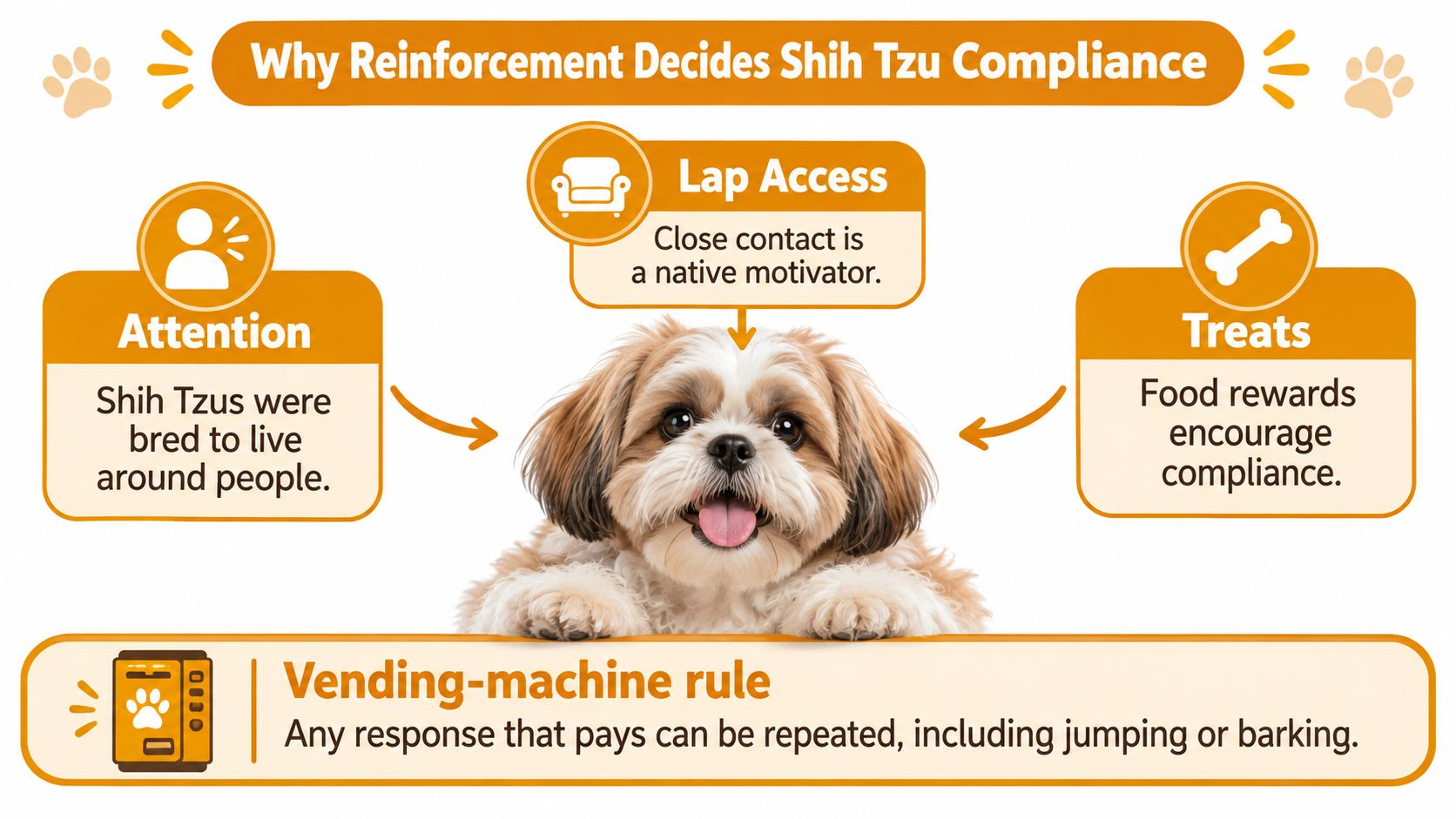
Shih Tzus were developed to live around people, not to herd, retrieve, or guard for long stretches. That history makes attention, lap access, treats, and play unusually powerful currencies. It also creates the breed's central training risk. People reward charming behavior without noticing they've done it, then call the result stubbornness when the dog repeats what worked.
The American Kennel Club guide to whether a Shih Tzu is right for you notes that allowing a Shih Tzu to routinely get its way can create a difficult pet, and recommends early socialization, puppy classes, incremental skill-building, and reward-based instruction. The same guidance supports short, frequent sessions, marking the correct behavior immediately, and delivering a small food or play reward within seconds. The mechanism is straightforward. If attention, access, or treats follow an unwanted response, that response becomes more likely. If calm behavior is what reliably produces those rewards, calm behavior becomes more reliable.
That leads to a useful vending-machine test for your home. Before you blame a cue, ask what the dog received in the five seconds after it barked, jumped, pawed, or sat still. The answer usually identifies the behavior you're training. This is why one person allowing couch access after demand barking can undo another person's careful work at the door. The dog hasn't forgotten the rule. It has learned that the rule depends on the person.
The visual below maps the three motivators to manage first, before you add harder cues.
Why Reward Isn't Just the Gentler Option
The American Veterinary Society of Animal Behavior position statement on humane dog training recommends reward-based methods for all canine training and advises against aversive techniques, citing welfare and human-animal bond risks. Companion-dog research summarized in that literature found dogs trained with aversive stimuli showed more stress behaviors and larger post-training cortisol elevations, and dogs exposed exclusively to aversive methods performed more pessimistically in a cognitive-bias task than dogs trained with reward or mixed methods. For this breed, that's a practical warning, not a philosophy debate. A dog that disengages or shuts down under pressure gives you fewer clean repetitions, and fewer repetitions slow learning.
Force also creates a measurement problem. A puppy that sits to avoid a leash correction may look obedient while learning to watch your hands rather than the cue. A puppy that sits because the behavior reliably earns a pea-sized treat, praise, or a brief game is learning the contingency you want to repeat in other rooms. Keep treats tiny and soft so you can reward often without turning a short session into a meal, and count training food as part of the day's ration. Ask your vet what treat type and amount fit your dog's weight, teeth, stomach, and any medical diet, and check labels for clear ingredients and calorie information rather than relying on front-of-pack claims.
A Session You Can Run This Week
- Start small: Choose one behavior in a quiet room and use a food lure, capturing, or shaping to get the first version.
- Mark precisely: Say your marker word or click the instant the behavior happens, then deliver praise, play, or a tiny treat.
- End early: Stop after a successful repetition while the dog is still engaged and the reinforcement rate is high.
- Change one variable: Practice in a second room, then near a doorway, then outdoors, raising distractions only after the cue holds at the easier level.
- Fade the food last: Move from continuous food toward intermittent reinforcement only after the behavior is reliable in that setting.
Capturing means rewarding a behavior the dog offers on its own, such as choosing to sit. Shaping means rewarding small steps toward the final behavior, such as looking at a mat, stepping on it, then lying on it. Both suit a dog that loses interest in drilling because the dog keeps earning feedback instead of waiting through repeated cues it doesn't yet understand.
The short video below is useful to watch for timing. Notice the gap between the behavior, the marker, and the reward.
Choose classes by method, not by promises. Ask whether the instructor uses praise, food, and play, how they handle mistakes, and whether puppies are allowed to opt out of overwhelming greetings. Leave any class that relies on intimidation, flooding, or physical corrections. If you see a claim that Shih Tzus need 80 to 100 repetitions to learn a new command with first-time obedience in about 25% of attempts, treat the 2026 PuppyBase Shih Tzu training guide figure as a commercial estimate to discuss with a trainer, not as a deadline for your dog. Your better measure is simpler. Track whether today's cue works in a harder place than yesterday's.
The same reinforcement logic explains why another people-focused toy breed can look easier in one home and harder in another. Our Maltese breed page is worth comparing if responsiveness to proximity matters more to you than the Shih Tzu's particular mix of independence and coat care. In both cases, the household contingency decides more than the slogan on a breed profile.
How to House-Train a Shih Tzu
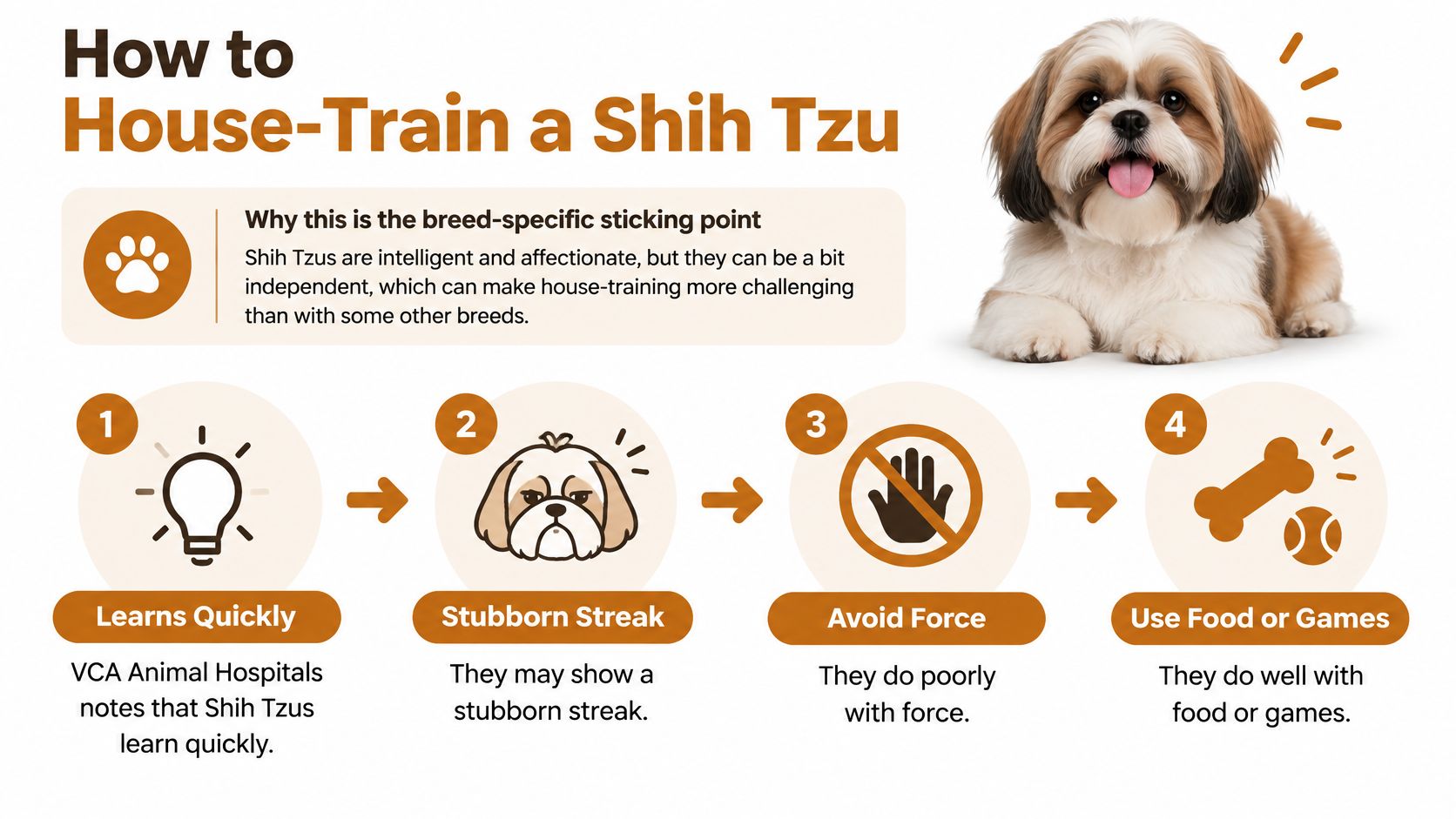
House-training is where the answer to are Shih Tzus easy to train most often becomes no. The VCA Animal Hospitals Shih Tzu breed profile reports that Shih Tzus learn quickly but may have a stubborn streak, respond poorly to force-based methods, and do well with reward-based training involving food or games. It also identifies house-training as potentially more challenging for Shih Tzus than for many other breeds. Those two facts can both be true because learning a cue quickly doesn't give a small puppy a larger bladder or a longer attention span.
The protocol that follows from that profile is management first, freedom later. You aren't waiting for the puppy to prove character. You're preventing indoor rehearsals while bladder control, routine, and the outdoor reward history catch up. Every accident you prevent is one less repetition of the wrong location.
The process image below summarizes why the method matters as much as the schedule.
The Outing Routine
- Feed on a schedule: Predictable meals make bathroom timing more predictable and help you spot appetite changes.
- Go out at anchor points: Take the puppy outside immediately after waking, after eating, and before and after play, and also every few hours during the training period.
- Use a leash and stay present: Accompany the puppy to the chosen spot rather than opening a door and assuming elimination happened.
- Reward at the finish: The American Shih Tzu Club training and socializing guidance recommends offering praise and a treat within three seconds after the dog finishes eliminating in the desired location.
- Watch the signals: Sniffing and circling indoors mean you should interrupt calmly and go out, not scold and wait.
- Confine when you can't watch: Use a crate or a small, safe pen during unavoidable gaps in supervision.
- Earn freedom gradually: Keep unsupervised indoor freedom restricted until four to eight weeks pass without indoor elimination, then lengthen the interval between outings gradually.
Timing does the teaching. A treat given after the puppy has walked back inside rewards returning indoors, not eliminating outside. A treat given at the potty spot within that narrow window connects the pay with the correct location and the completed act. Keep the reward pouch and leash by the door so you're not searching for shoes while the puppy is already circling.
The Four to Eight Week Threshold
| Indoor status | Supervision step |
|---|---|
| Accidents still happening | Constant indoor supervision; crate when you cannot watch |
| 4 to 8 accident-free weeks | Earliest point to lengthen outing intervals gradually |
| Accident after more freedom | Return to supervision and shorten the outing interval |
That threshold is the decision aid most owners skip. A good weekend isn't reliability. A puppy can have several clean days because you happened to take it out often, then fail on the first morning the routine changes. Wait for the longer accident-free stretch, then add freedom one room at a time and keep outings frequent enough that success stays easy.
Weather can expose a weak routine. Some small dogs dislike rain, cold wind, or wet grass, and a brief standoff at the door can become an indoor accident ten minutes later. Build a sheltered potty spot if you can, keep the outing boring until elimination happens, and play only after the job is done. If you live in an apartment, decide early whether an indoor pad or grass patch is a backup or the primary target. Mixing targets casually can blur the location lesson, so ask your vet or trainer how to sequence an indoor option if stairs, weather, or mobility make outdoor trips unrealistic.
Do not punish an accident after the fact. It does not teach the right location, and it can teach the puppy to avoid eliminating in front of you.
Clean accidents with an enzymatic cleaner made for pet urine, following the label for dwell time, because lingering odor can draw the puppy back to the same spot. Then adjust the system, not the volume of your voice. Shorten the interval, watch more closely after meals and naps, and check whether the puppy is sneaking behind furniture. Small dogs can disappear from view fast, which is one reason supervision matters more than lectures.
An adult dog that was previously reliable and starts having repeated accidents needs a different response. Don't restart the puppy protocol and assume defiance. Call your vet to rule out urinary, digestive, pain, mobility, or medication-related causes before you treat the change as a training failure.
When Health and Grooming Slow Training
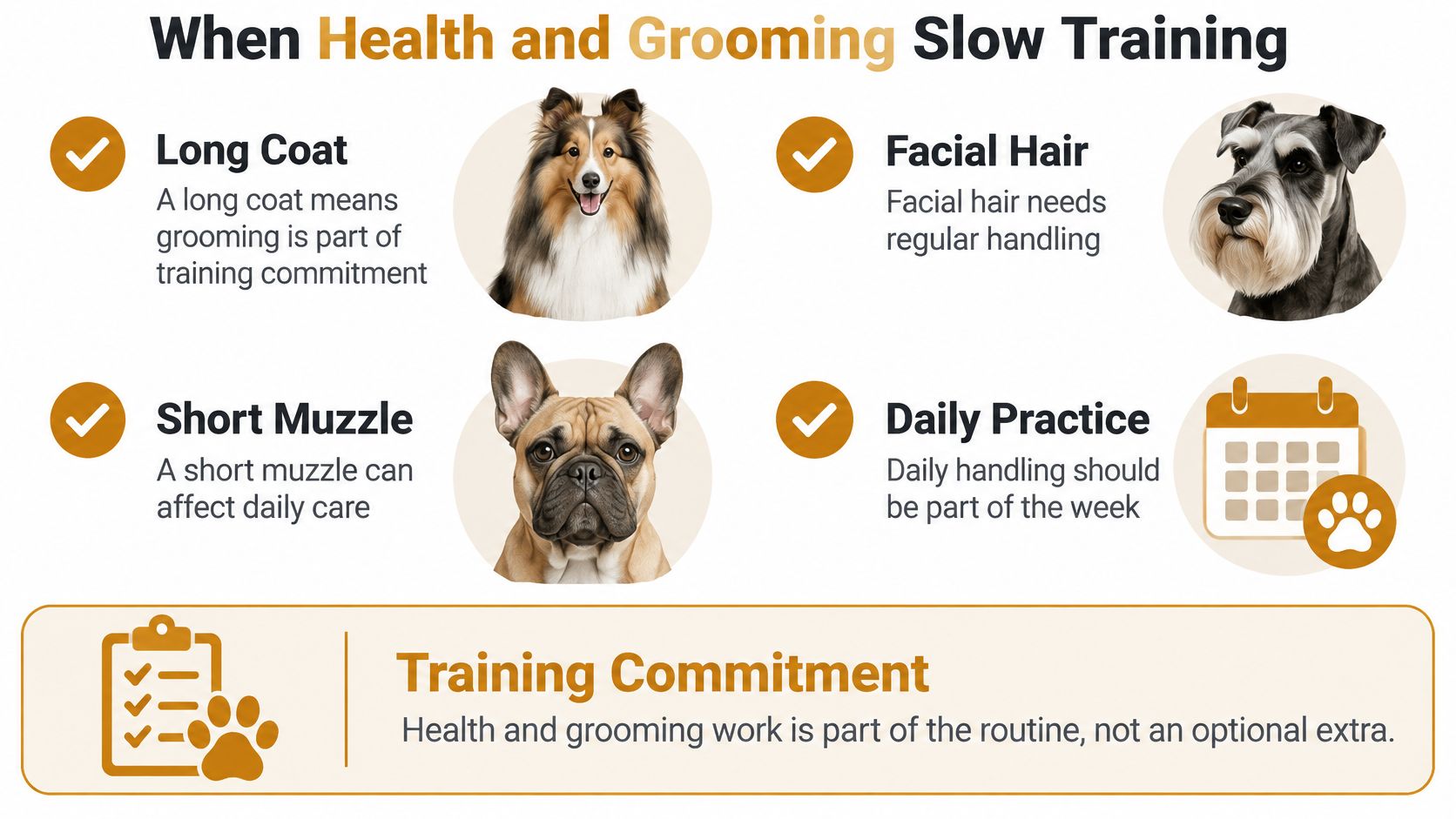
A Shih Tzu's week includes handling work that a short-coated working breed owner may never have to teach. The long coat, facial hair, and short muzzle make brush tolerance, face wiping, paw handling, ear checks, and nail care part of the training commitment. If you count only sit and recall, you'll underestimate the job.
The checklist image below frames those care tasks as training inputs, not optional extras.
Train the Grooming Behavior Directly
Pair a calm stand or chin rest with one brief action. Touch a paw, reward, and release. Wipe one side of the face, reward, and stop. Run a slicker brush or comb through a small section, reward, and end before the dog twists away. Over days, work from seconds to minutes, add the sound of clippers or nail tools at a distance, and let the dog investigate grooming tools without being restrained. A lick mat can help during practice, but it shouldn't be used to pin a frightened dog in place while you finish a full groom.
Discomfort changes the interpretation of refusal. An ear that hurts, an irritated eye, dental pain, a matted coat pulling on skin, or a knee that slips can make standing still, sitting squarely, or climbing a step look like disobedience. Brachycephalic dogs also have less margin in heat and excitement, so keep outdoor lessons short and cool, use a well-fitted harness rather than pressure on the neck, and end the session if breathing becomes noisy or the dog seeks to lie down and disengages. A harness label should state size range and materials clearly, and the fit should allow comfortable movement without rubbing behind the front legs. Ask your vet which harness style and grooming tools suit your dog's airway, skin, coat length, and joints.
Health probabilities on breed pages are estimates, and other health points belong to published veterinary literature and your own vet's examination. Use the Shih Tzu page under /breeds/ and our vet-cost guide under /guides/ for the wider care picture, without treating any general profile as a diagnosis. A related long-coated companion raises some of the same handling questions, which is why the Lhasa Apso breed page is a useful comparison before you commit to daily coat work.
When to Call Your Vet
- Breathing: Noisy, labored, or rapidly worsening breathing, or blue or pale gums, needs urgent veterinary attention.
- Eyes: Squinting, cloudiness, heavy discharge, or pawing at an eye should prompt a same-day call.
- Movement: Limping, skipping a rear leg, crying on stairs, or refusing a previously easy sit needs assessment before more drilling.
- Toileting: Straining to urinate, blood in urine, or repeated accidents in a previously reliable adult should not be managed as stubbornness.
- Digestion: Vomiting, or soft stool in a puppy or senior, warrants a same-day call, especially with low appetite or lethargy.
Pause training difficulty until your vet clears the dog. You can keep rewarding calm contact if the vet agrees, but don't add duration, distance, heat, or restraint to a dog that may be hurting.
How Shih Tzus Compare With Similar Toy Breeds
Choosing among small companions is not the same as ranking obedience intelligence. The more useful comparison is what each breed asks you to repeat. One dog makes barking the daily project. Another makes coat handling the project. Another tires quickly in warm weather, so the session length is set by breathing rather than attention.
Breed traits in the table below follow the established roles and profiles published for each breed by the American Kennel Club. They're qualitative planning categories, not scores. An individual puppy's breeder, early socialization, health, and home routine can move the experience in either direction.
Training Commitment Next to Similar Toy Companions
| Breed | Training trait | Usual hard task | Handling load |
|---|---|---|---|
| Shih Tzu | People-focused, selective about repeats | House-training and distracted recall | Daily coat and face handling |
| Lhasa Apso | Companion with a watchdog streak | Barking at household noise | Long coat, regular grooming |
| Pekingese | Independent, tires quickly | Forced exercise and long drills | Coat care plus heat and breathing limits |
| Maltese | Responsive to praise and proximity | Consistent house rules | Silky coat needs frequent gentle handling |
| Bichon Frise | Social and often food-motivated | Keeping sessions from turning into play only | Coat grooming is ongoing |
| Pomeranian | Alert and vocal | Demand barking | Brushing a double coat, less salon time |
The Shih Tzu and the Lhasa Apso can look similar on a sofa and still create different training weeks. With the Shih Tzu, your repetition budget goes toward potty supervision, recall under distraction, and preventing charm from becoming the household rule. With a Lhasa Apso, more of that budget may go to a bark plan at doors, windows, and hallway noise, while the coat still demands steady practice.
The Pekingese narrows the format further. Short, cool, low-pressure sessions aren't a preference. They're the format the dog's breathing and stamina allow. A Maltese may check in with people readily, which can make praise and proximity powerful, but that responsiveness doesn't remove the need for coat handling or consistent rules about jumping, barking, and lap access. A Bichon Frise often brings strong social and food motivation to a session, yet the owner still has to keep play from replacing the cue and keep grooming on the calendar. A Pomeranian shifts the constraint again. Alert vocal behavior becomes the main household negotiation, while brushing a double coat is usually less like maintaining a long, clipped companion coat.
Choose by the hard task you can repeat calmly for months, not by the cue a puppy performs once during a visit.
That rule also prevents a common mismatch. None of these breeds is the right answer for an owner who wants a working-dog pace, long drill sets, or instant reliability around heavy distraction. They're companion dogs with different pressure points. If grooming time is your binding constraint, a lower-coat toy breed may fit better even if its recall takes the same careful build. If daily coat handling sounds enjoyable and short reward sessions sound sustainable, the Shih Tzu's profile is more reasonable than its stubborn label suggests.
Use our breed comparison tool to place two finalists side by side, then read the individual breed pages under /breeds/ for health profiles before you decide. For the wider ownership picture, the calculator and guides on the main site keep the planning qualitative here and let you model details by breed, state, and age there.
Decide Whether a Shih Tzu Fits Your Training Time
Run a three-condition fit test before you decide whether Shih Tzus are easy to train for your household. The breed is a fair match when all three are true, not just when you like the temperament description.
- Session time: Someone can run several short reward sessions on most days and stop while the dog is still engaged.
- One household rule: Every person handles jumping, barking, food begging, and lap access the same way, including visitors who think small-dog exceptions are harmless.
- Potty supervision: An adult can take the puppy out at the anchor points and restrict unsupervised freedom until the four to eight accident-free week threshold is met.
If one condition fails, the dog will feel harder than the breed profile implies. Miss the sessions and cues stay stuck indoors. Split the rules and the dog learns person-specific compliance. Skip supervision and house-training becomes a cleanup cycle that can look like defiance. None of those outcomes proves the dog cannot learn. They show that the learning conditions aren't in place.
For the first week, keep the plan narrow. Teach one cue, preferably name response or sit, in a quiet room with immediate rewards. Run the full potty schedule at the same time, because that routine cannot wait for the obedience lesson to look polished. Add grooming touches for only a few seconds each day, rewarding a brush stroke, a face touch, and a paw hold before the puppy objects. That combination covers the three systems that will define your first months: cue learning, bladder management, and handling tolerance.
Do not use the first week to test the puppy at a busy park, a pet store, or a family gathering. Those settings raise distraction, heat, handling, and social pressure all at once, so a failure tells you nothing specific. Change one variable, record what worked, and repeat the easier version if the dog stops responding. Simple notes on cue, place, reward, and success are enough. You're looking for a pattern in your own dog, not trying to beat a breed average.
If breathing noise, eye squinting, limping, or repeated accidents already interrupt sessions, book a vet visit before adding difficulty. If the fit still looks close but coat care is the reservation, compare the Havanese breed page and other companion profiles under /breeds/ before you broaden the search. Joining our newsletter gets you a free dog training guide with cost-saving tips, and unsubscribing is possible at any time. For lifetime planning beyond training, our free tool under /tools/ asks for breed, state, and age, while the guides under /guides/ cover the care categories that sit around the training decision.
Before you bring home a Shih Tzu or add another toy breed to your shortlist, visit PetCostEngine to model lifetime ownership by breed, state, and age, including the grooming, veterinary, training, and daily care categories that shape your real weekly commitment. Compare the Shih Tzu with similar companions, check the breed health profile, and use the result to decide with the full care picture in front of you rather than a single trainability label.
Estimated lifetime and yearly costs for a Maltese, state by state, plus whether pet insurance breaks even for the breed.
See Maltese costs →
Is insurance worth it for a Maltese? →
No-pull harness → Puzzle toys → Durable chews →
As an Amazon Associate, PetCostEngine earns from qualifying purchases.