Your dog has a toy in their mouth, you reach for it, and they trot behind the couch. You say “Drop it,” but they grip harder or invite you to chase. It's a familiar problem, and reaching faster usually isn't the answer.
Learning how to teach a dog to drop it starts with a distinction: a playful dog needs a clear exchange, while a dog protecting an object needs a safety plan. For ordinary play, the lesson is simple. Letting go earns something worthwhile, and often gets the game going again.
Table of Contents
- Tell Play From Guarding Before You Trade
- Teach Drop It With an Eight-Step Trade
- Move Up the Item Ladder After Eight of Ten
- Use Tug and Fetch as the Reward
- Correct the Habits That Break the Cue
- Keep Drop It on Ordinary Walks
Tell Play From Guarding Before You Trade
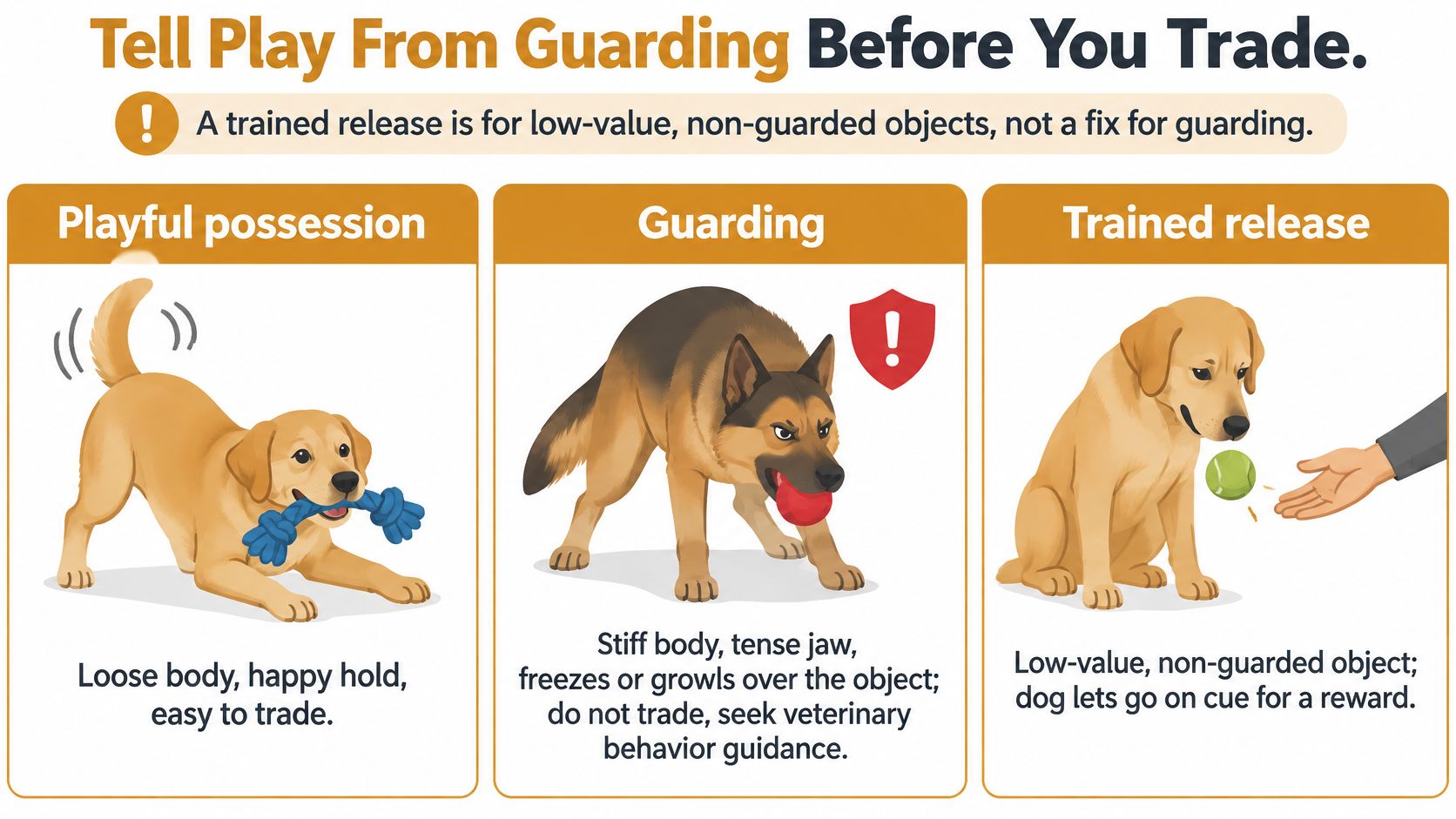
Play, early guarding, or stop
| Pattern | What you see | Do now | Practice drop it? |
|---|---|---|---|
| Playful possession | Loose body, resumes the game | Trade and restart play | Yes, on low-value toys |
| Early guarding | Freeze, stiffen, stare, speed-eat, or carry the item off | Stop the drill, create distance, manage the item | No, not on that item |
| Bite risk | Growl, snap, snarl, or leaves the item to confront someone | Separate people, skip the trade, contact a vet or behavior professional | No |
A trained release isn't treatment for resource guarding. Preventive Vet's resource-guarding guidance distinguishes ordinary exchanges from situations involving tension, threats, or aggression, where management and professional assessment matter more than practicing a cue.
Look at the whole interaction, not just the tail. A dog carrying a toy away might be inviting pursuit, but carrying it away while stiffening or watching your hands closely calls for caution. Don't approach again just to test the response.
Use these visual differences to decide whether practice is appropriate.
When the answer is to stop
With early guarding, stop working on that object. Manage access, give the dog space, and arrange help with counterconditioning from a qualified reward-based trainer or veterinary behaviorist. That process changes how the dog feels about someone approaching; it isn't a kitchen experiment involving repeated attempts to take a bone.
With bite-risk behavior, skip the trade. Move people, especially children, away without reaching toward the dog or item, and contact your veterinarian or a veterinary behavior professional the same day. Children shouldn't retrieve possessions from a dog or participate in these drills.
Punishing a growl can suppress a warning without resolving the fear behind it. Prying or forcibly taking possessions can also teach the dog that an approaching person predicts loss or conflict.
Tonight's safety rule: Put high-value items away before guests arrive. A guarded bone is not a training prop.
Medication, batteries, cooked bones, glass, and sharp objects aren't practice opportunities either. If the dog's body remains loose and a high-value treat is already in your hand, offer it without pulling or reaching into the mouth. Otherwise, separate people and call a veterinarian immediately for instructions. Suspected ingestion warrants urgent advice, not waiting for a training attempt to work.
Later practice should use safe, supervised props, starting with a plain tug rather than anything the dog protects.
Teach Drop It With an Eight-Step Trade
Living-room tug can turn into a keep-away lap as soon as you reach for the toy. Instead of pursuing your dog, set up an exchange they can understand: letting go starts the fun again.
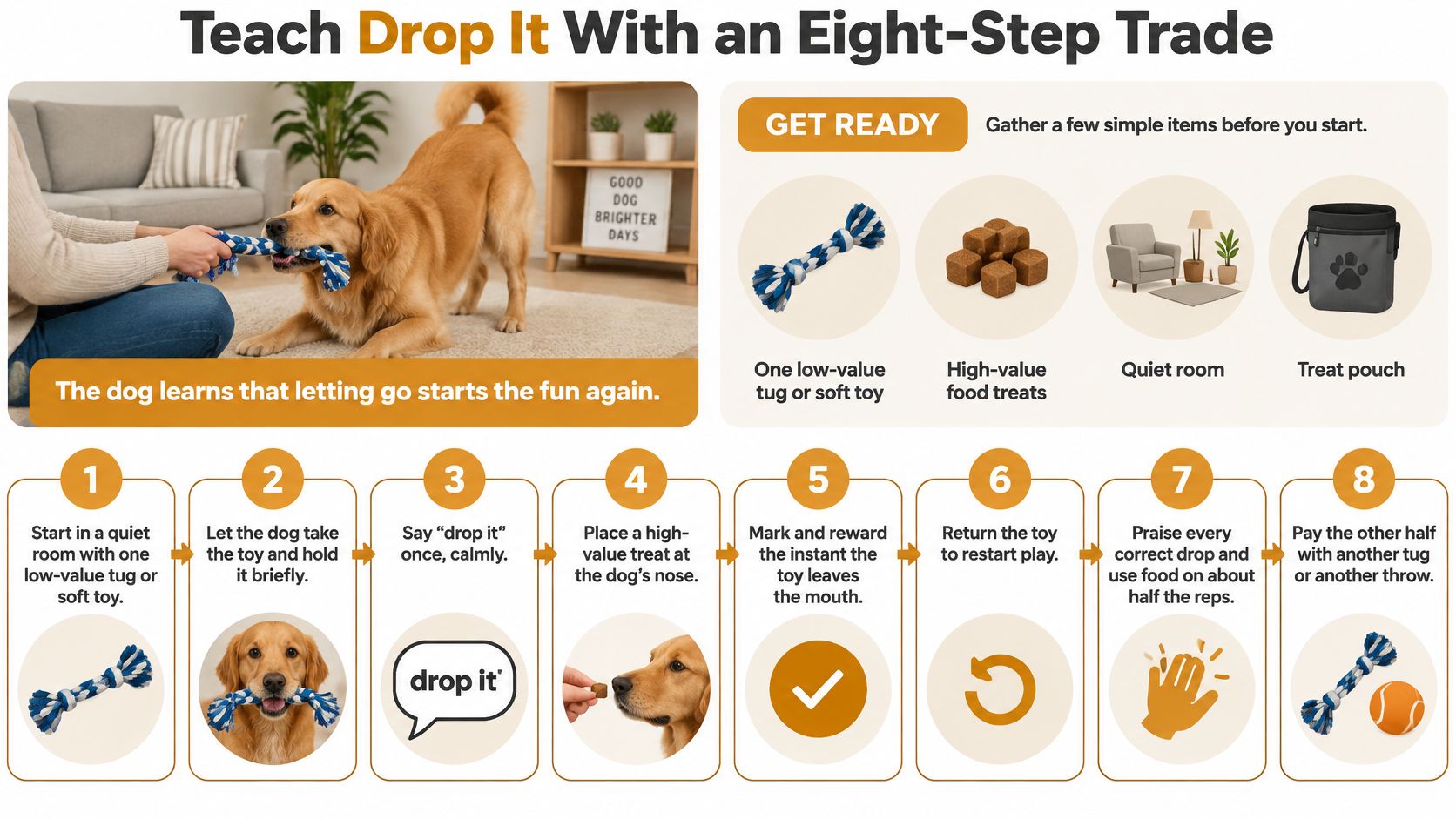
Gather a low-value tug or soft toy, pea-sized treats your dog already likes, and a treat pouch in a quiet room. The American Veterinary Society of Animal Behavior's drop-it progression recommends short sessions of approximately 3–5 minutes, with food, praise, and renewed play reinforcing release.
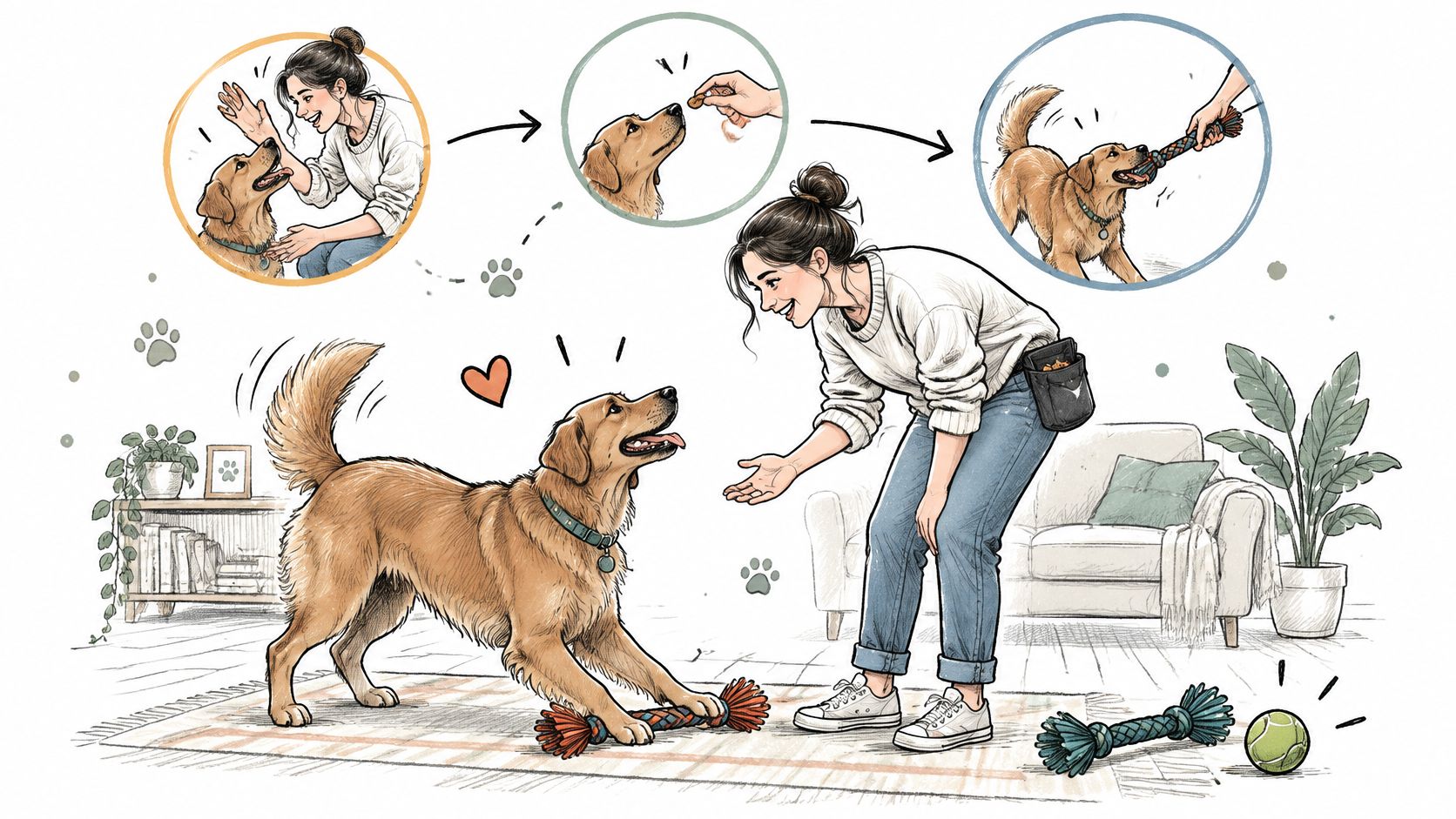
The visual below summarizes the exchange and the later transition to play rewards.
Run the exchange
Offer the boring toy. Let your dog take it and play briefly. Choose something they enjoy holding but won't find especially hard to surrender.
Bring a treat near their nose and say “Drop it” once, clearly and cheerfully. Keep your hands relaxed rather than tugging against their grip.
Mark the instant the mouth opens. Use brief praise or a clicker as the toy leaves the mouth. Don't wait until you've picked it up.
Deliver the treat promptly. The marker identifies the behavior; the food makes releasing worthwhile.
Retrieve the toy while your dog eats. If you're already holding the other end, keep it still briefly. This isn't a chance to snatch or wrestle.
Return the toy or restart the game. This step matters: the dog learns that release can produce more play, rather than reliably ending it.
Move the word ahead of the food. After clean exchanges, say the cue as your hand moves toward the pouch, then before revealing the treat. The American Kennel Club's drop-it lesson starts with the food lure, adds the verbal cue after reliable releases, and then introduces about a one-second wait before showing food.
Finish while your dog is still succeeding. Put the supplies away calmly instead of attempting a harder object as a final test.
The lure-first and cue-during-exchange approaches have the same destination: a dog who responds to the word, not just visible food. If your dog hasn't learned the exchange yet, establish that easy release before expecting the cue alone to work.
Keep the timing clean
Don't pull the toy away, chase your dog, pry open their mouth, or chant the cue. If the attempt stalls, make the next setup easier rather than more forceful.
Watch the demonstration with particular attention to when the release happens and when the reward arrives.
Keep a simple tally of cued releases and misses. Count a release prompted by displayed food as a successful exchange, but don't record it as proof that the dog understands the word alone.
Move Up the Item Ladder After Eight of Ten
A dog who releases a dull toy beside the couch hasn't necessarily learned to release a favorite ball outside. Item value, cue timing, location, and distraction are separate challenges. Change them separately so you can tell what made an attempt harder.
The AKC's trade-training procedure begins with a low-interest object and a better reward, then progresses toward more valuable items. Returning the original object after eating helps prevent every exchange from predicting permanent loss.
Use 8 or 9 releases out of 10 cued trials as a practical advancement rule, not a promised success rate or a guarantee of safety. Stay at the current stage until those releases are predictable in that setting.
Drop it difficulty ladder
| Stage | Item | Cue timing | Pass mark | What changes next |
|---|---|---|---|---|
| 1 Easy trade | Low-interest toy | Treat at the nose, then the word | 8–9 of 10 | Add the cue before food |
| 2 Cue before food | Same low-interest toy | Word, then about a 1-second wait | 8–9 of 10 | Lengthen the wait a little |
| 3 Mild chew | Everyday chew, not a favorite | Cue, then treat | 8–9 of 10 | Return the item after eating |
| 4 Favorite toy | Tug or ball the dog prefers | Cue during play | 8–9 of 10 | Reward with more play on some reps |
| 5 Planted find | Sock or paper towel you set down | Cue from a short distance | 8–9 of 10 | New room, same item |
| 6 Light distraction | Current item | Cue with one person walking by | 8–9 of 10 | Only then try a busier space |
The first row is a check of the easy exchange, not a reason to move food back in front of a dog already responding to the word. Returning safe objects should continue throughout the ladder; it isn't a benefit reserved for the chew stage.
For the planted find, use a sock or paper towel only if your dog safely holds it rather than shredding or swallowing it. Otherwise, plant a familiar toy. Never substitute medication, food scraps, or a sharp object to make the exercise more realistic.
Change the challenge, not everything around it.
Record what actually happened
A useful log names the item, room, cue timing, and successful releases out of attempts. Note whether food was visible and whether the dog remained relaxed. A tally without those details can make a food-prompted release look like an independent response.
Keep practice brief rather than extending a session to finish the tally. You can accumulate attempts across short sessions under the same conditions.
A new room comes after the planted-find stage is solid. Add the walking person separately, and save a busier space for later. If performance deteriorates, return to the last setup where your dog understood the task.
Use Tug and Fetch as the Reward
Food doesn't have to remain the only reason to release a toy. For a dog who wants another chase or tug, access to that activity can reinforce letting go.
The AKC's play-based training guidance describes stopping tug movement to create a natural release opportunity, or giving the cue just before a dog normally drops a fetch ball. Restarting tug or making the next throw then provides the payoff.
Keep the interaction relaxed, with enough room to handle the toy without crowding your dog.
Tug on a rug
For example, set up a brief tug game on a nonslip rug with children out of the room. Start with a relatively boring toy, play gently, then stop moving it.
A still toy is less inviting to pull against than a wiggling one. As your dog begins to loosen their grip, give the cue once, mark the release, and offer another game. Don't chant the word while they clamp down or jerk the toy to manufacture a release.
Fetch in the hallway
In a clear hallway, use a plain ball your dog can safely carry. Watch where they naturally let it go when returning.
Give the cue just before that release, mark it, and throw again. If your dog returns but won't release, use the easier food exchange rather than repeatedly reaching toward the ball.
Choose the reward your individual dog wants. A dog who loves carrying may value renewed tug more than a throw. Breed information, such as the American Water Spaniel profile, can provide background, but your dog's behavior during the game should determine the payoff.
- Keep food for learning. Continue treating when the cue is new or the setting becomes harder.
- Mix rewards after reliability. Praise every correct release, use food on roughly half the repetitions, and pay the others with another tug or throw.
- End separately. Don't make every correct drop the moment all play disappears.
Put treats out of sight for some familiar repetitions, not out of reach for an entire session before your dog is ready.
Correct the Habits That Break the Cue
Your dog sniffs the treat and keeps the toy. That doesn't automatically mean they're stubborn. In a loose, playful dog, it usually means the exchange isn't attractive enough or the setup asks for more than they've learned.
Troubleshoot playful training stalls only here. Make a small change on the next attempt instead of inventing a more demanding drill.
Drop it stalls and the next rep
| What you see | Likely cause | Change on the next rep |
|---|---|---|
| Ignores the treat | Toy outranks the food | Easier toy or a better pea-sized treat |
| Drops only when food is showing | Still following the lure | Cue, brief wait, then show food |
| Cue said over and over | Word lost its meaning | One cue, then still the toy |
| Grips harder at a reaching hand | Hand predicted a steal | Trade at the nose; do not pull |
| Quits or gets silly | Session ran long | Stop during the short practice window, on a success |
| Fails outside | Distraction jumped too soon | Return to the successful indoor setup |
An ignored treat calls for an easier choice. Put away the favorite tug and use a less exciting toy. If necessary, select a smaller, smellier piece of food your dog already tolerates. Don't keep pressing the same treat against their nose.
A dog who releases only after seeing food has learned part of the task. On the next repetition, say the cue before your hand reveals the reward. Keep the pause brief enough that your dog can succeed, then gradually separate the word from the food presentation.
One clean trade beats a string of argued ones.
Fix your hands and your setup
Repeated cues often accompany increasingly busy hands: the owner says the word again, reaches closer, then starts tugging. Instead, give the cue once and stop moving the toy if nothing happens. Reset with a less valuable object rather than adding volume.
If a playful dog grips harder whenever you reach, stop rehearsing the reach-and-steal pattern. Present the exchange before attempting to collect the toy, and retrieve it only after release. Returning safe toys helps make your hand less likely to predict the end of possession.
Session length can also explain a messy finish. A dog who was engaged and then starts wandering, bouncing, or missing easy releases may need the practice to end. Don't prolong it to recover a perfect final attempt.
Outdoor failure is a setup problem, not proof that the indoor learning vanished. Return indoors, confirm the familiar response, and choose a quieter outdoor transition later. Carrying the same toy outside is already a change; adding a favorite ball and passing dogs at the same time makes it hard to identify the problem.
Keep Drop It on Ordinary Walks
Once home practice is dependable, maintain the cue through short games during the week rather than turning every possession into a test. Praise clean releases and alternate food with the activity your dog wants.
Outside, choose opportunities carefully. A familiar plain ball is a better transition than an unknown sidewalk find. If you need to keep the ball afterward, reward the release with food or another appropriate activity rather than expecting its return.
Choose safe opportunities
- Use controlled finds first. Practice with planted objects before expecting a response around unexpected items outdoors.
- Handle household mistakes calmly. Trade a shoe you can safely return during practice, or offer an appropriate chew instead.
- Skip risky props. Don't deliberately practice with sticks that could splinter or objects your dog might swallow.
- Carry the safety boundary outside. Stiffening or growling means stop and create distance. Medication, batteries, and bones call for veterinary advice, not sidewalk drills.
If your dog has something hazardous, contact your veterinarian immediately for instructions, particularly if swallowing may have occurred. A trained cue is useful, but it doesn't make an unsafe approach safe.
Keep expectations tied to the setting. An easy release at home doesn't justify testing a difficult find on a crowded walk, and breed background doesn't replace reading the dog in front of you.
Tonight, run a brief trade session with a boring toy and write down the outcomes. Work toward a tally of ten attempts across short sessions if needed, without stretching practice to meet a quota. The useful result is a relaxed dog who understands the exchange, not a completed tally at any cost.
At PetCostEngine, we offer breed-specific planning tools and reference guides to help you plan for training and ongoing care. Visit us to explore those resources, or join our newsletter for a free dog training guide with cost-saving tips. You can unsubscribe at any time.
Estimated lifetime and yearly costs for a American Water Spaniel, state by state, plus whether pet insurance breaks even for the breed.
See American Water Spaniel costs →
Is insurance worth it for a American Water Spaniel? →
No-pull harness → Puzzle toys → Durable chews →
As an Amazon Associate, PetCostEngine earns from qualifying purchases.