
At 7:40 on a Tuesday morning you push back from the kitchen table, and a hundred pounds of dog gets up with you. You walk to the sink. The dog walks to the sink. You close the bathroom door and a nose appears in the gap underneath it.
If that's your house, you've probably typed "why does my dog follow me everywhere" into a search bar at least once, half amused and half wondering whether something is wrong and whether you're supposed to fix it.
Here's the useful version of the answer. Most following is normal. It is what a secure attachment looks like in daily life. What matters far less is how many rooms your dog tracks you through, and far more is what your dog does in the first half hour after you leave. Those are two different behaviors, and only one of them needs a professional.
This guide separates them with a test you can run this week, a table for reading your dog's absence behavior, and a checklist for the moments that deserve a call to your vet.
Table of Contents
- Why Dogs Follow Their Owners Everywhere
- Normal Following Versus Separation Distress
- How to Run a 30-Minute Alone Test and Plan Your Week
- Sudden Clinginess That Can Signal Illness
- Ways to Ease Constant Shadowing
- When to Call Your Vet or a Behaviorist
Why Dogs Follow Their Owners Everywhere
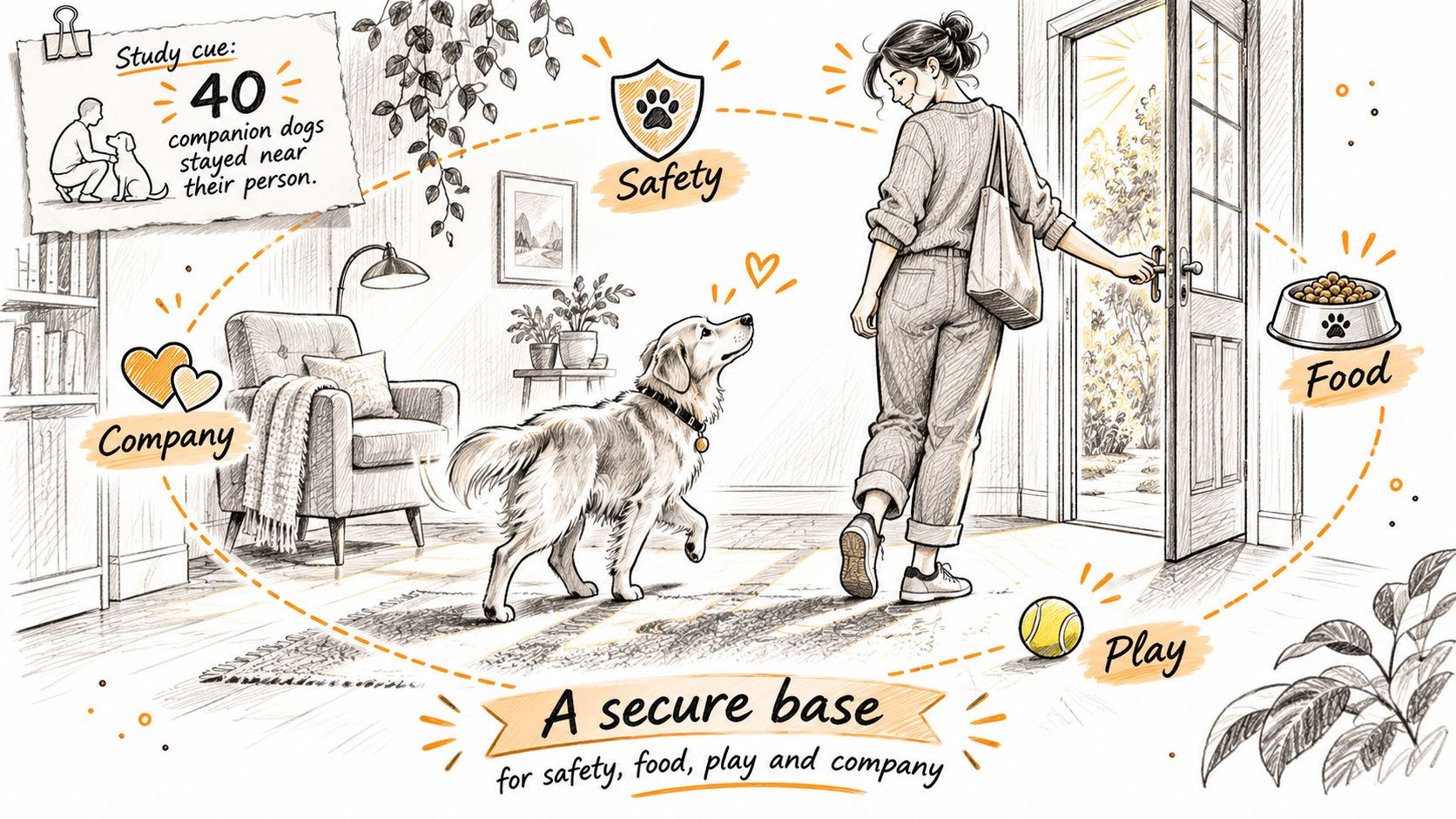
A dog trailing you from room to room is usually doing something simple. You are the safe place. Researchers call this a secure base, and the term comes from a 2010 study of 40 companion dogs that adapted the child-attachment "Strange Situation" procedure for dogs. Dogs stayed near their owners for a median of 127.0 seconds, compared with 50.5 seconds near an unfamiliar person. They also explored more with the owner in the room, with median exploration of 20.5 seconds against 6.0 seconds with a stranger.
Watch a four-year-old at a playground and you'll see the same pattern. The child climbs, runs off, glances back, sees the parent still on the bench, and returns to playing. The parent isn't holding the child in place. The parent's presence is what makes the wandering possible. Your dog does this on a smaller scale, checking in at the kitchen door and then flopping down two feet from your chair.
What else keeps a dog close
- Attachment. Following is a bond behavior, not a trained trick. It shows up in dogs that are perfectly relaxed about spending an afternoon alone.
- Reinforcement. Every follow that ends in a scratch, a bit of cheese or a walk has paid off. Behavior that gets paid happens again.
- Routine cues. Your dog reads the fridge door, the jingle of keys, the closing laptop. Following often starts before the event, because the cues come first.
- Temperament. Some dogs are more people-focused, and breed shows it. The Vizsla breed profile describes a gundog bred to work within sight of a handler all day, which is a very different starting point from a dog bred to guard a yard alone.
Puppies add one more layer. The American Kennel Club's explanation of Velcro dogs notes that from birth through about six months, a puppy's closeness partly reflects the role its mother played, which is one reason very young dogs seem surgically attached to whoever fills the bowl.
None of this is a diagnosis. A dog that follows you everywhere and still naps, eats and plays when you're out of sight is showing healthy attachment, not a disorder.
Normal Following Versus Separation Distress
The figure that reframes this whole question comes from a study published in Scientific Reports: while more dogs diagnosed with separation anxiety followed their owners, 64% of dogs without separation anxiety also followed them. Following is what most dogs do.
True separation problems are rarer than the internet implies. A look at 43,517 U.S. dogs split the two ideas cleanly: 88.9% showed attachment or attention-seeking behaviors, including following owners around the home, while 9.3% scored in the moderate-to-serious range for separation-related behavior, as this summary of the survey findings reports. Attachment is the norm. Distress is the exception.
| Behavior When You Leave | Normal Attachment | Possible Separation Distress |
|---|---|---|
| Settling | Rests, sleeps or plays within minutes | Pacing, panting or unable to settle |
| Vocalizing | Brief or none | Persistent barking or howling |
| Destruction | None, or chewing unrelated to exits | Focused on doors, windows or exits |
| House soiling | None | Urination or defecation indoors despite house training |
| Eating and drinking | Normal | Refuses food or water |
| Escape attempts | None | Tries to escape a crate or room |
How to read the comparison
Read across a row, not down a column. A single distress sign on an otherwise relaxed day is noise. Three signs that repeat every time you leave is a pattern. A dog that shadows you all evening and then naps by the door once you leave sits in the left column; a dog that stays relaxed until your hand touches the doorknob and then starts scratching at it sits in the right.
Timing matters as much as the behavior. Following happens while you're present. Distress happens at departure, and often at the cues that come just before it.
Decision rule: count the rows in the right-hand column. Trips to the kitchen with a dog at your heels prove nothing on their own.
Breed adds one more variable. Anxiety traits tend to cluster together and vary by breed, which means inheritance, early socialization, household routine and your own responses all feed into how tightly a dog shadows one person. The Cavalier King Charles Spaniel breed profile is worth a look before you assume the problem is training, especially when nervousness shows up in more than one area.
How to Run a 30-Minute Alone Test and Plan Your Week
Veterinary behavior references list the signs that carry weight: destruction focused on exits or your belongings, vocalization, house soiling, salivation, pacing, restlessness, inability to settle, loss of appetite and repetitive behavior. Those signs commonly begin during the first 15 to 30 minutes after departure, which is exactly why the test is short, and some dogs start earlier, at the shoes and the keys. The Merck Veterinary Manual's behavior section is blunt about the rule: close attachment behavior alone, including following family members around the home, does not establish separation anxiety or predict it reliably.
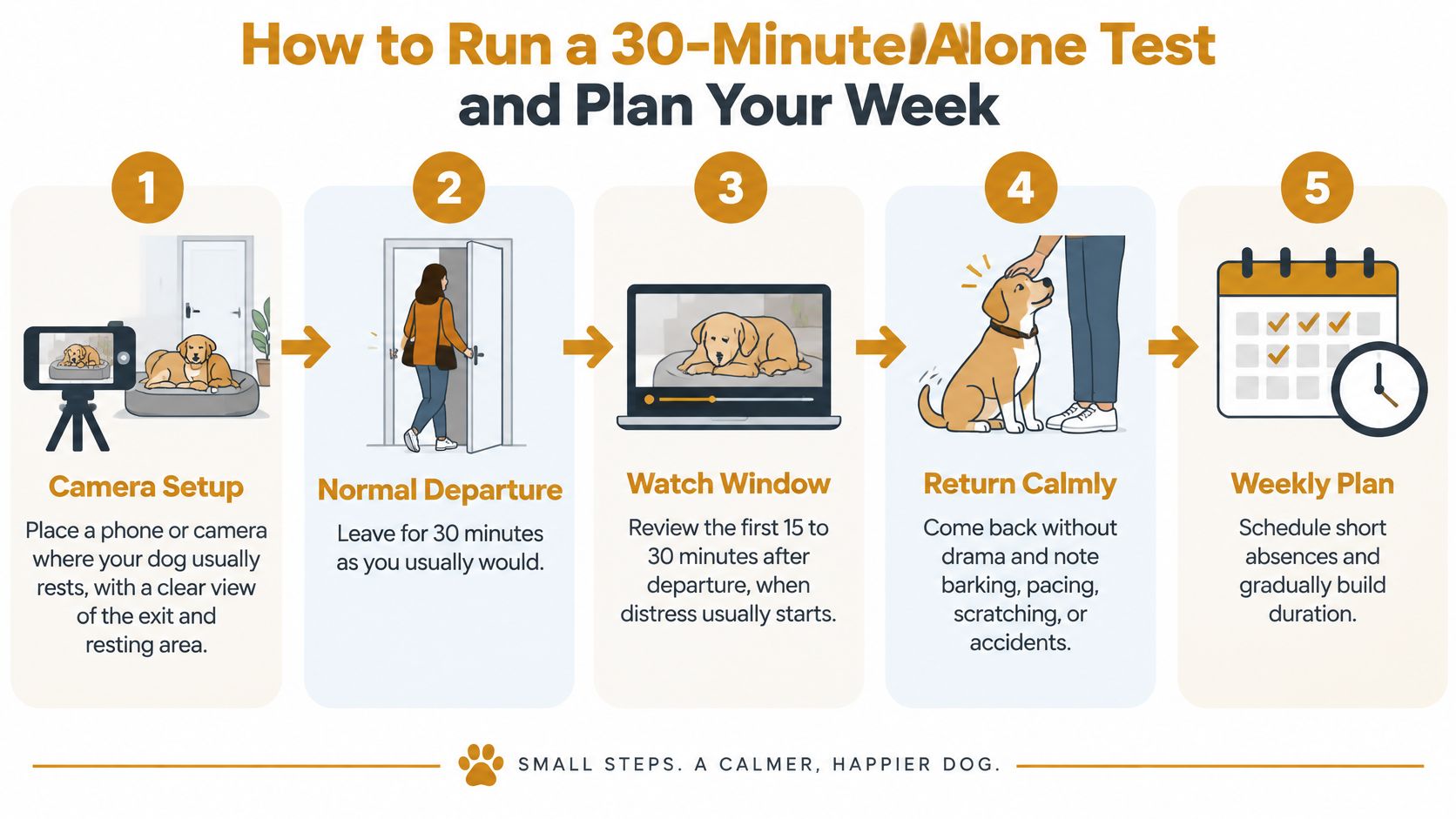
That leaves one thing to measure, and it's your dog's response to absence. Here is the sequence to set up, and it takes one departure.
Run the test in seven steps
- Set the camera. Put a phone or household camera where your dog usually rests, with a clear view of the room and the door you leave through. Charge it the night before.
- Give the usual chew. Hand over the stuffed food toy or long-lasting chew you'd normally give. Changing the routine on test day changes the result.
- Leave normally. Depart at a normal time, without a long goodbye. A dramatic farewell raises arousal before you've reached the car.
- Note the minute. Write down when you left and the first sign you spot on the recording: pacing, vocalizing, panting, destruction, elimination, or nothing.
- Watch for settling. Record whether your dog settles, eats or rests within 15 minutes. That single fact carries more weight than anything else you'll observe.
- Repeat on three days. Include one day you stay home, so you have a comparison for what a relaxed version of your dog looks like.
- Log it. Date, duration, behaviors, and how long your dog took to recover after you came back.
Don't punish the dog during the test, and don't extend an absence to "see if it passes." Both make the next departure harder.
Build the week around the log
Start the written log today, before you run the first test. Note when your dog follows, what happened in the ten seconds before, and what happened in the ten seconds after. Three days of that usually reveals the trigger: the fridge, the front door, the sound of your work bag, or nothing at all.
Record the breed at the top of the page. Your vet will ask, and a breed page such as the Havanese profile tells you whether your dog's level of closeness is typical for the breed or a change from it.
If you'd rather watch the routine than read it, this walkthrough covers the same ground in a few minutes.
When the week is done, the log makes the decision for you. A dog that relaxes, eats and rests has an attachment habit, and routine changes will blunt the shadowing. Distress in two or more sessions, or any red flag from the checklist below, means a veterinary appointment comes before any training purchase. If you want a starting point while you're logging, our free analysis asks four questions and gives one answer suited to the dog's breed, state and age.
Sudden Clinginess That Can Signal Illness
A dog that has shadowed you for six years is one story. A dog that started last month is another story entirely. Write down the date the behavior changed, because that single detail reshapes what your vet will look for.
Veterinary guidance identifies pain, gastrointestinal illness, hormonal or systemic disease, and declining vision or hearing as possible causes of a sudden increase in clinginess, according to Rex Vet's review of sudden clinginess. Cognitive dysfunction belongs on that list for older dogs, but it should be treated as a diagnosis of exclusion, since several reversible conditions produce the same picture: a dog that seems confused, clingy and unsettled at night.
| Warning Sign | Possible Cause to Ask About | Next Action |
|---|---|---|
| Limping, or reluctance to jump or climb stairs | Joint or back pain | Book a vet visit this week |
| Increased thirst and urination | Hormonal or systemic disease | Book a vet visit this week |
| Vomiting, diarrhea or a changed appetite | Gastrointestinal illness | Call the vet the same day |
| Bumping into objects, or slower response to sounds | Vision or hearing decline | Book a vet visit this week |
| Nighttime wandering or disorientation | Cognitive dysfunction, after ruling out other causes | Vet exam first, then a plan |
| Panting at rest, or pain when touched | Pain or systemic illness | Call the vet the same day |
What to record before the appointment
- Onset and age. The date you first noticed, and whether your dog is middle-aged or senior.
- Body signals. Appetite, thirst, weight, panting at rest, stiffness after lying down.
- Sleep and night behavior. Wandering, staring at walls, restlessness, accidents at night.
- House soiling. New accidents in a dog that was reliably trained.
- Touch sensitivity. Flinching when you handle the collar, back or hips.
A sudden change paired with any physical sign calls for an exam, not punishment and not forced independence training. Expect the visit to include a hands-on pain assessment, and possibly blood tests or imaging.
Breed shifts which conditions sit higher on the list before the exam even starts, and a profile like the American Water Spaniel breed page shows how predispositions are worth raising with your vet rather than saving for later.
Ways to Ease Constant Shadowing
A dog that settles on its own bed still loves you exactly as much. Independence is a skill, and like any skill it builds through short, repeatable wins.
Six changes that build it
- Set a resting station. Put a bed or mat in the room you use most, and drop a treat between your dog's front paws whenever they lie on it without being asked. Quiet delivery, no party.
- Pay the mat, not the shadow. Reward settling at increasing distances. A few steps toward the hallway first, then a full room away, then a closed door for two minutes.
- Stop funding every trip. Attention is a currency. If following you to the kitchen earns a chat and a snack, the habit pays out every time.
- Vary the cues. Keys, shoes, the fridge handle and the bathroom door all predict something. Pick up your keys at random times, or pair the cue with a chew, so it stops meaning "she's leaving."
- Hand over a job. A puzzle feeder, a scatter of kibble on a towel, or a long-lasting chew gives your dog something to do that doesn't involve tracking you. Herding breeds were developed for long working days, so many need a scheduled outlet for that drive, such as training games or structured exercise, before they can settle. For a Border Collie, the breed's health risk profile shows the predispositions worth factoring in when you plan that workload.
- Check the timing. If following spikes right before walks or meals, the routine is doing the work. Shift feeding and outings so they aren't always preceded by fifteen minutes of contact.
There's a biological layer under all of this. An exploratory study of dog-owner interaction found associations between owners' hormone levels and their dogs' behavior during the session, with higher baseline owner cortisol linked to more time spent standing by the dog (r_s = 0.683, p = 0.041). The study does not claim hormones cause following. What it supports is the everyday observation that your dog reads your state, which is a reason to stay calm and unhurried when you practice.
Measure progress over weeks, and let the alone-test log do the scoring. Longer settled distances and quieter recordings mean the plan is working. A flat line after consistent practice is worth writing down too, because it tells you to change one variable at a time rather than all six at once.
When to Call Your Vet or a Behaviorist
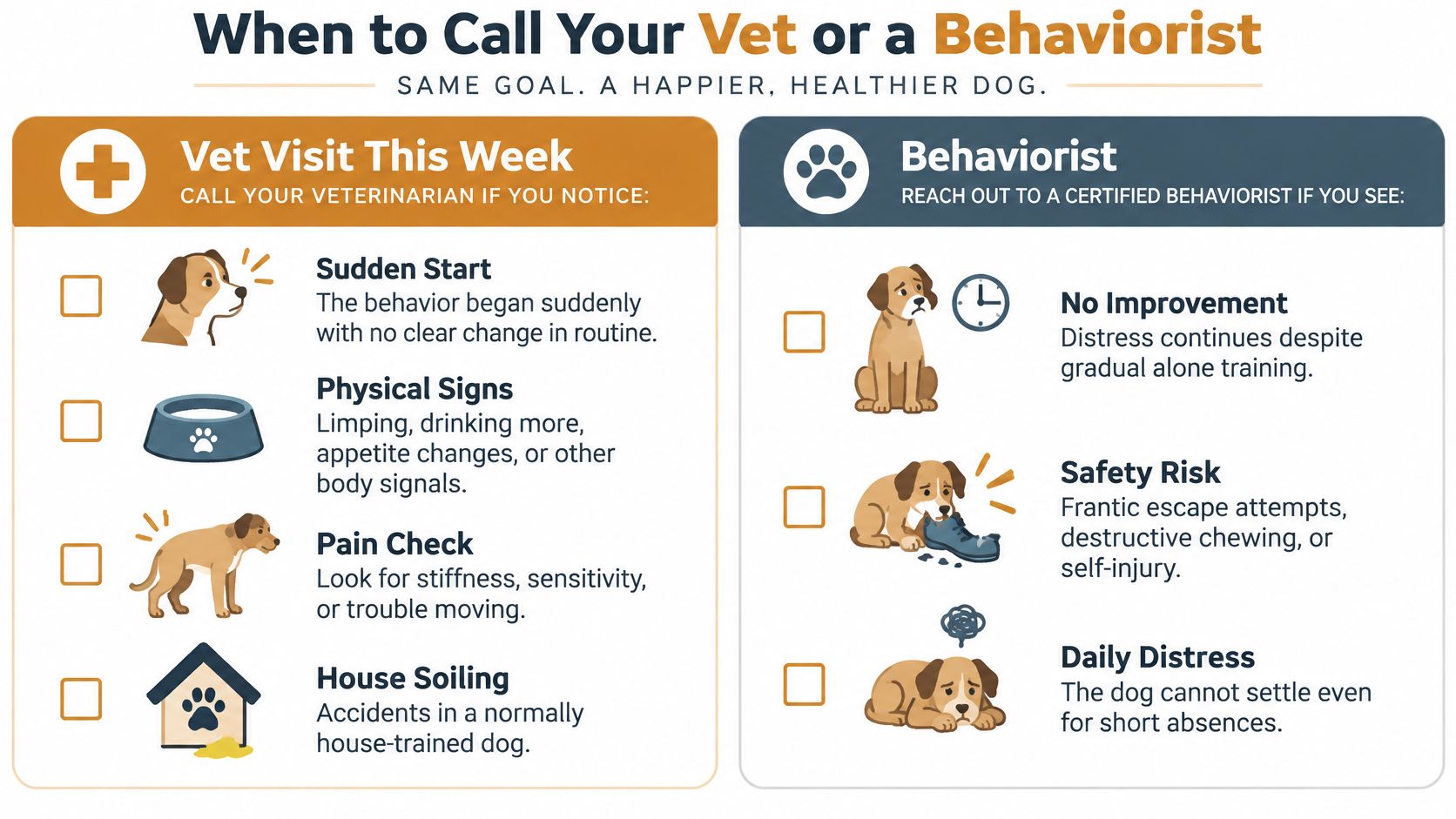
Some signs are a training question and some are a medical one. This list sorts them, and it's the part to screenshot and keep on your phone.
Book a vet visit this week if
- The following started suddenly with no clear change in routine, household or schedule.
- Your dog shows physical signs: limping, drinking more, eating differently, stiffness or trouble on stairs.
- There is new house soiling in a dog that was reliably trained.
- Your separation test shows distress in two or more sessions.
Call the vet the same day if
- Your dog vomits, has diarrhea that persists, or stops eating for a full day.
- Your dog pants at rest or pulls away when touched in a specific spot.
- Soft or bloody stools appear alongside the behavior change, which is a same-day call rather than a wait-and-see.
Ask for a behaviorist referral if
- Your dog injures itself during absences, or damages teeth and nails on a crate.
- Your dog makes frantic escape attempts from a crate or room.
- Your dog panics during short absences, even after medical causes have been ruled out.
Bring four things to the appointment: your test log with dates and times, a list of recent changes at home, every medication and supplement your dog takes, and a short video of the behavior. Ask two questions directly. Have medical causes been ruled out, and is a graduated alone-time plan appropriate for this dog? Those answers decide whether you're looking at enrichment, medication, or both.
A dog that follows you from room to room is usually telling you something ordinary, and the only way to know for certain is to watch what happens once you're gone. PetCostEngine builds the rest of the picture around the dog you have: our lifetime calculator itemizes food, veterinary care, grooming, training, boarding, gear and insurance, adjusted for your dog's breed, state and age, so a breed with higher health risks doesn't take you by surprise at the front desk. Visit PetCostEngine and run the analysis before the next vet bill arrives.
Estimated lifetime and yearly costs for a Vizsla, state by state, plus whether pet insurance breaks even for the breed.
See Vizsla costs →
Is insurance worth it for a Vizsla? →
Premium dry food → Puzzle toys → No-pull harness →
As an Amazon Associate, PetCostEngine earns from qualifying purchases.