
74.2% of confirmed heat-related illness events were associated with exertion, compared with 12.9% caused by hot weather alone, in a VetCompass analysis of more than 900,000 UK dogs. Among the 395 confirmed events, the median ambient temperature on event days was approximately 62.4°F (16.9°C). That's not a safe-temperature cutoff. It's a warning that a hard run on a mild day can overwhelm a dog's ability to cool down.
Keeping your dog cool in summer starts with matching activity to the dog in front of you, not just checking the forecast. Use the profile table to set exercise limits, the daily checklist to reduce heat exposure, and the condition-based first-aid steps if something goes wrong.
Table of Contents
- Who Is at Risk and How Hot Is Too Hot
- Daily Summer Routine That Keeps Dogs Cool
- Heatstroke Warning Signs to Act On Early
- Cool First Then Go to the Vet
- What to Look for in Home Cooling Gear
Who Is at Risk and How Hot Is Too Hot
There isn't a universal outdoor temperature below which every walk is safe. Humidity, direct sunlight, limited airflow, hot pavement, and exercise intensity all change the demands on your dog. A shaded sniff walk and repeated ball chasing aren't equivalent, even in the same weather.
Body shape and health matter, too. Flat-faced dogs were four times more likely to develop heatstroke, and dogs weighing more than 50 kg were among the higher-risk groups described in this veterinary heat-safety summary. Older age, excess body weight, and heart or airway disease call for especially conservative limits.
Summer exercise approach by dog profile
Use the strictest applicable row when your dog fits more than one profile. These are planning rules, not promises that an outing will be safe.
| Dog profile | Exercise approach | Stop-and-cool signal |
|---|---|---|
| Lean, fit adult with a standard muzzle | Longer walks may be possible, preferably in early morning or evening; adjust to conditions | Heavy panting that doesn't settle in shade |
| Flat-faced, or brachycephalic, breed | Short, slow outings; avoid midday; stay indoors on hot, humid days | Noisy or labored breathing, restlessness |
| Senior dog | Short sessions with frequent shade breaks | Slowing down, unsteady steps, reduced responsiveness |
| Overweight or large dog, including over 50 kg | Lower intensity, shorter outings, no running in heat | Panting that increases while walking, reluctance to continue |
| Puppy | Brief play in cool hours with frequent rest | Weakness, confusion, or unusual lethargy |
| Dog with heart or airway disease | Personal limit set with a veterinarian before summer | Labored breathing, weakness, or any sign beyond that limit |
A dog's willingness to chase doesn't establish that chasing is safe. For an enthusiastic adult dog, you may need to end the game while the dog still wants more. For a flat-faced dog, the better choice may be a toilet break followed by indoor activity rather than a shortened version of a strenuous outing.
Owners reviewing the Bulldog breed profile should put breathing limitations ahead of exercise targets. Don't use another dog's comfortable walking distance as your benchmark.
Practical rule: Choose an outing you can end early, with a short route back to a cool resting place.
Before this week's walks, identify your dog's row and choose the activity you'll allow. If several risk factors overlap, reduce intensity first, then duration. Don't wait for the stop signal to prove that your planned limit was too generous.
Daily Summer Routine That Keeps Dogs Cool
Make the first check at the door: press the back of your hand against the pavement for several seconds. If it's too hot to leave your hand there comfortably, choose grass, a shaded route, or indoor activity. Passing this check doesn't establish that the air temperature or exercise is safe.
Build the rest of the routine around access and timing. The AVMA's warm-weather pet safety guidance recommends unlimited fresh water and shade outdoors, with indoor time or outings during cooler morning and evening hours on particularly hot days.
Keep these essentials visible near your walking gear.
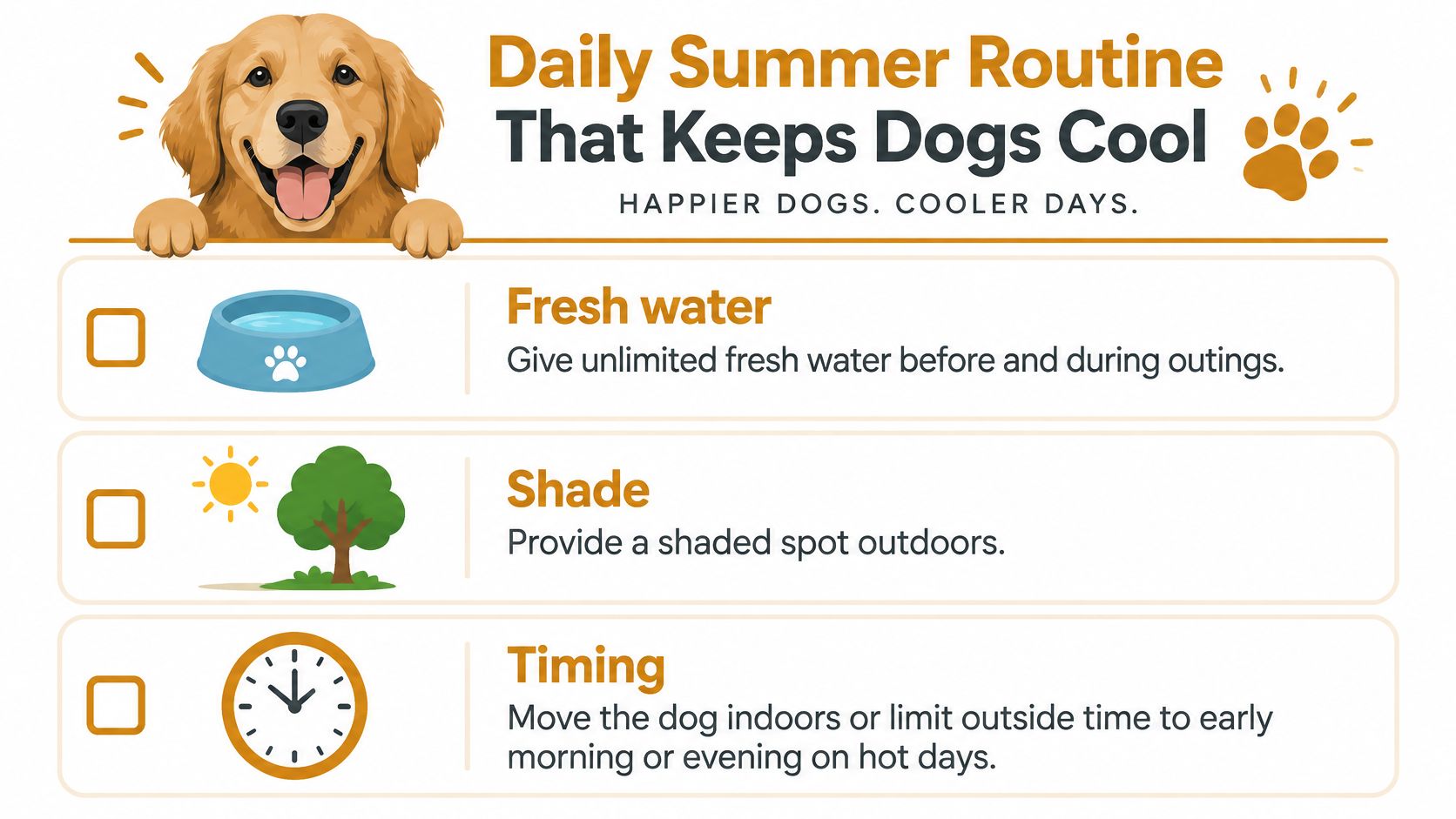
The before-you-leave checklist
- Check the surface and route. Prefer shaded trails or grass over sun-baked streets. Choose a route with an easy turnaround rather than committing to a long loop.
- Pack drinking water. Put a filled bottle and collapsible bowl beside the leash. Offer drinking opportunities during the outing instead of saving water for the return.
- Confirm the recovery space. Your dog needs a cool, ventilated room afterward. Use air conditioning when needed; a fan in a hot room isn't a substitute for a cooler environment.
- Replace strenuous play. Move fetch indoors or substitute scattered-kibble searches, puzzle feeders, and brief training. The aim is engagement without sustained running.
- Check the travel plan. Never leave your dog alone in a parked vehicle, even with windows cracked. Parked vehicles can become dangerously hot within minutes.
- Watch after activity ends. Don't assume the risk ends when you put away the leash. Keep checking breathing, coordination, alertness, and recovery.
Post-exercise observation matters because core temperature can continue rising after activity stops. In a randomized crossover study of 12 working dogs, dogs exercised until core temperature reached at least 105.1°F (40.6°C) or heat-stress signs appeared; voluntary head immersion in 71.6°F (22°C) water produced the lowest temperature during the first five minutes. That was a controlled protocol, not an instruction to dunk your dog's head.
A water-loving breed still needs the same checks. If you're reading the American Water Spaniel profile, don't mistake enthusiasm for swimming or retrieving for protection against overheating.
This video provides another way to review summer cooling habits.
Save the checklist on your phone or tape it beside the door. A routine you can follow while distracted is more useful than a detailed plan you only remember after a hot walk.
Heatstroke Warning Signs to Act On Early
Panting is a dog's main cooling mechanism, while sweat glands in the paw pads contribute little to overall heat loss, according to the AVMA's exercise-safety guidance. Heavy or unusually frequent panting is therefore a reason to stop and assess, not something to dismiss as ordinary tiredness.
Context matters. Panting after activity should be moving toward recovery in a cool setting, not becoming harder, noisier, or accompanied by behavior changes. You don't need to diagnose heatstroke before stopping exercise and beginning cooling.
Heat stress warning signs and the action to take
| Warning sign | Why it matters | Action now |
|---|---|---|
| Heavy or unusually frequent panting | Early warning that cooling demand may exceed the dog's ability to regulate heat | Stop activity, move to shade, offer cool water if alert |
| Anxiety or restlessness | Can be an early behavior change during heat stress | Stop, move to a cooler area, watch breathing |
| Excessive drooling | Can accompany difficulty losing heat | Cool the dog and call your vet if it continues |
| Discolored, dry, or sticky gums | Raises concern about circulation and hydration | Begin cooling and contact a vet promptly |
| Weakness, unsteady movement, or reduced responsiveness | Indicates a progressing, serious condition | Treat as an emergency; start cooling and transport |
| Vomiting, confusion, or collapse | Emergency signs | Begin cooling and go to an emergency vet now |
These signs don't follow a dependable sequence. A dog doesn't have to display every row before the situation becomes urgent. A dog that's still walking but stumbling is already beyond a reasonable exercise stop point.
For owners checking the French Bulldog breed profile, the important comparison is with the dog's comfortable resting breathing. Don't normalize worsening noise or effort just because the breed often breathes noisily.
When to call your veterinarian
Emergency action: Call or go to an emergency veterinary hospital immediately for collapse, confusion, vomiting, weakness, unsteady movement, or reduced responsiveness. Start cooling while arranging care, and seek urgent advice if other concerning signs persist after moving into a cooler environment.
Don't walk an affected dog home to see whether movement helps. Stop in the nearest safe place, arrange transportation, and tell the hospital that you suspect heat-related illness.
An apparently improved dog hasn't necessarily recovered. Serious injury can remain after body temperature falls, so suspected heatstroke still requires veterinary evaluation. Note what happened, the activity involved, the signs you noticed, and any cooling already started; that information helps the receiving team without delaying treatment.
Cool First Then Go to the Vet
Begin cooling before transport, but don't delay leaving while trying to achieve a normal temperature. Call the emergency hospital immediately, ideally while another person starts first aid. If you're alone, use speakerphone so you can act while receiving directions.
Cooling recommendations aren't completely uniform. The AVMA's pet first-aid guidance advises room-temperature wet towels around the neck, armpits, and groin, regularly refreshed, and advises against cool- or cold-water tubs. More recent veterinary cooling recommendations support cold-water immersion for conscious, young, otherwise healthy dogs, while favoring water application with airflow for vulnerable patients.
That difference matters. Don't treat immersion as the right method for every dog, and don't postpone available water-and-airflow cooling while searching for a tub.
Choose the method by the dog's condition
| Dog condition | Cooling method | Do not |
|---|---|---|
| Conscious, young, otherwise healthy dog | Cold-water body immersion, approximately 32.2–59°F (0.1–15°C), with head and airway above water, as described in the veterinary recommendations linked above | Rely on shade alone or alcohol on the paw pads |
| Older, debilitated, unconscious, or medically fragile dog | Spray or pour water with a fan or vehicle air conditioning; if using room-temperature towels on neck, armpits, and groin, rewet or replace them every few minutes | Use a cold tub or leave a warming towel wrapped around the body |
| Collapse, vomiting, confusion, or signs that don't ease | Continue suitable cooling and go to an emergency vet; cool the vehicle first | Wait for a normal temperature or force water into the mouth |
The first actions are simple enough to remember under pressure.
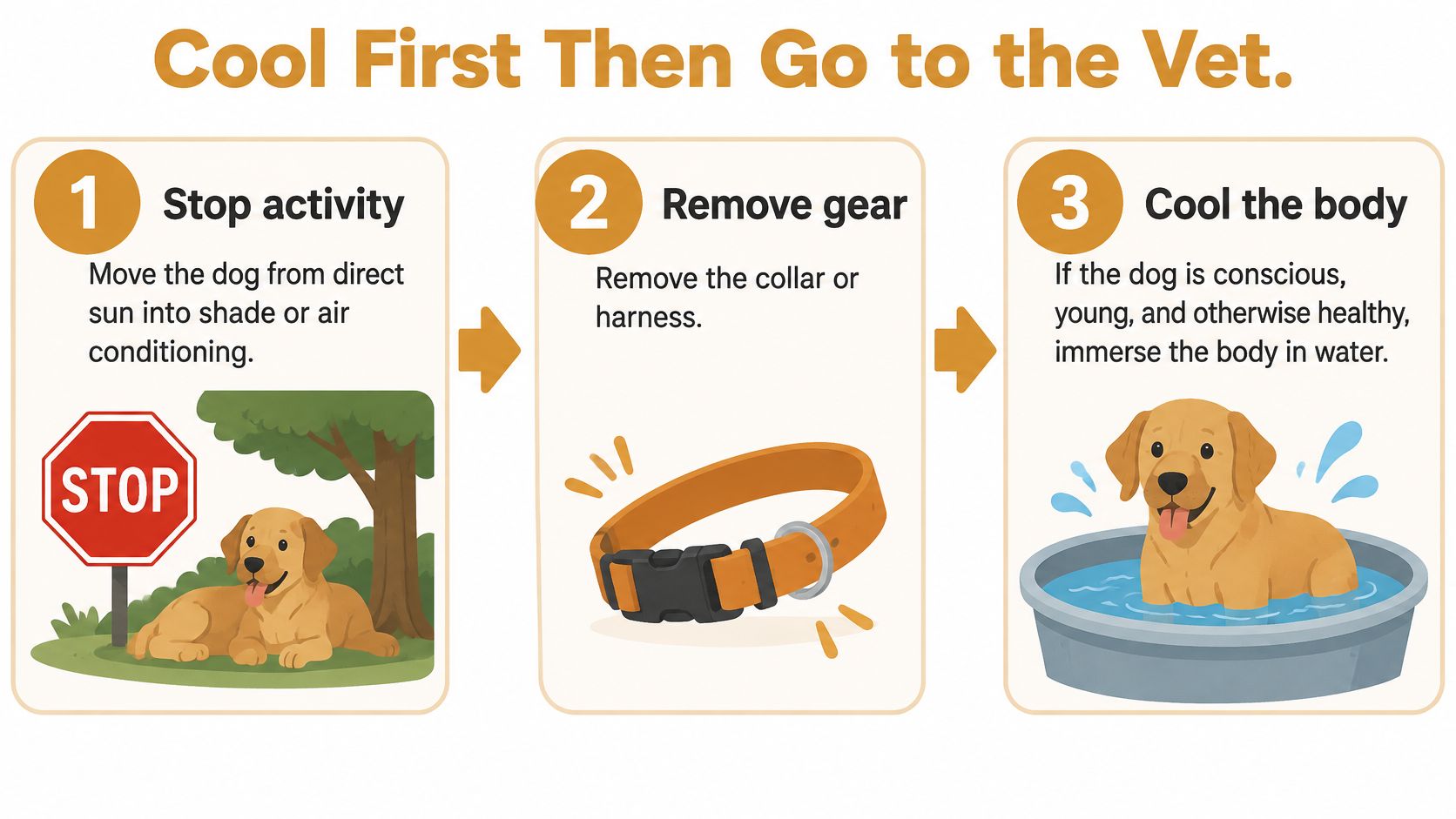
Follow the cool-first sequence
Stop activity and leave direct sunlight. Move into shade or air conditioning. Don't ask a weak or confused dog to keep walking to the car.
Remove the collar or harness. Clear unnecessary gear so you can wet the body and assess breathing. Keep control of an alert dog without restricting the neck.
Apply active cooling suited to the dog. For a conscious, young, otherwise healthy dog, body immersion can cool effectively if you can safely support the dog and keep the airway above water. Never submerge the head, restrain a struggling dog in a tub, or delay other cooling to obtain water at a precise temperature.
Use pouring or spraying with airflow for fragile dogs. Older, debilitated, unconscious, or medically vulnerable dogs need a method that doesn't require immersion. Wet the body and use a fan or vehicle air conditioning. If towels are all you have, refresh them frequently and avoid enclosing the body in a heavy wet wrap.
Don't force drinking. An alert dog may drink voluntarily, but pouring water into a confused or unconscious dog's mouth risks compromising the airway. Cooling the body and reaching veterinary care take priority.
Cool the vehicle and leave promptly. Continue appropriate cooling during the journey where practical. Have someone notify the hospital of your arrival, and don't leave the dog waiting in a parked vehicle.
Why passive waiting isn't enough
A 2023 randomized crossover study of working dogs found that partial water immersion reduced core temperature more effectively than passive cooling or isopropyl alcohol applied to paw pads, under conditions averaging 80.1°F (26.7°C), 68.2% relative humidity, and an 83.8°F heat index. Clinical evidence summarized in the same paper found that dogs presenting at 105.8°F (41.0°C) or higher had four times the risk of a fatal outcome compared with dogs below that threshold.
Those are clinical findings, not numbers you should wait to confirm at home. Don't make taking a temperature a prerequisite for action.
Begin useful cooling with what's available. A hose, pouring water, and airflow are preferable to waiting beside an overheating dog while someone searches for special equipment.
For a dog with breathing limitations, including one whose risks you're reviewing in the Pug breed profile, ask your veterinarian in advance which cooling approach they want you to use. A calm plan made before summer is easier to follow than conflicting instructions during an emergency.
What to Look for in Home Cooling Gear
Choose cooling equipment by fit, airflow, ease of cleaning, and how quickly you can remove or refresh it. No mat, vest, pool, or fan extends a dog's safe exercise limit automatically. Comfort equipment and emergency cooling serve different purposes.
Start with the setup your dog can use without being coaxed. A stable water bowl in a cool room is more useful than a complicated device the dog avoids. Keep a collapsible bowl in the walking bag rather than moving the household bowl between trips.
Match the category to its job
- Water bowls and shade. Choose a bowl that resists tipping and a shaded resting place the dog can enter and leave freely. Recheck outdoor shade as the sun moves.
- Fans and indoor cooling. Position airflow across the resting area, secure cords, and give the dog room to move away. If the room remains hot, move the dog somewhere cooler.
- Shallow pools. Look for stable footing, easy entry, and an easy exit. Supervised splashing is an activity for a comfortable, healthy dog, not a substitute for emergency assessment.
- Cooling mats and damp towels. Check how the item works. Evaporative fabric needs refreshing as it dries; other mats need the reset method stated on the label. Don't assume every mat should be soaked.
- Food enrichment. A dog-safe stuffed toy or lick mat can replace midday running. It's an activity choice, not an ice pack to hold against an overheated dog.
Read beyond the cooling claim
The label should disclose the size or weight range, cooling mechanism, care instructions, and warnings about chewing or unsupervised use. Check whether a wearable item needs wetting, how it fastens, and whether it can be removed immediately.
For a flat-faced dog, senior, or heart or airway patient, ask your veterinarian whether a cooling coat is appropriate. A covering that fits poorly or limits airflow isn't an upgrade because it's marketed for summer.
A heavily coated dog needs an individualized plan, too. Use the Alaskan Malamute breed profile to inform questions about breed-related care, then discuss activity and cooling with your veterinarian.
Keep emergency water access and transportation separate from your comfort-gear checklist. None of this equipment makes leaving a dog in a parked vehicle acceptable.
PetCostEngine offers breed-specific health profiles and planning tools suited to your dog's breed, state, and age. Visit PetCostEngine to review your dog's broader care needs, then use these summer checklists to set exercise limits and prepare a cooling plan with your veterinarian.
Estimated lifetime and yearly costs for a Bulldog, state by state, plus whether pet insurance breaks even for the breed.
See Bulldog costs →
Is insurance worth it for a Bulldog? →
Premium dry food → Puzzle toys → No-pull harness →
As an Amazon Associate, PetCostEngine earns from qualifying purchases.