Yes, dogs do get jealous in the behavioral sense, and no study confirms they feel jealousy the way a person does. In a controlled home experiment, 78% of dogs pushed or touched their owner when the owner fussed over a stuffed dog, compared with 42% when the owner handled a plastic jack-o'-lantern and 22% when the owner read a children's book aloud.
That gap is the whole story in one line. Whether dogs get jealous the way people do is a separate question from whether they act jealous, and only the second question can be answered by watching. The authors of the 2014 PLOS ONE home study describe the pattern as evidence of jealous behavior, not proof of a human-identical feeling.
What you can work with is the behavior: the push, the block, the whine, the snap. The signs below sort those into low and high intensity, an escalation ladder shows when a vet visit stops being optional, and a seven-day log turns scattered incidents into a pattern you can describe in a clinic.
Table of Contents
- Yes, Dogs Show Jealousy-Like Behavior Around Rivals
- Signs Your Dog Is Jealous and What Each One Means
- What the 2014 and 2021 Studies Found
- Why Some Dogs React and Others Stay Calm
- When Jealousy Becomes Aggression and Needs a Vet
- How to Respond When Your Dog Acts Jealous
- Preventing Jealousy When You Add a Dog or Baby
- Track Your Dog's Reactions for One Week
Yes, Dogs Show Jealousy-Like Behavior Around Rivals
Dogs reliably show jealousy-like behavior when attention goes to another dog or to a person who reads as a social rival. No study has shown that they feel what an adult human feels. Both halves matter, because the first tells you what to do on a Saturday afternoon and the second tells you what not to assume about your dog's inner life.
Think about a toddler who shoves between a parent and a new baby. The toddler isn't running a moral calculation about fairness. The toddler has registered that the parent's attention moved and is trying to move it back. Dogs work from something similar, and the comparison is a tool for understanding the mechanics rather than a claim that a dog's mind matches a two-year-old's.
Jealousy-like behavior here means a specific set of moves that appear when your attention swings toward a rival: pushing or nudging between the two of you, sitting on your lap or stepping in front of the other animal, whining, barking, pulling toward the pair, stiffening, or snapping. The first controlled test ran in dogs' own homes, with owners rotating attention among a stuffed dog, a book, and a pumpkin, and the interference clustered around the target that looked like a competitor.
What you can act on: the behavior is real, repeatable, and manageable. The feeling behind it stays an open question, and you don't need the answer to help your dog.
One caution before you read anything into a single incident. The surveys that made canine jealousy famous measure what owners say they saw, which means vocalizing, agitation, and leash pulling, not a verified private emotion. You can check your own dog in a few short sessions using the table below.
Signs Your Dog Is Jealous and What Each One Means
| Behavior | What It Looks Like | Likely Meaning | First Response |
|---|---|---|---|
| Pushing or nudging | Dog pushes its nose or body between owner and another dog or person | Wants attention back | Pause petting and call the dog to a mat |
| Body blocking | Dog sits on the owner's lap or steps in front of the rival | Attention competition | Give the dog a brief one-on-one interaction first |
| Whining or barking | Vocal protest while the owner greets someone else | Frustration at lost attention | Wait for quiet, then reward |
| Leash pulling | Lunging toward the rival while the owner stays close | Wants access to the owner | Redirect to a sit and reward loose-leash walking |
| Stiff body or staring | Rigid posture and fixed stare at the pair | Rising tension, possible guarding | End the interaction and increase distance |
| Growling or snapping | Lip lift, growl, or snap at the rival | Escalating conflict, possible guarding | Separate immediately and consult a behavior professional |
Read the table as a lookup, not a diagnosis. The first column is the only part you can observe, and it's the part worth writing down. The third column names the most likely driver, and in most cases it's a bid to get your attention back rather than a grudge against the other animal.
Where low intensity ends and high begins. The top three rows describe a dog who is still communicating and still easy to interrupt. The bottom three describe a dog whose arousal is climbing toward a snap that happens faster than you can react. Growling in that context is information, not defiance. It's the warning that buys you time to change the setup.
Behaviors that look like jealousy but usually aren't
- Pain or illness. A sore hip or a bad tooth makes plenty of dogs irritable around handling, and the timing can look suspiciously like jealousy.
- Fear of strangers. A dog who barks when a visitor arrives may be reacting to the person, not to the affection you're giving.
- Resource guarding. Food, chews, beds, and toys produce guarding that has nothing to do with attention.
- A recent routine change. A new work schedule, a move, or a stretch of travel can produce clingy, pushy behavior that fades when the routine settles.
One incident is not a pattern. Look for the same behavior in three or more similar situations before you decide your dog has an attention-competition problem, then work from what repeats.
What the 2014 and 2021 Studies Found
The first controlled test of canine jealousy ran in the dogs' own homes, with the owner as the trigger and a camera on the response.
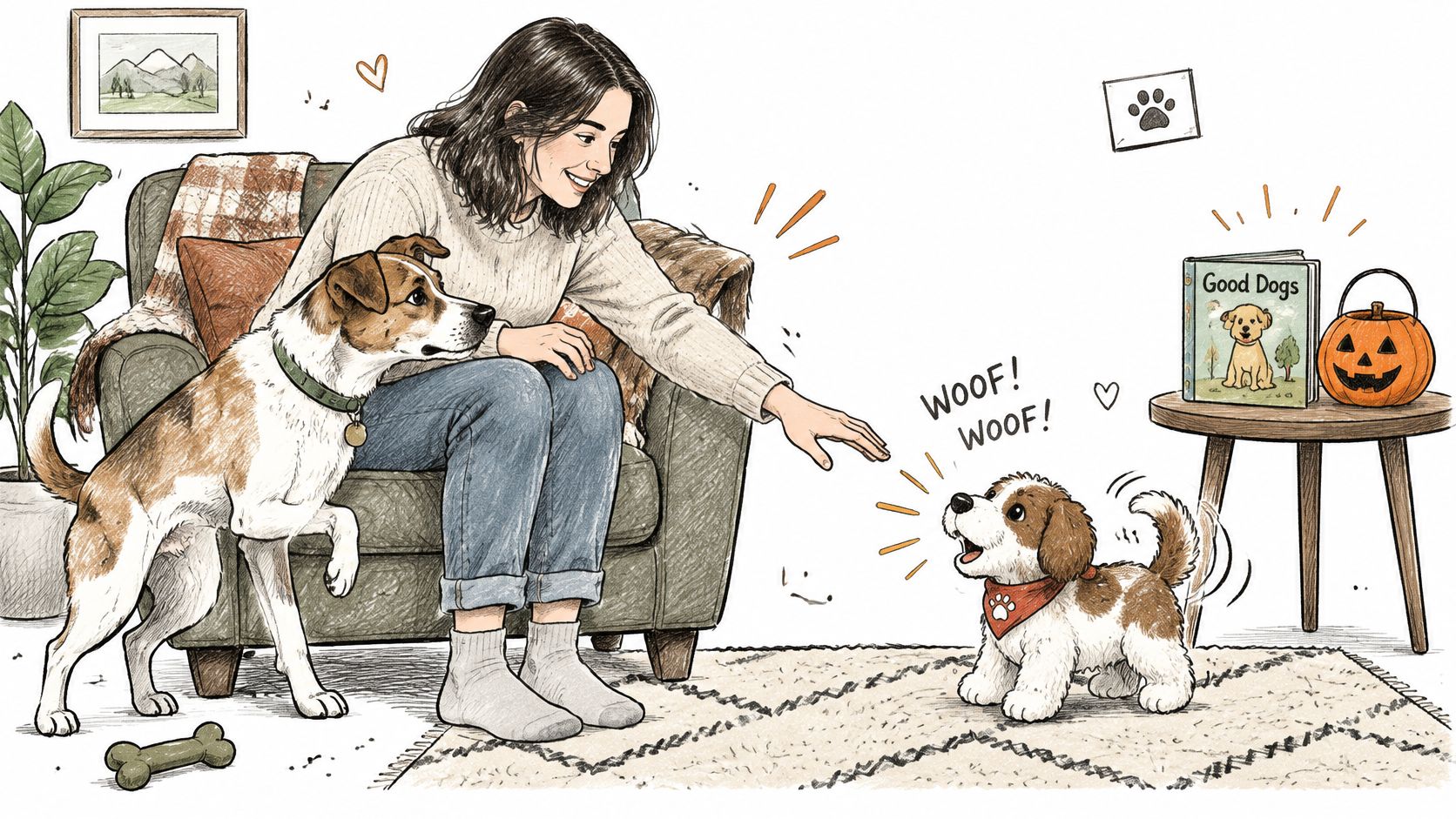
Researchers behind the 2014 PLOS ONE experiment tested 36 dogs at home while each owner moved through three targets in turn: an animated stuffed dog that barked, whined, and wagged its tail; a children's book; and a plastic jack-o'-lantern. The stuffed dog was the only target that behaved like a social rival receiving affection, and it was the only one that produced a surge in interference.
The numbers line up in a straight sequence. Dogs pushed or touched their owner in 78% of stuffed-dog trials, against 42% for the jack-o'-lantern and 22% for the book, roughly twice the response of the nearest comparison. About 30% tried to place themselves between the owner and the stuffed dog. 25% snapped at the stuffed dog, and the original paper also reported 41.7% of dogs snapping at some point during or just after that interaction. Only one dog snapped at the book or the pumpkin.
| Target | Owner pushed or touched | Dog placed itself between | Dog snapped at target |
|---|---|---|---|
| Animated stuffed dog | 78% | About 30% | 25% |
| Plastic jack-o'-lantern | 42% | Substantially less common | Only one dog snapped at the book or pumpkin |
| Children's book | 22% | Substantially less common | Only one dog snapped at the book or pumpkin |
What the experiment does and does not prove
The design matters because all three objects took the owner's attention, and only the stuffed dog looked like competition for it. A distracted owner or an odd object in the room doesn't explain why physical intervention and aggression clustered in one condition. A 2021 follow-up asked whether the dog has to see the affection at all.
The dynamic is easier to spot in motion than in a table, especially the moment a dog decides to insert itself.
The authors called these responses jealous behavior, not proof that dogs experience human jealousy identically. Nothing in the design measured hormones, brain activity, or self-report, so the honest summary is a behavioral one. For an owner, the practical reading is narrower and more useful: repeated blocking, pushing, vocalizing, or snapping around a new dog, a baby, or a partner is an attention-competition problem with bite-risk implications.
Repeated interference around a new arrival isn't a personality quirk. It's a competition pattern that can escalate, and it's worth managing before the first snap rather than after.
Why Some Dogs React and Others Stay Calm
Not every dog in these setups reacted, and the ones that did were responding to something specific. In the 2021 work, jealous behavior appeared when the owner interacted with a perceived social rival rather than an inanimate object, it followed the owner's interaction rather than the rival's mere presence, and it occurred even when the interaction happened out of the dog's sight. Dogs forcefully tried to reach their owners while the owners appeared to stroke a fake dog behind a barrier, even without a clear view of the supposed affection (the 2021 study in Psychological Science).
Common home triggers. Petting another dog in front of yours. Hugging or holding someone else. Eye contact and conversation with a visitor at the door. A partner's attention in the evening. A baby held in your arms. Leaving the room to spend time with a companion animal.
What separates reactors from the calm ones. Age, prior social experience, attachment to one particular person, baseline temperament, household composition, and resource history with food or toys. In the barrier work with 18 dogs tested through the Association for Psychological Science, some reacted strongly while others appeared not to care at all.
That variation is why breed averages and single incidents can't label an individual dog. Breed descriptions cover general tendencies only, nothing predictive; our American Water Spaniel breed profile shows the level of detail that's useful, health predispositions and typical traits, without pretending to forecast one dog's reaction to a new baby. The tracker in the final section is how you find your own dog's pattern.
When Jealousy Becomes Aggression and Needs a Vet
A nudge that stops quickly calls for a different response than a stiff posture or a snap. Use the signs you can observe to guide your next step; you do not need to decide what your dog feels.
| Level | Typical Signs | Action |
|---|---|---|
| Low | Nudging, brief whining, attention-seeking that stops quickly | Keep the routine and use the response steps |
| Moderate | Repeated blocking, leash pulling, stiff posture that lasts | Manage triggers, separate shared resources, and log episodes |
| High | Growling, lunging, snapping, or guarding | Separate immediately and see the vet and a behavior professional |
| Emergency | Bite that breaks skin or a fight between dogs | Seek urgent veterinary care and keep people and dogs apart |
At the low level, consistent use of the response steps may help. Repeated blocking or lasting stiffness calls for changes to the environment: use separate feeding stations and resting spots, and remove shared high-value chews while tension continues. Growling, lunging, snapping, or guarding needs professional help. Home practice alone is not a substitute.
The distinction is practical: approaching or nudging is different from stiffening, guarding access, growling, or snapping. Follow-up research on social attention in dogs supports separating these observable responses. When a dog repeatedly practices threatening behavior, that pattern can become more familiar, so preventing further incidents matters.
Call your vet the same day if a previously calm dog suddenly becomes aggressive, if the dog is a puppy, a senior, or has an ongoing condition, or if the behavior continues for more than a few days. Sudden behavior changes should be assessed with a physical exam first: pain or illness can look like a change in temperament.
Bring three questions to the appointment: Could pain be involved, and what tests might help rule it out? What management steps are safe to start this week? Does the behavior professional use reward-based methods rather than intimidation?
How to Respond When Your Dog Acts Jealous
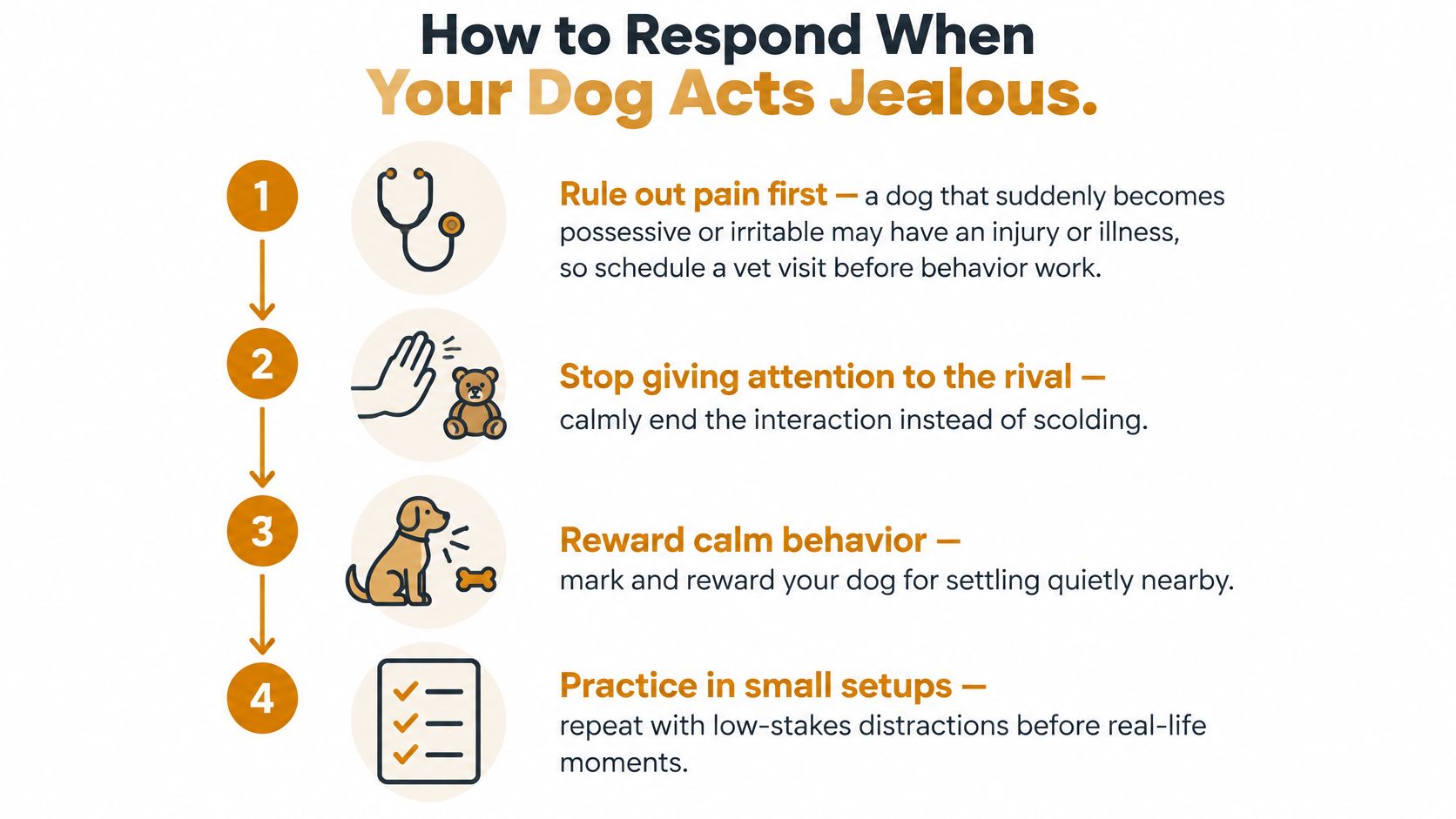
Work the steps in order, because each one removes a reason the next one could fail.
- Rule out pain first. A dog who turns possessive or irritable overnight may be hurting somewhere you can't see, and a sore back or an infected tooth reads as a short temper. Book the exam before you start behavior work, so you aren't training a dog who is in discomfort.
- End the attention calmly. When the push comes, stop petting the rival and step back without a scolding. Yelling adds a second source of arousal to a moment that's already charged.
- Give one short, calm interaction. A brief pet, a requested sit, or a chew on a mat gives your dog a legitimate way to get what they want. The point is to make calm behavior the fastest route to your attention.
- Reward the settle immediately. Mark and treat the moment your dog lies down or looks away. Calm is a behavior you catch, not one you wait for.
- Split attention evenly. One dog on a mat while the other is petted, then swap. Equal turn-taking removes the sense that one animal has permanent access to you.
- Skip punishment. Scolding around the rival adds tension to the exact moment you're trying to defuse, and it can suppress the early warning signs you need to see.
- Rehearse in low-stakes moments. Pet your dog, then briefly pet a stuffed toy, then return. Practice before visitors arrive or a baby comes home, not during the main event.
- Log each episode. Record the trigger, the behavior, the intensity, and how long recovery took. Progress usually runs in weeks rather than one session, and the log is what shows the trend.
Expect the first few sessions to look worse before they look better. A dog who has been pushing for months will try harder when the old move stops working, and that spike is a normal part of the change rather than a sign you've made it worse.
Preventing Jealousy When You Add a Dog or Baby
A new dog or baby changes who is nearby and how attention is shared. A 2025 study in Scientific Reports found that many dogs in multi-dog households snapped toward a social rival in some experimental conditions (Scientific Reports, 2025). Snapping is an observable response; it does not, by itself, prove what a dog feels. Preparing the home gives you ways to reduce competition and respond to what you see.
Set up the environment before the new arrival:
- Separate feeding stations in different rooms or across a gate, so each animal can eat without the other nearby.
- Individual beds and resting spots where your resident dog can rest undisturbed.
- Separate toys and chews at first. Give each dog their own chew in a different area.
- A baby gate to create a dog-only room, with a closed door behind it when needed.
- Scheduled one-on-one time for your resident dog, planned into each day rather than left to chance.
- Practice with a doll or stuffed toy, carrying and speaking to it as you expect to with a baby.
- A gradual introduction over several days, keeping early greetings brief and the resident dog on leash.
Before the arrival, observe how your dog responds to shared attention, meals in the same room, resting areas, toys, visitors at the door, and your leaving. These situations are useful clues about where you may need more distance or separate resources. The aim is not to label the dog jealous, but to notice which setup brings out pushing, guarding, or calm behavior.
Plan for duplicate supplies, gates, training time, and the possibility of a behavior consultation. These are practical parts of preparing for a new household member, not signs that the introduction has failed.
Household rule: Make time for both dogs' greetings and attention. If you greet the new puppy first, follow with a calm greeting for your older dog, then give each dog individual attention when the household is settled.
Track Your Dog's Reactions for One Week
| Date | Trigger | Behavior | Intensity (1-3) | Recovery time | Response used |
|---|---|---|---|---|---|
| Example: 4 May | Owner petting a visitor | Pushing or nudging | 1 | About 2 minutes | Paused petting, dog to mat |
| Example: 5 May | New puppy on the rug | Body blocking | 2 | About 5 minutes | Brief one-on-one session first |
| Example: 6 May | Partner hugging owner | Whining | 1 | About 1 minute | Waited for quiet, then rewarded |
Record for seven days and aim for at least three triggered episodes, so a pattern has room to show. Use the behaviors from the signs table as your labels and rate intensity from 1 to 3, with 1 being a nudge you can interrupt and 3 being a snap you couldn't stop.
Read the trend, not the day. Falling intensity and shorter recovery mean the response plan is working. Rising intensity, a first snap, or a brand-new trigger means it's time for a call to your vet and a behavior professional. Bring the log to that visit so the conversation starts with facts instead of memory.
For background, our breed profiles describe general tendencies, and the guides library covers the health and household context around them. Neither predicts this one dog's reaction, and neither does the free tool set on its own. If any high-level sign shows up this week, book the vet visit now. If not, run the response steps for two more weeks and read the log again.
If you're planning for a second dog, a new baby, or a first puppy, the household logistics matter as much as the training plan. PetCostEngine builds a lifetime estimate from your dog's breed, your state, and your dog's age, itemizing veterinary care, grooming, boarding, and gear, and it gives each of the 226 AKC breeds its own health risk profile. Run the free four-question analysis before the new arrival resets the routine, and you'll see the year ahead in numbers instead of guesses.
Estimated lifetime and yearly costs for a American Water Spaniel, state by state, plus whether pet insurance breaks even for the breed.
See American Water Spaniel costs →
Is insurance worth it for a American Water Spaniel? →
Premium dry food → Puzzle toys → No-pull harness →
As an Amazon Associate, PetCostEngine earns from qualifying purchases.