

Forty-five pounds is the number that decides most neuter dates. Small dogs expected to stay under that line as adults are usually neutered at about 6 months. Dogs expected to reach 45 pounds or more should wait until growth has stopped, which usually lands between 9 and 15 months.
Six months became the small-dog answer, and for decades the industry sold it as the dog answer. The American Veterinary Medical Association rejects that position outright: there is no one-size-fits-all recommendation, and timing should be individualized by breed, sex, body size, working role, environment and health status (AVMA spaying and neutering guidance). A UC Davis review of veterinary records across dozens of breeds found substantial breed differences, with early neutering linked to higher joint disorder or cancer risks in some breeds and no significant effect in others (UC Davis canine spay and neuter research).
Earlier is not automatically healthier. That single idea drives everything below.
So the order of operations is projected adult weight first, breed and sex second, and a veterinarian's exam last. Get that order wrong and you either postpone a surgery that could safely have happened at six months or rush one that would have gone better after the growth plates closed. Start with the chart, then read the breeds and female cases that break it.
Table of Contents
- Recommended Neuter Ages by Adult Size and Sex
- Adult Size, Growth Plates and Breed Exceptions
- Medical and Behavioral Trade-offs of Timing
- Female Dogs, Heat Cycles and Maturity
- Local Rules and Shelter Practices That Set Timing
- Vet Questions, Warning Signs and Your Next Step
Recommended Neuter Ages by Adult Size and Sex
The American Animal Hospital Association's canine life stage guidance sets sterilization at roughly 5 to 6 months for males and females expected to weigh under 45 pounds as adults. For dogs expected to pass 45 pounds, it points to waiting until growth has stopped, usually between 9 and 15 months. Large dogs mature skeletally later than small ones, and removing sex hormones before the skeleton is finished can influence how the joints develop.
Treat that as the default. Every deviation needs a specific reason, and the usual reasons are breed, sex and an adult size nobody can predict yet.
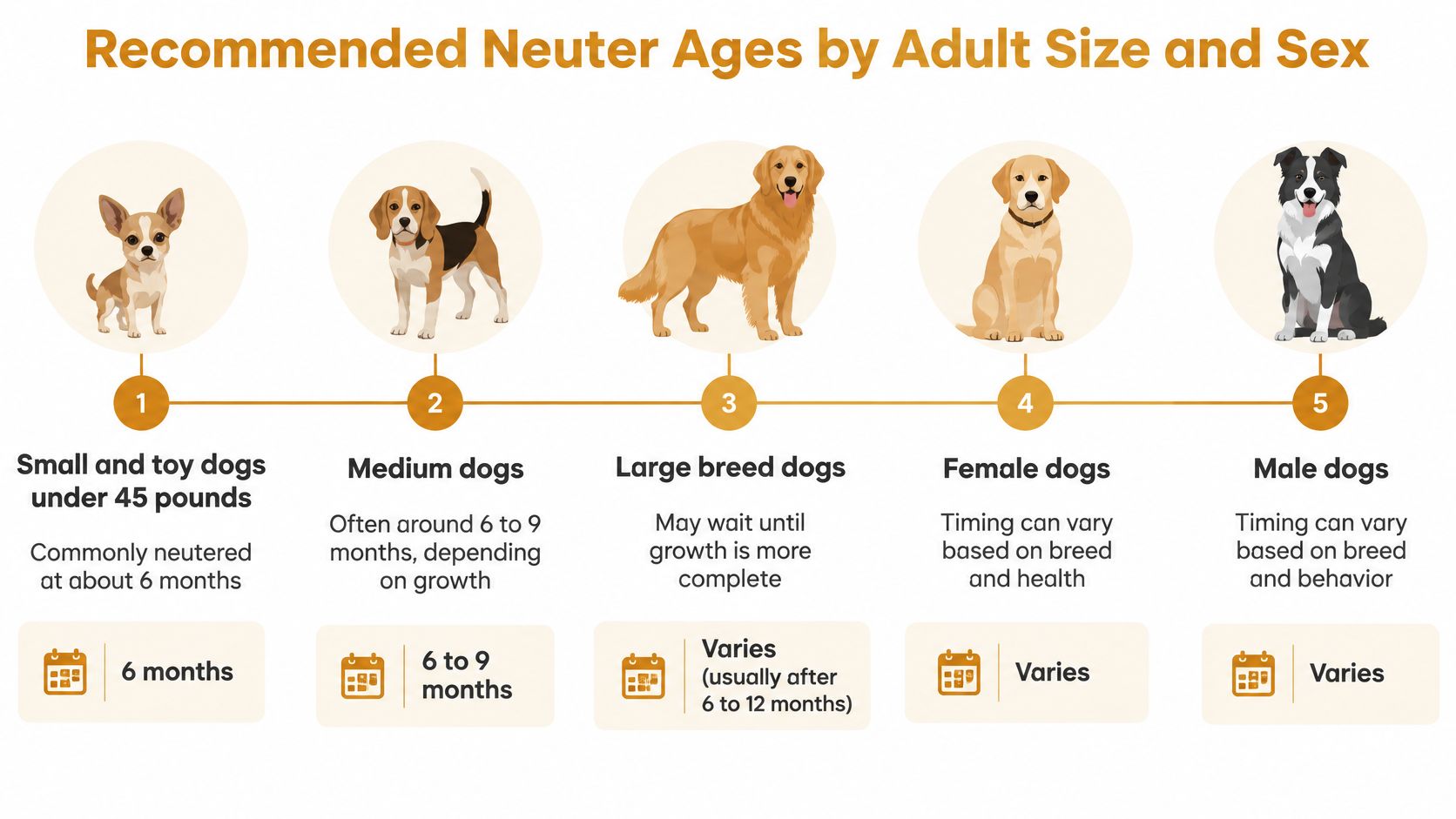
| Dog group | Males | Females | Notes |
|---|---|---|---|
| Small and toy, under 45 lb as adult | about 5 to 6 months | about 5 to 6 months, ideally before first heat | Sex matters less than size in this group |
| Medium and large, 45 lb or more as adult | usually 9 to 15 months, after growth stops | usually 9 to 15 months, after growth stops, individualized by the vet | Vet reviews breed, growth and health before setting the date |
| Mixed breed, adult size unknown | use the 45 lb split once the vet projects adult weight | same split, with the female timing question answered separately | Estimate adult weight from parent breeds and the puppy's growth |
How to pick your dog's row
- Use projected adult weight, never puppy weight. A 14-pound Labrador puppy at four months is heading for 70 pounds, and the row that applies is the large one. Breed, parent size and the puppy's own growth curve give the estimate.
- Match the dog to a row, not to a calendar habit. Under 45 pounds projected goes in the early window. At or above 45 pounds, the date belongs after growth, not before it.
- Confirm the window with a veterinarian before you book the surgery. The exam checks growth status, retained testicles, body condition and any breed risk that shifts the date in either direction.
Step three isn't ceremony. Hand the vet the expected adult weight and the breed or mix, because the benchmark that matters is projected mature size rather than what the puppy weighs today (AAHA's spay and neuter resource). For a mixed-breed puppy, the vet works out adult size from the parent breeds and the growth curve so far, and that estimate picks the row.
Two cases sit outside the default even after the row is chosen. A small-breed female is often scheduled to land before her first heat cycle, and since you don't control when that cycle starts, book early enough that the window is still open when the appointment arrives. A female expected to pass 45 pounds gets her date set case by case: orthopedic risk, cancer risk, your ability to prevent a pregnancy and her living situation all feed in, and the vet weighs them.
Cost is the piece owners forget during the wait. A puppy headed for 45 pounds or more grows into a bigger surgery and bigger bills everywhere else, and the large dog breed pages break down what that size category runs across food, veterinary care, grooming, training and insurance.
Adult Size, Growth Plates and Breed Exceptions
The difference between a 6-month-old Pug and a 6-month-old Great Dane isn't sentiment. It's cartilage. Growth plates at the ends of the long bones stay open until hormones signal them to close, and that signal runs on a schedule that varies with breed size.
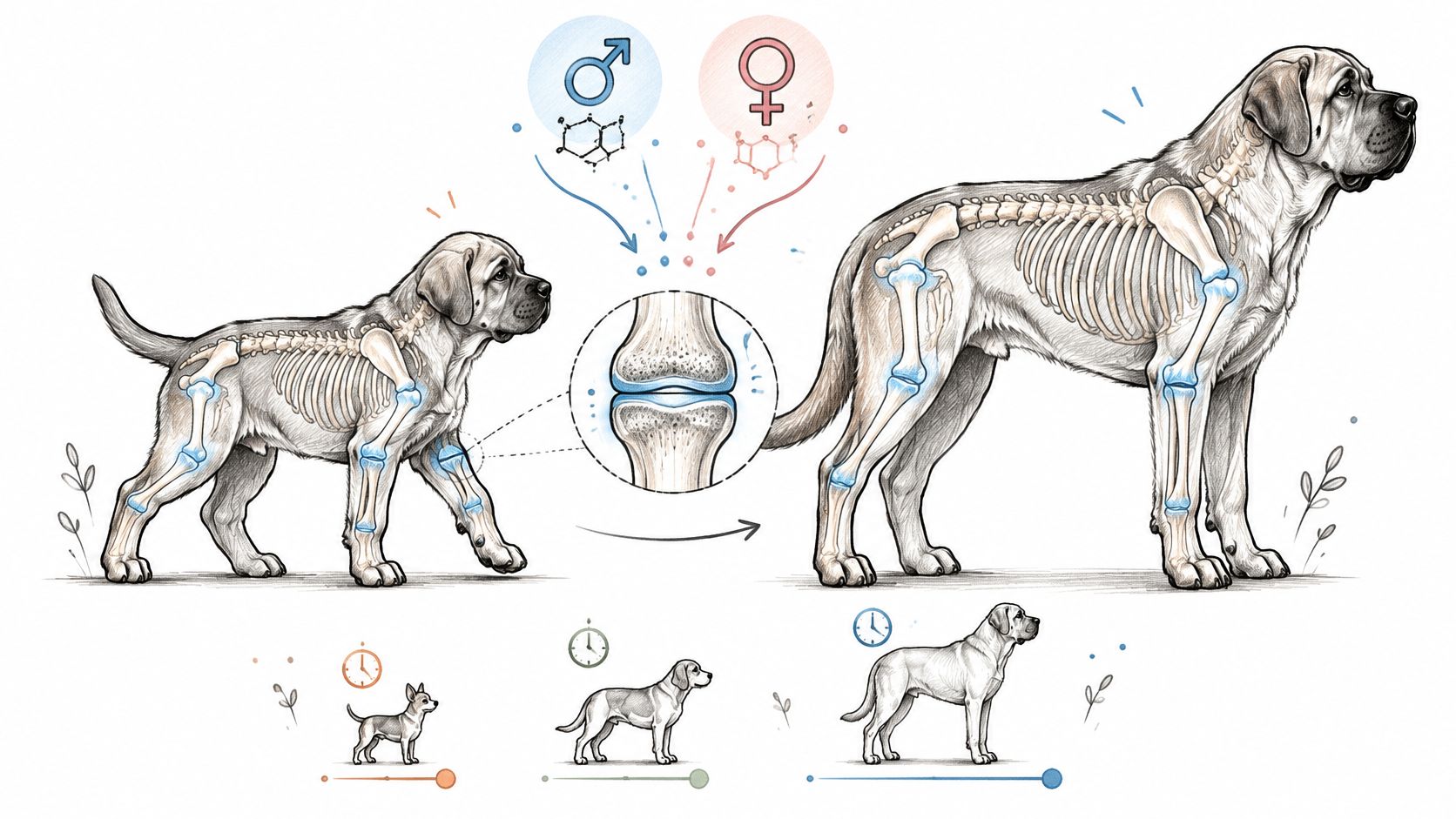
The frame analogy: pulling a support beam out of a building while the frame is still going up changes the finished shape. Take testosterone and estrogen out before the plates close and you've altered one of the inputs to the schedule.
What the UC Davis records show
Breed-specific research bears this out. A 10-year University of California, Davis study of veterinary records across many breeds found that vulnerability to joint disorders tracked body size. In a follow-up analysis, dogs in the three heaviest weight categories spayed or neutered before 12 months were about three times as likely to develop joint disorders as intact dogs (UC Davis canine spay and neuter research).
The Labrador and Golden Retriever figures usually change an owner's mind. In a separate UC Davis analysis of 13 years of records for dogs aged 1 to 8, intact dogs of both breeds had an observed joint-disorder rate of about 5%. Labrador Retrievers neutered before 6 months ran around 10%, roughly double. Golden Retrievers neutered before 6 months showed a four- to five-fold increase.
Read those as associations drawn from clinical records, not proof of cause. They also don't mean every large dog should still be intact at two years, or that early neutering is unsafe for every breed.
Breed patterns worth knowing before you book
Breed-level patterns reach further than size. UC Davis researchers found early sterilization was associated with increased joint-disorder or cancer risk in some large breeds while others showed little or no measurable effect: male Mastiffs carried increased joint-disorder risk, some Pointer populations showed joint or cancer concerns, female Rhodesian Ridgebacks showed heightened mast-cell-tumor risk with very early spaying, and Siberian Huskies showed no significant increase in the outcomes evaluated (UC Davis on neutering timing by breed).
| Breed and sex | Documented pattern | Timing discussed |
|---|---|---|
| Labrador Retriever | about 5% joint-disorder rate in intact dogs vs about 10% when neutered before 6 months | waiting until growth ends is discussed |
| Golden Retriever female | four- to five-fold joint-disorder increase when neutered before 6 months | spay delayed to about 1 year with cancer monitoring |
| Boxer male | high breed cancer rates | neutering after 2 years discussed in some cases |
| Mastiff male | elevated joint-disorder risk with early neutering | later surgery considered |
| Rhodesian Ridgeback female | higher mast-cell-tumor risk with very early spay | very early spay weighed against this risk |
| Siberian Husky | no significant increase in the evaluated outcomes | standard window less constrained by these studies |
AVMA reporting on the same body of work describes delaying a female Golden Retriever's spay to about 1 year while monitoring cancer risk, and delaying Boxer neutering beyond 2 years because of the breed's high cancer rates (JAVMA news on when to neuter dogs). Neither is a universal instruction. Both show why breed and sex belong in the plan.
If you want the reasoning laid out before your appointment, this walkthrough covers how growth and joint development shape the decision.
What the vet actually weighs
The exam pulls five things together, and skipping any one of them weakens the answer.
- Projected adult weight, from breed standard, parent size or growth curve.
- Breed and mix, including the patterns in the table above.
- Sex, because male and female risk profiles diverge within the same breed.
- Joint, cancer or urinary history, in the dog and in its close relatives.
- Risk of accidental breeding, which is a household fact, not a medical one.
A breed pattern describes a population, not your individual dog. Mixed-breed dogs get assessed by their likely parent breeds plus how they're really growing. And delaying surgery brings its own trade-off: you manage an intact dog for longer, with everything that comes with it. Giant breeds sit at the far end of the schedule, still growing well past a year, and the health and cost profile of a breed like the Great Dane shows why the joint conditions common in those dogs make the timing worth getting right.
Medical and Behavioral Trade-offs of Timing
Every delay buys one thing and costs another. The owners who get this right know which side of the trade their dog is on.
The medical benefits are real and they don't expire. Removing the testicles takes testicular cancer off the table. Spaying removes the uterus, which makes pyometra impossible, and pyometra is a uterine infection that can turn life-threatening fast. Spaying before the first heat also lowers the risk of mammary tumors later in life, the strongest argument for an early window in small females. None of these benefits argues for the earliest possible date, though. They argue for the right date.
The costs sit on the other side of the scale. Surgery changes metabolism, and neutered dogs commonly need smaller portions and more deliberate exercise to hold a healthy weight. That weight matters more than most owners expect, because extra load on a joint already predisposed to dysplasia makes the underlying problem worse with every added pound.
Behavior is where the sales pitch outruns the evidence. Neutering commonly reduces roaming, urine marking and mounting in males, and it ends heat cycles in females, a genuine improvement in a multi-dog house or a shared yard. Effects on aggression, fear and trainability vary by dog and by the age at which surgery happens. Don't book a neuter expecting it to fix a behavior the dog has rehearsed for two years.
The calendar tells you how old the dog is. It stays silent on whether the growth plates have closed, whether the dog has been through a heat cycle, and how much of the marking is hormones and how much is habit.
Before the appointment, write down four things:
- Current behavior problems. Roaming, marking and mounting, with how long each has been going on.
- Any aggression or fear history. Include when it started, because timing changes what surgery can reasonably address.
- Weight trend and current diet. Bring the actual portions you feed, not the number printed on the bag.
- The questions you want answered. Put them on paper. Exam-room memory is unreliable.
Breeds with a documented predisposition deserve their own reading before the date is set. The German Shepherd breed profile shows what that reading looks like: a cost model for the breed, a health risk profile and an insurance recommendation, with costs broken down by category. If your dog's breed carries a joint or cancer pattern, that estimate belongs in the room when you and your vet pick a date.
Female Dogs, Heat Cycles and Maturity
Female timing gets its own conversation, because the first heat changes the calculation in a way nothing does for males.
Most guidance hands you a calendar cutoff: 6 months, or 12 months. A 2024 scoping review asked whether the biology that matters is puberty rather than the calendar, and came back with a thin answer. The literature it reviewed largely measured age at neutering rather than whether the dog had reached puberty, and it concluded the evidence is insufficient to make clear recommendations based on pre- versus post-pubertal timing (RCVS Knowledge scoping review on neutering and puberty). A fixed age on its own settles nothing about urinary, orthopedic, obesity or cancer-related risk.
Some UK studies built on veterinary clinical records add a second thread. They associate spaying after the early puppy window with a lower rate of early-onset urinary incontinence compared with spaying in the first months of life. That pattern is observational. It doesn't prove delaying caused the difference, and it doesn't hand you an optimal age for any breed. What it does is puncture the assumption that earlier is automatically healthier for every female.
The trade-off runs both ways, and owners get the decision wrong in each direction. Spay too early by default and you may trade away whatever protection post-pubertal timing carries. Delay without a plan and you're managing heat cycles that run for weeks rather than days, with pregnancy to prevent through each one. An owner who can't reliably contain a female in season has an earlier real deadline than the medical ideal, and pretending otherwise is how litters happen.
The four things to record
- The date the first heat started, so you know where you are in the cycle if surgery is planned around it.
- Growth status, meaning the vet's assessment of whether the dog has finished growing.
- Any urinary history, including leaking, accidents in a previously clean dog, or repeated urinary infections.
- Your containment plan for each heat cycle, written down before the cycle starts rather than during it.
Then decide with your vet whether to spay before the first heat or wait until after it, and write the reason next to the date. Owners who can say why their dog was spayed at a given age usually had that conversation. Owners who can't, usually didn't. For breeds where the timing debate runs long, start from the breed's lifetime health picture. The Golden Retriever cost and health profile shows the kind of breed-level breakdown that tells you why your vet wants the full history before setting a date.
Local Rules and Shelter Practices That Set Timing
The deadline that catches owners most often isn't medical. It's a clause in a contract.
Breeder contracts frequently tie spay or neuter to a stated age, or to a health condition such as waiting until a joint issue is assessed. Read that clause before you pick a date, and if it collides with the medical window, raise it with your vet rather than ignoring either one. A contract date and a surgery date can usually be reconciled once someone names the conflict out loud.
Local rules are the second layer, and they differ by city, county and state. Some jurisdictions require sterilization for certain dogs, and some tie licensing to altered status with a lower fee for altered animals. There's no national deadline to plan around, which is exactly why checking matters: owners who assume the rules are the same everywhere are the ones who get surprised at license renewal.
Shelters and rescues are the third layer, and they usually act first. Many animals are altered before adoption, and adoption agreements often set a deadline for surgery on a young puppy placed before the procedure. If your dog was sterilized very young, that decision is already made, and your job now is monitoring joint development and keeping weight down. The British Small Animal Veterinary Association's neutering position statement makes the point that when neutering a dog younger than 12 weeks is considered, the vet has to account for the animal's physiological immaturity and its breed.
Run through this before you accept any date:
- Check the city or county animal ordinance for your address, not for the nearest big city.
- Check licensing requirements and whether altered dogs get different terms.
- Read the adoption or breeder contract for a written deadline, and note the exact wording.
- Compare that deadline to the medical window from the chart at the top of this article.
- Tell your vet about any conflict and ask what to do when a contract date lands before the medical one.
Vet Questions, Warning Signs and Your Next Step
Bring the list. A neuter conversation takes ten minutes when you arrive with specifics and thirty when you're reconstructing the dog's history from memory in the exam room.
- What is the projected adult weight for my dog's breed and mix, and how confident are you in that estimate?
- Has growth finished, and what are you using to judge that?
- Does my dog's breed carry documented joint, cancer or urinary risks that change the timing?
- For a female, should we spay before the first heat or wait, and what's the reason either way?
- Does any local rule or contract deadline conflict with the window you're recommending?
- What's the plan if the dog is still intact when a deadline arrives, whether that's a contract date or a license requirement?
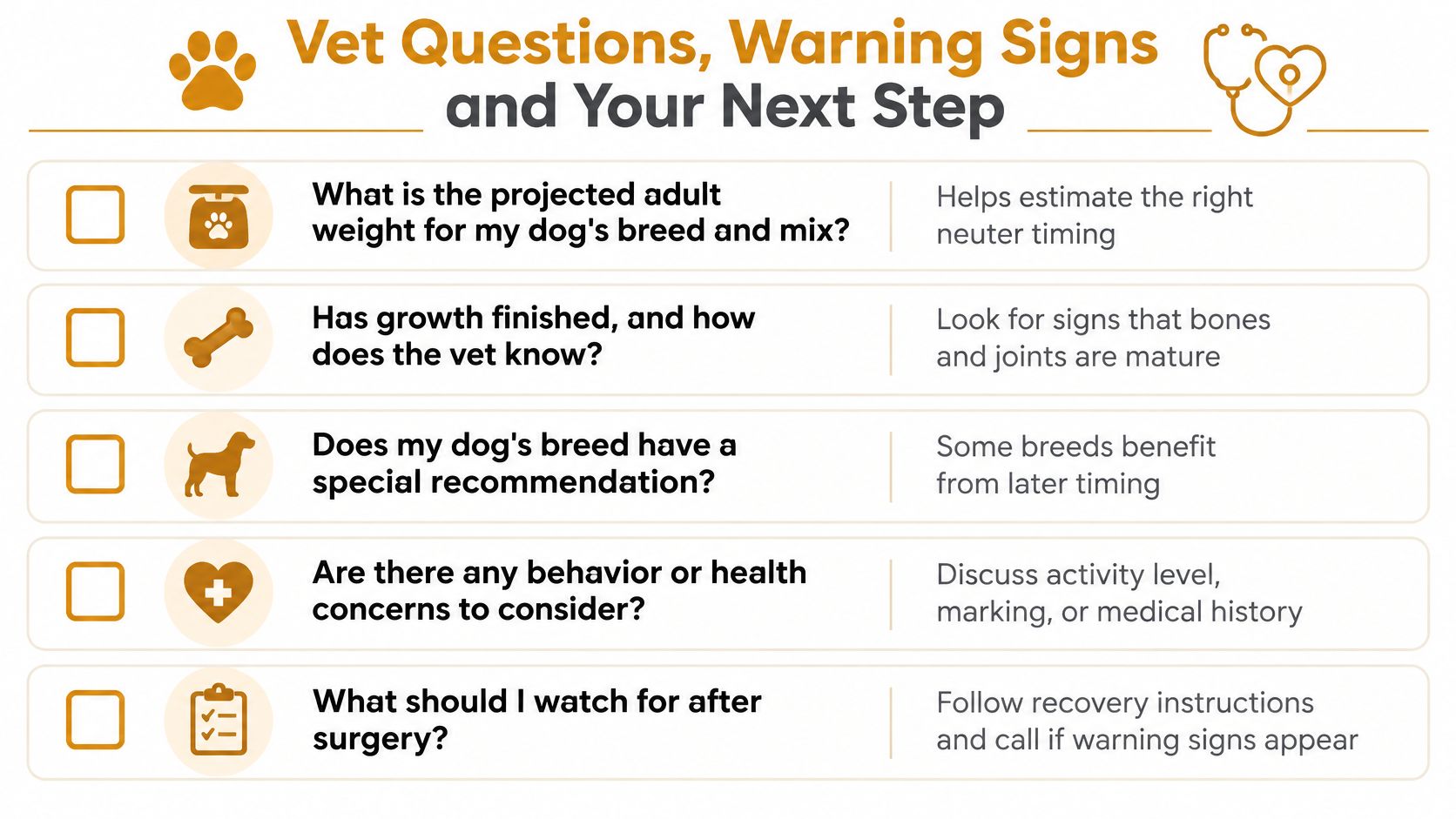
What to watch for after surgery
Call your vet the same day if you see: bleeding, swelling or discharge at the incision, vomiting that keeps going, weakness or collapse, trouble urinating, or any sign the dog is in real pain rather than ordinary post-operative soreness. For puppies, senior dogs and dogs with ongoing conditions, treat a continuing problem as a same-day call rather than a wait-and-see.
The recovery period is also when owners notice how much the dog's metabolism has shifted, so start the portion adjustment early rather than after the weight arrives.
Then run one sequence. Write the projected adult weight on paper. Bring your local ordinance printout and any contract clause with you. Book the exam. Set a calendar reminder for the date the vet names, plus a second reminder thirty days before it so nothing gets lost between now and then. The vet makes the final call, and your job is to arrive with the facts that make it a good one.
If you want the health side sketched out before you sit down, our breed pages are built for this: the free analysis asks four questions and returns one answer matched to your dog's breed, state and age.
The date on the calendar matters less than what the years after it look like, and that picture swings more by breed than most owners expect. PetCostEngine models all 226 AKC breeds individually rather than averaging them into size buckets, so you can see the health conditions a breed's first decade tends to involve before you commit to a surgery date. Run the free analysis at PetCostEngine with your dog's breed, state and age, and take the result to the appointment alongside the vet's notes.
Estimated lifetime and yearly costs for a Great Dane, state by state, plus whether pet insurance breaks even for the breed.
See Great Dane costs →
Is insurance worth it for a Great Dane? →
Premium dry food → Puzzle toys → No-pull harness →
As an Amazon Associate, PetCostEngine earns from qualifying purchases.