
A lot of owners land here after a small but unsettling moment. Their dog pauses at the stairs, hops off the couch more carefully than usual, or lets out a sharp yelp during play and then acts almost normal a few minutes later. By dinner, the dog may be walking stiffly, standing with a hunched back, or avoiding being picked up.
That kind of change is easy to second-guess. Maybe your dog just twisted the wrong way. Maybe it's a sore muscle. Maybe it's one of those classic back problems in dogs that people talk about online, especially IVDD. Sometimes it is. Sometimes it isn't.
The hard part is that spinal pain can look subtle at first, then become urgent fast if weakness or loss of coordination appears. Early action matters because the spine controls both comfort and movement. A painful dog may stop jumping, playing, sleeping comfortably, or even eating normally. A dog with spinal cord involvement can also develop trouble placing the feet, supporting weight, or walking.
If you're trying to sort out what's serious and what can wait, this guide is built for that exact moment. It starts with simple spine anatomy, then moves into who faces higher risk, what signs to watch for, why not every painful back means a slipped disc, and how veterinarians usually approach diagnosis and treatment. If you want background on the site behind this guide, you can find it on the PetCostEngine about page.
Table of Contents
- Introduction to Back Problems in Dogs
- How Your Dogs Spine Works and Why It Hurts
- Which Dogs Face Higher Risk for Back Issues
- Recognizing Early Signs of Back Pain and Trouble
- Common Causes Beyond a Slipped Disc
- How Veterinarians Diagnose and Treat Back Problems
- Prevention Recovery and Living Well With a Sensitive Back
Introduction to Back Problems in Dogs
Back problems in dogs matter because the spine does more than hold the body up. It protects the spinal cord, carries signals between the brain and limbs, and helps your dog bend, balance, run, and turn. When something irritates that system, even a mild problem can affect daily life quickly.
Owners often picture a dramatic collapse when they think about spinal disease. In real life, the first signs are often quieter. A dog may resist jumping into the car, stand with the abdomen tucked and the back rounded, or flinch when turning. Those details are easy to dismiss until they start adding up.
Why owners get confused
Part of the confusion comes from the phrase "back pain" itself. Owners use it to describe a lot of different things:
- Movement changes: slower rising, reluctance on stairs, hesitation to jump
- Posture changes: hunching, stiffness, holding the neck or back oddly
- Pain signals: yelping, restlessness, panting, not wanting to be touched
- Nerve-related changes: wobbling, scuffing nails, dragging a leg, sudden weakness
Some of those signs point to pain alone. Others suggest the spinal cord or nerves may be involved. That difference affects how urgently your dog needs care.
When a dog with a sore back also starts looking weak or unsteady, treat it as more than simple soreness.
What owners need most in the moment
Most worried owners don't need a textbook. They need a way to decide what they're seeing and what to do next.
A useful starting point is simple. Ask yourself three things:
- Did this come on suddenly?
- Is my dog painful, weak, or both?
- Is my dog still walking normally?
Those answers help frame urgency. Pain without weakness still deserves attention. Pain plus weakness, dragging, or collapse deserves prompt veterinary contact.
How Your Dogs Spine Works and Why It Hurts
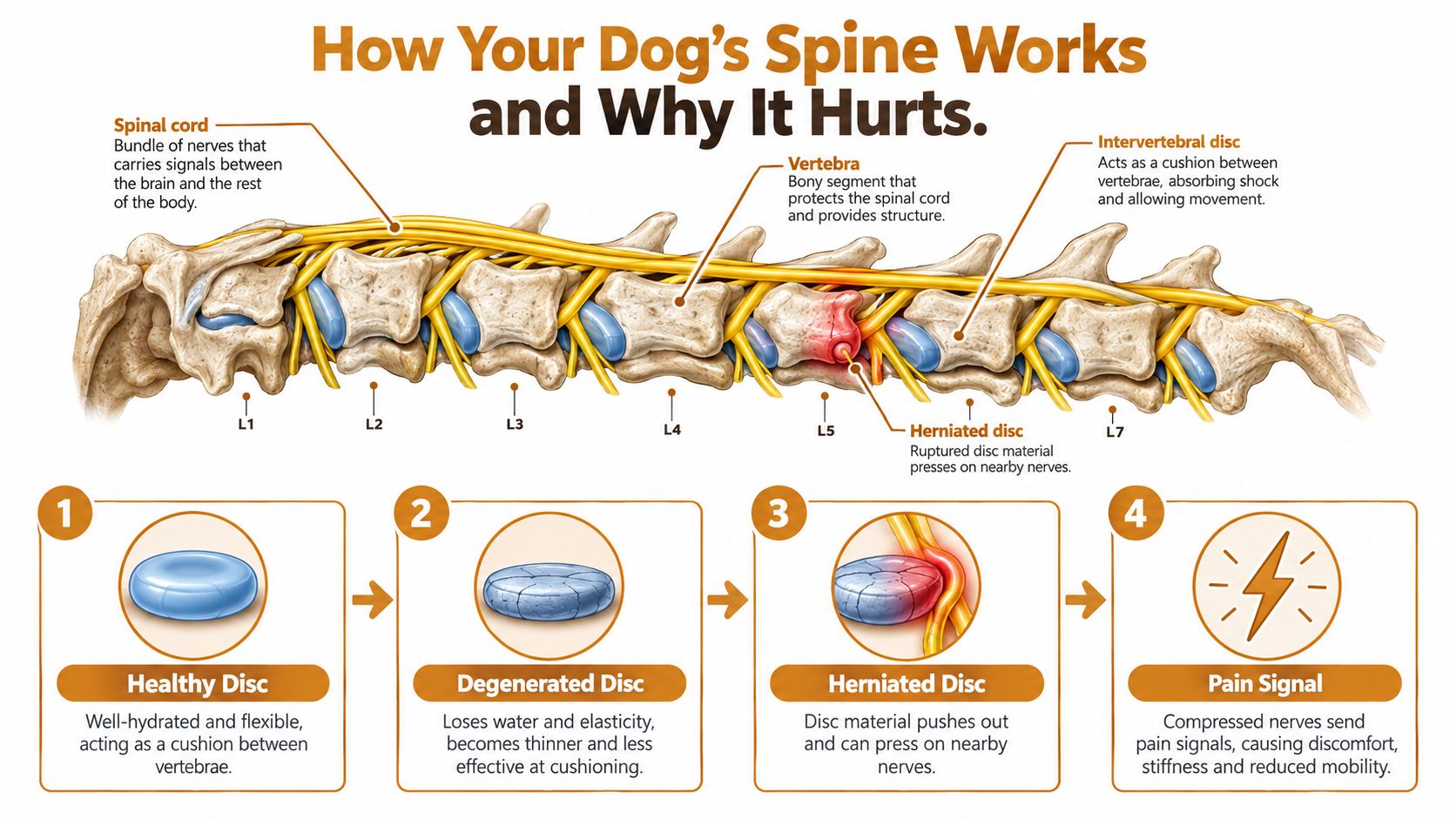
A dog's spine works a lot like a flexible stack of blocks with cushions between them. The blocks are the vertebrae. The cushions are the intervertebral discs. Running through the middle is the spinal cord, which acts like a protected cable carrying messages between the brain and body.
The simplest way to picture a disc
Think of each disc like a jelly donut used as a shock absorber. In a healthy disc, the outer layer helps hold the softer center in place while the spine bends and absorbs force. If that disc degenerates, dries out, bulges, or ruptures, it can stop acting like a cushion and start acting like a pinch point.
Practical rule: A spinal problem can cause pain in two main ways. The tissues become inflamed, or the damaged disc starts pressing on nearby nerves and the spinal cord.
That pressure explains why some dogs only seem sore, while others become weak or even paralyzed. Pain happens when structures around the spine are irritated. Neurologic changes happen when the "wiring" of the spinal cord or nerves gets compressed.
Why location changes the signs
Location matters. Problems in the neck can make a dog hold the head low, resist turning, or cry when looking up or down. Problems in the back, especially the mid-back region, more often affect posture, jumping, and hind limb function.
Clinical back disease in dogs is dominated by thoracolumbar intervertebral disc disease, with roughly 65% of cases in the back and about 18% in the neck, and in small-breed IVDD, 80% to 90% of cases occur in the mid-back region, according to Cornell's overview of canine intervertebral disc disease. That pattern helps explain why so many owners first notice trouble with stairs, jumping, or the hind legs.
The spine is one structure, but signs aren't one-size-fits-all
Two dogs can both have spinal pain and look very different. One may just seem stiff and guarded. Another may walk with crossed steps or drag the toes. The same body system is involved, but the exact tissue and location change the picture.
Owners of bigger dogs often assume spinal disease is mainly a small-dog issue. That's not always true. Large breeds can also develop back problems, and breed size changes the pattern more than the possibility. If you want a broader look at larger breeds, the large dog breed pages can help put spinal risk in context with other health patterns.
Which Dogs Face Higher Risk for Back Issues
A common scene in practice goes like this. One dog yelps after jumping off the couch and recovers by evening. Another dog with the same small movement change is at the emergency hospital a few hours later because the hind legs have become weak. The difference is often not just pain. It is the mix of breed, where the problem sits in the spine, and how much the spinal cord is being affected.
Breed risk changes the odds, not the diagnosis
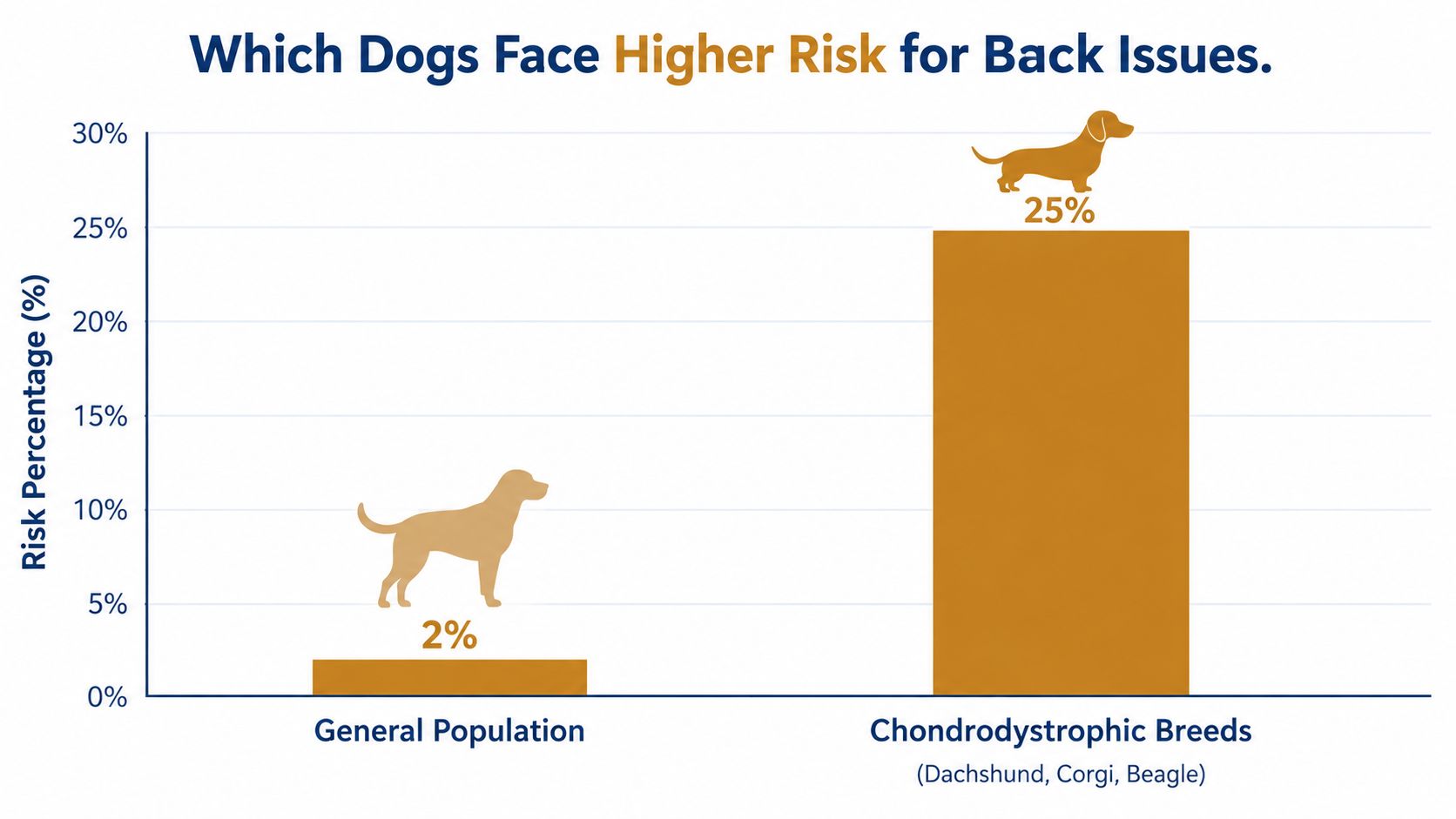
Back problems are not evenly distributed across dogs. Some breeds are built with a much higher chance of early disc wear, especially chondrodystrophic breeds, the short-legged breeds whose cartilage develops differently.
Intervertebral disc disease is widely described as the most common spinal disorder in dogs, and multiple veterinary sources place the lifetime prevalence of disc herniation in the general dog population at about 2% to 3.5%. A large U.S. owner-reported study of 43,517 companion dogs found an overall lifetime prevalence of owner-reported IVDD of 1.2%, but breed risk was much higher in Dachshunds at 15.3%, French Bulldogs at 8.4%, and Beagles at 6.6%, as summarized by Physio-Pedia's canine IVDD review.
Older veterinary literature cited in that same review reported that Dachshunds account for 45% to 73% of all acute disc extrusions in dogs and are 12.6 times more likely than other breeds to develop disc herniation. That is why a mild change in movement means more in some dogs than others. A long-backed dog who suddenly refuses stairs raises a different level of concern than a low-risk breed who overdid play.
For owners living with a high-risk breed, a breed overview like this Dachshund guide can help put that risk in context before you speak with your veterinarian.
Age and sex help explain why timing changes
Risk also shifts as dogs get older. Degeneration-related disc disease was measured at 27.8 occurrences per 10,000 dog-years at risk, with especially high breed concentrations in Miniature Dachshunds at 237.1, Standard Dachshunds at 141.5, and Doberman Pinschers at 88.6 occurrences per 10,000 dog-years at risk. The same study found incidence increased with age and was higher in males than females, based on the JAVMA report on intervertebral disc degeneration-related disease.
That pattern helps owners make sense of a confusing timeline. A dog can look perfectly normal for years, then start showing trouble after the discs have slowly lost some of their shock-absorbing ability. The spine works a bit like a stack of cushions between blocks. As the cushions dry out or weaken, one awkward jump or twist can matter more.
Risk is also about what kind of spinal problem a dog is likely to get
Breed risk does not point to one single outcome. It points to patterns.
Short-legged chondrodystrophic breeds are more likely to have disc material harden early and push suddenly into the spinal canal. Some larger breeds more often develop slower, chronic disc changes. Dobermans also remind us that neck disease can matter, not just mid-back disease. For owners, this is the practical takeaway. The same word, "back problem," can describe very different levels of urgency depending on the dog and the part of the spine involved.
A simple way to judge urgency at home
Risk matters most because it changes how quickly you should act. Predisposition is not destiny, but it should lower your threshold for calling your veterinarian.
A useful decision framework is:
- High-risk breed plus pain only: prompt veterinary visit
- High-risk breed plus wobbliness, toe scuffing, or trouble rising: same-day evaluation
- Any dog with weakness that is rapidly worsening or any loss of walking ability: emergency care
- Any dog with loss of bladder control along with back or neck signs: urgent veterinary assessment
Lifestyle can play a role too. Recent work in English cocker spaniels found an overall IVDD prevalence of 5.73%, with show dogs at 8.99% and working dogs at 3.44%, and the study also found higher odds with harness walking or pulling on a harness, according to this Journal of Veterinary Internal Medicine article.
The main point is simple. Do not stop at the question, "Could this be IVDD?" Ask three questions instead. Is my dog in a higher-risk group, where might the problem be located, and are there any neurologic changes beyond pain alone? Those answers do more to guide urgency and prognosis than breed label by itself.
Recognizing Early Signs of Back Pain and Trouble
Many owners expect severe back problems to be obvious. Sometimes they are. Often they're not. Dogs can show very small movement changes before they show dramatic pain or weakness.
The signs owners notice first
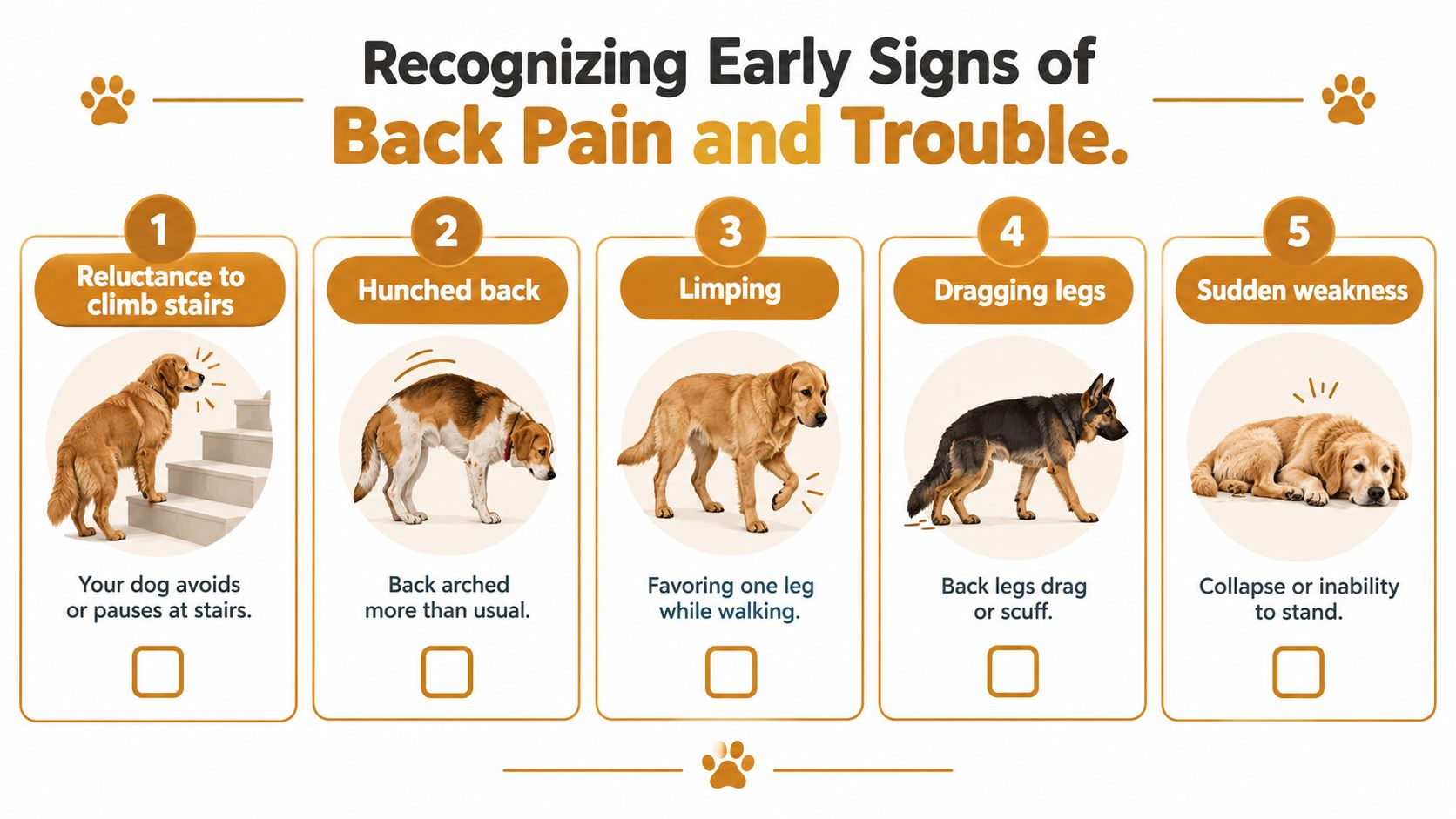
The American Kennel Club says IVDD is a neurologic condition in which the protective material around the spinal cord changes, and resulting signs can include pain, dysfunction, or paralysis. AKC also lists limping, dragging the legs, and hunching the back as observable symptoms in its IVDD guidance for dog owners.
Those classic signs often show up in daily routines before they show up on a formal exam.
- Jumping changes: your dog hesitates before the couch, bed, or car
- Stair avoidance: your dog pauses, refuses, or goes one step at a time
- Posture shift: the back looks rounded or tense
- Walking changes: limping, toe scuffing, stiffness, or a shorter stride
- Touch sensitivity: your dog tenses, turns, or cries when picked up
Sudden problems can be easy to miss
Washington State University's veterinary teaching hospital notes that common spinal injuries in dogs can cause temporary paralysis and weakness, particularly in the hind legs, and onset is often sudden after exercise, play, or mild trauma such as a fall. The same source notes that some dogs yelp at the moment of injury and then show little pain afterward, which can make the problem easy to miss, according to WSU's spinal injury overview.
That last point catches owners off guard. A dog may scream once during rough play, then walk around, eat dinner, and still have a meaningful spinal injury.
A short video can help you compare what you're seeing at home with typical spinal warning signs:
A simple urgency checklist
Use this as a practical sorting tool before you call your veterinarian.
| What you see | What it may mean for urgency |
|---|---|
| Mild stiffness, reluctance to jump, still walking normally | Needs veterinary advice soon, especially in a high-risk breed |
| Hunched back, repeated pain episodes, shaking, crying when moving | Same-day contact is sensible |
| Weakness, stumbling, dragging a leg, scuffing nails | Prompt veterinary evaluation |
| Sudden inability to stand or walk | Emergency care |
| Pain plus rapidly worsening hind limb function | Emergency care |
If your dog can't walk normally, don't wait to see if a night's rest fixes it.
Before the appointment, jot down four details: when it started, whether it was sudden or gradual, whether there was play or a fall beforehand, and whether your dog is painful, weak, or both. That short history helps the veterinary team a lot.
Common Causes Beyond a Slipped Disc
A lot of online content treats canine back pain as if it automatically means IVDD. That's too narrow. IVDD is common and important, but it isn't the only reason a dog may look sore, weak, or hunched.
A large U.S. community study found owner-reported lifetime IVDD prevalence was 1.2% across 43,517 dogs, with much higher rates in some breeds. That gap is useful because it reminds owners that many dogs with back pain have something other than classic disc disease. A referral neurology case series also represented other causes including neoplasia, congenital anomalies, myelitis, and discospondylitis, as discussed in this JAVMA article on the broader differential for canine back pain.
Back Pain Causes Compared
| Cause Category | Typical Context | Why Veterinary Evaluation Matters |
|---|---|---|
| IVDD or disc herniation | Sudden pain, stiffness, weakness, or dragging, especially in predisposed breeds | Disc problems can range from painful to neurologically urgent |
| Trauma or spinal injury | Fall, rough play, twist, impact, or other physical event | Fracture, instability, or cord injury may not be obvious from the outside |
| Neoplasia | Gradual pain, persistent decline, sometimes vague signs | Tumors can mimic simpler causes early |
| Congenital anomalies | Younger dogs or breeds with structural predispositions | Anatomy may shape both diagnosis and long-term management |
| Myelitis | Inflammation affecting the spinal cord | The problem may involve inflammation rather than a mechanical disc issue |
| Discospondylitis | Back pain with signs that may suggest infection or systemic illness | Treatment approach differs sharply from routine rest and pain control |
Why breed risk doesn't equal diagnosis
Owners often get tripped up. A Dachshund with back pain may indeed have IVDD. A German Shepherd with back pain may have a different pattern entirely. Either way, the breed gives context, not certainty. If you're comparing how health risks differ across breeds, a breed profile such as this German Shepherd page can be useful background, but it shouldn't replace an exam.
The practical takeaway is simple. Don't self-diagnose a "slipped disc" just because your dog is painful and belongs to a predisposed breed. The cause changes treatment, urgency, and outlook.
How Veterinarians Diagnose and Treat Back Problems
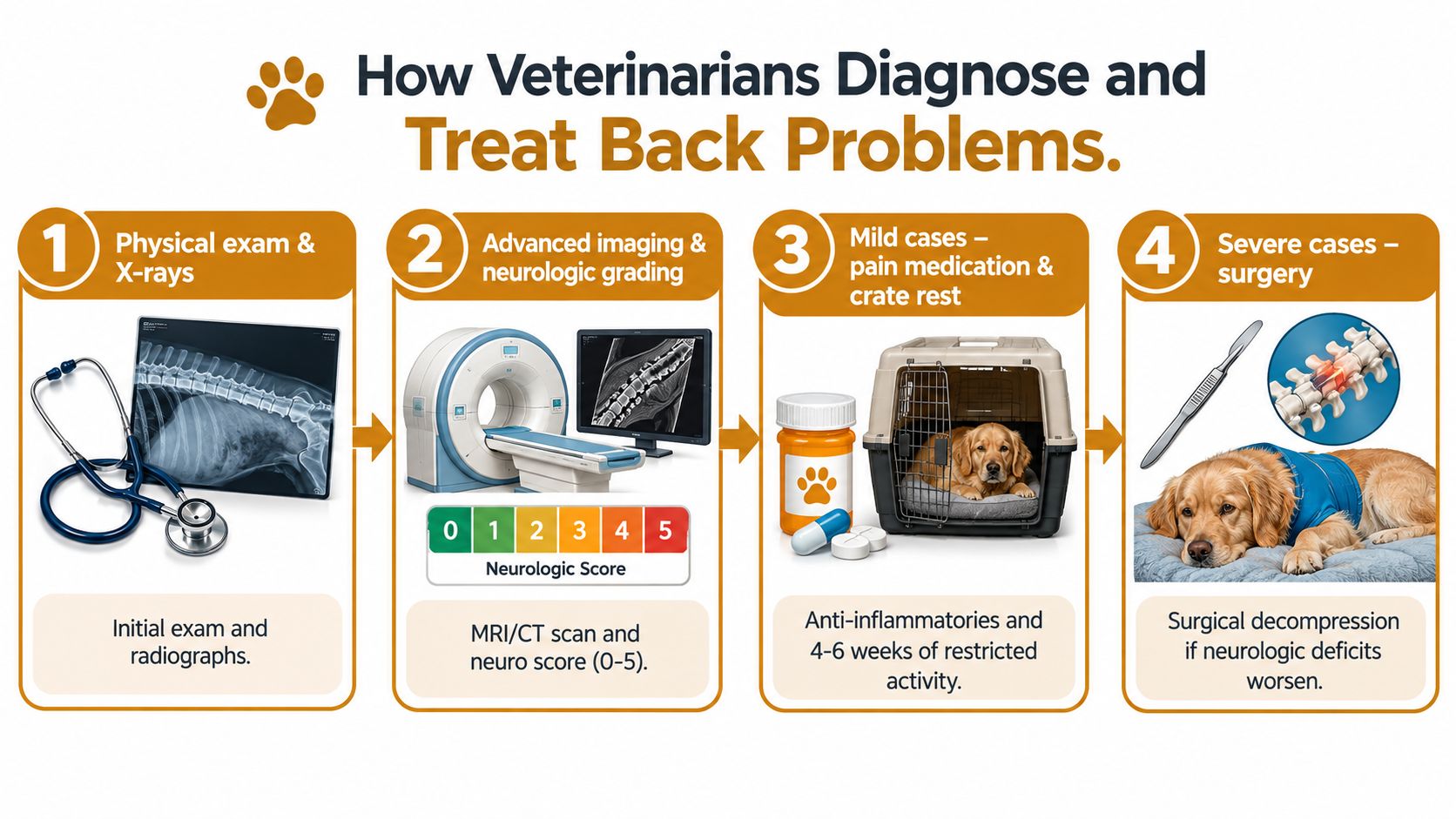
A dog may walk into the clinic with nothing more than a hunched posture and a cry when picked up. Another may drag a paw or suddenly stop standing. Both have "back problems," but they are not the same emergency, and veterinarians sort that out by answering three questions: where is the problem, what is causing it, and how much has the nervous system been affected?
The first steps in the clinic
The spine works like a protective tunnel for the spinal cord. Veterinarians first try to figure out which part of that tunnel is painful or under pressure. A neck problem can look very different from a lower back problem, and a painful dog with normal strength is in a different category from a dog that is weak, wobbly, or losing bladder control.
The visit usually starts with a history and a hands-on exam. Cornell's canine health center notes that a veterinarian uses the exam, along with imaging such as x-rays, to work toward a diagnosis, and the AKC Canine Health Foundation overview of intervertebral disc disease describes treatment ranging from medication and rest to surgery in more serious cases.
Your veterinarian may ask:
- How the signs began: after a jump or twist, over several days, or all at once
- What your dog can still do: walk, rise, bear weight, or use the stairs
- Where pain seems to be centered: neck, mid-back, or lower back
- Whether the issue is pain alone or pain plus nerve changes: weakness, knuckling, stumbling, or paralysis
The neurologic exam matters here. Reflexes, paw placement, limb strength, and pain response help localize the trouble spot. That step guides the next decision more than breed alone.
Severity changes urgency and prognosis
Owners often hear "disc problem" and picture one diagnosis with one treatment plan. Real cases are less uniform. Location matters. Cause matters. Severity matters most.
A dog that is sore but still walking may be managed very differently from a dog that is losing the ability to stand. Severe neurologic loss can indicate heavier spinal cord compression or more extensive cord injury, which changes both urgency and outlook. In practical terms, veterinarians are asking whether they are dealing with pain, loss of coordination, loss of strength, or loss of deep pain sensation. Each step up that ladder raises concern.
That is why two dogs from the same breed can leave the clinic with very different recommendations. One may go home with strict confinement and medication. Another may need same-day referral for advanced imaging and possible surgery.
What treatment can look like
Treatment usually falls into four broad paths, and the right one depends on the dog's exam findings rather than the phrase "slipped disc" alone.
Conservative care
Dogs with pain and mild deficits are often treated with rest, pain relief, and close rechecks. The goal is to calm inflammation, prevent another flare, and watch carefully for any new weakness.Advanced imaging and referral
MRI or CT may be recommended when the diagnosis is uncertain, when neurologic deficits are present, or when surgery is being considered. These tests show whether the problem is a disc, infection, tumor, fracture, or another spinal disorder that can mimic IVDD.Surgery
Surgery is typically considered when spinal cord compression is significant, neurologic function is worsening, or a dog has already lost important motor function. Timing can matter. Dogs with rapidly progressive signs are often treated more urgently.Rehabilitation and home support
Recovery continues after the first treatment decision. Physical rehabilitation, careful nursing care, bladder support in some cases, and follow-up exams all affect function and comfort.
Costs vary widely because a painful walking dog and a non-ambulatory dog do not need the same level of care. For owners trying to plan for that practical side, some use PetCostEngine and its guides for dog owners as budgeting tools alongside their veterinarian's recommendations.
The clearest takeaway is this: veterinarians do not treat "back pain" as one single problem. They sort spinal cases by location, likely cause, and neurologic severity, then match treatment to that specific pattern. That framework helps owners understand why some dogs need rest and monitoring, while others need fast referral.
Prevention Recovery and Living Well With a Sensitive Back
Once a dog has had spinal pain, daily habits matter more. Recovery is rarely just about waiting. It's about reducing strain, watching for setbacks, and making movement safer without turning your dog into a statue.
The day-to-day habits that help
A few changes usually make the biggest difference:
- Keep movement controlled: avoid wild leaps off furniture and rough twisting play during recovery
- Use safer access: ramps, non-slip flooring, and thoughtful crate setup help many dogs
- Handle the body evenly: support both the front and rear when lifting a small dog
- Watch harness use carefully: if your dog pulls hard, talk with your veterinarian about safer walking management
- Protect body condition: extra weight increases strain on an already sensitive back
What owners should monitor after the first episode
Some dogs recover and never have another major problem. Others have recurring flare-ups. The earlier you notice a pattern, the better you and your veterinarian can respond.
Watch for return of stiffness, hesitation on stairs, a rounded posture, slower rising, toe scuffing, or a change in gait. If you already know your dog belongs to a breed with orthopedic or spinal concerns, reviewing breed-specific health pages such as the American Water Spaniel profile can add context, but your dog's own history matters more than any breed summary.
The bigger message is reassuring. Many dogs with sensitive backs still live active, content lives. The dogs who do best usually have owners who notice early changes, act quickly when function worsens, and stick closely to the recovery plan.
PetCostEngine helps dog owners look at breed-specific health patterns, long-term care planning, and pet insurance questions in one place. If your dog is in a higher-risk breed or you're trying to prepare for future spinal care decisions, visit PetCostEngine to explore breed pages, planning tools, and owner guides.
Modeled estimates for 226 breeds, with the formula and sources published in full.
See the data →
Joint supplement → Puzzle toys → No-pull harness →
As an Amazon Associate, PetCostEngine earns from qualifying purchases.