Plain peeled banana is safe for dogs as an occasional treat and is not a daily food, and the number that sets the limit is calories rather than slices. For a 10 kg (22 lb) dog eating about 600 kcal a day, the treat ceiling is roughly 60 kcal, and a quarter cup of banana at about 34 kcal spends more than half of it. The size chart below turns that ceiling into a row for your dog.
Most banana advice for dogs is a slice count tied to breed size, and that's where it breaks down. A slice count ignores the dog's daily energy needs, ignores the sugar in the fruit, and ignores the biscuits, dental chews, and training treats already spent from the same allowance. Slice thickness varies by banana and by knife, so two owners following the same advice can feed portions that differ by a factor of three.
The question of whether banana is good for dogs splits into two questions, and they get different answers. Is it safe? Yes, the flesh is non-toxic. Is it useful? Only as a small, counted extra beside a complete food, and the case for anything beyond that is thinner than the nutrient list suggests.
Start with your dog's row, then read the caveats that follow it. The ceiling is a real limit, not a suggestion to round up.
Table of Contents
- Banana Portion Chart by Dog Size
- Why Non-Toxic Does Not Mean Unlimited
- Nutrients in a Treat-Sized Piece of Banana
- How to Serve Peeled Banana the First Time
- Dogs Who Need a Smaller Banana Allowance
- Stomach Signs That Mean Calling the Vet
- Set the Treat Rule Then Check the Diet
Banana Portion Chart by Dog Size
Banana flesh is non-toxic to dogs, but the same guidance that clears it treats the fruit as a calorie-controlled supplement rather than a nutritionally necessary food, per Tufts Veterinary Nutrition. That guidance keeps treats and snacks, fruit included, at no more than 10% of a dog's daily calories, and it estimates 1/4 cup of banana at approximately 34 kcal, which is enough to build a table from.
| Size and weight | Approx. daily calories | 10% treat cap | Banana ceiling that day |
|---|---|---|---|
| Toy, about 5 kg (11 lb) | ~350 kcal | ~35 kcal | About 1/4 cup (34 kcal) uses nearly the whole cap; start with a few slices |
| Small, about 10 kg (22 lb) | ~600 kcal | ~60 kcal | 1/4 cup uses about 57% of the cap; just under 1/2 cup fills it |
| Medium, about 20 kg (44 lb) | ~1,000 kcal | ~100 kcal | Most of one medium banana (110 kcal) only if no other treat is given |
| Large, about 30 kg (66 lb) | ~1,400 kcal | ~140 kcal | About 3/4 cup (roughly 102 kcal) leaves room for one small chew |
| Giant, about 45 kg (99 lb) | ~1,950 kcal | ~195 kcal | Up to about 1 1/4 cups, well short of two bananas (220 kcal) |
The last column is a ceiling for a day when banana is the only treat. The 10 kg row follows the published 600 kcal example; the other calorie figures are standard maintenance estimates for a neutered adult at a healthy weight, and an individual dog can sit well above or below them.
Why a quarter cup is the number that bites
For a 10 kg dog near 600 kcal a day, the discretionary allowance is about 60 kcal, and a quarter cup of banana spends roughly 57% of it before a single training treat. That's the arithmetic most slice-based advice never shows. A food that looks like a healthy snack has already consumed more than half the day's treat budget.
A whole fruit is a bigger object than most owners picture. Dogster puts one medium ripe banana at 110 calories, which exceeds a small dog's entire daily treat cap and takes most of a medium dog's.
Practical rule: a quarter cup in a measuring cup beats an eyeballed coin of banana every time, and it takes four seconds.
Measure the piece, not the slice
- Pick one measuring method and stay with it: loosely sliced banana fills a quarter cup at a lower weight than mashed banana, so a cup measurement only means something if you repeat the same preparation.
- Use a kitchen scale for repeat portions: weighing the piece removes the guesswork once you've found an amount your dog tolerates.
- Watch slice thickness: a thick coin cut from a large banana can weigh several times what a thin slice from a small one does, and the calories scale with the weight, not the count.
- Subtract everything else: biscuits, cheese, dental chews, and training rewards come out of the same 10% before banana gets a share.
Very large dogs have their own economics, and the giant dog size pages pair the size data with breed-level health context that changes how fruit fits a diet.
Growing puppies, overweight dogs, diabetic dogs, and dogs eating a therapeutic diet should stay under the row or skip banana until a veterinarian sets the allowance. Make the first serving smaller than the ceiling so you can check stool and appetite before repeating it.
Why Non-Toxic Does Not Mean Unlimited
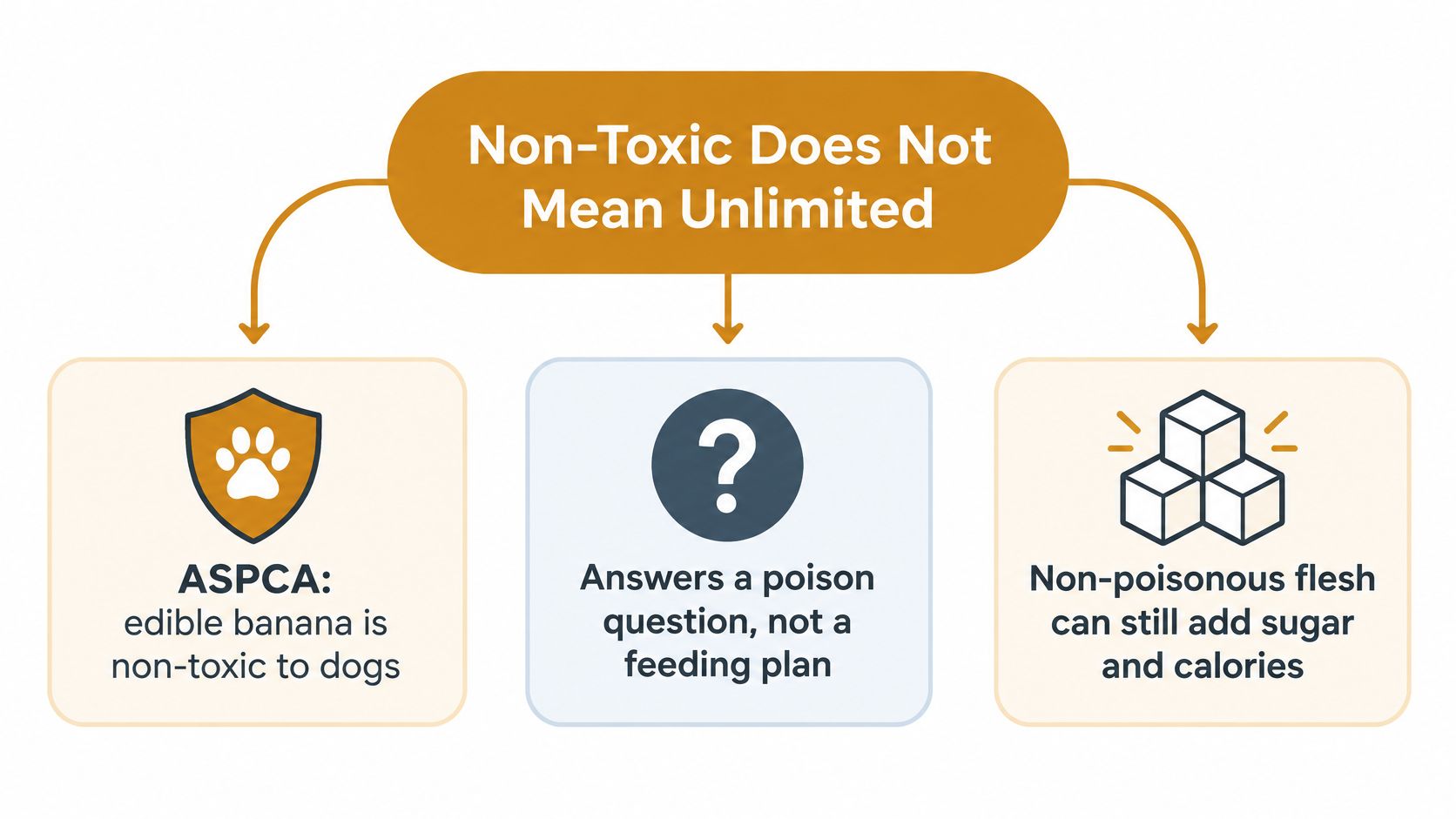
The ASPCA's Poison Control listing classifies edible banana as non-toxic to dogs, and that classification settles exactly one question: whether the fruit is poisonous. It does not set a serving size, and it does not say a dog benefits from eating it.
Non-toxic is a safety category, not a feeding plan. Flesh that won't poison a dog can still add sugar and calories a dog doesn't need, and it can't stand in for the nutrients a complete diet supplies.
The 90 percent side of the split
The rest of the daily calorie budget, roughly 90%, is meant to come from a complete and balanced food formulated for the dog's life stage. That ordering matters most for three groups the ASPCA guidance singles out: overweight dogs, dogs with diabetes, and dogs on therapeutic diets. A food that looks wholesome can still break a calorie target or a prescription.
Banana, biscuits, cheese, and leftovers all spend the same balance. Once the wallet is empty, the next wholesome food is an overspend.
Peel is a separate matter from flesh. The skin isn't classed as poisonous either, but it's difficult to digest, and a large swallowed piece carries a gastrointestinal obstruction risk. It isn't a serving, it isn't a fibre source worth counting, and it doesn't belong in the bowl.
What mashing it into the bowl does not do
A spoon of mashed banana stirred through kibble doesn't convert commercial food into a homemade diet, and it doesn't repair a diet that needs repair. The food stays the source of required nutrients and the fruit sits beside it as a small extra. That distinction is easy to lose when a bag of kibble and a banana look equally edible.
Owners of big dogs often reverse the logic and assume more body weight means more fruit freedom. The large dog size pages show why that assumption needs checking against breed-level conditions before any new food lands in the bowl.
The failure mode is predictable. An owner reads non-toxic, skips the ceiling, and blows past the row in the chart by a wide margin. Growth diets and prescription diets keep their authority, and banana waits for veterinary approval.
Nutrients in a Treat-Sized Piece of Banana
The case for banana rests on its nutrient list, not on any demonstrated effect on a dog's health. Allstate's veterinary-reviewed guide to fruits dogs can eat names the useful pieces: potassium, a mineral involved in normal muscle, nerve, and heart function, plus vitamins B6 and C and fiber.
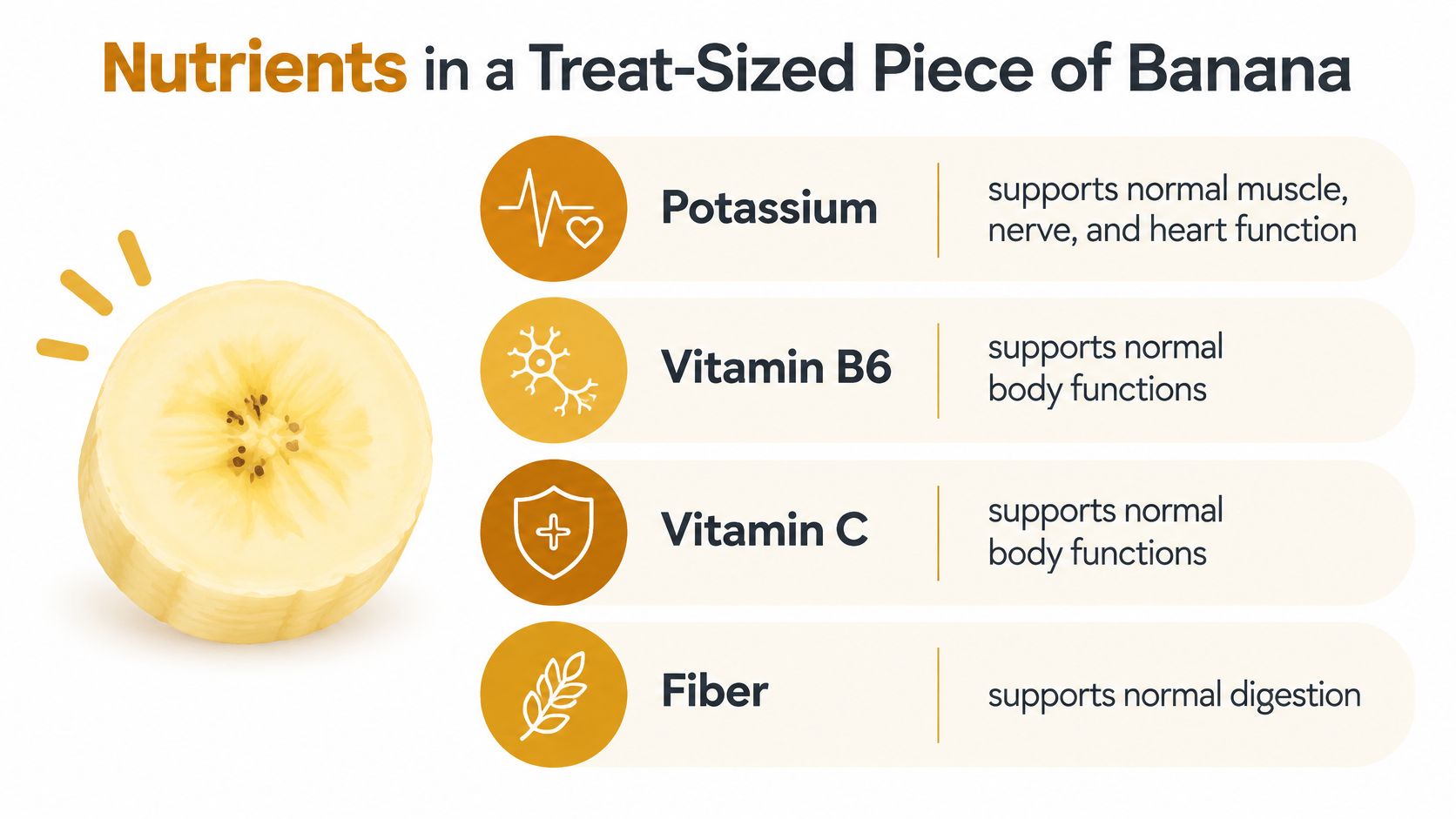
Those names sound like a supplement label, and that's the trap. The portion that fits under the ceiling is small, and small portions don't correct deficiencies.
What a treat portion cannot claim
Veterinary guidance doesn't establish that banana treats correct nutrient deficiencies or improve a healthy dog's outcomes. A dog eating a complete and balanced food already gets the potassium, B6, C, and fiber it needs from that food, and the banana adds variety rather than coverage. Banana is not a potassium treatment, a constipation cure, or a reason to cut the regular ration.
The tradeoff is sugar and calories. Feed banana generously and it works against a weight-management plan, and it can upset a gut even when the fruit itself is harmless. Fiber in a sudden large piece isn't the same as a vet-planned fiber adjustment for a chronic problem, and the two shouldn't be confused.
Portion control, not a universal slice count, is what the guidance recommends. The right amount depends on body size, total calorie requirement, age, activity, and medical conditions, which is why a fixed number of slices serves almost nobody well.
Serve it plain and peeled. Sweetened, flavored, or baked preparations add ingredients the dog doesn't need, and gradual introduction tells you more than any serving chart about how your dog handles fruit.
A treat portion is a condiment, not a course. It changes the plate slightly and doesn't rebuild the meal.
Dogs come in very different sizes, and the medium dog size pages place breed-level risk data next to the weight band, which is where questions about diet and digestion usually start.
The fair characterisation is a low-risk, nutrient-containing occasional treat. It is not a supplement canine nutrition requires and it is not a treatment for illness.
How to Serve Peeled Banana the First Time
The American Kennel Club treats human foods as occasional extras rather than part of the daily ration, and its banana guidance asks owners to introduce a small piece and watch for loose stool, vomiting, or other digestive changes. A first serving is a procedure, not a portion.
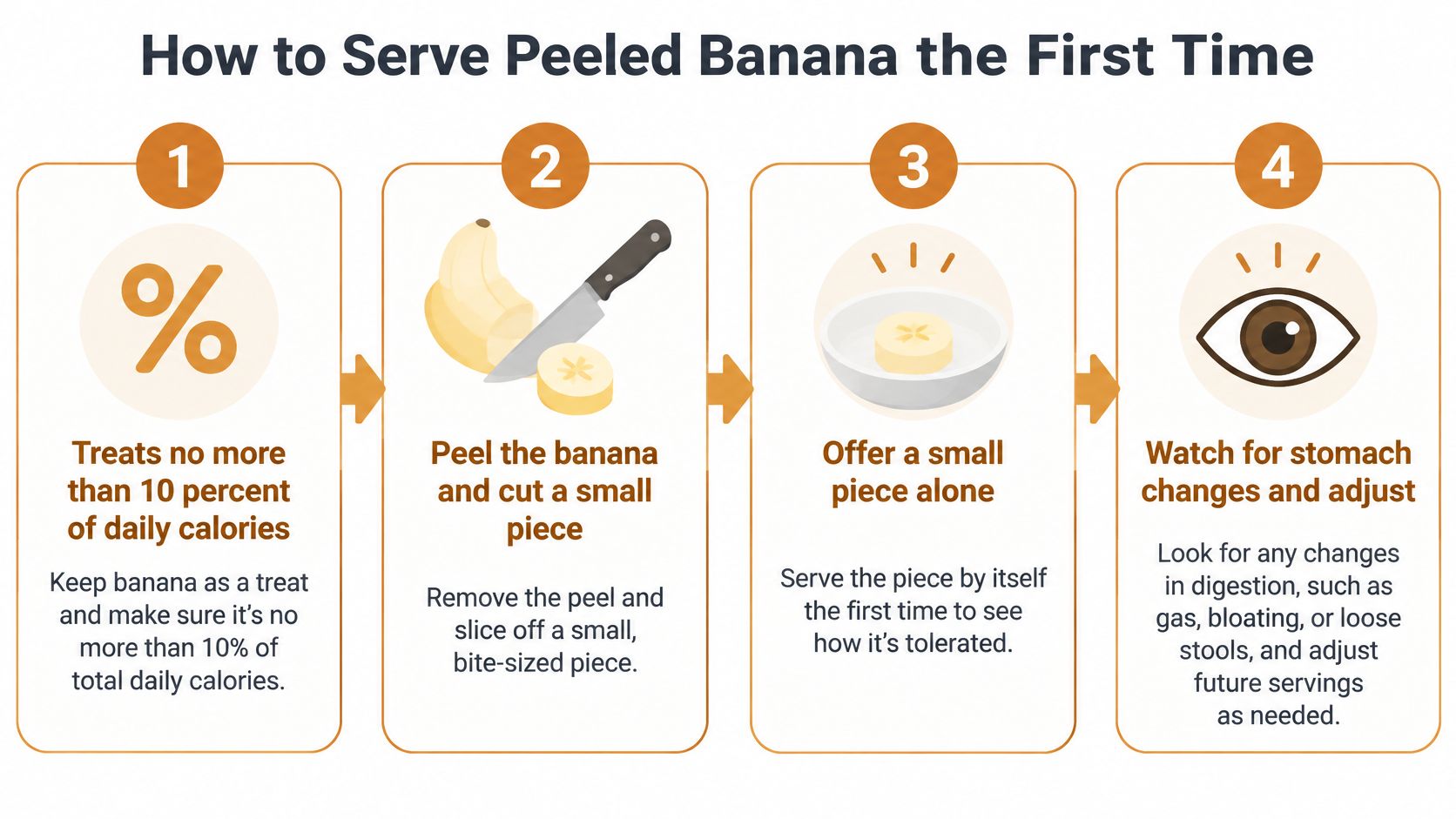
The first-time routine, in order
- Get the peel into the trash before the dog is in the room. A swallowed chunk of skin is a blockage question, not a snack, and it's easier to prevent at the counter than at the bowl.
- Serve the flesh plain. No sugar, chocolate, syrup, yogurt coating, or baked batter.
- Cut a piece under the ceiling for your dog's row. For a toy or small dog that means a few thin slices, not half the fruit.
- Offer it alone, not on top of dinner. One new food at a time is the only way to know what caused a change.
- Skip human spreads unless the label is checked. Xylitol is toxic to dogs and shows up in many human supplements as well as some spreads, so ask a vet before handing over any human supplement or probiotic capsule.
- Leave banana bread, smoothies, and human frozen treats out of it. These carry sugar, fat, and sometimes sweeteners a dog shouldn't get.
- Watch the rest of the day. Stool, gas, vomiting, and interest in the next meal tell you more than the first bite does.
Why the first piece should be smaller than the ceiling
A rapid diet change is the most common cause of soft stools in a healthy dog, and eating too fast is the second cause to rule out. That's the reasoning behind one new food at a time: if two things change on the same afternoon, you've lost the ability to tell which one did it.
Small dogs have the least room for error. Owners working through the small dog size pages will see the narrowest treat allowances in the chart, which is exactly where an oversized first piece does the most damage to a weight plan.
If the first small piece goes down well, later servings can move toward the ceiling. Banana still shouldn't become a daily staple, and a good week doesn't justify a bigger piece.
Dogs Who Need a Smaller Banana Allowance
The chart assumes a healthy adult at a stable weight. Several kinds of dog need a tighter rule than their row shows, and a few shouldn't get banana at all this month. Sort the dog before you sort the fruit.
Skip it, ask first, or use the chart
Skip it for now: diabetic dogs, dogs on any prescription or therapeutic diet, dogs in the middle of a weight-loss plan, and dogs with a history of pancreatitis, chronic gut disease, or food-responsive skin trouble. Human food can break a carbohydrate or calorie target even when the food itself is wholesome.
Ask the vet before the first piece: puppies. Growth foods are built to precise nutrient ratios, and banana should be a rare taste rather than a mixer stirred into the puppy meal. A dog with a diagnosed deficiency or a condition that limits potassium, sugar, or fiber belongs in this group too, because the chart doesn't override a treatment plan.
Use the chart, at the low end: sedentary dogs and seniors whose calorie needs have fallen. An older dog that used to sit in the medium row may now eat closer to the small row, and the treat allowance follows the calories, not the collar tag.
Size-based shortcuts exist and they're coarse. Nine.com.au reported that dogs weighing under 15 kg should receive no more than one-quarter of a banana per day, which is a sensible outer bound for a mid-sized dog and still too much for a toy dog whose entire cap sits near 35 kcal.
Body condition beats breed name. A lean, active 20 kg dog and a soft, inactive 20 kg dog shouldn't share the same habit just because the table shows one ceiling.
Breed background changes the calculation too. In our breed catalog, 26 of 226 breeds carry a digestive or allergy-based skin predisposition with an estimated probability of at least 15%, and those dogs are the last candidates for experiment-by-bowl when a new food arrives for variety.
If the dog already gets pill putty, dental chews, and three kinds of training treat, banana may not fit at all that day. The order of caution is skip, vet-approved small portion, then chart ceiling.
The toy dog size pages show where the smallest allowances sit, and they're worth reading before a four-pound dog gets a "small" piece sized for a spaniel.
Stomach Signs That Mean Calling the Vet
Too much banana, or banana introduced too quickly, produces loose stool, gas, vomiting, or a skipped meal. None of that is poisoning. Not all of it is safe to wait on.
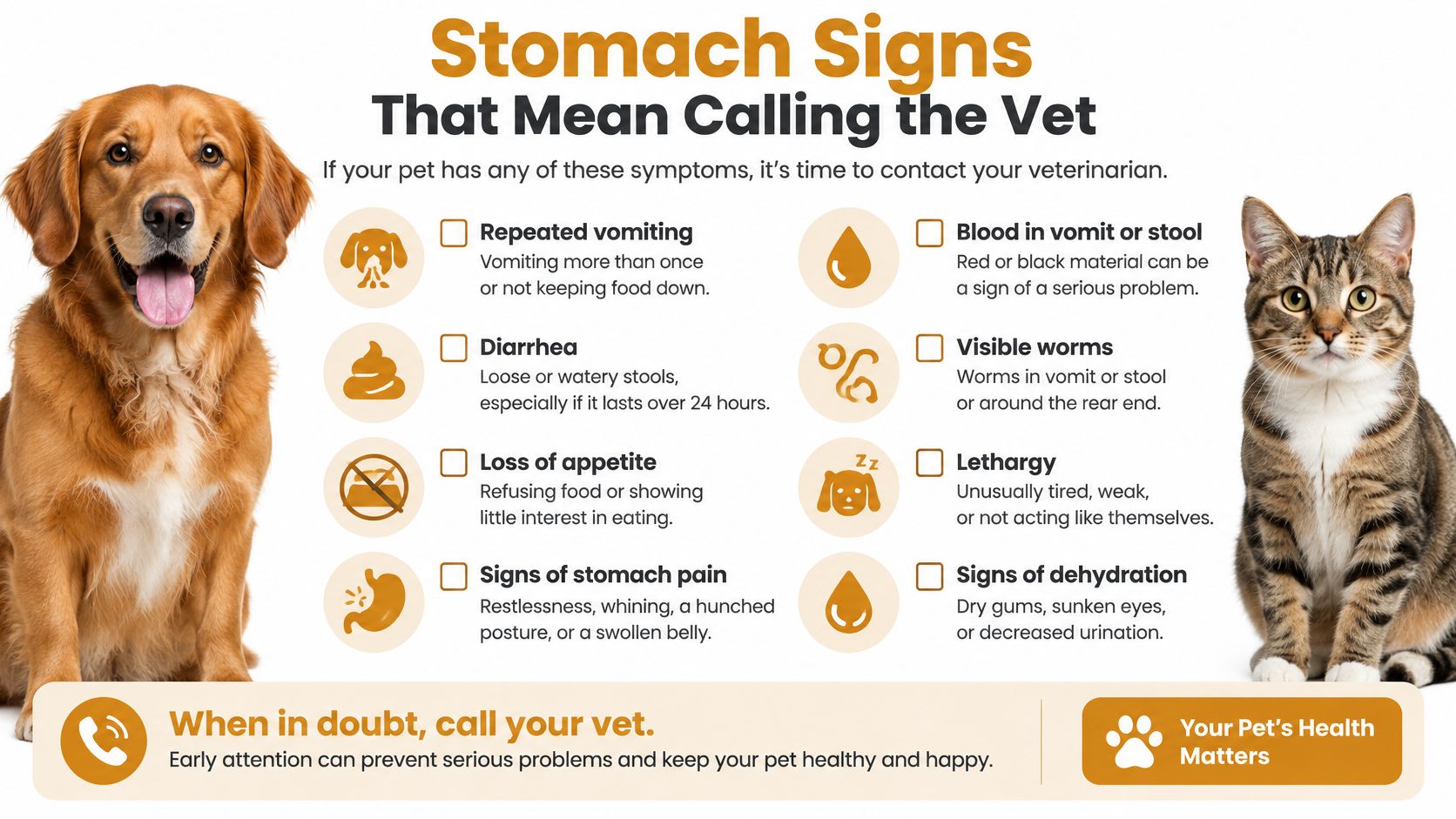
| What you see | Who it applies to | Action |
|---|---|---|
| One soft stool, dog still bright, eating and drinking | Healthy adult | Watch that day; call if it lasts past two or three days |
| Soft stool | Puppy, senior, or dog with an ongoing condition | Call the vet the same day |
| Vomiting, blood, or black tarry stool | Any dog | Call immediately |
| Large piece of peel swallowed | Any dog | Call the vet because of blockage risk |
| Dehydration, extreme lethargy, trouble breathing, or possible xylitol in the recipe | Any dog | Contact a veterinarian immediately |
When watching is enough, and when it isn't
A lively adult that's still eating and drinking gets a watching window of one day for soft stool, and past two or three days the call is the right move. Puppies, elderly dogs, and dogs with ongoing conditions don't get that window at all; for them, soft stools are a same-day call.
Blood, black or tarry stool, or vomiting jumps straight to the top of the table no matter how short the episode has been. Those signs aren't a reason to buy a product and wait.
Peel belongs in the call-now row because of obstruction risk, and a piece of skin is easy to miss when a dog eats fast. Tell the clinic how much banana went in, whether peel was involved, and every other ingredient in the bowl.
Describing what you saw speeds up triage, and our poop colour and consistency check tool gives owners a shared vocabulary for that conversation before they dial. It doesn't diagnose anything.
A remedy isn't a plan. For acute, passing diarrhoea, a probiotic's benefit is real but small and concerns how long the episode lasts, not its cause.
The AKC Gazette guidance on toxic foods is blunt about add-ins. Human food offered to a dog should be plain, small, and unseasoned, and peanut butter products must not contain xylitol, which the AKC identifies as deadly toxic to dogs even in small amounts. If an unsafe ingredient may have been eaten, contact a veterinarian immediately rather than trusting the banana's safety record.
This page isn't veterinary advice. A blockage, dehydration, or a toxin exposure is a veterinary event, and the response is a call, not a kitchen remedy.
Set the Treat Rule Then Check the Diet
Decide once, write it down, and stop renegotiating at the fridge. Three answers cover almost every dog.
- Healthy adult at a stable weight: banana stays on the list as a peeled occasional treat inside the size row, with every other snack subtracted from the same allowance.
- Diabetic, on a prescription diet, overweight, very young, or already carrying a full treat load: banana stays off until the veterinarian says otherwise.
- Any immediate-call sign from the previous table: stop the food experiment and phone the clinic.
After a mild episode that resolved, don't repeat the same amount the next day. Go back to the regular complete food and reintroduce a smaller piece on a quiet afternoon, when you'll be home to watch the stool that follows.
A gut upset, a blockage worry, or a toxin exposure is a veterinary event, not a kitchen problem, and what it costs depends on what the clinic finds and where you live. That's the kind of question our lifetime cost calculator handles by breed, state, and age, itemizing food, veterinary care, grooming, boarding, gear, and insurance rather than hiding local fees behind a national average; the free analysis asks four questions and returns one answer built from the same inputs.
Insurance questions belong with the comparison tools, not with a piece about fruit, and no supplement cures a medical condition.
The food choice an owner controls is the bowl plus a written treat cap, with banana filled in only when the row and the dog's health both allow it. That's a smaller decision than it feels like, and it's the one that keeps a good snack from working against the diet.
PetCostEngine builds lifetime projections by breed, state, and age, itemizing food, veterinary care, grooming, boarding, gear, and insurance so a treat decision and a care decision sit in the same frame. If this page has you rethinking the treat shelf, run your dog's details through the free analysis and see which categories drive the total. Visit PetCostEngine to start with your dog's breed, state, and age.
Modeled estimates for 226 breeds, with the formula and sources published in full.
See the data →
Premium dry food → Puzzle toys → No-pull harness →
As an Amazon Associate, PetCostEngine earns from qualifying purchases.