The bin looked like an upgrade. It holds a full bag, it latches shut, and it beats a crumpled sack with a chip clip in the corner of the kitchen. Three months later the bottom inch is a different color, the kibble carries a faint smell of the last two bags, and the packaging with the lot number went out with the recycling.
A dog food container earns its place by protecting the food and keeping the product's identity readable. Capacity matters less than most buyers think. The best dog food container is the one your dog empties before the food starts to turn.
Table of Contents
- Container Size Chart by Household and Feeding Volume
- Keeping the Bag and Its Label Together
- Material Trade-Offs in Warm and Humid Homes
- Airtightness and Lid Features to Check Before You Buy
- How to Clean, Dry and Rotate Food in Your Container
- Confirm Your Setup and Know When to Call the Vet
Container Size Chart by Household and Feeding Volume
| Household | Typical daily feeding | Food for 3 weeks | Container capacity to target |
|---|---|---|---|
| One small dog (under 20 lb) | 0.5 to 1 cup | about 3 to 5 lb | 5 to 10 lb |
| One medium dog (20 to 50 lb) | 1.5 to 3 cups | about 8 to 16 lb | 20 to 25 lb |
| One large dog (over 50 lb) | 3 to 5 cups | about 16 to 26 lb | 25 to 30 lb |
| Two medium dogs | 3 to 6 cups | about 16 to 32 lb | 35 lb |
| Two large dogs | 6 to 10 cups | about 32 to 53 lb | 55 lb |
Match your daily scoop to a row, then target a container that holds about three weeks of food.
Three weeks is the number that makes the rest of this work. Kibble starts losing aroma and fat-soluble vitamins once air reaches it, and the best-by date is stamped for a sealed bag, not an open one. Size the bin so the food turns over inside that window and you never reach a stale last third.
Two numbers drive every row. The first is weight per cup, and a cup of typical kibble weighs about 4 ounces, though dense formulas run heavier. The second is the feeding chart on the bag, which overrides this table entirely: a working dog on a performance formula and a couch dog on a light formula can sit a full cup apart at the same body weight.
Sizing rule: buy for the food you'll finish in three weeks, not for the bag you just carried in from the car.
Oversizing is the common mistake. A 50 lb bin holding 12 lb of kibble leaves a large headspace that exchanges air every time the lid opens, and it ends up wherever the house has floor space, which is often the warm corner. A container that's slightly too small is the milder problem. You refill more often, and refilling is fine as long as the bin gets washed between bags.
Households that rotate proteins or feed two formulas need one container per food, not one bin with a mix at the bottom. Once you know your daily volume, our lifetime cost calculator carries that feeding rate into the food line of a breed-and-state projection, so the container decision sits next to the rest of the plan.
The test you can run tonight: scoop your normal daily ration into a measuring cup, write the number down, multiply it by 21, and find your row. If the answer lands between rows, size up, because a bin packed to the lid is hard to scoop from without spilling half of it on the floor.
Keeping the Bag and Its Label Together
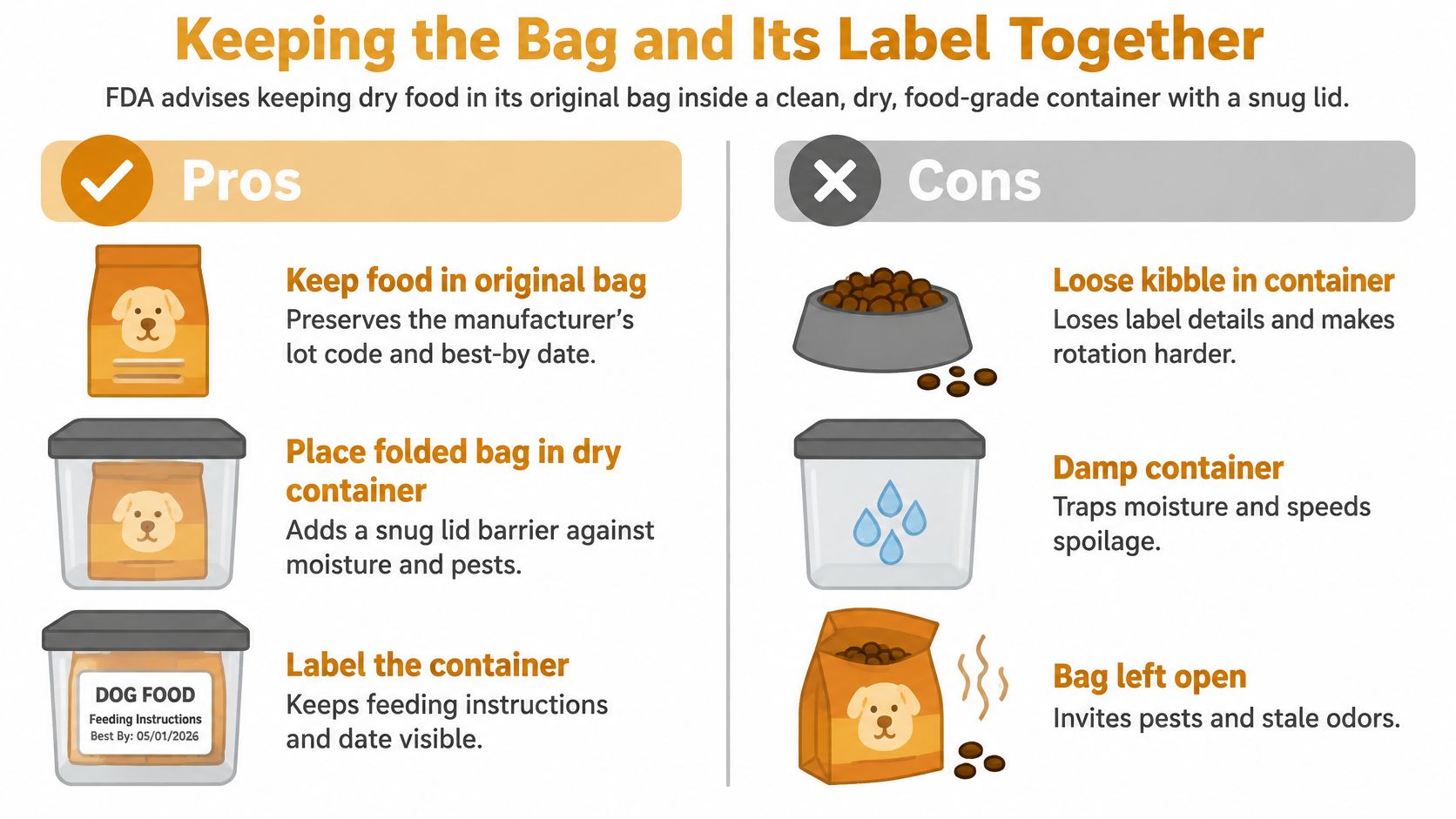
The U.S. Food and Drug Administration recommends keeping dry dog food in its original bag, and if you add a container, putting the whole bag inside it. The FDA's guidance on storing pet food and treats leads with the reason: the bag preserves the product name, UPC, lot number and best-by date needed to identify a specific product during a defect investigation or recall. The same page sets the container conditions, which are clean, completely dry, and fitted with a snug lid. The American Veterinary Medical Association makes the same call, recommending the original bag go inside a clean, dedicated, airtight container whenever possible.
The bin is also the one piece of packaging you buy once. Petfood Industry, citing Pet Sustainability Coalition estimates, puts U.S. pet food and treat packaging waste at about 300 million pounds a year, with more than 99% of dry dog food bags going to landfill rather than being recycled, a direct consequence of the multilayer films and coatings that protect kibble from moisture and punctures but defeat curbside sorting (Petfood Industry on pet food packaging and sustainability). Keeping the bag inside a durable container doesn't fix that system, but it does replace a monthly disposable with a single object you'll own for years.
The trade-offs of keeping the bag come down to a short list.
Bag-in-Bin Versus Direct Fill
Bag-in-bin wins on almost every measure that matters. The bag acts as a second barrier, so fats and oils stay where they belong, the kibble never touches a surface you have to scrub, and the identifying panel stays with the food. The one requirement is fit: choose a food-grade container large enough that the folded bag sits inside without being compressed, because a bag crushed against the walls develops pinholes and splits at the seams.
Direct fill gives you a tidier counter and easier scooping. It also deletes the label, which is the point where you start relying on memory for a lot number you'll never recall under pressure.
Then there's the topping-up trap. Fresh kibble poured over the crumbs and oil film of the previous bag leaves the oldest food at the bottom of the bin, where the scoop never quite reaches it. Repeat that four or five times and you've built a permanent layer of stale food that flavors everything above it. If you pour, the rule is simple: empty and wash the bin between bags, every time.
The Four Items to Record
The AVMA's guidance on safe handling of pet food and treats covers the case where the bag doesn't survive the transfer. Keep the section showing the complete product name, manufacture date, lot number, and expiration or best-by date. Those details support traceability if a product is recalled or if a dog falls ill after eating it.
Four items, plus the date you opened the bag. Photograph the panel before you throw it out, or cut it free and tape it inside the lid. Update the record every time a new bag goes in, because an unlabeled bin holding three-quarters of an old bag tells you nothing when a recall notice names a lot code.
Multi-dog households and anyone rotating diets should run one labeled container per food. Two bins with two label cards takes ten seconds to set up and prevents the wrong food going into the wrong dog during a week when it matters.
If you can't read the lot number on the container, the container has already failed the one job that counts after a recall notice.
Material Trade-Offs in Warm and Humid Homes
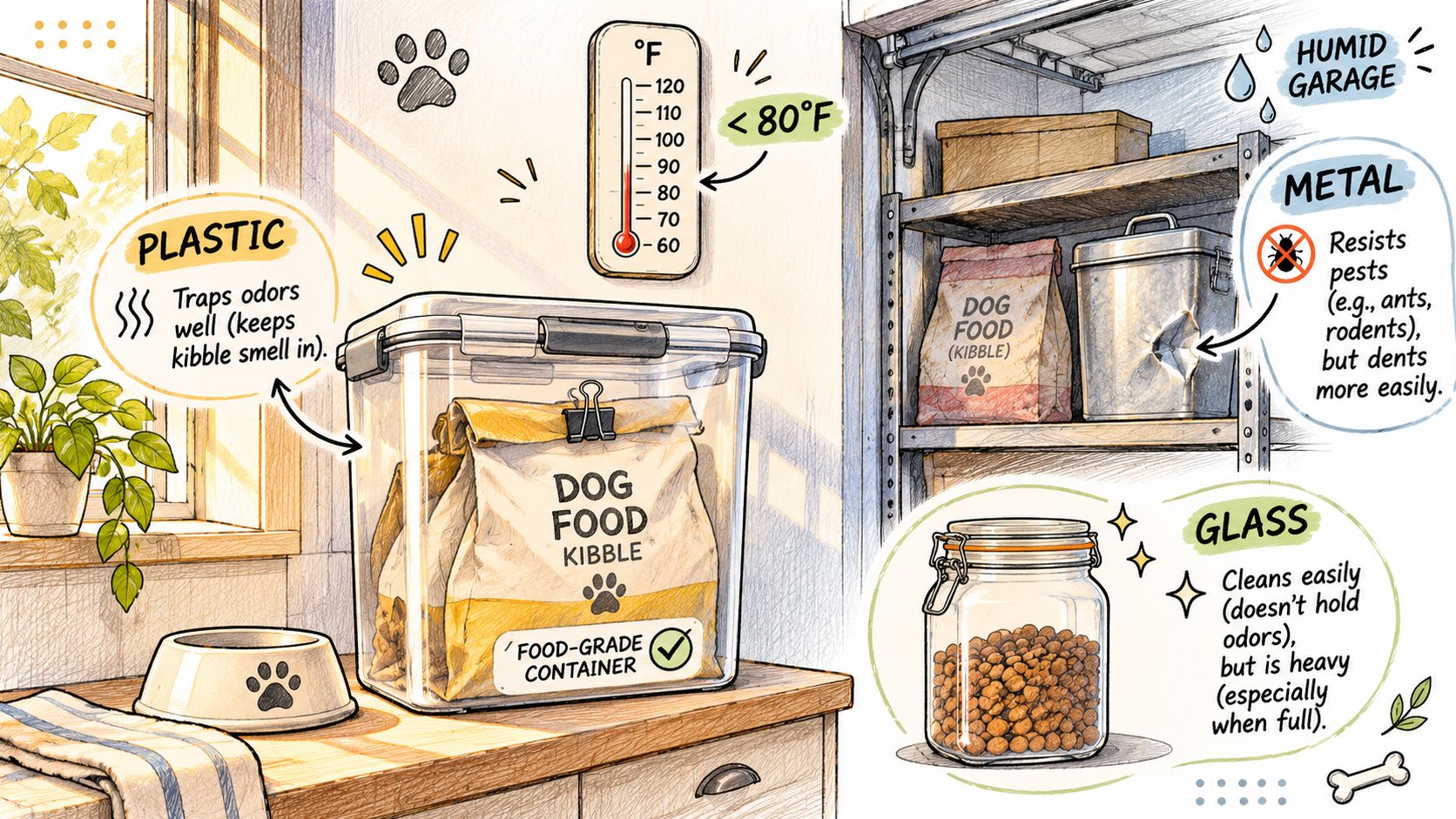
Dry food has a temperature ceiling. The FDA's tips for safe handling of pet food and treats puts the storage spot below 80°F in a cool, dry place, and that single line reshapes the material question. A summer garage, a shed, or a kitchen corner that catches afternoon sun can sit well past that mark for hours at a time.
Four common materials, judged by what they do rather than how they look.
| Material | Strengths | Watch for | Best fit |
|---|---|---|---|
| Food-grade plastic (HDPE or polypropylene) | Light and easy to move | Can hold odor and oil in scratches | Cool pantry with frequent washing |
| Stainless steel | Resists odor transfer and cleans quickly | Heavier and can dent | Warm or humid homes and frequent opening |
| Glass with airtight lid | Shows food level and blocks odor | Breakable and admits light | Dark, cool cabinet |
| Gasketed rigid bin | Strong seal | Gasket can trap crumbs unless removable | Owners who will clean the gasket every wash |
Decision Rules by Room
For a hot garage or a humid laundry room, pick metal or a well-sealed plastic bin and move the food indoors anyway. No container beats a room that's too warm. For a climate-controlled pantry, food-grade plastic is fine if you wash it often enough that the walls never feel slick.
Material matters most where the food is opened daily. A small stainless canister that holds a week of kibble protects the working supply better than a large rolling bin you open four times a day, because every opening swaps the headspace air. Rolling containers ease access for anyone with back trouble, but the wheel wells and deep corners are the hardest places to clean, and that's where old oil collects.
Keep every container off the floor, away from heaters, and out of direct sun, whatever it's made of. Then check what happens when the bin finally goes: multilayer kibble bags aren't accepted curbside, while rigid containers have clearer pathways. The EPA's containers and packaging figures put PET bottles and jars at a 29.1% recycling rate and HDPE natural bottles at 29.3%, against 8.7% for plastics overall, so a rigid bin at least has a route that a coated film never will.
One test beats every spec sheet: wash the empty container, let it dry, and smell it. An oily film or a lingering odor means the material is holding onto the last bag.
This covers dry kibble only. No container here is ranked, and opened wet food follows refrigeration rules of its own.
Airtightness and Lid Features to Check Before You Buy
Airtight means a seal that keeps out air, moisture and pests, not a lid that snaps shut with a satisfying click. Plenty of bins marketed as airtight have a single latch on the front and a lid that lifts at the back corner. The seal is what you're buying, so check it before the bin goes in the cart.
Here's the checklist I'd run in a store aisle or against a product page.
- A gasket that comes out without tools. A silicone ring you can lift, rinse and refit is the difference between a clean bin and a permanent crumb trap.
- Latches on more than one side. Two or four latches distribute pressure across the rim. One latch pulls the lid tight at the front and leaves a gap at the back.
- A lid lip that seats over the rim, not inside it. An overhanging lip sheds spills and blocks the seam where insects and moisture enter.
- A mouth wide enough for your scoop. Narrow openings force you to tip the bin, which sends dust into the air and cracks kibble.
- No hidden crevices. Look at the inside corners and the underside of the lid. Rounded interiors wipe clean in one pass.
- Capacity marked on the body. A bin that states its volume in quarts or pounds saves you the guesswork of the chart above.
- Replacement gaskets or parts sold separately. A seal that can't be replaced turns a two-year container into a one-year container.
A manufacturer should disclose the food-contact materials, whether the body and lid are food-grade, the temperature limits, and whether the lid and gasket are dishwasher safe. If the listing is silent on all four, that's your answer.
The Paper-Strip Test
Do this at home in under a minute. Close the lid on a strip of paper at six points around the rim. Where the strip slides out with no resistance, the gasket isn't gripping. Then hold the seam up to a window and look for daylight. Any bright line is a leak, and a leak in a humid kitchen is a mold problem waiting for a slow-eating dog.
Pests change the material answer too. Rodents and pantry beetles chew thin plastic, so a container kept in a garage or a utility closet is better in metal or in thick-walled plastic with recessed latches rather than exposed clips.
Three things to ask the manufacturer before you buy: how the gasket is replaced, whether the body has food-contact certification, and what washing method they recommend. Answers to those three tell you more than a seal graphic on the box.
How to Clean, Dry and Rotate Food in Your Container
A container that never gets washed is a slow composting system for kibble dust. The routine below takes about ten minutes and belongs on the calendar for the day a new bag is opened, not on the day you notice a smell.
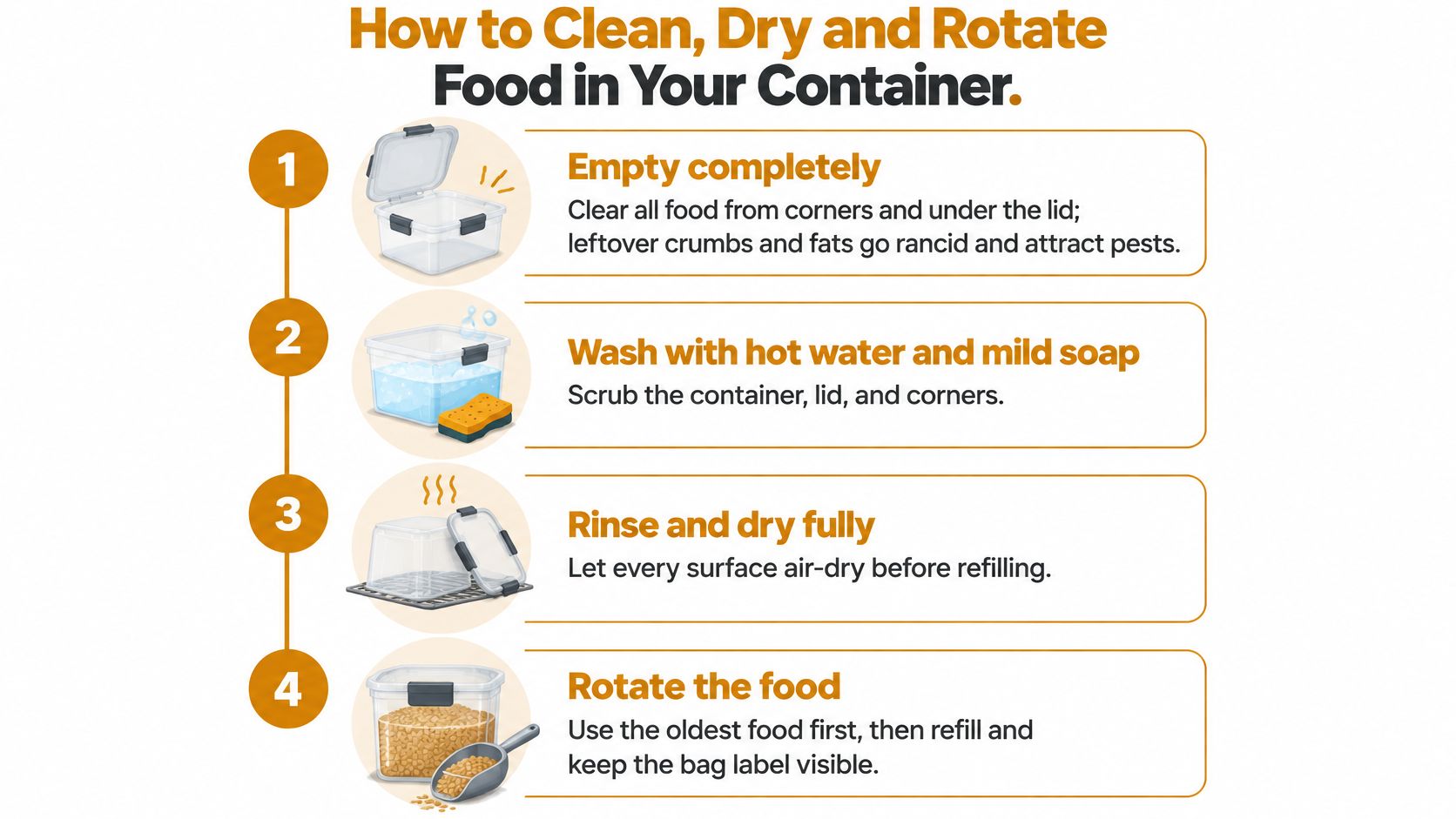
- Empty it completely. Tip out every scoop, then wipe the corners and the underside of the lid with a dry cloth. Leftover crumbs and fats go rancid and pull in pests, and the bottom layer is exactly where you can't see them.
- Wash with hot water and mild unscented dish soap. Scrub the body, the lid, and especially the gasket and the channel it sits in. The common slip is a quick rinse of the visible surfaces while the gasket keeps a film of old oil.
- Rinse thoroughly and air dry with the lid off. Leave it upside down until no moisture remains anywhere. Closing a damp container traps humidity against the next bag of kibble and invites mold.
- Wipe the interior with a dry cloth. Skip scented cleaners and sprays. Plastic picks up fragrance, and kibble picks it up from the plastic.
- Check the date before you refill. Read the best-by date on the new bag, put the newest bag behind the older one, and write the opened date on the bag or the container. First in, first out keeps the food moving instead of stacking.
- Add the food and close the lid fully after every scoop. A lid propped open between meals is an open invitation to pantry moths and to humidity.
- Repeat the full wash with each new bag. For a slow eater or a small dog working through a large bag, add a wash every few weeks even if the bag isn't finished.
For a visual pass through the routine, watch it once before you set your first reminder.
Three signals mean the container needs a full clean before the next scoop, or the food needs to go: a sour or rancid smell when you open the lid, kibble clumping together in the bin, and an oily film on the interior walls. Clumping usually means moisture, and moisture is the one thing a seal is supposed to keep out. If the food itself smells off, discard it rather than mixing fresh kibble on top.
Confirm Your Setup and Know When to Call the Vet
Run the setup in order once, then it only needs a glance before each new bag.
- Size. Your container matches a row in the chart above, not the bag size you happened to buy.
- Traceability. The folded bag fits inside without compression, or your label record is current and includes the lot number.
- Material. Metal or sealed plastic if the room runs warm or humid, glass or plastic in a cool pantry.
- Seal. The paper-strip test passed and the seam shows no daylight.
- Location. Off the floor, out of the sun, away from heaters, and never in a garage or shed.
- Cleaning reminder. Set for the day you expect to open the next bag.
Before you break the seal on the next bag, confirm four things: the container still fits the folded bag or your label card is updated, the storage spot stays cool and dry, the gasket is clean and seated, and the lot number is written down where you can find it in a hurry.
When to Call Your Vet
Even with perfect storage, a new bag can bring a diet change, and a diet change can bring loose stools. Storage problems look like digestive ones, so it helps to know where the line sits.
- Puppies, senior dogs, and dogs with ongoing conditions: soft stools are a same-day call. Their margin for dehydration is thin.
- An adult, lively dog that's eating and drinking: one day of soft stools can be watched. Past two to three days, call.
- Anything that doesn't fit the pattern: vomiting that won't stop, lethargy, or blood in the stool means a call to your vet regardless of what food is in the bin.
- No DIY supplements. Don't give human probiotics without asking your vet first. Xylitol is toxic to dogs and shows up in many human supplement products.
The two to three day window is a practical rule of thumb, not a published standard. If your dog is a puppy, a senior, or already managing a condition, treat day one as the day to call.
When the setup is done, keep it honest with your household's real numbers. The free tools on the site recheck household size, feeding volume and the storage plan as your dog grows, so the container you bought for a nine-week-old puppy gets replaced before it becomes the wrong size.
PetCostEngine turns a feeding plan into a household number: the lifetime cost calculator itemizes food, vet care, grooming, boarding and gear by breed, state and age, so you can see what a larger dog or a different formula does to the yearly picture. The breed pages also flag health risks that change feeding and storage needs as a dog ages, which matters more than any container feature when you're planning ahead. Visit PetCostEngine to answer four questions and get one projection built around your dog.
Modeled estimates for 226 breeds, with the formula and sources published in full.
See the data →
Premium dry food → Slow-feeder bowl → Digestive support →
As an Amazon Associate, PetCostEngine earns from qualifying purchases.