
Water above 45°C can cause thermal injury when a warm container stays against an animal's skin, according to the veterinary burn guidance in Burns First Aid for Pets. A dog heating pad doesn't have to feel scorching to become hazardous. How long your dog stays on it, and whether they can leave, matters as much as the heat setting.
The safest starting point isn't the product label. It's your dog's ability to stand, reposition, notice discomfort, and walk away. Use the decisions below to separate supervised comfort care from situations that need a veterinarian's direction.
Table of Contents
- Which Dogs Can Safely Use a Heating Pad
- Temperature Limits That Cause Burns
- What a Pet Heating Pad Label Should Disclose
- Safe Setup and Supervision Procedure
- When Heat Makes an Injury Worse
- Burn Signs and What to Do First
- Confirm Heat Use With Your Vet First
Which Dogs Can Safely Use a Heating Pad
Heating pad use by dog situation
| Dog situation | Use decision | Supervision and main hazard |
|---|---|---|
| Alert adult dog that moves freely | Supervised use on the lowest setting | Watch throughout. Contact burns remain possible if the dog falls asleep on the pad. |
| Senior or arthritic dog that still walks | Supervised use with an unheated retreat | Stay nearby. Stiffness may limit movement once the dog settles. |
| Dog recovering from surgery | Use only if the vet approves | Follow the recovery plan. Reduced sensation and restricted movement can increase risk around the incision. |
| Sedated, anesthetized or drowsy dog | Do not leave on an electric pad unattended | Veterinary direction and continuous monitoring are essential because the dog may not reposition. |
| Puppy or teething puppy | Supervised use only, cord out of reach | Watch both the puppy and cord. Chewing can cause electrical and mouth injuries. |
| Paralyzed or neurologically impaired dog | Use only under veterinary direction | The dog may not reliably sense heat or escape it. |
Mobility means more than being able to walk across the room. Your dog must also be able to rise from the actual sleeping surface, turn around, and step off the heated area without help. A soft bed or awkward placement can make that harder than walking on a firm floor.
The American Kennel Club cautions that dogs with limited movement may be unable to escape rising temperatures. Puppies and senior dogs need extra supervision, but age alone doesn't settle the decision. An alert senior who moves freely presents a different situation from a younger dog recovering from spinal surgery.
VetzInsight's heating-pad safety guidance emphasizes low heat, protective padding, and the animal's unrestricted ability to move away. Those conditions matter even when the package says the device is designed for pets.
Practical rule: If your dog can't reliably leave the heat without assistance, don't improvise a home warming arrangement. Get veterinary input before using an electric pad.
Watch your dog get up before deciding. Don't assume that a dog who could move comfortably earlier can still do so after medication, exercise, or a period of rest.
Temperature Limits That Cause Burns
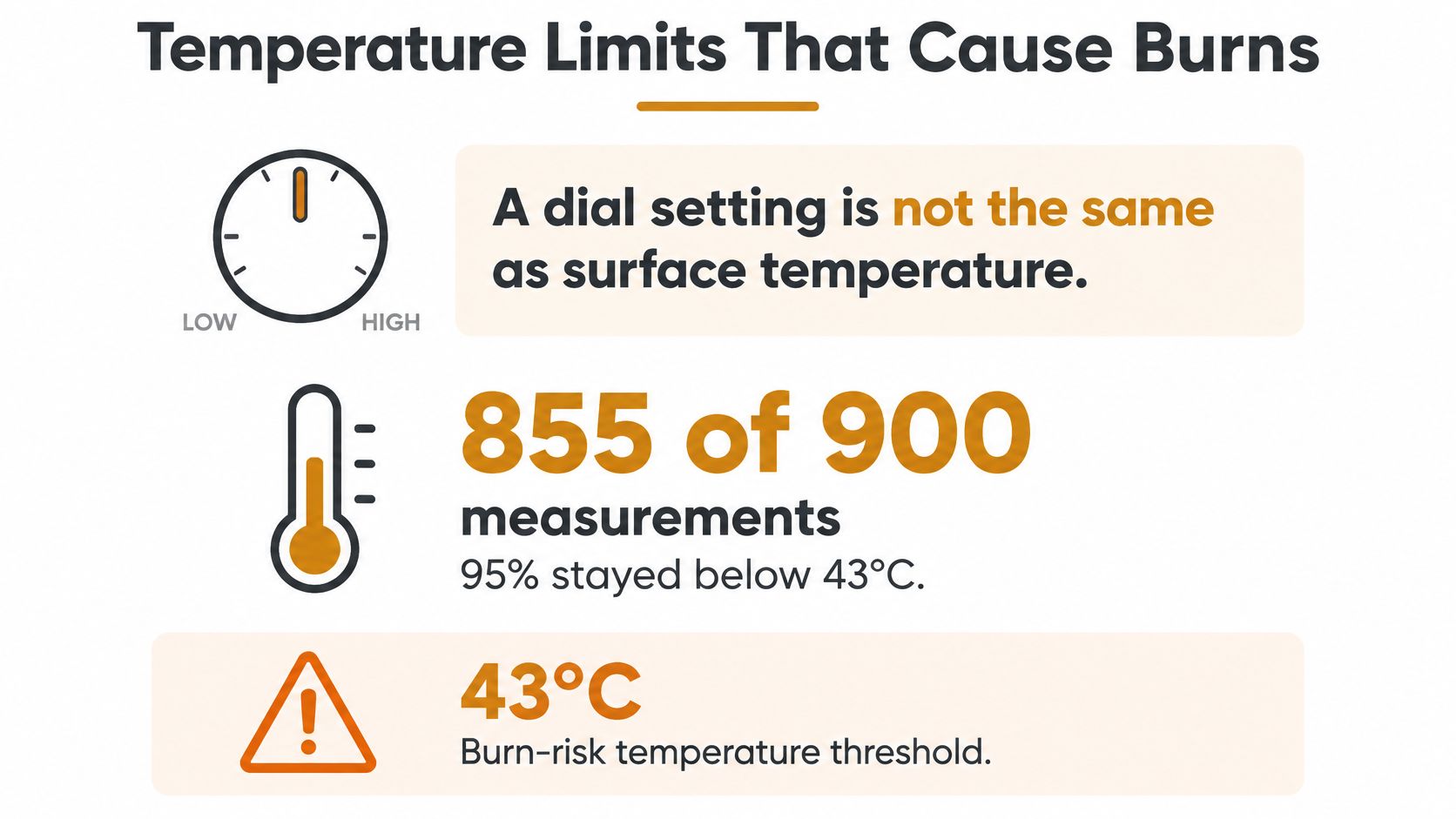
A dial setting isn't the same as surface temperature. In a 2018 study of a veterinary patient-warming system summarized in the North Carolina Veterinary Medical Board bulletin, 855 of 900 measurements, or 95%, stayed below the 43°C controller setting, while 45 measurements, or 5%, reached or exceeded it; readings ranged from 29.8°C to 45.8°C.
Those measurements came from simulated clinical conditions, not a test of every household dog heating pad. They demonstrate why a thermostat display shouldn't be treated as proof that the entire contact surface has a uniform temperature.
The temperature distinctions are shown below.
Surface temperatures and the injury risk each carries
| Surface temperature | Risk shown in veterinary sources |
|---|---|
| 29.8-45.8°C | Observed range across the clinical-system study; the controller setting didn't describe every surface reading. |
| 43°C | Controller setting in that study; some readings reached or exceeded it. This isn't a universal safe-versus-burn cutoff. |
| 45°C (113°F) | Skin temperatures above this can cause irreversible tissue damage. |
| 70°C (158°F) | Temperatures above this may cause a full-thickness burn after approximately one second. |
Veterinary Practice News' heating-device guidance identifies skin temperatures above 45°C (113°F) as capable of irreversible tissue damage and temperatures above 70°C (158°F) as capable of a full-thickness burn after approximately one second. These are injury warnings, not recommended home settings.
Contact time changes the risk
A dog who can't reposition keeps absorbing heat at the same contact points for an extended period. A surface that feels only mildly warm during a brief touch can therefore still injure during prolonged exposure.
Choose temperature-limited equipment rather than relying on an unexplained high/low switch. Before your dog lies down, check the covered surface with the back of your hand, including its edges and center. Any hot spot is a reason to lower the setting or stop, and a comfortable hand check still isn't a guarantee of safety.
What a Pet Heating Pad Label Should Disclose
We haven't tested heating pads and don't name a best pick. Evaluate the label and manual as safety documents, not as promises that a device suits every dog.
The Pet Infrastructure heated-bed safety guide identifies pet-specific construction, temperature controls, protected cords, suitable covers, and recognized electrical-safety listings as useful safeguards. Look for concrete specifications rather than reassuring words alone.
Label checklist
- Explicit pet use: The intended animal use and permitted environment should be stated. Don't substitute a generic human pad.
- Surface temperature control: Look for the temperature limit, how it's controlled, and whether heating is gradual.
- Cord protection: Check for a protected or chew-resistant cord and instructions for routing it safely.
- Insulating cover: Identify the supplied cover's material, washing instructions, and replacement requirements.
- Electrical-safety listing: Look for UL, ETL, or MET identification and certification details for the actual device.
- Moisture protection: Confirm which components are water-resistant and the conditions in which they may operate.
- Operating instructions: The manual should explain placement, approved coverings, session restrictions, and shutdown.
A thermostat helps control heating, while cord protection reduces access to electrical components that could injure the mouth. An electrical-safety listing addresses equipment safety requirements. None of these features compensates for a dog who can't move away.
Low-voltage construction may reduce shock severity compared with direct mains-powered equipment. It doesn't eliminate burns, overheating, chewing, moisture, or fire hazards, and “chew-resistant” doesn't mean safe to chew.
A safety feature reduces a particular hazard. It doesn't make the whole setup risk-free.
Placement instructions still apply after the label passes your checks. Keep the pad flat, avoid damaged wiring and uncontrolled moisture, and don't add heat-trapping bedding unless the manufacturer explicitly permits it. If the manual doesn't explain a proposed arrangement, don't guess, and ask your veterinarian whether the category is appropriate before buying.
Safe Setup and Supervision Procedure
Prepare for one supervised session at a time, not an open-ended source of heat. The American Kennel Club's heated-bed guidance emphasizes a dog's ability to move away, extra caution for puppies and seniors, and monitoring for overheating.
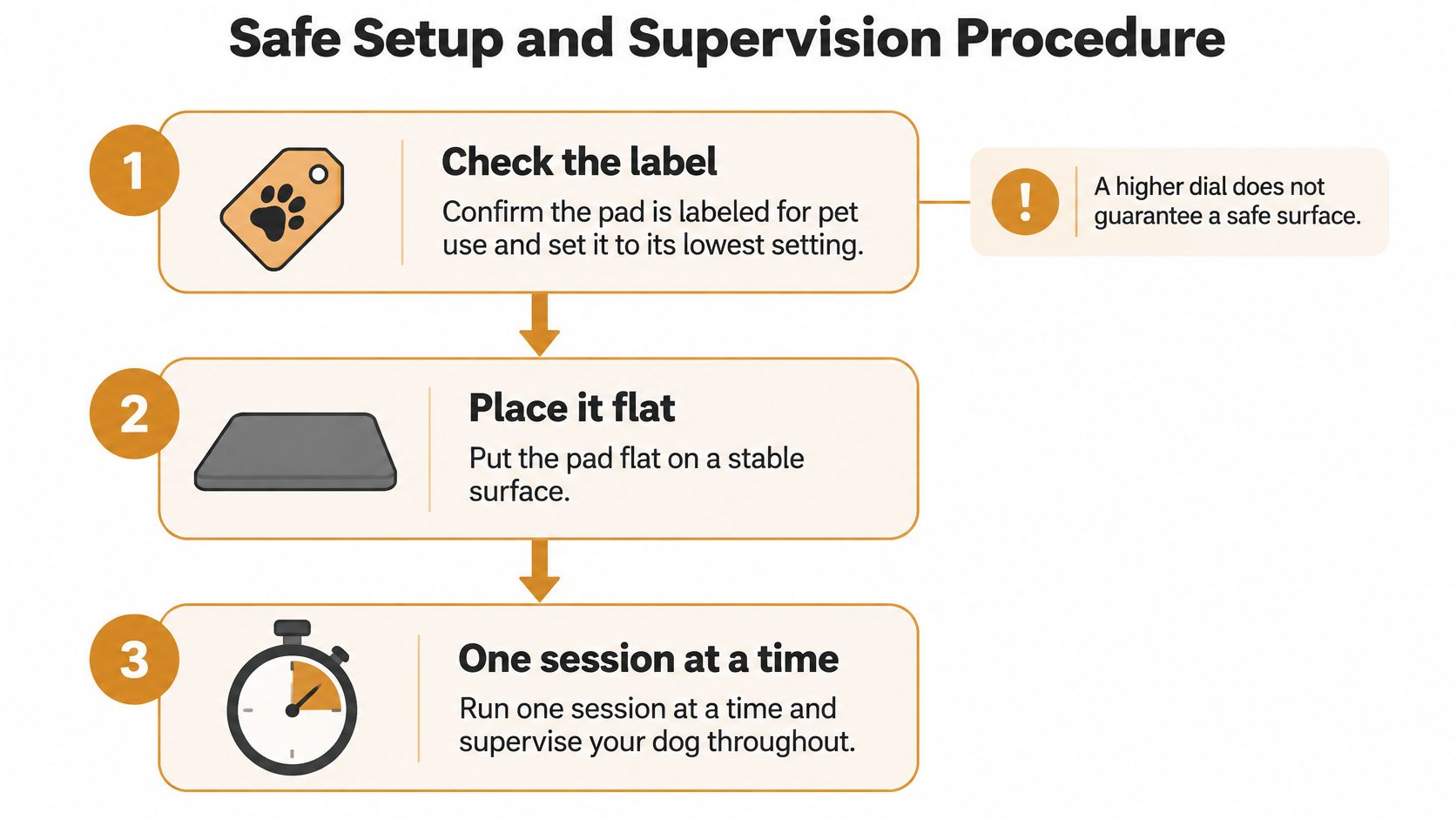
Start with the basic setup shown below, then complete every check in the procedure.
Before and during each session
Confirm pet use and select the lowest setting. Read the label before plugging in the pad, and use it only within your veterinarian's plan. Starting low limits contact heat, but a higher or lower dial position doesn't certify the surface as safe.
Place the pad flat on a stable surface. Keep it away from water and drafts, and inspect for damaged, stretched, or trapped wiring. Stable placement avoids bunching and prevents your dog from having to negotiate an awkward exit.
Use the approved insulating barrier. Fit the manufacturer's cover, or use a substantial towel only if the manual permits that arrangement. Never fold the pad or wrap it in unauthorized layers, because added insulation can trap excessive heat.
Provide an unheated retreat immediately beside it. Put regular bedding within easy reach, without a raised edge or obstacle that makes stepping away difficult. Your dog needs a genuine choice between heated and unheated surfaces.
Check for hot spots before contact and during use. Run the back of your hand across the covered surface rather than touching only one corner. An uneven or hot area warrants stopping and checking the equipment, not moving the dog onto a different part of the same pad.
Choose a session you can supervise throughout. Stay close enough to notice changes in posture and behavior, and use the duration your veterinarian specifies. Never leave a sedated, elderly, or immobile dog unattended; dogs with impaired movement need veterinary direction before starting.
Stop at signs of discomfort or excess warmth. Heavy panting, restlessness, repeated shifting, or feeling unusually hot are reasons to end the session. Don't hold your dog on the pad or coax them back after they leave.
Keep the cord inaccessible and unplug afterward. Route it outside chewing reach without stretching it across a walkway. Unplugging ends exposure and prevents a later, unsupervised return to the heated surface.
Regular bedding is usually the better overnight choice. Treat a heated bed as a supervised warming aid, not a night-long heater that you leave running while everyone sleeps.
When Heat Makes an Injury Worse
Heat decisions by situation
| Situation | Heat appropriate? | Next step |
|---|---|---|
| Stiffness a vet has linked to arthritis | Possibly, under a vet-approved plan | Low setting with an unheated retreat |
| Hot, swollen or red joint | No | Call your vet the same day |
| Fresh wound, stitches or surgical site | No, unless the vet directs it | Contact the vet before any heat |
| Sudden inability to bear weight | No | Same-day veterinary assessment |
| Cold, shivering, weak or lethargic dog | Heat alone is not enough | Urgent veterinary care |
| Chewed cord or suspected burn | No | Unplug safely, stop exposure and call a vet now |
Use symptoms and diagnosis, rather than apparent enjoyment, to decide whether warming belongs in the care plan.
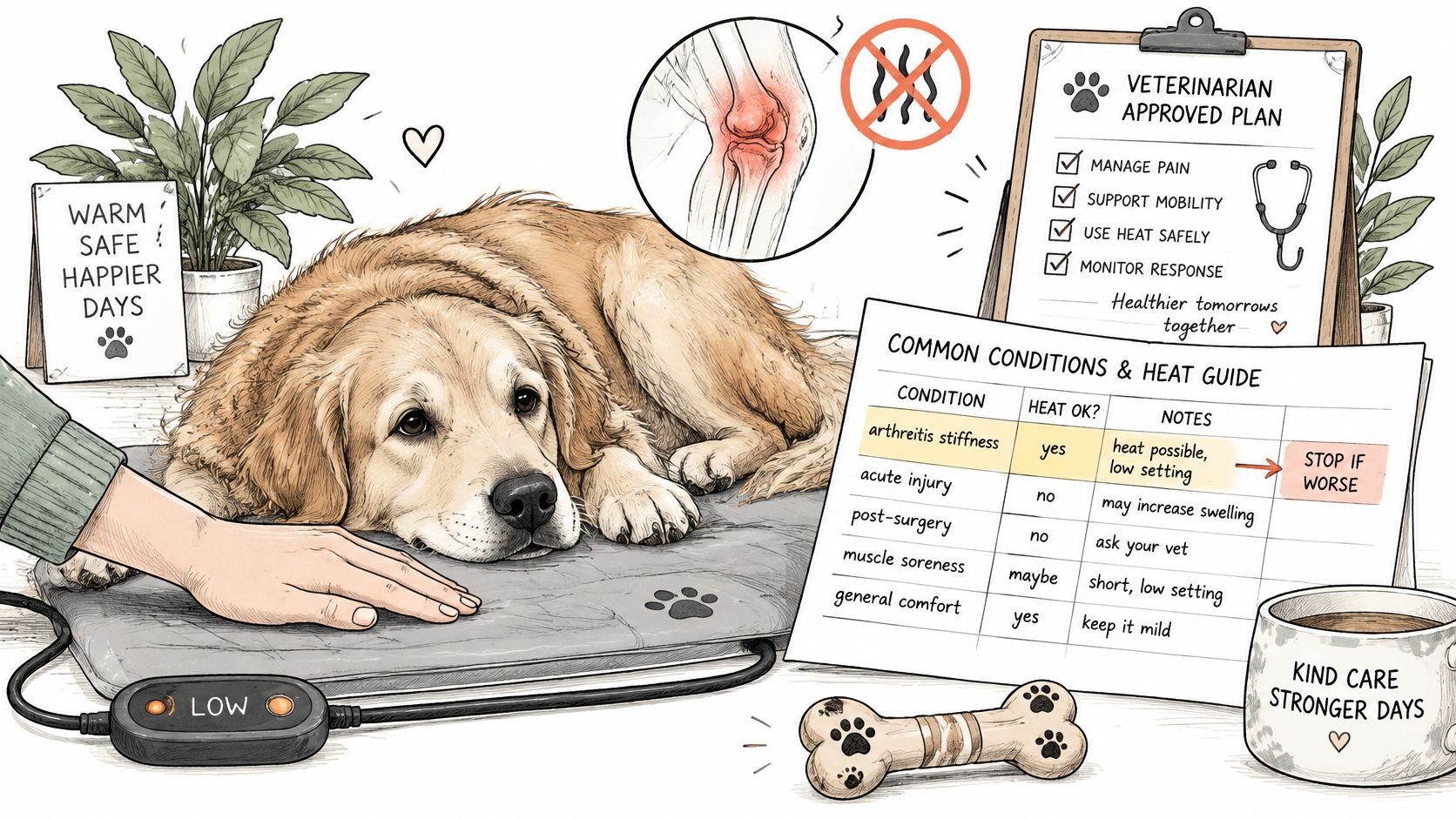
Warmth can feel comforting without treating the cause of pain. RexVet's arthritis and cold-weather guidance distinguishes chronic stiffness from problems such as hot or swollen joints, fresh injuries, and surgical sites where heat should be avoided without veterinary direction.
Say your dog suddenly starts limping after playing outside. Settling on a warm bed doesn't establish that the problem is arthritis. Assuming it does can delay evaluation of trauma, inflammation, infection, or another condition needing treatment.
The American Animal Hospital Association's warming guidance also identifies separate thermal and electrical hazards from electric pads, including significant contact burns and injuries from cord chewing. Even safer warming methods require monitoring.
When to call your vet
- Your dog won't leave the heat: End the session and ask whether pain, weakness, reduced alertness, or impaired mobility makes home warming unsuitable.
- Illness isn't improving: Don't keep extending heat sessions for a dog who remains unwell.
- A limp continues without improvement: Arrange an examination rather than repeatedly treating an undiagnosed symptom.
- The condition changes: New swelling, a different gait, or worsening discomfort means the previous comfort plan needs reassessment.
Keep the focus on diagnosis when considering any heat-therapy demonstration.
A relaxed dog may still need an examination. Comfort is useful only when it doesn't postpone appropriate care.
Burn Signs and What to Do First
- Persistent color changes: Redness or pale patches remain after heat exposure.
- Surface damage: Blisters, peeling, or hair loss appear where your dog lay.
- Painful skin: The area feels hot, tender, or painful to touch.
- Protective behavior: Your dog licks, bites, or guards the contact area.
- Mouth injury: Drooling, mouth sores, or lip burns follow cord chewing.
- General changes: Lethargy, shivering, or reluctance to move develops after exposure.
- Delayed sores: Damage becomes visible a day or more afterward, rather than immediately.
A burn can look minor at first, and visible skin changes may not show its full depth. No obvious mark doesn't rule out injury, particularly when your dog is painful or a cord has been chewed.
First-response sequence
Remove the heat source. Move your dog away and unplug the pad safely. If electrical damage or moisture is involved, disconnect power without touching exposed wiring.
Cool the affected skin gently with lukewarm water, not ice. Keep the rest of your dog warm and avoid delaying the call for veterinary help. Aggressive cooling isn't a substitute for assessing the injury.
Leave household treatments off the skin. Don't apply butter, ointments, or other remedies unless the veterinarian directs you. The clinician needs to assess the area and select appropriate wound care.
Call your veterinarian now. Contact an emergency clinic after hours and explain whether heat contact or cord chewing occurred. Don't wait for blisters or a larger sore before seeking advice.
Bring the pad and its label if practical. Keep damaged equipment unplugged and tell the veterinarian which setting and covering you used. Those details help describe the exposure without requiring anyone to switch the device on again.
Urgent action: Suspected dog burns are medical emergencies. Stop exposure and seek prompt veterinary care, even when the affected area looks small.
Confirm Heat Use With Your Vet First
Confirm the plan before first use, especially if your dog has arthritis, recent surgery, neurological signs, sedation, or a sensitive skin condition. The important decision is whether heat suits the diagnosis and the individual dog, not whether the package sounds reassuring.
Bring the manual or a clear photograph of the label to the conversation. Explain where the pad will sit, how your dog gets off the bed, and whether anyone can supervise the entire session.
Questions to copy into your call
- Diagnosis: Is heat appropriate for this condition, or could it worsen the problem?
- Temperature: What contact-surface temperature should I use, and how should I check it?
- Duration: What session length in minutes is appropriate for my dog?
- Alternatives: Would a warm compress, self-warming bed, or ordinary layered bedding be more suitable?
- Stop signs: Which changes mean I should stop immediately or seek urgent care?
- Mobility: Can my dog reliably leave this setup without assistance?
- Medication: Could the current medication make my dog too drowsy or less responsive to discomfort?
Write down the settings, session length, supervision rules, and stop signs your veterinarian gives you. There's no universal session length in this guide; ask for a specific duration in minutes, and let the veterinarian's instructions take priority. Recheck the plan whenever mobility, sensation, or medication changes.
For planning ahead, our breed pages provide breed-specific health-risk context, including joint and skin concerns, and our free tools support ownership planning. PetCostEngine also has a Calculator listed under its Resources menu.
Our content isn't veterinary advice, and no supplement cures a medical condition. Call your veterinarian before starting heat therapy, with your dog's symptoms, mobility limitations, medications, and proposed pad setup ready to discuss.
PetCostEngine offers breed-specific health-risk references and planning tools to help you prepare for routine care and unexpected veterinary needs. Visit PetCostEngine to organize that planning, and call your veterinarian to confirm whether a dog heating pad belongs in your dog's care plan.
Modeled estimates for 226 breeds, with the formula and sources published in full.
See the data →
Premium dry food → Slow-feeder bowl → Digestive support →
As an Amazon Associate, PetCostEngine earns from qualifying purchases.