Your dog's back from a walk, the coat smells a little stale, and you don't have a bath planned. A bottle of dry shampoo looks like an easy fix. It can be, provided you're dealing with a dirty coat rather than irritated skin.
Dry shampoo for dogs earns its place as a touch-up tool. Before applying it, part the hair and check what's underneath. The right choice might be a brush, a bath, or a call to your vet, not another layer of fragrance.
Table of Contents
- When Dry Shampoo Fits and When a Bath Is Needed
- What Dog Dry Shampoo Is and Why It Cannot Treat Skin Disease
- A Label Checklist for Dog Dry Shampoo
- How to Apply Dry Shampoo to a Dog Safely
- Warning Signs That Call for a Vet Visit
- Plan Your Dog's Grooming With Your Vet
When Dry Shampoo Fits and When a Bath Is Needed
Dry shampoo or full bath, by situation
| Situation | Dry shampoo or full bath | Why |
|---|---|---|
| Dry dust or surface dirt on a healthy coat | Dry shampoo | Absorbs loose oil and helps lift surface debris during brushing |
| Light doggy smell after a walk, healthy skin | Dry shampoo, occasionally | Freshens the coat between baths |
| Dry leaves, grass or sand in the coat | Brush out first, then dry shampoo if needed | Removes debris before any product is applied |
| Muddy or wet dirt on the coat or legs | Full bath | Powder cannot lift wet or caked dirt from the skin |
| Oily or sticky residue from the yard or garage | Full bath with a dog-labeled shampoo | Residue needs water and surfactants to remove; unknown chemicals need vet advice first |
| Strong odor from rolling in something unknown | Full bath or vet advice | Dry shampoo may spread the substance and cannot rinse it away |
| Vet has said no water after surgery or stitches | Dry shampoo, only if the vet approves the product | Keeps the incision dry while the surrounding coat stays presentable |
| Cold weather, or a senior or arthritic dog that cannot stand in a tub | Dry shampoo for light surface cleaning | Avoids chilling and slipping during an unnecessary bath |
| Travel, camping or a dog that panics in the tub | Dry shampoo, occasionally | A stopgap until a real bath is possible |
| Matted coat or dense double coat with dirt underneath | Full bath after safe mat removal and brushing | Product cannot clean skin it never reaches |
Dry shampoo absorbs surface oil, and brushing or toweling removes some of the product and loosened debris. It doesn't flush dirt from the skin. The American Kennel Club's between-bath cleaning advice describes waterless products as a way to freshen the coat, not replace thorough bathing.
That distinction matters after an ordinary backyard outing. Loose dust on a smooth coat is a reasonable touch-up job. Mud packed around the feet needs rinsing, and sticky garage residue shouldn't be covered with powder. If you suspect fuel, pesticide, or another chemical, prevent licking and contact your vet before choosing a cleaner.
Check Beneath the Hair
Practical rule: If you can see or feel dirt on the skin, choose water. If the coat only looks dull or smells mildly doggy and the skin looks normal, dry shampoo may be enough.
Part the coat before deciding, especially over the belly, behind the ears, and beneath a dense undercoat. Powder sitting on the outer hair won't address dirt underneath. For mats, don't force a brush through painful tangles or cut close to the skin with scissors. Arrange safe mat removal, then bathe when needed.
What Dog Dry Shampoo Is and Why It Cannot Treat Skin Disease
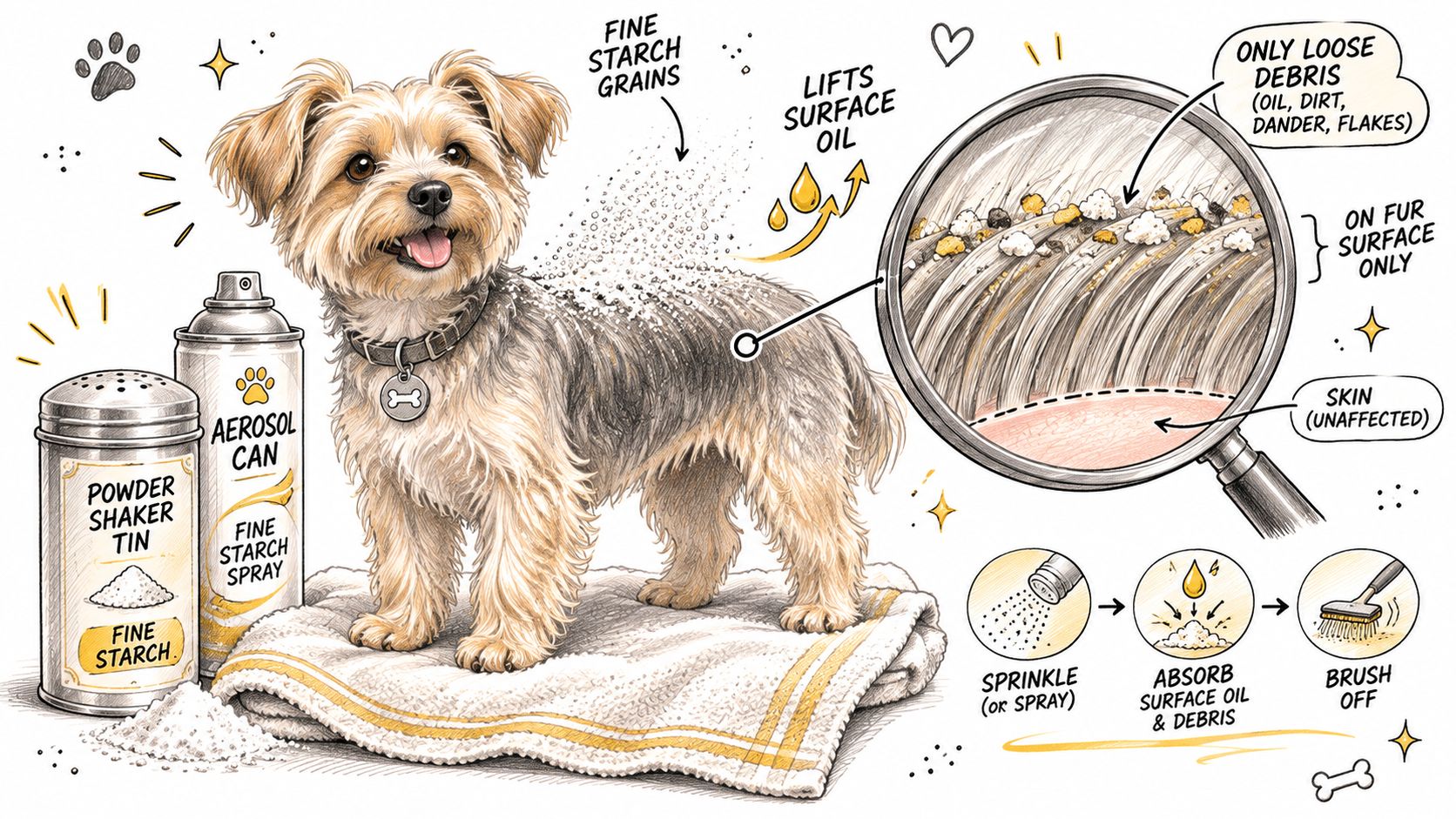
Dog dry shampoo comes as powder, aerosol, or foam, but the formulas don't all work identically. Powders commonly use starches or mineral ingredients to absorb oil; aerosol systems may pair a solvent with a mattifying powder, as described in pet-care formulation guidance from Happi. Foams spread a no-rinse cleansing formula through the coat for removal according to the label.
Think of an absorbent powder as a dry sponge pressed against a spill. It can take up material at the surface, but it doesn't rinse the whole area clean. A foam may feel more like washing, yet you still need to remove the residue rather than assume that a fresher smell means clean skin.
The illustration shows the surface-cleaning idea behind powder and spray formats.
Choose the Format You Can Remove Thoroughly
Powder, aerosol or foam, compared
| Format | How it is applied | Suits | Watch for |
|---|---|---|---|
| Powder or powder puff | Puffed or sprinkled onto the coat, worked in, then brushed out | Short coats and small greasy patches on otherwise healthy skin | Inhaled dust near the face, powder left against the skin |
| Aerosol spray | Sprayed at the label's stated distance, then brushed | Dense or long coats needing broad coverage, provided residue can be removed | Solvent smell, coughing if directed toward the head, flammability warnings near heat |
| Foam or mousse | Pumped into the palm, worked through the coat, then toweled or brushed out | Spot cleaning, nervous dogs, seniors | Stiff or tacky hair when residue remains |
I would choose the format the dog tolerates and the owner can remove properly, not the one with the strongest scent. A spray may cover a long coat quickly, but that convenience disappears if the dog startles or the product stays trapped underneath. Foam offers more control over placement, while powder requires particular care around breathing zones.
Cosmetic Claims Aren't Treatment Evidence
Under the FDA's animal grooming-aid policy, ordinary non-medicated dog shampoos with cosmetic claims are comparable to human cosmetics and aren't regulated as animal drugs. Claims to treat infection, inflammation, or parasites can move a product into animal-drug territory. The word shampoo alone establishes no clinical effectiveness.
Therapeutic washing depends on the right active ingredient reaching the skin for an adequate contact time. Veterinary dermatology literature on topical therapy discusses antimicrobial ingredients such as chlorhexidine and the importance of appropriate shampoo use. A powder quickly brushed away cannot be assumed to treat pyoderma, Malassezia overgrowth, or allergic dermatitis.
The danger isn't just that a cosmetic product fails to help. An owner may accept a pleasant fragrance as improvement while greasy, inflamed skin remains untreated. Don't use a refreshing scent as evidence that an infection has cleared. Keep ordinary dry shampoo in its proper role: between baths, for surface dirt on healthy skin.
A Label Checklist for Dog Dry Shampoo
Read the back label before smelling the bottle. You need to know what stays on your dog's coat, how to remove it, and what happens if your dog licks the treated area.
The American Kennel Club's shampoo guidance explains that human shampoos are formulated for a different skin pH and can dry or irritate canine skin. It also cautions that some essential oils can be toxic to dogs. A familiar botanical name isn't a safety assessment.
Check the Formula and the Instructions
- Made for dogs: Choose a canine-specific formula rather than your own dry shampoo or a vaguely labeled shared-use product.
- Complete ingredients: Look for named starches, mineral powders, solvents, and other ingredients, not just claims of natural or gentle cleansing.
- pH information: Look for pH-balanced labeling intended for canine skin, but don't treat that phrase as proof that every dog will tolerate it.
- Fragrance and essential oils: Identify scent sources and any stated concentrations; ask your vet about ingredients whose safety or dilution isn't clear.
- Format and directions: Confirm whether it's a powder, spray, or foam, how much to apply, and whether to brush or towel it out.
- Warnings: Check cautions concerning eyes, nose, inhalation, licking, broken skin, and age restrictions.
- Therapeutic claims: Flag promises about infection, itching, or parasites for veterinary review rather than treating them as grooming benefits.
- Maker details: Keep the company name and contact information available if you need clarification or want to report a reaction.
Use this visual checklist while comparing labels.
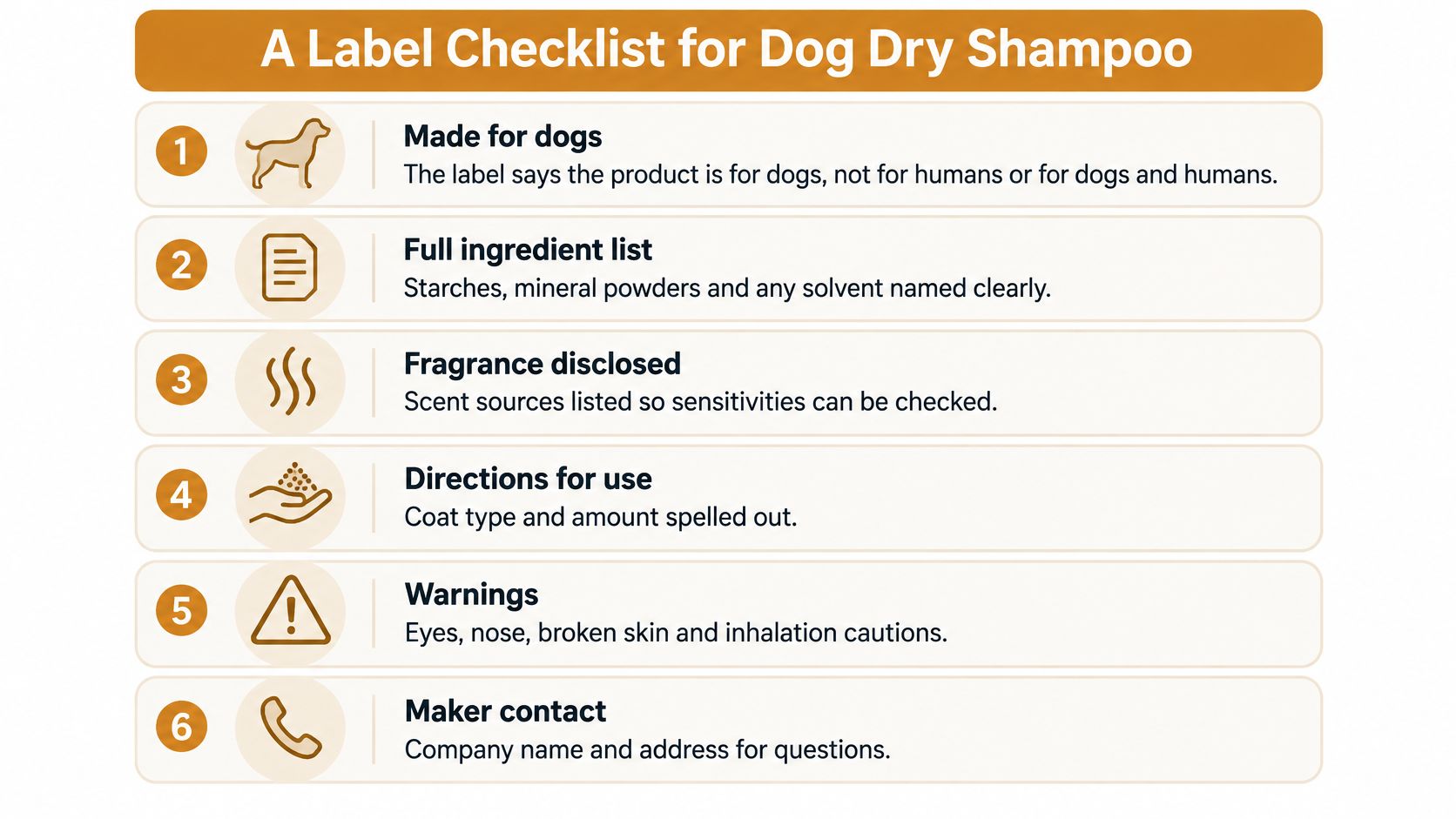
An incomplete label is a reason to keep looking, not an invitation to guess. If your dog already uses a prescribed topical treatment, ask whether a leave-on grooming product could interfere with that routine.
PetCostEngine doesn't name a best product in a category because we haven't tested any products. We don't rank these formulas. The label checklist is the shopping tool, and your vet can review a specific ingredient list against your dog's medical history.
How to Apply Dry Shampoo to a Dog Safely
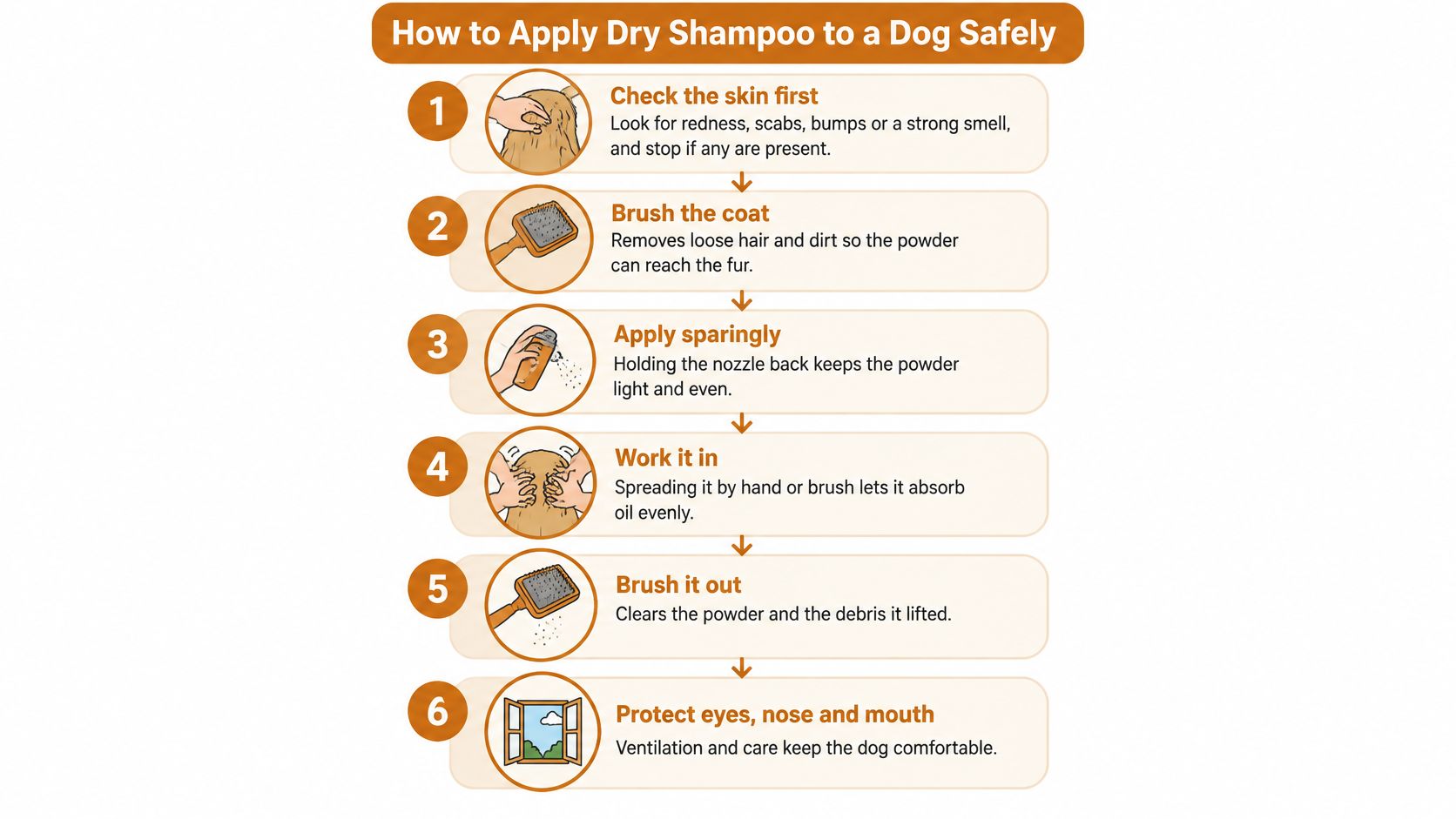
Set out a suitable coat brush, a clean towel, and the product before bringing your dog over. Use a nonslip surface and keep the session calm enough that you can stop without wrestling.
The visual summarizes the handling essentials; the procedure below adds the skin check and monitoring.
Apply Lightly and Remove Completely
- Inspect the skin. Part the hair and look for redness, scabs, bumps, or an unusually strong smell. Stop if you find them, because grooming could obscure a problem that needs assessment.
- Brush first. Remove loose hair, leaves, and grit so you're not working product into a layer of debris. Don't drag a brush through tight mats.
- Choose ventilation. Work in an airy room or a sheltered outdoor area without wind blowing product toward the dog. Keep airborne powder away from both your breathing zones.
- Apply sparingly. Shake or prepare the container as directed and use the label's spray distance. A light application is easier to remove than a saturated coat.
- Protect the face. Keep product away from eyes, nose, and mouth. Use a damp cloth for ordinary facial dirt instead of directing powder or spray toward the head.
- Distribute gently. Work through the intended coat area without vigorous rubbing. Follow the label's stated waiting time rather than assuming longer is better.
- Remove the residue. Brush thoroughly and towel as directed, checking underneath the outer hair. Leftover product can remain against the skin or be licked off.
- Monitor afterward. Stay nearby after application and watch for redness, itching, coughing, sneezing, drooling, or stomach upset. Stop using the product and call your vet if signs develop; breathing difficulty needs urgent care.
A controlled evaluation of experimental canine dry-shampoo formulations reported good tolerance under test conditions, but all tested formulas had an alkaline pH near 11, above commonly reported canine-skin ranges. That raises a plausible barrier-disruption concern with prolonged or repeated exposure, particularly on inflamed skin. Safety evidence is formulation-specific, not permission to assume another bottle is equally well tolerated.
Use ceiling: I would reassess rather than reapply if the coat needs another refresh before its next bath or quickly smells unpleasant again.
That's a conservative decision rule, not a universal dosing schedule. Over-application is an easy mistake to make; these steps apply to powders and foams too, with the product's contact time and removal instructions taking priority.
For an additional demonstration of coat-cleaning technique, use the video alongside your product's directions.
Warning Signs That Call for a Vet Visit
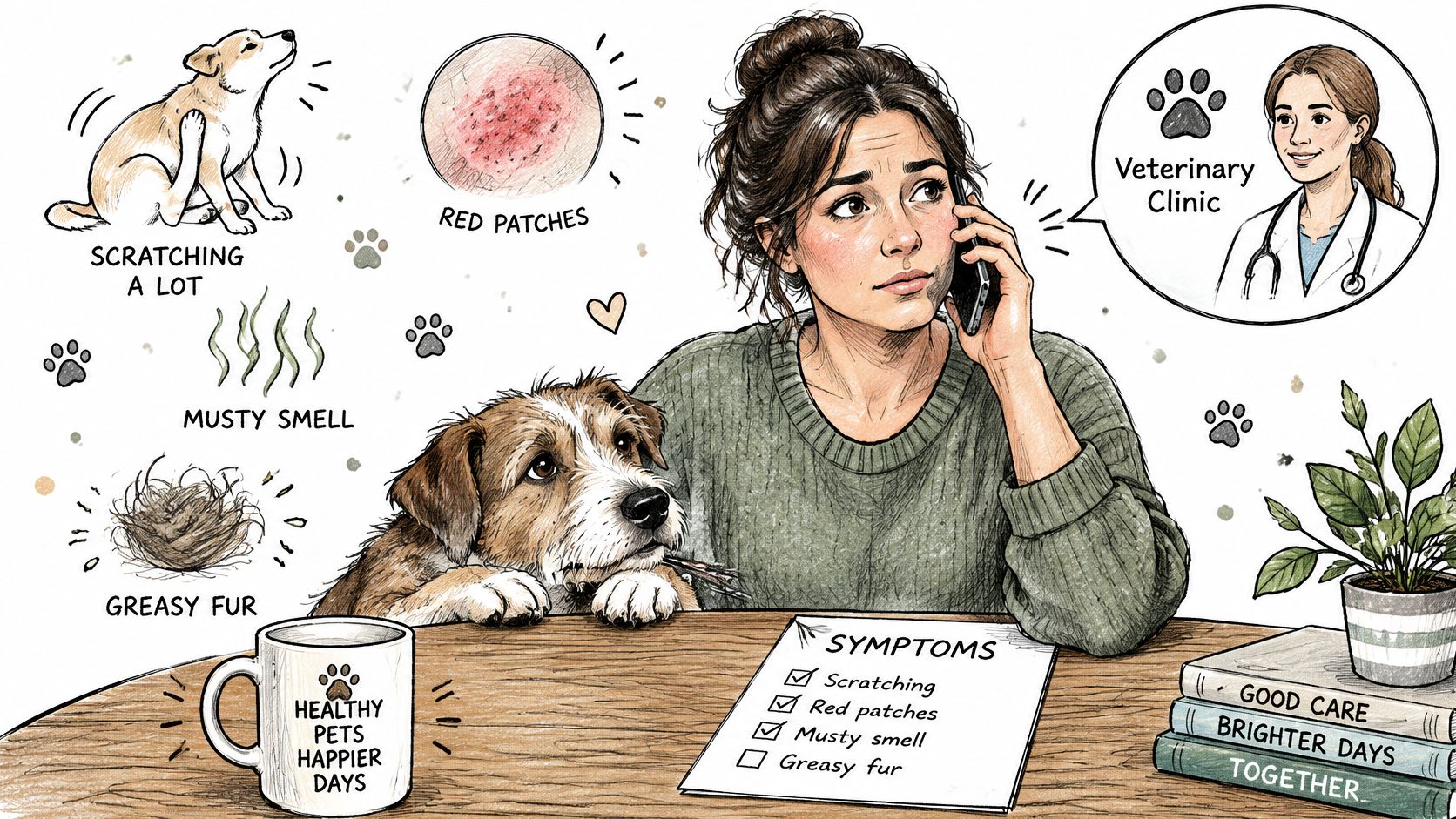
A greasy or musty smell that returns soon after grooming deserves attention. Recurring odor is a symptom to investigate, especially when the dog is also scratching, licking, or developing visible skin changes.
Veterinary dermatology guidance on shampoo therapy distinguishes targeted skin treatment from cosmetic cleaning and describes irritation or contact reactions as possible problems with topical products. Don't keep switching fragrances while the underlying signs continue.
Dog skin and coat signs, likely causes and next step
| Sign | Possible cause | Next step |
|---|---|---|
| Greasy or musty smell that returns soon after grooming | Skin infection or yeast overgrowth | Book a vet visit, stop repeated dry shampoo |
| Persistent scratching, licking or chewing | Allergy, parasites or infection | Book a vet visit |
| Redness, scabs, pustules or crusting | Bacterial skin infection | Vet visit soon, sooner if it spreads |
| Patchy hair loss | Allergy, infection or hormonal cause | Book a vet visit |
| Ear odor or head shaking | Ear infection | Book a vet visit |
| Coughing, sneezing, vomiting or drooling after a product | Product exposure or reaction | Stop the product and call the vet, urgently if severe |
These are possible causes, not diagnoses. Your vet may need to examine the skin, ears, or samples before deciding which treatment fits. Don't put coat shampoo inside an ear or apply it to an open sore.
When to Make the Call
Ordinary coat odor should improve with appropriate bathing and brushing. Skin disease can keep producing odor or discomfort despite a cleaner-looking coat, so recurrence matters more than how pleasant the dog smells immediately after grooming.
Call your vet when
- Signs persist after bathing: Odor, itching, or irritation remains despite appropriate cleaning.
- Signs spread or worsen: Redness, crusting, sores, or discomfort increases.
- A vulnerable dog develops signs: Make a same-day call for a puppy, senior, or dog with a known medical condition.
Photograph affected areas before applying anything else, and keep the container if a reaction follows product use. Tell the vet where you applied it and whether licking occurred.
Plan Your Dog's Grooming With Your Vet
For a healthy dog with light surface dirt, occasional dry shampoo can be a practical choice when you follow the label and remove it properly. If a warning sign appears, book a veterinary assessment before adding more product. A dog that avoids a bath because its joints hurt may also need a more comfortable bathing setup, not indefinite waterless cleaning.
Bring the actual bottle or clear photos of its label to the appointment. Describe the smell, affected areas, scratching, and whether signs change after bathing. Those details are more useful than saying the dog needs a stronger shampoo.
Ask for a Dog-Specific Routine
- What's causing the problem? Ask whether the signs suggest bacteria, yeast, allergy, parasites, or something else.
- What treatment is needed? If a medicated bath or topical product is prescribed, confirm where to apply it, its skin contact time, and how to remove it.
- Which grooming products fit this dog? Discuss coat type, skin sensitivity, age, and existing treatments before choosing a between-bath product.
Owners of brachycephalic, allergy-prone, or senior dogs should also discuss folds, difficult-to-reach areas, and bathing comfort. Breed references, such as our American Water Spaniel page, can help you prepare questions about breed-specific needs, but they don't diagnose an individual dog. Our breed references and free tools can support care planning; keep a separate calendar note of baths, products used, and any reactions.
PetCostEngine's content is general information, not veterinary advice. No supplement cures a medical condition, and ordinary cosmetic dry shampoo doesn't cure skin disease. Use a grooming product to manage a grooming task, not to postpone finding out why your dog is uncomfortable.
Visit PetCostEngine for breed health references and free planning tools suited to your dog's breed, state, and age. Use them to prepare for routine grooming and veterinary care, then bring your product label and symptom notes to your vet if odor or irritation keeps returning.
Estimated lifetime and yearly costs for a American Water Spaniel, state by state, plus whether pet insurance breaks even for the breed.
See American Water Spaniel costs →
Is insurance worth it for a American Water Spaniel? →
Premium dry food → Puzzle toys → No-pull harness →
As an Amazon Associate, PetCostEngine earns from qualifying purchases.