
The trip is on the calendar, the dog has never spent a night away, or the last stay left them quiet and off their food, and the booking window is still weeks out. That gap is the useful part. To board a dog safely, pick the kind of care that matches the dog, audit the place or the sitter, and clear vaccine lead times before anyone talks about drop-off. Drop-off is the last step, not the plan.
Table of Contents
- Choosing Between Kennels, Vet Boarding and Sitters
- How to Audit a Facility or Sitter Before You Book
- Vaccine and Record Requirements at a Glance
- Preparing Your Dog, Including Puppies and Seniors
- Records and Emergency Authorization to Settle First
- Pack, Drop Off and Watch the Stay
Choosing Between Kennels, Vet Boarding and Sitters
Five setups cover almost every boarding situation, and the right pick depends on the dog's health, temperament, and medication schedule.
| Option | Best fit | Medical oversight | Group play | Watch for |
|---|---|---|---|---|
| Boarding kennel | Healthy, social adults with no medical needs | Staff checks; a veterinarian is called, not always on site | Usually yes | Separation by size and temperament |
| Veterinary boarding | Dogs on medication, after surgery, or with chronic conditions | Licensed veterinary staff on site | Limited or none | Confirm staffing hours and whether a vet is on call overnight |
| Pet hotel | Owners who want private suites and more attention | Ask who is on call after closing | Only if you request shared play | Upscale features do not replace documented procedures |
| In-home sitter | Anxious, senior, or multi-dog households | Only if the sitter is trained and you leave written doses | No | Written instructions and a trial visit |
| Family or friend | A trusted caregiver who has handled the dog before | The caregiver uses your written emergency plan | No | A written routine and emergency plan |
Compared on the same criteria, these options come down to four questions.
Medical oversight asks who notices a problem at 2 a.m. and who is allowed to act. A kennel attendant can call a clinic. A veterinary hospital already has licensed staff in the building. A sitter or a relative can only do what you wrote down and what they are trained to do.
Group play asks whether the dog spends the day with other dogs. Many kennels run play groups, while veterinary wards usually keep dogs apart. A sitter or a family caregiver keeps the dog out of a pack entirely, which is the point for a reactive or frail dog.
Overnight staffing asks who is present when the building is quiet. "Someone checks every few hours" is a different promise from "a person sleeps on site." Get that sentence in writing.
Medication handling asks whether doses go out on schedule and get logged. Pills in a bag with a verbal reminder fail on day three of a holiday week.
The slot that looks easiest on the calendar can still be the wrong fit for an anxious dog on daily medication. Match the dog to the type of care first and the dates second.
- Choose a kennel for a healthy, social adult with no medical needs and a history of settling around other dogs.
- Choose a pet hotel when you want a private suite and extra walks, and only after the written medical and incident rules are as clear as the suite photos.
- Choose veterinary boarding for post-surgery dogs, chronic conditions, or several medications that must be given on time.
- Choose an in-home sitter for dogs that stress in kennels, for seniors, or for a multi-dog household that should stay together.
- Choose a trusted family member when that person has already handled this dog and will keep the routine on paper, including who to call if you can't be reached.
Service tiers differ by the level of attention behind the name on the sign. Peak holiday weeks often carry surcharges and minimum stays. Medication handling and late pickup are often billed separately from the nightly stay. Ask each provider for an itemized quote in writing, then run the boarding line through the PetCostEngine lifetime cost calculator, which adjusts estimates to your state, before you choose. If boarding makes you weigh insurance, the site's comparison models expected claims against premiums across 15 U.S. carriers.
How to Audit a Facility or Sitter Before You Book
A polished lobby tells you nothing about safety. What the staff can answer on a tour does: whether a written isolation rule exists, whether a veterinarian is named, and whether someone can explain how a missed pill gets caught before the dog misses a second one.
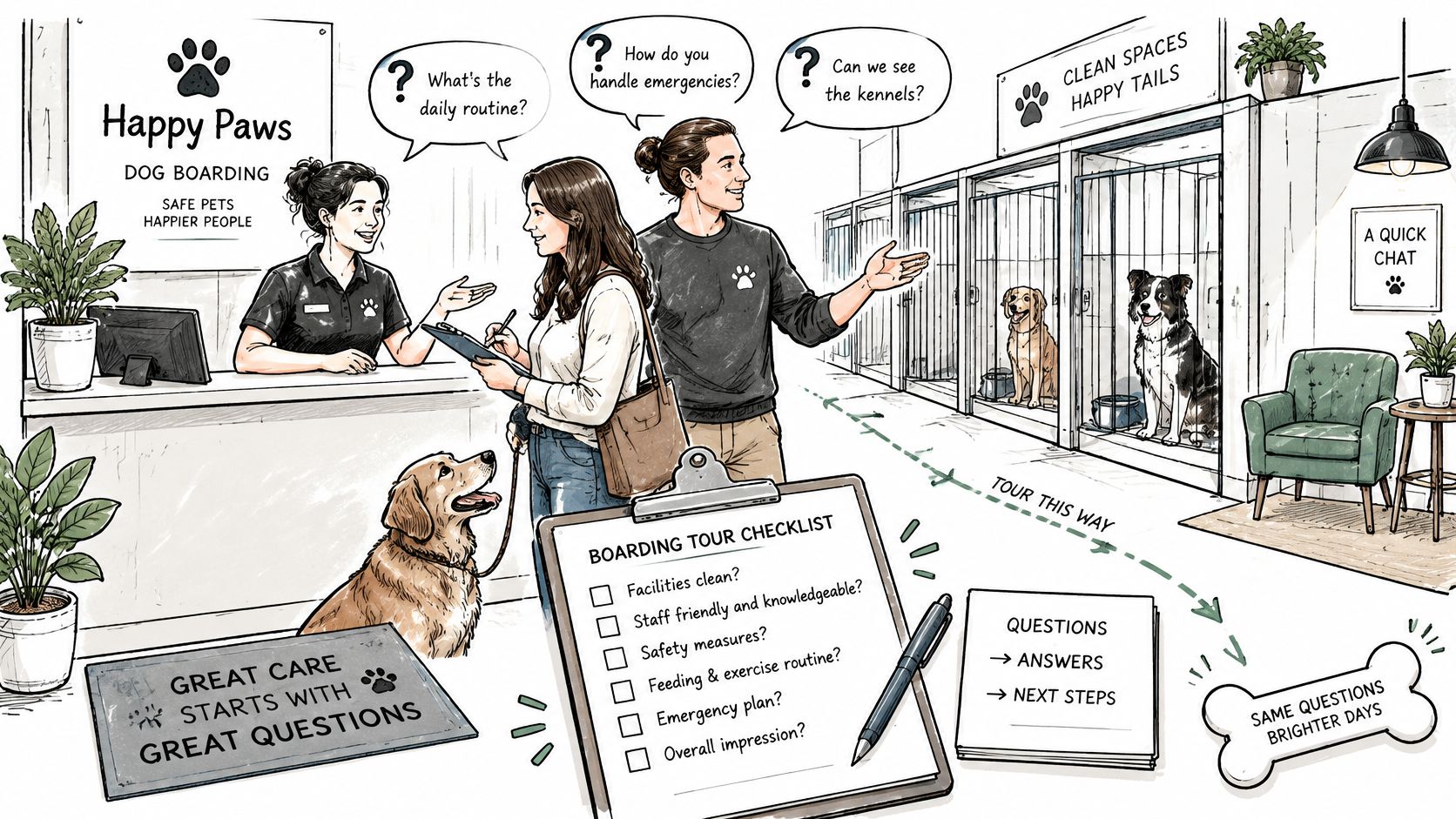
Take this list on the tour or into the sitter interview and write each answer down. Give one point for each clear, specific answer. A shrug, a "we always do," or a promise to email you later is zero.
- Who is on site overnight, and how many dogs does each staff member watch?
- Show me the isolation area and explain when a dog goes there.
- How is medication given, logged, and checked against the label?
- What is your written policy for escapes, bite incidents, and illness?
- How often is the kennel cleaned and disinfected, and with what product?
- May I see the written vaccine and parasite policies before I reserve?
- How is temperature controlled, and how is ventilation maintained in summer and winter?
- Which veterinarian is on call, and what happens if a dog needs emergency transport?
Question 8 has to match the emergency items you will settle in the records packet. If the tour answer names one clinic and the intake form names another, stop and reconcile them before you pay a deposit.
Boarding-establishment standards give owners a baseline to test these answers against. A facility that meets them verifies current vaccinations, follows written cleaning and disinfection procedures, controls infectious disease and parasites, keeps an experienced veterinarian available, and maintains safe ventilation and equipment. The same standards call for a responsible person present whenever dogs are boarded, regular welfare checks, and physically separated isolation so one sick dog does not move through the ward. Requirements differ by jurisdiction, so the written policy in front of you outranks a general list from another state.
Score it before you leave the parking lot
7 or 8 points means proceed to a written walkthrough of the stay. 4 to 6 means request the missing answers in writing before you book. Under 4 means walk away.
Two failures override any score: a refusal to show the isolation area, and a veterinary plan nobody can describe. For a dog with medical needs, either one disqualifies the facility on the spot, whatever the lobby looks like.
Walk-away rule: No written vaccine policy, staff who cannot describe the medication log, or group play forced on every dog are red flags, not negotiating points.
Puppies, seniors, unvaccinated dogs, dogs on medication, and dogs that cannot safely play in a group each need a separate written plan. Run the same eight questions against that plan. A building that works for a healthy adult can still be the wrong one for a puppy halfway through a vaccine series.
A short walkthrough of a careful drop-off shows these questions working inside a real building.
Vaccine and Record Requirements at a Glance
| Requirement | Who usually asks | Lead time before arrival |
|---|---|---|
| Rabies | Required by law in most places and by nearly all facilities | 28 days if not current |
| Distemper | Core requirement at most facilities | About 7 days |
| Adenovirus-2 | Core requirement at most facilities | About 7 days |
| Parvovirus | Core requirement at most facilities | About 7 days |
| Bordetella | Often required; AVMA recommends it for boarding | At least 3 days (intranasal or oral) |
| Canine parainfluenza | Often combined with Bordetella | At least 3 days (intranasal or oral) |
| Canine influenza | Recommended by AVMA for boarding; facility-specific | Ask your vet and the facility for the lead time |
| Parasite check | Facility-specific | Ask the facility for its written parasite policy |
The lead-time column is where a last-week scramble falls apart.
How to read the lead times
If the dog is already current, you are confirming dates on a certificate rather than building new immunity. If status is unknown or lapsed, AVMA vaccination guidance says to give the vaccines before entry and wait for immunity to develop: about 7 days for distemper, adenovirus-2, and parvovirus, at least 3 days for intranasal or oral Bordetella and parainfluenza products, and 28 days for rabies where that wait applies. A rabies shot given inside that window can leave the dog unprotected on arrival day, certificate in hand or not. The same guidance sets the screening order: confirm jurisdiction-required rabies compliance, confirm core protection, weigh Bordetella, canine parainfluenza, and canine influenza against the facility and local spread, and defer admission for any dog showing respiratory, gastrointestinal, dermatologic, or other potentially infectious signs.
The American Kennel Club's travel-care guidance notes that facilities commonly request records for distemper, parvovirus, Bordetella, canine influenza, and rabies, and may want a parasite-free confirmation on top. Whether a given kennel requires influenza is that kennel's rule, so those cells stay with your veterinarian and the written policy, not a national default. Ask for the policy before you reserve, and ask which format they accept for the records.
If their list is stricter than your veterinarian's routine, book the extra vaccine early enough to meet their clock or pick another facility.
Vaccines are not a guarantee. Respiratory vaccines can reduce illness severity and shedding and still fail to prevent every infection. Treat the certificate as an entry requirement, not proof the dog cannot get sick mid-stay.
Book the veterinary visit two to four weeks before drop-off. If a rabies or core vaccine is due, move that visit to at least four weeks out so the vaccine still has time to work. Request the facility's written vaccine and parasite policy in the same week you request the quote.
Preparing Your Dog, Including Puppies and Seniors
Book a veterinary exam two to four weeks before the trip. The visit confirms vaccines are current and catches problems that would show up mid-stay, such as a new cough, a painful joint, or a dose that is hard to give.
Then run four practices at home. They are small on purpose. A dog that meets a new schedule, a new bed, and a new medication routine on the same morning is learning too many things at once.
- Practice short separations once or twice a week. Crate time, or a 30-minute stay with the sitter, is enough. You are teaching the dog that you leave and come back, not rehearsing a week away.
- Shift meals and walks toward the times the facility uses. A dog fed at 7 a.m. at home and at noon in a kennel spends the first day convinced breakfast was skipped.
- Train the medication routine before the trip. Practice the pill or the liquid dose at the scheduled times, with the same food you will send. If pilling takes three people at home, it will not get easier for a stranger.
- Pack familiar bedding and one worn item that smells like you. Novelty is the enemy on night one. The item goes in the bag, not in the wash, the day before you leave.
A dog that has never been crated needs more lead time than one that already sleeps in a crate. Start that crate practice in week four, not the night before.
| Dog situation | Change to make | Why it matters |
|---|---|---|
| Healthy adult | Keep meal and walk times close to the home routine | A predictable schedule lowers stress |
| Puppy without a finished vaccine series | Avoid kennels until the initial series is complete, or choose a facility that isolates puppies | AVMA advises limiting exposure |
| Senior dog | Pre-trip exam for heart, joints, and kidney function; bring a ramp and an orthopedic bed | Early illness is easier to catch before boarding |
| Brachycephalic breed | Ask about temperature control and extra supervision | Airway problems worsen with heat and stress |
| Dog on medication | Written schedule, labeled doses, and practice at home | A written schedule prevents most missed doses |
| Anxious dog | Short practice separations two to four weeks ahead; ask for a private room | Reduces stress and early withdrawal |
Preparation changes by dog situation are not optional extras. The AVMA's canine distemper guidance tells owners to limit exposure to kennels, daycare, groomers, parks, and training classes until a puppy's initial series is complete. When you do evaluate a provider, favor one that requires current vaccinations, runs health checks, keeps hygiene tight, and isolates sick dogs. Those policies reduce, and cannot eliminate, contagious disease in a shared building.
A flat-faced dog needs a direct question about room temperature and who watches breathing after play or excitement. A double-coated sporting dog, such as an American Water Spaniel, still needs the same vaccine clock and a coat that is dry and free of mats before a shared run, because a damp coat in a warm kennel is a skin problem waiting for day two.
If the dog cannot be apart from you for a week without real distress, an in-home sitter or veterinary boarding is the better decision. Forcing a kennel stay to "get them used to it" is not a training plan.
Records and Emergency Authorization to Settle First
Settle these six items before drop-off, on paper, with a copy in your travel folder. AKC Reunite's boarding prep guidance is plain about the set: your veterinarian's contact information, an emergency contact who can authorize care, a complete medication list with written instructions, and a named destination if the dog is ill or injured. Staff should not be inventing that plan while you are on a plane.
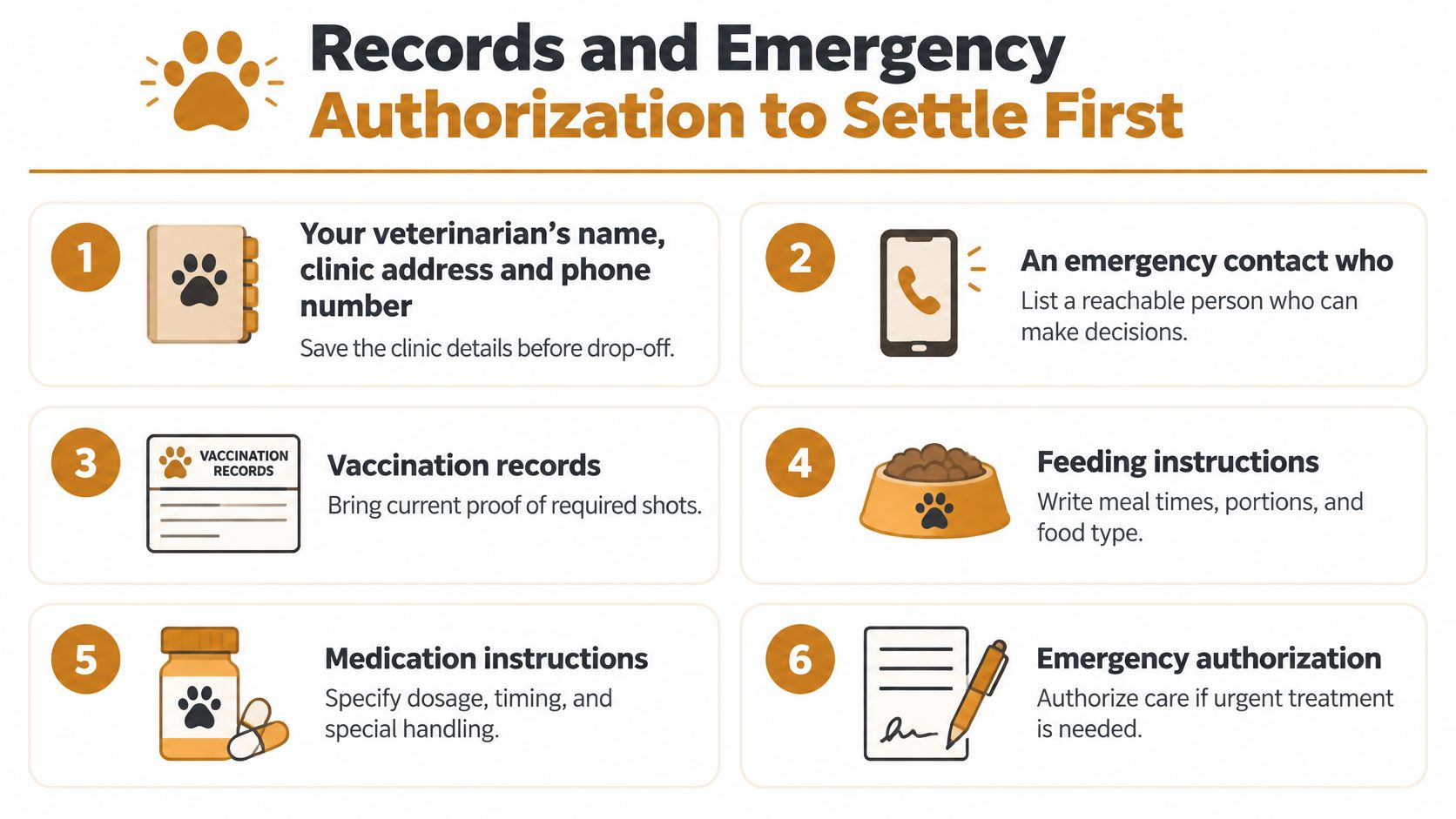
- Your veterinarian's name, clinic address, and phone number. Include after-hours instructions if the clinic publishes them. A name without a number is not a contact.
- An emergency contact who lives nearby and can make decisions when you cannot be reached. Pick someone who will answer a late call and who already knows the dog.
- Written authorization for emergency veterinary care. Name the emergency clinic and the treatment limits you set, so staff are not guessing what you would approve.
- A complete medication list. Drug, dose, times, and how each is given. Bottles stay labeled, and a written copy is attached to the bag, not only stored in your phone.
- Where an ill or injured dog goes. The dog's regular veterinarian, a partner emergency clinic, or an on-site veterinary professional. This answer has to match what you heard on the tour.
- Copies of current vaccine records. Paper copies travel with the dog. A portal login you forget to share does not help at intake.
Without this packet, staff stop and call around during an emergency. Those calls eat the hour you would rather spend on treatment. Call ahead, ask for the facility's half of the packet in writing, and keep your half in the same folder as the booking confirmation.
If the facility cannot name its emergency veterinarian, or will not put the authorization in writing, choose another option. A friendly front desk is not a substitute for a named clinic.
Pack, Drop Off and Watch the Stay
What goes in the bag
Pack the night before, then check the bag against this list in the morning so a last-minute toy doesn't push the medication sheet onto the counter.
- Food in the original bag, measured by meal, so a diet change doesn't start on day one.
- Medications in labeled containers with the written schedule clipped to the bag.
- Copies of vaccine records and the signed emergency authorization.
- A collar with ID tags, and the microchip number written on the tag or on the contact sheet.
- A harness and leash the dog already walks in.
- Familiar bedding and a worn T-shirt that smells like you.
- One favorite toy, not a basket of new ones.
- A recent photo plus a contact sheet with your veterinarian and emergency contact.
What to confirm in writing
Before you hand over the leash, the booking should already say four things back to you.
- Dates and drop-off time match the reservation you paid for.
- Vaccine dates satisfy the facility's written policy, not a verbal "you're probably fine."
- Pick-up time, and what happens if you are late, is spelled out, including any extra holding arrangement.
- A phone line is answered during your trip, and you know which number that is.
If any of those items is still unanswered, ask again before the leash changes hands. A missing answer on the sidewalk is harder to fix than a missing answer the week before.
On drop-off day
Leave the bedding and the toy in the space the dog will use. Ask staff to call on the first day with a short update on eating, drinking, and sleep. Expect a quiet first night. Quiet by itself is not distress.
At pick-up, ask for the daily notes: food, water, stool, vomiting, cough, breathing, sleep, and how the dog acted after handling. One sign is not a verdict. Judge each change against that dog's normal day at home.
A controlled kennel-versus-home comparison found significant changes in urinary cortisol-to-creatinine and vanillylmandelic-acid-to-creatinine ratios, with P = 0.003 and P = 0.01, and surface temperature also differed at P = 0.001. Those physiological changes were not explained by movement or exercise. The University of Surrey record of that study is careful on the next point: the emotional reading was ambiguous, and the authors did not find definitive evidence that kenneling caused harmful emotional stress. Appetite, barking, or activity alone is a weak stress test. A stronger check records several signs and compares them with the individual dog.
| Sign | Often normal | Call your vet when |
|---|---|---|
| Appetite | Eats less on the first day or two | Skips two meals in a row, or a puppy or senior skips one |
| Stool | One soft stool after a change in routine | Diarrhea for more than two to three days, or any blood |
| Vomiting | A single episode | Repeated vomiting, or cannot keep water down |
| Breathing | Heavier breathing after excitement | Labored breathing, pale or blue gums, or a persistent cough |
| Behavior | Quiet, clingy, or wary the first night | Hiding while refusing food and water, or not responding to staff |
Daily signs during a stay: normal or call your vet is the escalation line staff should already have. For an adult, lively dog that is still eating and drinking, one soft stool can be watched. Past two or three days, call. For puppies, elderly dogs, and dogs with ongoing conditions, soft stool is a same-day call. Those dogs also warrant a same-day call sooner than a healthy adult for skipped meals or a new cough.
If the dog stops eating or drinking, or shows labored breathing, the facility should contact your veterinarian or an emergency clinic at once. Do not wait for the evening update. Tell them that threshold when you drop the dog off, and write it on the contact sheet so the night staff sees it without a phone call to you.
PetCostEngine turns breed, state, and age into a practical picture of lifetime care, including how often boarding shows up for a dog like yours. Before the next trip, see where supervised stays fit next to veterinary care and everyday gear. Visit PetCostEngine and run the free analysis for your dog.
Estimated lifetime and yearly costs for a American Water Spaniel, state by state, plus whether pet insurance breaks even for the breed.
See American Water Spaniel costs →
Is insurance worth it for a American Water Spaniel? →
Premium dry food → Puzzle toys → No-pull harness →
As an Amazon Associate, PetCostEngine earns from qualifying purchases.