Plain cream cheese is not toxic to a healthy dog, but it is a high-fat dairy treat that belongs in small, occasional portions, and any product containing xylitol is an emergency.
The surprising distinction is that the ingredient label can matter more than the dairy itself. A tiny smear of plain cream cheese and a lick of a sweetened or onion-flavored spread require different decisions. Before sharing, check the ingredients, your dog's medical history, and the amount you're offering.
Table of Contents
- Safe Cream Cheese Portions by Dog Weight
- Dogs Who Need a Vet Before Any Cream Cheese
- Reading the Label for Xylitol and Other Hazards
- Why Cream Cheese Upsets Some Dogs' Stomachs
- Safer Treats to Share Instead
- Confirm the Portion Fits Before the First Taste
Safe Cream Cheese Portions by Dog Weight
Use these conservative editorial portion ceilings, not as veterinary-established safe doses or targets your dog needs to reach. They apply only to otherwise healthy dogs eating plain, unsweetened, xylitol-free cream cheese. Start below the ceiling when testing tolerance.
| Dog weight | Maximum per occasion | Approx. calories | How often |
|---|---|---|---|
| Under 10 lb | 1/4 teaspoon | About 4 kcal | No more than once a week |
| 10 to 30 lb | 1/2 teaspoon | About 8 kcal | No more than once a week |
| 30 to 60 lb | 1 teaspoon | About 17 kcal | No more than once a week |
| Over 60 lb | 1 tablespoon | About 50 kcal | No more than once a week, never as a daily habit |
| Pancreatitis history, obesity or prescribed low-fat diet | None | 0 kcal | Avoid unless a veterinarian approves |
The calorie estimates are calculated from GetFoodFacts' plain cream cheese listing, which gives about 50 kcal and 5 g of fat per 15 g tablespoon, and approximately 340 kcal and 33 g of fat per 100 g. Household spoon measurements are approximate, and the package's nutrition panel takes priority when its serving information differs.
Check calories before using the full portion
A teaspoon works out to roughly a third of a tablespoon, which explains the smaller calorie estimates in the table. The important distinction is between a measured teaspoon and a heaped eating spoon. A generous scoop can exceed what you intended before your dog takes the first lick.
Cream cheese must fit inside the dog's existing treat allowance, alongside dental chews, training rewards, and table scraps. Ask your veterinarian to set that allowance if you don't know it, especially during weight management. Don't treat unused calories as permission to increase the cream cheese portion, because fat and lactose tolerance still matter.
Practical rule: The table is a ceiling, not a serving recommendation. A thin smear may be enough to provide the reward.
Measure and record it
Use a level measuring spoon rather than judging a dollop on a knife. Put the measured amount on a separate dish so family members don't each offer an extra taste.
Log it with the rest of the day's treats. If multiple people train or feed your dog, a shared note prevents several individually small servings from becoming a substantial extra meal. Don't replace nutritionally complete food with cream cheese to make the calorie total work.
Dogs Who Need a Vet Before Any Cream Cheese
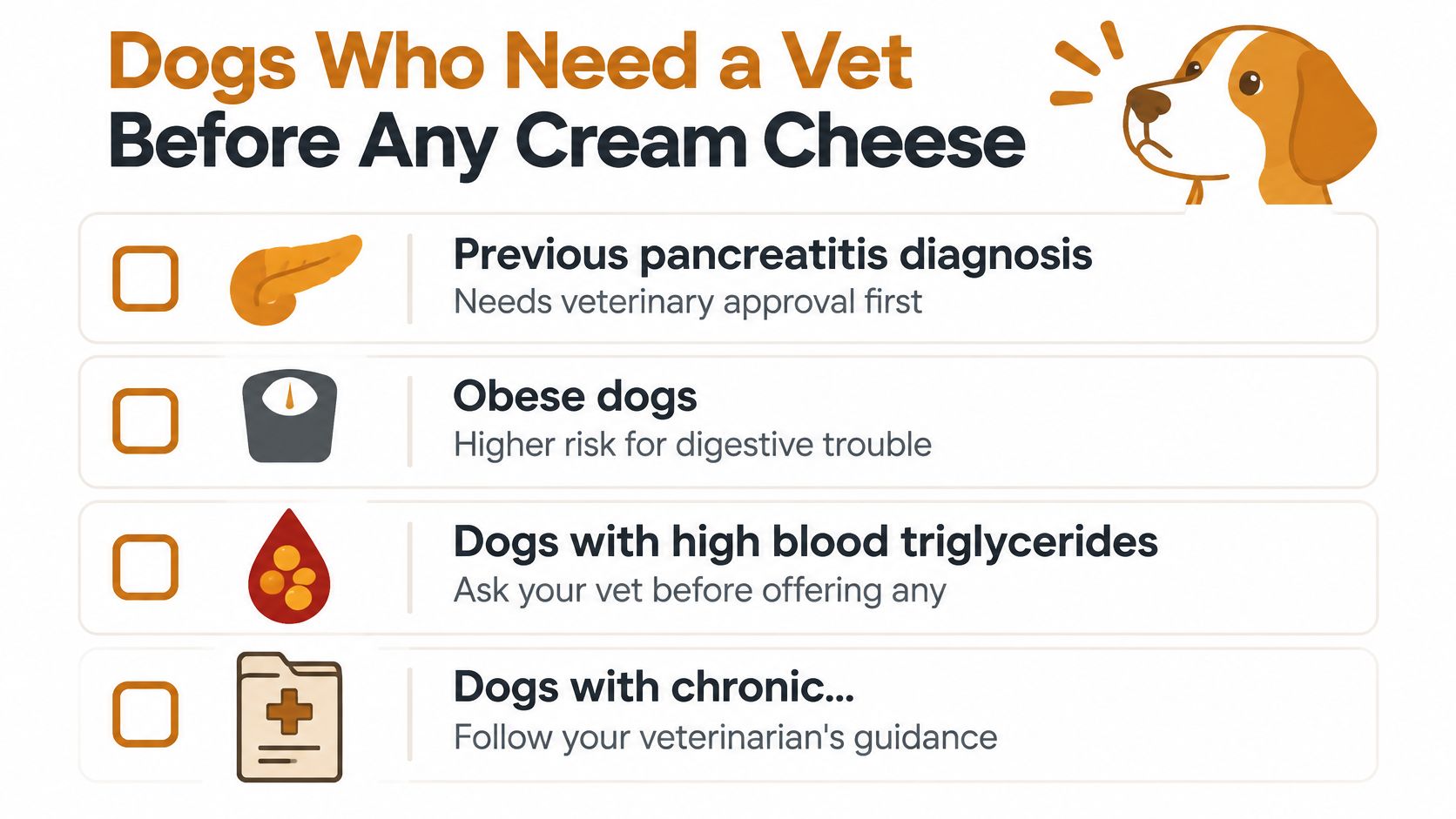
Dogs with pancreatitis, obesity, high blood triglycerides, or a prescribed low-fat diet should skip cream cheese unless their veterinarian approves it. A small amount isn't automatically appropriate for a medically vulnerable dog, even when the ingredient list looks harmless.
Use this checklist before considering a taste:
- Previous pancreatitis diagnosis: Don't restart fatty treats because the dog currently seems well.
- Obesity or an active weight-management plan: Ask which rewards fit the feeding plan.
- High blood triglycerides: Follow the veterinarian's dietary fat restrictions.
- Chronic gastrointestinal disease: Avoid experimenting with rich foods without approval.
- A prescribed low-fat or other therapeutic diet: Check whether extras are permitted at all.
- Puppies or senior dogs with ongoing conditions: Get advice suited to their health and current diet.
- Current vomiting or diarrhea: Withhold cream cheese rather than testing tolerance during illness.
These medical flags deserve attention before portion size does.
Why fatty treats deserve extra caution
Pancreatitis means inflammation of the pancreas, an organ involved in digestion. It's more complicated than eating too much fat, but diet can be a trigger. The American Kennel Club's pancreatitis guidance identifies a high-fat diet as a common trigger and warns that even a single large serving can bring on an episode in some dogs.
That's why a lower-fat label doesn't overrule a medical restriction. Treatment diets require deliberate control of the entire day's food, not just a smaller spoonful of something rich.
Repeated uses can create a larger exposure
Avoid using cream cheese as a generous food-puzzle stuffing, a routine meal topping, or repeated training rewards. Pill hiding also deserves a separate conversation with your veterinarian, particularly when medication is given regularly. A small dab repeated throughout the day is no longer an occasional taste.
Repeated vomiting, abdominal pain, a hunched posture, refusal to eat, and marked lethargy warrant prompt veterinary attention. Don't assume those signs are ordinary dairy intolerance, especially after a large serving or in a dog with previous pancreatitis.
For a dog on this checklist, the veterinarian decides whether cream cheese belongs in the diet. Neither a plain label nor a weight-based portion table can provide medical clearance.
Reading the Label for Xylitol and Other Hazards
If the label lists xylitol, birch sugar, or E967 and your dog has eaten the product, call a veterinarian or animal poison control immediately. Don't wait for symptoms. Reduced-sugar, light, and sugar-free products deserve particular scrutiny, but the complete ingredient list matters more than any front-label claim.
The FDA's xylitol warning explains that dogs can develop dangerously low blood glucose within approximately 10 to 60 minutes because xylitol triggers rapid insulin release. Signs include vomiting, weakness, staggering, incoordination, collapse, and seizures; liver damage is also possible, so an initially normal appearance doesn't establish safety.
Label terms that change the answer
| Label term | Why it matters | Action |
|---|---|---|
| Xylitol, birch sugar or E967 | Can trigger rapid insulin release and dangerously low blood sugar within 10 to 60 minutes | Call a veterinarian or animal poison control now |
| Onion, garlic or chives | Allium ingredients can damage red blood cells | Don't share; flavored spreads aren't treats |
| Raisins or grapes | Linked to kidney injury in some dogs | Don't share |
| Chocolate or cocoa | Contains theobromine, which dogs process slowly | Don't share |
| Plain milk, cream and salt only | Lowest-risk list for an occasional small serving | Still limit to the weight-based portion |
The ASPCA's foods-to-avoid guidance identifies alliums, grapes and raisins, and chocolate as hazards for pets. If your dog has already eaten a spread containing one of these ingredients, contact your veterinarian for an exposure assessment rather than assuming the amount was harmless.
A plain product may also list cultures or stabilizers. Their presence doesn't automatically make it poisonous, but neither does a short ingredient list guarantee that the product suits your dog. Plain, unsweetened, and free of hazardous additions is the useful screening standard.
Check the actual tub every time
- Read the complete ingredient list. Don't rely on the flavor name or a familiar package.
- Match unfamiliar terms against the hazard table. Check sweeteners and savory additions carefully.
- Act on uncertainty after ingestion. If xylitol is present or the ingredients are unknown, obtain immediate veterinary or poison-control guidance rather than watching at home.
Keep the container and note approximately what your dog ate. Formulas change, so check each new tub rather than relying on an earlier purchase.
Xylitol also appears in many human supplements. Don't give human probiotics to your dog without asking a veterinarian, and don't assume a supplement is suitable only because its advertised purpose sounds helpful.
Why Cream Cheese Upsets Some Dogs' Stomachs
Dairy intolerance is a digestion problem, not automatically a dairy allergy. Many dogs don't have enough lactase, the enzyme needed to break down lactose comfortably. Think of lactose as sugar arriving without its key: when the dog can't digest it effectively, intestinal bacteria handle more of it.
Undigested lactose draws water into the bowel and undergoes fermentation. That can produce loose stool, gas, rumbling, and abdominal discomfort. The digestive process helps explain why one dog tolerates a tiny taste while another develops symptoms.
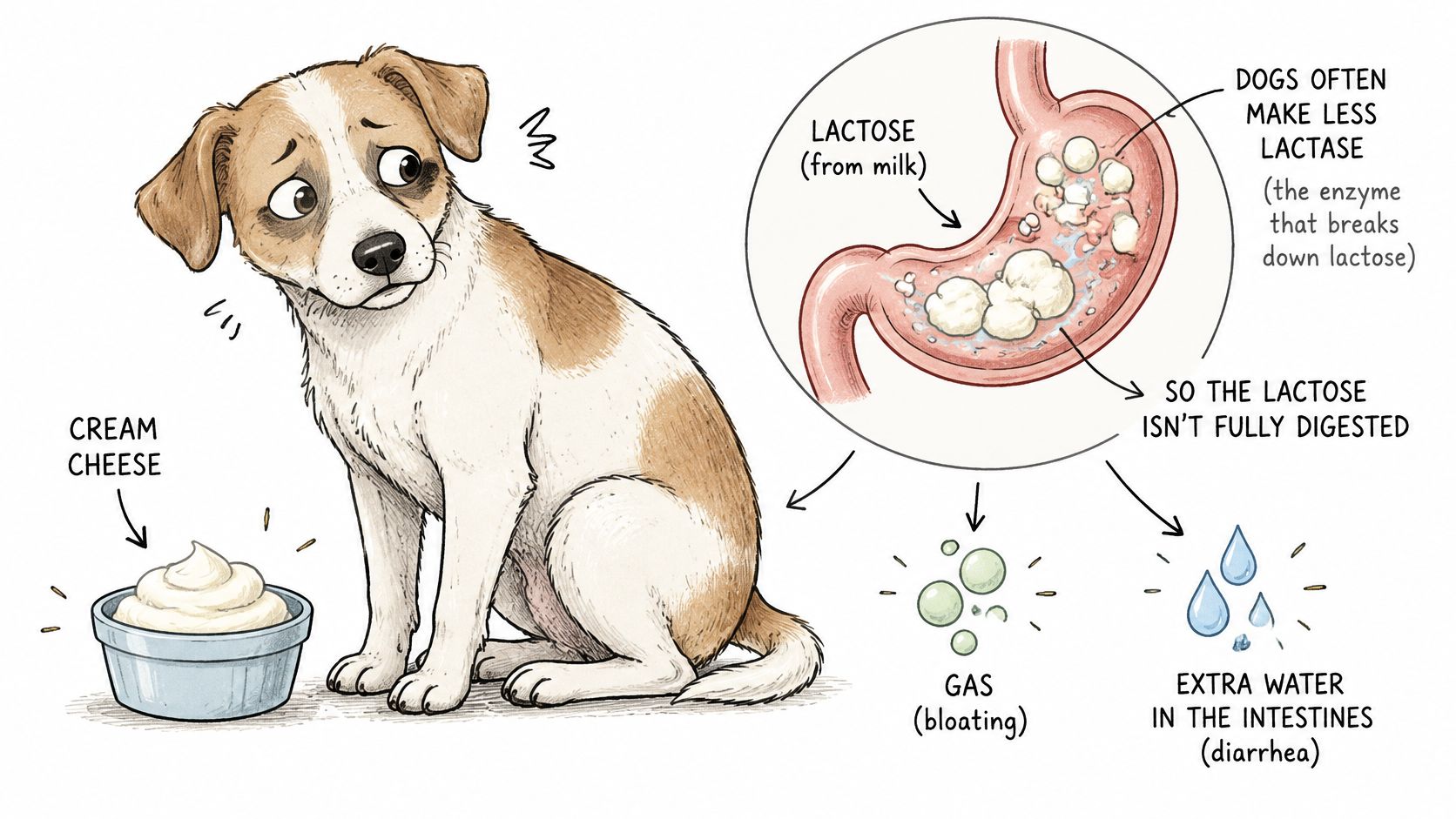
The Merck Veterinary Manual's discussion of malabsorption explains that intestinal damage can cause secondary lactose intolerance and advises avoiding dairy in animals with diarrhea. Skip cream cheese during active vomiting, diarrhea, or recovery from gastrointestinal disease.
Less lactose doesn't mean no reaction
Cheese generally contains less lactose than whole milk, but severely lactose-intolerant dogs can still react to small quantities, according to the AKC's guidance on holiday foods. Stop offering dairy if digestive symptoms appear.
Fat-free cream cheese reduces fat exposure, but it doesn't necessarily remove lactose. It also doesn't remove the need to inspect sweeteners, sodium, and other additions. Changing to a fat-free tub isn't a reliable way to solve a dog's dairy intolerance.
A dog that tolerated a lick hasn't demonstrated that it can tolerate a spoonful.
For a worked example, consider an otherwise healthy adult dog weighing 18 lb that eats a tablespoon of plain cream cheese. That is six times the half-teaspoon editorial ceiling for its weight band. Treat it as an excessive fat-and-dairy exposure, not proof of poisoning, and monitor closely if your veterinarian agrees home observation is appropriate.
Decide what the symptoms require
For an adult dog that remains lively, eats and drinks normally, and has just one soft stool, withhold dairy and watch. If vomiting or diarrhea continues, contact your veterinarian; don't wait through a prolonged episode because cream cheese seems like a minor dietary mistake.
Puppies, elderly dogs, and dogs with ongoing conditions need a same-day call for soft stools. Repeated vomiting, belly pain, a hunched posture, weakness, collapse, or signs of dehydration require more urgent assessment. These signs can overlap with pancreatitis or other illness.
The following video provides additional context on the topic.
Don't induce vomiting at home unless a veterinarian or animal poison service directs you to do so. After symptoms appear, stop the food and don't repeat a test dose during recovery. Recurrent symptoms after dairy are a reason to avoid it, not to keep searching for a slightly smaller serving.
Symptom timeline after cream cheese
| Situation | What it looks like | What to do |
|---|---|---|
| One soft stool, dog otherwise lively | Mild loose stool, normal appetite and drinking | Withhold dairy and watch for 24 hours |
| Diarrhea or vomiting for two to three days | Signs persist beyond the initial observation period | Call your veterinarian; call earlier if worsening |
| Puppy, senior or dog with an ongoing condition | Any soft stool | Same-day veterinary call |
| Repeated vomiting, belly pain or hunched posture | Possible pancreatitis signs | Veterinary care now |
| Weakness, collapse or suspected hazardous ingredient | More than uncomplicated digestive upset | Immediate veterinary guidance |
The observation window applies only to a comfortable, otherwise healthy adult. It is never a reason to delay care when symptoms worsen or a toxic ingredient is possible.
Safer Treats to Share Instead
For many dogs, a small portion of plain lean meat or a suitable vegetable is a more practical reward than cream cheese. These options avoid lactose, and several make it easier to offer a small reward without a concentrated dairy-fat serving. They're still extras, not substitutes for a complete diet.
Choose according to what your dog already tolerates. The AKC's human-food safety guidance supports careful preparation and portion control, and notes that a lower-fat cheese category can be preferable to rich cheese for dogs that tolerate dairy.
Match the alternative to the job
- Plain cooked skinless chicken breast: Useful when you want a protein-based reward. Remove skin and bones, cook thoroughly, and cut into small pieces.
- Plain cooked green beans: A lighter vegetable option that's easy to portion. Serve soft, chopped pieces without butter or sauce.
- Plain pumpkin puree: Offers fiber and a soft texture for a small food reward. Choose unsweetened puree, not seasoned or sweetened pie filling.
- Blueberries: Convenient for a small occasional taste. Wash them and offer very small quantities, adjusting their size for your dog.
- Baby carrots: Provide a firm chewing texture. Cut or soften them appropriately instead of handing a hard whole carrot to a dog that gulps food.
- Plain cooked lean turkey: Another lactose-free protein option. Remove skin, bones, and fatty drippings, and keep seasoning out.
Preparation matters more than novelty
Don't add butter, oil, salt, onion, garlic, or seasoning. Remove bones, pits, and hard fragments, and choose a texture your dog can manage comfortably. A plain ingredient can become unsuitable once it's prepared as part of a seasoned family meal.
Introduce one new food at a time so you can identify what caused a reaction. If your dog has a therapeutic diet or medical condition, ask which alternatives are allowed rather than assuming vegetables or lean meat are automatically exempt.
Reward, not replacement: Keep the treat small enough that the dog's regular, nutritionally complete food still supplies its nutrition.
Confirm the Portion Fits Before the First Taste
The useful answer to “Can dogs eat cream cheese?” is conditional: the dog must be an appropriate candidate, the ingredients must pass inspection, and the portion must stay deliberately small. A dog's enthusiasm doesn't help make any of those decisions.
Use this procedure before opening the tub for your dog.
A pre-serving check
- Screen for medical exclusions. Run through the veterinary checklist. Stop if a condition applies, and ask your veterinarian rather than choosing a smaller serving yourself.
- Read the entire label. Reject hazardous ingredients, including xylitol, birch sugar, E967, and the flavored additions in the label table. Don't use a product whose ingredients you can't verify.
- Measure the portion. Use a level measuring spoon and your dog's weight band. For a first exposure, offer less than the maximum, not a heaped approximation.
- Choose a time when help is available. Offer the plain serving during the day, when you can observe your dog and reach a veterinary practice if needed. Don't introduce it just before leaving home.
- Watch the dog, not just the bowl. Check stool, appetite, comfort, and energy afterward. Stop if soft stool, vomiting, or lethargy appears, and use the symptom decision table to choose the next action.
- Record it as an occasional extra. If tolerated, keep it infrequent rather than turning it into a daily topping. Record the amount with other treats so another family member doesn't unknowingly repeat it.
Keep feeding decisions separate from health treatment
A treat isn't a digestive remedy. No supplement cures a medical condition, and switching between dairy products or adding a probiotic isn't a substitute for assessing recurring symptoms.
Our free tools can help with planning, while our breed pages provide breed-specific health-risk context. A veterinarian should confirm daily calorie needs and any dietary restrictions; a breed profile can inform questions but can't diagnose your individual dog.
Before the first taste, take the simplest useful action: turn the tub around and read the ingredients. If the label passes, then check medical suitability and measure.
PetCostEngine's content is informational and is not veterinary advice.
Visit PetCostEngine to explore breed-specific health profiles and free planning tools based on your dog's breed, state, and age. Use them to prepare better questions about your dog's needs, then confirm feeding restrictions and suitable treats with your veterinarian.
Modeled estimates for 226 breeds, with the formula and sources published in full.
See the data →
Premium dry food → Slow-feeder bowl → Digestive support →
As an Amazon Associate, PetCostEngine earns from qualifying purchases.