A double coat is working equipment, and the quickest way to damage it is to treat it like a summer haircut. Under the long, coarse hairs you can see sits a second layer you mostly can't: a dense, soft undercoat that traps air against the skin and buffers the dog against cold and heat alike. Clip both layers away and the dog loses insulation and sun protection at the same moment, while the shedding you were trying to stop carries right on.
That gap between how a coat looks and how it works explains most of the confusion owners bring to grooming. Hair length tells you very little. A short-haired Chesapeake Bay Retriever carries a full double coat, and plenty of long-haired dogs carry only one layer. What matters is structure, how many layers there are, how dense they run, and how the dog's body schedules their replacement through the year.
Table of Contents
- Double Coat Versus Single Coat at a Glance
- Double-Coated Breeds and What Their Coats Reflect
- When Seasonal Shedding Is Normal
- Choosing Brushing Tools for a Double Coat
- How to Brush and Deshed a Double Coat Step by Step
- Why Shaving Backfires and When Clipping Is Medically Justified
- Heat and Cold Health Risks by Coat and Body Type
- How Coat Type Changes Grooming Frequency and Upkeep
- Set a One-Week Coat Plan and Know When to Call Your Vet
Double Coat Versus Single Coat at a Glance
| Trait | Double coat | Single coat |
|---|---|---|
| Layers | Topcoat of guard hairs plus dense undercoat | One layer of hair |
| Undercoat | Soft, dense, insulates in cold and heat | Little or none |
| Outer coat | Coarse, water- and dirt-resistant | Varies by breed |
| Seasonal shedding | Heavy blowing cycles, often spring and fall | Gradual, usually lighter |
| Grooming need | Regular brushing plus periodic deshedding | Brushing or trimming, often less |
| Effect of shaving | Removes both layers; regrowth can be uneven | Removes the hair only |
Read that table as a map of what you're maintaining, not a ranking of dogs. A double-coated dog carries two biologically distinct layers, and each one fails differently when neglected. The American Kennel Club's guide to double-coated breeds describes the outer layer, also called the topcoat, guard coat, or primary hair, as longer, coarser hairs that shield the skin and help repel water, dirt, and environmental debris. The inner layer, the undercoat or secondary hair, is shorter, softer, and denser, and its principal job is insulation.
What the undercoat does in July
The undercoat traps air close to the skin, which slows heat loss in cold conditions. It also helps in warm weather by holding a layer of relatively cooler air around the body, rather than acting as a permanent heat source the way many owners assume. That's why a compacted or matted undercoat makes a dog more uncomfortable, not less. The air layer is gone, and what's left sits flat and damp against the skin.
Why double coats shed more
Undercoat hairs are weaker than outercoat hairs, and the American Kennel Club notes they commonly grow and shed multiple times per year, often in seasonal cycles. The practical result is volume. A double-coated dog can produce substantially more loose hair during a shedding cycle than a single-coated dog, which turns brushing from an occasional chore into a recurring one. German Shepherd Dogs, Siberian Huskies, Bernese Mountain Dogs, Collies, and Corgis all sit in this group.
Length is a red herring. A short-coated dog can carry two layers and a long-haired dog can carry one, so breed write-ups and hair length alone won't tell you what you're dealing with.
Do this now: part the hair at the lower back and look beneath the guard hairs. A soft, dense, slightly woolly layer that springs back when you push it means a double coat. Bare skin under a single smooth layer means you're working with one coat, and the upkeep is different.
Double-Coated Breeds and What Their Coats Reflect
| Breed | Coat texture | Typical shedding | Original work |
|---|---|---|---|
| German Shepherd Dog | Dense, straight outer coat over thick undercoat | Heavy seasonal blowing | Herding and guarding |
| Siberian Husky | Thick, soft undercoat under dense guard hairs | Heavy seasonal blowing | Sled work in cold climates |
| Bernese Mountain Dog | Long, thick, moderately coarse double coat | Seasonal shedding | Farm and draft work |
| Collie | Long, rough outer coat over a dense undercoat | Seasonal shedding | Herding |
| Pembroke Welsh Corgi | Medium double coat, weather-resistant | Seasonal shedding | Herding cattle |
| Chesapeake Bay Retriever | Short, dense, oily undercoat with a wavy outer coat | Seasonal shedding | Waterfowl retrieving in icy water |
| Great Pyrenees | Thick white double coat | Undercoat sheds in warm weather | Livestock guarding |
Every row traces back to a job. These coats were selected for cold water, cold air, long days of herding, or nights guarding livestock in the open, not for appearance. The American Kennel Club's explanation of the double coat keeps the functional split clear: the undercoat insulates in both cold and hot conditions, while the outer coat protects the skin from environmental exposure. Once you know which job a breed was built for, its shedding pattern stops looking random.
The Chesapeake Bay Retriever, a coat built for ice water
The breed's documented history makes the case better than any chart. The Chesapeake Bay Retriever's working past centers on a dense, woolly undercoat loaded with natural oil, a combination that let the dog work in the frigid waters of Chesapeake Bay, breaking through ice to retrieve game. The American Kennel Club formally described that coat in 1918, when it accepted a unified breed standard specifying a short, hard double coat that could show waves around the shoulder, neck, back, and loins.
The Great Pyrenees runs the same logic on a different calendar. Its insulating undercoat sheds out in warm weather while the protective outer coat stays in place. That's adaptation, not a coat failure, and it's why a guard dog can look scruffy in June and fully coated again by November.
Use the table as an expectation, not a verdict. Find your breed, note the texture, and assume shedding that matches the original work. Density still varies with climate, age, and individual genetics, so check your own dog. Golden Retrievers carry a comparable double coat, and our Golden Retriever breed page ties that coat to the health conditions the breed meets most often.
When Seasonal Shedding Is Normal
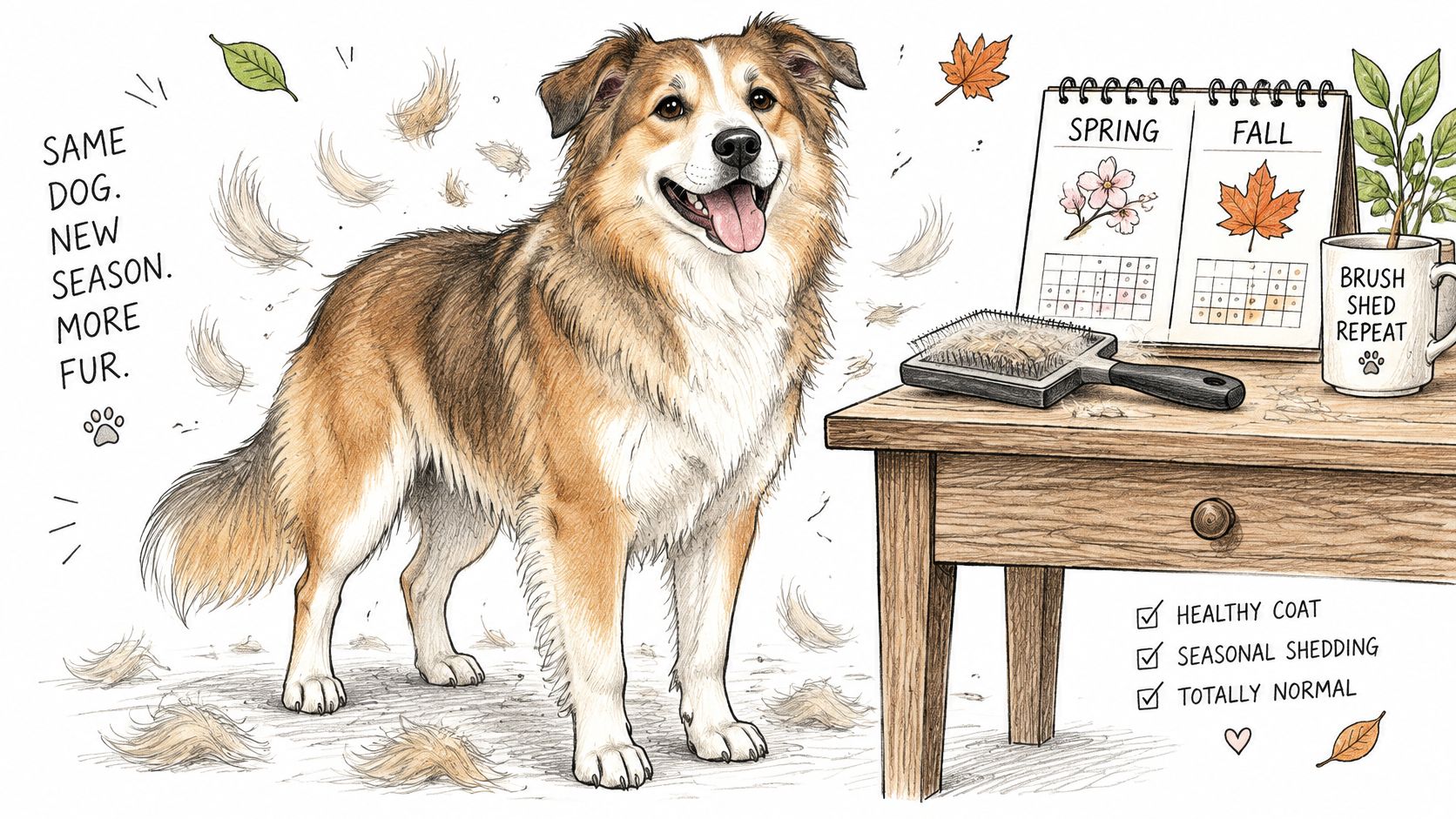
The image above captures what most owners see during a coat blow: a dog dropping undercoat while the weather shifts.
A blowing coat is the heavy, short-lived shed of the undercoat that most double-coated dogs run through once or twice a year, usually as days lengthen in spring and shorten in fall. The old undercoat releases in tufts, the dog leaves hair on every surface it brushes past, and the coat can look patchy for a week or two even though the skin underneath is healthy. It's normal turnover, not illness.
The household changes the calendar
Where your dog lives matters more than most owners expect.
| Household setting | Typical shedding pattern | What to watch |
|---|---|---|
| Cold-climate home with seasonal temperature change | Heavy blowing in spring and fall | Brush more often during the blow |
| Warm home with air conditioning | Shedding up to four times a year or continuously | Steady weekly brushing |
| Indoor dog under artificial lighting and climate control | Less distinct seasons, more year-round loss | Track hair volume after each brushing |
| Outdoor working double-coated dog | Seasonal blowing tied to temperature and daylight | Check for mats and skin changes |
AKC guidance on grooming double-coated dogs notes that dogs in warmer homes may shed four times a year or continuously, and that indoor dogs under artificial lighting and climate control often show less distinct seasonal shedding and more year-round hair loss. In other words, a calendar month is a poor predictor for a dog that sleeps on a heated floor. Breeds with a dramatic blow, such as the Akita, can look alarming in April and completely normal by June.
The indicators that set your schedule
Start with the usual baseline: weekly brushing for a steady coat, and every two to three days during heavy shedding. Then let the dog's coat move that schedule up or down using what you can see and feel.
- Comb resistance: a rake that slides through with no drag means you can wait; a rake that snags means work through that section in short strokes.
- Loose undercoat: if pinching a small tuft releases a clump of grey fluff, the coat is blowing and needs more frequent sessions.
- Skin visibility: pink skin showing through the coat on the back or flanks after brushing means you've cleared the loose layer for now.
- Mats forming: knots behind the ears, in the armpits, or under the tail mean the schedule is already behind.
- Odor: a sour, damp smell from the undercoat usually means trapped moisture and needs attention before it becomes a skin problem.
- Volume after one session: a pile the size of your palm is routine; a pile the size of a dinner plate tells you to shorten the interval.
Brushing is not deshedding
A maintenance pass tidies the outer coat and lifts surface hair. Deshedding works the undercoat out deliberately, and it irritates skin when you attack the same patch with a rake every day. Alternate: one thorough undercoat session, then lighter passes until the coat starts releasing again.
Year-round shedding in a climate-controlled home is common and isn't automatically a health problem. Patchy bald areas, redness, flaking, and hair loss that arrives with itching are different, and those belong with your vet rather than with a better brush.
Choosing Brushing Tools for a Double Coat
Pick tools by the job they do, not by the picture on the package. Four categories cover almost every double coat.
- Slicker brush: fine angled pins that lift tangles and light debris from the outer coat. Check that the pins are coated or rounded at the tips, because bare wire tips scratch skin.
- Undercoat rake: long, widely spaced teeth that reach the dense layer. The label should say it's intended for undercoat removal, and the tines should be rounded, since sharp or closely spaced teeth scrape skin and snap guard hairs.
- Dematting tool: a comb or blade with a guard. Buy only with a guard, and use it on tight knots rather than on open coat.
- Bristle brush or finishing brush: smooths the outer coat and spreads natural oils after the rake work is done.
Match the set to density and season. A heavier rake earns its place during a blow; a lighter slicker and a metal comb handle the rest of the year. Before you buy, ask a groomer or your vet three things: which tool they'd use on this specific coat, whether a guarded dematting blade is safe for this dog's skin, and how often they replace worn tines. Dull or bent teeth pull hair instead of releasing it.
How to Brush and Deshed a Double Coat Step by Step
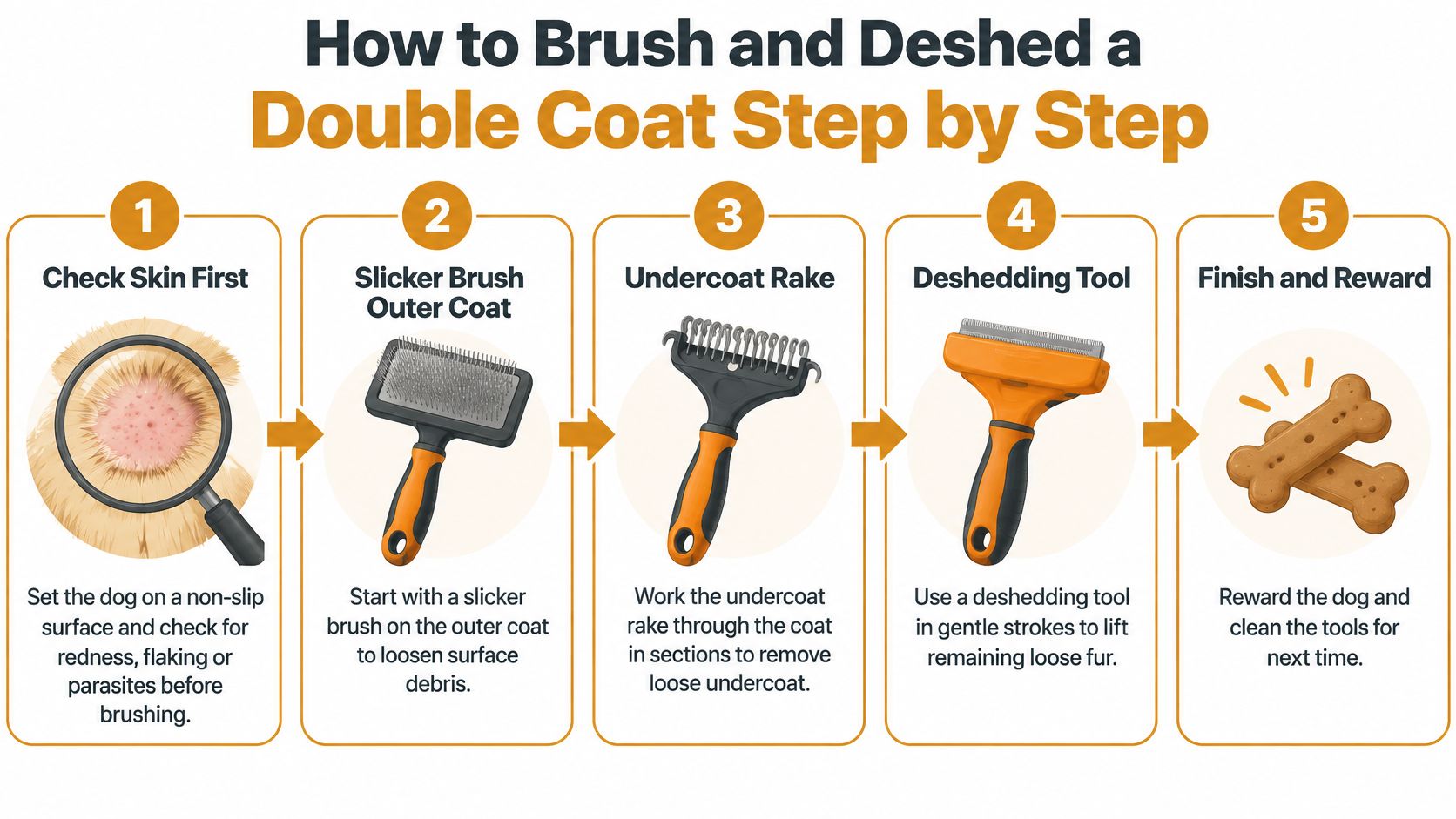
The sequence below is the one to follow, in this order, because each step makes the next one easier and safer.
Check the skin before the brush comes out. Stand the dog on a non-slip mat or a rubber-backed rug and run your fingertips against the coat from the shoulders to the tail. You're looking for redness, flakes, scabs, or fleas. Brushing over a hot spot or a tick spreads irritation and hides the problem, so inspect first.
Loosen the surface with a slicker brush. Work in sections from the back forward, using light pressure and letting the pins do the work. Heavy pressure on a slicker scratches skin, and scratching teaches the dog that grooming hurts.
Part the coat down to the skin. Use your fingers to open a channel, then brush along the direction of growth so you can see the undercoat you're trying to reach. Brushing only the top surface is the single most common reason owners say a brush "doesn't work".
Switch to an undercoat rake in short strokes. Move in passes no longer than a couple of inches, and stop on any area where hair releases easily. When the rake stops pulling loose fluff, that section is done. Never scrape the skin, and never saw back and forth in one spot.
Give the friction zones extra time. Behind the ears, in the armpits, along the britches, and under the tail collect mats first. Work knots apart with your fingers or a guarded dematting tool before they tighten. Pulling a mat with a brush drags the skin underneath and hurts, so separate first, brush second.
If you want to see the tools in motion on a real coat, this walkthrough shows the hand position and pressure that keep a rake working without scraping.
Bathe only when the coat needs it. Use a shampoo formulated for the coat type, rinse until the water runs clear, and dry the dog completely. A damp undercoat holds odor, mats against the skin, and chills the dog in cool weather.
Finish with low heat and a reward. A low-heat dryer or a high-velocity dryer pushes out the loose undercoat the rake loosened and dries the layer nearest the skin. End every session with a treat and a calm minute together, because the dog's willingness next week depends on how this week ended.
What a finished session looks like: an even, fluffy outer coat with no tufts standing proud, no knots behind the ears or under the tail, and a clear drop in loose hair when you run your hand along the flank. If you can still lift a clump of undercoat, the session isn't finished.
Why Shaving Backfires and When Clipping Is Medically Justified
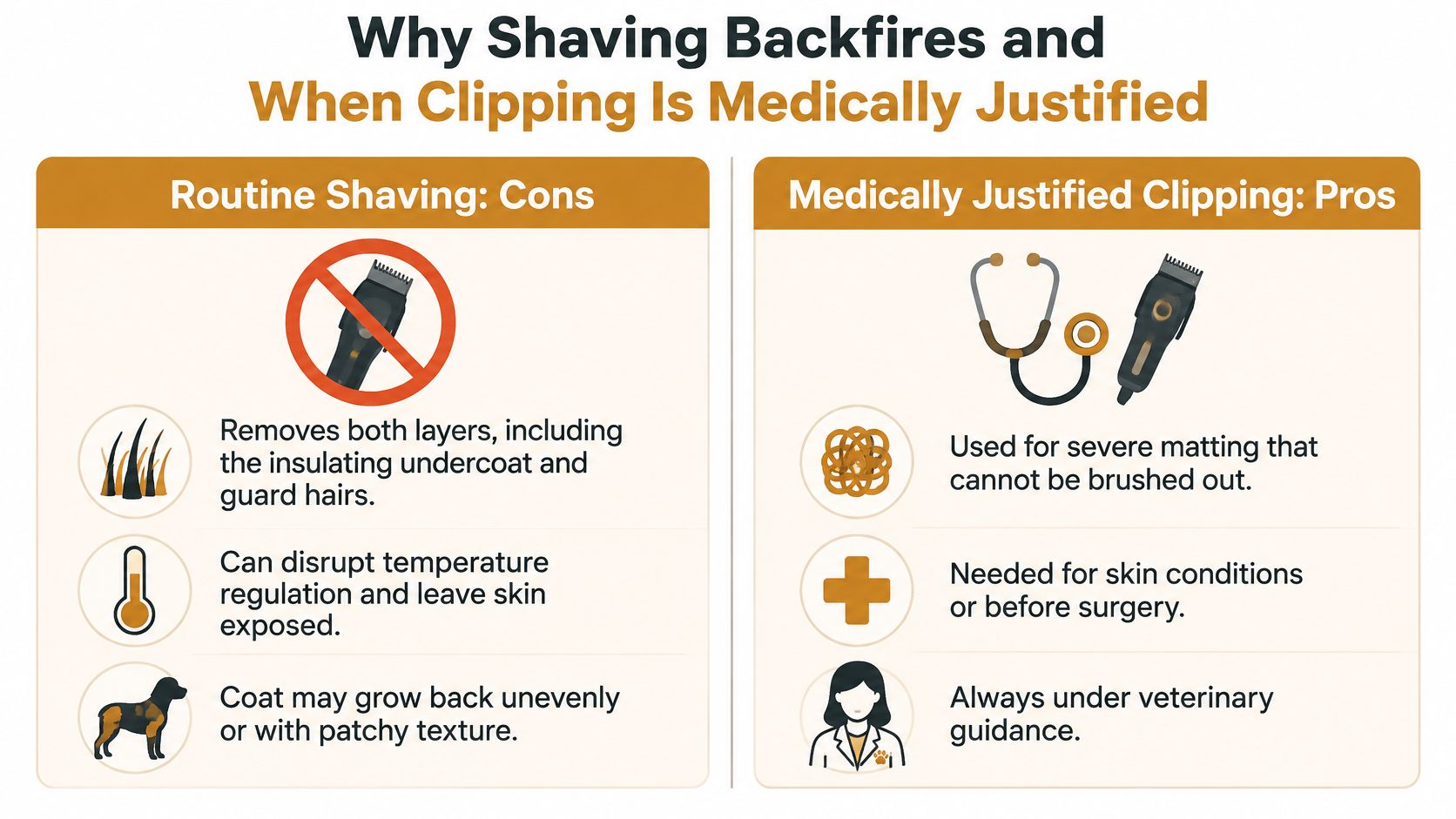
The myth goes like this: the dog is panting, the coat is thick, so removing the coat must cool the dog down. For a healthy double-coated dog, routine shaving is a poor thermal strategy. AKC guidance on grooming a double-coated dog explains that clipping removes the guard layer that protects the skin and helps maintain the coat's insulating architecture. It doesn't stop shedding either, and regrowth can arrive late or uneven, with some dogs developing altered texture or incomplete restoration of the primary hairs, leaving a coat dominated by undercoat and less protective than before.
Dogs don't cool the way people do. They cool mainly by panting, with limited sweating through the paw pads, so the coat isn't a layer of clothing you can peel off to feel a breeze. A dog with a shaved back is still panting in the shade.
The trade-offs, side by side
Routine shaving, the costs:
- Lost insulation: both the cooling barrier of the undercoat and the weather resistance of the guard hairs go at once.
- Sun exposure: bare skin under strong summer sun burns, and repeated exposure irritates it.
- Unpredictable regrowth: the undercoat can outpace the topcoat and come back patchy or woolly, which mats more easily than the original coat.
- No shedding benefit: the same amount of hair still leaves the dog, now in shorter pieces that work into fabric.
Professional undercoat removal, the gains:
- Keeps the guard hairs: a groomer works the compacted undercoat out while leaving the protective outer layer intact.
- Better airflow: in humid climates, removing packed undercoat lets air move through the coat again.
- Fewer mats: releasing undercoat before it felted prevents the tight knots that trap moisture.
For normal summer management, the effective list is shade, hydration, airflow, and regular deshedding. Cool rather than icy water, walks shifted to early morning and late evening, and a raised bed with air moving under it do more for a dog than a clipper. In humid, high-risk environments, professional grooming earns its place by removing compacted undercoat while preserving guard hairs.
When clipping is the right call
The actionable exception is veterinary necessity, such as surgery or treatment of severe skin disease, and that clipping follows veterinary direction. The vet sets that decision, not the groomer and not a forum thread. A Siberian Husky heading into surgery needs a surgical field; a Husky heading into July needs shade and a rake. Our Siberian Husky breed page covers the coat and the breed's health profile together.
Heat and Cold Health Risks by Coat and Body Type
Heat and cold attack the same two layers differently: summer challenges the coat's ability to shed heat, winter its ability to trap it. Body type decides which dogs reach the danger zone first.
| Dog type or situation | Main risk | Warning signs | First action |
|---|---|---|---|
| Dark-coated double-coated dog in strong sun | Heat absorption and sunburn on exposed skin | Reddened skin, heavy panting | Provide shade and water, shorten walks |
| Brachycephalic, overweight, or senior double-coated dog | Heat stress driven by physiology | Labored breathing, restlessness, slowing down | Limit exertion, move indoors, call the vet early |
| Dense, matted coat in warm, humid weather | Skin cannot dry; hot spots and irritation | Odor, moist patches, scratching | Remove mats or get professional help; call the vet for wounds |
| Double-coated dog kept outside in cold, wet weather | Insulation lost when the undercoat is wet or matted | Shivering, reluctance to move | Dry the coat, provide shelter, limit time outdoors |
| Any coat type with heat exhaustion or heatstroke | Dangerous overheating | Collapse, weakness, vomiting, very rapid breathing | Emergency veterinary care immediately |
Coat length is only one input. A brachycephalic, overweight, senior, or medically compromised dog can overheat with a perfectly normal coat, because the airway and the body's ability to dump heat set the limit. Heat-related illness runs from heat exhaustion to fatal heatstroke, and flat-faced, heavy, and older dogs reach that point faster than lean, long-nosed dogs of the same size. Dark coats absorb more sun, and a dense coat packed with felted undercoat can't dry in humid weather, which is how hot spots start.
Cold works through the same structure. Dry undercoat traps a layer of still air warmed by the skin; once the coat soaks through or mats flat, that air layer collapses and the insulation is largely gone. A dog left outside in freezing rain chills far faster than the thermometer alone would suggest. The Alaskan Malamute breed page pairs that cold-weather coat with the breed's own health risks.
The American Veterinary Medical Association and the ASPCA both publish heat and cold safety guidance worth reading before a heat wave or a cold snap, and your own vet sets the threshold for a dog with heart, breathing, or weight problems.
Call your vet now if you see: heavy panting that doesn't settle after a few minutes in shade, thick drooling, weakness or wobbling, vomiting, collapse, or any open skin wound under a mat. Heatstroke and heat exhaustion are emergencies. Cool the dog with room-temperature water, get air moving, and drive to the clinic rather than waiting to see if it passes.
How Coat Type Changes Grooming Frequency and Upkeep
Upkeep follows coat structure, not hair length. A dense double coat needs scheduled undercoat removal, extra time during a blow, and vigilance around mats. A single coat may need nothing more than a brush and the occasional trim around the feet and sanitary areas. Two dogs with identical hair length can sit at opposite ends of that scale.
Four things raise the workload: undercoat density, climate, indoor heating and cooling, and age. A dense coat in a humid climate with a dog that swims will mat faster than a sparser coat in a dry one. A senior dog who lies down more develops mats on the pressure points. Activity matters too, since a dog that runs through brush picks up burrs and tangles that a sofa dog never meets.
In practical terms, what changes is time and frequency: minutes per home session, how many sessions a week, how often the dog needs a bath, and how quickly rakes and slickers wear out. A professional appointment also runs longer when a groomer has to lift a season's worth of undercoat or work through mats before the bath.
Our German Shepherd breed page pairs that dense coat with the breed's health risks, and the cost calculator lets you model how grooming visits fit into a full ownership picture.
Before booking, ask a groomer four questions:
- Will you shave a double coat without veterinary direction? A "yes" without questions is a reason to keep looking.
- How do you remove undercoat? You want a description of raking, bathing, and drying, not just "a deshed treatment".
- How do you handle mats? The answer should separate detangling from clipping, and mention skin checks.
- Do you offer deshedding as a standalone service? It's cheaper in time and stress than a full groom every visit.
Set a One-Week Coat Plan and Know When to Call Your Vet
A coat plan is five habits, not a product. Work through these in order and repeat them weekly.
- Record the current state. Note loose undercoat, any mats, skin condition, and whether the dog is mid-blow or steady. Use the indicators from the shedding section rather than the month on the calendar.
- Set the rhythm. Weekly maintenance brushing as the baseline, moving to every two to three days while the coat is blowing.
- Check the friction zones at every session. Behind the ears, the armpits, the britches, and under the tail, where mats start first.
- Confirm heat and cold protection. Shade, fresh water, a dry coat in wet weather, and no routine shaving.
- Book the vet if something changes. Patchy hair loss, itching, redness, or any heat-stress sign from the risk table.
If you want a coat-specific starting point, our free analysis asks four questions and gives one answer suited to your dog's breed, state, and age, and the breed pages carry coat notes alongside each breed's health and upkeep profile.
Keep the coat, brush on the schedule the dog's shedding shows, and stop routine care to call the vet the moment warning signs appear.
PetCostEngine exists so you can see the whole picture of a dog before the bills arrive, and coat care is part of it. Our breed pages break down grooming, veterinary care, food, training, and insurance for 226 breeds, adjusted for your state, alongside the health conditions each breed meets most often. If you're weighing a heavy-coated breed or budgeting for a dog you already have, run the free analysis and get one answer built around your dog's breed, state, and age.
Estimated lifetime and yearly costs for a Golden Retriever, state by state, plus whether pet insurance breaks even for the breed.
See Golden Retriever costs →
Is insurance worth it for a Golden Retriever? →
Deshedding brush → Orthopedic bed → Premium dry food →
As an Amazon Associate, PetCostEngine earns from qualifying purchases.