
Most healthy adult dogs can have a few tablespoons of plain milk occasionally, but fresh water should remain the default drink and milk isn't nutritionally required. You've just poured cereal, your dog is watching the bowl, and you're wondering whether a little milk in a saucer is a harmless treat or a stomach ache waiting to happen.
That moment is where confusion starts. Milk isn't toxic to dogs in the way chocolate or grapes are, so many owners assume it's healthy. It isn't that simple. Whether dogs drink milk safely depends on the individual dog, the amount, and what's already going on in the gut. A healthy adult and a puppy, a senior, or a dog with pancreatitis aren't in the same position, and they shouldn't get the same answer.
Table of Contents
- The Short Answer on Milk for Dogs
- Why Lactose Upsets Many Adult Dogs
- Puppies, Seniors and Dogs With Health Conditions
- Run a Safe First Milk Trial
- When Milk Symptoms Mean Call Your Vet
- Dog-Safe Alternatives to Milk
The Short Answer on Milk for Dogs
Most healthy adult dogs can tolerate a small amount of plain milk, but tolerance varies a lot and milk adds nothing a complete, balanced dog food doesn't already provide. Treat it as dessert, not as a meal and not as a drink.
Milk is an occasional treat, not a beverage. Water covers hydration, and a complete diet covers nutrition.
Controlled evidence shows why caution matters even at realistic doses. In the 2022 controlled study of adult Springer Spaniels, 40 adult Springer Spaniels with lactose intolerance were split into groups of 10 receiving standard cow-milk powder, goat-milk powder, lactose-free cow-milk powder, or water. Feeding intolerance, defined as diarrhea and vomiting lasting at least two days, occurred in 40% of dogs receiving standard cow milk and 60% receiving goat milk. Milder lactose-intolerance symptoms appeared in 50% of dogs fed standard cow milk and 60% fed goat milk, while the lactose-free and water groups didn't show the same pattern.
What That Study Can and Can't Tell You
Those numbers don't prove exactly half of all dogs are lactose intolerant. The sample involved one breed and dogs already identified as lactose intolerant, so you can't apply the percentages to every pet at home.
What it does establish is practical. Ordinary dairy milk can cause digestive symptoms at doses owners might offer, and goat milk isn't automatically safe because it still contains lactose. If your dog develops loose stool, gas, vomiting, or abdominal discomfort after milk, stop offering it. There's no nutritional reason to push through a bad reaction to an optional extra.
Why Lactose Upsets Many Adult Dogs
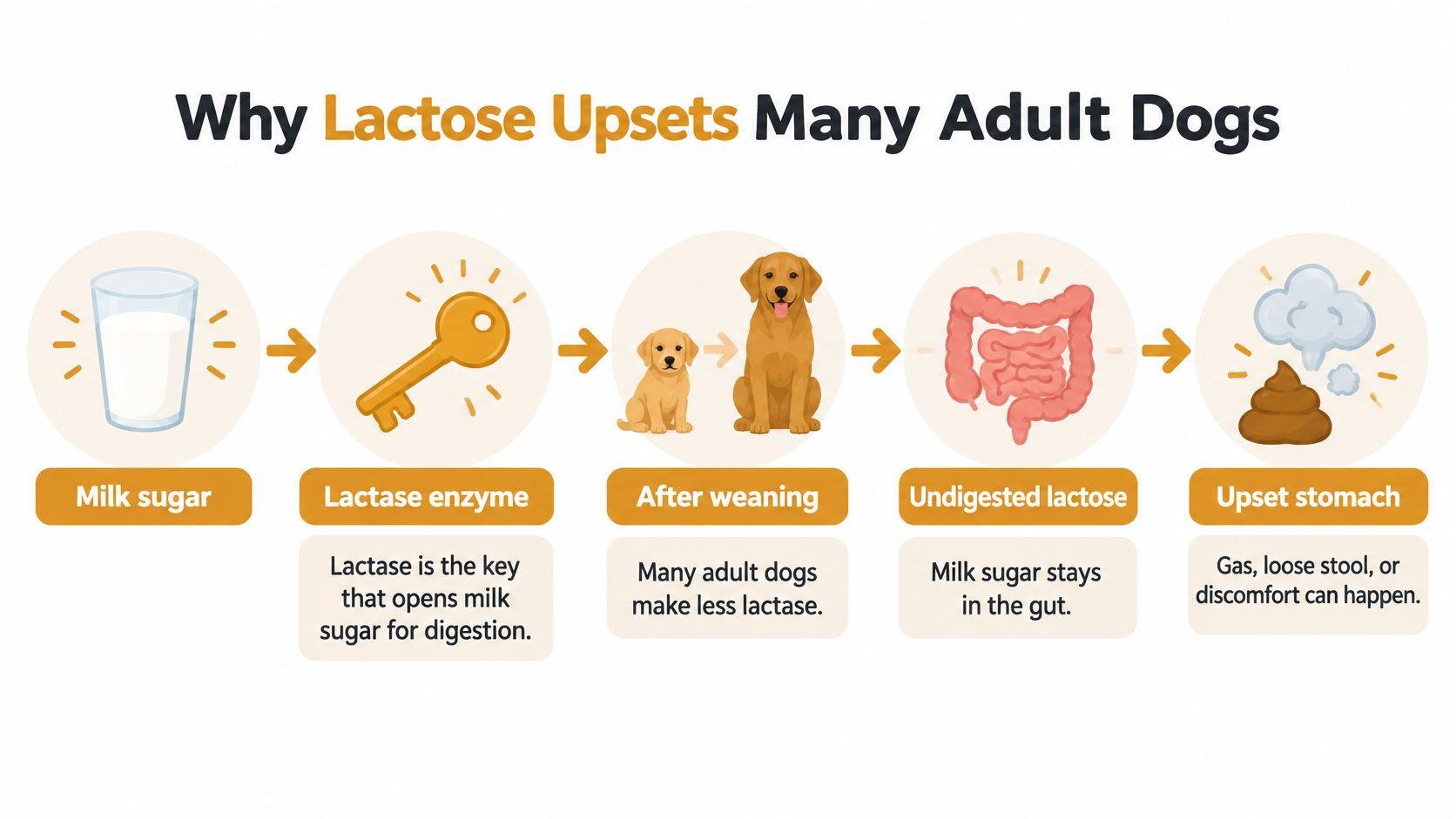
Lactose is milk sugar. To use it, the body needs an enzyme called lactase. Think of lactase as a key that opens the sugar so the small intestine can absorb it.
Puppies nursing from their mother make plenty of those keys. After weaning, many dogs make fewer. The sugar then stays locked, travels through the gut intact, and causes trouble downstream.
What Happens in the Gut, Step by Step
Say a healthy adult dog laps up a small saucer of milk in the morning and seems fine at lunch. Inside, the sequence is still unfolding. First, incompletely digested lactose sits in the small intestine. Next, it pulls water into the gut. Then intestinal microbes ferment it, producing gas.
The veterinary review in PMC describes this pattern. Adult dogs commonly have reduced lactase activity after weaning, undigested lactose increases osmotic water movement into the gut and is fermented by intestinal microbes, and the typical signs are gas, bloating, abdominal discomfort, and diarrhea.
That timing explains a common mix-up. Signs often appear hours later, not while the dog is still licking the bowl, so owners blame dinner, a new treat, or something picked up outside. By evening, the dog may have cramping, flatulence, a reduced appetite, or a loose stool on the walk, and the morning milk is long forgotten.
Why One Dog Is Fine and Another Isn't
Dose matters, but it's not the only variable. A larger dog may handle an amount that overwhelms a small dog. Age, gut health, and how much lactase that individual still produces all shift the threshold. Dogs with intestinal disorders may have especially reduced lactase activity, so a quantity another dog tolerates can trigger osmotic diarrhea in them.
The rule that follows is simple. If you're testing tolerance at all, offer only a very small amount and watch stool, gas, vomiting, appetite, and abdominal discomfort for the rest of the day, not just the first hour.
Puppies, Seniors and Dogs With Health Conditions
A healthy adult dog trying a spoonful of milk and a dog with a history of pancreatitis shouldn't be treated the same way. Calories and fat matter here too, not just lactose. Milk can add energy a weight-management plan didn't allow for, and fat can be a problem for dogs prone to pancreatic flare-ups.
Guidance summarized by Canine Journal on dogs and milk notes dairy can be problematic for dogs with lactose intolerance or pancreatitis and recommends lower-fat choices if dairy is offered. It also makes a point owners miss. Lactose-free doesn't necessarily mean low-calorie, low-fat, or appropriate for every medical diet. A product can solve the sugar problem and still disrupt a prescription diet or a weight plan.
Match your dog to a row before you offer anything. When checking breed background, our page for the American Water Spaniel shows the kind of breed-level health context worth reviewing alongside your vet's advice.
| Dog situation | Milk verdict | Why | What to do |
|---|---|---|---|
| Healthy adult dog, no known intolerance | Occasional few tablespoons acceptable | Adult lactase levels vary; small doses often tolerated | Run a small, monitored trial and keep it occasional |
| Puppy | Avoid unless a vet approves | Developing digestive system; diarrhea can cause fast dehydration | Ask a vet; use puppy-appropriate nutrition instead |
| Senior dog | Ask a vet first | Digestive function and hydration status may be reduced | Confirm with a vet before any dairy |
| Known lactose intolerance | Avoid regular milk | Symptoms follow even small doses in tested dogs | Skip dairy; ask a vet about lactose-free options |
| History of pancreatitis | Avoid | Fat content can trigger a flare | Don't offer milk; follow the vet's diet plan |
| Overweight or on a weight-management plan | Avoid or count as a treat | Milk adds calories with little nutritional value | Subtract the calories from the daily allowance |
| Chronic gastrointestinal disease | Ask a vet first | Reduced lactase activity can cause osmotic diarrhea | Offer only what the vet approves |
| Prescription diet | Avoid unless the vet approves | Extra foods can disrupt a therapeutic diet | Keep to the prescribed food and water |
The downside isn't lactose alone. An apparently harmless treat can create avoidable digestive symptoms, weight-management problems, or a veterinary visit, while providing little unique nutritional benefit. When complete food and water already meet your dog's needs, that's a poor trade.
Run a Safe First Milk Trial
A trial only tells you something if you control the amount, the timing, and the dog's starting health. Pouring milk into a bowl on a day your dog already has loose stool teaches you nothing.
The American Kennel Club guidance on milk for dogs gives the portion anchor. A few tablespoons on an occasional basis may be acceptable, while an entire bowl at once can cause digestive problems, and fresh, clean water should remain the primary source of hydration.
Before You Start
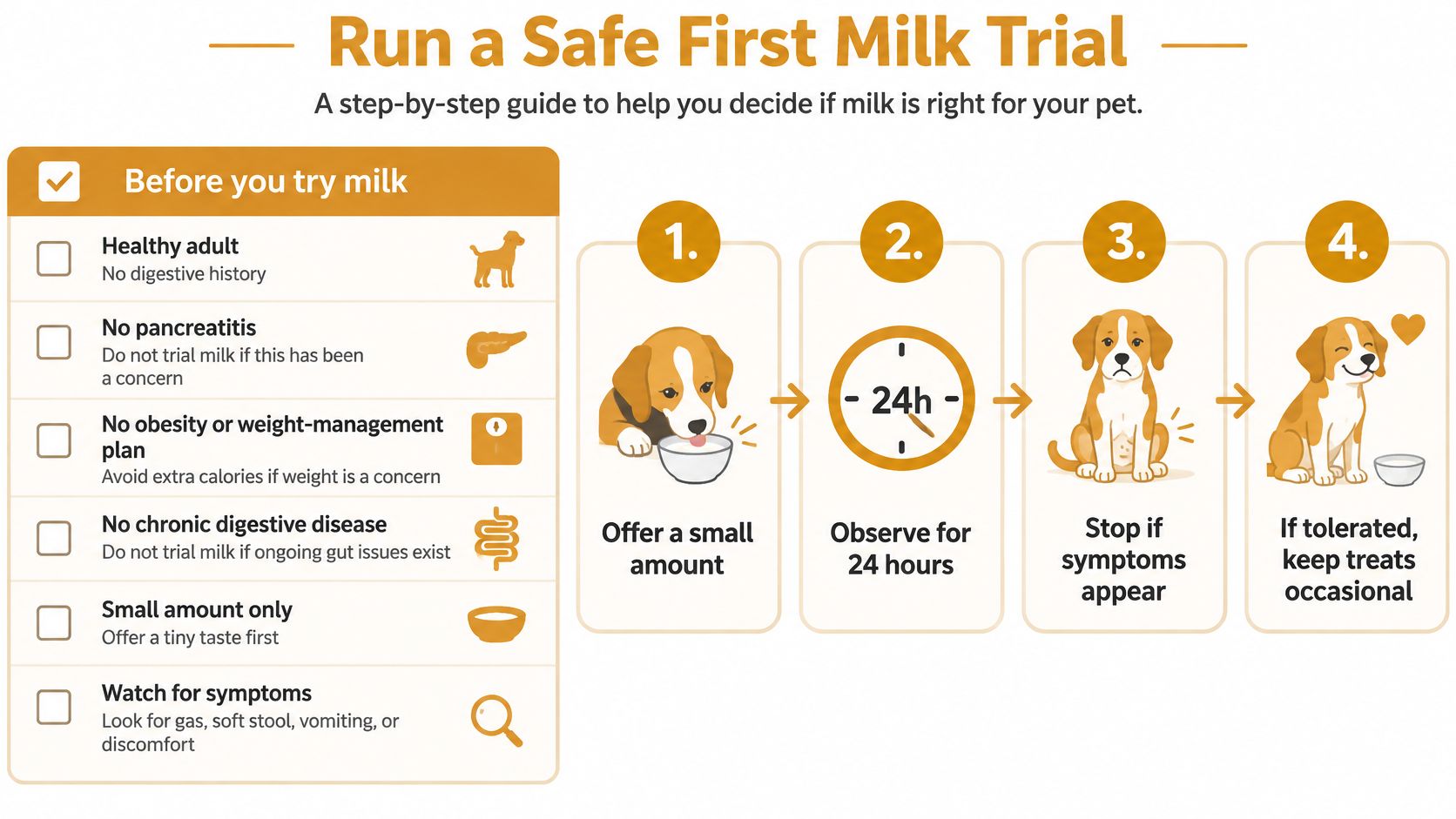
Check every item first. If any one fails, skip milk and offer fresh water or a dog-safe treat instead.
- Healthy adult: No digestive history and no current stomach upset.
- No pancreatitis: Don't trial milk if this has ever been a concern.
- No obesity or weight-management plan: Extra calories work against the plan.
- No chronic digestive disease: Ongoing gut issues make a trial unsafe and unreadable.
- No prescription diet and no vet restriction: Extra foods can interfere with both.
Breed background can inform that check, not replace it. PetCostEngine's breed catalog has 226 breeds, and 26 of them have a digestive or allergy-based skin predisposition with an estimated probability of at least 15%. If your dog's breed sits in a higher-risk group, raise dairy with your vet first rather than testing at home.
The Trial, Step by Step
- Confirm water is down. Fresh water stays available at all times, before and after. Milk never replaces it.
- Choose plain milk only. Use unflavored, unsweetened cow or goat milk. Skip flavored and sweetened products, since added sugar adds calories with no benefit and extra ingredients muddy the result.
- Measure with a spoon. Offer a few tablespoons once, with food rather than on an empty stomach. The common slip is pouring straight from the carton into the bowl, which turns a taste into a serving. Ask your vet for a smaller amount if your dog is a toy or small breed, because the few-tablespoon guidance describes a typical dog.
- Write it down. Note the date, time, type of milk, and exact amount. Memory is unreliable by the time symptoms show up hours later.
- Watch for at least 24 hours. Track stool consistency, gas, vomiting, appetite, and abdominal discomfort. Check the stool on every walk, not just the first one after the treat.
- Decide based on what you saw. If your dog's fine, you may offer the same measured amount on a later day, never daily. Repeating too soon is another common slip, because a second dose can land before the first reaction declares itself.
- Stop at the first bad sign. Don't retest to make sure. One clear reaction is enough information.
- Call your vet for call-now signs. Repeated vomiting, blood, black stool, marked pain, weakness, or inability to keep water down ends the experiment immediately.
Call-now rule: Stop dairy and call your vet if signs are severe, repeated, or persistent. A trial is optional. Treatment for dehydration isn't.
When Milk Symptoms Mean Call Your Vet
Mild, short-lived gas or one soft stool in a lively adult dog that eats and drinks can usually be watched at home for a day. Past two or three days, a call to the vet is advised. That home-watch window doesn't apply to every dog or every sign.
PetMD guidance on whether dogs can drink milk stresses that reactions vary substantially. Some dogs develop diarrhea, gas, bloating, vomiting, abdominal pain, or appetite loss after only a small amount, while others tolerate occasional dairy. Persistent or severe signs, especially repeated vomiting, dehydration, marked abdominal pain, weakness, or inability to keep water down, should prompt veterinary contact rather than continued home experimentation.
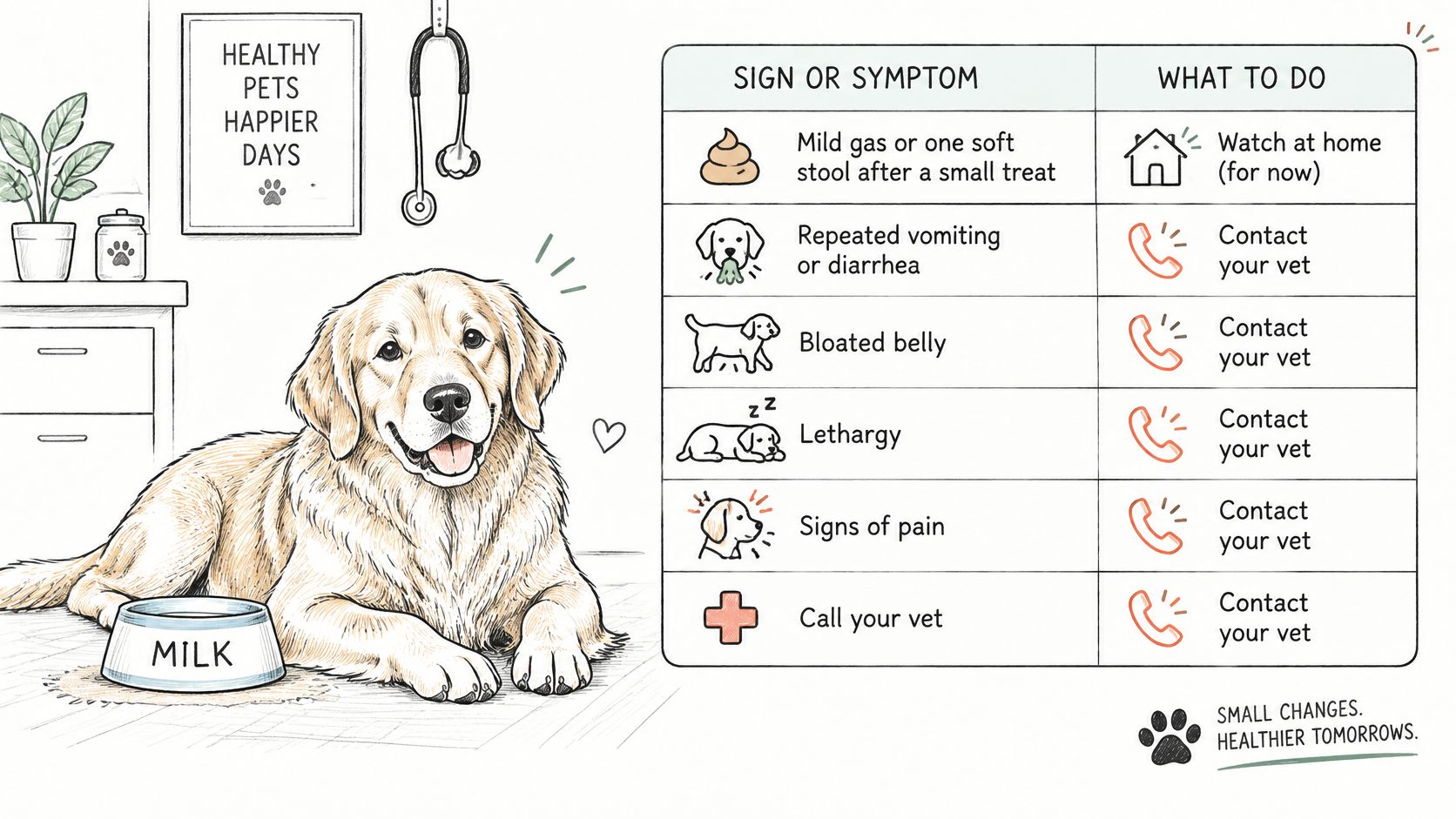
| Symptom | Watch at home | Call the vet now |
|---|---|---|
| Mild gas or one soft stool | Watch at home for the rest of the day | Not needed unless signs continue |
| Soft stool that continues or worsens | Stop dairy and keep fresh water available | Call your vet |
| Single vomiting episode | Pause food and milk, offer small water sips | Call if vomiting repeats |
| Repeated vomiting | Not a home-watch sign | Call now |
| Black or tarry stool, even once | Not a home-watch sign | Call now |
| Blood in stool or vomit | Not a home-watch sign | Call immediately |
| Marked abdominal pain, weakness, or cannot keep water down | Not a home-watch sign | Call immediately |
| Any soft stool in a puppy, senior dog, or dog with an ongoing condition | Not a home-watch sign | Call the same day |
Two rules override duration. A single black or tarry stool is a reason to call, and if there's blood, black stools, or vomiting, the vet is called immediately regardless of how long the diarrhea has lasted. For puppies, elderly dogs, and dogs with ongoing conditions, soft stools are a same-day call.
Diarrhea can dehydrate a dog quickly, especially a small, young, or older dog. Don't wait out signs in those dogs to see if tomorrow looks better.
First-time owners sometimes read "not toxic" as "healthy" or assume a lactose-free product is automatically safe. Neither follows. Judge the dog in front of you by age, size, digestive history, amount consumed, and symptoms, and call when the table says call.
Dog-Safe Alternatives to Milk
Start with the bowl that asks nothing of your dog's gut: fresh water. It is the daily hydration default, and many dogs are just as happy with a small food treat as with milk. Milk is a discretionary treat, not a hydration source and not a required food.
Lactose-free products sit in the middle ground. In the FAO AGRIS record of the 21-day Springer Spaniel study, dogs with lactose intolerance given lactose-free milk powder did not show the same digestive symptoms as dogs given standard cow or goat milk. The groups were small, and the result does not show that dairy is necessary or beneficial. Lactose-free milk made for dogs can be an occasional treat for a dog with lactose sensitivity, but it still adds calories and fat, so count it against the daily energy allowance.
| Alternative | Best for | Check on the label | Avoid or ask a vet |
|---|---|---|---|
| Fresh water | Daily hydration | Clean, fresh, always available | Milk as a hydration source |
| Lactose-free milk made for dogs | Occasional treat for a dog with lactose sensitivity | Calorie count, fat content, added ingredients | Assuming it is low-calorie or safe for every medical diet |
| Plain cooked lean meat | Training treat | No seasoning, no bones, no onion or garlic | Fatty cuts and spiced or seasoned meats |
| Plain canned pumpkin | Fiber-rich occasional treat | No added sugar or spices | Pie filling and sweetened products |
| Vet-approved vegetables | Low-calorie snack | Plain, cooked or raw as the vet advises | Grapes, raisins and onion |
How to Read a Label Before You Offer Anything
Check the ingredient list first, then sodium, added sugar, and the calorie statement. A short ingredient list you recognize beats a long one with sweeteners and flavorings. Ask your vet whether the fat level fits your dog's history, whether the calories fit the daily allowance, and whether the product conflicts with any prescription diet or medication.
One label warning applies beyond milk. Xylitol is toxic to dogs and appears in many human supplements, so human probiotics should not be given to dogs without asking a vet. The same label habit protects you with human plant milks and sweetened products, where sweeteners can hide in flavored versions.
PetCostEngine's food-budgeting guides can help you fit treats like these into portion and calorie planning. If any check in the trial fails, skip milk, offer fresh water or a dog-safe treat from the table, and ask a vet before changing the diet.
Before you decide dogs drink milk safely in your household, use PetCostEngine to review your dog's breed health profile, including digestive predispositions, and to plan food and veterinary expectations by breed, state, and age. Check your breed page, note any digestive risk flags, and take that list to your next vet visit so treat choices like milk are decided on your dog's actual risk, not on a generic yes or no.
Estimated lifetime and yearly costs for a American Water Spaniel, state by state, plus whether pet insurance breaks even for the breed.
See American Water Spaniel costs →
Is insurance worth it for a American Water Spaniel? →
Premium dry food → Puzzle toys → No-pull harness →
As an Amazon Associate, PetCostEngine earns from qualifying purchases.