
You reach down to pet your dog, and their ears slide backward. Their tail might still be moving, but you're not sure whether they're pleased to see you, worried about your hand, or uncomfortable around one ear. Before reaching again, pause and watch what the rest of their body does.
A dog's ears pinned back are a clue, not an emotional diagnosis. The useful distinction is between a brief, relaxed response during an interaction and a sudden, persistent, one-sided, or painful change. The meaning chart and decision checklists below help you choose between giving space, adjusting the interaction, and contacting your veterinarian.
Table of Contents
- Ear Positions and What Each One Usually Means
- Reading the Whole Body Before the Ears
- Telling Fear, Appeasement and Excitement Apart
- When Pinned Ears Point to Pain or Ear Disease
- How to Respond Safely When Ears Stay Pinned
- Breed Ear Shape and Reading Signals Accurately
- Confirm the Pattern Before You Act
Ear Positions and What Each One Usually Means
| Ear position | Usual meaning | Check alongside | First response |
|---|---|---|---|
| Upright, forward ears | Attention or interest in something | Relaxed face, weight forward | Carry on; no action needed |
| Ears rotated back, loose body | Greeting, appeasement or social uncertainty | Soft eyes, loose mouth, wagging | Let the dog approach on its own terms |
| Ears held low, tight to head | Fear, anxiety or stress | Lowered body, tucked tail, lip licking | Reduce pressure and give space |
| Ears flattened so they nearly disappear | Extreme fear | Cowering, freezing, growling | Stop, increase distance and avoid restraint |
| One ear down or asymmetric | Possible pain or ear problem | Head tilt, scratching, head shaking | Stop handling the ear and contact a veterinarian |
Forward ears tell you where the dog's attention is directed. A dog watching a squirrel may lean forward without looking distressed. Carrying on is reasonable when the face and body remain relaxed, but attention alone doesn't establish that a dog wants to be touched.
Loosely backward ears can accompany a friendly greeting or an attempt to keep an interaction peaceful. Let the dog close the distance rather than leaning over them. A wagging tail belongs in the assessment, but it shouldn't override a tense mouth or hesitant movement.
Tightness changes the response
Low, tightly held ears deserve a pause. If the dog also lowers their body or turns away, stop whatever is adding pressure, such as reaching over their head, crowding them, or continuing a greeting.
When the ears flatten so completely that they nearly disappear, don't try to lift the dog's head or pull the ears forward to inspect them. Make space and let the dog withdraw without following.
Asymmetry needs a different kind of attention. An ear that suddenly sits differently from its partner can indicate discomfort rather than a social message. Don't repeatedly touch it to see whether the dog reacts.
Practical rule: Choose the closest row, then check the circumstances and the whole dog before deciding what it means.
Ear shape also changes how visible these movements are. Upright ears, such as those associated with the German Shepherd, make rotation easier to notice than hanging ears do. The breed-specific guidance below helps you compare your dog with their own normal carriage, not an unrelated breed.
Reading the Whole Body Before the Ears
Ear position works as a graded signal, not an on-off switch for fear or friendliness. A veterinary behavioral review of canine communication distinguishes moderately backward ears associated with appeasement or conflict avoidance from tightly flattened ears associated more strongly with fear, including extreme flattening sometimes called seal ears.
That distinction matters because forward ears generally indicate attention or approach-oriented motivation, while backward ears reflect changes in arousal and social intent. Backward doesn't automatically mean aggressive. You need the dog's posture, expression, movement, and situation to interpret the signal.
Use this visual checklist while observing from a comfortable distance.
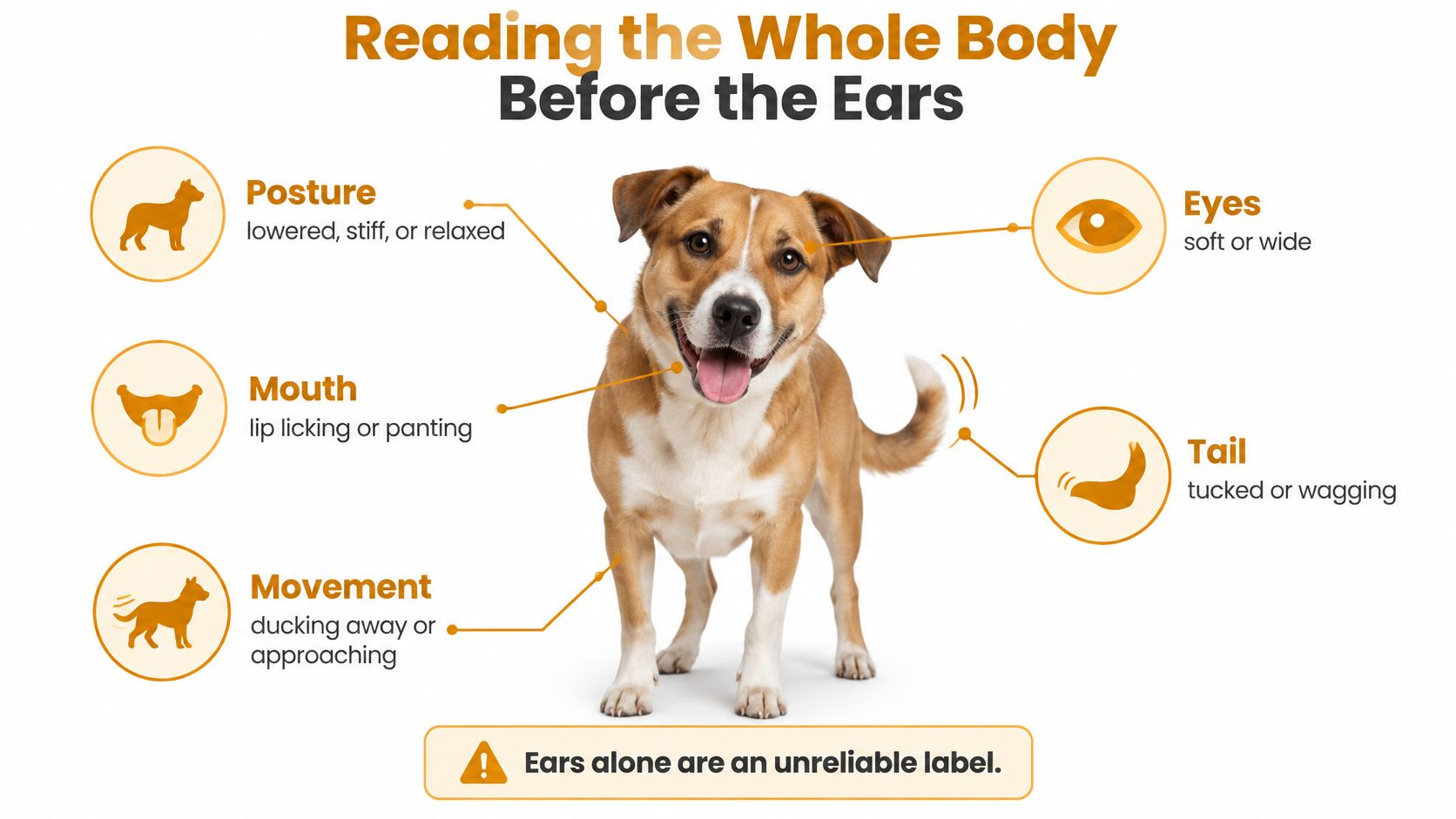
Read the signals together
- Posture: Look for a lowered body, crouching, stiffness, or weight shifted backward. Compare that with a dog who moves loosely and stands comfortably.
- Tail: Notice whether it's tucked, held low and still, or moving in broad, loose sweeps. Interpret its position alongside body tension rather than treating every wag as permission.
- Face: Check for lip licking, yawning, averted gaze, visible eye whites, or a tight mouth. Soft eyes and a relaxed muzzle suggest a different experience from a fixed, tense expression.
- Movement: Watch whether the dog approaches voluntarily, retreats, ducks away, or freezes. Remaining still isn't necessarily an invitation to continue touching.
- Context: Identify what happened just before the ears moved. Record who was present, what they were doing, how long the change lasted, and what happened when the interaction stopped.
Long ear coverings can make subtle changes harder to see. With a dog such as an Afghan Hound, prioritize body height, facial tension, and movement rather than trying to interpret the hanging outline alone.
Keep an episode log
Use observations rather than emotional labels. Write “stepped backward when a visitor reached over the head,” not “acted guilty” or “became stubborn.”
| Trigger | Duration | Body signals | Recovery time |
|---|---|---|---|
| What happened immediately beforehand | How long the ears stayed back | Posture, tail, eyes, mouth and movement | How long until normal relaxed behavior returned |
Don't recreate a frightening interaction to improve your notes. If flattened ears accompany avoidance or freezing, provide distance and an unobstructed escape route. Your reading becomes more reliable when several signals point in the same direction.
Telling Fear, Appeasement and Excitement Apart
The same backward ear position can appear during very different encounters. The AKC's explanation of commonly misunderstood dog behavior identifies pulled-back ears as possible appeasement in either happy or fearful dogs, while tightly pinned ears can accompany fear, anxiety, or stress.
Compare the ears with the expression and body position shown here.
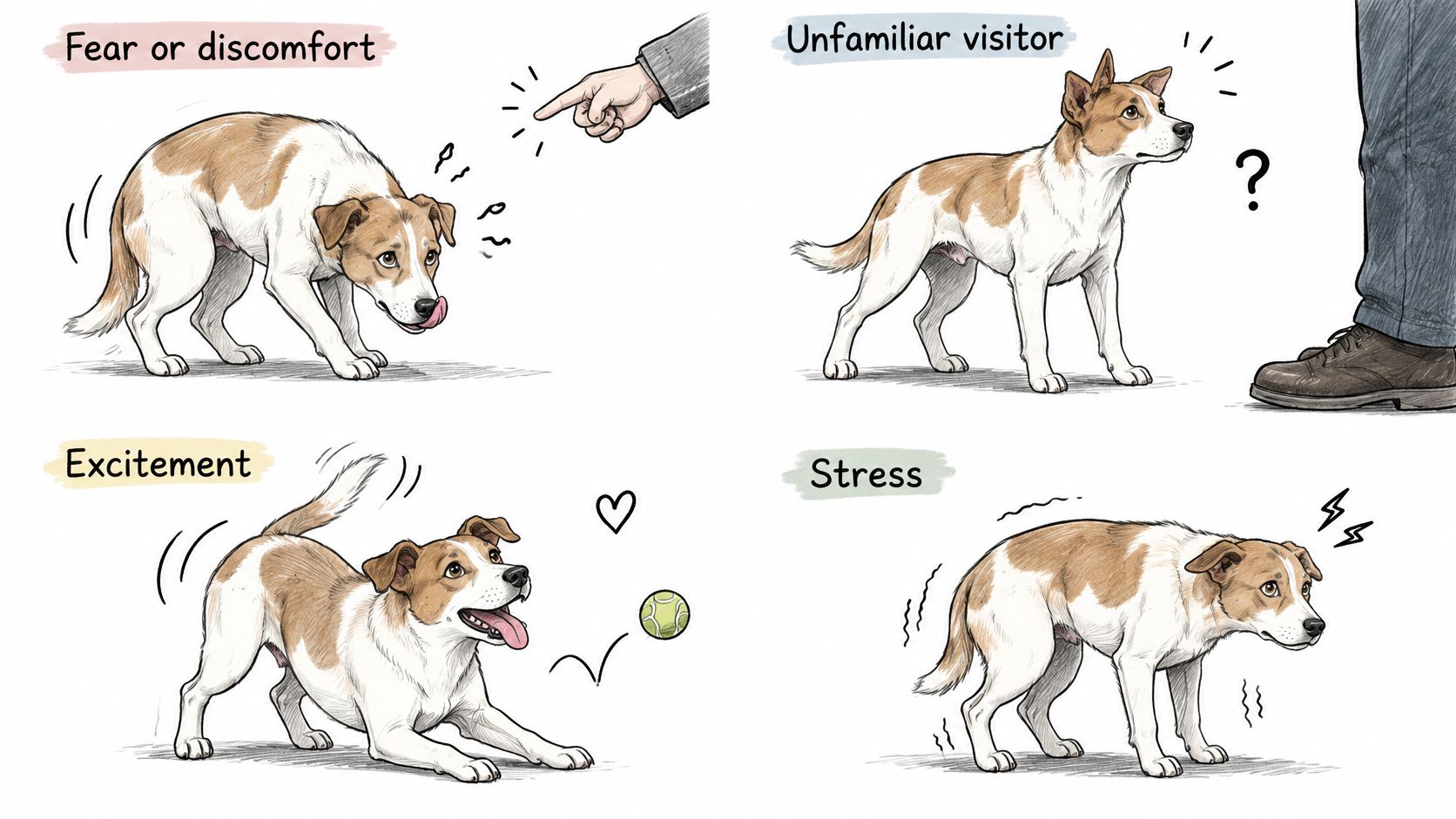
Read the situation, then choose an action
During scolding: A lowered head, ears back, ducking away, and lip licking support an interpretation of discomfort. They don't establish that the dog understands a past mistake or is confessing. Action: Stop the scolding and address the practical problem, such as preventing access to the object they chewed.
With an unfamiliar visitor: Loosely rotated ears, soft eyes, and a wiggling body may indicate appeasement or social uncertainty rather than panic. The dog may be interested without wanting an immediate hand over their head. Action: Ask the visitor to slow down and let the dog choose whether to approach.
The video offers another opportunity to observe canine communication in context.
During handling or grooming: Ears back with leaning away, visible eye whites, or a tight mouth mean the interaction needs reassessment. Don't assume that remaining on the grooming surface means the dog is comfortable. Action: Stop handling and determine whether the task, restraint, or possible pain needs attention before continuing.
During play or a homecoming: Backward ears alongside a play bow, bouncy movement, and a loose mouth can fit excitement rather than fear. A joyful greeting can still become overwhelming if people crowd or hold the dog. Action: Lower the pace and leave room for the dog to move away.
A friendly intention from a person doesn't guarantee a comfortable experience for the dog.
Context narrows the interpretation, but it doesn't make you certain. After removing the trigger, ask: Does my dog relax again within a short time? A dog who remains tense or continues holding the ears unusually needs more attention than a fleeting greeting expression.
When Pinned Ears Point to Pain or Ear Disease
Pinned ears can be a pain behavior, especially when the change appears suddenly or continues outside a particular interaction. The Merck Veterinary Manual's guidance on otitis externa describes inflammation of the external ear canal and signs including pain, itching, head shaking, scratching, odor, redness, swelling, and discharge.
Deeper ear problems can affect more than ear carriage. Middle-ear disease may cause pain and holding the head to one side, while inner-ear involvement can affect balance, coordination, and eye movements. Don't label these changes as anxiety and wait for training to resolve them.
When to call your veterinarian
Arrange a prompt examination if you notice:
- A changed pattern: Ears pinned persistently or suddenly, particularly when this isn't normal for your dog.
- Uneven carriage: One ear held down or a tilted head.
- Ear irritation: Head shaking, scratching, odor, discharge, redness, or swelling.
- Movement or eye changes: Balance problems, difficulty walking, circling, or abnormal eye movements.
- Changes in comfort or appetite: Eating less or showing pain when the head or mouth is touched.
New balance problems or abnormal eye movements warrant immediate contact with a veterinary clinic for triage. Tell the staff what changed rather than waiting to see whether the ears return to normal.
This flowchart helps separate observation from unsafe home examination.
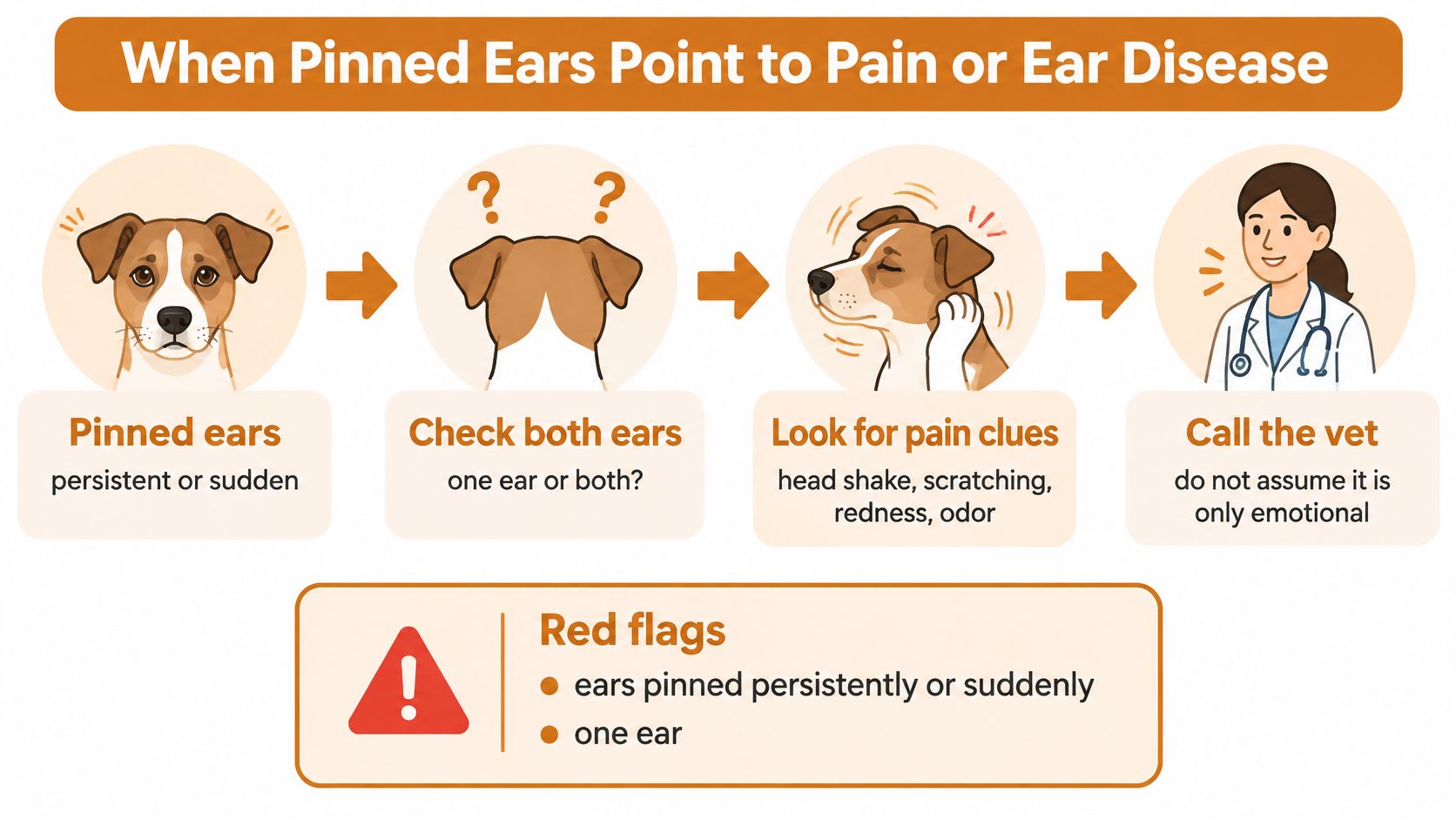
A safe triage sequence
- Stop handling the ear. Don't hold the head still or force an examination if your dog pulls away.
- Leave the canal alone. Don't insert cotton swabs, use home remedies, or apply leftover ear medication because the cause and eardrum's condition haven't been established.
- Record what changed. Note whether one or both ears are affected, when it began, and which other signs appeared without manipulating the ear.
- Book a prompt veterinary examination. Assessment commonly includes otoscopy, which lets the veterinarian look inside the ear canal and assess what treatment is appropriate.
Growling or snapping during ear handling can reflect fear or pain, according to VCA's dog behavior and training guidance. Don't punish the response or force drops into a painful ear.
Breed information, including the American Water Spaniel profile, can provide background about your dog. It can't establish the cause of a new ear change or replace an examination.
How to Respond Safely When Ears Stay Pinned
Pinned ears become a management concern when they show up alongside escalating tension. Tucked ears, whale eye, a tucked tail, raised hackles, panting, pacing, growling, whining, and avoiding eye contact are commonly described stress-related signs, so watch for several of them together rather than treating any single one as a verdict.
Growling communicates discomfort or a need for space. It doesn't, by itself, tell you whether the underlying cause is fear, pain, or another source of distress. Your immediate job is to remove pressure, not to test whether the dog will tolerate more contact.
Create a safe pause
- Stop reaching. Withdraw your hand without leaning closer, grabbing the collar, or trying to inspect the face.
- Increase distance and preserve an exit. Step away so the dog can leave without squeezing past you.
- End the interaction. Move children or visitors away instead of asking the dog to endure another greeting.
- Don't punish communication. Avoid correcting the growl, the pinned ears, or the dog's attempt to retreat. A dog that learns its warnings get punished may skip the warning next time.
- Use separation when needed. A gate, barrier, or quiet room can interrupt contact when the dog can't disengage safely. Don't drag a distressed dog into confinement.
- Arrange qualified behavior help for recurring escalation. Cowering, trembling, lunging, or repeated growling call for a management plan, with veterinary assessment when the pain-related red flags apply.
Recognize higher bite risk
Treat stiffening, a fixed stare, snapping, or lunging as a higher-risk situation than growling alone. Growling works like a warning light on a dashboard: it tells you the system is under strain. Stiffening and lunging mean the strain is closer to release. Don't wait for a snap before separating people and the dog, and don't reach between them during an escalating encounter.
A dog who can't leave should be treated as cornered, even if nobody intended to trap them. Use a barrier or close a room door once people and the dog are safely apart.
Safety first: Move people away rather than moving your hands closer to a distressed dog.
More hands-on reassurance can add pressure in these moments. Calmly giving the dog room is often more useful than hugging, stroking, or holding them still. If the pinned ears were sudden or one-sided, or the growling is out of character for this dog, treat that as information for your veterinarian rather than assuming the tension was only about the moment.
Breed Ear Shape and Reading Signals Accurately
Compare your dog with their own baseline, not a photograph of another breed. Ear shape affects what you can see, and a position that looks dramatic on one dog may be difficult to notice on another.
Observe your dog during ordinary, relaxed activities over several days. Notice where the ear bases sit while resting, walking, greeting familiar people, and listening to a sound. Don't delay a veterinary call to collect baseline observations if the change is sudden or uncomfortable.
Hanging ears and upright ears
Floppy ears on Basset Hounds, Bloodhounds, and Cocker Spaniels can hide much of the movement at the ear base. The hanging flap may look similar even when the dog changes its position. Watch the head, eyes, tail, and body first rather than lifting the ears to investigate.
Upright prick ears on German Shepherds and Siberian Huskies make small rotations easier to see. A slight backward turn can look pronounced without being tightly flattened. Watch whether the body remains loose and whether the dog keeps choosing to participate.
| Ear type | What can mislead you | Better observation |
|---|---|---|
| Hanging ears | The flap obscures rotation | Head position and whole-body movement |
| Upright ears | Small shifts look dramatic | Tightness at the base and body tension |
| Cropped ears | Altered shape limits visible cues | Facial expression, posture and voluntary movement |
Altered ears and individual differences
Dogs with cropped ears have fewer readily visible ear signals, making facial and postural cues especially important. Don't assume a relatively fixed ear outline means the dog isn't communicating. Look for changes in weight distribution, mouth tension, and willingness to stay close.
The Basset Hound breed page provides a breed reference, but your dog's usual appearance remains the most useful comparison. A new asymmetry, wound, or change in ear shape deserves veterinary attention rather than being dismissed as a breed trait.
Confirm the Pattern Before You Act
- Onset: Did the position change gradually during an interaction, or suddenly without an obvious trigger?
- Setting: Does it happen only in particular situations, or continue during ordinary rest?
- Symmetry: Are both ears moving together, or is one behaving differently?
- Touch sensitivity: Does your dog pull away when someone approaches the head? Don't deliberately provoke a reaction.
- Associated changes: Are any of the signs in the pain-section call-the-vet checklist present?
| Pattern | Outcome | Action |
|---|---|---|
| Gradual change, only in certain situations, symmetric ears, loose body | Monitor and adjust the situation | Change pace, add distance or limit who is present |
| Sudden or one-sided ears, persistent pinning, pulls away from touch | Veterinary exam within a short window | Stop handling the ear and book an exam |
| Escalating growling, cowering or trembling | Manage now and seek qualified behavior help | Stop the interaction, increase distance and use a barrier |
Situational and relaxed: Adjust the encounter rather than assigning an emotion from the ears alone. Keep greetings voluntary and observe whether your dog returns to their usual behavior.
Sudden, persistent, or sensitive: Contact your veterinarian promptly to determine how soon your dog should be examined. Only an examination can rule out pain or ear disease.
Escalating distress: Separate safely now and arrange qualified behavioral support. Don't continue the interaction just to confirm your interpretation.
For breed context, use the breed comparison reference. You can also visit our free tools while keeping the episode log in a notebook or phone note; bring that log to the appointment rather than relying on memory.
PetCostEngine's content is not veterinary advice, and no supplement cures a medical condition. Record the next naturally occurring episode only if it's safe, including the trigger, body signals, duration, and recovery.
Visit PetCostEngine for breed-specific health references, dog ownership planning tools, and practical guides. Use those resources to understand your dog's broader needs, and bring your ear-position observations to your veterinarian when the pattern suggests discomfort rather than a passing interaction.
Estimated lifetime and yearly costs for a German Shepherd, state by state, plus whether pet insurance breaks even for the breed.
See German Shepherd costs →
Is insurance worth it for a German Shepherd? →
Premium dry food → Puzzle toys → No-pull harness →
As an Amazon Associate, PetCostEngine earns from qualifying purchases.