
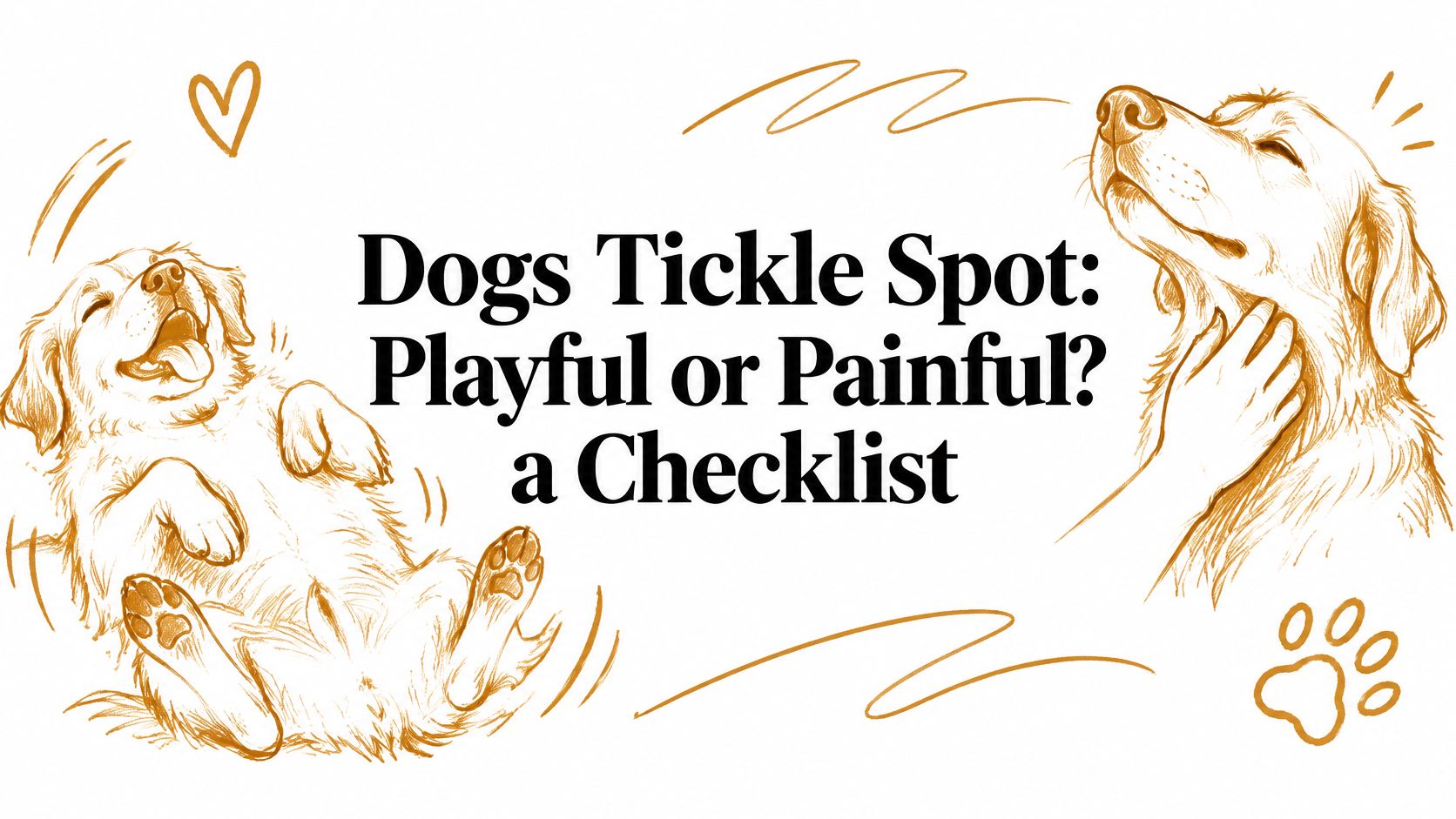
Light scratching along the belly, flank or ribs makes most dogs kick, and in a study group of 155 neurologically normal dogs that reflex appeared in all of them, with its rear boundary sitting around the fifth or sixth lumbar vertebra in 153 of the 155. What the kick is not is proof that the dog is enjoying itself.
Most advice about the dog tickle spot tells you to hunt for the spot that produces the biggest kick and treat that as a jackpot. That reading gets the biology backwards. The kick is a defensive reflex that fires before the dog forms an opinion about your hand, and a dramatic kick often points to more skin irritation rather than more delight.
The useful question isn't where the spot is. It's whether the dog in front of you is comfortable, and the answer comes from the whole body: posture, eyes, ears, what happens in the seconds after you lift your hand, and what the skin looks like the next day. A checklist covers that better than a leg ever could.
Table of Contents
- Do Dogs Really Have a Tickle Spot?
- Telling Playful Responses From Discomfort
- How to Test a Tickle Spot Safely
- Allergies, Parasites and Itch That Looks Like Play
- When to Call Your Vet About Skin or Nerve Changes
- Log What You See Before Your Next Vet Visit
Do Dogs Really Have a Tickle Spot?
Yes, most dogs have one, and it works more like a region than a point. The belly, flanks, sides of the rib cage and much of the back sit over the cutaneous trunci muscle, a thin sheet that runs just under the skin of the trunk. Light scratching there fires the cutaneous trunci reflex, also called the scratch reflex or panniculus reflex, and most owners know it as the dog tickle spot.
The Leg Kicks Before the Dog Decides Anything
Two steps happen almost instantly. Sensory nerves in the skin register the light touch, and a short loop through the spinal cord tells the muscle to contract. The skin twitches, and in many dogs the hind leg swings at the same moment, well before the brain has weighed in.
Think about the knee-jerk a doctor triggers with a small hammer below your kneecap. Your leg swings before you've formed a thought about the tap. This reflex runs on the same principle, with a light scratch standing in for the tendon tap.
A prospective study of 155 neurologically normal dogs and 10 dogs with thoracolumbar spinal disease mapped how far the field reaches and found the lateral sensory field covered at least 50% of the trunk's circumference at every tested level, which is why the reactive zone feels like a saddle instead of a bullseye. The cutaneous trunci reflex study shows the response is standard canine wiring, not a quirk owned by one breed or one lucky dog.
Where a Dog Reacts Depends on the Dog
The AKC's explanation of ticklish dogs calls the light-touch sensation knismesis, closer to the feel of an insect landing on your arm or goosebumps than to the laughter-driven tickling people give each other. Reported spots cluster on the belly and sides, and plenty of dogs also react around the ears, neck, back, paws or the base of the tail.
That variation is the point. One dog twitches, another kicks, a third turns to mouth the hand, and a fourth leaves. None of those reactions is a personality test, and none of them proves the touch was welcome.
Walk away with one rule: a kick is a reflex, and a reflex tells you about wiring, not about joy. Sensitivity shifts with skin disease, pain, age and anxiety, so the same spot can be quiet one week and explosive the next.
Telling Playful Responses From Discomfort
The leg alone won't settle the question. The reliable read comes from eight signals across the whole dog, and they line up into two recognizable columns.
| Signal | Likely playful | Likely uncomfortable |
|---|---|---|
| Body posture | Loose, wiggly, relaxed | Stiff, tense, hunched |
| Face and mouth | Soft eyes, relaxed mouth, may play-bow | Lip licking, whale eye, tight mouth, repeated yawning |
| Movement after touch | Leans in, nudges, returns for more | Turns away, moves off, tucks tail |
| Ear position | Neutral or relaxed | Pinned back or flattened |
| Response when touch stops | Asks for more or waits calmly | Walks away or freezes |
| Kick pattern | Brief, even on both sides, stops quickly | Strong, one-sided, prolonged, or happens without touch |
| Area touched | Several spots, mostly belly and sides | The same single spot every time |
| Skin and licking afterward | Smooth skin, no licking | Redness, hair loss, scabs, odor, or repeated licking or chewing |
Read the table down both columns rather than across a single row, because one signal rarely decides anything. Whale eye means the dog is showing the whites of the eyes, a classic sign of tension in a dog that feels cornered.
Decision rule: one uncomfortable signal earns a pause and a reset. Two or more in the same session means the belly rub is over for today, whatever the hind leg is doing.
What the Two Dogs Look Like in Practice
Say you're kneeling on the floor and a dog leans into your hand, wiggles its whole back end, noses your palm when you stop, and comes back for another pass. That dog is comfortable, and a brief session is fine.
Picture the other version. The dog goes still the moment your fingers reach the flank, turns its head toward your hand, pulls its skin away, licks its lips twice and holds a tight mouth while you keep going. Nothing about that is playful, and no amount of kicking makes it playful.
When Playful and Uncomfortable Overlap
Real dogs don't sort neatly. A relaxed dog can kick once, then flatten its ears on the second pass because the spot is ticklish in the irritating sense. Treat the newest signal as the truest one and stop there.
There's a mechanical reason not to chase the kick. Repeated stimulation of the same patch of skin eventually stops producing a response at all, a fatigue effect in the reflex circuit itself. A slowing or fading kick is evidence that the area has had enough, not evidence that the dog has settled into it and wants more.
How to Test a Tickle Spot Safely
A short, structured test beats repeated poking, and it gives you something concrete to describe at the next appointment. Here's the sequence, with the reason behind each step.
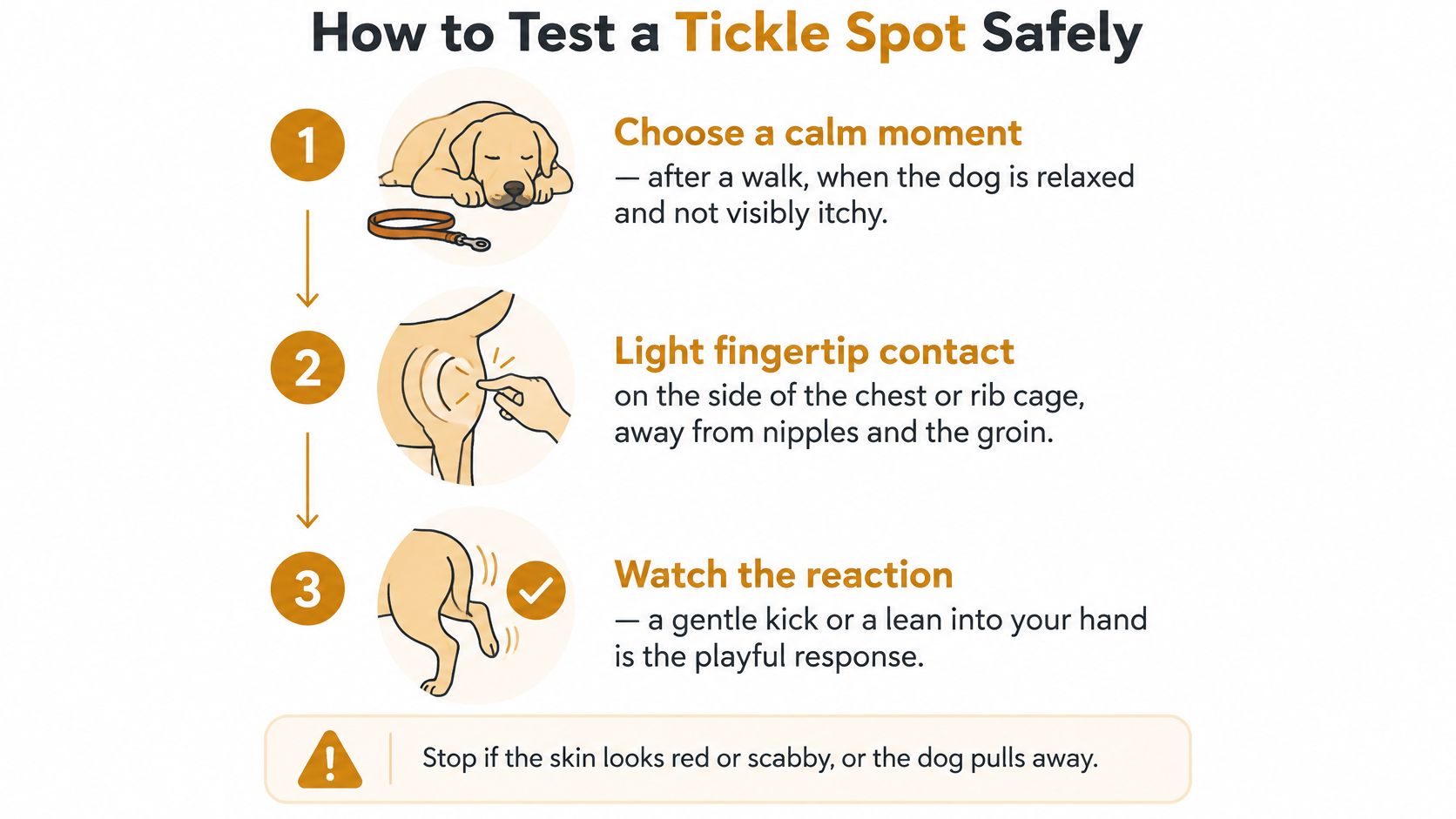
- Pick a calm moment. Settle the dog after a walk or after dinner. A dog who is already itchy, wound up or half asleep will react to everything, so the test measures mood instead of the reflex.
- Start on the side of the chest or rib cage. Use one or two fingertips, and stay away from nipples, the groin and any patch that looks red or scabbed. Those areas carry competing signals from irritation and produce a reaction you can't interpret.
- Stroke for 5 to 10 seconds, then lift your hand. A short pass is enough to trigger the reflex. Prolonged pressure turns a test into a massage the dog didn't request.
- Score the whole dog against the eight signals above. Watch the face and ears, not just the leg, because the body tells you more than one kicking limb.
- Stop at the first clear stop signal. Stiffening, turning away, a growl, a snap or repeated licking of the same patch ends the session. Those are answers, not obstacles.
- Never hold the dog still or lift a leg to force a kick. The LoveToKnow Pets guidance on the scratch reflex draws the same line: a reflex you have to restrain the dog to produce is a test done to the dog, not with it.
- Compare both sides. Note whether the left and right flanks respond the same way, since an even response in a comfortable dog is the reassuring pattern.
- Rest the area for several minutes before retesting. The circuit dulls with repeated touch, so back-to-back passes give you a false negative.
Starting points, not rules: the 5 to 10 second stroke and the few minutes of rest are conservative home-testing starting points, not thresholds from research. Let the dog's signals outweigh the clock.
Mistakes That Turn a Test Into a Problem
Pinching instead of stroking: a firm pinch tests pain tolerance and tells you nothing about the reflex.
Repeating the same spot until nothing happens: that's how you get the fatigue effect and a confused reading.
Testing a sore, hairless or scabby patch: inflamed skin reacts to everything, so the result means nothing.
Testing a dog in pain, just groomed or recovering from an injury: all three make touch aversive in a way that mimics a strong reflex.
Allergies, Parasites and Itch That Looks Like Play
Light touch and itch travel the same skin nerves, which is why the two get confused so easily. A dog with an active skin flare kicks faster and harder than a comfortable dog, and owners read that as a better spot.
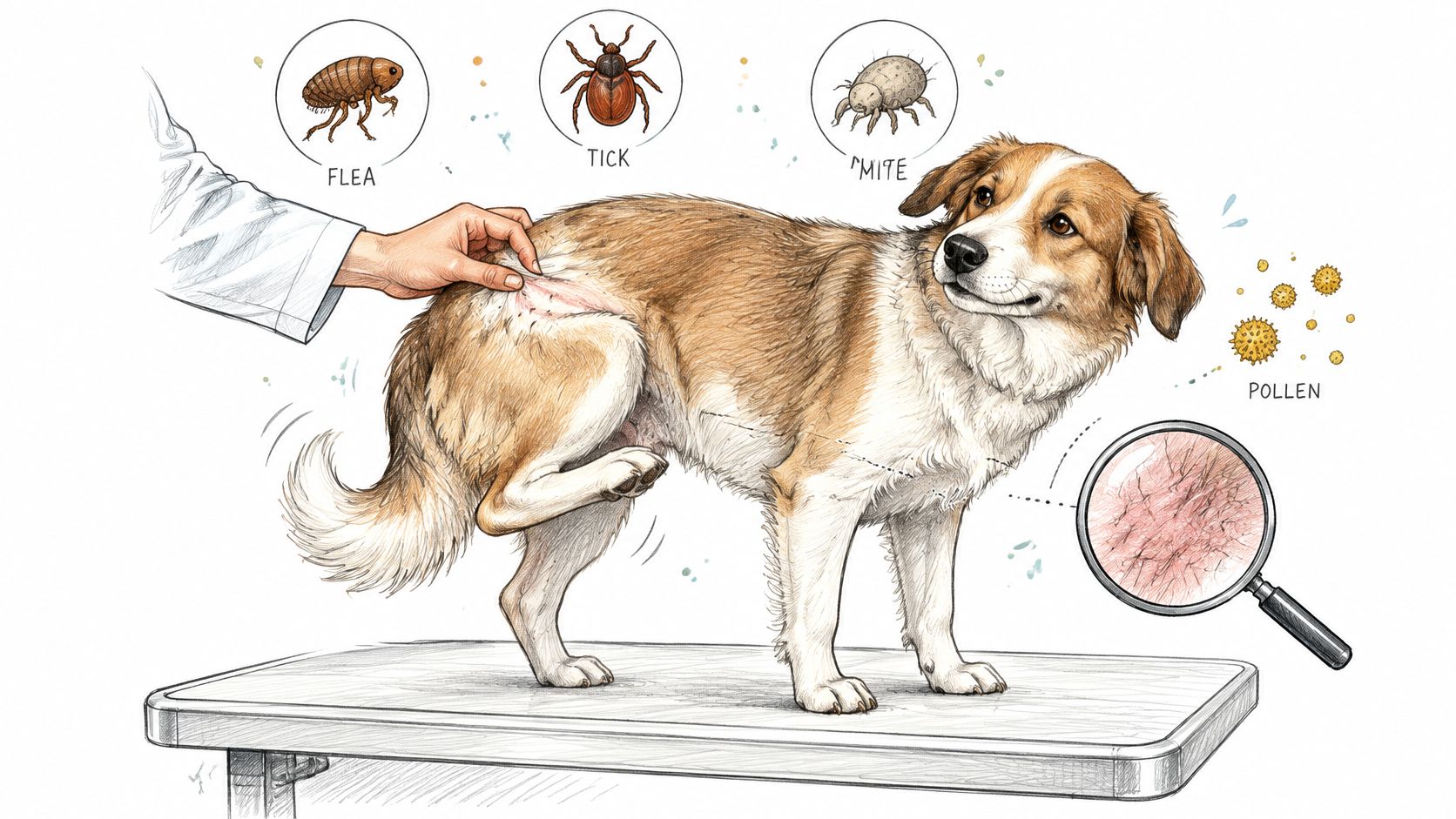
The usual drivers are environmental allergies to pollen, dust and mold, food reactions, flea saliva, mites and ticks, plus bacterial or yeast infections that start small and spread once a dog chews the skin. Fleas can be the cause even when you never see one, because the reaction is to saliva rather than to the number of insects on the dog.
Breed matters here, and not in a fortune-telling way. Our breed catalog covers 226 breeds, and 26 of them carry a digestive or allergy-based skin predisposition with an estimated probability of at least 15%. That's a reason to read a breed's health profile before assuming a strong kick is just personality.
Check the Tick-Friendly Places Daily
The paws, ears, underside of the tail and around the neck deserve attention during tick checks. Ticks hide between the toes, near or inside the ears, under the tail and where the legs meet the body. The AKC's guide to finding ticks on dogs advises running your hands over the coat after outdoor exposure, feeling for small bumps and parting the fur to inspect anything unusual, checking daily or more often when a dog spends substantial time outside.
If you find one, part the fur to expose it, grip it as close to the skin as you can with fine-point tweezers and pull straight upward, slowly and steadily. Don't twist, jerk or squeeze it, and don't use bare fingers. Wash your hands and the bite site afterward, and call the vet if you can't get it out cleanly or the dog later shows lethargy, lameness, joint swelling or enlarged lymph nodes.
The movement in real time matters here, because it shows how little pressure is needed to produce a big reaction.
Age, Pain and the Line Between Normal and Concerning
Older dogs and dogs with arthritis or back pain react differently to the same touch, and a dog who has always kicked may stop because moving hurts. A brief, even kick in a comfortable dog is normal. Ongoing scratching, redness or hair loss points to skin disease. A weakened, absent or one-sided reflex can signal a spinal problem, which is exactly why a veterinarian reproduces the same response during a neurologic exam with light pinch or pinprick stimulation along the dermatomes.
When to Call Your Vet About Skin or Nerve Changes
Timing is the part owners get wrong most often, usually by waiting to see whether a change settles on its own. The table below pairs the common observations with the most likely cause to raise and how soon to act.
| What You Observe | Possible Cause | Timing |
|---|---|---|
| Sudden loss of the kick or one-sided response | Possible spinal or nerve problem | Same day |
| Yelping, pulling away, or reluctance to move when touched | Pain or injury | Same day |
| Redness, hair loss, scabs, or odor at one spot | Skin irritation, parasites, or allergy | Within a few days |
| Persistent licking or chewing at one area for over a week | Ongoing itch or skin problem | Routine appointment |
| Tick found and not fully removed | Tick-borne disease risk | Call the vet for advice |
A reflex that disappears or turns up on one side only is worth a same-day call, especially if the dog also seems weak or reluctant to move. In a prospective study of 41 dogs with thoracolumbar injuries confirmed by MRI, a clear reflex cut-off was present in 33 dogs, or 80% of the sample, and in 80% of those cases the cut-off sat zero to four vertebral bodies behind the lesion. That's the finding behind the urgency: the reflex is a localizing tool, and its sudden change gives your vet a real head start. The report on the cutaneous trunci reflex as a localizing test is worth reading if you want the detail.
Yelping or pulling away when a hand lands on a familiar spot suggests pain or injury rather than a mood change, so it belongs in the same-day column too. Redness, hair loss, scabs or odor at one patch points toward skin irritation, parasites or allergy, and a few days is enough time to get it looked at before a small patch becomes a hot spot.
Persistent licking or chewing at one area for more than a week calls for a routine appointment, since chronic itch rarely resolves without identifying the trigger. If you find a tick and can't remove it completely, phone the practice for advice rather than digging at it.
Emergency, no waiting: collapse, inability to stand, sudden paralysis or trouble breathing means an emergency clinic now, not a scheduled visit.
These timing windows are general editorial guidance rather than research findings, cross-checked against AVMA and ASPCA advice on urgent signs. If you're unsure which row fits, call sooner. It costs you a phone call, not an afternoon of guessing.
When you call, breed context helps the conversation. A profile such as the American Water Spaniel breed page lets you describe known risks and history in one place instead of hunting for paperwork mid-call.
Log What You See Before Your Next Vet Visit
Two weeks of brief notes will tell your vet more than a memory of "he kicked a lot last month." Keep the routine small enough that you'll stick with: after each play or belly-rub session, write down the date, the spot you touched, the reaction scored against the eight-signal comparison, and any scratching, licking, redness or hair loss you see over the next day.
| Date | Location touched | Reaction (playful or uncomfortable) | Skin check | Notes |
|---|---|---|---|---|
| Day 1 | Right flank | Playful, brief kick | Smooth, no licking | After evening walk |
| Day 2 | Same flank | Two uncomfortable signals | Slight pink patch | Dog walked away |
| Day 3 | Belly only | Playful | Smooth | Licked flank twice |
Five columns and one line per session is enough. The point is to catch a pattern, not to produce a diary.
Questions to Bring to the Appointment
Is this reflex normal for my dog? Ask directly, and bring the log so the vet can see the symmetry and the timing.
Does the skin need testing for parasites or allergies? Skin cytology, scrapings and fungal checks answer questions that observation can't, and the log shortens the guessing.
Should a neurologic reflex check be done? If the response faded or turned one-sided, say so plainly and let the vet decide whether a full exam is warranted.
For breed-specific risk context, browse the breed pages in our library. For skin and itch topics, the guides library at /guides/ collects the practical reference material, and the free tools under /tools/ keep the record-keeping simple.
Keep the loop closed. If the log shows steady, symmetrical, playful signals, keep sessions short and carry on. If it records a disappearing or one-sided kick, yelping on touch, or a scabbed patch, act on the same-day or few-days timing rather than waiting for the next scheduled visit.
PetCostEngine turns the same observation habit into a plan you can budget around, with lifetime cost estimates built from your dog's breed, state and age and breed pages that carry allergy and skin-condition risk data rather than generic averages. If the log you keep points to a persistent itch or a reflex that changed, run your dog's details through the PetCostEngine calculator to see what ongoing skin care may look like over a lifetime, and compare insurance breakeven against your dog's actual risks. It's free, needs no account, and starts with four questions.
Estimated lifetime and yearly costs for a American Water Spaniel, state by state, plus whether pet insurance breaks even for the breed.
See American Water Spaniel costs →
Is insurance worth it for a American Water Spaniel? →
Premium dry food → Puzzle toys → No-pull harness →
As an Amazon Associate, PetCostEngine earns from qualifying purchases.