
You've turned out the lights, climbed into bed, and heard the first whimper from the crate. Your puppy went outside before bedtime, but now you're wondering whether to take them out again or ignore the crying. Learning how to make a puppy stop whining starts with that decision, not with teaching silence. Check what the puppy needs, then choose a response that builds calm without overlooking discomfort or fear.
Table of Contents
- Match the Whining to Its Likely Cause
- Build a Daily Schedule That Heads Off Whining
- How to Crate Train a Puppy Without Triggering Whining
- What to Do When Whining Starts at Night
- When Whining Signals Separation Anxiety or Illness
- Start Your Quiet Routine Tonight and Track Progress
Match the Whining to Its Likely Cause
A puppy who cries immediately after the crate door closes may need a different response from one who wakes whining after sleeping peacefully. Timing gives you a starting point, not a diagnosis. Watch the puppy's posture and behavior alongside the sound.
The distinction matters because whining isn't necessarily disobedience. A 2024 study in the Proceedings of the National Academy of Sciences analyzed 4,400 whines from 220 puppies across 40 litters, describing whining in contexts such as hunger, cold, discomfort, and separation from mothers and littermates. Whining increased as separation lasted longer.
Whining context, likely cause and first check
| When the whining happens | Likely cause | First check or action |
|---|---|---|
| Within minutes of entering the crate | Stress or not yet settled | Pause, shorten the crate interval, stay closer |
| After the puppy has been settled for a while | Bathroom need, hunger, or boredom | Quiet potty trip and check meal timing |
| At night, after the last bedtime potty | Toileting need or discomfort | Quiet, brief potty trip with no play |
| After a nap or time in the crate | Need to eliminate | Take outside directly to the toilet area |
| When you leave, with pacing or door-focused chewing | Separation distress | Gradual alone-time training and vet or behavior referral |
| With limping, straining, or lethargy | Possible pain or illness | Call your vet the same day |
These are working possibilities, not labels to assign permanently. For example, a puppy who cries immediately might still need to urinate if the previous outing involved sniffing but no elimination. Notice what happened outside, not just whether you opened the door.
The study involved young puppies in breeding facilities, so it doesn't establish a normal crying duration for every household puppy. It also doesn't justify setting a timer and assuming distress becomes harmless when that time passes.
Practical rule: Decide whether the puppy needs help before deciding whether to withhold attention.
Run the physical-needs check first
Before training, check toileting, food and water, temperature, pain, and safety, in that order. Confirm that the puppy has eliminated, has appropriate access to food and water, and isn't too hot or cold. Look for an awkward position, a trapped paw, unsafe bedding, or signs of discomfort.
Only after those checks should you treat the situation as a settling or attention problem. You're not rewarding bad behavior by investigating a legitimate need. You're establishing whether training is appropriate at all.
Build a Daily Schedule That Heads Off Whining
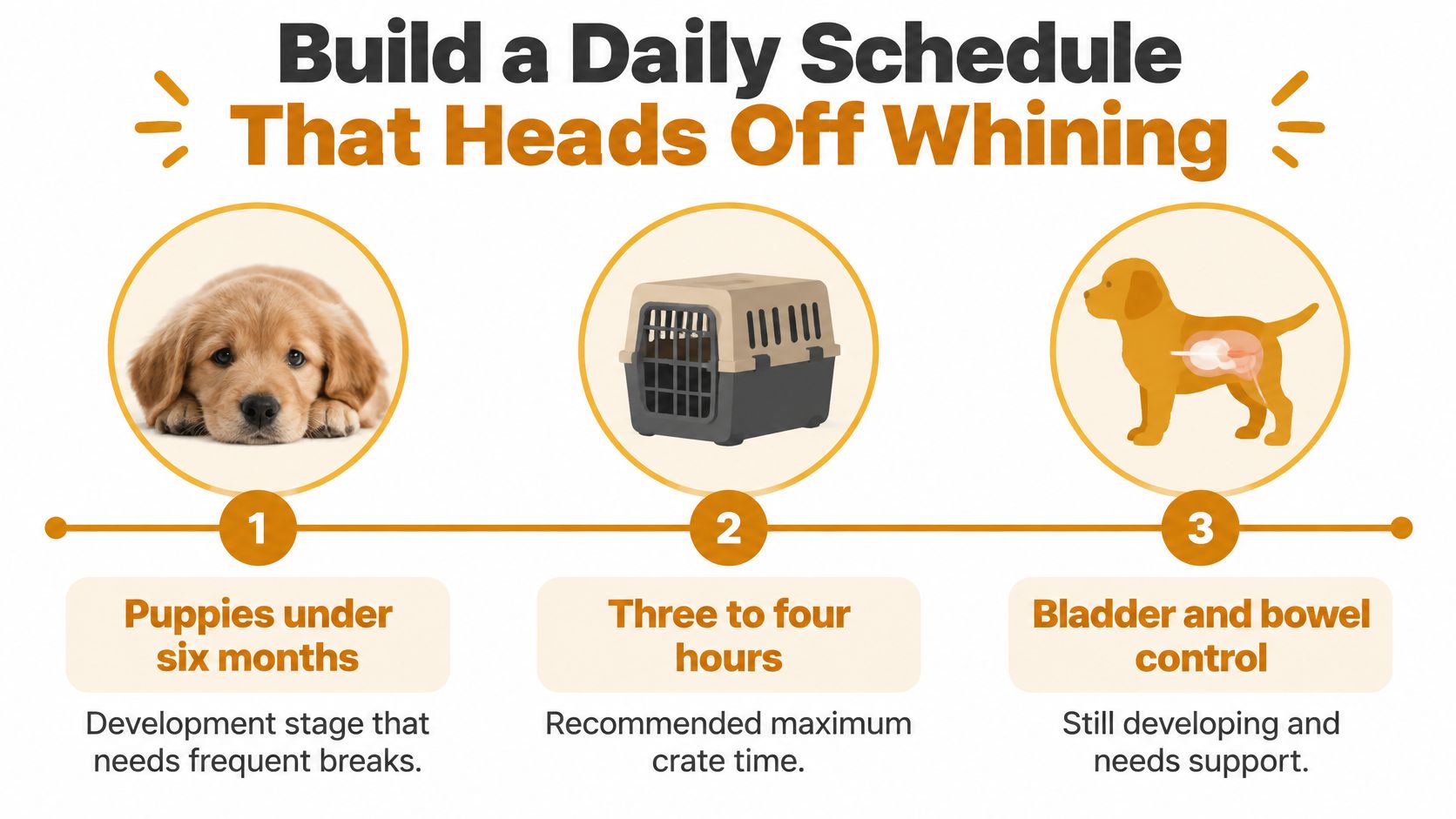
For puppies under six months, Humane World for Animals' crate-training guidance generally advises no more than three or four hours in a crate, because bladder and bowel control is still developing. Confirm an appropriate limit with your veterinarian. That ceiling isn't a target, and a puppy may need a break much sooner.
Maximum crate and alone time by puppy age
| Puppy age | Maximum time in crate or alone | Routine focus |
|---|---|---|
| Under 6 months | 3 to 4 hours at most in a crate, not a guaranteed tolerance for being alone | Potty check on waking and before crating |
| 6 months and older | Confirm the limit with your vet | Adjust the routine with your vet |
Bladder capacity and emotional comfort are separate limits. A puppy who can physically wait for a bathroom break may still become distressed when left alone.
Use this visual reminder when arranging breaks and supervision.
Build the day around repeatable events
Start with waking, then going directly outside. Offer the scheduled meal, allow appropriate play or a short training session, and provide another potty opportunity before rest. The AKC's house-training guidance identifies waking, naps, and crate time as important opportunities to take young puppies outside.
Place alone-time practice during a calm, awake period before the next nap. Don't wait until you need to leave for an appointment to discover whether your puppy can cope with your absence.
Early practice is worthwhile. A Generation Pup study summarized by the Royal Veterinary College followed 145 puppy-owner pairs in the United Kingdom and Republic of Ireland; at six months, 46.9% met its definition of separation-related behavior, while 7.6% showed whining specifically when left alone. The broader figure combines several behaviors and doesn't mean every affected puppy becomes a chronic whiner.
Your daily checklist can stay simple:
- On waking: Go to the designated toilet area.
- At mealtime: Offer the puppy's usual meal.
- After play: Provide another potty opportunity.
- During rest: Use a familiar, settled spot without demanding interaction.
- Before a nap: Include an easy alone-time practice opportunity while the puppy is still awake.
Arrange help when your commitments exceed your puppy's current abilities. If confinement itself causes distress, discuss a puppy-proofed pen or another safe arrangement rather than repeatedly extending crate time.
How to Crate Train a Puppy Without Triggering Whining
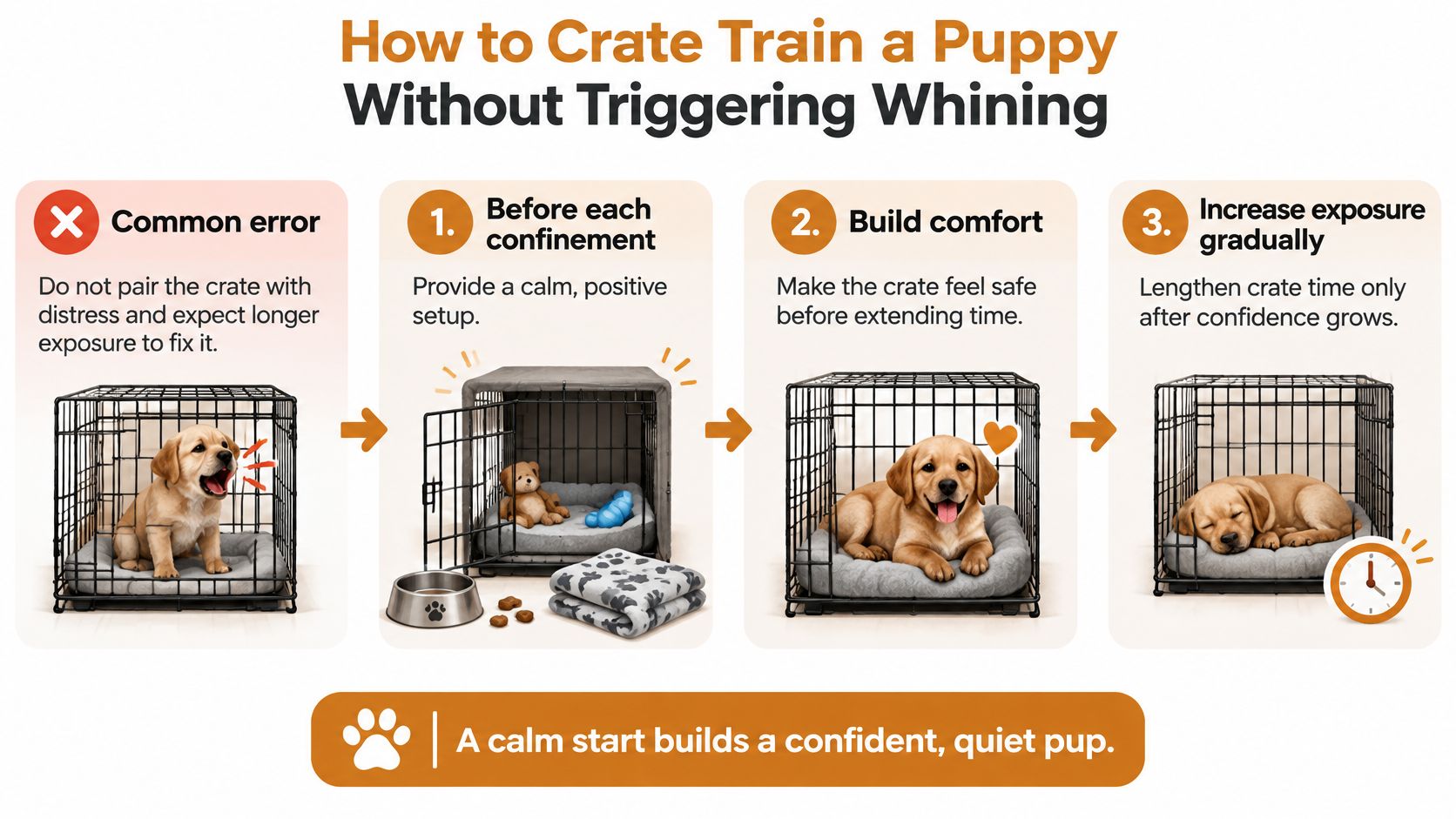
The common mistake is to pair the crate with distress, then expect longer confinement to fix the association. Instead, teach separate skills: entering willingly, relaxing behind a closed door, and remaining comfortable as you move away.
The RSPCA's crate-training guidance supports gradual introductions and backing up when distress appears. The puppy's behavior determines when you advance, not your preferred schedule.
Follow the puppy's comfort level
Prepare before confinement. Provide a toilet opportunity, appropriate exercise, and a safe food-dispensing toy. Choose a toy suitable for the puppy's size and chewing style, and supervise its introduction before considering it for independent use.
Start with the door open. Let the puppy investigate and reward voluntary entry without pushing or placing them inside. Feeding near the entrance, then farther inside as confidence grows, gives the puppy a reason to approach willingly.
Introduce brief door closures. Close the door for a very short interval while the puppy remains relaxed and you stay nearby. Reopen it before the puppy becomes worried, so the exercise rehearses comfort rather than endurance.
Increase duration in small increments. Change the length of confinement gradually instead of making a large jump after a successful attempt. Avoid increasing duration and your distance from the crate at the same time.
Back up when body language changes. Panting, cowering, escalating vocalization, excessive barking, or aggression means the exercise has become too difficult. Shorten the interval, remain closer, or return to open-door exploration and feeding.
Keep departures and reunions calm. Leave without a dramatic farewell and return without an excited greeting. Give the puppy a predictable transition rather than turning every reunion into a major event.
Keep the sequence visible wherever you practice.
Look for relaxation, not just silence
A puppy lying comfortably, chewing calmly, or sleeping gives you more useful information than a puppy who has stopped making noise but remains tense. Use the diagnostic table's timing clues when deciding whether a new whine suggests an unmet need or an exercise that advanced too quickly.
A Royal Veterinary College study on easing puppy separation stress found more quiet resting among puppies whose owners received guidance on calm departures and reunions, gradual alone-time training, exercise, and enrichment. The intervention didn't significantly reduce every measured sign of separation distress.
Quiet resting is a useful benchmark, not a promise that a particular technique will eliminate whining.
If your puppy can relax only while you sit beside the crate, start there. Moving farther away is a later training step, not something the puppy must tolerate immediately.
What to Do When Whining Starts at Night
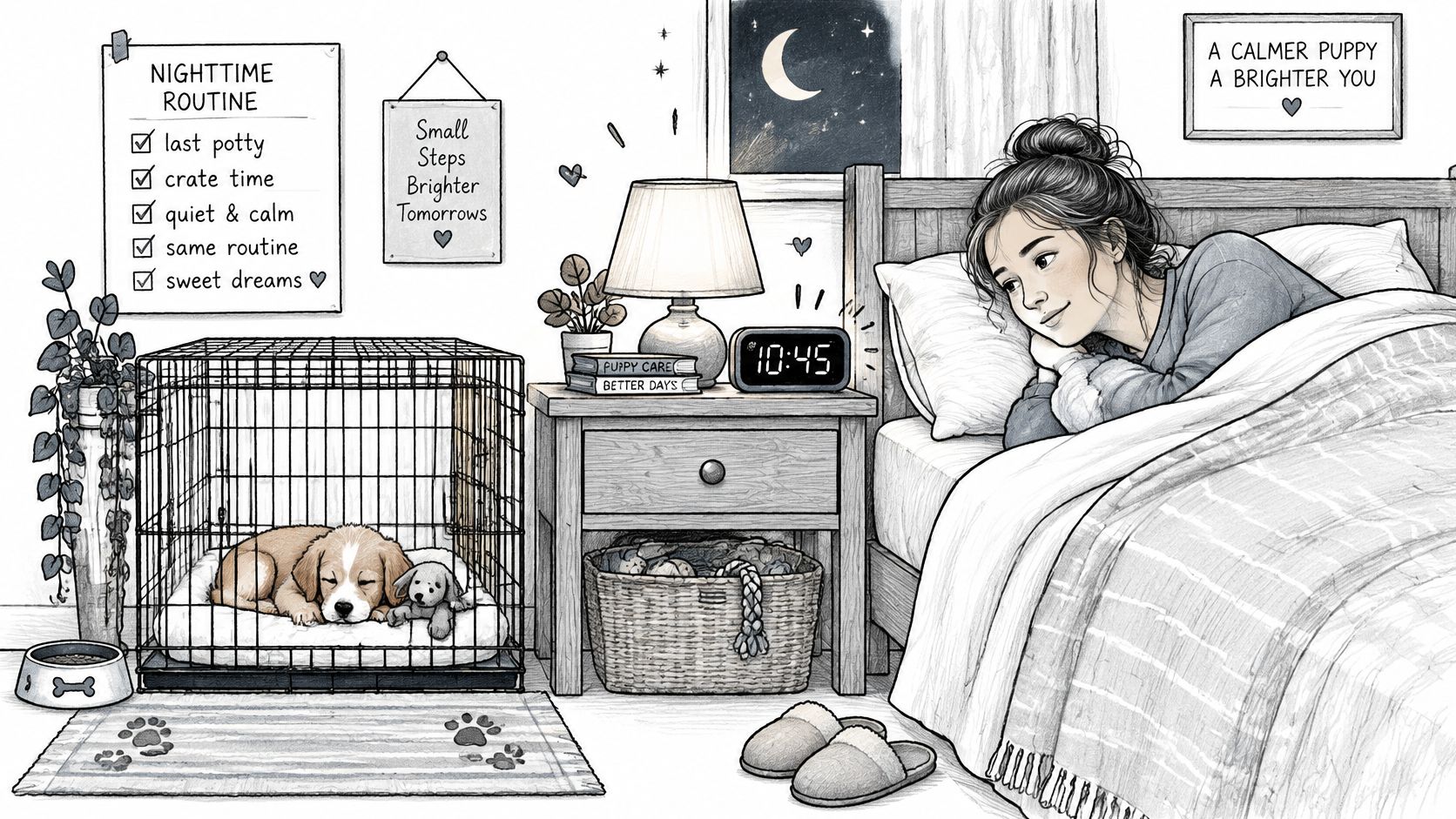
Keep the crate in your bedroom initially so you can hear and assess your puppy. The AKC's first-day puppy guidance recommends that arrangement, a consistent bedtime, and an alarm set slightly before the puppy's usual nighttime whining.
A nearby crate lets you notice waking and restlessness without making every check a trip across the house.
Keep the bathroom trip boring
When your puppy needs to go, take them directly to the toilet area. Keep the outing brief and quiet, with no play, feeding, or extended attention, then return directly to the crate. Minimal eye contact and conversation help distinguish a bathroom break from daytime social time.
For mild protest after needs are met, wait for a gap in vocalization before opening the door or offering attention. RSPCA Victoria's crate-training guidance recommends waiting for a pause before release while also stepping back when distress appears.
Don't apply the silence rule to panic. Panting, frantic escape attempts, or escalating distress calls for intervention and an easier setup, not prolonged crying-it-out. Likewise, don't delay a clearly needed bathroom trip while waiting for perfect quiet.
The same distinction applies during the day. If the puppy is safe, fed, recently toileted, and showing only mild attention-seeking protest, withhold interaction during the vocalization. Reward the first quiet gap with a calm treat or brief play session.
Use the video as a companion to your nighttime practice.
Agree on the response before bedtime
Different household members shouldn't alternate between ignoring every sound and starting an exciting cuddle session. Choose a shared response, avoid lengthening confinement abruptly, and don't dismiss possible pain or illness as stubbornness.
Before lights out, check:
- Last potty trip: Confirm that elimination happened.
- Quiet water access: Keep drinking low-key; don't withhold needed water to force a dry night.
- Consistent surroundings: Keep lights and household sounds predictable.
- Alarm ready: Plan the outing before the usual waking pattern.
- Designated responder: Have one person handle the initial check to prevent mixed responses.
A predictable night isn't necessarily an uninterrupted night. The immediate aim is a puppy whose needs are met without turning each waking into playtime.
When Whining Signals Separation Anxiety or Illness
Whining that happens mainly when you leave deserves a different assessment from whining while you prepare a meal nearby. Look for a departure-linked pattern, especially when the puppy also shows:
- Pacing: Repeated walking without settling.
- Panting or excessive drooling: Particularly alongside other signs of distress.
- Exit-focused destruction: Chewing or scratching near doors or windows.
- Indoor elimination: Urination or defecation during absences.
- Depression around departures: Withdrawal or other marked changes as you prepare to leave.
The ASPCA's guidance on whining identifies these accompanying signs and recommends gradual desensitization using short absences that don't trigger anxiety, increasing duration over many weeks of daily practice. Confining a puppy may prevent access to furniture without resolving the distress behind the behavior.
Use clear escalation rules
If whining comes with departure-related distress, contact your veterinarian or a qualified veterinary behavior professional. Seek help when the problem is severe, appears suddenly, or worsens despite gradual training. You don't need to wait for destructive behavior before asking for an assessment.
For alone-time work, use a camera to see what happens after you leave. Begin with an absence the puppy can manage calmly, vary manageable durations, and return before distress escalates. If the puppy becomes distressed immediately, the starting exercise needs to be easier, potentially just moving away while remaining visible.
Stop-training boundary: A puppy who is panicking needs a safer, easier situation and professional support, not a longer test of endurance.
Treat sudden changes as possible health problems
Call your veterinarian the same day for whining accompanied by straining to urinate, a hunched or painful posture, vomiting, refusing food, or lethargy. Ask whether the puppy needs an immediate examination rather than assuming a routine appointment is sufficient. Inability to pass urine warrants urgent veterinary attention.
A previously settled puppy who suddenly cries shouldn't receive stricter training. Physical discomfort can change how a puppy sleeps, moves, eats, or tolerates handling.
Bring observations to the appointment: when the whining starts, what happened beforehand, whether it occurs in your presence, and any changes in appetite or elimination. A short recording can help the clinician assess behavior that may not appear in the exam room.
Start Your Quiet Routine Tonight and Track Progress
Choose a manageable routine and follow it for seven days as a tracking exercise, not a deadline for success. Combine an age-appropriate daily rhythm, the crate step your puppy can handle now, and a predictable nighttime potty sequence.
Keep a short note on your phone:
- First vocalization: Minutes from entering the crate to the first whine.
- Quiet resting: Minutes spent visibly relaxed rather than merely silent.
- Recovery: How quickly the puppy settles after you return.
Look for longer relaxed stretches and easier recovery, not instant silence. If departure-related distress or medical warning signs appear, follow the escalation rules rather than pushing through the exercise. A difficult session is information you can use to make the next attempt easier.
For broader planning, explore our free planning tools and breed pages. Keep training notes separate from health assumptions: a quiet puppy isn't automatically a comfortable puppy.
PetCostEngine's content is not veterinary advice, and no supplement cures a medical condition. Take health concerns to your veterinarian instead of trying to solve them with a calming product.
Tonight, prepare the crate, set the potty alarm, and write down the first quiet interval. Start with an exercise your puppy can succeed at.
PetCostEngine helps you plan for dog ownership alongside the daily work of raising a puppy. Our free analysis asks four questions and gives one answer based on your dog's breed, state, and age. Visit PetCostEngine to build your longer-term plan while you establish a calmer routine at home.
Modeled estimates for 226 breeds, with the formula and sources published in full.
See the data →
Crate and bedding → Durable chews → Premium dry food →
As an Amazon Associate, PetCostEngine earns from qualifying purchases.