
You leave for work, then come home to foam on the floor, tooth marks on the coffee-table leg, and a dog who looks pleased to see you. The behavior feels personal, but furniture chewing usually isn't spite. Your dog has found an accessible outlet for a normal need, and every unsupervised chewing session gives that choice more opportunity to repeat.
The reliable answer to how to stop a dog from chewing furniture starts with management, not punishment. Remove access, create a safe confinement area, identify the reason behind the chewing, teach an appealing replacement, and escalate when the pattern points to anxiety or ingestion risk.
Table of Contents
- Why Dogs Target Furniture in the First Place
- How to Figure Out Why Your Dog Chews
- Set Up Your Home to Prevent Furniture Chewing
- Training Techniques That Redirect Chewing for Good
- Daily Habits That Keep Chewing From Coming Back
- When to Get Help and What to Do After Damage
Why Dogs Target Furniture in the First Place
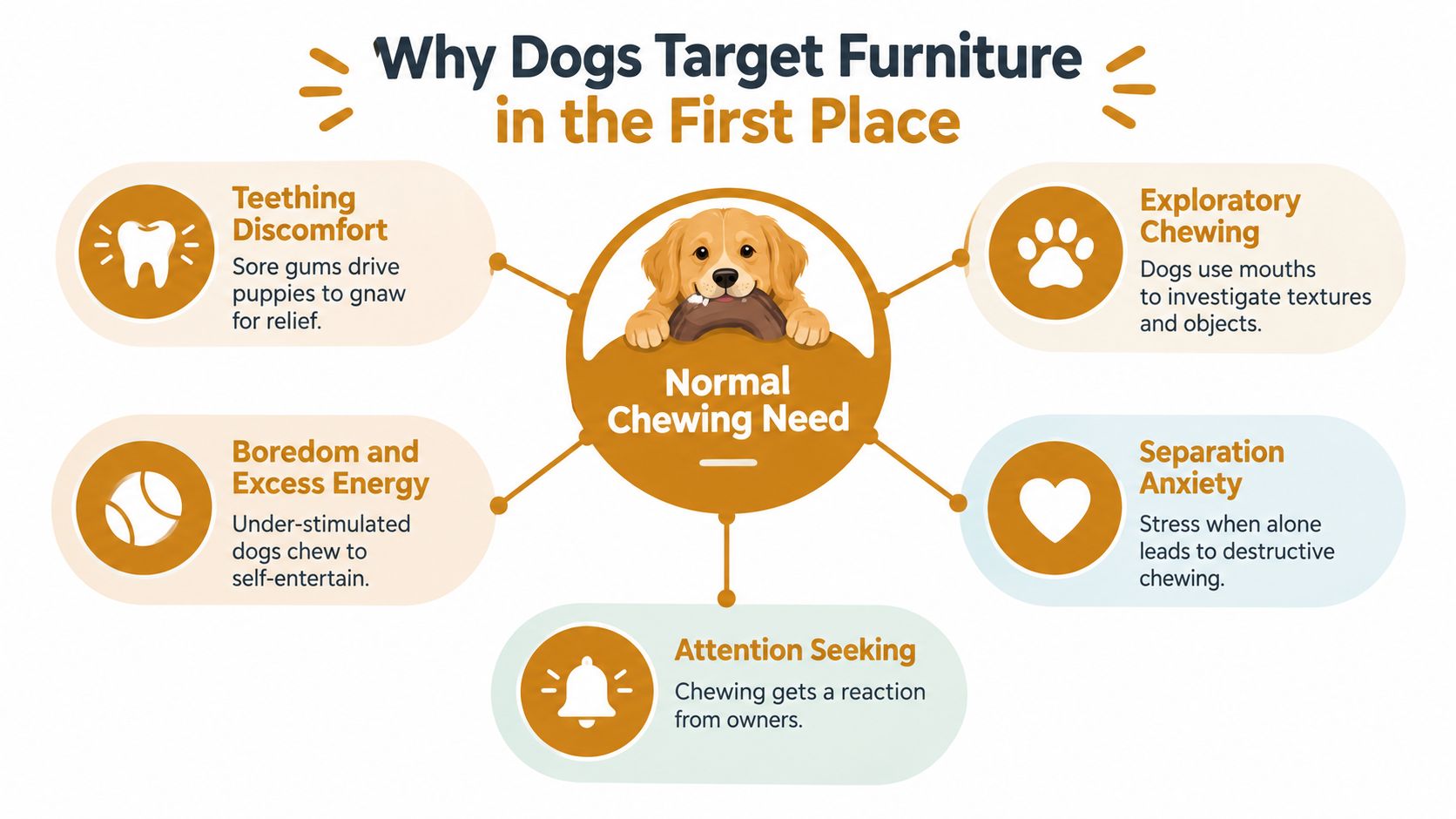
Furniture chewing has different causes at different life stages. A puppy may press its mouth against a chair leg because sore gums need pressure, or because the texture helps it investigate the room. An adult dog may work at a sofa cushion to fill quiet time. A dog that targets a door frame only after departures, especially with pacing or vocalization, needs closer attention for separation-related distress.
A survey-based exploratory study published in 2021 found that daily chewing on soft household objects was reported in 2.5% of dogs, compared with 2.2% for resting places and 1.4% for clothes or shoes. Dogs up to one year old showed this behavior significantly more often than older dogs, supporting age as a major factor in furniture-adjacent chewing the 2021 study on household-object chewing in dogs.
The common drivers
- Teething discomfort: Young dogs often seek pressure and texture when their mouths feel sore. Cushions, upholstery, and soft beds are attractive because they yield under the teeth.
- Exploration: Dogs gather information through smell, taste, and touch. A new ottoman or exposed table leg can become an investigation target.
- Boredom and restlessness: An adult dog with too little activity or too few outlets may chew to occupy itself. The ASPCA describes chewing as a pleasurable way for adult dogs to pass time when bored or restless its position statement on appropriate dog chews and treats.
- Stress when alone: Chewing near exits, windows, or owner-scented belongings can accompany separation-related distress. Destruction during thunderstorms or other loud events may point to noise sensitivity.
- Attention seeking: If chewing consistently triggers a chase, loud reaction, or immediate interaction, that response can keep the behavior interesting.
A puppy that chews several objects while the family is present needs a different plan from an adult that destroys one cushion only after departures. Age, timing, location, and preferred texture provide useful clues. Breed and temperament also shape activity and behavior needs, so owners can review dog breed profiles for additional context.
Start with prevention regardless of the cause. Confinement, closed doors, gates, and cleared furniture reduce rehearsal while you identify the driver. A dog cannot practice furniture chewing when the target is inaccessible, and training progresses faster when chewing no longer provides repeated sensory relief or entertainment. Escalate promptly if destruction occurs only during isolation, or if your dog swallows wood, foam, fabric, or stuffing. Those patterns call for professional assessment rather than a basic redirection plan.
How to Figure Out Why Your Dog Chews
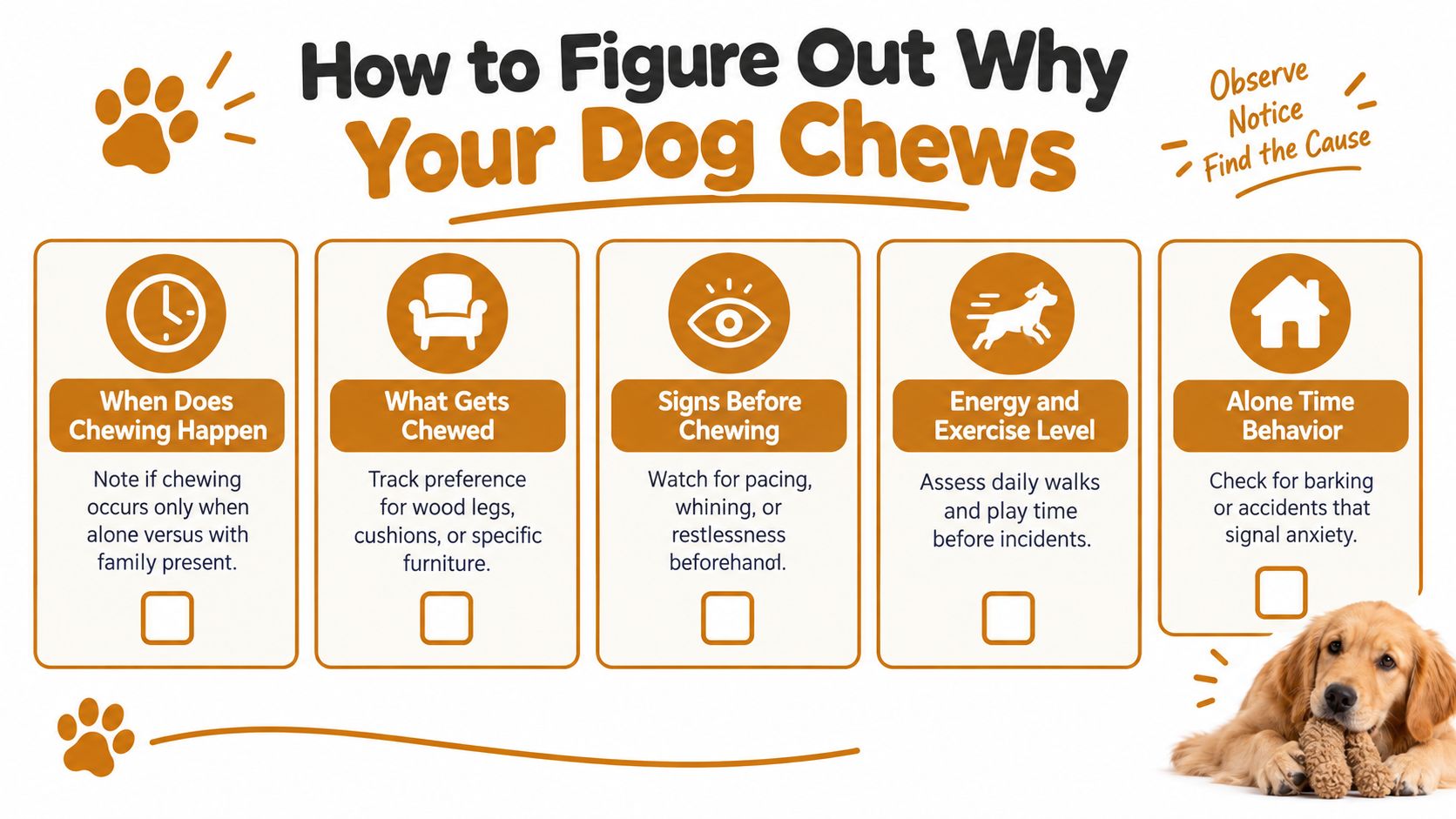
Don't diagnose the behavior from the damaged object alone. A shredded pillow can reflect teething, boredom, or distress, so look at what happens before, during, and after the incident.
A 2025 experimental and survey study on puppies reported that 65.51% of owners described minor damage to off-limit household items, while 20.68% reported no damage and 13.79% reported major damage. Furniture-related objects, including couch legs, pillows, and carpet, appeared among the most frequently chewed items the puppy chewing study. That finding makes puppy damage a predictable management issue, not evidence that your individual dog is unusually difficult.
Use the pattern, not the guess
Ask these questions and write down the answers for several days:
- Does chewing happen only when your dog is alone? If yes, record whether your dog also barks, paces, scratches doors, eliminates indoors, or refuses food. Those signs raise concern about separation-related distress rather than simple boredom.
- Does your dog chew while people are nearby? Frequent chewing during quiet family time may reflect an unmet need for an appropriate outlet, exploratory behavior, or a learned way to gain attention.
- What texture attracts your dog? Cushions and upholstery suggest a preference for soft, yielding material. Wood legs, trim, and table corners point to a harder surface preference. The replacement chew should offer a comparable but safer experience.
- What happens before the incident? Note departures, household noise, missed exercise, exciting play, naps, meals, and visitors. A consistent trigger is more useful than a broad label such as “bad behavior.”
- What does your dog do after you intervene? A dog who calmly swaps to a toy may need clearer reinforcement. A dog who panics, circles, vocalizes, or continues frantic destruction needs a more careful behavioral assessment.
Keep the log simple: time, location, object, who was home, recent activity, visible body language, and what stopped the chewing. Owners of active breeds, including the American Water Spaniel breed profile, may need to examine both exercise and mental work rather than assuming a walk alone will meet the dog's needs.
Your working hypothesis doesn't need to be perfect. It only needs to guide the first management choice. If the pattern changes when access changes, you can then test enrichment, alone-time training, or professional support without letting the dog continue rehearsing the behavior.
Set Up Your Home to Prevent Furniture Chewing
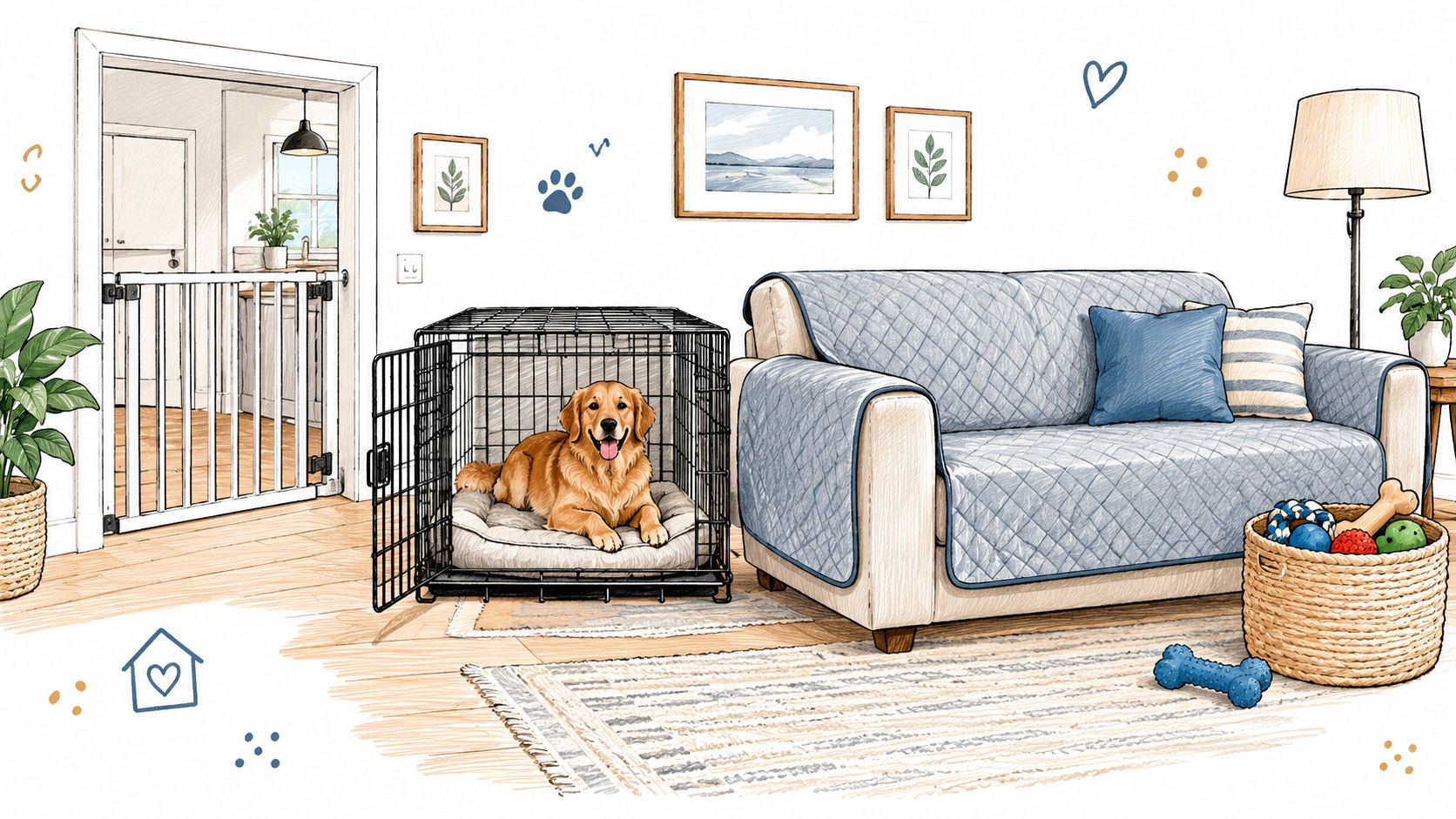
Management does the heavy lifting because it stops the behavior before your dog can perform it. The ASPCA recommends dog-proofing rooms, restricting access with a crate, exercise pen, or baby gates when the dog is unsupervised, and allowing access only to areas protected from chewing opportunities its guidance on destructive chewing.
Build a protected zone
Choose a space where your dog can rest, drink, and use approved chews without reaching furniture. That might be a crate introduced positively, an exercise pen, or a gated room with safe flooring and no exposed cords, cushions, remotes, shoes, clothing, or loose household objects.
A crate shouldn't become a place of isolation or punishment. Feed meals nearby or inside it when your dog is comfortable, provide calm activities, and increase confinement gradually. If your dog panics in a crate, use a pen or gated area while you address the underlying response.
Use a room-by-room sweep
Before leaving, check the dog's reachable zone from nose level and paw level. Remove:
- Soft targets: Cushions, throw blankets, pillows, bedding, and clothing.
- Small objects: Remotes, children's toys, pens, and food wrappers.
- Hazards: Cords, loose trim, foam, splintering wood, and unstable furniture.
- High-value scent items: Shoes, laundry, bags, and personal belongings.
Covering a sofa can protect the surface, but it isn't a substitute for restricting access. A determined dog may pull off the cover, shred it, and swallow pieces.
Practical rule: If you can't watch your dog, your dog shouldn't have access to furniture that remains reachable.
During supervised training windows, keep your dog close enough to interrupt immediately. A leash or house line can help when used responsibly and while you remain present. Never leave a tethered dog unattended, and don't use restraint to force a dog to remain near an object that causes frustration.
Reintroduce freedom in stages
Start with one protected room. After repeated success with approved chews, allow access to a second area while you supervise. If chewing returns, reduce access again instead of giving repeated verbal corrections.
Everyone in the household must follow the same rule. Letting a dog chew an old shoe teaches that shoes are available, not that only one particular shoe is permitted. The same confusion occurs when one person allows sofa chewing during play and another later punishes it.
Small-dog households can also review size-category breed resources when choosing gates, confinement spaces, and chew formats. The physical setup should fit the dog's body, strength, and ability to reach over or through barriers.
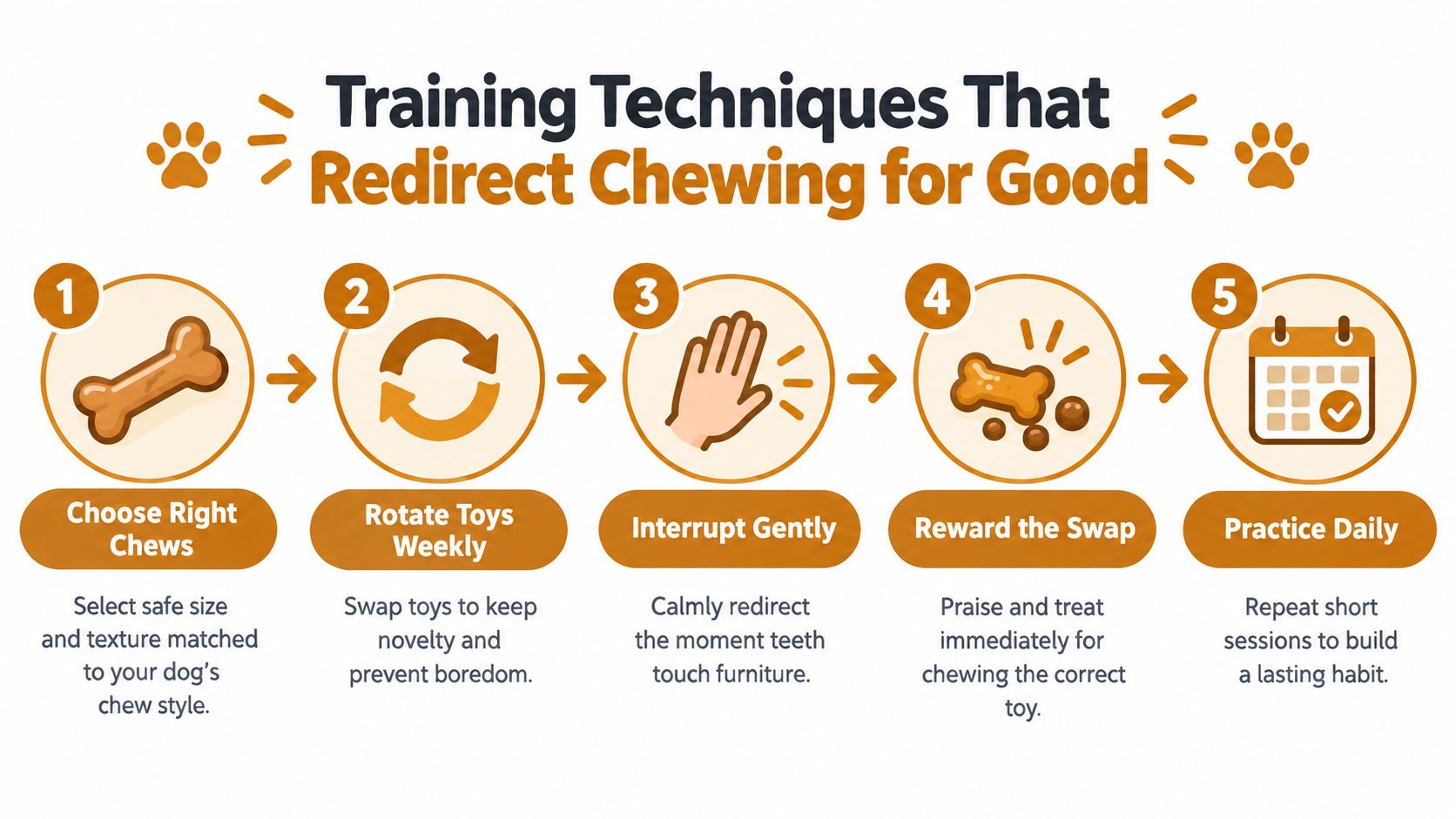
Training Techniques That Redirect Chewing for Good
Once access is controlled, teach your dog what earns attention. Redirection works best when it happens at the first sign of interest, before your dog settles into a satisfying chewing session.
Make the approved chew worth choosing
Offer several safe textures that match your dog's style. A dog drawn to soft cushions may prefer a durable rubber toy with some flexibility. A dog that seeks wood may respond better to a firm, purpose-built chew, provided it doesn't threaten the teeth and you supervise its use.
Inspect every chew regularly. Discard it when pieces break away, it becomes small enough to swallow, or its surface develops sharp edges. No chew is risk-free for every dog, so observe how your dog bites, carries, and dismantles it.
Rotate available toys rather than leaving every item out at once. Novelty can restore interest, but rotation won't replace exercise, supervision, or anxiety treatment when those are the drivers.
Interrupt, swap, and reward
If you catch a puppy chewing a table leg, walk over calmly and say, “This way,” while presenting the approved toy. Avoid chasing, grabbing, or shouting, since those responses can turn the object into part of an exciting game.
The instant your puppy takes the toy, mark the choice with “yes,” praise, and offer a small reward if food motivates the dog. Then let the dog continue chewing. Your timing teaches a clear sequence: furniture makes the owner calmly intervene, while the approved object produces access, attention, and reinforcement.
With an adult dog working on a sofa arm, use the same process. If the dog drops the furniture and moves toward the toy, reward the movement. If the dog ignores the toy, don't repeat the cue louder. Guide the dog away, restrict access, and try again later with a more compelling chew.
Teach leave it and drop it separately
“Leave it” means don't take the object. “Drop it” means release something already in the mouth. Practice with low-value items first, reward cooperation, and increase difficulty gradually.
A simple progression looks like this:
- Leave it: Place a boring object under your hand. Reward your dog for looking away, then add the cue.
- Drop it: Trade a toy for a treat, return the toy, and keep practicing so release doesn't always end the fun.
- Furniture practice: Use the cue before contact whenever possible, then reward the approved alternative.
Bitter sprays can support this process on immovable targets, but they aren't a standalone solution. The AKC says these sprays may deter chewing on baseboards and furniture, and recommends applying them daily for at least three or four weeks while the dog learns what not to chew its guidance on furniture and baseboard chewing. Test the product on an inconspicuous area first, follow the label, and keep using barriers and supervision.
This approach works well for dogs with a strong habit of returning to one chair or baseboard. It won't solve a dog who is panicking alone, and it won't make an unsafe object safe to ingest. Owners of powerful, active retrievers can compare temperament and activity context through the Labrador Retriever breed page, but the training principle remains the same: prevent rehearsal, make the alternative rewarding, and repeat the exchange consistently.
Use this video as a visual companion for calm redirection and reinforcement:
Daily Habits That Keep Chewing From Coming Back
Furniture chewing often returns after supervision and barriers disappear too soon. Keep a routine that gives your dog regular chances to move, sniff, solve problems, rest, and chew approved objects. Management still does much of the work: use a protected area whenever you cannot supervise, especially during departures or predictable rest periods.
Chewing can provide a pleasant way to pass time for a bored or restless adult dog. Appropriate chew toys help fill that need, provided they are safe for the individual dog and used under sensible supervision.
Match activity to the individual dog
A young puppy needs age-appropriate movement, frequent naps, and safe chewing outlets. An adolescent with strong drive may need structured training, scent work, retrieving, or puzzle feeding in addition to a short walk. An older dog may do better with gentle movement and enrichment that does not aggravate painful joints.
Build the day in layers instead of trying to exhaust the dog:
- Physical activity: Walks, play, and movement suited to age, health, breed, and temperament.
- Mental work: Sniffing, food puzzles, shaping games, and brief obedience sessions.
- Chewing time: A safe chew before predictable rest periods or departures.
- Recovery: A quiet place where the dog can sleep without constant stimulation.
Make alone time predictable
Practice departures while you are still home. Step behind a door briefly, return before distress begins, and increase duration only when the dog remains relaxed. Keep departures and arrivals calm. Do not turn the final minutes before leaving into a burst of attention that raises arousal.
Before a longer absence, provide an appropriate activity in the protected area. If the dog refuses food, vocalizes continuously, scratches at exits, or destroys objects near departure points, stop lengthening the exercise. Those signs point to a problem that needs behavioral guidance, not more repetition.
The schedule must fit the household. A plan requiring constant novelty will fail, while a repeatable pattern of movement, enrichment, approved chewing, confinement, and protected alone time can become ordinary practice. Review the setup after any relapse, then tighten management before adding more freedom.
When to Get Help and What to Do After Damage
Some chewing problems are training problems. Others are safety or clinical problems, and delaying help can make both worse.
Chewing deserves veterinary attention when it begins suddenly in an adult dog, appears obsessive, involves the dog's own body, or occurs alongside signs of pain or illness. Seek a qualified trainer or veterinary behavior professional when destruction happens specifically during departures, comes with panic, vocalization, escape attempts, house soiling, or severe distress around confinement or noise.
Treat ingestion as a safety issue
Fabric, foam, and wood can cause an intestinal blockage if swallowed the clinical guidance on furniture shredding and ingestion risk. If your dog has eaten part of a cushion, upholstery, toy, or wooden object, contact your veterinarian or an emergency veterinary service promptly. Don't wait for severe symptoms, and don't induce vomiting unless a veterinary professional specifically tells you to.
After an incident, secure the remaining debris, photograph the damaged area, and note what may be missing. Record when it happened, whether your dog vomited or retched, changes in appetite or stool, abdominal discomfort, energy level, and any behavior around departures. Bring the material or a clear description to the veterinary team when safe to do so.
Sprays can make a surface less appealing. They can't supervise a dog, treat separation distress, or remove swallowed material.
If the issue is persistent, professional support can combine environmental control, gradual alone-time training, reinforcement, and veterinary evaluation. Use the PetCostEngine calculator to organize broader dog-care planning while you decide what ongoing support your household can maintain.
PetCostEngine provides breed-, age-, and state-aware dog ownership projections, along with breed health references and insurance comparison tools for US owners. Visit PetCostEngine to make informed care plans while you put furniture management, safer chewing outlets, and professional support in place.
Modeled estimates for 226 breeds, with the formula and sources published in full.
See the data →