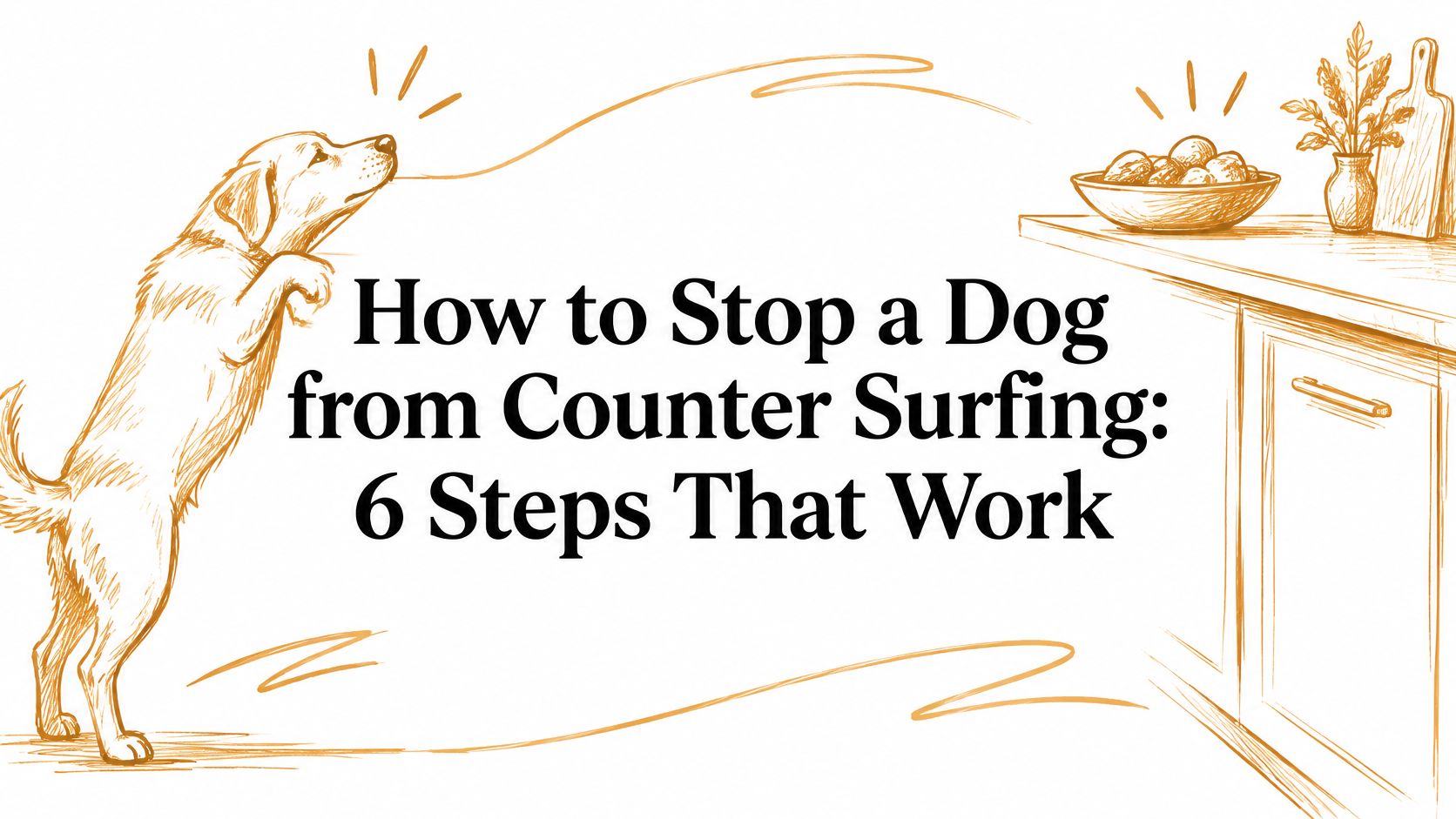
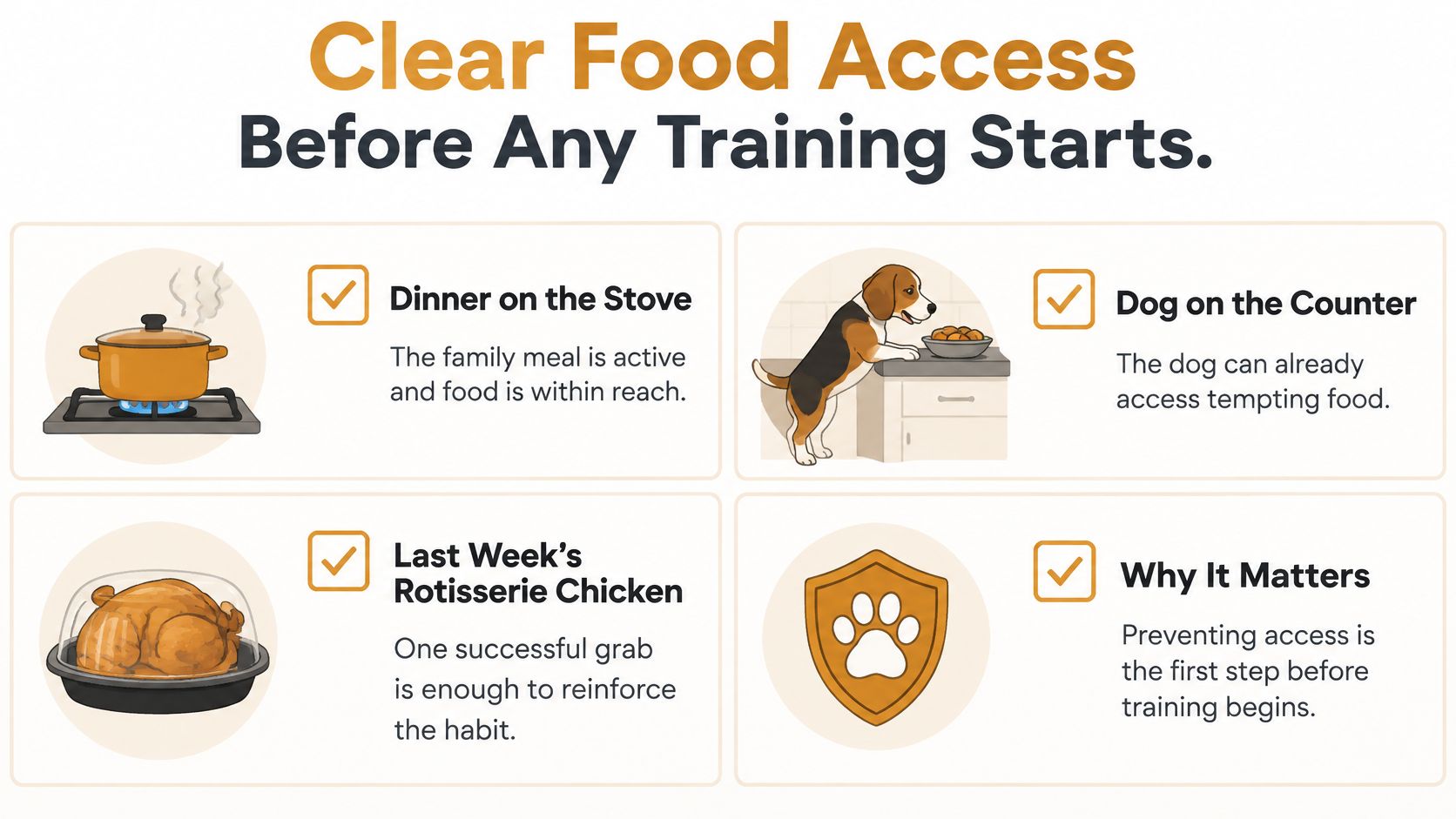
Dinner is on the stove, the dog is already on the counter, and last week's rotisserie chicken is why this scene feels familiar. That one grab paid off. How to stop a dog from counter surfing starts by taking the payoff away, then teaching a mat, and treating a toxic bite as a medical call rather than a manners problem.
Table of Contents
- Clear Food Access Before Any Training Starts
- Xylitol Exposure and When to Call Your Vet
- How to Teach a Mat Behavior Step by Step
- Why Yelling and Leash Corrections Backfire
- When to Advance Stages and Track Weekly Results
- Fixing Relapses, Stalls and Food Guarding
Clear Food Access Before Any Training Starts
A single success matters because counter surfing is self-reinforcing. When a dog finds food on a counter, that food works as a reward and makes another search more likely. Veterinary behavior guidance on the Veterinary Information Network treats environmental management as the foundation: remove food whenever the dog is unsupervised, store it in a cabinet or the refrigerator, and use a baby gate, closed door, crate, or another safe separation so the dog cannot rehearse the jump. A mat comes later, once supervision is real. Consistent management also cuts the chance of a hazardous swallow that turns into an emergency vet visit.
A kitchen checklist you can finish today
- Counters, sinks, and stovetops: Clear food, dishes, crumbs, and cutting boards before you turn your back.
- Leftovers: Put them in a cabinet or the refrigerator, not on the counter "for a minute."
- Surfaces: Wipe after every meal so grease stops paying the dog for a second look.
- Trash: Keep it behind a closed lid or a cabinet door.
During cooking, set the gate, shut the door, or crate the dog so jumping cannot happen while nobody is watching. Offer a food-stuffed chew in another room so the mouth has a job that is not the counter.
Household rule: Every person in the home, including guests and older children, follows the same routine. One person who hands food from the counter undoes the rest.
This week, remove access completely. Start a simple tally of counter approaches so you have a baseline before any training stage begins.
Xylitol Exposure and When to Call Your Vet
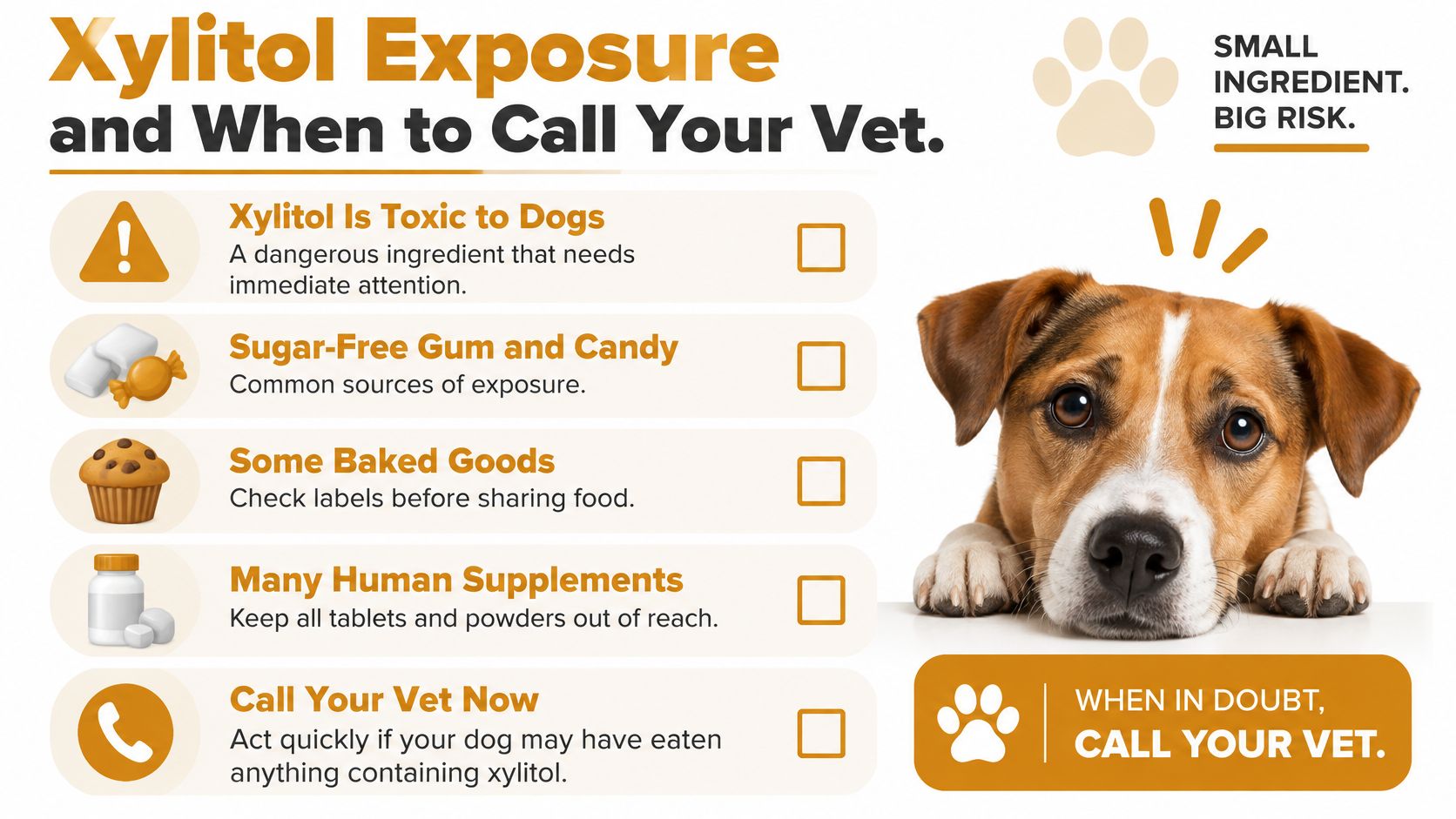
Counter access is a route to toxic food, so this step comes before any cue work. The FDA consumer update on xylitol identifies counter surfing as a path to xylitol exposure and notes that symptoms can begin within 10 to 60 minutes, with weakness, collapse, and seizures among possible signs.
Xylitol is toxic to dogs and appears in many human supplements, so human probiotics should not be given to dogs without asking a vet. It also shows up in sugar-free gum, candy, and some baked goods. Read the label on anything left within reach, and tell everyone in the household which products contain it. Saying "leave it" will not undo a swallow if the package was already on the counter.
If you suspect xylitol, secure the rest of the food at once, keep the package so the ingredient can be identified, and call a veterinarian or emergency hospital without waiting for symptoms. For other missing foods, your vet or the ASPCA Animal Poison Control Center can sort the ingredient. This is not veterinary advice from a training article, and no home remedy replaces that call.
Training versus emergency: what to do
| Situation | Action | Timing |
|---|---|---|
| Suspected xylitol ingestion | Call a veterinarian or emergency hospital and keep the package | Now, before any symptoms appear |
| Other food missing, no symptoms yet | Call your vet or the ASPCA Animal Poison Control Center for guidance | Same day |
| Vomiting, weakness, collapse, or seizures | Emergency veterinary care | Immediately |
Resume mat work only after the dog is safe and food access is closed again.
How to Teach a Mat Behavior Step by Step
The useful skill is not a louder "off." It is a place the dog can be while food is in the room. A mat or bed is incompatible with jumping: four paws on the mat cannot also be on the counter. Build that job away from the stove first.
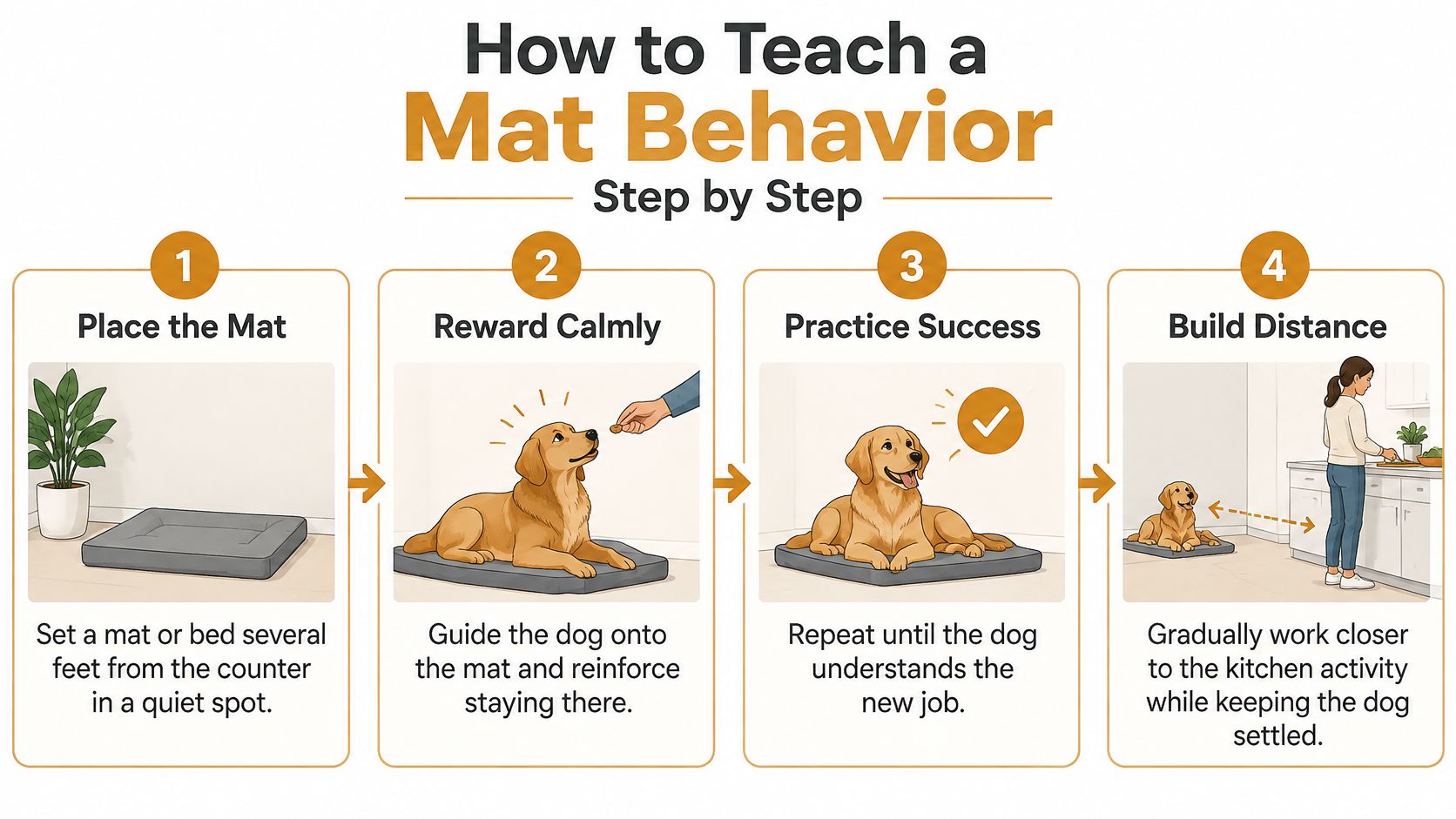
- Place a mat or bed several feet from the counter in a quiet spot. The dog should learn the mat before the counter is part of the picture. The common slip is dropping the mat at the stove on day one, with dinner already smelling.
- Reward any turn toward the mat, one small piece of food for each moment of attention. You are paying orientation, not perfection. Waiting for a flawless down starves the first lesson of rewards.
- Reward a step onto the mat as soon as a paw lands. Many people hold the treat until the dog lies down, which slows the whole chain. Mark the step, feed, and let the down come next.
- Reward lying down and a hold of a few seconds, then lengthen the hold a little at a time. A jump from three seconds to a full dinner collapses the behavior. Short reps, repeated, beat one long stare-down.
- Add a verbal cue such as "mat" only after the dog moves to the mat reliably without a lure. A word added too early is noise. The cue should name a movement the dog can already do.
- When kitchen activity starts, cue the mat, reward the dog for keeping all four paws on the floor, and release on purpose. An oven beep is not a release. If you want the dog up, say so.
- If the dog leaves, calmly guide it back and reward the position you asked for. A chase, a clap, or a scolding makes leaving the mat exciting. Calm return, then pay the stay.
A cue is a label for a skill the dog already has, not a word you hope will work on the first try.
What a working mat looks like
During dinner prep the dog walks to the mat on cue without being carried or coaxed, holds it while you chop, and waits for a release. Sessions stay brief. Between reps, the gate, door, or crate still blocks the kitchen, because an unwatched success on the counter will outvote the mat.
Why Yelling and Leash Corrections Backfire
The reflex after you catch the dog is to yell, grab a spray bottle, jerk the leash, or reach for a prong or shock collar. Those moves feel decisive. They do not change the reason the dog checked the counter.
The picture below is the split that matters: pay the floor, or punish the jump and hope the search for food fades on its own.
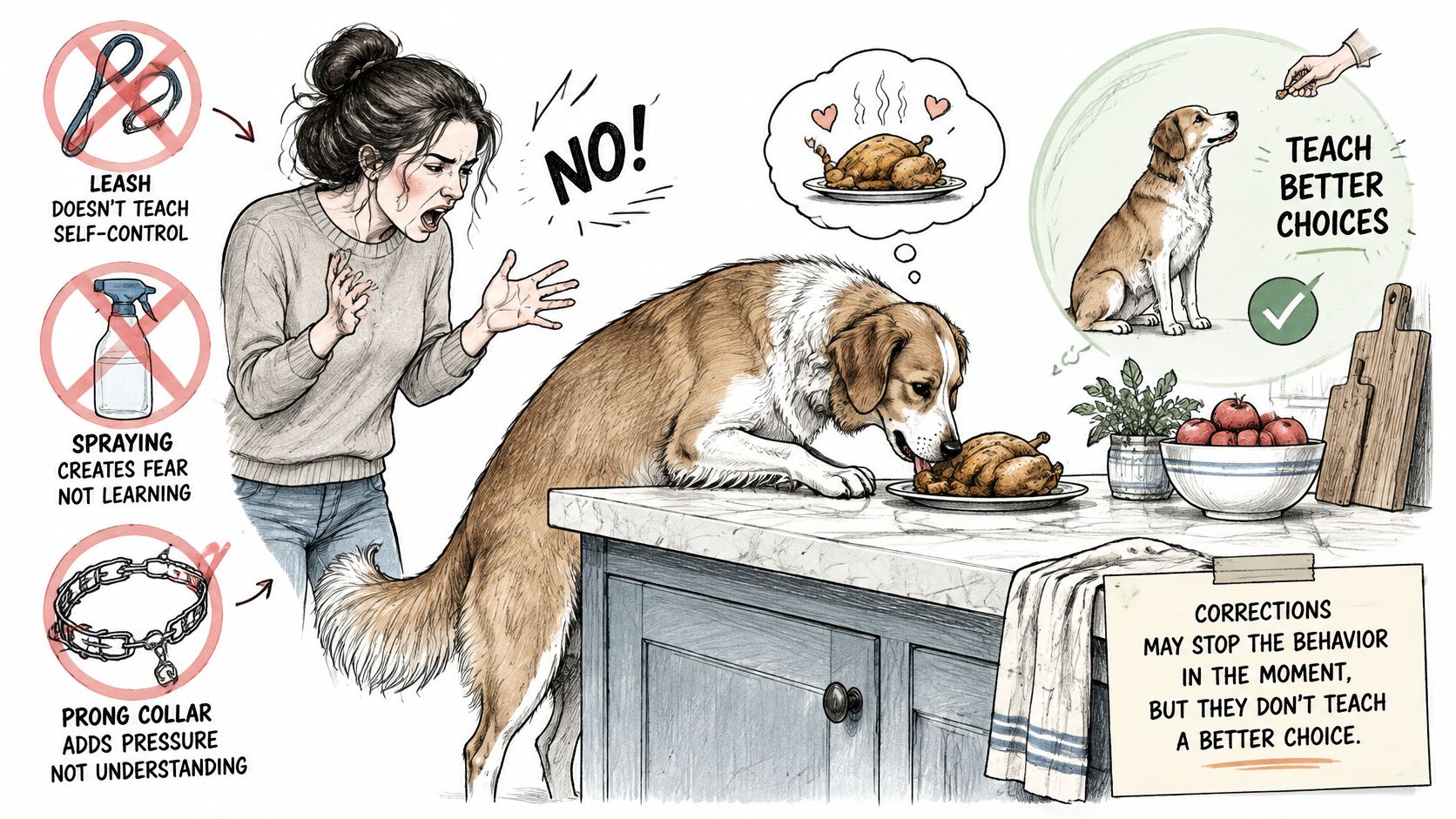
The American Veterinary Society of Animal Behavior position statements state that reward-based methods should be used for all dog training and behavior modification, including problem behaviors. The position rejects electronic collars, prong collars, choke chains, physical corrections, and intimidation, and it states that aversive methods should not be used under any circumstances. Punishment can inhibit learning and increase fear-related or aggressive behavior. Shouting, hitting, or chasing after a jump can also deliver attention while the food-seeking motive stays untouched.
What welfare comparisons add
Purdue's Center for Animal Welfare summarizes evidence that dogs trained with aversive methods showed more stress-related behavior, more tense or low behavioral states, greater panting, and larger post-training cortisol increases than reward-trained dogs. A scared dog in the kitchen is not a dog that has learned where food is allowed.
Replace the correction with four habits:
- Four paws on the floor: Feed, praise, or play for that stance while you cook.
- The trip to the mat: Pay the dog for going there, not for getting caught.
- Remove access or attention: If a jump happens, the counter stays empty and the scene stays dull.
- A barrier or a loose leash: Use either to keep the dog out of the kitchen. Do not yank.
A short demo of calm redirection is more useful than another lecture on "no."
Get a qualified reward-based trainer or a veterinary behaviorist if the dog cannot disengage from food, guards stolen items, becomes frantic, or keeps ingesting dangerous things. Harsher gear is not the next step.
When to Advance Stages and Track Weekly Results
Change one variable per stage: distance, duration, distraction, or food intensity. Advance only when the middle column is true. I would not drop a barrier because the dog "seems better" on a quiet Tuesday.
Training stages and when to advance
| Stage | Setup | Advance when | Barrier status |
|---|---|---|---|
| 1. Mat first | Empty counter, low-distraction mat several feet away, short holds | Dog steps onto the mat and holds the position reliably | Full barrier during unsupervised time |
| 2. Add the cue | Verbal cue added after the movement is reliable | Dog goes to the mat on cue without a lure | Full barrier during unsupervised time |
| 3. Add distraction | Mild distractions, longer holds, more distance | Dog holds the mat with distraction present | Barrier stays in place |
| 4. Sealed food | Low-value food in a sealed container | Dog disengages from the sealed food when cued | Barrier stays in place |
| 5. Exposed food | Low-value food exposed with a backup barrier | Zero thefts for several consecutive weeks | Barrier reduced only after the target is met |
The Animal Welfare Society identifies counter surfing as a learned behavior and recommends keeping food away, rewarding floor-level calm, teaching a mat, and avoiding common management errors. Use a tether, baby gate, crate, or closed door whenever you cannot watch, because an intermittent steal keeps the habit persistent.
Each week, write three numbers against the dog's own baseline: counter approaches, approaches redirected without jumping, and thefts. The working target is zero thefts for several consecutive weeks before any barrier comes down. Fewer attempts are not enough, because an occasional win preserves the habit. One theft means you drop back to the last stable stage, not that you scrap the plan.
Falling approaches with zero thefts means you may move one stage. Rising approaches or repeated thefts after real management means you stop advancing.
Expect weeks, and sometimes months, before the change holds. Review the tally at the same time each week. Breed traits can stretch that timeline, and our breed pages under /breeds/ are a practical place to check the dog you have. This is training guidance, not veterinary advice, and no supplement cures a medical condition.
Fixing Relapses, Stalls and Food Guarding
The first relapse usually looks like a clean counter and a dog that has not jumped in weeks. Then one plate gets left out, the dog checks, and the habit gets paid. Drop back to the last stage that held and keep the barrier in place for about a week before you test exposed food again. A single theft tells you the setup failed somewhere. Adjust the setup; do not restart the whole protocol.
Relapse and stall symptoms, causes and fixes
| Symptom | Likely cause | Fix |
|---|---|---|
| Jumps only when the owner leaves the room | Access during unsupervised time | Add a gate, crate, or closed door for all unsupervised periods, plus full food removal |
| Ignores the mat when food is exposed | Counter reward outweighs the mat reward | Return to sealed food and raise the value of the mat reward |
| Jumps again after a long good stretch | One successful theft | Drop back to the last stable stage and keep the barrier in place |
| Jumps for crumbs on counters and sinks | Small leftovers still reinforce | Wipe after every meal and check sinks, cutting boards, and the trash |
| Progress stalls after several weeks | A household member still feeds or allows access | Restate household rules, recount approaches, and confirm everyone follows them |
| Guards stolen food or becomes frantic | Strong food arousal and possible resource guarding | Stop exposed-food training; see a vet, then a qualified reward-based trainer or veterinary behaviorist |
Read the row before you change the plan. A dog that only jumps when you leave is getting a private rehearsal, so the gate, crate, or closed door has to cover every unsupervised stretch, with food gone too. Crumbs on a sink or cutting board count as payment. Treat the wipe-down as part of training.
One theft is a training reset. A theft of a human supplement is a vet call. Xylitol is toxic to dogs and appears in many human supplements, so if the stolen item could contain it, phone your vet now and do not wait for a relapse pattern to emerge. That is an ingestion problem. Treat it as a vet call before any training decision.
When you stop adjusting and get help
If the tally is flat for several weeks, check whether someone still slips the dog a bite or leaves a plate out. Restate the rule out loud and start the approach count again so you can see whether the stall is a people problem. A flat tally with a clean kitchen is a training gap, and it needs a smaller step, not more repetitions of the same one.
Food guarding needs a different response than another training stage. Stop all exposed-food practice, keep the dog out of the kitchen during meals, and call your veterinarian first to rule out a medical driver. Then book a qualified reward-based trainer or veterinary behaviorist. Ask how they handle guarding and whether shock, prong, or choke equipment is part of the plan. A reward-based plan for guarding should not need those tools. If the trainer says yes, keep looking. I would make that call before another week of food left out on purpose.
PetCostEngine's free analysis estimates lifetime dog costs by breed, state, and age and compares 15 U.S. pet insurance carriers.
Modeled estimates for 226 breeds, with the formula and sources published in full.
See the data →
Premium dry food → Puzzle toys → No-pull harness →
As an Amazon Associate, PetCostEngine earns from qualifying purchases.