Have you ever wondered why a dog can seem to understand a click during training, yet still has no idea what you want when the treat disappears? That gap exposes the part many beginner guides skip: a clicker isn't a command, a reward by itself, or a shortcut to faster learning. It's a communication tool, and its value depends on timing, consistency, and what follows the sound.
Table of Contents
- What Clicker Training Actually Is
- How the Marker Signal Works
- What the Research Says About Clicker Results
- Shaping a Real Behavior With a Clicker
- Common Mistakes and How to Fix Them
- Time and Cost Expectations for Owners
- Getting Started with Your First Sessions
What Clicker Training Actually Is
What is clicker training for dogs, beyond “click, then treat”? It is reward-based operant conditioning that uses a brief, consistent sound to identify the precise moment a dog performs a behavior the trainer wants repeated. The trainer follows that marker with a primary reward, such as food, play, or praise.
The click works like a verbal highlighter. If your dog sits, it marks the instant the rear reaches the floor, even though delivering the reward takes longer. That information helps the dog connect the consequence with the action. The click is not the reward, and it does not teach “sit” without practice and reinforcement.
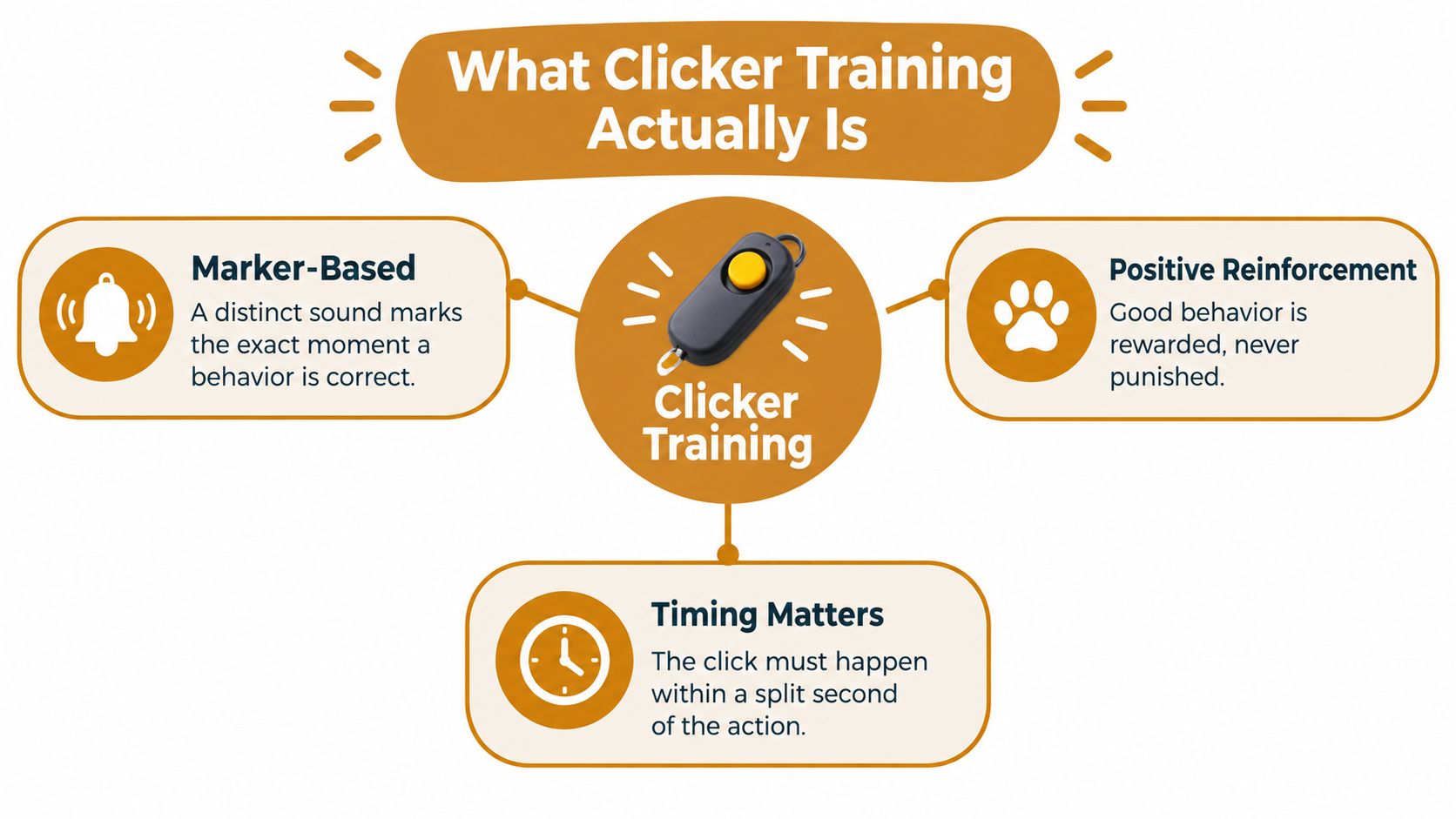
The four ideas to keep in mind
- Marker-based: The sound identifies the behavior you want repeated.
- Reward-based: The dog receives something valuable after that behavior.
- Timing-sensitive: Click while the desired action is happening, rather than several moments afterward.
- Optional: A short verbal signal such as “yes” can serve the same basic communication purpose.
Clicker training is one tool within reward-based training. The American Veterinary Society of Animal Behavior recognizes a clicker or verbal marker as an appropriate signal in this approach and recommends reward-based methods for canine training and behavior modification. The method reinforces desirable behavior instead of trying to suppress unwanted behavior through physical or psychological discomfort. The NAIA overview of how dogs learn provides background on this distinction.
The same principles can apply to any dog, whether you are comparing breeds using breed-specific dog information or training a newly adopted adult. A clicker may sharpen communication, yet it does not automatically make learning faster than a well-timed verbal marker. Owners also need to account for accidental clicks, fading treat dependence, and the timing mistakes that can make the method confusing.
How the Marker Signal Works
What turns a meaningless click into useful information for a dog? Pairing, a learning process in which a neutral sound repeatedly occurs immediately before something the dog values. After consistent pairings, the dog hears the click and expects reinforcement. The click has become a conditioned reinforcer, also called a secondary reinforcer.
Trainers often call this process loading or charging the clicker. Hold the clicker out of the way, make one click, and immediately give a small treat. Repeat the pattern calmly. The dog does not need to perform a behavior yet. You are teaching one simple relationship: “That sound predicts something good.”
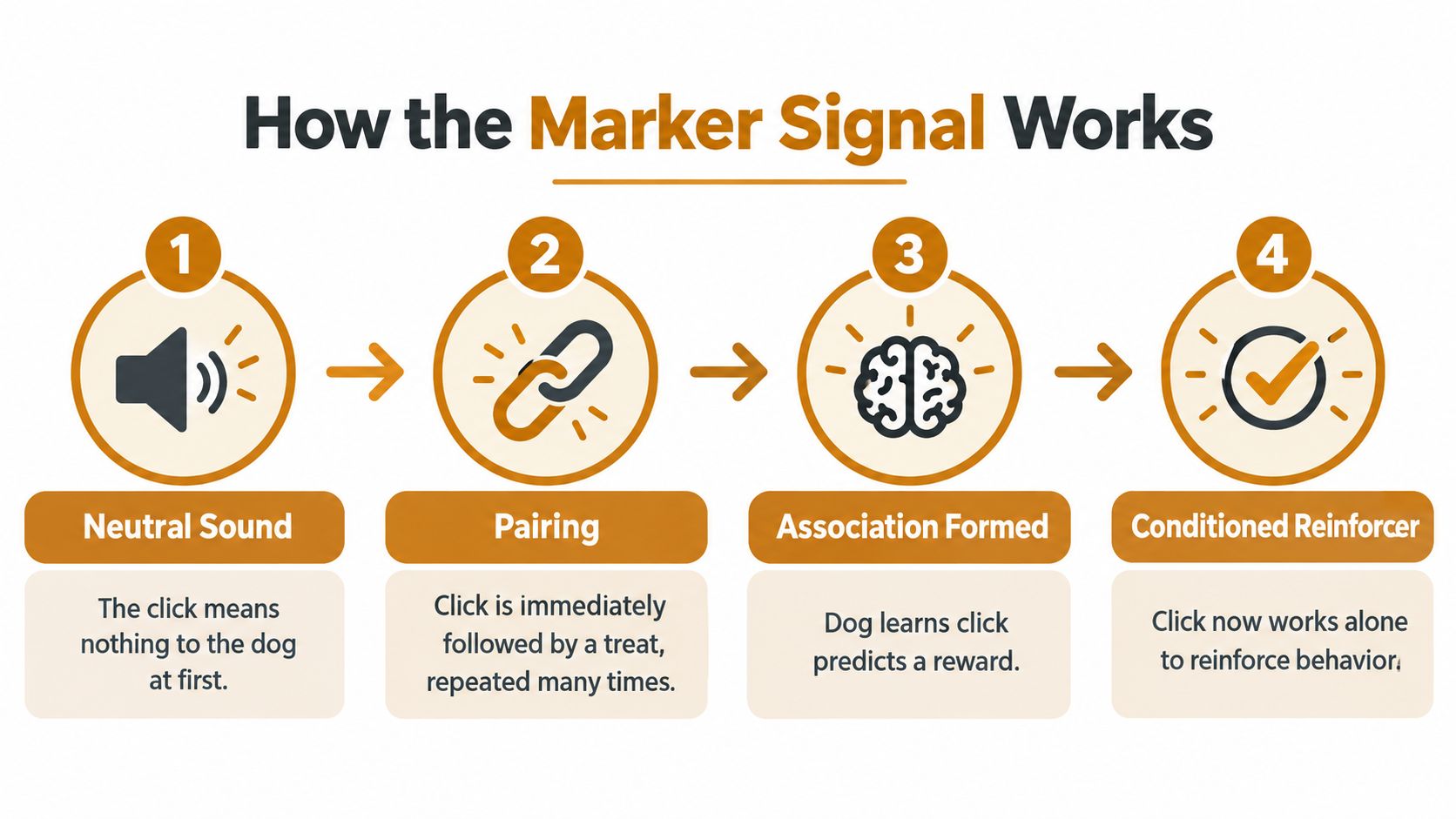
Why timing carries the method
The click forms a bridge between the behavior and the reward. Food may take a moment to reach your dog's mouth, while the click can occur as the correct action happens. That precision helps the dog separate the behavior that earned reinforcement from nearby movements.
Timing errors explain why “click then treat” can feel confusing in practice. If the click comes after the dog sits up, looks away, or moves again, you may mark the wrong moment. An accidental click also carries meaning once the sound has been paired with food, so keep the device covered or out of reach between repetitions.
The idea connects to B. F. Skinner's work on operant conditioning. Skinner popularized operant conditioning in his 1938 book The Behavior of Organisms, and in 1951 he described using a cricket-like sound as a conditioned reinforcer for animal training. Modern dog clicker training is a more specific named approach, commonly dated to two presentations made in May 1992. The historical development belongs to the broader framework of learning through consequences.
Practical rule: The click identifies the behavior. The reward gives the click its meaning.
A small handheld clicker can work, and a consistent verbal marker can serve the same communication role. The dog still needs reinforcement after the marker, especially while learning. Over time, vary rewards thoughtfully rather than letting the clicker become a promise of a treat for every response. A dog with a Border Collie breed profile learns through the same association, although motivation, sensitivity, and preferred rewards differ between individuals.
What the Research Says About Clicker Results
Does a clicker make dogs learn faster? The strongest case for it is precise communication, not a guarantee of quicker learning. A 2021 peer-reviewed study compared a clicker, a verbal secondary reinforcer, and primary reinforcement alone across three experiments. The average delay between the target behavior and reinforcement was 2.5 seconds for the clicker condition, 2.6 seconds for the verbal-marker condition, and 3.1 seconds for primary reinforcement alone. The full peer-reviewed study reports these timing results.
Those small timing differences did not show that clicker-trained dogs acquired a novel behavior more rapidly or reached a higher performance level than dogs trained with a verbal marker or primary reinforcement alone. A clicker can make the trainer's message clear, much like placing a precise label on the exact action you want, but a well-timed “yes” can serve the same practical role.
The tool is only one part of the training arrangement. Results also depend on reward quality, marker timing, trainer consistency, behavior difficulty, and the dog's motivation. If a dog ignores the clicker, or a family member finds it awkward to use, the equipment itself is not the problem to solve.
The broader evidence supports conditioned reinforcement within reward-based procedures. A systematic review of 34 studies found a medium overall effect, reported as Tau-U = 0.77 with a 95% confidence interval of approximately 0.53 to 0.89, for interventions using conditioned reinforcement. The systematic review also found that dog studies commonly paired clickers with hand-delivered food, while reported clicker-intervention effects ranged from Tau-U 0.48 to 0.98. Our methodology and data sources document the same evidence-first approach used when interpreting training claims.
For owners, the practical conclusion is simple. Use a clicker if it improves your timing and helps you mark the right moment. Use “yes” when your hands are occupied or a mechanical sound is inconvenient. In either case, follow the marker with reliable reinforcement and practise consistently so your dog can understand the pattern.
Shaping a Real Behavior With a Clicker
Teaching a dog to go to a mat shows why clicker training is more than saying “click, then treat.” Put the mat on the floor and wait. The first useful response might be your dog looking at it. Click while the dog looks, then deliver the treat. Next, you might mark a step toward the mat, a sniff, or one paw touching the surface.
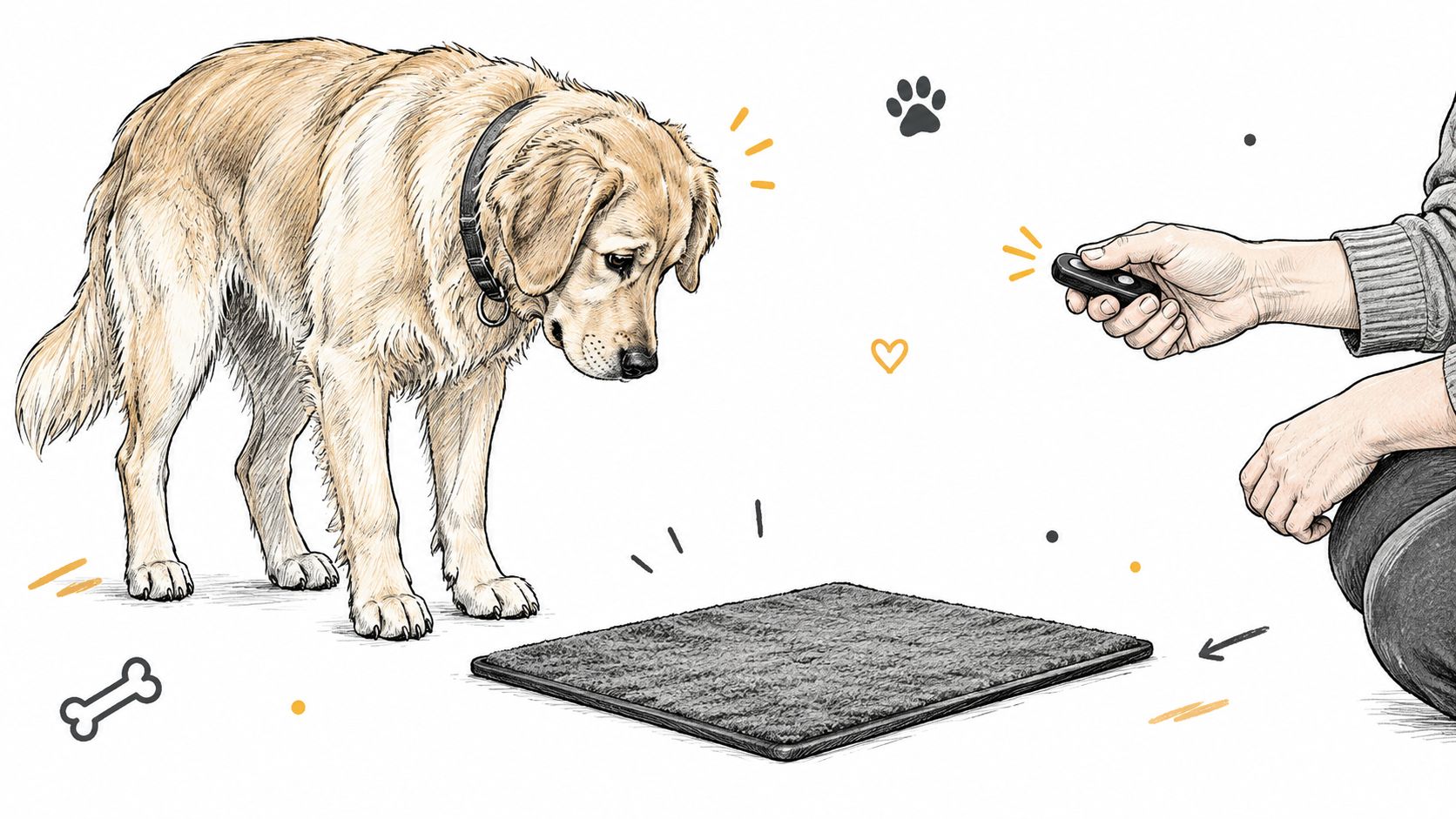
Each click marks the best response the dog has offered at that moment. You aren't waiting for a perfect settle that the dog doesn't yet understand. You're reinforcing successive approximations, which means gradually rewarding actions that move closer to the final behavior.
Build one feature at a time
Once your dog consistently approaches or steps onto the mat, you can begin waiting for more. A dog may first stand on it, then sit, then lie down, and eventually remain there. The trainer decides which small improvement is ready to earn the next click.
The American Kennel Club recommends increasing duration gradually and working on only one training dimension at a time among distance, duration, and distraction. If you ask for a longer stay while also moving farther away in a busy room, your dog may not know which change caused the reward to stop.
During acquisition, every click should be followed by a reward. The click and treat work together, so clicking without reinforcing can weaken the sound's predictive value. Once the dog reliably understands the behavior, you can begin changing how often reinforcement arrives, but that transition should follow fluency rather than precede it.
A mat behavior can also become useful in daily life. A Labrador Retriever breed guide may help you think about breed-specific traits, but the training principle remains individual: observe the action, mark the precise improvement, reinforce it, and make the next challenge small enough for the dog to solve.
Common Mistakes and How to Fix Them
Most clicker problems aren't caused by a stubborn dog. They come from unclear information. A late click, an accidental click, or a missing reward can teach the dog something different from what the owner intended.
Timing errors change the lesson
If you're teaching a sit, click as the dog's rear reaches the floor. Clicking after the dog stands again may mark standing, looking at you, or moving toward the treat. Keep the clicker close enough to use quickly, watch the behavior instead of the treat pouch, and practice without asking for too much at once.
Accidental clicks create the same confusion. A dog sniffing the ground, pawing at you, or bouncing toward the food may receive reinforcement if the owner clicks while managing the treat. Keep treats ready but hidden, and click only when you can identify the exact action you want repeated.
A click isn't general applause. It's a precise record of the behavior that earned reinforcement.
During early learning, don't click and then decide whether the dog deserves a treat. The reward should follow every click while the marker is acquiring and maintaining its meaning. If you clicked by mistake, calmly provide the reward and reset rather than adding frustration or trying to punish the dog for your timing error.
Avoid creating a frantic routine
Long strings of repetitions can produce over-arousal. Keep sessions short enough that your dog can still think, pause between attempts, and finish after a successful response. If the dog starts vocalizing, grabbing at the pouch, or offering random behaviors rapidly, lower the difficulty and give a break.
Partial or unpredictable rewards aren't a reliable shortcut to motivation. Experimental evidence found that partial rewarding didn't improve learning speed and may have negatively affected dogs' affective state. Another study found that clicker-trained dogs didn't learn a simple operant task faster than controls, although the click could make behavior more resistant to extinction when food was later withheld. This review of the relevant findings supports keeping reinforcement dependable during acquisition.
Once the behavior is reliable, you can gradually use intermittent reinforcement. You can also fade the clicker by marking less often and using a verbal signal when practical. On an off-leash walk, in wet conditions, or when your hands are occupied, a consistent “yes” can be easier to deliver than a mechanical click. The marker choice matters less than clear timing and a reward history the dog understands.
Time and Cost Expectations for Owners
What does clicker training cost in time and supplies? The equipment is modest: a handheld clicker, suitable treats, and, for exercises such as mat training, a target mat. Your attention is the larger investment. A marker only helps when you notice the right behavior and signal it at the right moment.
Short, frequent sessions usually suit both dog and owner better than one demanding practice period. Prepare treats first, choose a behavior that can produce early success, and stop while your dog can still think. Training should build understanding, not turn into repeated drilling after focus has disappeared.
The ongoing budget extends beyond training equipment. Food, preventive care, grooming, boarding, gear, and veterinary care all belong in a household's ownership plan. Senior dogs typically add veterinary line items such as bloodwork and dental care, which a lifetime cost calculator can itemize separately from training supplies.
A broader estimate can be organized by breed, state, and age with the PetCostEngine lifetime dog ownership cost calculator. If insurance is part of your planning, compare the available options through the site's pet insurance guides. Keep those financial estimates separate from the training choice. A clicker supports clear communication, while consistent timing and practice determine whether sessions help.
Getting Started with Your First Sessions
Start with one behavior and one clear criterion. You might choose looking at a mat, touching your hand, or sitting. Prepare the clicker and treats before bringing the dog into the room so you aren't searching for supplies while the behavior is happening.
First, pair the click with a treat until your dog notices the sound and expects reinforcement. Then wait for a small action you want to encourage. Click during that action, deliver the treat immediately, and pause before trying again. If the dog offers something different, don't keep clicking in the hope that the right behavior appears by accident.
A simple session check
- Charge the marker: Pair each click with a reward before asking for formal behavior.
- Prepare the treat pouch: Use rewards your dog can eat promptly without losing focus.
- Choose a quiet room: Reduce distractions while your dog is learning the pattern.
- Pick one behavior: Decide what action will earn the click before the session starts.
- Mark the action: Click while the desired movement is happening, not after it ends.
- Deliver the reward: Follow every acquisition click with food, play, or another suitable reinforcer.
- Change one variable: Increase distance, duration, or distraction separately.
- End with success: Stop after a response your dog can perform confidently.
The clicker doesn't need to stay in your hand forever. Once a behavior becomes reliable, you can use it less often and reinforce the response through other methods. A verbal marker can remain useful when a clicker isn't practical, while the underlying lesson stays the same: your dog needs clear information about which behavior earned the outcome.
For continuing education, browse the site's dog training guides, use the lifetime calculator when planning broader ownership responsibilities, and review insurance information when that conversation becomes relevant. Breed-specific behavior and health considerations can help you adapt expectations, but careful observation and consistent reinforcement remain the foundation of the first session.
PetCostEngine brings together breed- and state-based lifetime ownership estimates, breed health information, training resources, and insurance comparisons for US dog owners. Visit PetCostEngine to connect your training plan with the broader practical decisions of caring for a dog.
Estimated lifetime and yearly costs for a Border Collie, state by state, plus whether pet insurance breaks even for the breed.
See Border Collie costs →
Is insurance worth it for a Border Collie? →
No-pull harness → Puzzle toys → Durable chews →
As an Amazon Associate, PetCostEngine earns from qualifying purchases.