
You found a tiny white tooth on the blanket, and the four-month-old puppy is chewing the sofa leg like it owes rent. One front tooth looks gone. Another spot on the side of the mouth looks crowded. A dog teething timeline is easier to trust when you read it tooth by tooth, instead of waiting for one birthday when the whole mouth is supposed to be done.
Puppies grow two sets. A gap is usually fine when that row's adult tooth is coming in. Two teeth in one spot is the finding that needs a vet. The tables below are the decision aid: match the tooth type, then match the sign to a call threshold.
Table of Contents
- Puppy Tooth Timeline by Tooth Type and Age
- Normal Teething Signs and When to Call Your Vet
- How to Check Your Puppy's Mouth Each Month
- Retained Baby Teeth in Small and Toy Breeds
- Broken Teeth, Root Fragments and Safe Chew Choices
- Schedule the Dental Check Before Seven Months
Puppy Tooth Timeline by Tooth Type and Age
Puppies grow two dentitions because the jaw is still small when the first teeth arrive. The second set is larger, and it includes teeth the baby mouth never had.
Deciduous teeth begin erupting at approximately 3-5 weeks of age, according to a 2024 pilot study in the National Library of Medicine. The Merck Veterinary Manual places the full 28-tooth baby set by roughly 6-8 weeks, with shedding normally starting around 14 weeks at the upper central incisors. Replacement then runs for about three months as permanent teeth emerge.
The lookup table
Find the tooth that looks wrong, then read only that row. A missing tooth is normal only when its adult successor is erupting or already in place.
| Tooth type | Baby tooth loss | Adult tooth arrives |
|---|---|---|
| Incisors (front teeth) | Loosen from about 12-16 weeks; shedding often starts near 14 weeks | Permanent incisors appear around 3-5 months |
| Canines (fangs) | Lost during the replacement phase | Permanent canines commonly appear around 22 weeks (5-6 months) |
| Premolars | Lost during the replacement phase | Mainly erupt around 4-6 months |
| Molars | No baby predecessor; added rather than replaced | Commonly erupt around 5-7 months |
| Full set | 28 baby teeth replaced by 42 adult teeth | Adult set normally present by about 6-7 months; some references extend to 7-8 months |
Incisors loosen from about 12-16 weeks. PetMD places permanent incisors and canines first, beginning around 3-5 months, with premolars mainly at 4-6 months and molars commonly at 5-7 months. Completion can run to 7-8 months in some dogs.
Canines are lost during replacement. Permanent canine teeth generally erupt at about 22 weeks, or 5-6 months, in a 2024 study indexed by the National Library of Medicine. If the fang is still a single baby tooth at four months, that row has not started yet.
Premolars sit farther back. They loosen during the same replacement stretch and mainly erupt around 4-6 months. Check them after the front teeth, not before.
Molars have no baby predecessor. They are added, not swapped, commonly around 5-7 months. An empty molar spot at five months is often the adult tooth that has not arrived, not a lost tooth.
The adult set is 42 teeth, 14 more than the puppy set, because those extra premolars and molars fill in. The full adult dentition is normally present by about 7 months. A permanent tooth is larger than the baby tooth it replaces. If it erupts while the baby tooth stays, two teeth share one spot, and that crowding can shift position quickly.
One-line test: Which row is changing this month?
Small and toy dogs often finish later, so the chart is for planning, not a diagnosis. A Yorkshire Terrier can still be working through side teeth after a larger puppy looks finished. If the adult tooth for that row is absent and the baby tooth is still alone, keep watching that row. If both are present, move to the sign table.
Normal Teething Signs and When to Call Your Vet
Most teething stays mild and short. The puppy chews more, drools a little, and then eats again. The useful split is whether the sign stays tied to one changing tooth or starts to affect the whole mouth.
The American Veterinary Medical Association lists bad breath, broken or loose teeth, extra teeth, and retained baby teeth as reasons for an earlier dental check. A brief, mild sign around one tooth is usually teething. An ongoing sign, a worsening sign, or a puppy that stops eating needs a veterinarian.
| Sign | Usually normal | Call your veterinarian if |
|---|---|---|
| Chewing and mouthing | Normal during the replacement window | Chewing causes bleeding, a cracked tooth, or refusal to eat |
| Mild drooling | Normal for a few days around a changing tooth | Drooling comes with bad breath, swelling, or bleeding |
| Light gum tenderness | Normal around one tooth that is changing | Tenderness spreads or the gum bleeds steadily |
| Small shed baby teeth | Normal when the root is intact | A tooth breaks, or a shed tooth looks partial |
| Two teeth in one spot | Not normal; needs an examination | Any time; book an exam |
| Picking at hard kibble | Brief and mild | Lasts beyond a few days or eating stops |
| Bad breath, extra teeth, or a loose tooth | Not normal | Book a dental check promptly |
A red-tinged spot on a chew toy is common when a baby tooth lets go. Bleeding that does not stop, facial swelling, a bite that suddenly looks different, or a puppy that refuses food is not part of that brief window. Merck Veterinary Manual guidance and AVMA dental guidance both treat those as reasons to be seen, not as something to watch through the weekend.
Owners of small breeds should be quicker to book, because a crowded mouth hides a double tooth behind the lip. Photograph the spot the same day you notice it so the vet sees the sign, not only your description.
How to Check Your Puppy's Mouth Each Month
Set a monthly reminder from about 3 months of age, then check weekly from 4 to 7 months, when permanent teeth are emerging. Look at each tooth type separately: front teeth, canines, then the side teeth. This makes it easier to spot a tooth that is missing, doubled, or slow to move into place.
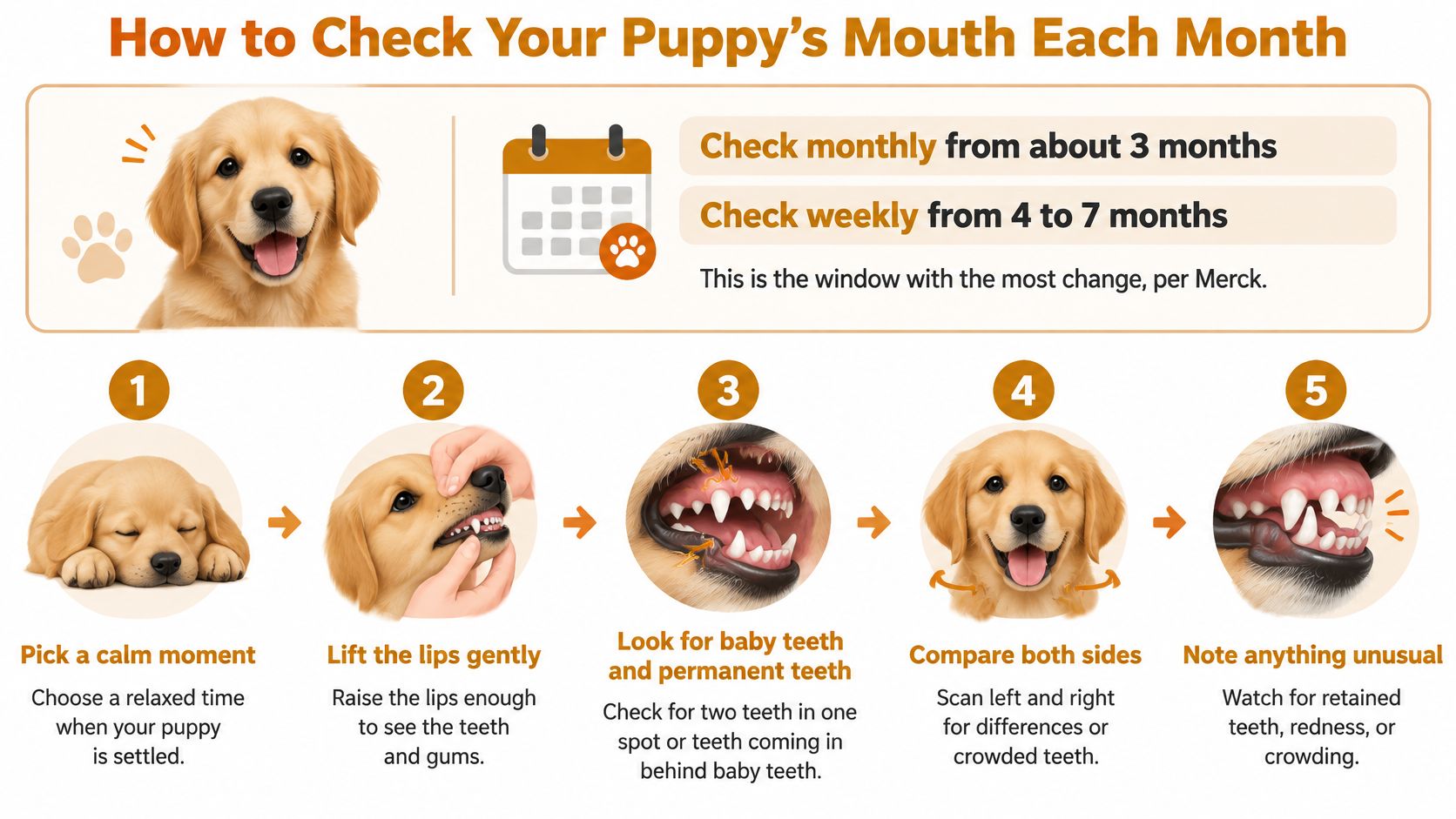
Use this seven-step check in good light, with your puppy calm and settled:
- Lift each lip gently. Check the gum line on both sides, including the teeth at the back.
- Count the front teeth and canines. Compare the top and bottom, looking for two teeth in one expected spot.
- Scan the side teeth. A baby premolar may sit close beside its permanent successor, partly hidden by the lip.
- Look for loose, chipped, or dark teeth. Do not force the jaws open or press on a tooth. Stop if your puppy pulls away.
- Check the gums. Note any redness, swelling, or fresh blood. Do not try to treat it at home.
- Smell the breath. A foul odor is worth mentioning when you contact your veterinarian.
- Record the date and take a photo. Compare it with your next check to see whether a tooth moved, remained in place, or appeared beside another.
For a Chihuahua's small mouth, take particular care to lift the lip enough to see the canines clearly. If the check reveals a doubled tooth, a loose tooth, or a foul smell, arrange an examination and bring your photo log.
A brief clinic walk-through of a lip lift can help make the first home check feel more familiar.
Retained Baby Teeth in Small and Toy Breeds
If a puppy has two canines on the same side, one may be a retained deciduous tooth: a baby tooth still in place after its permanent successor has erupted. In a small mouth, the two teeth can sit close together, so check whether both crowns emerge from the same spot.
Retention is seen more often in small dogs, and small/toy and brachycephalic dogs may have a different permanent-tooth eruption schedule. A longitudinal study of 440 puppies from 82 breeds found that breed size and skull type affected the onset and completion of permanent-tooth eruption. A permanent tooth usually emerged within roughly 3 days before or after its baby tooth was lost, while canine replacement showed a wider interval. This timing does not make two teeth in one spot a wait-and-see finding. Arrange a veterinary exam if you spot a double tooth, including a double incisor.
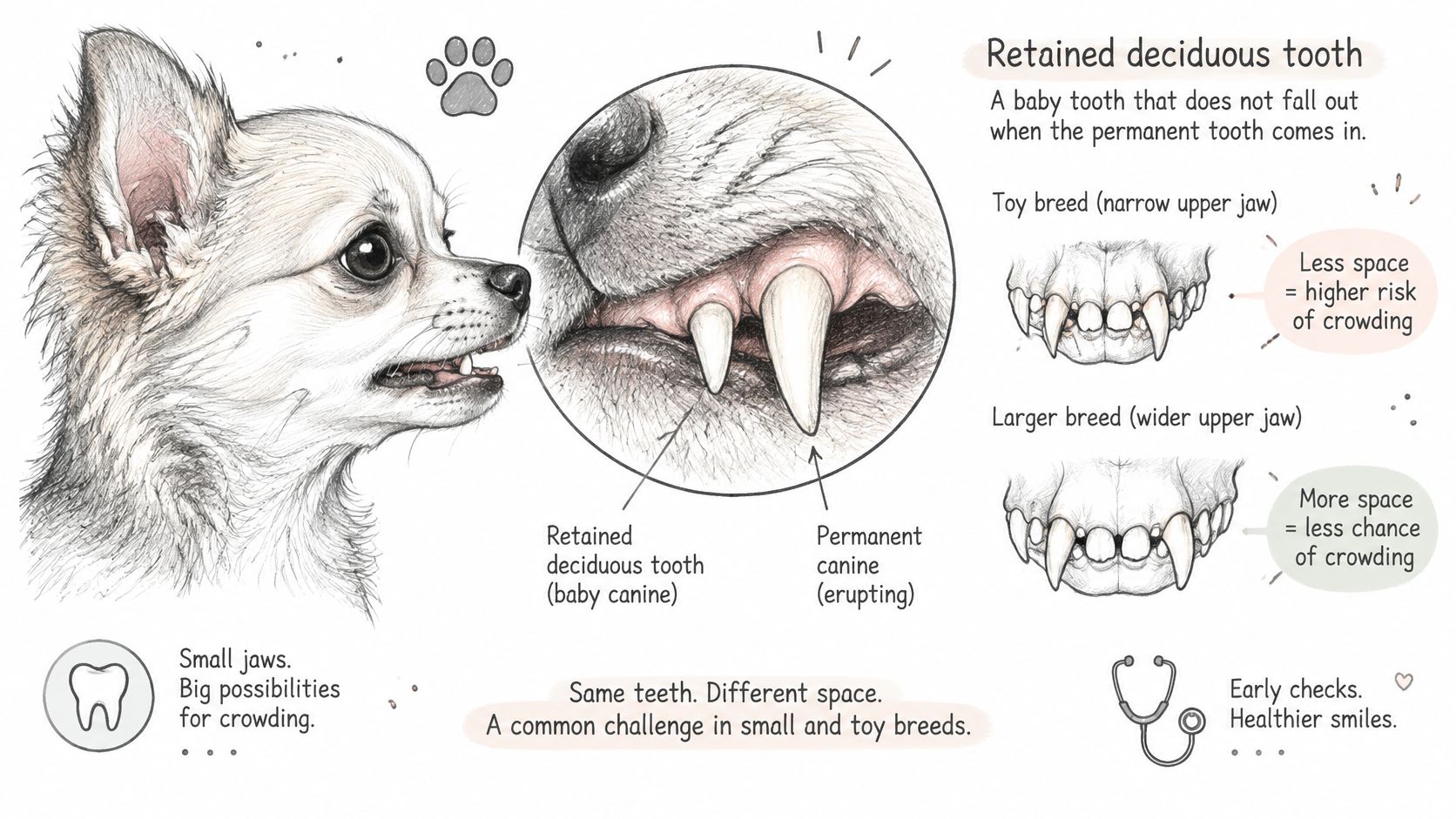
A retained tooth can push the adult tooth out of line, trap food, and contribute to gingivitis. The vet can identify which tooth is the baby tooth, assess the bite, and decide whether removal is needed. Sometimes removal can be scheduled alongside another planned procedure.
Do not pull a persistent tooth at home. Its root can break, and a professional should assess how the teeth meet.
Toy breeds are especially prone to this issue. Breed and skull shape can help explain why teeth erupt on a different schedule, but they do not change the action threshold: show your vet any two teeth occupying one spot.
Broken Teeth, Root Fragments and Safe Chew Choices
A baby tooth sometimes breaks, or the piece on the blanket looks too short. The crown can be gone while a root fragment stays in the jaw. That leftover piece is not a finished shed.
Veterinary literature documents that a tooth or root fragment can remain embedded after the crown is lost. AVMA-published guidance links retained fragments with inflammation, infection, draining tracts, osteomyelitis, or chronic pain. When a deciduous tooth breaks, falls out incompletely, or you suspect part of it was left behind, ask whether an intraoral dental radiograph is needed so the root and the adult successor are both accounted for. Complete removal is the preference when it can be done safely. A small, embedded fragment without inflammation may sometimes be monitored if removal would risk the tissues around it.
Chew choice is the other half of the same problem. Developing teeth and new adult teeth fracture on objects that do not give.
- Choose a resilient chew you can supervise, something that flexes a little under a thumbnail.
- Skip very hard objects, including antlers, weight-bearing bones, hooves, and rigid nylon, while adult teeth are still erupting.
- Stop the session if you hear a click on the tooth or see blood on the toy.
- Bring the broken piece, plus the photo log, so the vet can match what came out with what might remain.
Xylitol is toxic to dogs and shows up in many human supplements, so human probiotics should not be given to a dog without asking a vet. A teething puppy does not need a human chewable "for gums." Ask which canine dental chew, if any, fits this mouth, and what the label should say about xylitol and hardness.
Schedule the Dental Check Before Seven Months
A dental exam before seven months gives the vet time to check whether each adult tooth has replaced its baby tooth. Book one sooner if a call-the-vet sign appeared, a double tooth remains, or your photo log shows a tooth changing out of step with its row. If the mouth looks clear at seven months, with one tooth per spot and no foul odor, arrange a routine check rather than an urgent visit.
Bring a short list of questions:
- Which baby teeth are still in place, and on which side?
- Is an intraoral dental radiograph needed to check the root and adult tooth?
- Should a retained tooth be removed during a planned procedure?
- What should be rechecked at the next visit?
Ask the vet to review the photo log. Comparing pictures across weeks can show changes that a single view may miss. For general breed health information, PetCostEngine's Pomeranian breed page is one place to explore breed-specific information.
Keep chewing supervised until the adult teeth are in. PetCostEngine's breed pages show condition probabilities and typical treatment costs, which can help you consider health costs alongside the tooth-by-tooth timeline. Look up your puppy's breed before the dental appointment.
Estimated lifetime and yearly costs for a Yorkshire Terrier, state by state, plus whether pet insurance breaks even for the breed.
See Yorkshire Terrier costs →
Is insurance worth it for a Yorkshire Terrier? →
Dental care → Durable chews → Premium dry food →
As an Amazon Associate, PetCostEngine earns from qualifying purchases.