You leave for work with a stuffed toy on the floor, a bowl of water by the crate, and the hope that your dog will nap until you get home. Then the pet camera sends an alert. Your dog has paced to the door, ignored the food toy, and started barking before you've reached the end of the block. That scene is common, but it doesn't always mean your dog needs more toys.
Learning how to keep a dog busy when home alone works best as a layered plan. You need to match exercise, food, chewing, scent work, rest, and alone-time training to the dog in front of you. The first priority is the period immediately after departure, then you can use camera observations to decide whether you're managing boredom, distress, or both.
Table of Contents
- Why Most Dogs Struggle in the First 15 Minutes Alone
- Building an Enrichment Plan That Actually Works
- DIY Toys and Puzzle Feeders You Can Set Up Today
- A Realistic Daily Schedule for Working Owners
- Adjusting the Plan by Age and Breed
- Boredom or Separation Anxiety: How to Tell the Difference
- Measuring Success and Troubleshooting Common Issues
Why Most Dogs Struggle in the First 15 Minutes Alone
A working owner may see the same pattern every morning. The dog eats breakfast, follows the owner toward the door, watches the keys, and then begins pacing as soon as the lock clicks. On camera, the dog may stare at the entrance, react to hallway sounds, or move repeatedly between the door and a window. By the time the owner returns, the dog's frantic greeting can look like pent-up energy, but the difficult period often began much earlier.
A review summarized estimates that 22% to 55% of dogs may show separation-related problems, while a UK welfare report found that 19% of dogs are left alone for five or more hours on a typical weekday, compared with 15% in 2022 and similar levels in 2019, as reported in Faunalytics' review of dog enrichment and separation anxiety. These figures don't diagnose an individual dog, but they explain why proactive planning matters for owners who work outside the home.
Why the departure window matters
In a study of dogs with separation anxiety, problem behaviors occurred most often during the first 15 minutes after the owner left, then declined after environmental enrichment was introduced, according to the KCI-indexed behavioral study. A separate controlled isolation study found that long-lasting chews produced calmer, more positive emotional responses during the earliest five to 10 minutes and kept dogs engaged longer than treat-dispensing devices or toys, as summarized by Faunalytics.
That timing creates two common mistakes. Some owners leave a durable chew untouched on the floor, but a highly aroused dog may be unable to settle enough to use it. Others schedule an exhausting pre-work run and assume physical fatigue will solve everything, only to see the dog become overstimulated or rebound into activity after the owner leaves.
Practical rule: The first enrichment item should be available at the moment of departure, but the dog should encounter it after a calm routine, not at the peak of frantic excitement.
Use a pet camera before trusting any setup for a full workday. Watch whether your dog takes the food, how quickly the dog moves away from the door, and whether chewing leads to rest. A toy list without timing is improvised management. A reliable plan is layered, observed, and adjusted based on what the camera shows.
Building an Enrichment Plan That Actually Works
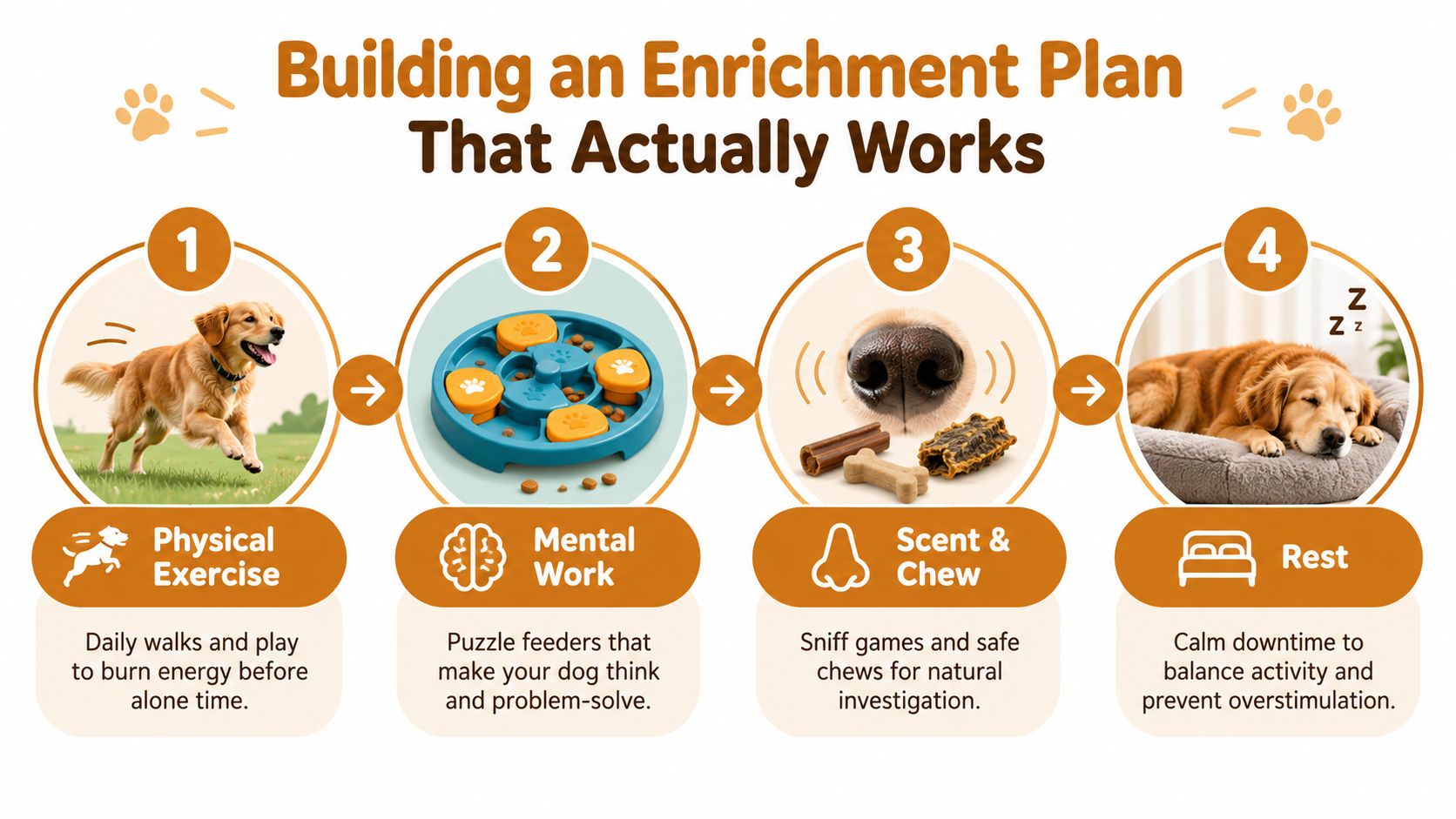
Enrichment means more than placing a toy beside the crate. A useful sequence combines physical activity, mental work, scent investigation, chewing, and rest so the dog moves from engagement toward recovery. The order matters because a dog that has had an outlet but no opportunity to settle may remain activated when you leave.
Environmental enrichment helped reduce problem behaviors after departure in the study discussed above, and the broader evidence favors long-duration chewing and food-based activities over quick novelty. In a 20-minute isolation study, dogs interacted longest with a long-lasting chew, which produced lower arousal and more positive emotional responses early in isolation than a toy or smart treat-dispensing device, according to the peer-reviewed study available through PMC.
Four layers for the morning
Physical work: Schedule aerobic activity in the 60 to 90 minutes before departure, then allow a short transition into calm behavior. A brisk walk with sniffing, controlled fetch, or simple training can work better than pushing the dog until the body is exhausted.
A departure chew: Offer a high-value, durable chew as you shut the door. Test it while you're home first, and choose a form that matches the dog's chewing style and safety profile.
One rotating puzzle: Use a food puzzle after the chew or make it part of breakfast. Rotating two or three familiar options usually gives you clearer feedback than leaving a dozen toys scattered around the room. Too much choice can teach some dogs to wait for a preferred item instead of engaging.
A defined rest zone: Provide a bed, mat, crate, or quiet room where the dog already relaxes. Scent games can compete with departure-focused attention because sniffing requires investigation, but the activity still needs to end in a place where the dog can sleep.
The trade-off is real. A layered routine takes about 10 minutes to set up each morning, and owners should expect roughly two weeks of consistent practice before camera footage reliably shows a calmer pattern. Those figures are practical planning estimates, not guarantees. If your dog ignores food immediately, don't keep adding puzzles. Treat that response as information about arousal or anxiety.
DIY Toys and Puzzle Feeders You Can Set Up Today
Food-based enrichment is often the easiest way to turn a normal breakfast into an activity. It also lets you control difficulty, duration, and ingredients without buying a new toy for every departure.
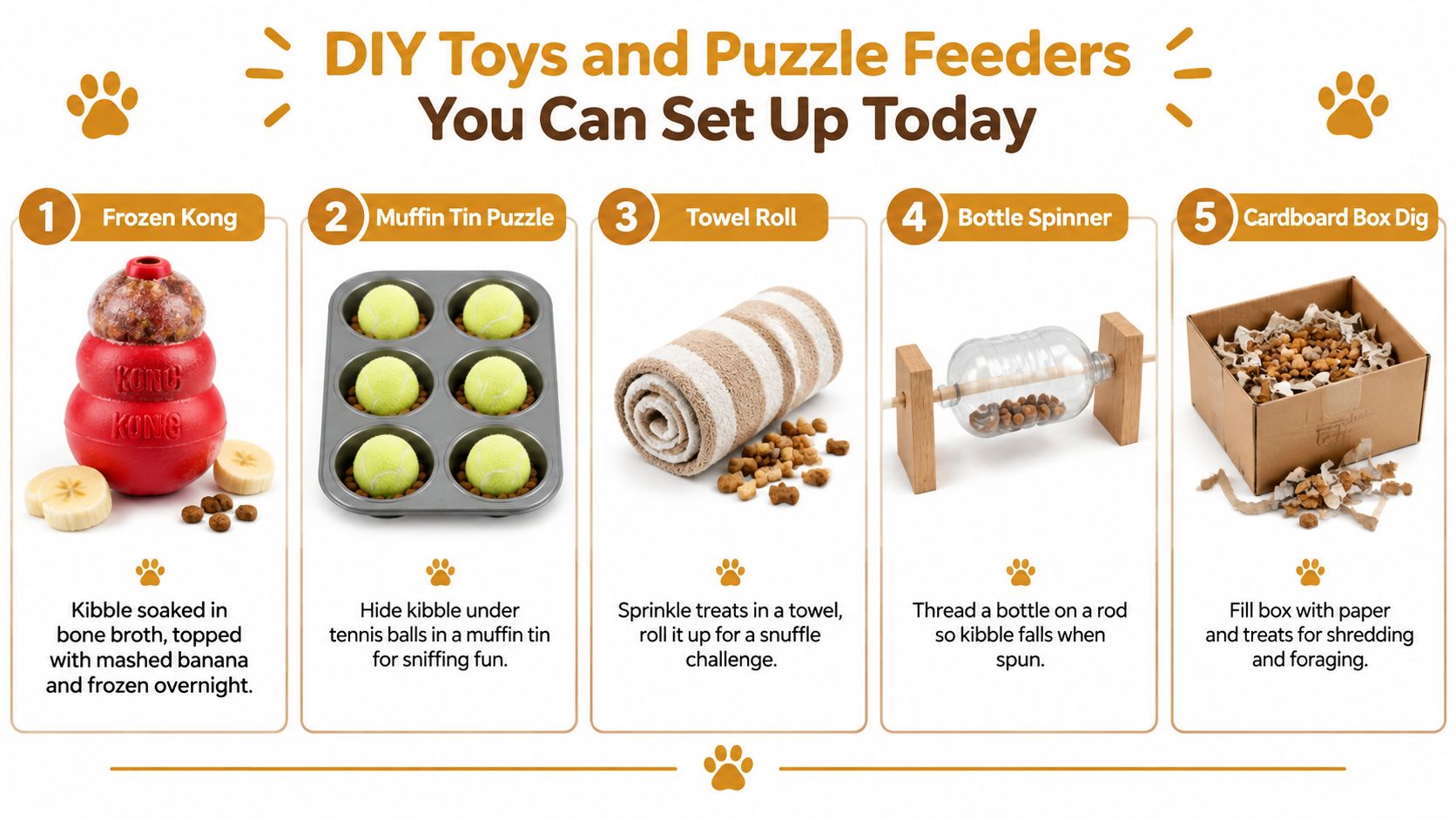
Start with a frozen stuffed Kong. Fill it with kibble soaked in bone broth, top it with mashed banana, and freeze it overnight. The owner-provided setup targets roughly 25 minutes of licking, but individual dogs will finish at different speeds. The mixture should be appropriate for your dog, and cooked bones should never be included in the recipe.
Simple setups with useful timing
- Frozen Kong: Plan around 10 minutes of preparation and freeze it overnight. Use the departure moment to create a predictable licking routine.
- Muffin-tin puzzle: Put kibble in the cups and cover some openings with tennis balls. This suits a medium dog that already knows how to nudge objects safely, but supervise the first trial.
- Snuffle mat: A rubber mat with fleece strips can turn part of a meal into scent work. Allow about 15 minutes of activity as a planning estimate, while checking that your dog doesn't pull off and swallow fabric.
- Rolled towel treat log: Sprinkle treats through a towel, roll it firmly, and bind it with low-tack veterinary wrap. The dog has to work through layers, but the wrap must not become a chew target.
- Frozen Toppl: A frozen Toppl can be planned as roughly 20 minutes of engagement, depending on filling and difficulty.
A bottle spinner or cardboard digging box can offer variety, but household objects need careful screening. Remove caps, labels, loose strings, and small pieces that could become choking hazards. Avoid any toy that splinters, collapses into swallowable parts, or encourages frantic destruction.
Before leaving a new item, use it while you're present. Watch how your dog grips it, whether the dog guards it, and whether the dog tries to consume part of the container. The ASPCA's separation anxiety guidance recommends a food-stuffed puzzle toy that takes a dog at least 20 to 30 minutes to finish, but that duration should be assessed safely for the individual dog.
For more breed-specific context on food drive and activity needs, compare guidance for a Labrador Retriever. On departure days, leave two toys maximum. One durable chew and one food puzzle are easier to evaluate than a crowded floor, and they reduce the chance that your dog becomes selective about which novelty item appears next.
Use the video as inspiration, not as a substitute for supervision. A setup that works for a calm adult dog may be unsafe for a puppy, an aggressive chewer, or a dog that swallows fabric.
A Realistic Daily Schedule for Working Owners
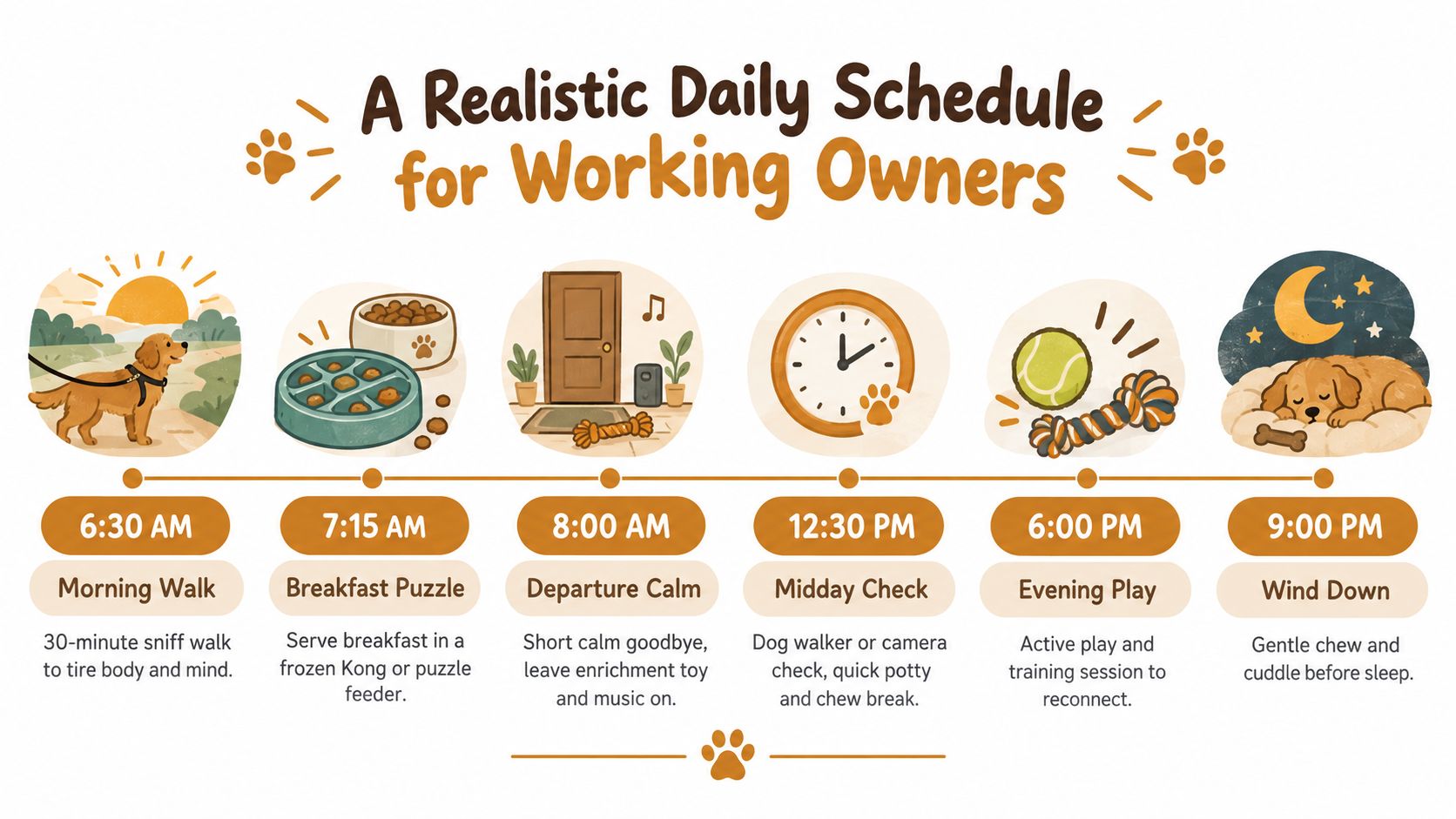
A workable weekday plan doesn't need constant entertainment. It needs predictable transitions, a meaningful morning outlet, food delivered in a way that occupies the dog, and a midday break when the dog's age, bladder control, or distress level makes one necessary.
| Time | Routine | Purpose |
|---|---|---|
| 6:30 a.m. | Brisk walk or fetch for 20 to 30 minutes | Move the body and allow sniffing |
| 7:00 a.m. | Breakfast in a slow feeder or puzzle | Replace rapid eating with food work |
| 7:30 a.m. | Quiet rest while the owner prepares to leave | Lower arousal before departure |
| 8:00 a.m. | Calm goodbye, chew, and one puzzle | Cover the first post-departure period |
| 12:30 p.m. | Neighbor or dog walker for a 15-minute potty and sniff walk | Provide relief and a reset |
| Afternoon | Rotate a frozen Kong or snuffle mat | Offer a controlled activity, not constant stimulation |
| 6:00 p.m. | Decompression walk | Reconnect without immediately demanding intense play |
Timing beats constant duration
A dog exercised right before departure may rest more, but the activity should end with enough time for water, toileting, and a calm handoff to the enrichment station. A long, frantic game immediately before the door closes can leave the dog energized rather than settled.
Breakfast at 7:00 can come from the same daily ration you'd otherwise serve in a bowl. The 8:00 departure should be boring and consistent. Avoid a dramatic goodbye, and don't repeatedly return to reassure a dog that is already watching the door.
Weekends should preserve the same departure cues without recreating the full workday. Keep the morning walk and food puzzle familiar, then vary the length of your outing gradually. If weekdays require a midday visitor, use weekends to practice short, calm absences rather than suddenly leaving the dog alone for a much longer stretch.
A medium-dog routine guide can help you compare activity needs without treating every dog of the same size as identical. Breed, age, health, weather, and the dog's response on camera should determine the final schedule.
Adjusting the Plan by Age and Breed
The same puzzle can be appropriate for one dog and frustrating or unsafe for another. Puppies need shorter activities and more frequent rest, healthy adults often tolerate more complex problem-solving, and seniors may gain more from scent and licking than from forceful chewing or high-impact play.
AKC guidance gives specific puppy alone-time limits: under 10 weeks, about one hour; at 10 to 12 weeks, two hours; at three months, three hours; at four months, four hours; at five months, five hours; at six months, six hours; and over six months, a maximum of six to eight hours, according to AKC's puppy-alone guidance. These are limits for planning, not targets for every puppy, and they don't replace gradual training.
Enrichment adjustments by age and breed group
| Category | Session Length | Chew Difficulty | Best Enrichment Type | Key Caution |
|---|---|---|---|---|
| Puppy | 10 to 15 minutes of training or sniffing | Soft, puppy-appropriate chews | Short scent games, stuffed food toys, supervised confinement activities | Overstimulation can backfire, and crate naps may be needed around every two hours |
| Healthy adult | 20 to 45 minutes of problem-solving | Moderate to tougher chews, matched to the individual | Puzzle feeders, scent searches, durable food toys | Difficulty should increase only when the dog stays calm |
| Senior | Short, gentle sessions | Softer chews or lick mats | Scent work, lick mats, easy food puzzles | Avoid slippery floors and heavy-impact exercise |
| Working or herding breed | Task-based sessions, adjusted to fitness | Durable options with supervision | Advanced puzzles, training tasks, scent searches | Physical fatigue alone may not satisfy a dog bred to work |
| Brachycephalic breed | Lower-intensity, shorter sessions | Easy-access food toys | Licking, short sniffing, calm puzzles in a cool room | Heat and breathing limits matter |
| Scent hound | Sniff-led sessions | Chews plus food searches | Snuffle mats and hide-and-seek feeding | Prevent the dog from escalating into frantic searching |
Border Collies and Belgian Malinois usually need a job-like outlet, not just a longer walk. Bulldogs and Pugs may need shorter activities in a cool room, while scent hounds often engage with a snuffle mat. Breed traits predict drive, but individual variation wins every time.
Use breed-specific pages as a starting point, then adjust based on body condition, health, chewing style, and camera footage. A dog that finishes a difficult puzzle calmly is ready for a small increase in challenge. A dog that paces afterward needs less intensity or a better transition to rest.
Boredom or Separation Anxiety: How to Tell the Difference
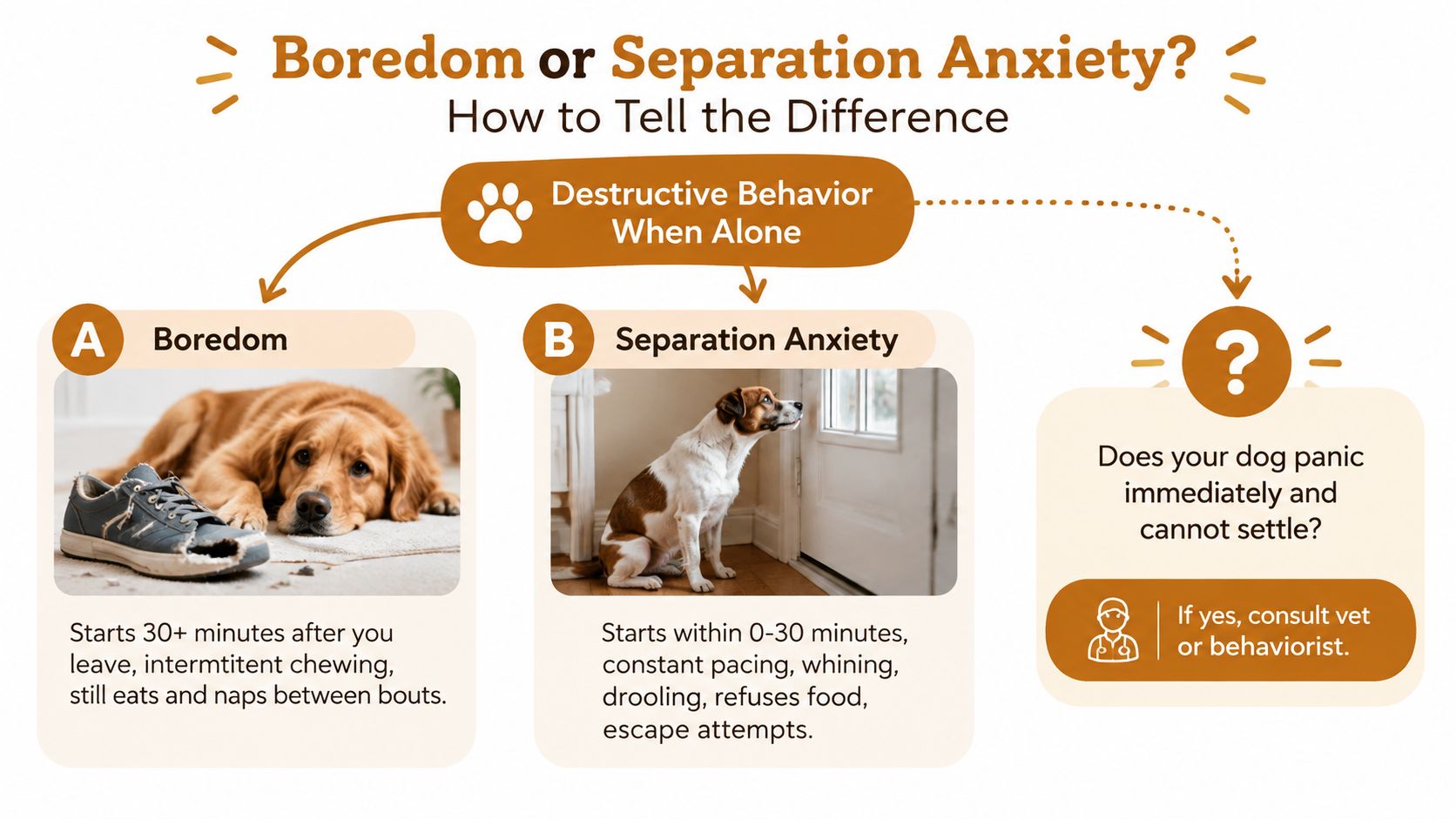
A destroyed shoe does not automatically mean boredom. A dog that needs more activity may engage with food puzzles or scent work. A dog experiencing panic may ignore the same enrichment because distress has already stopped it from eating.
Use a camera and focus on the first part of the absence, especially the first 15 minutes. Intermittent destruction that begins 30 or more minutes after departure, with normal eating and rest between episodes, fits boredom or under-stimulation more closely. Pacing, whining, panting, drooling, escape attempts, or refusal of high-value food within the first 30 minutes point more strongly to separation-related distress. One recording cannot establish a diagnosis, so assess the whole pattern.
For a breed with moderate independence, compare the American Water Spaniel profile to see how temperament can shape alone-time tolerance. Breed tendencies provide context, not a conclusion.
A practical decision tree
Does the behavior begin immediately after departure?
If yes, look for panic signals before adding another toy.Will the dog eat food that is normally valuable?
If yes, food enrichment may still help. If no, arousal may be too high for a puzzle to work.Can the dog lie down and recover between episodes?
Rest between short activities suggests a different problem from continuous pacing or door-focused behavior.Does the dog follow you from room to room at home?
This adds context, particularly when paired with intense reactions to departure cues.Does intensity increase the longer the dog is alone?
Escalation deserves more attention than a single mess.
Run a simple self-test across five departures. Record the departure time, first behavior change, food intake, time of settling, and behavior after your return. The AVMA Journal review notes that prevalence estimates vary by setting and measurement. Observation therefore matters more than labeling a problem from destruction alone.
Household context also affects risk. One study found dogs in single-adult homes were about 2.5 times as likely to have separation anxiety as dogs in multi-adult homes, according to the PubMed-indexed study. This does not show that a single-adult household caused the problem. It may mean fewer chances for gradual alone-time practice and fewer backup options during a long workday.
Involve a veterinarian behaviorist or credentialed trainer if your dog injures itself, prompts neighbor complaints, urinates despite reliable house-training, attempts to escape, or refuses food while alone. Choose a professional who uses gradual desensitization and behavior modification, rather than recommending more toys.
Measuring Success and Troubleshooting Common Issues
Success isn't a silent house at any cost. A dog may stop barking because it has shut down, or it may look quiet while remaining tense at the door. Measure the dog's behavior during the first 15 minutes, then check whether the enrichment leads to genuine rest.
Use three practical indicators:
- Camera behavior: Vocalization is minimal or absent, and the dog moves from the food item to a normal resting place.
- Enrichment timing: The stuffed Kong or other feeder lasts close to its expected duration rather than disappearing instantly or remaining untouched.
- Re-entry body language: The dog can greet you without frantic escalation, then return to ordinary behavior.
The ASPCA recommends a food-stuffed puzzle that takes 20 to 30 minutes to finish, while your individual dog may finish faster or slower, as explained in its separation anxiety guidance. Treat a 20 to 40-minute stuffed Kong finish as a practical observation range, not a universal performance target. The more important question is whether the dog remains relaxed before and after using it.
Fix the setup based on the failure
- The dog finishes everything in five minutes: Increase the feeder's difficulty carefully, freeze the filling, or divide the meal across a chew and puzzle. Don't make the item so hard that frustration replaces engagement.
- The dog ignores food: Stop adding more food. Review the departure routine, provide calmer pre-departure exercise, and check for separation anxiety.
- The dog barks at the door: Look at the exact start time and body language. Door-focused barking within the early window is more concerning than occasional later noise.
- The dog seems restless after exercise: Reduce frantic play and add a quiet sniffing or licking transition.
- The dog destroys the container: Remove that item and supervise a safer replacement before using anything during an absence.
For separation training, the ASPCA recommends starting with absences of one to two seconds and building gradually over many weeks. Once a dog tolerates 40 minutes, increases can initially move in five-minute increments, then later in 15-minute increments, but only while the dog remains comfortable.
Review this checklist weekly:
- Record the first sign of stress.
- Note whether food was accepted.
- Check the time needed to settle.
- Inspect the toy for damage.
- Adjust one variable, not everything at once.
- Contact a veterinarian or certified behavior consultant after two weeks of unchanged destructive behavior, or sooner for self-injury or neighbor complaints.
For dogs with strong working-drive needs, compare task-based ideas for a Border Collie, but keep the same standard: calm recovery matters more than exhausting activity. If the plan keeps failing, don't abandon enrichment. Reclassify the problem and get help.
PetCostEngine helps US dog owners compare breed- and state-specific ownership projections, health risks, and related planning tools before a routine problem becomes a larger household challenge. Visit PetCostEngine to explore practical breed references and personalized planning resources for your dog.
Estimated lifetime and yearly costs for a Labrador Retriever, state by state, plus whether pet insurance breaks even for the breed.
See Labrador Retriever costs →
Is insurance worth it for a Labrador Retriever? →
Durable chews → Puzzle toys → Crate and bedding →
As an Amazon Associate, PetCostEngine earns from qualifying purchases.