
Most Yorkshire Terriers stop gaining height between 6 and 8 months, their growth plates usually close somewhere around 6 to 9 months, and their bodies keep filling out toward about 12 months. The gap between the height answer and the body answer is where nearly every worried question about Yorkie growth begins.
A Yorkie's frame is finished long before the dog is. Owners who expect a single finish line watch the scale move in the second year and assume something has gone wrong, when the likelier explanation is that muscle, body condition, and coat were never on the height clock. Growing taller and growing into an adult body are two different processes running on two different schedules, and only one of them is close to complete by the first birthday.
This breed is built to confuse its owners on exactly that point. A Yorkshire Terrier is small enough that a single pound changes how the dog looks, and the show-ring weight ceiling gets repeated in forums as though it were something to feed toward. It isn't. That figure describes a standard, not a feeding plan, and it says nothing about whether the dog in front of you is healthy or overweight.
Here is what each stage means, how to check your own puppy against a milestone table, and the signs that mean a veterinarian should see the dog.
Table of Contents
- Yorkie Growth Milestones Month by Month
- What Stops Growing and What Keeps Changing
- Three Growth Paths Owners Commonly See
- Factors That Change Final Size and Shape
- How to Track Growth at Home Step by Step
- When to Call the Vet and What to Bring
Yorkie Growth Milestones Month by Month
Find your dog's age band in the table and compare it with what you're seeing at home. The answer to when does a Yorkie stop growing splits into two timelines once you look at what's developing, so read the rows as typical ranges rather than deadlines. A puppy a few weeks ahead of its row isn't necessarily early, and one running behind isn't automatically slow.
| Age | What Is Developing | What to Expect | What You Should Do |
|---|---|---|---|
| 2 to 3 months | Rapid early skeletal and body growth | Steady weekly weight gain on a consistent curve | Weigh weekly and keep a log |
| 4 to 6 months | Height gains begin to slow | Growth slows in length while weight still climbs | Keep the feeding plan your vet set and recheck the trend monthly |
| 6 to 8 months | Height and skeletal growth largely finished for most Yorkies, with growth plates closing around 6 to 9 months | Adult height nearly set | Ask your vet to confirm the adult-size trend |
| 9 to 12 months | Growth plates finished in most dogs and the body filling out | Muscle and body condition refining toward the adult shape | Move to adult food when your vet recommends it and check body condition |
| 12 to 24 months | Weight may still shift slightly | Adult maintenance with small changes | Score body condition monthly rather than relying on the scale alone |
| Adult | Maintenance stage | Weight changes reflect diet, activity and health | Keep a yearly weight and body-condition check at the vet |
The 6 to 8 month rows are where most owners land when they start asking. The skeleton has mostly done its work by then, and a dog at that stage can look lanky, narrow-chested and long-legged. Three months later the same dog often looks completely different without having gained much height at all.
Weight can keep drifting after the skeleton is settled. A small-breed growth reference from Doggomeal's Yorkshire Terrier puppy weight guide places a typical dog at roughly 86% of its eventual two-year reference weight at 12 months and about 94% at 18 months. That leaves a real, measurable amount of filling out after the first birthday, which explains why a Yorkie weighed at a year and again at eighteen months may not match.
How to use the table without turning it into a deadline
Run a three-part self-check. Find the age, compare the weight trend with that row, then compare body shape with the description. If the trend is steady and the body shape fits, your dog is developing on its own schedule even if the scale disagrees with a chart online.
One figure the table deliberately ignores is the breed standard's maximum weight. That number describes the show-ring ideal. The rows above describe development, and none of them is a target to feed toward.
What Stops Growing and What Keeps Changing
The skeleton finishes its main work in puppyhood. Weight and body condition keep changing for months after the legs stop getting longer. A Yorkie grows the way a house goes up. The frame sets the outline first. Walls, flooring, and paint keep changing long after that frame is standing.
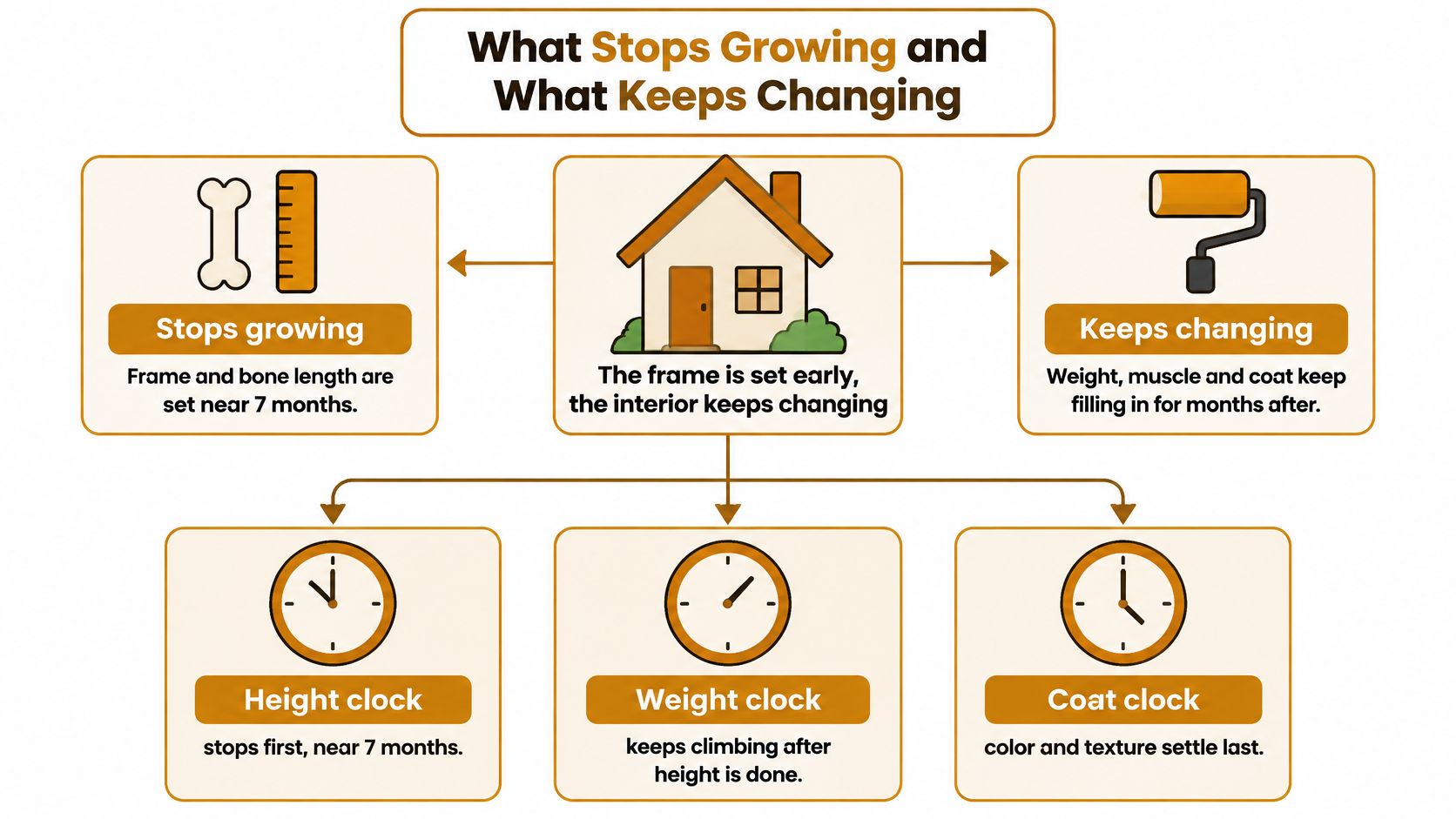
Most Yorkies reach their adult height by about 6 to 8 months, though many keep adding a small amount of body mass afterward and fill out toward the first birthday. Long-bone growth at the ends of the legs, and along the spine, is what sets adult height and body length. That part is close to finished while the dog can still look adolescent. Muscle tone, fat cover, and coat texture are slower. Two Yorkies of the same height can look like different dogs because one is still lean through the chest and the other has started to fill in.
Height is the first clock to stop. It is almost never the last one that matters.
Growth plates are soft zones of cartilage near the joints. They harden into solid bone on their own schedule during puppyhood. You cannot watch a plate close from across the room. You can see why puppy exercise stays short and free: heavy jumping and long forced runs load joints that are still finishing. Once those plates have closed, added length mostly stops, and later change shows up as shape rather than stature.
The reading that causes the most anxiety treats the first birthday as a hard finish line. An owner sees one endpoint in an article, reads every later ounce as a problem, and cuts portions without checking the ribs. A dog that is still filling out can slide into underfeeding. The breed standard's weight ceiling, the familiar figure near 7 pounds, is a show-ring reference, not a feeding target. Follow the trend across weeks, and feel the body under your hands. A waist you can see from above, and ribs you can find with light pressure, tell you more than one weigh-in.
If a smaller scoop leaves the hips looking hollow within a few days, call the vet rather than cutting again.
Three Growth Paths Owners Commonly See
The puppies below are composites built from the patterns that show up most often, not dogs anyone measured. Each one teaches a different lesson about what to do when your own puppy's curve looks unusual.
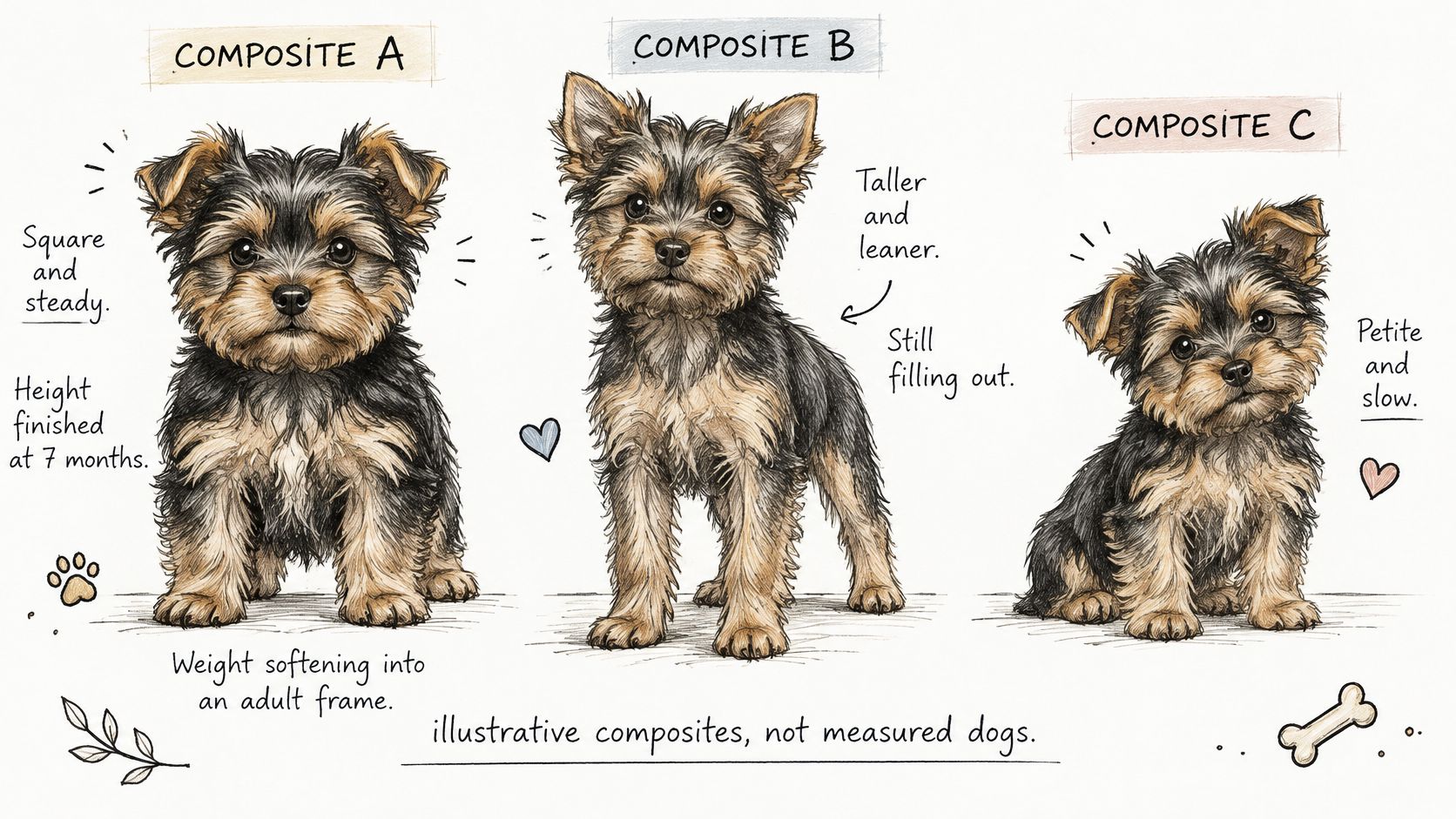
Puppy A is the one the charts describe. She gains steadily from eight weeks, adds a little every week without a jump, and her height looks finished near seven months. By about a year her weight has softened into a tidy adult frame, and her owner's only job was to keep the same food, watch her waist, and check her ribs once a month. Follow the trend and you don't need to change much.
Puppy B is small and slow. His weight curve runs below the typical line, and his owner spends a month convinced something is wrong. The vet examines him, reviews the feeding amounts, checks a stool sample for parasites and looks at his teeth, then finds a healthy, fine-boned dog whose growth is steady on his own scale. A low line on a chart is not a problem when the trend is smooth and body condition is good.
For a sense of how much variation exists across the whole toy group, our toy breed size hub groups the small breeds by shared health-risk patterns, which helps put one puppy's curve in context.
Puppy C gains faster than the curve between 4 and 8 months. His owner panics and considers halving his food. The better route is to feel for ribs and look for a waist from above, then ask the vet for a written feeding plan rather than restricting a growing puppy on a guess. Rapid gain is worth investigating, but the answer starts with a body-condition check, not a smaller scoop.
A short visual walkthrough of how a Yorkie's frame and coat change across the first year helps connect these patterns to a real dog.
The lesson across all three cases is the same. Follow the trend, assess the body by hand, and call the vet when the pattern breaks rather than when a single number looks strange.
Factors That Change Final Size and Shape
Most consumer guidance collapses the whole question into an endpoint of roughly 6 to 12 months. That single date creates a common error: owners treat any weight change after the first birthday as abnormal, when weight can keep moving for years after height is settled.
A veterinary dataset of 28,032 Yorkshire Terriers reported a median adult weight of 11.2 lb, with the middle half of the dogs ranging from 8.4 to 14.3 lb, according to Compare Pet Coverage's Yorkie growth chart analysis. Those figures sit well above the 7-lb breed-standard ceiling that many guides repeat. The same analysis found that Yorkies may continue gaining weight until approximately five years old.
That finding reframes the whole question. "Stops growing" describes height and skeletal development finishing in puppyhood, while muscle, body condition and fat mass keep changing long after.
What moves the outcome, and what to do about it
- Genetics and parents. Adult size is inherited, so ask the breeder for the parents' adult weights where they're known. A dog from two 12-lb parents will not settle at the standard's ceiling, and no feeding plan should try to make it.
- Sex. Sex can shift both adult weight and body composition, so compare a dog with its own earlier measurements rather than with a sibling or a chart.
- Early nutrition. Feed a complete puppy diet matched to the growth life stage. Never deliberately underfeed a puppy to keep it under a breed-standard maximum, because the maximum was never a nutritional goal.
- Health. Endocrine disease, intestinal disorders, congenital conditions and dental pain that reduces eating all change a growth curve. A curve that flattens or steepens without a diet change belongs in a vet appointment.
- Neutering. Sterilization can change energy needs and body composition, so reassess portions in the months afterward instead of assuming the old scoop still fits.
- Activity. Exercise shapes body condition as much as calories do. A Yorkie with daily walks and play carries muscle that an indoor-only dog won't.
- The "teacup" label. It's a marketing term, not an AKC size category, and it predicts nothing about adult size.
Why a size prediction is a range, not a promise
Charts often present a tidy progression of about 75% of adult size at six months, 90% at nine months and 100% at 12 months, but those percentages are generalized by size category rather than measured for each puppy, as PawCalculator's full-grown size overview explains. Small-breed variation is wide enough that a projection should be treated as a range.
Layering the factors gives you a working estimate: take the puppy's own four-week trend, adjust for the parents' size if you know it, account for sex and neutering status, and then confirm with a vet who can feel the ribs. Our Yorkshire Terrier breed page carries the breed-specific health risk detail that pairs with that conversation.
Body condition is the check that matters, because a Yorkie above the standard's number may be genetically larger, while a smaller dog can still carry excess fat. The practical question isn't only when a Yorkie stops growing. It's how to tell normal maturation from unhealthy fat gain.
How to Track Growth at Home Step by Step
Start this routine this week and you'll have something far more useful than a single number: a curve your vet can read in ten seconds.
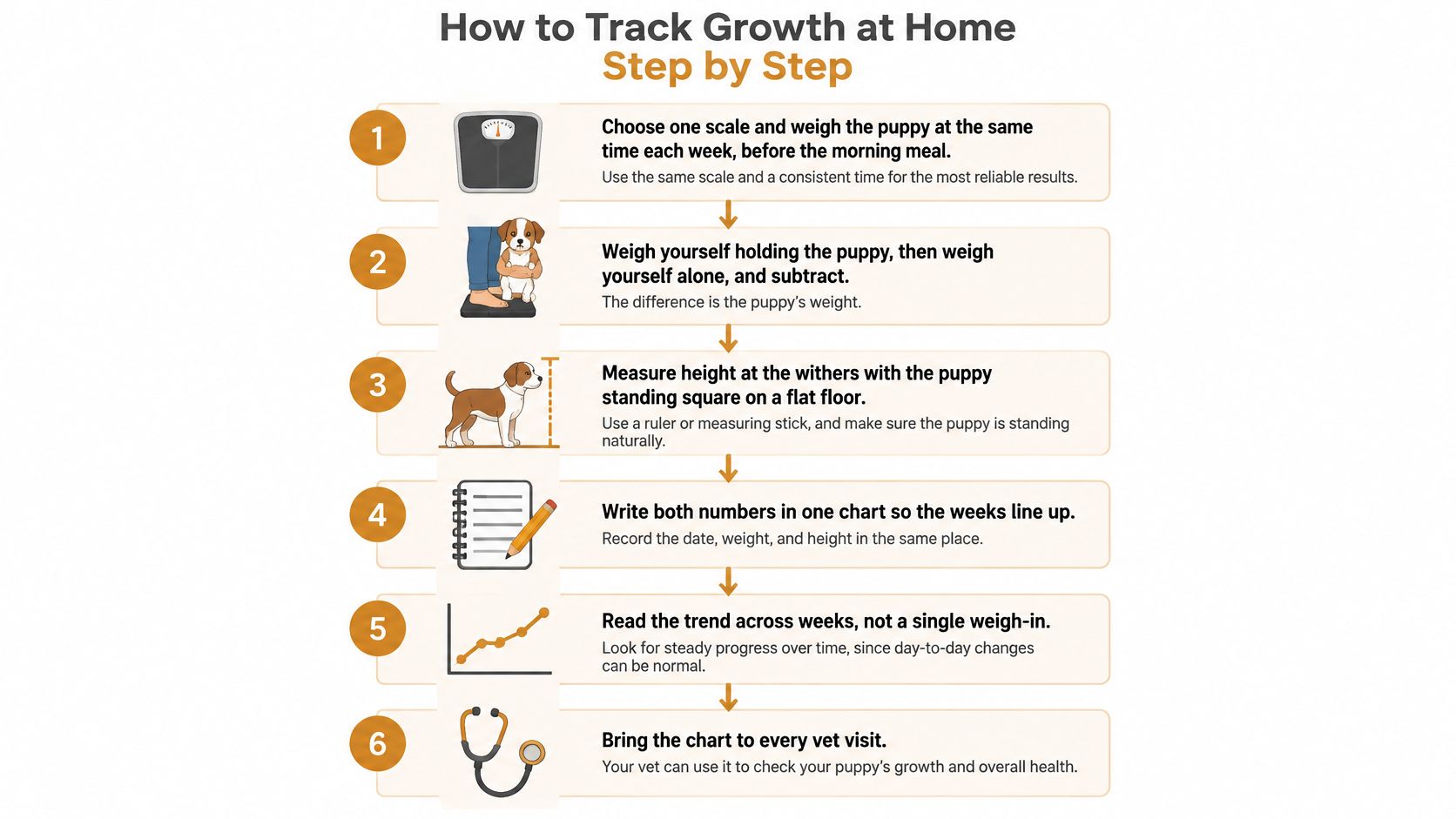
- Pick one scale and one time. Weigh the puppy on the same scale each week, before the morning meal. Consistent conditions remove the noise that makes owners think a puppy lost weight overnight.
- Weigh yourself holding the puppy, then alone. Subtract the second number from the first. Kitchen and baby scales are too small once a Yorkie passes a few pounds, and a bathroom scale is accurate enough when the dog holds still.
- Measure height at the withers with the dog standing square. The withers are the highest point between the shoulder blades. A wall mark and a level edge give a repeatable reading, and height is the measurement that stops changing first.
- Write the date, age, weight and height in one place. A phone note works. The point is a single running chart, not measurements scattered across texts and receipts.
- Check body condition by hand every month. Run flat fingers along the ribs with light pressure: you should feel them easily without them standing out sharply. From above there should be a visible waist behind the ribcage, and from the side a slight tuck.
- Read the four-week trend, not one reading. Puppies plateau for a week and then gain, and a single weigh-in tells you nothing. A steady upward curve across a month is the signal that growth is proceeding.
- Log appetite, stool quality and energy beside each weight. These notes turn a number into a story, and they're the first thing a vet asks for when growth looks off.
The slip that ruins most home growth logs isn't the scale. It's the timing, because a puppy weighed after dinner on Sunday and before breakfast on Wednesday will show a swing that has nothing to do with growth.
A Yorkie in the filling-out stage can hold the same weight for three weeks while its shape changes noticeably, so trust your hands alongside the chart. Bring the log to every visit along with the food brand, daily amounts and treats, since treats are the most commonly forgotten calorie source.
When to Call the Vet and What to Bring
The rule is simple. A Yorkie whose growth looks persistently too fast or too slow should be seen, and a puppy whose growth stalls alongside other symptoms should be seen that day. Growth guidance for the breed warns that individual puppies vary and recommends asking a veterinarian when growth doesn't look right, as PawCalculator's Yorkie puppy weight chart guidance notes. Your dog's expected adult size should come from its own trend, its parents, its diet and its health, not from a breed maximum alone.
| Pattern | What It May Indicate | Action |
|---|---|---|
| Weight gain or loss with no change in food | Changes in appetite, intestinal or endocrine health | Call the vet within a few days |
| Growth stops unusually early or falls far behind the puppy's own curve | Nutritional gaps, illness or a developmental issue | Schedule a vet visit |
| Rapid weight gain after 12 months with a rounder belly | Fat gain, endocrine disease or excess feeding | Vet visit with a body-condition check and a diet review |
| Limping, skipping gait or reluctance to jump | Joint or bone problems such as patellar luxation | Vet visit soon rather than waiting for the next weigh-in |
| Vomiting, diarrhea or lethargy with poor growth | Gastrointestinal, parasitic or systemic illness | Same-day call to the vet |
Those entries list possibilities for a vet to rule out. They are not a diagnosis, and a table can't examine a dog.
Call your vet today, not at the next visit, if you see a sudden weight change, poor appetite, weakness or lethargy, vomiting or diarrhea alongside poor growth, a visibly pot-bellied appearance, or lameness and a skipping gait. A skipping gait deserves particular attention in this breed, because early joint findings are much easier to manage than late ones. Our own founder's Brittany puppy was diagnosed with a luxating patella after injuring a leg before six months of age, which is exactly the kind of pattern that starts as an occasional hop.
What to bring to the appointment
Bring the raw material a vet needs to separate normal small-breed variation from a nutritional, gastrointestinal, parasitic or developmental problem.
- The puppy's age and full weight history from your log, not a remembered number.
- The feeding schedule, including food brand, daily amount in cups or grams, and every treat and table scrap.
- Stool quality over the past two weeks, with any changes in color or consistency.
- Appetite and symptom notes, including when they started and whether they're getting better or worse.
Three questions worth asking
- What adult weight range fits this puppy's parents and its current trend?
- When should we switch to adult food, and how should the portion change?
- If we neuter, how should feeding change afterward?
Any veterinarian can answer those in a few minutes with your log in hand, and the answers are far more useful than a chart's projected final weight. Our Yorkshire Terrier breed page holds the breed-specific health risk material worth reading before the puppy stage ends.
A Yorkie's shape and health risks follow it for a decade or more, and the categories that matter later, from dental care to joint monitoring, are exactly what PetCostEngine models. The free analysis asks four questions and returns one answer matched to your dog's breed, state and age, so you're looking at a Yorkshire Terrier's profile rather than an average across all dogs. Visit PetCostEngine before your next vet appointment and keep the breed's full picture in hand while the conversation is still about weight and growth.
Estimated lifetime and yearly costs for a Yorkshire Terrier, state by state, plus whether pet insurance breaks even for the breed.
See Yorkshire Terrier costs →
Is insurance worth it for a Yorkshire Terrier? →
Premium dry food → Puzzle toys → No-pull harness →
As an Amazon Associate, PetCostEngine earns from qualifying purchases.